Home Blog Page 5262

P28.9-B fund to help LGUs build capacity for devolution

BARANGAY HEALTH CENTER in San Nicolas, Iriga City

THE Department of Budget and Management (DBM) said the P28.9-billion Local Government Support Fund will be deployed for capacity-building projects ahead of the imminent devolution of National Government (NG) services.

“We will formulate capacity-building training, and seminars for our LGUs (local government units) to help them — so that by the time we have full devolution, they can stand on their own feet,” Budget Secretary Amenah F. Pangandaman said.

The LGUs will be aided in operations about to be shed by the National Government, such as procurement, project planning and identification, and implementation, she added.

“The Department of Finance’s Bureau of Local Government Finance may also provide guidance on how LGUs may use their budgets,” she said.

LGUs are to be given more responsibility for operating services formerly undertaken by the National Government after receiving a larger share of National Government revenue. The DBM has said that LGUs’ share of NG revenue this year amounts to P820.3 billion, representing 40% of the NG’s revenue three years prior.

The Supreme Court, in its Mandanas ruling, had determined that LGUs are entitled to a 40% share of all NG revenue. Before the ruling, the NG interpreted the Local Government Code narrowly, disbursing 40% of “internal revenue” to the provinces, cities, municipalities, and barangays, effectively defining the pool of funds to be allocated as the collections of the Bureau of Internal Revenue. Before the Mandanas ruling, this payout was known as the “Internal Revenue Allotment” (IRA).

The Mandanas ruling resulted in the renaming of the IRA to the National Tax Allocation, reflecting the LGUs’ entitlement to 40% of all NG revenue, including the collections of the Bureau of Customs, among others.

Of the other parties to be tapped for capacity-building, Ms. Pangandaman added: “We are also partnered with the Department of Interior and Local Government (DILG) and the Development Academy of the Philippines. There are a lot of groups and departments that will help and hopefully, before 2027, we are able to capacitate (the LGUs).”

In January, the DBM’s National Budget Call for the 2024 spending plan highlighted the importance of funding capacity-building programs for LGUs.

The 2024 budget call signaled encouragement for regional programs to bring disadvantaged and laggard LGUs to a position where they can handle devolution.

“The DBM is here to provide guidance to LGUs who are planning their respective projects. We also have the Philippine Development Plan, (which) we’re hoping (LGUs) will follow” to align their projects with national priorities, Ms. Pangandaman said.

Late in his term, former President Rodrigo R. Duterte signed Executive Order No. 138, transferring some basic services to LGUs by 2024 in response to the larger share of NG revenue going to LGUs. 

In November, the DBM delayed the devolution of some NG functions to 2027 from 2024. — Keisha B. Ta-asan

PSALM offers co-ops 90 MW in uncommitted capacity

THE Power Sector Assets and Liabilities Management Corp. (PSALM) told a House committee that it can make available to Luzon electric cooperatives 90 megawatts (MW) worth of uncontracted power.

PSALM, a government-owned and -controlled corporation, told the chamber’s energy committee that it can supply the cooperatives during peak demand hours, which is when energy supply is tightest.

Emelina S. Blanco, representing PSALM, said at the hearing on Monday that the 90 MW can be supplied by the company to electric cooperatives “upon their request.”

“We will accommodate the request of the electric cooperatives in Luzon, so we can wholly provide the available uncontracted capacity in Luzon to those electric cooperatives. We will just have to get the necessary documentation as well as approvals from our board,” Ms. Blanco said.

Ms. Blanco added that cooperatives must submit a letter of intent to initiate the request.

“We are providing the requested capacity… but we cannot provide them more than that… we’re just basing our supply agreements on what the electric co-ops request,” Ms. Blanco told the panel.

PHILRECA Party-list Representative Presley C. De Jesus said PSALM’s offer will help make the island’s supply-demand balance more favorable.

The energy committee was evaluating House Resolution No. 235, calling for an investigation into rising generation costs, a contributory factor to increased electricity rates.

The 90 MW represents PSALM capacity not yet tied to power supply agreements. “That is our available capacity during peak hours that… (have) no customers consuming it,” Ms. Blanco told BusinessWorld. “We really encourage (power co-ops) to send a request,” she said.

PSALM manages government power assets and liabilities formerly held by the National Power Corp. as authorized by the Electric Power Industry Reform Act of 2001 (EPIRA). The restructured post-EPIRA Napocor is mainly tasked with supplying power to rural areas. — Beatriz Marie D. Cruz

PHL, EFTA partners working to improve trade deal utilization

THE Philippines said it and the European Free Trade Association (EFTA) are working to improve utilization of their free trade agreement (FTA), which were 31% for the Philippines and 30% for the four-member EFTA bloc in 2020.  

In a statement on Monday, the Department of Trade and Industry (DTI) said the decision to tap the trade deal more extensively was arrived at during the inaugural joint committee meeting on Jan. 10.

The EFTA consists of Switzerland, Norway, Liechtenstein, and Iceland.

The FTA was signed in April 2016 and came into force for the Philippines, Norway, Liechtenstein, and Switzerland in June 2018. The trade deal took effect in Iceland in January 2020.   

“Over the 5 years of implementation, both sides have confirmed that the FTA is working well and has no critical implementation issues to date,” the DTI said.

“Both sides are determined to further improve their respective utilization rates,” it added.

The FTA with the four non-European Union countries was intended to tap non-traditional markets with high growth potential for trade and investment. 

“This agreement facilitates increased market access, reduction of non-tariff barriers, trade and sustainable development, and protection of intellectual property rights among others, which we see as crucial for the Philippine economy,” Trade Secretary Alfredo E. Pascual said.

The DTI said total trade between the Philippines and EFTA was $953.58 million in 2021, against $821.81 million in 2020 and $821.41 million in 2019.

It added that the Philippines had a trade surplus with EFTA of $129.89 million in 2021, widening from the $101.49 million posted in 2020 and the $47.12 million reported in 2019.

The DTI valued the Philippine agricultural and industrial products entering the EFTA zone tariff-free at €24.84 million in 2020. These products include tuna, desiccated coconut, fruit and nuts, processed food and food preparations, malt products, vacuum cleaners, new pneumatic tires, and hairdressing apparatus. 

“The Philippine market does not compete and is complementary in nature to the EFTA market. As such, the Philippines was able to secure duty-free market access for all industrial and fisheries exports to EFTA and significant concessions on major agricultural products through the FTA,” Trade Undersecretary Ceferino S. Rodolfo said.  

The DTI said that EFTA countries also helped increase foreign direct investment (FDI) entering the Philippines, adding that more FDI is expected following recent economic reforms such as the opening up of renewable energy projects to 100% foreign ownership.

“From 2018 to the third quarter of 2022, investment promotion agencies approved Swiss investments totaled P1.40 billion (or $25.865 million) in the following sectors: manufacturing, real estate activities, administrative and support activities,” the DTI said.

“From 2018 to the second quarter of 2022, investments from Norway, Iceland, and Liechtenstein also amounted to P229.4 million (or $4.23 million) in the financial and insurance industries, and the manufacturing, administrative, transportation, and storage sectors,” it added. — Revin Mikhael D. Ochave

Marriages surged in 2021 with easing quarantine

UNSPLASH

REGISTERED MARRIAGES rose sharply in 2021 as quarantine measures eased, the Philippine Statistics Authority (PSA) said in a report on Monday.  

Citing preliminary data from its Vital Statistics report, the PSA said marriages in 2021 totaled 356,839, up 48.2%.

On a per-thousand people basis — an indicator known as “crude marriages,” the marriage rate was 3.2% that year, the PSA said.

The daily marriage rate averaged 978 in 2021, the report said.

Calabarzon (Cavite, Laguna, Batangas, Rizal, Quezon) logged the largest number of marriages with 50,211, or 14.1% of the national total. Metro Manila had 41,025 (11.5%), and Central Luzon 39,402 (11%). 

These regions collectively accounted for 36.6% of the national total in 2021.

The Bangsamoro Autonomous Region in Muslim Mindanao posted the fewest registered marriages with 2,337 (0.7%). 

December was the preferred month for marriages with 52,788, or 14.8% of the total. June followed with 34,943 (9.8%) and May 34,246 (9.6%).

August had the fewest marriages with 17,710 or 5% of the total.

The age range most represented in the marriage numbers were couples aged between 25 and 29, with men that age entering 136,613 marriages or 38.3% of the total. Women that age accounted for 142,617 or 40% of the total.

The median age at marriage was 29 years for men and 27 for women, the report added.

Adolescents who married in 2021 included 15,253 females (4.3% of the total) and 3,499 males (1%).

Marriages between a Filipino and a foreign national numbered 4,787, or 1.3% of the total.

In 2021, civil marriages remained the preferred type of ceremony, accounting for 141,183 or 39.6% of the total. This was followed by Roman Catholic rites with 114,660 or 32.1%.  

Other forms of religious rites accounted for 26.4%. Muslim rites accounted for 1.1% of marriages and tribal rites 0.9%. — Abigail Marie Pelea Yraola

ASEAN trade show generates over P100M in sales leads for Philippine tourism industry

KAULAYAW COFFEE FACEBOOK PAGE

THE Tourism Promotions Board (TPB) said a regional trade show generated over P100 million in sales leads for 16 exhibitors from the Philippine tourism industry.

The TPB, the marketing arm of the Department of Tourism (DoT), was reporting the result of Philippine participation in the ASEAN Tourism Forum.

In a statement on Monday, the TPB said the Philippine delegation, representing airlines, tour operators, and the accommodations industry, were in Yogyakarta, Indonesia to exhibit their offerings.

Within ASEAN, Singapore and Malaysia were the ninth and tenth largest sources of visitors to the Philippines before the pandemic, according to the DoT. In 2019, the Philippines tallied 158,595 visitors from Singapore and 139,882 from Malaysia.

In 2022, some 50,964 Singapore tourists and 44,357 Malaysians visited the country. The DoT also reported Vietnam as a top 10 country of origin last year with 37,028 visitors.

At the forum, Tourism Secretary Maria Esperanza Christina G. Frasco put out the welcome mat for ASEAN visitors.

“We aim to give you the best of the Filipino to remind you that while the Philippines continues to be a top-of-mind destination all over the world, there is much more to our beaches, our dive sites, our mountain ranges, and our underground rivers,” she said.

The DoT is seeking to highlight other elements like food and living cultural traditions. A pavilion at the trade show highlighted Philippine coffee company Kaulayaw and a performance by the Lapu-Lapu Arnis de Abanico martial arts organization. — Brontë H. Lacsamana

Bill seeking to leverage ODA with other funding sources filed in House

PHILIPPINE INFORMATION AGENCY/ RELEASED

A BILL seeking to remove the exclusivity of official development assistance (ODA) in funding Philippine projects has been filed in the House of Representatives.

House Bill No. 7135 proposes a “blended financing” model with an ODA component mixed in with other financing sources.

Albay Rep. Jose Ma. Clemente S. Salceda, the House ways and means committee chairman who filed the bill, said the measure also gives local government units access to ODA in a revamp of the rules for contracting of ODA loans.

The bill will allow blended financing if the partner government, bilateral or multilateral agency or lending institution mobilizes financing from private or commercial institutions in funding the loan or grant.

Speaking at the committee hearing on Monday, French ambassador to the Philippines Michéle Boccoz said that the current rules “limit the definition of ODA to projects fully financed with sovereign loans which restricts significantly the list of potential partners for the Philippines.”

“This limitation also restricts European partners’ ability to provide expertise in many areas where cooperation would also contribute to support and investment in the Philippines,” she added, citing the example of a French company looking to develop a shipyard in the Philippines for €25 million.

The bill seeks to amend Republic Act No. 8182, which according to Mr. Salceda, “does not explicitly provide a mechanism for ODA in the blended financing approach,” and restricts “bilateral (especially European) partners’ ability to provide their expertise in many areas where cooperation could contribute to the development of the Philippines,” he said in a statement.

If signed into law, the bill would reduce the ODA grant component to 15% to allow more flexibility in financing.

The bill also proposed to cap the effective interest rate “and the terms on the loan or loan component, including private or commercial financing mobilized by bilateral or multilateral partners,” at 7%, or a rate and terms deemed concessional by the Department of Finance.

The effective interest rate will incorporate project management costs and other costs incurred in contracting the ODA.

Liabilities that subnational governments may sustain from ODA loans, even those arising from exposure to foreign currency risk, will be subject to restrictions as prescribed by the Bureau of Local Government Finance, according to the bill.

Mr. Salceda noted in his explanatory note that some 43.93% or P1.663 trillion of the Philippines’ external debt was contracted through ODA.

ODA loans contracted between Jan. 1, 1995 and Dec. 1, 2023, will follow the existing rules. If enacted, loans contracted after Jan. 1, 2024 will follow the bill’s rules. — Beatriz Marie D. Cruz

Balisacan calls for economic model based on sustainable consumption

OFFICIALGAZETTE.GOV.PH

THE consumption-driven Philippine economy must be revamped to make it more sustainable, National Economic and Development Authority (NEDA) Secretary Arsenio M. Balisacan said at a forum in support of the 2023-2028 Philippine Development Plan (PDP).

“To achieve transformation, we must introduce systematic changes to our consumption and production patterns, as well as manage our natural capital resources, if we are to sustain a well-functioning and resilient economy,” Mr. Balisacan said on Monday.

“Given today’s technological advances, sustained levels of high growth need not be at the expense of the environment. We must promote consumption and production patterns that maximize current and future welfare, allowing us to balance the pressing needs of today with the optimal preservation of our natural resources for future generations,” he added.

The forum’s particular focus was the PDP’s Chapter 15: Accelerate Climate Action and Strengthen Disaster Resilience.

According to Mr. Balisacan, the main courses of action are outlined in the Philippine Action Plan for Sustainable Consumption and Production (PAP4SCP) and the operationalization of the roadmap to implement a system for valuing natural resources known as Natural Capital Accounting (NCA).

“The NCA Roadmap provides strategic guidance for the full institutionalization and integration of NCA in the government’s planning, policymaking, investment programming activities, as well as comprehensive accounting of the country’s wealth,” Mr. Balisacan said.

“To make sure we are fully aware of the environmental impact of our economic activities, we must measure and properly account for the use of our natural resources,” he added.

According to NEDA, the government hopes via the PAP4SCP to influence consumer and producer behavior and practices to reduce waste and environmental degradation.

“The PAP4SCP and the NCA Roadmap are integral in translating the PDP goal and strategies into implementable actions to realize our country’s Ambisyon Natin 2040,” Undersecretary Rosemarie G. Edillon said.

“However, we must keep in mind that the government cannot do this alone. Our concerted effort is key to accelerating the country’s shift toward a more sustainable and climate-smart economy,” she added.

Mr. Balisacan also cited the Legislative Executive Development Advisory Council Executive Committee which endorsed the inclusion of the Philippine Ecosystem and Natural Capital Accounting System as priority legislation for the 19th Congress.

Speaking to reporters on the sidelines of the conference, Mr. Balisacan said he deems 10 more bills on the list of priority legislative measures as crucial.

“We’ll get all the bills passed, especially those that are critical in the success of our PDP and the eight-point agenda of our President,” Mr. Balisacan said.

In January, President Ferdinand R. Marcos, Jr. signed Executive Order No. 14, which directs government agencies to adopt and implement the PDP.

Agencies should align their budgets and programs with strategies identified in the PDP, as well as identify priority programs and projects under the Public Investment Program 2023-2028.

Under the PDP, the government hopes to achieve 6-7% gross domestic product growth this year, and 6.5-8% between 2024 and 2028. The plan also aims to lower the unemployment rate to 4-5% by 2028.

The economy expanded by 7.6% in 2022, the fastest growth rate posted since 1976. — Keisha B. Ta-asan

BoC agenda puts digitalization front and center

BW FILE PHOTO

THE new Bureau of Customs (BoC) commissioner said digitizing the bureau’s process is his main priority, with the aim of making governance more data-driven.

“I aspire to foster a healthier trade environment, which will contribute to the expansion and economic recovery, by equipping the Bureau of Customs with better and modernized mechanisms for trade facilitation, and a more improved collection efficiency, through the introduction of these sustainable reforms,” Commissioner Bienvenido Y. Rubio said at his turnover ceremony on Monday.

Finance Secretary Benjamin E. Diokno also called on the Bureau in a statement to set digitization as a key priority.

“Digital customs administration allows the government to focus its resources on identifying higher-risk entities, while enhancing the ease of doing business,” he said in a speech.

Mr. Rubio hopes to push down data-driven decision-making to every level of the organization, whose members will use “factual and calculated forecasts” en route to sweeping institutional changes “that will shape the Bureau’s immediate and future plans,” he said in his speech as quoted in a BoC statement.

The BoC exceeded its collection target for 2022 of P862.929 billion by 19.6%. It also beat the January target as early as Jan. 27 with collections of P65.801 billion, up 13.2% from a year earlier.

The BoC has been set a target of P901.3 billion for 2023, including P570.3 billion in value-added taxes from imports, P207.4 billion worth of excise taxes, P105.1 billion in import duties and P18.5 billion from other fees.

The 2023 target is 24.9% higher than the P721.5-billion target set for 2022. — Aaron Michael C. Sy

Post review of transactions

Today, we are celebrating Valentine’s Day, which many will celebrate by giving flowers or boxes of chocolate, or by arranging dinner dates or visits to romantic locations. These gestures are meant to show our appreciation and care for loved ones.

All things considered, this love month can also be a time for showing how much we care for our company. We can express this by preparing for future tax assessments via a transaction post review after we close the books.

By this time, the books of account for the taxable year ended Dec. 31 should have been closed. Note that for taxpayers using loose-leaf or computerized accounting systems, the submission of the books to the BIR should have been completed by Jan. 15 and Jan. 31, respectively.

Thus, for taxpayers whose taxable year ends on Dec. 31, the next challenge is the preparation of audited financial statements (AFS) and the annual income tax return (AITR), which are due for filing and payment on or before April 15.  As a prelude, taxpayers should initiate post review for transactions that were recorded on the books and the corresponding amounts reported in the tax returns. This exercise will help taxpayers identify any potential oversights or tax exposure that can be addressed early. Correcting entries should be considered in finalizing the AFS. Thus, taxpayers can minimize, if not eliminate, the potential impact on financials in terms of the monetary penalties levied during a tax investigation.

Considering that the Philippines follows self-assessment for tax purposes, after taxpayers calculate or determine their tax liability and file the corresponding returns, the Bureau of Internal Revenue (BIR) has the right to examine or audit such returns. We observed that the BIR conducts its tax investigation a year, or sometimes less than a year, after the annual income tax return is filed. Part of the BIR’s audit procedure is to compare an independent record with other records. Hence, with this type of approach, taxpayers can start to assess whether the reported final balances on the books match the amounts reported on the tax returns duly filed.

As we perform the high-level comparison of the Revenue and/or Sales accounts, taxpayers should check whether the sales and/or revenue amounts were fully reported in the value-added tax (VAT) return. Note, however, that for a taxpayer engaged in services, revenue may reflect a mismatch because VAT reporting of revenue is on a cash basis. Thus, the accounts need to be reconciled to reflect the difference with the revenue reported when the AFS and ITR were finalized in preparation for a future BIR audit.

Another post review should cover expense accounts. Taxpayers need to evaluate whether all expenses should be subject to withholding tax. After all items are identified, the next step is to check whether these were properly reported in the withholding tax on compensation, expanded withholding tax, and final withholding tax and final VAT returns, as the case may be.

The ideal result when comparing the amount per books and per return is that there should be no differences, but this is not the case most of the time. Nevertheless, should there be a discrepancy between the revenue and expenses per book against the tax returns filed, it is not automatic for the taxpayer to immediately be exposed and made liable to remit the tax.

The taxpayer should evaluate whether the discrepancy will require a mere adjustment to the books due either to a wrong entry or misposting of a transaction, or whether such difference will require the amendment of the tax return.

An amendment of the tax return may or may not require an additional payment. Nevertheless, taxpayers should not be discouraged by amending tax returns if there is a due that needs to be remitted. Responsible taxpayers render unto Caesar what belongs Caesar.

Previously, when a taxpayer amended a tax return and it resulted in an additional payable, the BIR would impose a 25% surcharge, in addition to the 12% interest and compromise penalty, as provided for by Revenue Memorandum Circular (RMC) 21-2018.

But the more recent RMC 43-2022 does away with the 25% surcharge on additional tax, provided that the taxpayer was able to file the initial tax return on or before the due date of its filing I believe that it is a good development that encourages taxpayers to correct tax liabilities that were initially reported mistakenly.   

Please note, however, that the 25% surcharge still applies to those cases of failure to file any tax return and pay the tax due thereon by the due date. Hence, taxpayers should exercise due diligence and not miss the filing and payment due dates.

Note that the main objective of the post review is to ensure that the recorded transactions on the books were all captured and reported in the tax returns. Hence, the alleged under declaration of sales or revenue and non-withholding of expenses can be mitigated during the tax audit.

Nonetheless, any errors committed by the taxpayer that were caught during post review could be the basis for correcting faulty practices in recording the transaction on the books and determining the tax treatment for the current year and prospectively.

With all these tax rules in mind, may we also remember to show our support not just for our loved ones but for our company, as well. Happy Valentine’s Day!

Let’s Talk Tax is a weekly newspaper column of P&A Grant Thornton that aims to keep the public informed of various developments in taxation. This article is not intended to be a substitute for competent professional advice.


Richard R. Ibarra is a director of Tax Advisory & Compliance division of P&A Grant Thornton, the Philippine member firm of Grant Thornton International Ltd.

pagrantthornton@ph.gt.com

Philippine Coast Guard accuses China of blocking resupply ship

PHILIPPINE COAST GUARD FACEBOOK PAGE

THE PHILIPPINE Coast Guard on Monday accused China of trying to block a resupply ship at the Second Thomas Shoal in the South China Sea, prompting lawmakers to seek more joint patrols with security allies to deter China’s militarization of the waterway.

A China Coast Guard vessel had tried to blind the crew of BRP Malapascua on Feb. 6 by shining a laser light at the ship, putting them in danger, it said in a statement posted on its Facebook page.

Philippine lawmakers condemned the act and sought more joint patrols and international pressure to stop Chinese excursions.

The Philippines claims sovereignty over the shoal in the Spratly Islands that it calls Ayungin, having deliberately grounded the Navy ship BRP Sierra Madre — a World War II-era vessel it acquired from the United States in 1976 — there in 1999.

Second Thomas Shoal lies within the Southeast Asian Nation’s exclusive economic zone.

As BRP Malapascua reached a 10-nautical mile distance from the shoal, the Chinese Coast Guard vessel was seen about 4 nautical miles dead ahead, maneuvering from the Philippine ship’s left side and heading toward its right side.

“The Chinese ship illuminated the green laser light twice toward the BRP Malapascua, causing temporary blindness to her crew at the bridge,” the Philippine Coast Guard said. “The Chinese vessel also made dangerous maneuvers by approaching about 150 yards from the vessel’s starboard quarter.”

The Philippine vessel altered its course from Second Thomas Shoal and headed toward Lawak Island (Nanshan).

“The deliberate blocking of the Philippine government ships to deliver food and supplies to our military personnel on board the BRP Sierra Madre is a blatant disregard for, and a clear violation of, Philippine sovereign rights in this part of the West Philippine Sea,” it said, referring to areas of the South China Sea with the Philippines’ exclusive economic zone.

The Chinese Embassy in Manila and Philippine Foreign Affairs department did not immediately reply to separate text messages seeking comment.

“The Philippine Coast Guard will continue to exercise due diligence in protecting the country’s territorial integrity against foreign aggression,” Philippine Coast Guard Commandant, Admiral Artemio M. Abu said in the statement.

“The Armed Forces of the Philippines can always rely on the Philippine Coast Guard to support their resupply mission in Ayungin Shoal,” he said.

“Despite the dangerous maneuver of the much larger Chinese Coast Guard ships and their aggressive actions at sea, the Philippine Coast Guard ships will always be in the West Philippine Sea to sustain our presence and assert our sovereign rights.”

Party-list Rep. France L. Castro said the Philippines should increase coast guard patrols and launch joint patrols with Vietnam, Malaysia, Indonesia, Brunei and Taiwan.

“By doing this, we are increasing the cooperation with Association of Southeast Asian Nation (ASEAN) countries with generally equal footing with the Philippines and at the same time defending our territory,” she said in a statement.

Senator Ana Theresia “Risa” Hontiveros-Baraquel urged China to act responsibly “if it wants to show true leadership in the region” and restrain its coast guard, navy and maritime militia to avoid inflaming the situation at sea.

“Tensions are already high, but what is China doing instead? She is only getting more brazen by the day,” she said in a separate statement. “Her shameless harassment, causing temporary blindness to Filipino crew members, should warrant a penalty.”

Senator Francis Joseph G. Escudero in a statement said the incident should be referred to the Foreign Affairs department, which can file a diplomatic protest or summon the Chinese ambassador in Manila.

Senator Joseph Victor G. Ejercito said the Philippines should enter into an alliance with the US, Japan, Australia and other ASEAN nations with a territorial dispute with China to stop its “continuing aggression.”

The Philippine Coast Guard noted that back in August, the Chinese Coast Guard had also prevented its ships from coming closer to Second Thomas Shoal while these were providing security to a Philippine Navy resupply mission.

The same China Coast Guard vessel removed the cover of its 70 mm naval armament when BRP Teresa Magbanua came close to the shoal, it said.

The Chinese ship, together with two Chinese maritime militia and another coast guard ship formed a 13-nautical mile-radius blockade with the grounded Philippine Navy vessel to prevent government ships from reaching the Armed Forces troops, it added.

The Philippine Coast Guard said it was evident that the Chinese maritime militia vessels had taken orders from China’s coast guard to prevent the Philippine ships from entering the shoal.

“The Chinese maritime militia even deployed their utility boats to support the blockade and shadowing by the Chinese Coast Guard,” it added. — Norman P. Aquino, Kyle Aristophere T. Atienza, Beatriz Marie D. Cruz and Alyssa Nicole O. Tan

Philippine cops arrest 8,183 drug suspects

PHILIPPINE STAR/ MIGUEL DE GUZMAN

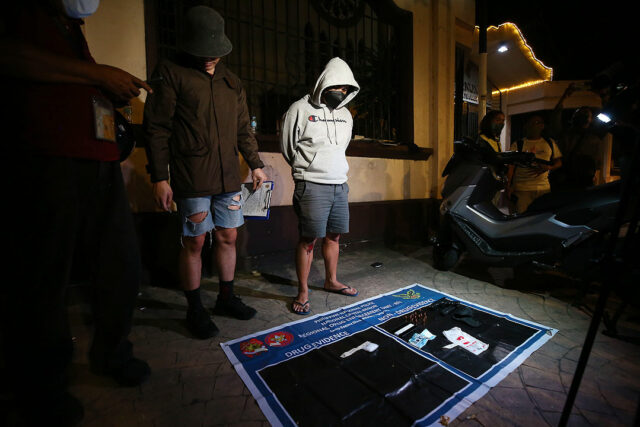
PHILIPPINE police arrested 8,183 drug suspects in 6,044 illegal drug operations from the start of the year to Feb. 11, the Philippine National Police (PNP) said on Monday.

Law enforcers seized P530 million worth of illegal drugs during the period, national police chief General Rodolfo S. Azurin, Jr. told a livestreamed news briefing. 

“The PNP is addressing all of these law enforcement and public safety concerns while continuously addressing our internal house cleaning as accountable public officials,” he said.

Interior and Local Government Secretary Benjamin C. Abalos, Jr. earlier said Mr. Azurin would join the five-man committee that would look into the records of top police officers who might be involved in the illegal drug trade.

Last month, the interior chief called on all colonels and generals to resign after a probe found many top police officers were involved in illegal drugs.

Mr. Azurin said the team would meet this week to discuss the evaluation of senior police officers.

“We will also discuss how we intend to finish the job in less than three months with the data we have at hand,” he said.

After the review, the committee will submit recommendations to the National Police Commission, which is headed by the Interior chief.

The five-man advisory body is composed of Mr. Azurin, Baguio City Mayor Benjamin B. Magalong, ex-Defense Secretary Gilberto C. Teodoro, retired police Major General Isagani R. Nerez and a fifth person who declined to be named, Mr. Abalos said on Feb. 1.

The country’s top cop, who quit his job on Jan. 5, earlier said the committee should be composed of people outside the police and Department of the Interior and Local Government to ensure fairness.

Mr. Abalos said Mr. Azurin could help “steer the committee” because he has access to intelligence reports on the police officers.

Police seized P30.9 billion worth of illegal drugs in 37,000 raids last year, the presidential palace said last week, citing a Philippine Drug Enforcement Agency report. More than 53,000 drug suspects were arrested during the raids.

PDEA was reducing drug demand through community-based rehabilitation programs and information campaigns that provide information on drug abuse, the palace added.

At least 25 policemen have been charged with murder in connection with ex-President Rodrigo R. Duterte’s anti-illegal drug campaign, Justice Secretary Jesus Crispin C. Remulla told the United Nations (UN) Human Rights Council in November. An inter-agency task force on extralegal killings had investigated at least 17,000 cops.

In November, the Philippines accepted more than 200 recommendations from the UN Human Rights Council, including investigating extralegal killings and protecting journalists.

More than 30 member-states of the UN body urged the Marcos government to do something about these. — John Victor D. Ordoñez

Marcos: Increased US access to bases not meant to worsen tensions

PRESIDENTIAL COMMUNICATIONS OFFICE

PHILIPPINE President Ferdinand R. Marcos, Jr. on Sunday said the government’s decision to give the United States access to four more military bases is not meant to increase tensions in the South China Sea.

 “It’s a valid concern and is something that we have to pay attention to,” he told reporters on his return flight from his working visit to Tokyo, based on a transcript sent by the presidential palace.

He was referring to the possibility of more US access increasing tension in the region. “We do not want to be seen as… provocative to anyone.”

On Feb. 2, the Marcos government gave increased US access to military bases under the Enhanced Defense Cooperation Agreement (EDCA).

Under the 2014 deal, Philippine military bases may be used for joint training, pre-positioning of equipment and building facilities such as runways, fuel storage and military housing.

“I always think about the agreement because we always say we want a peaceful [region] and that there will be safe passage,” Mr. Marcos said.

The South China Sea, a key global shipping route, is subject to overlapping territorial claims involving China, Brunei, Malaysia, the Philippines, Taiwan and Vietnam. Trillions of dollars flow through the sea, which is also rich in fish and gas.

China has said greater US access to Philippine military bases undermine regional stability.

“The statement is a de facto admission by President Marcos that adding EDCA sites expectedly will annoy China,” Jaime B. Naval, who teaches political science at the University of the Philippines, said in a Facebook Messenger chat.

“It is his way of parrying accusations or criticisms that he may be steering the Philippines, and even the region to perilous routes,” he said. “It is a diplomatic way of massaging China’s back in what is actually a reconfiguring of the security landscape, not only with reference to our alliance with the US but also with respect to calibrating alignments and force deployments which would connect to contingencies as in Taiwan, the South China Sea, East China Sea and even the Korean peninsula.

Last week, Philippine lawmakers said the deal would help deter China’s aggression in the South China Sea.

US Defense Secretary Lloyd Austin, who met with Mr. Marcos in Manila early this month, said the Philippine-US alliance “makes both of our democracies more secure and helps uphold a free and open Indo-Pacific.”

“That’s just part of our efforts to modernize our alliance,” he said. “And these efforts are especially important as the People’s Republic of China continues to advance its illegitimate claims in the West Philippine Sea.” — J.V.D. Ordoñez

ADVERTISEMENT
ADVERTISEMENT