Home Blog Page 5256

Stocks drop on selling pressure ahead of US CPI

BW FILE PHOTO

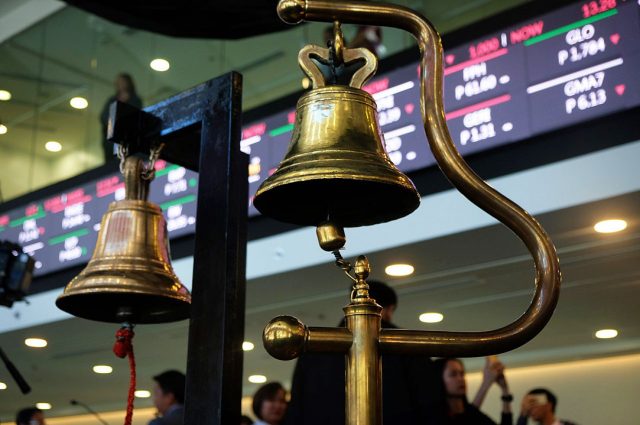
PHILIPPINE SHARES declined further on Tuesday on selling pressure amid expectations of faster US consumer inflation in January.

The bellwether Philippine Stock Exchange index (PSEi) declined by 47.52 points or 0.69% to 6,791.24 on Tuesday, while the broader all shares index went down by 11.31 points or 0.31% to end at 3,631.65.

“Selling pressure steadily weighed on prices through most part of the day as investors likely kept to the sidelines ahead of the US inflation report due out later. Investors may be bracing for a negative surprise,” China Bank Securities Corp. Research Director Rastine Mackie D. Mercado said in an e-mail.

“This may also factor into investor expectations of higher terminal rates for the US Federal Reserve and the BSP (Bangko Sentral ng Pilipinas), and curb the appetite for equities in the near term. Note that the BSP’s policy decision is also due out this week,” Mr. Mercado added.

The US Bureau of Labor Statistics was set to release January’s consumer price index (CPI) data overnight, which was expected to show how effective Federal Reserve policy tightening has been in taming inflation.

Analysts expect the headline CPI to rise 0.5% in January, with the core number seen advancing 0.4%, compared with 0.3% in the previous month, according to a Reuters poll. On an annual basis, consumer price inflation likely eased to 6.2%, from 6.5% in December.

The US central bank raised the fed funds rate by 25 basis points (bps) to a range between 4.5% and 4.75% at its Jan. 31 to Feb. 1 meeting. Its next policy review is on March 21-22.

Meanwhile, the BSP will hold its first policy meeting for the year on Thursday, where analysts expect a 25-bp or 50-bp rate hike.

“The PSEi sank after the market succumbed to profit taking ahead of US CPI and BSP’s meeting,” AP Securities, Inc. Equity Research Analyst Carlos Angelo O. Temporal said in a Viber message.

All sectoral indices closed lower on Tuesday. Property went down by 27.80 points or 0.93% to 2,956.02; holding firms lost 45.96 points or 0.7% to end at 6,517.91; financials declined by 9.46 points or 0.51% to 1,822.53; services dropped 5.60 points or 0.32% to 1,711.25; mining and oil slid by 31.62 points or 0.27% to 11,435.4; and industrials inched down by 15.26 points or 0.15% to 9,855.70.

Value turnover went up to P7.37 billion on Tuesday with 969.20 million shares changing hands from the P6.60 billion with 1.01 billion issues traded on Monday.

Decliners outnumbered advancers, 103 versus 84, while 43 names closed unchanged.

Net foreign selling rose to P461.38 million on Tuesday from P373 million on Monday.

China Bank Securities’ Mr. Mercado placed the PSEi’s support at 6,780-6,800 and resistance at 7,000, while AP Securities’ Mr. Temporal put support at 6,700 and resistance at 7,000. — Ashley Erika O. Jose with Reuters

Lack of awareness, energy costs continue to burden PHL recycling sector

High energy costs and low waste collection rates continue to burden the recycling sector in the Philippines, according to Bulacan’s Rural Industrial Corp.

“The cost of electricity has increased by over 30%, while fuel costs have almost doubled since the pandemic and the ongoing war abroad,” said Max L. Sy, general manager of the paper recycling company in Santa Maria, Bulacan. 

Another challenge is sourcing recycling-ready wastes.

“It’s still challenging due to the lack of awareness about the recyclability of UBCs (used beverage cartons),” he told BusinessWorld on Feb. 14. “Improvements also need to be done at our local MRFs (materials recovery facilities).”

An MRF receives, separates, and prepares recyclables to be sold to an end buyer. 

The company, Mr. Sy said, is able to sustain its operations and cover for rising costs through an increase in its mill’s efficiency by reducing rejects and improving production processes. 

“We were also able to increase our revenue stream by around 8% through our board production line made from UBCs,” he added. 

When asked about demand, he said: “There’s definitely still a stigma that recycled products are generally less durable and should be cheap; however, that’s not entirely true and, of course, with the right technology and innovation, recycled products can be a proper alternative to existing products, and actually provide economic value.”

“For our Poly Al Pro boards (eco boards) and recycled packaging paper, there’s definitely a demand and market in the construction and packaging industry, respectively,” he added.

FROM CARTONS TO BOARDS
The company uses UBCs from companies like Tetra Pak Philippines, a food packaging solutions provider, and recycles these into either paper that can be used for paper bags and news prints, or boards that can be used for tiles, furniture, and roofing. 

Tetra Pak’s UBCs are 75% carton, 20% polyethylene (the most commonly used plastic), and 5% aluminum.  

The widespread adoption of recycling requires a mindset change, according to Terrynz Tan, Tetra Pak’s sustainability director for Southeast Asia.  

“Creating the behavior so it becomes automatic… that needs time – even generations – to switch that behavior,” she said. 

Tetra Pak, Ms. Tan added, has organized awareness campaigns at around 200 public and private schools in the greater Manila area. 

“We teach them that recyclables should be treated with respect. Send recyclables to proper recycling centers,” she said. “There’re still so many areas we can cover. It’s a journey. We take one step at a time.”  

Only 9% of plastic waste is recycled worldwide, according to a 2022 report of the Organization for Economic Co-operation and Development or OECD.

“Another 19% is incinerated, 50% ends up in landfill and 22% evades waste management systems and goes into uncontrolled dumpsites, is burned in open pits or ends up in terrestrial or aquatic environments, especially in poorer countries,” it said. — Patricia B. Mirasol

Sugar import volumes set at 440,000 MT await approval

BOC - PUBLIC INFORMATION AND ASSISTANCE DIVISION (BOC-PIAD)

THE Sugar Regulatory Administration (SRA) said on Tuesday that it is waiting a “go signal” from President Ferdinand R. Marcos, Jr. to formally release a sugar order authorizing the imports of 440,000 metric tons (MT) of refined sugar.

“In all the SRA Sugar Board meetings, the President, if he is not available, is represented by (Senior Undersecretary Domingo F.) Panganiban. In yesterday’s meeting, we all signed the Sugar Order (which was) sent to Malacañang for the go-signal from the President, in his capacity as Secretary of Agriculture,” SRA Board Member and Planter’s Representative Pablo Luis S. Azcona told reporters in a virtual briefing.

According to Mr. Azcona, the sugar imports will come in three tranches — 100,000 MT and 100,000 MT, with the remaining 240,000 MT to be held back as buffer stock.

The first tranche is cleared for arrival “as soon as possible” while the second shipment will be admitted into the country starting April 1.

The remaining 240,000 MT, per order of Mr. Marcos, will be classified as “reserve” sugar. The SRA will re-classify the reserve for release to the domestic market as needed.

According to Mr. Azcona, the imports will address strong demand and contain prices.

He projected domestic sugar production at around 1.83 million MT. He noted that demand “is a lot more” and called the imports a mechanism for ensuring that “consumers get a good retail price.”

“We have more Filipinos every year so the demand should be going up,” he said.

“However, the data for actual consumption of big sugar users is not very accurate because they don’t really share with us their actual usage. We can monitor this through their taxes… so I think the import volume of 200,000 plus 240,000 buffer is very safe,” he added.

Mr. Azcona said that the import volume was arrived at after “careful calibration,” to ensure farmers can obtain reasonable prices even in the presence of imports.

He said the buffer stock is a mechanism to keep some control over supply with the SRA.

“We cannot 100% control the traders; however, the SRA Board controls when the (reserve) sugar will be made available to the market,” he said.

Separately, the MAV Management Council has approved the entry of 64,050 MT of sugar through the minimum access volume (MAV) mechanism.

The MAV allows trading partners guaranteed access to the Philippine market, up to a certain volume, as part of the Philippines’ World Trade Organization commitments.

According to Mr. Azcona, the details of the MAV shipments are still being studied, with the SRA having little involvement in the process.

The arrival of MAV sugar is between mid-April and the end of August, for consumption before the start of the next crop year. — Sheldeen Joy Talavera

IEMOP backs review of secondary price cap amid high fuel prices

BW FILE PHOTO

THE Independent Electricity Market Operator of the Philippines (IEMOP) said the Energy Regulatory Commission (ERC) needs to review the secondary price cap as market participants grapple with high fuel and power generation costs.

“As the market operator we see the merit of the call to review the price cap especially now that fuel prices and the production cost of power plants continue to increase, yet the price cap is low,” Robinson P. Descanzo, chief operating officer of IEMOP said in a virtual briefing on Feb. 10.

Power plant generators are entitled to additional compensation once the secondary price cap is triggered, according to an ERC resolution.

The secondary price cap limits the price that can be charged for power after certain price levels are breached within a short period. It is used by regulators to dampen volatility. The ERC set the secondary price cap at P6.245 per kilowatt-hour (kWh) after the breach of a P9 per kWh rolling average of the generator-weighted average price over a three-day period.

“What is happening here is the power plants recover their expenses through additional compensation, which is also provided by a mechanism of the secondary price cap,” he added.

ERC Chairperson and Chief Executive Officer Monalisa C. Dimalanta said that Philippine Independent Power Producers Association (PIPPA) has filed a position paper seeking a review of the secondary price cap.

“We are studying how to balance it because the cap is helpful. It provides consumers with some protection but it also distorts (market) signals. The WESM (Wholesale Electricity Spot Market) is there to send us signals but if we have the cap, the signals are distorted,” she told reporters on the sidelines of an energy forum last week.

Anne Estorco Montelibano, president of PIPPA, said that the secondary price cap should be examined as it discourages investment in the power sector.

“We have been shouldering the cost; the government need to examine policies that would encourage investment,” Ms. Montelibano said.

“Since the ERC allows additional compensation claims, I think it is right to increase the price cap set; at the same time the additional compensation claims would be reduced significantly,” Mr. Descanzo said.

Energy Secretary Raphael P.M. Lotilla has also said that the Energy department would have to raise the secondary price cap to encourage more investment in the energy sector. — Ashley Erika O. Jose

Palace reviewing application to extend Malampaya service contract

THE Department of Energy (DoE) said on Tuesday that the Malampaya gas field concession, known as Service Contract 38, is currently under review by the Office of the President in the wake of an application to extend the concession.

In a statement, the DoE declined to elaborate on the extension application while the Palace is evaluating it, other than to say: “the Philippine government retains at all times its full control over all aspects of gas and oil exploration and development. The service contractor is exactly that: Contractor.”

Prime Infrastructure Capital, Inc. (Prime Infra) is seeking a 15-year extension for the concession, which is set to expire next year.

Prime Infra, through its subsidiary Prime Energy Resources Development BV (Prime Energy) is a member of the Malampaya consortium operating SC 38.

Prime Energy holds a 45% stake in the Malampaya project. The other members of the consortium, UC38 LLC and PNOC Exploration Corp., own 45% and 10% stakes, respectively.

The DoE described the Malampaya project as a successful public-private partnership.

“PD (Presidential Decree) 87 embodies an early example of public-private partnerships (where the private sector bears all the risk) and, in the case of the Malampaya deepwater Gas-to-Power Project, a successful one,” the DoE said.

PD 87 governs the development of the petroleum industry, and introduced the service contracting system, through which blocks of Philippine territory are allocated to private parties for exploration.

Last week, Prime Infra President and Chief Executive Officer Guillaume Lucci said the company is optimistic about the Malampaya gas field and expects to extract gas from a new well by 2026.

The Malampaya project supplies power plants on Luzon which account for 20% of the Philippines’ power requirement. — Ashley Erika O. Jose

Onion farmers say millions worth of produce lost in cold storage

BOC PHOTO

A FARMING cooperative from Bongabon, Nueva Ecija said it lost 128,000 bags of onions which were improperly stored, rendering the crop unsellable and possibly contributing to the onion shortage.

Israel Reyugal, president of the Bonena Multi-Purpose Cooperative in Bongabon, told the House committee on agriculture and food that the onions, which he valued at P168 million, were rendered unmarketable after being exposed to temperatures that were too low at a cold storage facility in Bulacan.

He named the cold storage company in his remarks to the committee. BusinessWorld is withholding identification of the company while seeking comment from its representatives.

Mr. Reyugal said the cooperative is currently pursuing legal action against the privately-owned cold storage facility.

“Onions are sensitive,” he said, adding that “in May or June, we saw that the temperature (at the facility) was between minus 3 and minus 5 Celsius,” he told the panel, by which time the produce could not be saved.

According to the Bureau of Agriculture and Fisheries Standards, onions must be stored at between 0.5 degrees Celsius and minus 0.5 degrees. 

He said that the loss of the crop may have contributed to the high onion prices that happened late last year. — Beatriz Marie D. Cruz

ECCP backs water council to ease path for PPP investment

DEPARTMENT OF AGRICULTURE HANDOUT

THE European Chamber of Commerce of the Philippines (ECCP) said it supports the establishment of an advisory panel to the Water Resource Management Office (WRMO), which it hopes will result in seamless cooperation with the private sector in developing water projects.

“This interim structural reform will hopefully provide more synergy with public-private partnerships (PPPs) as it leads and encourages the establishment of investments, technology, benchmarking, and sharing of best practices resulting to the improvement of the water sector and for the benefit of our people,” the ECCP said in a statement on Tuesday.  

“We highly encourage that a multistakeholder advisory panel be established under the WRMO with representation from the private sector, academics, and civil society to serve as an additional sounding board for the said office in the crafting and implementation of policies, programs and projects for the water sector in line with the Integrated Water Resource Management (IWRM) principle of participatory governance,” the ECCP said.

The ECCP said that the government should also consider using the IWRM principles for water resource planning.

“The IWRM is an internationally recognized framework that is used to guide countries on their journey to water security. It is based on the idea that water issues should not be approached in isolation, but rather in a more holistic manner due to the interdependence of the uses of finite water resources,” the ECCP said.  

Earlier this month, the Presidential Communications Office (PCO) announced that President Ferdinand R. Marcos, Jr. approved the creation of the WRMO as an arm of the Department of Environment and Natural Resources.  

The PCO said that the WRMO will serve as a transitory body pending the creation of a Water Resources department. The main functions of the WRMO include creating and ensuring the implementation of the Integrated Water Management Plan that will harmonize the plans of various agencies.

“The creation of the WRMO is a welcome first step in fully realizing this as it aims to strengthen collaboration among various agencies in implementing water management programs in accordance with the Integrated Water Management Plan, to be crafted by the said agency,” the ECCP said. — Revin Mikhael D. Ochave

Philippines still not free of H5N1 bird flu

THE Bureau of Animal Industry (BAI) said the Philippines is still subject to outbreaks of type H5N1 avian influenza, first detected in February 2022.

The BAI said it has detected six cases overall since the first outbreak. The cases were reported in Candaba and Masantol, Pampanga; Sta. Maria, Bulacan; the Cagayan Valley; Sultan Kudarat, and Sampaloc, Manila.

“We had our first case… in February 2022. Since then, hindi naman po tayo nag-declare na naging AI-free na uli tayo (we have not declared ourselves AI-free). We haven’t recovered our AI-free status,” BAI Assistant Secretary Arlene Asteria V. Vytiaco said.

Previous outbreaks, according to Ms. Vytiaco, were recorded in 2017 and 2020.

She said the outbreak at a commercial farm in Sta. Maria, Bulacan resulted in the cull of 17,425 chickens.

Culling is resorted to when the BAI wishes to contain the spread of avian influenza to a certain area.

She said the impact of the cull on the egg supply is not significant.

“Not all of these were in the active laying stage as they ranged from 16 to 22 weeks old,” she said.

The BAI said the Bulacan farm got its stock from Pangasinan but it is still testing birds from the source farm.

The outbreaks involve quail in Pampanga, backyard gamecocks in the Cagayan Valley and Manila, ducks in Sultan Kudarat, and chickens in Bulacan.

All of the farms involved have been depopulated to prevent further spread, Ms. Vytiaco said.

One of the likely sources of bird flu is migratory birds mingling with farmed birds.

Ms. Vytiaco said the BAI grants cash assistance of up to P300,000 per poultry farm. — Sheldeen Joy Talavera

Japan investment pledges expected to materialize within 2-3 years  

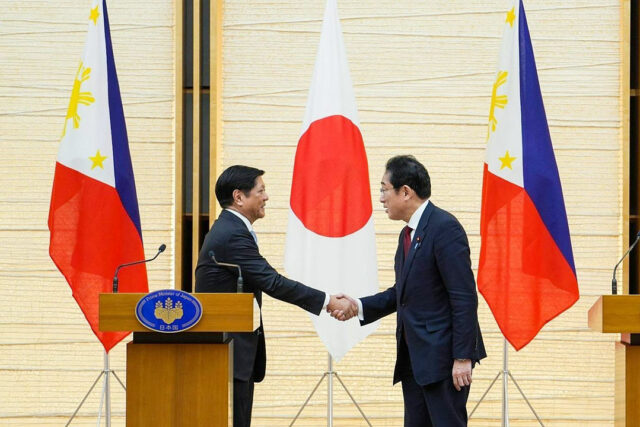
President Ferdinand R. Marcos, Jr. shakes hands with Japan’s Prime Minister Fumio Kishida after a joint press conference in Tokyo, Feb. 9, 2023. — COURTESY OF PRESIDENTIAL COMMUNICATIONS OFFICE

MOST OF THE investment pledges extracted from Japan are expected to materialize within the next two or three years, the Department of Trade and Industry (DTI) said.   

Trade Assistant Secretary Glenn G. Peñaranda said in a televised briefing on Tuesday that 21 deals secured by the Philippines will materialize in the next three years, adding that many of the Japanese investment pledges are related to manufacturing.   

Mr. Peñaranda said that of the 35 deals signed by Japan and the Philippines, 33 involved investments while the others were a cooperation agreement between the DTI and the Japan External Trade Organization and a $681,339 grant to the ASEAN Mentorship for Entrepreneurs Network for small and medium enterprises.   

“So (of) the 33 agreements, most of them are manufacturing and then their timelines are within the next three years,” Mr. Peñaranda said.   

President Ferdinand R. Marcos, Jr. said on Feb. 12 that the Philippines obtained $13 billion worth of investment pledges and contributions after his five-day official visit to Japan.   

He added that the commitments from Japanese companies have the potential to generate over 24,000 jobs.   

Dita Angara-Mathay, DTI commercial counselor and special trade representative in Tokyo, said in a separate virtual briefing that some projects could materialize in as little as “a year or two years.”  

However, she said that some of the bigger deals such as those related to mass transport and infrastructure would take longer. 

“Hopefully, most of them will be finished during the incumbency of this President,” Ms. Angara-Mathay said.   

Meanwhile, Mr. Peñaranda said that the DTI is still tallying the value of investment deals during the Japan visit of Mr. Marcos.   

He added that the investment pledges are from companies in the electronics, automobile, auto parts, renewable energy, software development, telecommunications, infrastructure, agriculture, property development, wiring harness, and printer industries.   

“We are not done counting because there are still many business interests that we are waiting to receive information from, and the visit of the President has generated increased interest in the country,” Mr. Peñaranda said.   

Trade Secretary Alfredo E. Pascual said in a separate statement on Tuesday that the agreements signed with Japanese businesses will put the Philippines in better position to pursue bilateral trade deals.   

“These (agreements)… promote our industries in Japan. We will be able to do so while learning from the new technology and innovations that Japanese companies use, which Filipinos can adopt and employ to improve service delivery,” Mr. Pascual said.   

Separately, Philippine Economic Zone Authority (PEZA) Officer-in-Charge Tereso O. Panga said that more Japanese locators are expected following the Presidential visit to Japan.    

“We are expecting more Japanese business partners and companies to come as the President continues to market the Philippines hand-in-hand with us in PEZA, the Board of Investments (BoI), and other investment promotions agencies (IPAs),” Mr. Panga said.   

Mr. Panga added that 884 Japanese companies are registered with PEZA, accounting for P745.64 billion or 27.42% of total PEZA-generated investment.   

“Japan has been the leading country in investing in the Philippine economic zones… We have received more inquiries from interested Japanese companies who will greatly add to the exports of the Philippines,” Mr. Panga said. — Revin Mikhael D. Ochave  

House banking committee approves bill amending FIST law 

BW FILE PHOTO

A BILL proposing amendments to the Financial Institutions Strategic Transfer (FIST) Act of 2021 has cleared the House banking committee.   

The committee approved House Bill No. 6773, an amendment to Republic Act No. 11523, also known as the FIST Act.  

FIST authorizes the transfer of bad assets held by financial institutions to asset management companies, also known as FIST corporations (FISTCs), clearing the institutions’ portfolios of troubled loans and freeing them up to lend more.  

The amendment seeks to allow a two-year extension for transferring nonperforming assets (NPAs); an additional three-year period for organizing FISTCs; a 10-year loss carryover period for financial institutions that book losses as a result of the asset transfers; an extension of the period for transferring assets from FISTCs to third parties; and a corresponding extension of tax exemptions and fee waivers on such transfers.     

“Banks remain sensitive to shocks given the behavior of the US. The NPL (nonperforming loan) and NPA ratios have not recovered to pre-pandemic levels,” Albay Rep. Jose Ma. Clemente S. Salceda said.   

The measure seeks to “extend the positive efforts of getting rid of our banks’ nonperforming assets, so they can free up more capital to lend to our pandemic-hit borrowers,” Committee Chair Irwin C. Tieng, the bill’s author, told the panel.   

Philippine Investment Companies (PIC) legal counsel Allan Bugayon said that the FIST law must be extended because “there’s an urgent equal request for the write down period on losses arising from sales.”   

He added that “these transactions become far less attractive to financial institutions so the deferral of losses on sale transfer of NPAs for a maximum of period of only five years is too short for banks and other financial institutions to maintain their financial health.” 

The banks panel also approved bills pushing for the adoption of digital payments for financial transactions of the government as well as of merchants. 

Undersecretary David L. Almirol of the Department of Information and Communications Technology said that the measure will help streamline processes in more than 450 bureaus and agencies it assists.   

“Most of the government (and private) agencies are using online payments but no one issues an official receipt… at the same time, there is no ledgering system of the Bureau of the Treasury including the government banks,” Mr. Almirol told the committee.   

The bill was approved on 3rd reading in the 18th Congress but was not acted on by the Senate.   

Meanwhile, the Trade and industry committee approved on Tuesday bills seeking to strengthen intellectual property laws.   

The committee passed House Bill No.  7028, which seeks to amend Chapter XVII of Republic Act No. 8293 or the Intellectual Property Code of the Philippines, adding a new section on preventing online infringement.  

Mr. Salceda said that online content piracy cases increased during the pandemic, estimating the potential revenue loss at P1 billion, citing studies by Media Partners Asia.   

“As content has become more easily transmissible in the digital space, infringement has become more prevalent in the online space,” Mr. Salceda said in his explanatory note. 

In the proposed measure, the Intellectual Property Office (IPO) has “the power to disable access to an online location” to prevent online infringement. 

An “online location” is defined as any single or collection of webpages accessible by a user through a domain, Internet Protocol (IP) address, or uniform resource locator.  

The panel also approved the consolidation of five bills amending RA 8293, by specifying procedures for patent registration, and noting functions and organizational structure of the IPO.   

Neil Gane of the Alliance for Creativity & Entertainment said site blocking could be an effective anti-piracy tool because it “is not just effective of blocking access to those particular piracy sites, but it also reduces traffic to other infringing sites and migrates consumers to legal services within that country. — Beatriz Marie D. Cruz

Tariff Commission receives petition to lower tariffs on natural gypsum to zero 

NATURLOOP.COM

KNAUF GYPSUM Philippines, Inc. is seeking zero tariffs on imports of natural gypsum, an input used in the manufacture of construction materials, the Tariff Commission (TC) said. 

According to a notice dated Feb. 10 posted on the TC website, the company sought the reduction of the most favored nation (MFN) tariff rate on natural gypsum to 0% from 3%.

“Notice is hereby given that this commission received a petition for reduction in the MFN tariff rate on natural gypsum ASEAN Harmonized Tariff Nomenclature (AHTN) 2022 subheading 2520.10.00 from 3% to 0% filed by Knauf Gypsum Philippines,” the TC said.   

According to the TC, it will conduct an investigation into the tariffs imposed on gypsum and anhydrite in line wih Republic Act No. 10863 or the Customs Modernization and Tariff Act.   

“Interested parties are requested to submit to the Commission their comments, inputs, and/or positions on the petition for tariff modification on natural gypsum and on the tariff rate of anhydrite, which is another product covered under AHTN 2022 subheading 2520.10.00 on or before Feb. 20,” the TC said.   

“The schedule of the public hearing will be announced at a later date,” it added.   

Knauf Gypsum Philippines makes gypsum board and jointing compounds. Some of its products include wall, ceiling, jointing, and finishing compounds, acoustic panels, ceiling tiles, and acoustic suspension systems.    

Gypsum board is also known as drywall, which is fire resistant. — Revin Mikhael D. Ochave 

Manila files diplomatic protest over China ‘harassment’ at sea

PHILIPPINE COAST GUARD FACEBOOK PAGE

By Alyssa Nicole O. Tan, Reporter

THE PHILIPPINES on Tuesday filed a diplomatic protest against China after accusing it of trying to block a resupply ship at the Second Thomas Shoal in the South China Sea.

In a statement, the Department of Foreign Affairs (DFA) said it had filed the protest before the Chinese Embassy in Manila as it condemned the Chinese Coast Guard’s dangerous maneuvers and alleged harassment of Philippine Coast Guard crew on Feb. 6.

The Chinese Coast Guard endangering the crew of BRP Malapascua by shining a military-grade laser light on the Philippine ship was a “threat to Philippine sovereignty and security as a state,” the agency said. The Chinese acts were “infringements of its sovereign rights and jurisdiction over its exclusive economic zone.”

President Ferdinand R. Marcos, Jr. summoned Ambassador Huang Xilian “to express his serious concern over the increasing frequency and intensity of actions by China against the Philippine Coast Guard and our Filipino fishermen in their bancas,” the presidential palace said in a separate statement.

“The Philippines has the prerogative to conduct legitimate activities within its exclusive economic zone and continental shelf,” DFA said. “China does not have law enforcement rights or powers in and around Ayungin Shoal or any part of the Philippine exclusive economic zone,” DFA spokesperson Ma. Teresita C. Daza said.

She described the use of the laser as “disturbing and disappointing,” noting that it came just a month after President Ferdinand R. Marcos, Jr. and Chinese President Xi Jinping “agreed to manage maritime differences through diplomacy and dialogue, without resorting to force and intimidation.”

A China Coast Guard vessel had tried to blind the crew of BRP Malapascua shining a laser light at the ship, putting them in danger, the Philippine Coast Guard said on Monday.

Philippine lawmakers condemned the act and sought more joint patrols and international pressure to stop Chinese excursions.

The South China Sea, a key global shipping route, is subject to overlapping territorial claims involving China, Brunei, Malaysia, the Philippines, Taiwan and Vietnam.

The Philippines claims sovereignty over the shoal in the Spratly Islands that it calls Ayungin, having deliberately grounded the Navy ship BRP Sierra Madre — a World War II -era vessel it acquired from the United States in 1976 — there in 1999.

Second Thomas Shoal lies within the Southeast Asian Nation’s exclusive economic zone.

As BRP Malapascua reached a 10-nautical mile distance from the shoal, the Chinese Coast Guard vessel was seen about 4 nautical miles dead ahead, maneuvering from the Philippine ships’s left side and heading toward its right side.

“The Chinese ship illuminated the green laser light twice toward the BRP Malapascua, causing temporary blindness to her crew at the bridge,” the Philippine Coast Guard said. “The Chinese vessel also made dangerous maneuvers by approaching about 150 yards from the vessel’s starboard quarter.”

The Philippine vessel altered its course from Second Thomas Shoal and headed toward Lawak Island (Nanshan).

“We call on China to comply with its obligations under international law, including the 1982 United Nations Convention on the Law of the Sea and the 2016 award in the South China Sea arbitration and direct its vessels to cease and desist from its aggressive activities against Philippine vessels,” Ms. Daza said.

She was referring to the 2016 ruling by a United Nations-backed tribunal that voided China’s claim to more than 80% of the sea based on a 1940s map.

Manila has sent eight note verbales to Beijing this year and 195 in 2022, Ms. Daza told reporters in a WhatsApp message.

In response, China accused the Philippines of intruding into its waters. “On Feb. 6, a Philippine Coast Guard vessel intruded into the waters off the Ren’ai Reef (Second Thomas Shoal) without Chinese permission,” Wang Wenbin, spokesman of China’s Ministry of Foreign Affairs, told media, according to a transcript posted on its website.

“In accordance with China’s domestic law and international law, including the United Nations Convention on the Law of the Sea (UNCLOS), the China Coast Guard ship upheld China’s sovereignty and maritime order and acted in a professional and restrained way,” he added.

‘DEFENSE POSTURE’
China demanded respect, telling the Philippines to “avoid taking any actions that may exacerbate disputes and complicate the situation.”

The United States, on the other hand, called China’s conduct “provocative and unsafe,” saying it had interfered with the Philippines’ lawful operations at the shoal.

“More broadly, the People’s Republic of China’s (PRC) dangerous operational behavior directly threatens regional peace and stability, infringes upon freedom of navigation in the South China Sea as guaranteed under international law, and undermines the rules-based international order,” US Department of State spokesman Edward “Ned” Price said in a statement posted on the agency’s website.

“As reflected in an international tribunal’s legally binding decision issued in July 2016, the People’s Republic of China has no lawful maritime claims to Second Thomas Shoal,” he added. “We call upon the PRC to abide by the ruling.”

Mr. Price reiterated that an armed attack on Philippine vessels in the South China Sea would trigger a 71-year-old Mutual Defense Treaty between the two countries.

“The United States stands with our Philippine allies in upholding the rules-based international maritime order and reaffirms that an armed attack on Philippine armed forces, public vessels or aircraft, including those of the coast guard in the South China Sea, would invoke US mutual defense commitments under Article IV of the 1951 US Philippines Mutual Defense Treaty,” he said.

Senator Ana Theresia “Risa” Hontiveros-Baraquel in a statement said the Chinese Ministry of Foreign Affairs was lying.

It is clearer than the light of day that Ayungin Shoal is a Philippine territory,” she said in Filipino. “It’s not China’s. Ayungin is part of the Philippines’ exclusive economic zone.”

“The UNCLOS affirms this. The wider international community recognizes this. It is only China’s authoritarian government that seems to think otherwise,” she added.

Senator Joseph Victor G. Ejercito urged the Marcos government to fast-track the modernization of the country’s armed forces and strengthen its defense posture.

“Given these recent incursions, we need to put up a naval force that can project a more respectable presence in the West Philippine Sea,” he said in a statement. “This is the best time for us to work with our regional neighbors and defense partners in countering China’s aggression.”


ADVERTISEMENT
ADVERTISEMENT