Home Blog Page 5237

CAMPI, TMA report 42% YoY sales leap in January
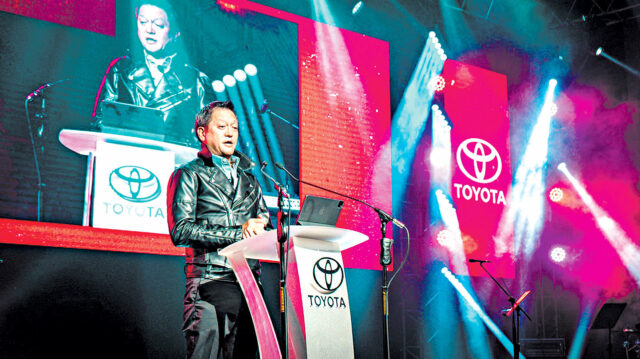
Toyota Motor Philippines, which once again leads the vehicle sales charge, is expecting “another milestone year,” said its President Atsuhiro Okamoto. — PHOTO BY KAP MACEDA AGUILA

VEHICLE SALES figures continue to trend upward, per the latest joint report of the Chamber of Automotive Manufacturers of the Philippines, Inc. (CAMPI) and Truck Manufacturers Association (TMA). Last January, member companies of the two groups posted a consolidated sales total of 29,499 units — reflecting a 42.1% increase versus the 20,765 units recorded in the same month in 2022. Versus December, the market exhibited an expected seasonality dip from 37,259 units sold during that month.

CAMPI President Atty. Rommel Gutierrez said that the figure, coming off a “robust growth performance in 2022, is a good development momentum for the auto industry as we start the year.”

Leading the charge anew is Toyota Motor Philippines Corp. (TMP), with 13,428 units sold in January, helping the company corner 45.52% of the market. In second place is Mitsubishi Motors Philippines Corp. (MMPC), which moved 5,030 vehicles and accounted for 17.05% of total sales for the month. Ford Motor Company Philippines, Inc. sold 2,107 units in January — good for third place and 7.14% share of the market. In fourth is Nissan Philippines, Inc. (NPI) with 1,878 vehicles sold and 6.37% market share. Rounding out the top five is Honda Cars Philippines, Inc. (HCPI), with 1,639 vehicles sold and 5.56% market share.

During the recent media thanksgiving party held by Toyota, TMP President Atsuhiro Okamoto expressed, “We are humbled by the trust of our customers that resulted in a market share of 50% in 2022.” The executive expects 2023 to be “another milestone year” for the company, which is marking its 35th anniversary. “This year, we aim to step up our initiatives in providing mobility for all Filipinos. All indications are pointing to sustained economic growth driven by the increased movement of people and goods. As such, we are cautiously optimistic that the auto market will hit 388,000 units — 11% higher than 2022,” he continued.

Atty. Gutierrez affirmed in a release, “The auto industry is optimistic of its continued expansion from the demand-side standpoint driven by the growing domestic consumer market.” However, he cautioned that “supply-side challenges are also an important factor that the industry is mindful of as this may hamper the industry growth… the auto sales sustained growth or exceeded the last year’s record is not always clear-cut as our overall economic health and activity depends on various economic key indicators.” — Kap Maceda Aguila


Rappers Drake, 21 Savage settle with Conde Nast over fake Vogue cover

RAPPER Drake arrives on the red carpet for the film The Carter Effect at the Toronto International Film Festival (TIFF), in Toronto, Canada, Sept. 9, 2017. — REUTERS

DRAKE and 21 Savage have settled a lawsuit by Conde Nast accusing the rappers of using the Vogue name and creating a fake Vogue magazine without permission to promote their recent No. 1 album Her Loss.

In an internal memo on Thursday, Conde Nast general counsel Will Bowes said the settlement with the rappers includes an unspecified monetary payment that will “bolster our ongoing creative output, including Vogue editorial.”

He also said the settlement includes a permanent injunction against their commercial use of Vogue’s trademarks.

A lawyer for Drake had no immediate comment, while a lawyer for 21 Savage declined to comment. Reuters obtained Mr. Bowes’ memo.

Conde Nast, also known as Advance Magazine Publishers, Inc., had sought at least $4 million in its Nov. 7 lawsuit against the rappers.

The promotional campaign included a bogus Vogue cover featuring the pair, and a suggestion they had longtime Vogue editor-in-chief Anna Wintour’s “love and support.”

Conde Nast said the campaign was also directed to Drake’s and 21 Savage’s more than 135 million social media followers. A federal judge concluded on Nov. 9 that the campaign was causing confusion, and Conde Nast would likely succeed on its trademark infringement and false advertising claims. Drake, a Toronto native, and 21 Savage, from Atlanta, then voluntarily halted the campaign without conceding wrongdoing.

Mr. Bowes said in the memo that while Vogue’s name is often referenced elsewhere, “it was clear to us that Drake and 21 Savage leveraged Vogue’s reputation for their own commercial purposes and, in the process, confused audiences who trust Vogue as the authoritative voice on fashion and culture.” Her Loss was released on Nov. 4, and debuted at No. 1 on the Billboard 200 album chart. It ranks No. 8 for the week ending Feb. 18. — Reuters

Philippines lags behind peers in Global Knowledge Index

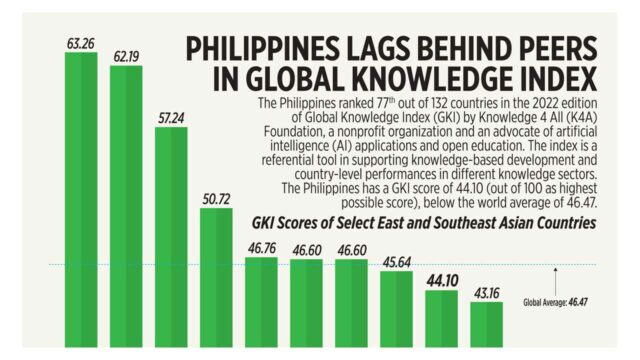
The Philippines ranked 77th out of 132 countries in the 2022 edition of Global Knowledge Index (GKI) by Knowledge 4 All (K4A) Foundation, a nonprofit organization and an advocate of artificial intelligence (AI) applications and open education. The index is a referential tool in supporting knowledge-based development and country-level performances in different knowledge sectors. The Philippines has a GKI score of 44.10 (out of 100 as highest possible score), below the world average of 46.47.

Philippines lags behind peers in Global Knowledge Index

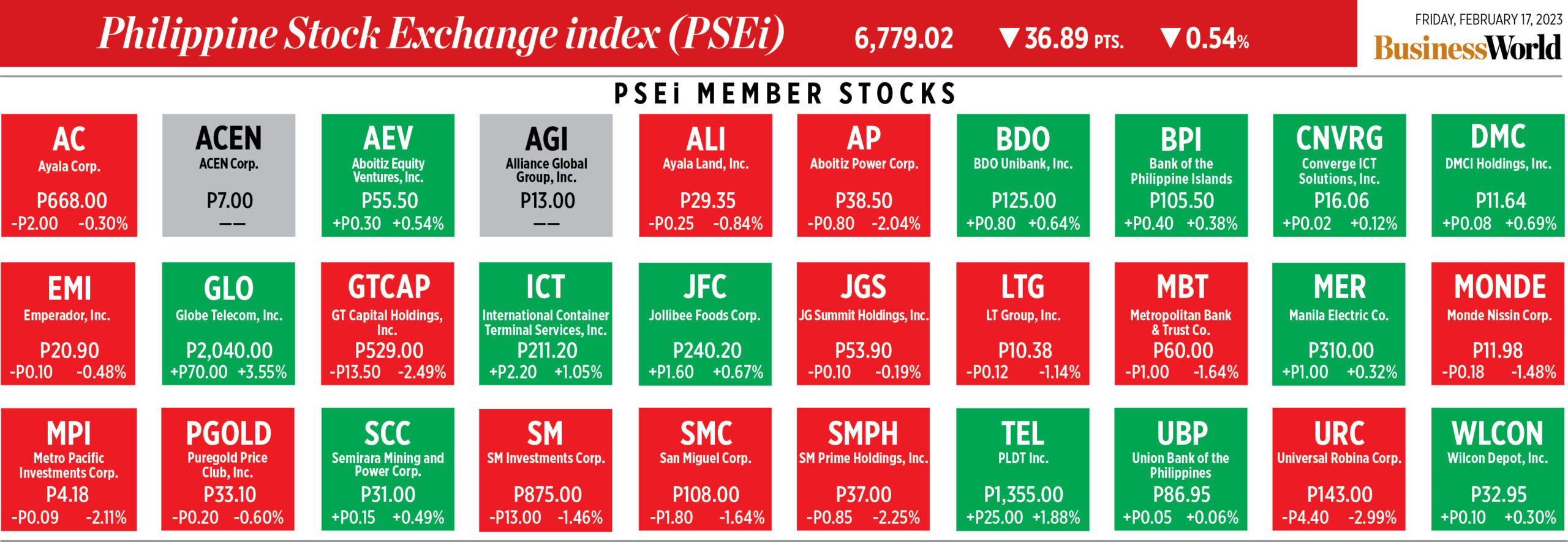
How PSEi member stocks performed — February 17, 2023

Here’s a quick glance at how PSEi stocks fared on Friday, February 17, 2023.


Shares may drop as BSP hints at more rate hikes

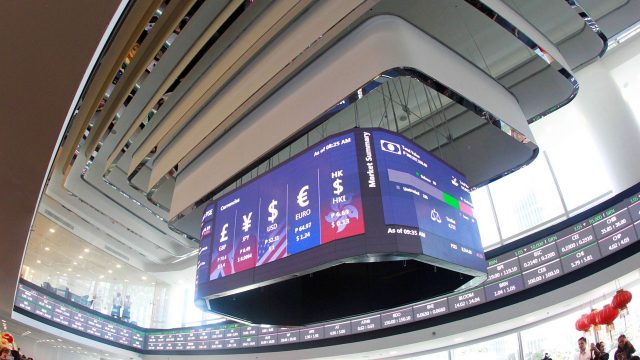
PHILIPPINE STAR/KRIZ JOHN ROSALES

STOCKS are expected to move sideways with a downward bias this week due to expectations of more interest rate hikes from the Bangko Sentral ng Pilipinas (BSP) amid elevated inflation.

The benchmark Philippine Stock Exchange index (PSEi) declined by 36.89 points or 0.54% to close at 6,779.02 on Friday, while the broader all shares index dropped 17.39 points or 0.47% to end at 3,621.69.

Week on week, the PSEi lost 97.77 points or 1.42% from its close of 6,876.79 on Feb. 10.

“Stocks tumbled after the BSP painted a gloomy first-quarter outlook for monetary policy. The spike in January inflation prompted the BSP to raise their 2023 inflation projection to 6.1%,” AB Capital Securities, Inc. Vice-President Jovis L. Vistan said in a Viber message.

The BSP’s policy-setting Monetary Board on Thursday raised benchmark interest rates by 50 basis points (bps) for a second straight meeting, and signaled more tightening to tame inflation.

The central bank increased its policy rate to 6%, the highest in nearly 16 years or since May 2007 when it stood at 7.5%.

The BSP has now hiked borrowing costs by 400 bps since May 2022.

The central bank raised its average inflation forecast for 2023 to 6.1% from 4.5% previously. This is beyond the BSP’s 2-4% target range.

It also hiked its 2024 inflation projection to 3.1% from 2.8% previously.

BSP Governor Felipe M. Medalla said after the meeting that it was difficult to rule out a third or maybe a fourth increase this year, with a 25-bp or 50-bp hike at their next meeting on March 23 almost guaranteed.

For this week, Mr. Vistan said the BSP’s hawkish outlook could affect market sentiment.

“The BSP hinted that there is still work to be done as the local benchmark rate is among those that are negative in real terms. The market is expected to remain weak this week as the PSEi broke some key support levels,” he said.

Philstocks Financial, Inc. Senior Research Analyst Japhet Louis O. Tantiangco also said the PSEi may trade with a downward bias after the BSP signaled more rate hikes to come.

“[Overall], the market is still seen to move with a downward bias amid resurfacing worries over aggressively hawkish monetary policy outlooks of the BSP and Federal Reserve,” Mr. Tantiangco said in a Viber message.

China Bank Securities Corp. Research Director Rastine Mackie D. Mercado said in an e-mail that the movement of offshore markets over the weekend could affect the PSEi on Monday.

“In case we see a sustained sell-off, then we are likely to track lower. Nevertheless, we think that there remain opportunities for bargain-hunting considering that we’ve already seen four weeks of decline,” Mr. Mercado said.

Mr. Vistan placed the PSEi’s support at 6,509 and resistance at 6,800, while online brokerage 2TradeAsia.com put support at 6,600-6,650 and resistance at 6,850 and Mr. Mercado pegged support at 6,600-6,640 and resistance at 6,950-7,000. — Ashley Erika O. Jose

Peso may climb amid hawkish policy signals

BW FILE PHOTO

THE PESO could strengthen against the dollar this week as the Philippine central bank’s chief hinted at more rate increases moving forward to help tame red-hot inflation.

The local unit closed at P55.24 per dollar on Friday, weakening by 12 centavos from its P55.12 finish on Thursday, data from the Bankers Association of the Philippines’ website showed.

Week on week, the peso dropped by 82 centavos from its P54.42 finish on Feb. 3.

The peso opened Friday’s session at P55.25 per dollar. Its weakest showing was at P55.335, while its intraday best was at P55.15 against the greenback.

Dollars exchanged fell to $878.3 million on Friday from $1.143 billion on Thursday.

The peso depreciated after hawkish signals from officials of the Bangko Sentral ng Pilipinas (BSP) and the US Federal Reserve, Rizal Commercial Banking Corp. Chief Economist Michael L. Ricafort said in a Viber message.

The BSP on Thursday raised benchmark interest rates by 50 basis points (bps) for a second straight meeting, and signaled more tightening to come to tame inflation.

The central bank increased its policy rate to 6%, the highest in nearly 16 years or since May 2007 when it stood at 7.5%. It has now hiked borrowing costs by 400 bps since May 2022.

The BSP raised its average inflation forecast for 2023 to 6.1% from 4.5% previously. This is beyond the BSP’s 2-4% target range.

It also hiked its 2024 inflation projection to 3.1% from 2.8% previously.

BSP Governor Felipe M. Medalla said after the meeting that they could not rule out a third or fourth rate increase this year and could consider a 25-bp or 50-bp hike at their next review on March 23.

Meanwhile, Cleveland Fed President J. Loretta Mester and St. Louis Fed President James Bullard both supported a 50-bp hike in the next Federal Open Market Committee meeting following data showing sticky US inflation.

US consumer prices accelerated in January amid higher costs for rental housing and food. The US consumer price index (CPI) increased 0.5% last month after gaining 0.1% in December.

In the 12 months through January, the CPI increased 6.4% following a 6.5% rise in December.

The US central bank this month raised its target interest rate by 25 bps to a 4.5%-4.75% range, bringing cumulative hikes since March 2022 to 450 bps.

The Fed’s next policy review will be held on March 21-22.

For this week, Union Bank of the Philippines, Inc. Chief Economist Ruben Carlo O. Asuncion said in a report that the BSP’s hawkish tone could support the peso against the dollar.

“Markets will have to contend with the BSP capable of being uber hawkish than the Fed, if demanded by local inflation risks… Following the BSP’s recent hawkish stance, the BSP’s higher inflation forecast will likely prompt more rate hikes in succeeding months to deter persistent inflation overshooting, and thus, uplift peso sentiment. In short, the BSP’s terminal policy rate cannot stay at 6% where the policy rate is now, which will be supportive of the peso,” Mr. Asuncion said.

The market will also wait for upcoming releases for leads, including the Philippine balance of payments report on Monday, Fed meeting minutes, as well as US data on employment, housing, and manufacturing, Mr. Ricafort added.

Mr. Ricafort expects the peso to trade between P55 and P55.50 per dollar this week, while Mr. Asuncion sees the local unit moving from P54.70 to P55.40. — A.M.C. Sy

BoI expects P1-T investment goal to be 80-90% filled by midyear

TRADE Secretary Alfredo E. Pascual expects the Board of Investments (BoI) to hit its P1-trillion investment target for 2023 following “serious interest” from foreign investors.

“With investment prospects being very positive, and as we continue to receive serious interest from global investors, we are definitely on track to meeting our annual investment target of P1 trillion. We are not even through with the second month of the year and we already have secured nearly half of our full-year target for investment approvals,” Mr. Pascual said in a statement.

The BoI is an investment promotion agency (IPA) of the Department of Trade and Industry.

Mr. Pascual, who chairs the BoI, was commenting after the BoI reported P414.3 billion worth of approved investments as of Feb. 9, equivalent to a 142.9% increase year on year.

Mr. Pascual said the BoI could hit 80% to 90% of the target before the middle of the year as the IPA is still following up on other investment leads.

“So far, the agency still has potential investment leads of around P344 billion that have yet to be processed,” Mr. Pascual said.

“The increase in investments proves that the government’s promotional visits abroad led by no less than the President himself, are working as a growing number of investors from around the globe, from Southeast Asia, the US, Belgium, China, and most recently Japan, have shown strong interest in putting in more investments into the country,” he added.  

Last year, the BoI recorded P729 billion worth of approved investments, up 11%.

The BoI accounted for 76% of the P927 billion worth of total IPA foreign and domestic approved investments in 2022.

Mr. Pascual said BoI foreign investment approvals as of Feb. 9 amounted to P163 billion. Investments from Germany accounted for P157 billion, followed by the Netherlands with P2.7 billion, Japan P524 million, the US P509 million, and the UK P194 million.  

“BoI-approved foreign capital for barely the first months of 2023 has already reached 56% of the total figure for all IPAs last year. So, this year looks very promising with heightened prospects and through our collective efforts, we are on course to surpass the 2022 figure way ahead of time,” Mr. Pascual said.

The BoI said the Western Visayas led the regions in investment as of Feb. 9 with P293.3 billion, followed by Calabarzon with P111.7 billion, Eastern Visayas P3.5 billion, Central Luzon P3 billion, and the National Capital Region P783 million.

The renewable energy sector had the biggest share of investment approvals at P398.7 billion, up 138%.

One of the top projects approved in January was the P392-billion investment in offshore wind farms by German-owned wpd Philippines, Inc. in Cavite, Negros Occidental, and Guimaras.  

“We aim to be a global hub for sustainability and green projects that align with the National Government’s policy of promoting cleaner sources of energy, for which full foreign ownership is now allowed under the amended implementing rules and regulations of the Renewable Energy Act,” Mr. Pascual said.

Other sectors posting significant investment approvals were manufacturing with P12.3 billion, administrative services P1.3 billion, agriculture P901 million, and transportation P847 million. — Revin Mikhael D. Ochave 

Regulatory overhaul needed for domestic mineral processing

BW FILE PHOTO

THE Department of Trade and Industry (DTI) said it is working towards establishing a domestic mineral processing industry to tap the potential of Philippine metals for the burgeoning electric vehicle (EV) industry.

Dita Angara-Mathay, DTI commercial counselor and special trade representative to Tokyo, said in a recent virtual briefing after the Japan visit of President Ferdinand R. Marcos, Jr. that the DTI is pushing for more domestic ore processing to move the Philippines into more high-value activities like battery production for EVs.

“The aspiration of the DTI is that we will find it in our regulations to stop the direct sale of ore because that’s a depletable resource, and only encourage new entrants if they invest in processing the ore into high value-added products. That doesn’t only apply to nickel but also copper, etc. So, we have to move up the value chain,” Ms. Angara-Mathay said.  

“They should also bring the processing technology so that our ore can be used in batteries ahead of the surge in demand for EVs. That’s what we really want,” she added.

Ms. Angara-Mathay said the DTI is convincing mineral processors Coral Bay Nickel Corp. and Taganito HPAL Nickel Corp. to consider higher-value activities.  Both companies are Philippine units of Sumitomo Metal Mining Co., Ltd.

Coral Bay and Taganito are hydrometallurgical nickel processing plants that utilize high-pressure acid leaching, which converts low-grade nickel lateritic ores into nickel and cobalt mixed sulfide. The mixed sulfide is an intermediate product that is further refined for use in special steels, electric materials, and battery materials.

“What we really want to do is to convince them to migrate the processing to even higher value-added stages of the production chain to include, hopefully, the manufacturing of lithium-ion batteries,” she said. 

“We’re hoping that since our mining regulations are getting clear. I think we’re waiting for more details from those regulators or authorities who actually oversee exploration and processing,” she added.

Ms. Angara-Mathay also disclosed that the DTI has already identified companies that should be working with the Philippines in processing its metals into batteries.

However, she said that there has been no interest from these companies as they are waiting for policies from relevant government authorities.

“We’re just hoping that some of these people will come in and be brought in after we have a very clear-cut policy that we announce from the relevant authorities. So right now, nobody has expressed any interest,” Ms. Angara-Mathay said.

Trade Assistant Secretary Glenn G. Peñaranda said that the DTI has formed a technical working group (TWG) to look into the possible policy changes to boost mineral processing investments.

“The TWG started last year. We looked at what Indonesia was doing. I think very soon, there should be a recommendation from the TWG. Today, some of the bigger users, particularly China, are really scrambling to secure their supply of the green metals. I think there is market pressure in a way to secure the minerals. The sooner we can make a decision, the better so it is clear,” he added.

Indonesia froze nickel ore exports last year in a bid to do more domestic processing.

The Mines and Geosciences Bureau said in December that the value of Philippine metallic mineral output in the first nine months of 2022 rose 29.21% to P175.61 billion. — Revin Mikhael D. Ochave

Marcos sees manufacturing as key to export growth

RIO LECATOMPESSY-UNSPLASH

PRESIDENT Ferdinand R. Marcos, Jr. said he views building up manufacturing to be a key prerequisite to growing the export sector.

“If the manufacturing operations (gain momentum), we can also export,” he said in a latest video blog. “That’s a big help because we can expand our business to other countries.”

Mr. Marcos said the money saved from foregoing imports can be invested in the economy.

Philippine manufacturing, as measured by the volume of production index, expanded 4.8% year on year in December, the weakest gain since the 4.6% reading in September, according to the Philippine Statistics Authority.

The December reading slowed from the revised 5.9% posted in November and 19.2% a year earlier. 

Mr. Marcos said cheap and reliable energy was also key to boosting factory output.

He said public-private partnerships will play an important role in the manufacturing sector.

The Presidential Communications Office (PCO) said two major consumer goods companies — one of them Procter & Gamble Co. (P&G) — are currently establishing state-of-the art manufacturing facilities in the Philippines, “with one securing a registration with the Board of Investments.”

P&G is establishing a new facility for production of diapers “for export,” while the other, which is European is setting up a facility for personal care products, the Palace said, citing Lanie Dormiendo, head of the International Investments Promotion Service of the Board of Investments (BoI).

The Philippines also plans to host a French ship builder, “which is just finalizing its agreement with the government for the establishment of a shipbuilding facility,” the Palace said. The French company currently operates a ship repair facility in the Philippines.

A Chinese company is also setting up a $3.5-billion integrated steel mill in the Philippines.

“We also met last week a Chinese company that will be building an EV (electric vehicle) facility. They plan to manufacture three types of e-vehicles in the country with more than one billion dollars’ worth of investments,” Ms. Dormiendo said.

The PCO said the Marcos government is making the manufacturing sector “innovative and sustainable.”

The administration has been “aggressively promoting the country’s priority sectors, such as green, innovative and sustainable manufacturing and services, to attract more foreign investors,” it said.

These sectors include high-value manufacturing activities such as electric vehicle assembly, battery manufacturing and mineral processing.

“We have a lot of minerals that can be processed to form part of batteries not only for electric vehicle but even for battery energy storage system,” Ms. Dormiendo was quoted as saying, noting that the government wants to capitalize on the resources already available in the Philippines instead of just exporting them to China and Japan as raw minerals.

“We want to attract foreign investors to do a higher value activity (like) mineral processing, and then attract battery manufacturers and eventually the EV assemblers and EV manufacturers.”

Ms. Dormiendo said the Marcos administration is also actively promoting renewable energy.

The government has so far registered more than P400 billion worth of investments this year, much of it related to the RE sector, she noted.

The Department of Energy last year amended the implementing rules and regulations governing clean energy investment to allow 100% foreign equity in wind, solar and tidal power generation.

Separately, the Palace announced that the Fiscal Incentives Review Board had approved a proposal from a Singapore company to operate a 23-megawatt data center.

A US company is also putting up two 200-megawatt data centers in the northern Philippines, it added.

“Elon Musk’s Starlink is also setting up its low-earth orbit satellite-based internet services in the country, which will make the Philippines Asia’s first to have this type of service,” it said, citing Ms. Dormiendo. — Kyle Aristophere T. Atienza

‘Blended financing’ could unlock private investment as fiscal resources dwindle

DPWH

By Luisa Maria Jacinta C. Jocson, Reporter

LEGISLATION proposing a “blended financing” model will help the Philippines tap more private funding, giving it more financing flexibility after its own ability to invest in projects was weakened by the pandemic, analysts said.

“Flexible funding modalities allow other interested parties to engage in development projects in the Philippines. This allows bilateral and multilateral partners to limit their exposure in specific development projects and provide space for private sector participation,” Terry L. Ridon, a public investment analyst and convenor of think tank InfraWatch PH, said in an e-mail.

“As long as there is transparency in the so-called blended financing approach, it could be a welcome development, as manifested if one of the objectives is to have flexibility in financing — which is advantageous to loan borrowers,” De La Salle University law and business professor Antonio A. Ligon added in a Viber message.

Albay Rep. Jose Ma. Clemente S. Salceda last week filed House Bill No. 7135, which proposes a blended financing model that allows for more diversified loan sources.

The model is defined as a “financing arrangement where the bilateral or multilateral partners mobilize funds from commercial or private financing institutions.”

It can be applied as long as the projects are covered by national or international official instruments in the nature of exchanges of notes, memoranda of understanding, or similar instruments.

The bill also seeks to reduce the official development assistance (ODA) grant component to 15% and remove the 40% requirement for the weighted average of the grant component of all ODA-funded initiatives.

According to the bill, current ODA guidelines under Republic Act No. 8182 “do not explicitly provide a mechanism for ODAs in the blended financing approach.”

“As such, similar financing arrangements could be subject to litigation, raising the risks of materially-adverse government action for such projects,” it added.

The bill also noted that these risks could also restrict bilateral partners, particularly those from Europe, and their ability to provide their expertise in many areas where cooperation could contribute to development.

Analysts said that the bill will attract more investors and speed up the completion of projects.

“ODA provides cheaper financing at much longer tenors and better terms such as grace periods, but greater flexibility though blended funding from commercial or private sources would improve flexibility in terms of more infrastructure projects being financed and rolled out, as well as completed at a shorter time period,” Rizal Commercial Banking Corp. Chief Economist Michael L. Ricafort said in a Viber message.

“Given the limited budget and financial resources of the government, more financing options and flexibility would be welcome,” he added.

However, Mr. Ridon noted that the blended financing model may not be immediately adopted.

“While providing this option opens wide-ranging opportunities to engage new development partners, we have yet to see whether blended funding modalities will be the norm in future projects. At present, ODAs are essentially vertically integrated endeavors, as funding partners typically originate development projects from conceptualization and feasibility determination to project construction, turnover and even maintenance,” he said.

Development partners may reject participation in projects if a major development partner is already leading various components of it, Mr. Ridon added.

“Public-private partnerships, in essence, are nothing new in the country, and with these projects come the benefit of likely faster execution, but also the potential downside of key public infrastructure in private hands, who will want to recoup their investment at some point, either initially or through the course of a long-term contract,” Pantheon Chief Emerging Asia Economist Miguel Chanco added in an e-mail.

At the end of December, around 44% or P1.663 trillion of external debt was contracted through ODA, according to the bill.

In 2021, the active ODA loan and grant portfolio of the Philippines was worth $32.24 billion, consisting of 107 loans and 297 grants.

This year, the National Government is expected to obtain around $19.1 billion worth of ODA, of which $9.2 billion in loans will come from multilateral development partners and $9.8 billion from bilateral lenders.

Labor group seeks relief for workers as LRT, MRT poised to raise fares

PHILIPPINE STAR/MIGUEL DE GUZMAN

A LABOR group said workers need relief more urgently than the capital’s light rail systems, whose proposed fare hikes have been billed as a means of helping them recover from losses incurred during the pandemic.

“It was reported that the fare hike is being considered to offset the losses incurred by the train systems due to the pandemic. However, the Federation of Free Workers (FFW) asserts that workers should not be made to bear the cost of these losses,” the FFW said in a statement.

Metro Manila’s commuter railway operators are the Manila Metro Rail Transit (MRT) and Manila Light Rail Transit System (LRT). LRT Line 1 is seeking a fare increase of P17-P44 from the current P11 to P30. LRT Line 2 is seeking stored value fare increases of P14-P33 from the current P12-P28, while raising the single-value ticket fare by P15-P35 from the current P15-P30.

The MRT proposed a fare hike of P4-P6.

“The proposed fare hike will impose a heavy burden on workers who are already struggling to make ends meet due to the high cost of living,” FFW Vice-President Jun Mendoza Ramirez said.

The FFW is asking the Department of Transportation (DoTr) and the Department of Labor and Employment (DoLE) “to prioritize the welfare of workers and find solutions that do not involve a fare hike.”

Transportation Science Society of the Philippines Ex-President Rene S. Santiago said that the price increase is expected, but he said the bigger issue is how much the increase will be.

“To reduce subsidies, rail transit fares have to go up. Only urban commuters benefit from subsidies to rail, but the majority of Filipinos (are not) and they are poorer. What the government has failed to do, for decades, is to rebalance fares among buses, jeepneys, trikes, taxi in terms of value-for-money,” Mr. Santiago said.

The government needs to establish a responsive fare collection system just like in other countries, according to Libra Konsult, Inc. Senior Adviser Nigel Paul Villarete.

“The sooner the government can come up with the correct Service Contracting and Fare Collection systems, the sooner our mobility woes will come to pass,” Mr. Villarete added.

The increase in fares reflects the rising price of fuel and electricity, analysts said.

“The public never likes price hikes. No different for fare hikes. But it is necessary, especially for rail because it is most capital intensive among all transport modes, import dependent, and (endures the most delayed fare adjustments),” Mr. Santiago said.

“The rising cost of living is impacting almost all sectors and it was only a matter of time that fares would need to be adjusted to cover expensive energy costs,” ING Bank N.V. Manila Senior Economist Nicholas Antonio T. Mapa said in a Viber message.

“The increase in fares however is an example of second round effects and could feed into more price pressures in the coming months,” he added.

“Personally, I think fare hikes are the least of our concerns. What’s crucial and exigent is the bad state of our mobility sector … If DoTr remains clueless in addressing mobility, people will continue to suffer, and so will the Philippine economy,” Mr. Villarete said.

“Fare rates should not even matter because transportation has always been and will always remain beneficial with excellent economic returns,” he added.

On Friday, the Department of Transportation held a public hearing for the proposed fare hikes, with petitioners Light Rail Manila Corp. and Light Rail Transit Authority pitching the fare hikes as a means of financing improvements and rehabilitation of their facilities.

The fare hike is also expected to “unburden” the National Government, which provides a P1-billion subsidy to MRT-3. MRT-3 General Manager Federico Canar, Jr. said these funds can be realigned to other government priority projects. — Justine Irish D. Tabile

ADVERTISEMENT
ADVERTISEMENT