Home Blog Page 5210

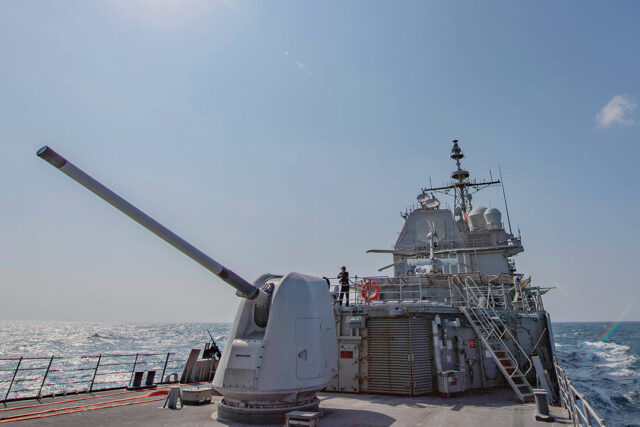
Chinese invasion of Taiwan may test US resolve

REUTERS/U.S. NAVY VIA EYEPRESS

By Kyle Aristophere T. Atienza, Reporter

A POSSIBLE Chinese invasion of self-ruled Taiwan would be a litmus test for US commitment to its security allies including the Philippines, according to experts.

“The Taiwan Strait conundrum would challenge the regional interoperability and deterrence posed by the US and its allies including the Philippines to China,” said Chester B. Cabalza, founding president of Manila-based International Development and Security Cooperation.

“It is a litmus test of the heightened power competition between China and the US,” he said in a Facebook Messenger chat. 

The Philippines has a 1951 Mutual Defense Treaty with the US, which has vowed to defend Taiwan in the event of an attack by China.

China claims Taiwan as a province and Xi Jinping, who secured a historic third term as Chinese president in October, has not ruled out the use of force regarding the self-ruled island.

Washington is expanding its training of Taiwanese forces, planning to deploy more American troops to the island-nation.

Earlier this month, President Tsai Ing-wen told visiting US lawmakers Taiwan would “cooperate even more actively” with Washington and other democratic partners, on issues such as authoritarian expansionism and climate change.

“If tensions escalate in Taiwan, the Philippine-US Mutual Defense Treaty could be invoked, since Filipinos in Taiwan will become vulnerable,” Mr. Cabalza said. 

He added that military bases in northern Luzon would play “pivotal roles” in Washington’s prepositioning of military equipment, aircraft and vessels.

“The simulated operations of evacuating Filipinos from Taiwan conceived in military exercises should be realized.”

The government of President Ferdinand R. Marcos, Jr. has given the US access to four more military bases under their Enhanced Defense Cooperation Agreement (EDCA).

The two countries have yet to disclose the locations of the new EDCA sites but last year, a former Philippine military chief said Washington had requested access to bases on the northern land mass of Luzon, the closest part of the Philippines to Taiwan, and on the island of Palawan, facing the disputed Spratly Islands in the South China Sea.

Once China invades Taiwan, “all the American treaty allies in the Asia Pacific will be embroiled in the war in different degrees of influence, including the Philippines,” said Emerson De-Yi Zhou, a research assistant at the Center for Foreign Policy Studies at the National Chengchi University in Taiwan.

‘ROPED INTO ALLIANCES’
“The US will respond first and possibly send troops to intervene, and require its allies such as the Philippines to provide military support, mainly on the logistical side,” he said via chat.

The potential war could indirectly affect the Philippine economy,” he said, citing a war simulation conducted by American think tank Center for Strategic and International Studies in January.

Chinese threat to the Philippines’ national security would be more alarming if China wins the war and manages to control Taiwan, Mr. Zhou said.

If tensions escalate, the US could impose economic sanctions  on China, and the Philippines would likely be required to do so too, he added.

Still, Mr. Zhou thinks Chinese invasion of Taiwan is “unlikely in this decade.” He expects the Marcos government to continue calling for a peaceful settlement of the China-Taiwan conflict.

Mr. Marcos would probably hedge its foreign policy strategy by boosting security ties with the US while keeping economic relations with China, he said.

The US has no formal diplomatic ties with Taiwan, but the two countries have “a robust unofficial relationship,” according to the US Department of State. Washington supplies arms to Taiwan.

The Philippines still adheres to the One China policy, which China has used to assert that Taiwan is part of its territory, Mr. Marcos said on the sidelines of the United Nations General Assembly in New York in September.

He urged “all parties involved to exercise maximum restraint.” “Dialogue and diplomacy must prevail.”

“The Biden administration will be OK with the Marcos government’s stance,” Mr. Zhou said. “After all, the national security strategy report of the Biden administration mentions that the US will support its allies’ sovereign decision-making capabilities based on their own interests and value.”

He also said US Secretary of State Anthony Blinken had said the US would not force its allies to take sides.

If China becomes more aggressive in the Taiwan Strait, the Philippines would likely be “roped into alliances,” said Hansley A. Juliano, a political economy researcher studying at Japan’s Nagoya University’s Graduate School of International Development.

“You can either see the US increasing its presence or it will pressure allies such the Philippines to invest more in defense,” he said in a Messenger chat.

“The high risk here is it will likely enlarge US foreign military engagement abroad, which is already causing headaches with Joe Biden’s recent engagement in Ukraine.” 

He said worsening tensions between China and Taiwan would probably result in supply chain disruptions, which might force the Philippines to enter into “unequal economic ties with Beijing.”

Philippines should work with human rights watchdogs — EU parliamentarian

PHILIPPINE STAR/ MIGUEL DE GUZMAN

By John Victor D. Ordoñez, Reporter

THE GOVERNMENT of President Ferdinand R. Marcos, Jr. should work with local civic groups and global human rights watchdogs to improve Philippine efforts to stop impunity, according to a European Union (EU) lawmaker.

“It is crucial that the government sees these organizations, civil society groups and labor unions as partners in making this country a better place,” Hannah Neumann, vice chairperson of the European Parliament subcommittee on human rights, told BusinessWorld in an interview last week.

She said these groups could help the government understand realities on the ground.

“They are on the ground with the people and have some sensitivity when things go wrong such as rights abuses,” Ms. Neumann said. “They could be the agents of change.”

Last week, a delegation of EU lawmakers met with human rights groups, Philippine lawmakers and other state officials to discuss the country’s human rights situation.

At a press briefing on Feb. 24, Ms. Neumann said the EU wants to see the Philippines rejoin the International Criminal Court (ICC) to reinforce its commitment to human rights.

“The human rights situation is better than it was under former President Rodrigo R. Duterte, I think we can clearly state,” she said. “We’d be very happy to see the Philippines rejoin the Rome Statute of the ICC as it would clearly reinforce the government’s commitment to fighting impunity.”

The EU lawmaker said Philippine officials and lawmakers seemed more willing to discuss reported rights violations than the previous administration.

Last month, the ICC pre-trial chamber reopened its investigation of the killings and so-called crimes against humanity under Mr. Duterte’s war on drugs.

The Hague-based tribunal said it was not satisfied with Philippine efforts to probe the deaths.

Ms. Neumann said the EU would reassess tariff perks enjoyed by the Philippines under the Generalized Scheme of Preferences Plus (GSP+) when it expires later this year.

She added that “it is not in the EU’s interest to punish countries” in relation to the agreement but countries should uphold human rights conventions to ensure good trade relations with other states.

Last week, Manila Rep. Bienvenido M. Abante, Jr. asked the EU lawmakers not to tie Manila’s tax privileges to the country’s human rights situation.

The European Parliament in February last year passed a resolution asking the Philippines to act on human rights abuses or face losing trade perks under GSP+.

GSP+ requires the Philippines to uphold commitments to 27 international conventions on human rights, labor, good governance and climate action.

The EU lawmakers also urged the government to release detained former Senator Leila M. de Lima, who has been in jail on drug trafficking charges since 2017.

“We have to see a positive trajectory because we make this trade agreement so that countries can improve,” Ms. Neumann said.

“Releasing Senator Leila de Lima, who is detained on bogus charges, and the Philippines returning to the ICC are moves that we expect from GSP partner countries,” she added.

Last week, Amnesty International urged the government to drop “fabricated charges” against Ms. De Lima, one of Mr. Duterte’s fiercest critics.

It said the state violated the former lawmaker’s right to a fair trial through her arbitrary detention.

Justice Secretary Jesus Crispin C. Remulla told the EU lawmakers on Feb. 23 the Philippine government could investigate extrajudicial killings under the war on drugs without the ICC’s help.

“We are fixing the justice system,” he told reporters in Filipino after the meeting. “If the ICC really has a problem that they want to investigate, they should let us handle it since these are crimes committed in the Philippines by Filipinos.”

Justice spokesman Jose Dominic F. Clavano earlier said the new administration has been transparent about Ms. De Lima’s case.

Neri J. Colmenares, a former congressman and chairman of the National Union of Peoples’ Lawyers, said it was crucial for the EU lawmakers to meet with civil society groups because these have realistic perspectives on the country’s human rights situation.

“Promises and pronouncements of steps towards drug rehabilitation are never commensurate to the fact that human rights violations and red-tagging continue,” he said in a Viber message.  “There is still no prosecution of the police involved in the drug war killings they admitted to.”

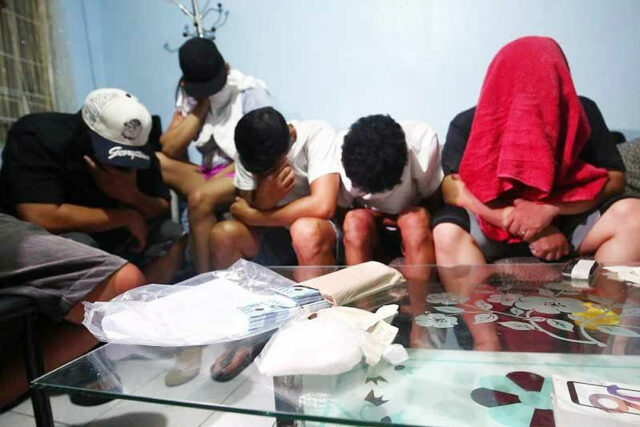
Philippine police arrested 8,183 drug suspects in 6,044 illegal drug operations from the start of the year to Feb. 11, national police chief General Rodolfo S. Azurin, Jr. told a news briefing on Feb. 13.

The Philippine government estimates that at least 6,117 suspected drug dealers had been killed in police operations. Human rights groups say as many as 30,000 suspects died.

More than 30 member-states of the United Nations Human Rights Council in November urged the Philippine government to do something about extralegal killings in connection with Mr. Duterte’s anti-illegal drug campaign.

The Philippines has accepted 200 recommendations from the UN Human Rights Council, including investigating extralegal killings and protecting journalists and activists.

“What we clearly hear are positive announcements from the government and critical assessments from civil society,” Ms. Neumann said.

“It is crucial to bring these two perspectives together and to start a constructive dialogue in which civil society organizations feel that they can impact change.”

SC upholds CoA ruling barring additional perks for PhilHealth employees 

PHILSTAR FILE PHOTO

THE SUPREME COURT (SC) has affirmed a ruling by state auditors that disallowed additional allowances given to Philippine Health Insurance Corp. (PhilHealth) employees worth P15.29 million for the years 2009 and 2010.  

In a 19-page decision made public on Feb. 23, the tribunal upheld the Commission on Audits (CoA) decision that said transportation and educational assistance allowances, and project completion incentives were released without legal basis and exceeded PhilHealth’s budget for those years.  

The court added that the Philhealth officers who approved the additional benefits and the recipients are liable to refund the disallowed amounts.  

“This court views the receipt by the payees of disallowed benefits as one by mistake, thus creating an obligation on their part to return the same,” Associate Justice Rodil V. Zalameda said in the ruling.  

The transportation allowances released amounted to P220,736.19, project completion incentives for contractual employees were worth P298,356.08, and the educational assistance allowances totaled P14.17 million.  

The tribunal noted that the employees were not entitled to the incentives since they were job-order workers.  

Under the Civil Service Commission’s rules, contractual employees do not enjoy the benefits entitled to regular government employees.  

The court said its ruling was consistent with previous rulings on similar disallowed benefits that involved PhilHealth employees.  

“In the said cases, we consistently found the authorizing officers solidarily liable for their gross negligence in granting the benefits and allowances based solely on PhilHealth’s alleged fiscal autonomy,” it said. John Victor D. Ordoñez

Remulla son wins Cavite congressional seat vacated by Justice chief 

COMELEC

THE SON of Justice Secretary Jesus Crispin C. Remulla has won the congressional seat in the seventh district of Cavite that was vacated by his father, the Commission on Elections (Comelec) announced on Sunday.  

Crispin Diego “Ping” D. Remulla, who was sitting as a provincial board member, garnered 98,474 votes in the special elections held on Saturday and was proclaimed Sunday morning, according to Comelec’s official count sent to reporters on Viber.  

The elder Remulla was reelected as a congressman in the May 2022 elections before he was appointed to head the justice department by President Ferdinand R. Marcos, Jr.  

Independent candidate Melencio de Sagun, Jr. trailed with 46,530 votes, Jose Angelito D. Aguinaldo with 1,610 and Michael Angelo B. Santos got 1,068 votes.  

Comelec spokesman John Rex C. Laudiangco said 149,581 or 42.11% out of 355,184 registered voters from Trece Martires City and the municipalities of Amadeo, Indang, and Tanza went out to vote. 

In a statement on Saturday night, the National Citizen’s Movement for Free Elections (Namfrel) said the special elections were generally smooth and peaceful, citing functioning vote-counting machines and well-trained Comelec personnel.  

“In the majority of polling places where Namfrel observers followed the closing and counting processes, the vote counting machines functioned normally,” it said. John Victor D. Ordoñez 

House leader wants ‘one-strike policy’ for tax collectors who fail to meet targets

PHILIPPINE STAR/ RUSSELL A. PALMA

THE HOUSE Speaker on Sunday called on President Ferdinand R. Marcos, Jr. to remove tax collectors who fail to meet their revenue targets and replace them with more competent individuals.”  

The one-strike policy is a key step towards achieving our revenue goals,Speaker Ferdinand Martin G. Romualdez said in a statement on Sunday. 

He said unmet collection goals compromise the governments budget for agriculture, education, infrastructure, and health, among others.  

Taxes are the lifeblood of government in the implementation of pro-poor programs designed to alleviate poverty and reduce inequality,he said.  

Mr. Romualdez, the presidents first cousin, also said that the House will exercise its oversight function to further promote transparency and accountability under the Marcos administration.”  

In December 2021, the Bureau of Internal Revenue sent a demand letter to Mr. Marcos Jr. asking him to pay his familys estate tax dues worth about P203 billion, including the principal amount and interests. Beatriz Marie D. Cruz

Maynilad sees improved water pressure after major pipe leak repair in Manila 

MAYNILAD/BW FILE PHOTO

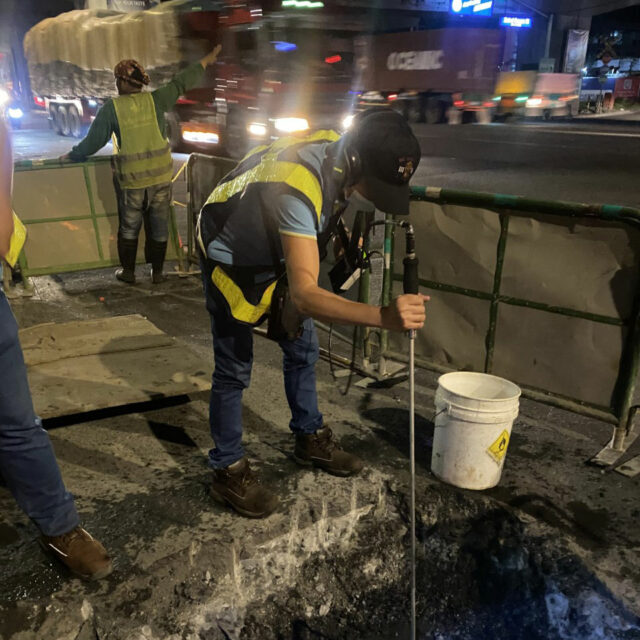
A MAJOR pipe leak along Osmeña Highway corner Zobel Roxas Street in Manila has recently been discovered and will be scheduled for repair, after which an improvement in water service in the area is expected, Maynilad Water Services, Inc. (Maynilad) said on Sunday. 

We were able to pinpoint the location of the leak from above-ground. Based on our initial assessment, the leak appears to be coming from a 2,200mm-diameter primary line,said Maynilad Water Supply Operations Ronaldo C. Padua said in a statement from the company. 

Maynilad estimates a water loss recovery of around 20 to 30 million liters per day once the leak is repaired.

We want to implement the leak repairs as soon as possible, since repairing it will help to significantly improve service levels in the area,Mr. Padua said.  

The company said it will announce the schedule of service interruptions and the specific affected areas prior to implementation of the repair works.

Maynilad needs to excavate the site and expose the pipe to fully assess the extent of the damagethe activity may take several days to implement,it said.

Maynilad is the concessionaire for the west zone of the Greater Manila Area, which covers parts of the cities of Manila, Quezon City, and Makati; the entire Caloocan, Pasay, Parañaque, Las Piñas, Muntinlupa, Valenzuela, Navotas and Malabon; and the cities of Cavite, Bacoor and Imus, and the towns of Kawit, Noveleta and Rosario, all in Cavite. 

Brooke’s Point fisherfolk say mining operations killing their livelihood

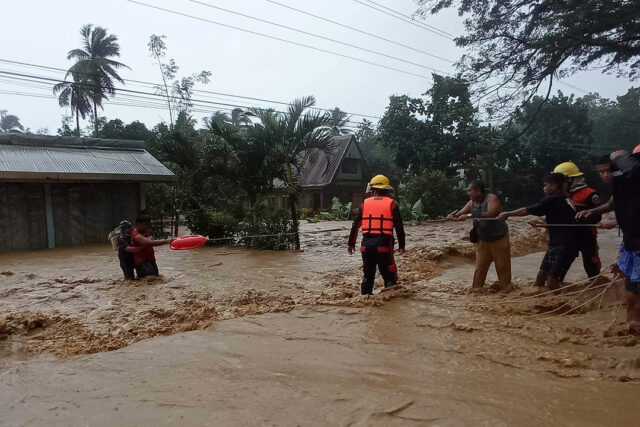
Floodwater rampages through a street in Brooke’s Point in January. — BROOKE’S POINT INFORMATION OFFICE

THE LIVELIHOOD of at least 100 families, mostly fisherholk, in the town of Brookes Point in Palawan have been affected by mining operations, according to a community leader.  

The fishermen who depend on the sea lost their jobs. They were banned by the mining company in the area where a causeway was built as they said they have applied for it,Job Z. Lagrada, a resident and community leader from Brookes Point, said in Filipino via Messenger call.  

He also said that floodwater triggered by rains from a low-pressure area in January came with laterite that drenched the homes and livelihood of the residents. Laterite is a reddish soil of aluminum ore, which he claimed came from the mining operations.  

It was added up to the water of the people and gradually became muddier. This will start to weaken the income of the community, especially the fishermen in the upcoming years,” said Mr. Lagrada.   

On Friday, Brookes Point local government officials and residents called on the Department of Environment and Natural Resources (DENR) to issue a cease-and-desist order against Ipilan Nickel Corp. (INC), citing that it does not have a renewed mayors permit.  

Mr. Lagrada also said that the mining firm did not conduct a public consultation for the extended applicationof its expired mineral production sharing agreement (MPSA).  

INC, in a statement on Thursday, said the DENR has clarified that their MPSA did not expire and was instead amended to comply with Republic Act No. 7942 or the Philippine Mining Act of 1995. 

The company also claimed that they have already submitted the necessary documents and complied with all laws and regulationsfor the mayors permit renewal.   

Leon Dulce, campaign support and linkages coordinator of Legal Rights and Natural Resources, said via e-mail that mining projects should be conscious of how they can affect all resource-dependent communities not only in their direct impact areas but also along the watershed where the impacts can flow.”  

These include indigenous peoples, small farmers and fisherfolk, and other residents, other economic activities such as agriculture and tourism, and the public authorities that represent these stakeholders,he said. Sheldeen Joy Talavera 

Bangsamoro legislators push for election, not appointment, of sectoral reps in parliament

BW FILE PHOTO/ TSBASMAN

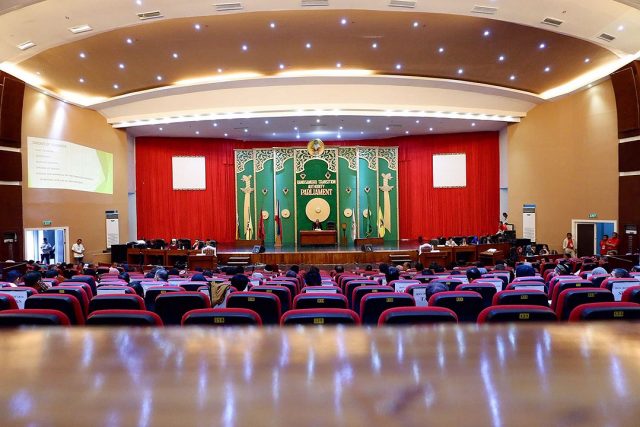
TWO legislators of the Bangsamoro Parliament have proposed amendments to the autonomous regions electoral code to strengthen sectoral participation by electing, instead of appointing, representatives for women, youth and other marginalized groups.  

Members of Parliament Amir S. Mawallil and Rasol Y. Mitmug, Jr. are calling for a revision of Section 22, Article VI of Parliamentary Bill (PB) No. 29 or the Bangsamoro Electoral Code to indicate the electionrather than selectionof sectoral representatives. 

The whole process veers away from an election and instead proposes a manner of selection, which is administrative in nature,Mr. Mawallil said in a statement.

This is contrary to the express provisions of the BOL (Bangsamoro Organic Law) that clearly requires an election of reserved and sectoral representatives,he said.  

Mr. Mitmug pointed out that provisions of the electoral code should not supersede nor go against the BOL. 

As the famous legislative phrase goes: the spring cannot rise above its source. So, the electoral code cannot go beyond its source of power and mandate, which is the BOL,he said. 

The two Parliament members are also calling for amendments to the draft electoral code that will increase the number of women nominees by changing the minimum 10% requirement under the current version. 

We believe that 10% is too small a number to bring about meaningful change in support of the womens agenda in the Parliament. And as the wording of the proposed bill says, it is preferablyand not even mandatory. So, we propose an increase in the number of women nominees and change the language of PB No. 29 to make it mandatory,Mr. Mawallil said.  

Under Republic Act 11054 or the BOL, the Parliament of the Bangsamoro Autonomous Region in Muslim Mindanao will have 80 elected members composed of 50% party representatives, 40% district representatives and 10% sectoral representatives.

The first parliamentary election in the region, which will be administered based on the electoral code, is scheduled in May 2025. MSJ 

BCDA breaks ground for Philippine Navy building in Taguig

BCDA

THE BASES Conversion and Development Authority (BCDA) held the groundbreaking ceremony for a nine-storey residential building in Fort Bonifacio, Taguig City that will be used by the Philippine Navy as part of its relocation and replication of facilities.    

This construction project will involve site development and will have 90 residential units, each with a floor area of 124 square meters, complete with all the amenities and features of a condominium unit,the BCDA said in a statement over the weekend.    

The building, which is expected to be finished by 2025, will be situated on a 25-hectare area inside the Bonifacio Naval Station, and will become the permanent housing facility for Philippine Navy senior officers affected by the construction of the new Senate Building and the ongoing area development in Bonifacio South Pointe.    

This praise-worthy project will not only impact the morale and welfare of our sailors and marines but will significantly contribute also to the operational preparedness of the Armed Forces of the Philippines,Defense Secretary Carlito G. Galvez, Jr. said.    

A total of 23 structures will be constructed for the Philippine Navy under an agreement signed in August 2021 by BCDA, Department of National Defense, and the Armed Forces of the Philippines for the replication and relocation of the Navys facilities from the 33-hectare Bonifacio South Pointe and Navy Village. Revin Mikhael D. Ochave

Most G20 economies condemn Russia for war but China silent

BENGALURU, India — Finance chiefs of the world’s largest economies strongly condemned Moscow for its war on Ukraine on Saturday, with only China and Russia itself declining to sign a joint statement.

India, which as chair of the Group of Twenty (G20) economies was hosting a meeting in the city of Bengaluru, was reluctant to raise the issue of the war but Western nations insisted they could not back any outcome that did not include a condemnation.

The lack of consensus among G20 members meant India resorted to issuing a “chair’s summary and outcome document” in which it simply summed up the two days of talks and noted disagreements.

“Most members strongly condemned the war in Ukraine and stressed that it is causing immense human suffering and exacerbating existing fragilities in the global economy,” it said, citing disruption of supply chains, risks to financial stability and continuing energy and food insecurity.

“There were other views and different assessments of the situation and sanctions,” it said, referring to measures put in place by the United States, European countries and others to punish Russia for the invasion and to starve it of revenues.

The outcome was similar to that of a G20 summit in Bali last November when host Indonesia also issued a final declaration acknowledging differences. The G20, formed over two decades to tackle economic crises, has increasingly struggled to reach the consensus needed to issue an official end-of-meeting communique.

“Although there was not what we would call a communique, but only an outcome statement, we still think we’ve made some progress in having all the ministers on board,” Indian Finance Minister Nirmala Sitharaman said.

German Finance Minister Christian Lindner said China’s refusal to join the declaration was “regrettable”.

US Treasury Secretary Janet Yellen earlier told Reuters that it was “absolutely necessary” for any statement to condemn Russia. Two delegates told Reuters that Russia and China did not want the G20 platform to be used to discuss political matters.

Russia, a member of the G20 but not of the G7, refers to its actions in Ukraine as a “special military operation,” and avoids calling it an invasion or war.

India has kept a largely neutral stance, declining to blame Russia for the invasion, seeking a diplomatic solution and sharply boosting its purchases of Russian oil.

China and India were among the nations that abstained on Thursday when U.N. voted overwhelmingly to demand Moscow withdraw its troops from Ukraine and stop fighting.

Besides the G7 nations, the G20 bloc also includes countries such as Australia, Brazil and Saudi Arabia.

“It’s becoming difficult for the G20 to engage in constructive discussion because of Russia’s invasion of Ukraine, which is an act that shakes the foundations of the global order,” Japanese Finance Minister Shunichi Suzuki told reporters.

On the sidelines, the International Monetary Fund (IMF) held a meeting on Saturday with the World Bank, China, India, Saudi Arabia and the G7 on restructuring debt for distressed economies, but there too there were disagreements among members, said IMF Managing Director Kristalina Georgieva.

“We just finished a session in which it was clear that there is a commitment to bridge differences for the benefit of countries,” Georgieva, who co-chaired the roundtable with Indian Finance Minister Nirmala Sitharaman, told reporters. — Reuters

IMF urges central banks to ‘stay the course’ till prices tamed

REUTERS

CENTRAL BANKS globally must remain vigilant until inflation is firmly under control, according to International Monetary Fund (IMF) Managing Director Kristalina Georgieva.

“I want to be clear we are not yet seeing inflation going down to target fast enough,” Ms. Georgieva told Bloomberg Television’s Haslinda Amin on the sidelines of the Group of 20 (G20) finance chiefs’ meetings in Bengaluru, India. “Central banks need to stay the course until we are comfortable that price stability is returning.”

As many central bankers begin to slow their policy tightening, inflation prints across the world remain sticky. With China reopening at a pace that’s exceeded expectations, Ms. Georgieva remained hopeful that domestic consumption there remains a growth driver for the world with little risk for an additional inflation flare-up.

In the US, the personal consumption expenditures price index rose 5.4% in January from a year earlier and the core metric was up 4.7%, both marking pickups after several months of declines. In Europe, underlying inflation is forecast to stay at a record 5.3% and in many parts of Asia, including India and Australia, core inflation has remained sticky.

Authorities shouldn’t let their guard down as price stability is essential for investors and for consumers to keep on spending, which are the foundations for economic growth, according to the IMF chief.

While China’s resurgence this year is a boon, Russia’s war on Ukraine is “still casting a long shadow on the global economy,” Ms. Georgieva said on Saturday.

“When we have uncertainty, that impacts investors, it impacts the ability for economies to grow,” she said. “And of course, the war is terrible for the people of Ukraine. It is terrible for the world economy.”

Apart from the prolonged war and lingering inflation, debt troubles besetting poorer nations like Zambia, Sri Lanka and Pakistan are adding to uncertainties, said Ms. Georgieva.

“I am concerned about emerging markets and developing economies that have very little fiscal space or none,” she said. “And at the same time, they have to service that big part of it, of which is dollar denominated, on top of higher interest rates.” — Bloomberg

Dow said it would recycle running shoes. We found them for sale in Indonesia

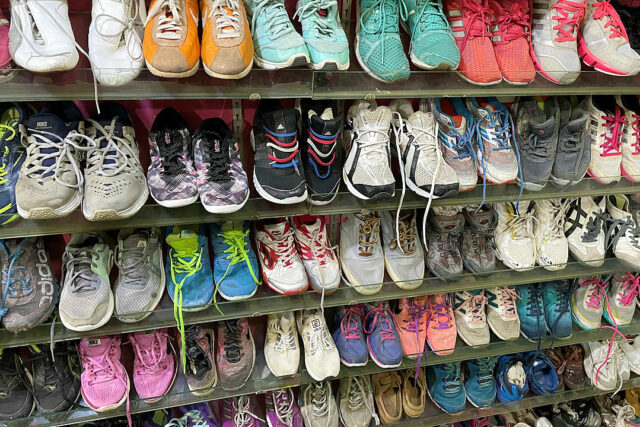
SECONDHAND shoes are displayed at a shoe shop in Batam, Indonesia, Aug. 4, 2022. — REUTERS

SINGAPORE — At a rundown market on the Indonesian island of Batam, a small location tracker was beeping from the back of a crumbling second-hand shoe store. A Reuters reporter followed the high-pitched ping to a mound of old sneakers and began digging through the pile.

There they were: a pair of blue Nike running shoes with a tracking device hidden in one of the soles.

These familiar shoes had traveled by land, then sea and crossed an international border to end up in this heap. They weren’t supposed to be here.

Five months earlier, in July 2022, Reuters had given the shoes to a recycling program spearheaded by the Singapore government and US petrochemicals giant Dow, Inc. In media releases and a promotional video posted online, that effort promised to harvest the rubberized soles and midsoles of donated shoes, then grind down the spongy material for use in building new playgrounds and running tracks in Singapore.

Dow, a major producer of chemicals used to make plastics and other synthetic materials, in the past has launched recycling efforts that have fallen short of their stated aims. Reuters wanted to follow a donated shoe from start to finish to see if it did, in fact, end up in new athletic surfaces in Singapore, or at least made it as far as a local recycling facility for shredding.

To that end, the news organization cut a shallow cavity into the interior sole of one of the blue Nikes, placed a Bluetooth tracker inside, then concealed the device by covering it with the insole. The tracker was synched to a smartphone app that showed where the shoe moved in real time.

Within weeks, the blue Nikes had left the prosperous city-state and were moving south by sea across the narrow Singapore Strait to Batam island, the app showed. Reuters decided to put trackers in an additional 10 pairs of donated shoes to see if wayward pair No. 1 had been a fluke.

It wasn’t.

None of the 11 pairs of footwear donated by Reuters were turned into exercise paths or kids’ parks in Singapore.

Instead, nearly all the tagged shoes ended up in the hands of Yok Impex Pte Ltd., a Singaporean second-hand goods exporter, according to the trackers and that exporter’s logistics manager. The manager said his firm had been hired by a waste management company involved in the recycling program to retrieve shoes from the donation bins for delivery to that company’s local warehouse.

But that’s not what happened to the shoes donated by Reuters. Ten pairs moved first from the donation bins to the exporter’s facility, then on to neighboring Indonesia, in some cases traveling hundreds of miles to different corners of the vast archipelago, the location trackers showed.

Using the smartphone app to trace the movement of each shoe, Reuters journalists later traveled by air, land and sea to recover three pairs — including the blue Nikes — from crowded bazaars in Indonesia’s capital Jakarta, and in Batam, which lies 12 miles (19.3 kilometers) south of Singapore. Four pairs ended up in locations in Indonesia that were too remote for Reuters to track down in person. In three other cases the trackers stopped sending a signal after they reached Indonesia.

The 11th pair remains in Singapore, but their fate is not what Dow and Sport Singapore had promised in media releases and a promotional video posted online. Those shoes — a pair of men’s white Reeboks — ended up in a public housing project about a mile (1.6 kilometers) from a community sports center where Reuters had dropped them into a donation bin on Sept. 8. Its tracker still blinks from that location, according to the app, an indication that they may have been taken from the donation bin. Reuters visited the housing project but wasn’t able to find the exact location of the shoes.

Presented with Reuters’ findings early this year, Dow said on Jan. 18 that it had opened an investigation along with Sport Singapore, a state agency, and other sponsors of the program: French-owned sporting goods retailer Decathlon S.A.; banking giant Standard Chartered plc; ALBA W&H Smart City Pte. Ltd (Alba-WH), a local waste management firm; and B.T. Sports Pte Ltd., a Singaporean firm responsible for shredding the donated footwear at a local facility.

On Feb. 22, Dow said in an emailed statement to Reuters that the investigation had concluded and, as a result, Yok Impex would be removed from the project, effective March 1. It did not explain why a used-clothing exporter had been involved in retrieving footwear from the donation bins, but said the program’s partners were now searching for another company to collect the shoes.

“The project partners do not condone any unauthorized removal or export of shoes collected through this program and remain committed to safeguarding the integrity of the collection and recycle process,” said the statement, which Dow issued on behalf of all the sponsors.

Reuters reporters visited the premises of Yok Impex on Feb. 23 to ask about whether it had been removed from the project. The trader’s accountant, June Peh, told Reuters the firm would be leaving the program when its one-year contract comes to an end, without giving a reason for its exit or an exact date.

In January, Decathlon sent Reuters a statement saying it had not authorized the export of any shoes from the program. Standard Chartered and B.T. Sports did not respond to requests for comment. Sport Singapore and Alba-WH referred questions to Dow. Alba-WH is a partnership between ALBA Group, a major German waste management company, and Wah & Hua Pte Ltd., a Singaporean waste disposal firm. The two companies did not respond to emailed requests for comment.

Reuters tracked the 11 pairs of shoes over a six-month period. All the footwear was placed in different donation barrels around Singapore between July 14 and Sept. 9 of last year. While the sample was small, the fact that none of these shoes made it to a Singapore recycling facility underscores weaknesses in the system.

The findings come as environmental groups say chemical companies like Dow are making exaggerated or false claims about recycling in order to burnish their green credentials, and to undermine proposed regulations to rein in the soaring production of plastics used in single-use packaging and fast fashion.

The donated shoes that ended up in Indonesia have added to a flood of illegal second-hand clothing pouring into that developing country, according to a senior government official there, who said such cast-offs pose a public health risk, undercut its local textile industry and often pile more waste into its already bulging landfills.

Dow told Reuters the Singapore shoe project was making progress. A sports facility under construction in Jurong, a district in western Singapore, will use recycled shoe material in its surfaces, Dow said in its January statement. The company also pointed to Kallang Football Hub, a new soccer complex whose running track purportedly was the first in Singapore to be made from recycled shoe granules. Dow said these builds will use the 10,000 kilograms (22,000 pounds) of recycled shoe material that have been produced through the Singapore recycling project so far.

Reuters was unable to verify if these sports surfaces had been built because both complexes are under construction and cordoned off from the public.

A pilot project in 2019 collected 21,000 pairs of shoes, Paul Fong, Dow’s Singapore manager, said in a promotional video posted on social media in July 2021 when the nationwide program was launched. Another pilot project in 2020 collected 75,000 pairs of shoes, Fong said in that video. Fong did not respond to emailed questions.

Dow and its partners declined to say how many of the shoes collected during the pilot phase had gone on to be recycled, nor would they provide those figures for the countrywide rollout. They did not explain what procedures were in place to ensure that donated shoes weren’t exported, diverted for resale or pilfered from bins.

HIDDEN TRACKERS
Dow manufactures silicone rubber and plastic used in soles and midsoles of sports shoes. The multinational and Sport Singapore said in their 2021 media releases that their “first of its kind” program would divert 170,000 pairs of shoes annually from the landfill. The program partners did not respond to questions about what would happen to these shoes or how many would be recycled to make sports surfaces.

Under the slogan “Others see an old shoe. We see the future,” they called on the public to donate used shoes with rubberized soles to help ease the burden on Singapore’s incinerators and its only landfill.

Dozens of wheelie bins for donations were placed across the city-state of 5.6 million people. These containers turned up in parks, community centers, schools and outlets of retail sponsor Decathlon. Singapore residents began depositing thousands of used sneakers, flip-flops and school shoes. In the promotional video, members of the public, including school children, talked enthusiastically about donating.

“I contributed 15 pairs of shoes,” student Zhang Youjia said in the video, which was produced by Dow.

The ten pairs donated by Reuters that were exported moved initially from the recycling drop-off bins to the warehouse of Yok Impex, situated in west Singapore close to the island’s biggest dockyard.

From there, the shoes traveled by sea to Batam, an entry point for goods entering Indonesia, which has a population of more than 270 million people, the fourth-largest in the world.

Guided by the smartphone app, Reuters in December followed two of the trackers to the same location in Batam: Pertokoan Cipta Prima, a sprawling flea market catering to low-income shoppers. There, dozens of vendors working out of rows of crumbling concrete shops patched with tarpaulin and metal sheets were selling everything from T-shirts and refrigerators to plastic toys.

The news agency spotted half a dozen stores selling used shoes, all clustered in the same area. At three of them, Reuters saw footwear stuffed into sacks emblazoned with the words “Yok Impex,” along with the Singapore company’s dolphin logo.

The first pair to be tracked down were the blue Nike running shoes. The app led to a gloomy, cluttered shoe store. But the sneakers weren’t on display. Using a function on the app to make the tracker start beeping, a reporter followed the sound to the back of the shop, finally locating those Nikes at the bottom of a mound of loose footwear. It had been five months since Reuters had deposited them into a donation barrel at a gleaming Decathlon store in Singapore. Reuters bought them back for 180,000 rupiah ($12).

The second tracker – tucked into a pair of women’s black Nikes – was located at a nearby shop. Reuters had dropped those shoes into a Dow recycling bin at a Singapore community center in September, three months earlier. They cost 120,000 rupiah ($8) to repurchase.

Other shoes went on a far longer voyage.

INCREDIBLE JOURNEY
A pair of pink and orange New Balance sneakers – donated by Reuters in Singapore on Sept. 7 – landed in the same Batam market a week later, the tracking app showed. By early October, they had moved to a nearby island called Bintan, before making a 400-mile journey to Medan, a city of 2.4 million people in northern Sumatra. On Oct. 10, the shoes traveled another 800 miles to Indonesia’s capital Jakarta, according to the app.

Indonesia’s second-hand clothing industry is made up of a complex network of traders, and they often exchange goods across different regions, two garment merchants told Reuters.

Three weeks later, on Nov. 1, two Reuters reporters searched a frenzied mall in Jakarta looking for the shoes, eventually discovering them in a cramped shop on the third floor. The sneakers, freshly cleaned and fitted with a new pair of laces, had crisscrossed Indonesia on a marathon eight-week journey. They cost Reuters 300,000 rupiah ($20) to buy back.

To learn more about Yok Impex’s role in the movement of these shoes, Reuters on Jan. 6, 2023, paid an unannounced visit to that used-clothing exporter, and was invited onto the premises. There reporters spotted wheelie bins from Dow’s shoe program stacked up in a backyard. Inside, women sorted through tables piled high with old shoes, carefully placing them into piles and then transferring them into sacks like the ones seen at the Batam flea market.

Yok Impex’s logistics manager, Tony Tan, told Reuters that waste handler Alba-WH was paying his company to collect the shoes from the donation bins around Singapore and then deliver the shoes back to Alba-WH.

Tan said Yok Impex did not export shoes it collected for the program. When informed that Reuters had found shoes it had donated being resold in Batam by merchants who had Yok Impex sacks in their shops, Tan said it was possible that shoes from the program got placed in error with other footwear it exports to Indonesia.

“Sometimes the workers mix it up. I’m not sure because we all collect from some other suppliers,” Tan said. “It’s a mistake. I think, some mistake.” Tan did not elaborate.

BANNED TRADE
In 2015, Indonesia’s Ministry of Trade introduced the Prohibition of the Import of Used Clothing regulation. The measure banned the import of used clothes and footwear over concerns about hygiene and the potential of these items to spread disease, as well as the need to protect the local textile industry.

Veri Anggrijono, Director General of Consumer Protection and Trade Control at the trade ministry, told Reuters that the illegal second-hand clothing import market in Indonesia is worth millions of dollars a year.

“It’s a well-organized activity because when we raid them in one place, then it will go quiet, then continue again,” Anggrijono told Reuters in an interview at his office in Jakarta. He said the importer is the party liable under the law, not the exporter or market seller.

Anggrijono said importers can be charged under trade and consumer protection laws, which carry penalties that can include imprisonment and fines. But he said so far the only action the trade ministry has taken is to revoke import licenses, as well as seizing and destroying used clothing.

A torrent of cheap, unregulated second-hand clothing flowing into Indonesia also adds to the country’s mounting garbage problem, said Dharmesh Shah, a policy advisor to the Global Alliance for Incinerator Alternatives, a nonprofit working on waste pollution. He said much of that merchandise is in such poor condition that vendors can’t resell it.

“They sort through it and a very small percentage is actually reusable,” Shah told Reuters. “It just gets burned in open dumps or goes into rivers or in landfills.”

Two market vendors in Batam, who asked not to be named, told Reuters they buy sacks of shoes of differing grades from used-clothing traders such as Yok Impex, but don’t know exactly what they’re getting until they open them up. They said it’s not uncommon to throw out half the shoes they receive because the footwear is not good enough to sell.

RECYCLING FLOPS
This is not the first novel recycling scheme launched by Dow that hasn’t lived up to its billing.

In 2021, a Reuters investigation found that a program in Idaho that the company said was using breakthrough technology to turn plastic waste into clean fuel was actually burning plastic trash to fuel a cement plant.

At the time, a Dow spokesperson said the Boise program was helping to “transform waste into valuable products.”

The same year, Reuters found that a Dow-backed project in India, which was supposed to collect plastic trash from the Ganges river and use high-tech machinery to transform the waste into clean fuel, had been shut down following regular equipment malfunctions.

The India project was run by The Alliance To End Plastic Waste (AEPW), a nonprofit group set up by big oil and chemical companies. At the time, a spokesperson for the AEPW confirmed that the project had ended, due in part to the COVID-19 pandemic.

Selling the promise of new recycling technologies, whether to turn shoes into playgrounds or plastic bags into clean fuel, is an attempt to lull the public into a false sense of security about the environmental impact of increased consumerism, environmental groups like Greenpeace and Break Free From Plastic say.

Dow declined further comment on those claims or its track record on recycling.

Jan Dell, founder of The Last Beach Cleanup, a US nonprofit focused on reducing plastic pollution, said large petrochemical companies should have to report on the results of their sustainability projects with the same transparency as the profit-making parts of the business.

“Dow promised to pick up these shoes and grind them into materials and make them into playgrounds, and instead they’re being found all over another country. They literally cannot be believed,” said Dell, after being given details of Reuters’ findings.

Promises about new recycling technologies also make good business sense for petrochemical companies, according to Dell, who said throw-away consumer culture is good for their profits. People are more likely to purchase more of a product when they are told it can be recycled into something useful, according to a 2013 study in the Journal of Consumer Psychology.

In its Jan. 18 statement, Dow said the shoe recycling partners are “energized by the common vision of sport championing a greener and more sustainable Singapore.” Dow did not comment on the Journal of Consumer Psychology study.

In July of last year, Dow launched a similar shoe recycling program in Malaysia, which has a population of 33 million people and neighbors Singapore to the north. In promoting that project, Dow’s Fong pointed to the Singapore shoe program as the blueprint for success. For its Malaysian initiative, Dow partnered with a local nonprofit and a textile firm. Neither responded to requests for comment.

Back in Singapore, Dow’s efforts are already winning accolades.

On the evening of Oct. 6, Fong and other partners in the Singapore shoe recycling program stepped onto the stage of an elegant ballroom at the Equarius Hotel beach resort on Sentosa Island, just off the mainland. There they were presented with the “Most Sustainable Collaboration” award at a glitzy event hosted by the Singapore International Chamber of Commerce, the city-state’s oldest business association. — Reuters


ADVERTISEMENT
ADVERTISEMENT