Home Blog Page 5206

Rust producers to pay $100,000 safety fine after shooting

ACTOR Alec Baldwin in a scene from Rust. — IMDB

PRODUCERS of the Western movie Rust on Friday said they had agreed to pay a $100,000 civil fine for “serious” workplace safety breaches prior to the fatal shooting of cinematographer Halyna Hutchins on a New Mexico film set in 2021.

New Mexico’s worker safety bureau last year levied its maximum possible fine against Rust Movie Productions (RMP) for what it called the firm’s “plain indifference” to hazards from weapons mishandling and accidental firearms discharges on set.

Ms. Hutchins was killed when actor Alec Baldwin fired a live round from a gun he was using during a rehearsal. Director Joel Souza was injured.

“RMP violated workplace safety laws by exposing employees to being struck by discharged rounds or projectiles when firearms were used on the set,” the state’s Occupational Health and Safety Bureau (OHSB) said in a statement.

Under the settlement, RMP’s fine marked the largest workplace safety penalty in over a decade in New Mexico but was reduced from an original citation of $136,793, according to the OHSB.

“Our top priority has always been resuming production and completing this film so we can honor the life and work of Halyna Hutchins,” Melina Spadone, a lawyer for RMP said in a statement. “Settling this case rather than litigating is how we can best move forward.”

Rust’s armorer Hannah Gutierrez-Reed has criticized the film’s producers for failing to provide enough time for firearms training. She told the OHSB on Dec. 7 Mr. Baldwin’s lack of knowledge and “poor form” using a revolver may have led to the accidental discharge that killed Hutchins.

Rust Line Producer Gabrielle Pickle told the agency on Dec. 20 Gutierrez-Reed’s requests for extra armorer days were granted.

Ms. Gutierrez-Reed, who mistakenly loaded a live round into the gun Mr. Baldwin fired, has been charged with involuntary manslaughter. At her first court appearance on Friday her lawyer said she would plead not guilty. Mr. Baldwin on Thursday pleaded not guilty to the same charge. — Reuters

Bank seeks to boost Islamic finance in PHL

A TURKISH LENDER is in talks with the Bangko Sentral ng Pilipinas (BSP) to help set up Islamic banks and Islamic banking units (IBUs) in the country, an official said on Friday.

BSP Deputy Governor Chuchi G. Fonacier told reporters during the central bank’s annual reception for the banking community that officials from a Turkish bank visited the BSP recently, which was already the third lender that approached the regulator to help push Islamic banking in the Philippines.

“Their objective is to help put up (Islamic banks and IBUs in the country), although they’re an Islamic bank themselves,” Ms. Fonacier said in a mix of English and Filipino.

“I was engaging them and asked them ‘maybe you want to consider also putting up, have a presence here,’ but they said they’re still scanning the market,” she said.

“But they’re very much open to helping prospective players outside that would like to come in. They said they can assist,” she added.

Ms. Fonacier said the BSP had exploratory talks with two banks to set up IBUs in the country before the pandemic hit in 2020. However, the two banks “did not reconnect” with the regulator because of the global crisis.

She added that a European bank was interested in setting up shop in the Philippines, but “changed their mind” due to changes in their strategic direction amid economic developments in their home country.

Asked if the BSP has eased the minimum capital requirement for Islamic banking units, Ms. Fonacier said they are still getting feedback from prospective players.

“The capitalization is still the same. It’s difficult to set it right away because we want to encourage prospective entrants as much as possible,” Ms. Fonacier said in Filipino.

“So, we’re engaging first with possible entrants,” she said.

The BSP last year said it will ease the minimum capital requirement for Islamic banking units so that more banks will consider entering the market.

The minimum capital required to set up an Islamic bank is the same as those for universal banks.

Al Amanah Islamic Bank is the only Islamic bank operating in the country. It is under the Development Bank of the Philippines. — Keisha B. Ta-asan

SEC warns against E-Ton, Zydex, Moneyfescent

THE Securities and Exchange Commission (SEC) warned the public against putting money on three entities that are soliciting investments without first securing a license.

In the advisory, the SEC identified the entities as E-Ton Trading, Zydex Trading, and Moneyfescent Global Ventures OPC.

E-Ton Trading allegedly deals with selling frozen goods. The entity also goes by Eton Phil Trading and E-Ton Profit Sharing in social media groups.

Depending on the option taken, investments in E-Ton start at P5,000 to P100,000 and are said to earn P1,250 to P39,062.5 or 20% up to 50% per month. Investors are also promised to earn a “rebate bonus” of 5% for fresh cash-ins.

Meanwhile, Zydex Trading was found to have been offering investment schemes ranging from P500 to P50,000 per account. It offers investors two types of profit plans: the “Beginner Plan,” which is supposed to earn up to 40% in 15 days; and an “Expert Plan,” which is said to earn 90% in 30 days. The entity also promises bonuses for referrals of 1% to 7% as a rebate.

According to the commission, Zydex Trading is a continuation of the illegal solicitation of entities named as Sophia Francisco Holding OPC, Financial Consultancy Services Sophia-Francisco,  Sophia Francisco Trading, and Cryptogix.

In a separate advisory, the SEC said that Moneyfescent has been soliciting investments in a social media group, through the direct selling of products.

Investors are offered two different packages: the “Brand Ambassador Package” worth P350 and the “VIP Package” worth P3,500, which is separated into “VIP Package B”, and “VIP Package C.”

Investors may also hold more than one VIP account to maximize profits ranging from P7,000 to P217,000 per day, depending on how many accounts the investor has.

The SEC characterized the companies’ offering as a Ponzi scheme where monies from investors are used in paying “fake profits” to prior investors.

The commission has also stated that all three entities have not secured a permit to sell or offer investment contracts to the public. — Adrian H. Halili

Bank stocks continue to rise amid aggressive interest rate hikes

By Abigail Marie P. Yraola, Researcher

Listed banks largely grew last year thanks to the central bank’s massive interest rate hikes that improved the lenders’ margins.

The last three months of 2022 saw the barometer Philippine Stock Exchange index (PSEi) gain 14.4% on a quarter-on-quarter basis, a reversal from the 6.7% decline in the third quarter and last year’s 7.8%.

Likewise, the financials subindex, which included the banks, grew by 12.2% quarter on quarter in the three months through December compared with the 1.7% growth in the prior quarter.

On a yearly basis, the subindex went up by 2.4%.

Majority of the banks’ stock performance rose in the fourth quarter amid the ongoing rate hikes by the Bangko Sentral ng Pilipinas (BSP) due to surging inflation.

Eleven listed banks logged quarter-on-quarter increases while four banks declined in the October-to-December period.

Philippine Business Bank (PBB) led with a 36% gain in its share price from P7.50 in the third quarter. Other lenders which posted quarter-on-quarter share price gains included Bank of the Philippine Islands (BPI, 14%), Philippine Trust Co. (PTC, 13.3%), and Philippine National Bank (PNB, 13.1%).

On the other hand, Bank of Commerce (BNCOM) declined the most with 10.3% to P7.90 from the third quarter. BDO Unibank, Inc. (BDO) fell by 5.2% and Asia United Bank (AUB) with 3.6%.

The Philippine Bank of Communications  (PBCom) dropped by 0.8% in the October to December period.

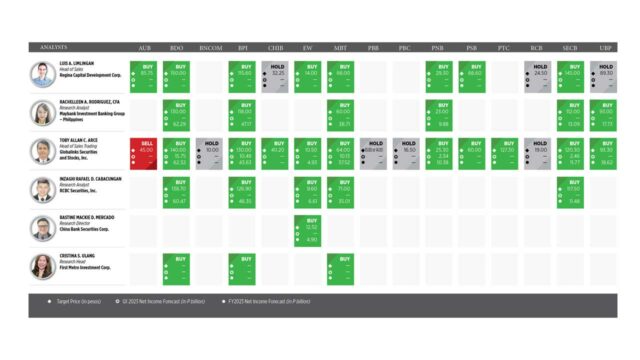
Inzaghi Rafael D. Cabacungan, research analyst at RCBC Securities, Inc., said that the central bank’s rate hikes paved the way for the expansion in the listed bank’s net interest margins (NIMs).

He also added that the further economic reopening supported loan and deposit growth.

Robust lending growth, higher NIMs, strong fees and normalized provisions drove the earnings of the listed banks, said Rachelleen A. Rodriguez, Maybank Investment Banking Group-Philippines’ research analyst.

“Banking stocks rose… and continues to trend up in January to February, given the bullish outlook on NIMs following the 350-bp rate hike in 2022, which the banks have yet to fully pass on to their predominantly floating rate loan book, and the unchanged hawkish tone at the start of 2023,” she added.

Ms. Rodriquez also said that the growth seen in most of these banks were due to strong and sustained earnings which raised buying interest, from both local and foreign investors, pushing valuations upward.

For Globalinks Securities and Stocks, Inc. Head of Sales Trading Toby Allan C. Arce, positive performance can also be attributed to window-dressing activities.

December inflation quickened to 8.1%, the fastest in over 14 years or since November 2008’s print of 9.1%.

To rein in stubbornly high inflation, the BSP has hiked benchmark interest rates by a cumulative 400 bps, including the 50-bp hike in February, to a 16-year high of 6%.

RATE HIKES ON BANK STOCKS
Cristina S. Ulang, research head at First Metro Investment Corp., said that the central bank’s rate hikes will keep bank loan spreads “robust” and create upside for the loan repricing cycle, adding that fees that are flow-related will also grow.

For Luis A. Limlingan, head of sales at Regina Capital Development Corp., the impact would vary depending on the bank.

“First tier banks are likely going to be able to benefit from it in the form of margin expansion. Meanwhile, other banks may have to deal with asset deterioration containment,” he said.

Mr. Limlingan added that inflation “imposes great weight” on the public’s paying capacity. The impact of rate hike adjustments, he said, could have dropped more in the last quarter of 2022 and will likely spill over moving forward.

“The continued rate hikes, albeit smaller, will still result in NIM expansion but at a slower pace. In addition, we don’t expect interest rates to rise by too much as to dampen loan demand or result in substantial deterioration of banks’ asset quality,” RCBC’s Mr. Cabacungan said.

Latest BSP data showed that aggregate net income of universal and commercial banks (U/KBs) reached P287.34 billion as of end-December, up by 38.5% from P207.45 billion in 2021.

Gross total loan portfolio of these large banks rose by 12.9% to P11.80 trillion as of end-December from P10.46 trillion in the year prior.

Meanwhile, gross nonperforming loans (NPL) ratio of U/KBs fell to 2.85% in December from 3.01% in November. This was also an improvement from 3.55% in December 2021.

The big banks’ NIM — a ratio that measures banks’ efficiency in investing their funds by dividing annualized net interest income to average earning asset — improved to 3.43% in the final three months in 2022 compared with the 3.38% NIM in the third quarter last year.

This was also higher than the 3.21% in the fourth quarter of 2021.

Provision for credit losses by these banks reached P95.32 billion, inching up by 2.2% from the P93.27 billion in the same period in 2021.

“Rate hikes should be positive for banks as their predominantly floating rate loan book could be repriced,” said Maybank’s Ms. Rodriguez.

“But could also temper credit appetite and trigger some corporates to frontload their funding requirements and/or defer [capital expenditures] capex deployments.”

BANK STOCK PICKS
Analysts’ recommendations on which banks should be bought, held and sold, as well as their outlook, must carefully be considered by market players.

Ms. Ulang said that bank valuation will improve in the coming months, which means, price gains and total returns will benefit investors who have overweighted the top three biggest listed banks, referring to BDO, BPI and Metropolitan Bank & Trust Co. (MBT).

She also said that growth in the banks and local bourse in the fourth quarter was due to foreign investors returning to the market.

“Biggest driver of bank profitability this year will be the continuing durability of household and corporate spending as the economy reopens, face to face classes in full swing and more pent-up demand manifesting,” she added.

For Mr. Cabacungan, investors should consider banks with the widest NIM expansion (i.e., BDO and BPI), with the fastest loan and deposit growth rates alongside NIM expansion (BPI and MBT) and those with more than adequate NPL coverage (BDO, BPI, and MBT).

“We forecast 17% growth in our covered banks’ core net income for 2023, underpinned by further NIM expansion from continued rate hikes and sustained loan growth from full-year economic reopening,” Mr. Cabacungan added.

Globalinks’ Mr. Arce said that the banking sector’s NPL ratio is likely to remain elevated for the rest of the year.

“Investors and analysts should pay particular attention for signs that a bank’s revenue is growing and that this growth is sustainable despite an environment of elevated inflation and rising interest rates,” he said.

He added that they should also assess banks’ ability to grow and produce profits by attracting more investors, make sustainable loans, issue credit in other forms or make investments.

For Ms. Rodriguez, banks earnings trajectory will drive stock performance this year and sees the banking sector’s growth to be sustained this year, and the ongoing rate hikes should be positive for the sector.


Volvo XC40 B5 R-Design Boost Hybrid is hole-in-one prize

PHOTO FROM VOLVO PHILIPPINES

VOLVO PHILIPPINES sponsored the hole-in-one of the recent Alabang Country Club’s 35th Mango Tee — offering the Volvo XC40 B5 R-Design Boost Hybrid to whoever could muster the feat at “one of the country’s most prestigious golfing events.” This year’s tournament was held from Jan. 30 to Feb. 4, and had P36 million at stake, with prizes and giveaways ranging from cars to golf carts.

The Volvo XC40 B5 R-Design Boost Hybrid is the first-ever Volvo model to win the prestigious European Car of the Year award. In a release, Volvo Philippines said that XC40 “is defined by a strong graphical design, a natural feeling of strength and quality, and a playful nature regarding colors and materials. Intuitive and convenient, it has a next-generation infotainment system that offers customers unprecedented personalization and unparalleled connectivity.” This compact SUV also features Volvo’s advanced kinetic energy recovery braking system, coupled with its existing internal combustion engines, to create a new integrated electrified powertrain. This new powertrain, electrified via brake-by-wire energy recovery, offers drivers up to 15% fuel savings and emission reductions.

The XC40 is now equipped with the award-winning safety technologies in Volvo’s 90 and 60 Series cars. It also has Volvo Cars’ latest Advanced Driver Assistance Systems (ADAS) sensor platform — a modern, scalable active safety system comprising radars, cameras and ultrasonic sensors. This platform enables the development and deployment of active safety systems, such as detecting other road users, automatic braking and collision avoidance. In addition, the Pilot Assist function also allows for gentle driver support from a standstill up to highway speeds.

“Volvo has many good reasons to engage in sports events like golf. First, it lets us catch up with customers and meet new ones. This Mango Tee tournament is one event where we can get together under exciting circumstances,” said Volvo Philippines CEO Atty. Alberto B. Arcilla.

Volvo has worked together with the sports world for many years. This cooperation began at the end of the 1970s through sponsoring tennis and equestrian events. Volvo has also been at the forefront of sports sponsorship, mainly focusing on sailing and golf. Among the most notable golfing events in the Volvo sponsorship portfolio are the Volvo Masters Andalucia, Volvo China Open, Volvo Masters of Asia, and the Volvo Masters Amateur.

Yields on government debt end mixed

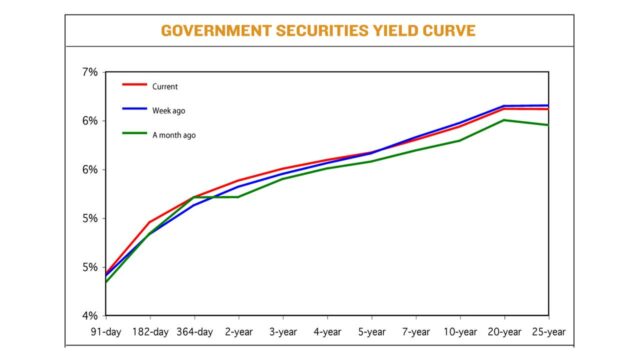
YIELDS on government securities (GS) traded in the secondary market were mixed last week following the result of the Treasury’s bond (T-bond) auction and the release of the March domestic borrowing program.

Bond yields, which move opposite to prices, rose by an average of 2.71 basis points (bps) week on week, according to the PHP Bloomberg Valuation Service Reference Rates as of Feb. 23 published on the Philippine Dealing System’s website.

Total GS volume traded reached P13.022 billion on Thursday, lower than the P15.809 billion seen on Feb. 17.

Philippine financial markets were closed on Friday in commemoration of the People Power Revolution anniversary.

Yields at the short end of the curve rose. The rates of the 91-, 182-, and 364-day Treasury bills (T-bill) climbed by 2.20 bps, 14.78 bps, and 9.81 bps, respectively, to end the week at 4.4988%, 5.1415%, and 5.4464%.

The belly of the curve also increased as the rates of the two-, three-, four- and five-year T-bonds climbed by 7.5 bps (to 5.6531%), 6.36 bps (5.8007%), 3.88 bps (5.908%) and 0.97 bp (6%), respectively. However, the seven-year dropped 3.17 bps to fetch 6.1534%.

Meanwhile, yields on all tenors at the long end of the curve went down, with the 10-, 20- and 25-year papers declining by 4.57 bp (to 6.3178%), 3.51 bps (6.5374%), and 4.42 bps (6.533%), respectively.

The bond trader said investors were focused on the BTr’s T-bond auction and the release of March borrowing schedule.

“Since Tuesday’s auction was well-received, the market found support even as the country is still experiencing high inflation and the policy rate is expected to be higher. The market also reacted positively to the borrowing schedule as the BTr (Bureau of the Treasury) will borrow less in terms of weekly volume for bonds,” the bond trader said in a Viber message.

ATRAM Trust Corp. Chief Investment Officer Alessandra P. Araullo likewise said in an e-mail that the movement in local bond yields were also driven by reissuance of the 10-year paper, the settlement and trading of the new 5.5-year retail Treasury bonds and the March borrowing plan.

The BTr last week raised P35 billion as planned from its offer of reissued 10-year papers, with total bids reaching P92.254 billion.

The bonds, which have a remaining life of nine years and six months, were awarded at rates ranging from 6.199% to 6.3%, bringing the average to 6.258%, 34.5 bps higher than the 5.913% quoted for the bond when it was first offered on Jan. 24.

Meanwhile, the BTr announced last week that it plans to borrow P200 billion from the domestic market in March, unchanged from the original program for February. However, the February borrowing plan was reduced to P130 billion after the BTr canceled two T-bond auctions worth P35 billion each due to its RTB offering.

Broken down, it targets to borrow P75 billion from its weekly T-bill auctions and P125 billion via T-bonds.

The short-dated T-bills will be offered at P5 billion each with benchmark tenors of 91, 182, and 364 days. Auctions will be held on Feb. 27, March 6, 13, 20, and 27.

For the long-term securities, the Treasury plans to raise P25 billion from six-year T-bonds on Feb. 28, and P25 billion from 10-year T-bonds on March 7.

It also aims to generate P25 billion from the offer of 13-year instruments on March 14; P25 billion from 20-year bonds on March 21; and P25 billion from seven-year papers on March 28.

The BTr previously offered P35 billion in T-bonds in its weekly auctions.

On the other hand, the government raised P283.711 billion from its offering of 5.5-year RTBs. Of this total, the government raised P31.671 billion from the bond exchange component.

The bonds carry a coupon rate of 6.125% and are set to mature on Aug. 22, 2028.

“This week, we will look for cues from Tuesday’s auction on what type of term premium the market will demand for the six-year reissuance. This should set the tone for local interest rates ahead of the February CPI (consumer price index) print release and upcoming bond supply in March,” Ms. Araullo said.

“For this week, it remains to be seen if current levels will hold as inflation remains high and current policy rate is higher than some of the actively traded bonds,” the bond trader added.

On Tuesday, the Treasury will offer P25 billion in reissued seven-year T-bonds that have a remaining life of six years and two months.

The Philippine Statistics Authority will likewise release February inflation data on Tuesday. — Lourdes O. Pilar

P500M worth of shared facilities targeted at coco farmers

PHILSTAR FILE PHOTO

THE Philippine Center for Postharvest Development and Mechanization (PHilMech) said on Sunday that it hopes to build P500 million worth of facilities meant to be shared by coconut cooperatives seeking to upgrade to value-added products.

In a statement, PhilMech Executive Director Dionisio G. Alvindia said the targeted commodities are crude coconut oil, processed coconut oil, virgin coconut oil, desiccated coconut, coconut coir, and coconut sap.

“To qualify, target beneficiaries or project proponents should be duly registered with the Cooperative Development Authority, have more than 100 members, and 5,000 coconuts of daily production,” Mr. Alvindia said in an e-mail.

Calabarzon will receive P58.61 million, followed by Northern Mindanao (P53.84 million), Zamboanga Peninsula (P52.66 million), Davao Region (P51.74 million), and Eastern Visayas (P50.15 million).

The PHilMech said it will also disburse P43.65 million in Bicol Region, P40.84 in Bangsamoro Autonomous Region in Muslim Mindanao, P32.51 in Soccksargen, and P29.74 in Caraga Region.

Of other regions, coconut cooperatives in Western Visayas will receive P27.13 million, while P25.49 in Mimaropa, and P25.01 in Central Visayas.
Meanwhile, Ilocos Region, Cagayan Valley and Central Luzon have been reported to be allocated P8.63 million each.

“At present, most coconut farmers’ cooperatives are still not capable of producing value-added products, and are mostly engaged in producing copra that are sold to oil millers for the production of coconut oil. Also, the discarded coconut husks or shells are mostly thrown away,” the PHilMech said.

According to Mr. Alvindia, the SPFs will enable coconut farmer cooperatives to produce more coconut oil and copra which can direct supply mills.

Also, coconut coir from discarded husks can be maximized into other products such as geotextiles, mats, ropes, and planting medium.

The establishment of SPS for coconut farmer cooperatives was mandated under the Republic Act 11524 or the Coconut Farmers and Industry Trust Fund Act.

The PHilMech shall allocate 10% or P7.5 billion for the program from the P75-billion Coconut Farmers and Industry Trust Fund.

Furthermore, P5 billion each will be released in the first two years under Executive Order No. 172 or the Coconut Farmers and Industry Development Plan.

Citing the United States Department of Agriculture, the PHilMech said that the Philippines is a top coconut oil producer and exporter with an output of 1.668 million metric tons.

Also, the country is the top exporter of desiccated coconut with 147,000 MT of the total 438,052 MT global productions in 2020, based on figures from the Department of Trade and Industry.

On the other hand, the PHilMech director added that the agency will also provide three years training for the farmer’s coconut cooperatives to become “viable business enterprises.” — Sheldeen Joy Talavera

PHL big banks’ total assets recover in Q4 2022

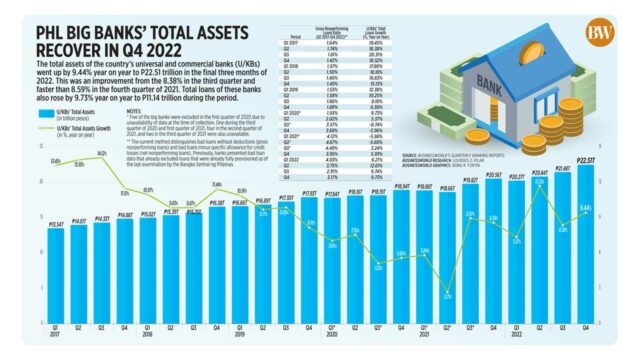
THE ASSETS of the Philippines’ largest banks grew by nearly 10% in the fourth quarter of 2022, as economic activity continued to pick up. Read the full story.

PHL big banks’ total assets recover in Q4 2022

SM Prime’s REIT listing revival piques investors

SM PRIME Holdings, Inc. (SMPH) was one of the most actively traded stocks in the local bourse last week amid news of the possible comeback of its real estate investment trust (REIT) initial public offering (IPO).

The Sy-led property firm was the sixth actively traded stock last week in terms of value turnover, with 19.02 million shares worth P699.53 million exchanging hands from Feb. 20 to 23, data from the Philippine Stock Exchange show.

Financial markets were closed on Friday to commemorate the 37th anniversary of the EDSA “People Power” revolution.

SM Prime’s share price closed at P36.35 apiece on Thursday, down 1.8% from its closing price on Feb. 17. For the year, the stock went up by 2.4%.

Globalinks Securities and Stocks, Inc. Head of Electronic Trading Mark Crismon V. Santarina said investors found the news of the firm’s IPO REIT revival attractive.

“The upcoming SM [Prime] REIT listing is generating significant buzz in the Philippine stock market. As one of the largest REIT listings in the market, it presents an attractive opportunity for investors seeking exposure to real estate assets,” Mr. Santarina said.

If it pushes through, the IPO is said to raise $1 billion, possibly the biggest listing in the local bourse.

“The listing is expected to generate substantial market activity and could have a positive impact on the broader market sentiment. As such, investors are eagerly anticipating the listing’s debut and closely monitoring any developments,” Mr. Santarina said.

Further, the company’s 2022 earnings report was deemed “positive” by the firm.

SM Prime’s consolidated income jumped 38.1% year on year to P30.1 billion last year, driven by the continued collection of full mall rental fees.

SM Prime President Jeffrey C. Lim said in the press release that 2022 ended on a “positive note,” mainly due to better consumer spending in the last three months of the year.

Consolidated revenues went up 28.6% to P105.8 billion from P82.3 billion in the previous year. The report said a chunk of the revenues was from the mall business at P49.8 billion versus P24.1 billion in 2021.

“SM Prime has benefited from the reopening of the Philippine economy, which has resulted in better earnings. However, despite this positive development, the stock is currently experiencing a neutral sentiment among investors due to the high inflation in the country,” Mr. Santarina said.

He expects SM Prime to generate P5.5 billion in the first three months of the year. While for 2023, he projects the property developer to post P38.7 billion, or about 29% higher than last year.

But economic factors could dampen sentiments toward the property company in the near term, he said.

“Inflation continues to be a significant factor in the Philippine market, which could impact SM Prime’s earnings and the broader market sentiment. Investors should keep an eye on the latest economic data, including inflation rates, to assess the potential impact,” Mr. Santarina said.

Despite this, he still sees the stock as an “attractive investment option” because of the company’s strong fundamentals.

“While SMPH may experience a period of sideways trading in the short term, my long-term outlook for the stock remains bullish,” he added, referring to the company’s ticker symbol.

Mr. Santarina sees the stock’s support level at P35 and resistance at P39. — Ana Olivia A. Tirona

Style (02/27/23)

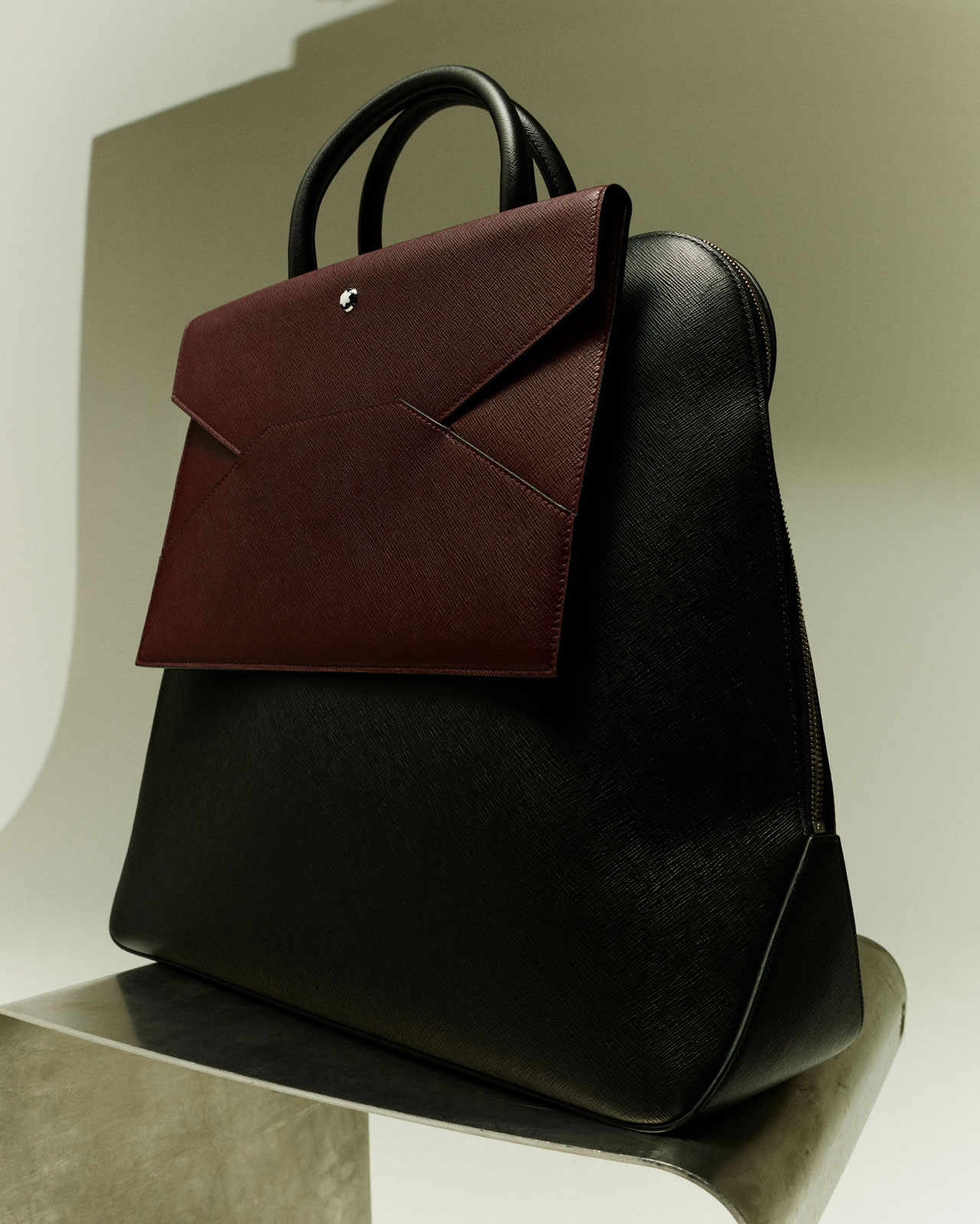
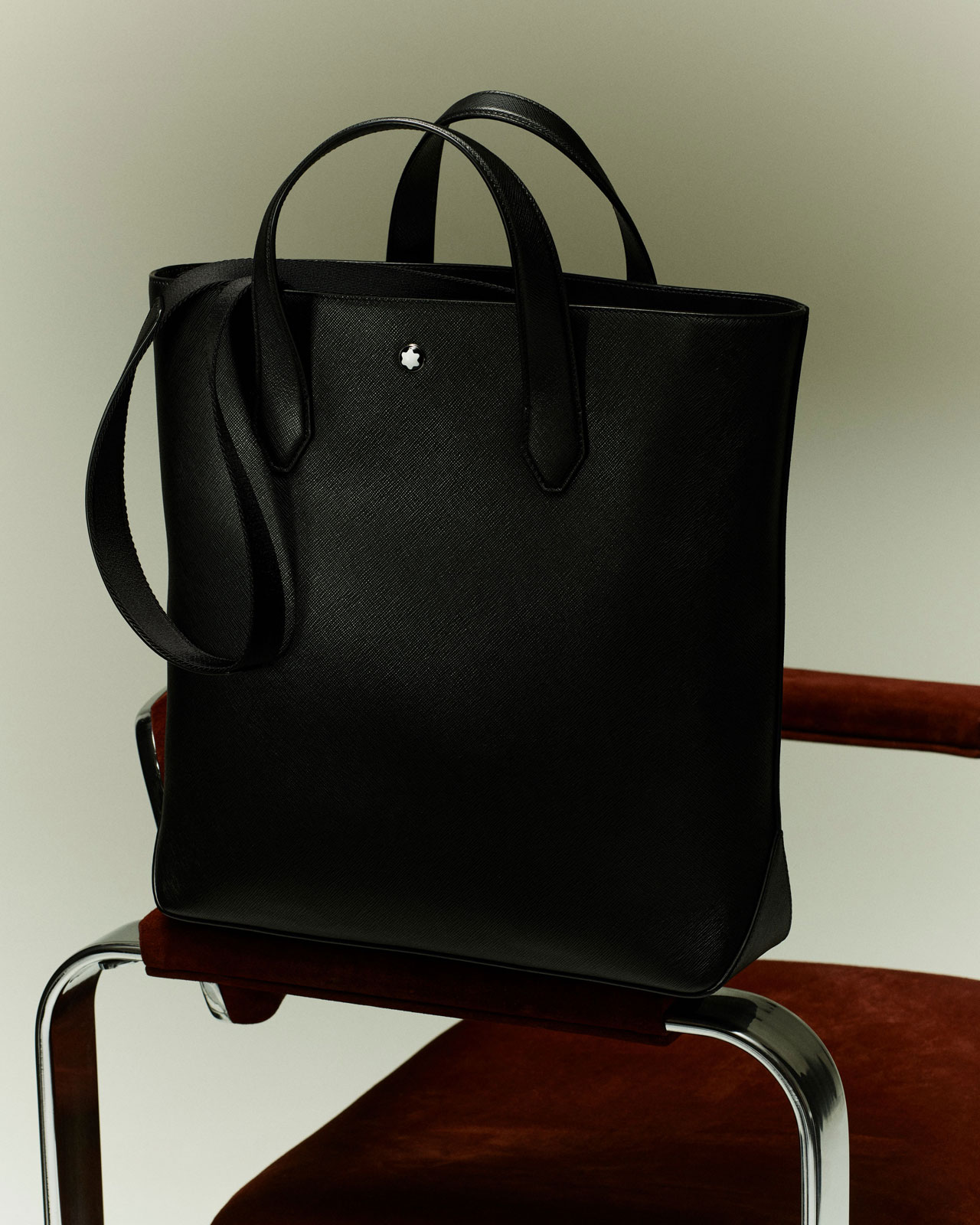
THE REDESIGNED Montblanc Sartorial Collection features bags and smaller accessories

Montblanc collection ripe for customization

MONTBLANC adds a new dimension to its signature business collection. The redesigned Montblanc Sartorial Collection features bags and smaller accessories in softer leather with a deep two-tone effect, new colors, and the introduction of a modularity system that allows small pieces to be attached to larger bags — creating new functionalities, styling options, and many customization possibilities. Inspired by the beauty and experience of handwriting, the design codes for Montblanc Sartorial are rooted in the Maison’s writing culture heritage. Recognizable ink bottles from the Montblanc archive have inspired the triangular design of the handles, while the construction of the sides of the bags evoke the opening of an envelope with two overlapping pieces of leather. The extensive assortment of large, medium and small leather pieces includes: Document Cases (large, medium, thin) and Backpacks (large, medium, small), with space for technical devices, A4 documents and other business essentials, including writing instruments in dedicated pockets. Open Totes for a more casual approach to work feature a classic vertical design and a new trapeze silhouette offering multi-wearable options with short handles in leather and longer handles in fabric. The capacity of the new tote can also be enlarged thanks to press buttons on the sides. A Bowling Bag with zip closure can be carried by hand, or on the shoulder thanks to the adjustable and detachable shoulder strap.  Compact bags include envelope-shaped Pouches, a Mini Bag, and a Mini Messenger featuring a back side leather band that fits the handles of document cases and totes, adding functionality to the larger pieces. Business companions include a laptop case with front handle, a notebook, and a notepad holder. wallets, card holders, pen pouches and key fobs make up the small accessory assortment, in a variety of colors as well as a new phone pouch that can be attached to document cases and totes so to have tech devices always at hands. The Montblanc Summit 3 Smartwatch also gets a Sartorial edit with the addition of leather straps in two new colors and a new watch face featuring customizable initials. While black and forged iron are the main colors for the bags, small accessories are also offered in red, blue, british green, mosto (a tone of burgundy) and ivory, creating a bold contrast when attached to larger pieces using the modular system created for the collection. The leather used throughout the collection has undergone a CO2 neutral tanning process. The Montblanc Sartorial Collection is available starting this month at Montblanc boutiques and online. For more information, visit www.montblanc.


Chapter 02 of Adidas Basketball 2023 collection out

CHAPTER 02 of Adidas Basketball’s The 2023 Collection is now available. The collection of shoes, hoodies, tops, shorts, and bottoms have had the excess stripped away to reveal a refreshing new palette and versatile assortment crafted for the modern athlete. Chapter 02 offers a new color refresh featuring Alumina, Black, and Heather Gray, supplementing the Halo Green, Metal Grey, and Cloud White colors previously introduced in Chapter 01. Chapter 02 also serves as a reintroduction to heritage silhouettes like the Forum and Rivalry. The 2023 Collection: Chapter 02, debuted at the 2023 NBA All Star Weekend, and is now available for purchase on the adidas App and at https://www.adidas.com.ph/chapters-basketball retailing from P1,700 to P7,500.


Havaianas releases UAAP flipflops

HAVAIANAS has released exclusive UAAP team flipflops and pins which are now available in selected branches. They are available at the following Metro Manila shops: Bonifacion High Street, Glorietta, Lucky Chinatown, Robinsons Ermita, SM Fairview, SM Grand Central, SM Mall of Asia, SM Manila, SM North EDSA Annex, SM San Lazaro, and SM Trinoma. Outside Metro Manila, they are available at branches at SM Batangas, SM Cabanatuan, SM Naga, SM Pampanga, and SM Sta. Rosa, SM Cebu and SM Iloilo, SM Davao, SM Mindpro, and Abreeza Mall. They are also available at All Flipflop stores at SM Bacolod and SM Lanang.

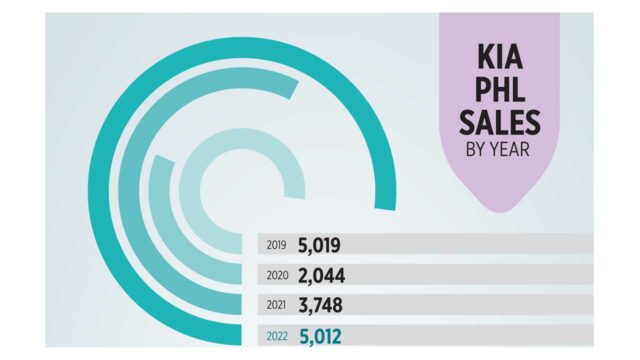
KIA PHL sales

KIA PHL sales

Shares may decline on rate concerns, rebalancing

BW FILE PHOTO

PHILIPPINE STOCKS are expected to drop this week on monetary policy concerns and ahead of the MSCI rebalancing.

The Philippine Stock Exchange index (PSEi) declined by 13.33 points or 0.19% to close at 6,685.90 on Thursday, while the broader all shares index dropped by 7.16 points or 0.2% to end at 3,572.20.

Philippine financial markets were closed on Friday for a special non-working day.

Week on week, the PSEi lost 93.12 points or 1.37% from its close of 6,779.02 on Feb. 17.

“The market’s decline last Thursday was likely due to a prevalent ‘no interest’ environment, leading to muted buying appetite, coupled with continuing selling pressure due to higher terminal rate worries,” China Bank Securities Corp. Research Director Rastine Mackie D. Mercado said in an e-mail.

Minutes from the US Federal Reserve’s Jan. 31-Feb. 1 meeting said that “almost all” Fed officials agreed to slow the pace of increases in interest rates to a quarter of a percentage point.

Its next policy review is on March 21-22.

For this week, First Metro Investment Corp. (FMIC) Head of Research Cristina S. Ulang said in an e-mail that a technical bounce is expected this week, but the market’s downward trend could be sustained.

“The market is expected to move sideways to lower as the pressures from high interest rates will dampen investors’ enthusiasm. Corporate earnings can provide some relief but the lag effect of the high cost of money is a concern for investors,” AB Capital Securities, Inc. Vice-President Jovis L. Vistan said in a Viber message.

Rizal Commercial Banking Corp. Chief Economist Michael L. Ricafort in a Viber message that Philippine stocks are expected to drop and track US stocks’ decline.

On Friday, the Dow Jones Industrial Average declined by 336.99 points or 1.02% to 32,816.92; the S&P 500 lost 42.28 points or 1.05% to 3,970.04; and the Nasdaq Composite dropped 195.46 points or 1.69% to 11,394.94.

“We may see volatility come Monday following the sudden holiday, as investors are likely to react to two days’ worth of price action in offshore markets. We are also set to see possible sharp movements in index issues given the conclusion of the MSCI rebalancing on Tuesday,” China Bank Securities’ Mr. Mercado added.

“For [this] week, we may see episodes of bargain hunting. Still, the local market is not expected to pose a strong rally amid weighing monetary policy concerns and lack of a strong catalyst. The hawkish outlook of the Bangko Sentral ng Pilipinas and the Federal Reserve are still expected to cloud sentiment,” Philstocks Financial, Inc. Senior Research Analyst Japhet Louis O. Tantiangco said in a Viber message.

Mr. Tantiangco put the PSEi’s support at 6,600 and resistance at 6,800, while China Bank Securities’ Mr. Mercado placed support at 6,600-6,640 and resistance at 6,850. FMIC’s Ms. Ulang pegged support at 6,500 and resistance at 6,800. — Ashley Erika O. Jose