Home Blog Page 5105

Julie Lluch chronicles life in these violent isles
Badi Grapiti (Para kay Ericson)

By Giselle P. Kasilag

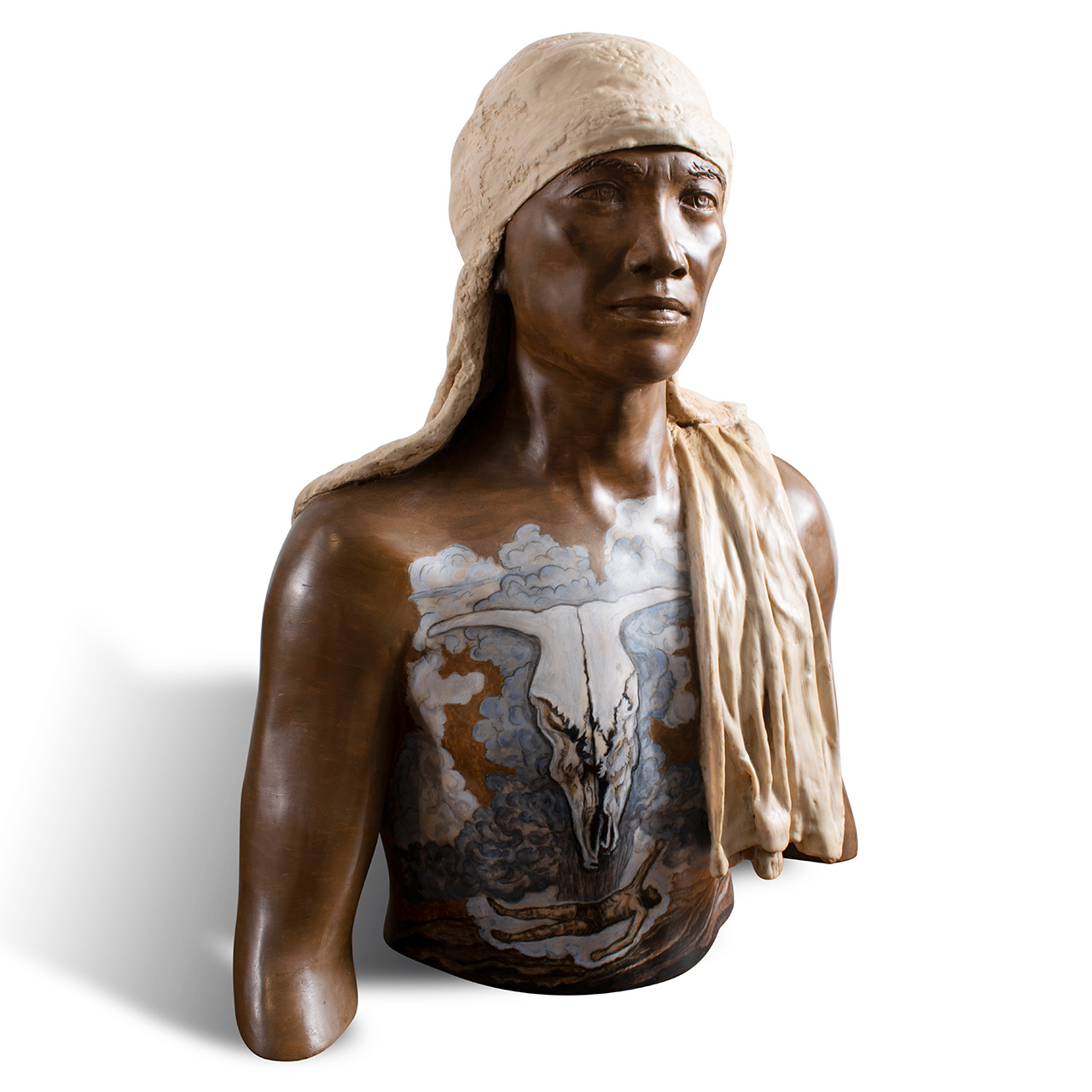
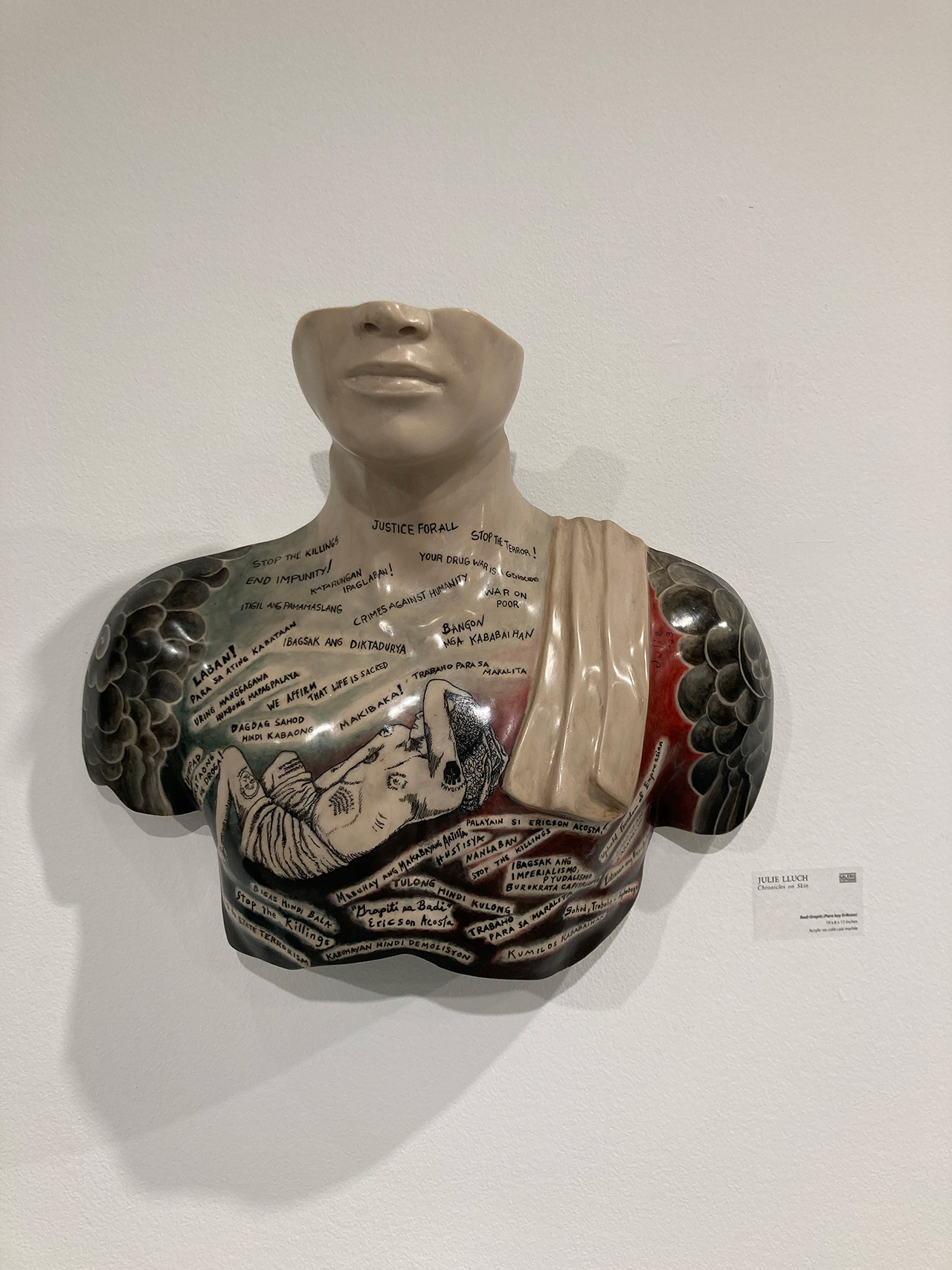
THE HUMAN body is replete with marks and scars that tell the stories of our lives. But in the artistic hands of Julie Lluch, it is a bountiful canvas of a nation’s history. “Chronicles on Skin,” her latest exhibition at Galerie Stephanie, explores the Philippines’ extraordinary record of violence and oppression through what appears to be her take on skin art using acrylic painting on cold cast marble of the human form. The resulting artworks are sculptural torsos and limbs, brightly painted with images referencing some of the most violent moments of the country.

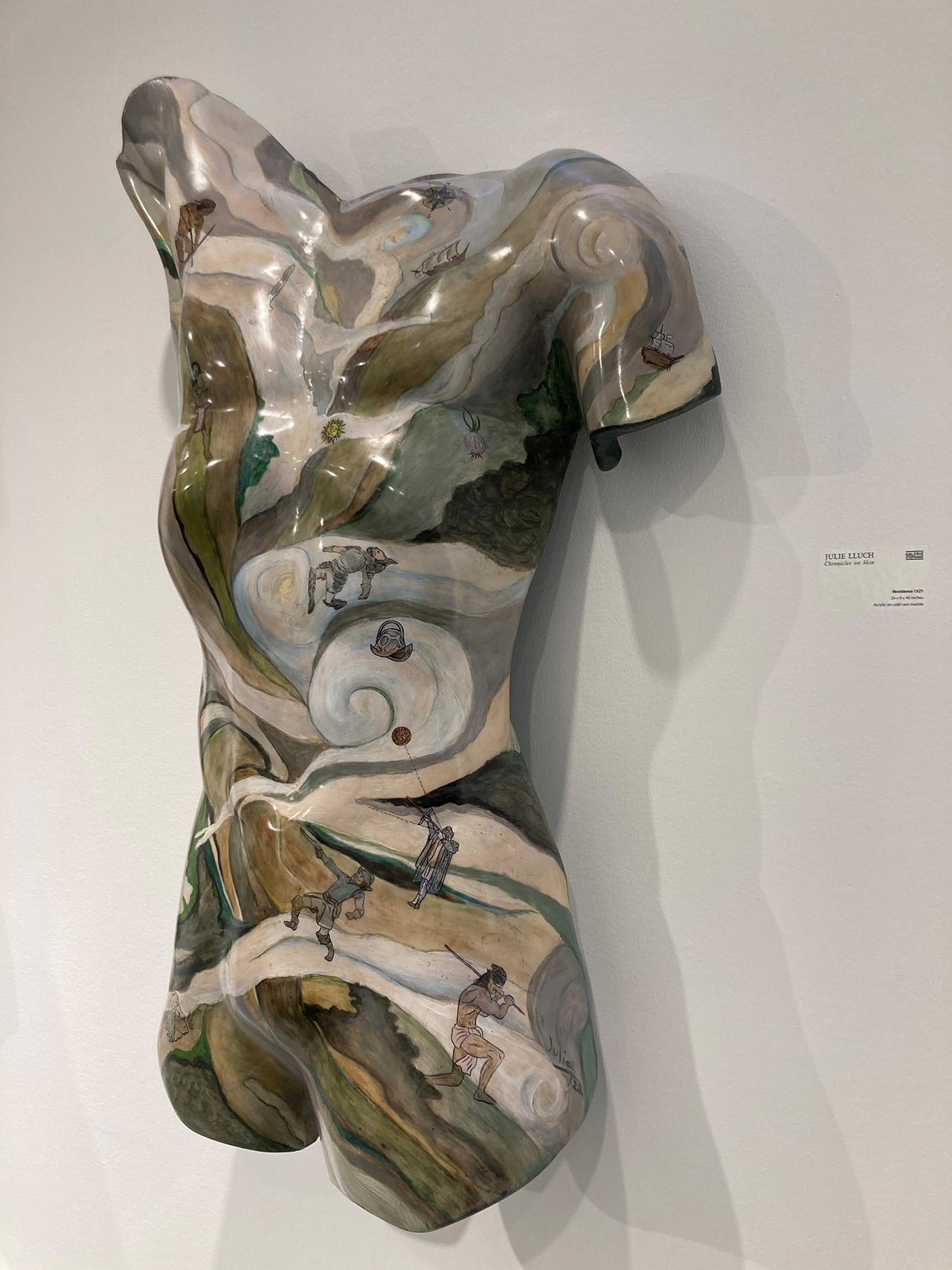
Resistance 1521 depicts Ferdinand Magellan’s arrival in Cebu and his subsequent death at the hands of Lapu-Lapu. The Battle of Mactan, explains Ms. Lluch, is one of the most critical events in the nation’s history, with the Portuguese explorer being our first foreign oppressor.

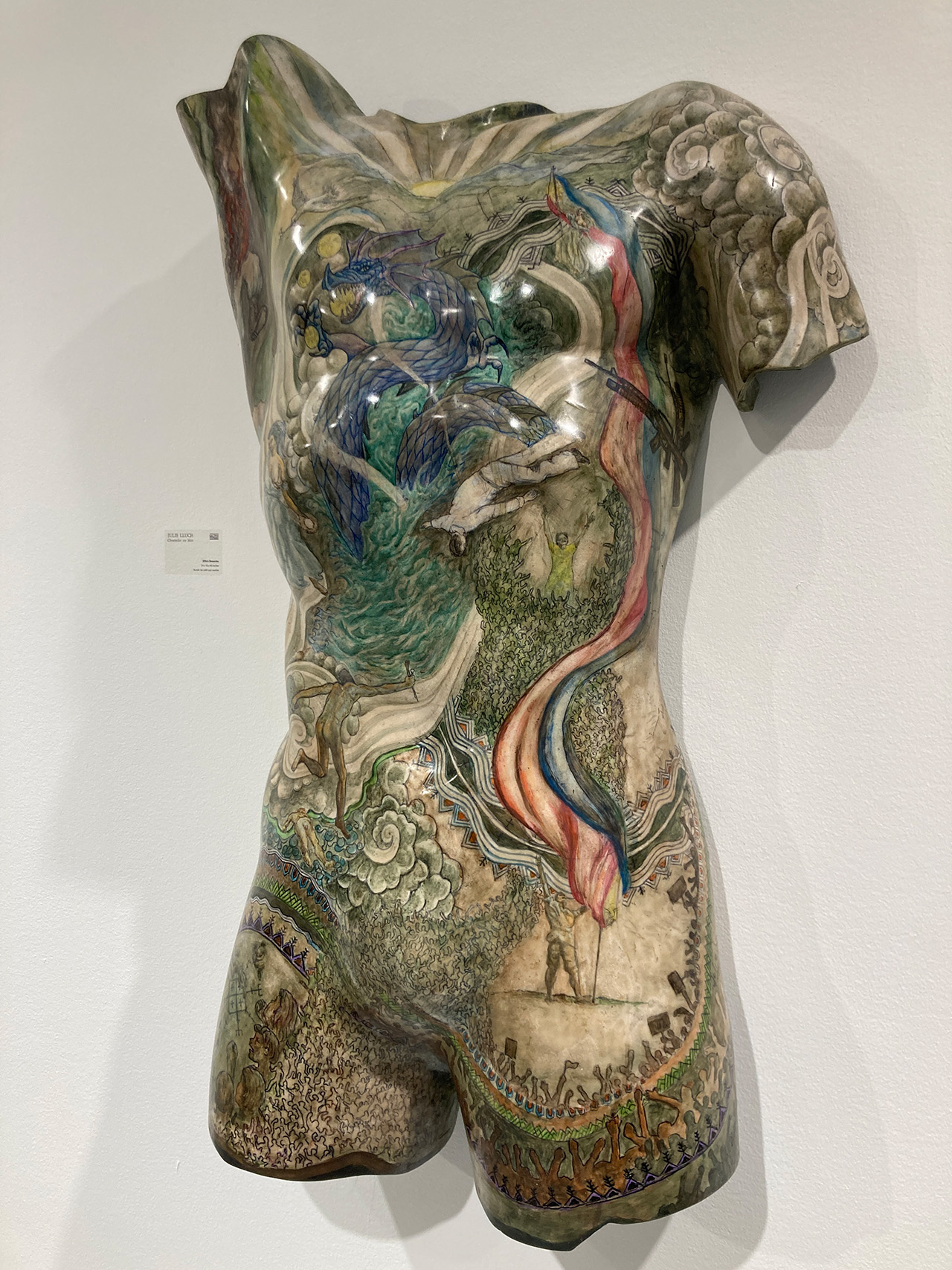
EDSA Chronicles features National Hero Andres Bonifacio and former President Corazon Aquino striking the same victory pose with two arms raised. The contorted body of the slain Senator Benigno Aquino, Jr. is on top of his wife’s defiant figure. Other elements include a ribbon of a flag spiraling up, a dragon eating gold coins, Chinese clouds, and an artist carrying paintbrushes.

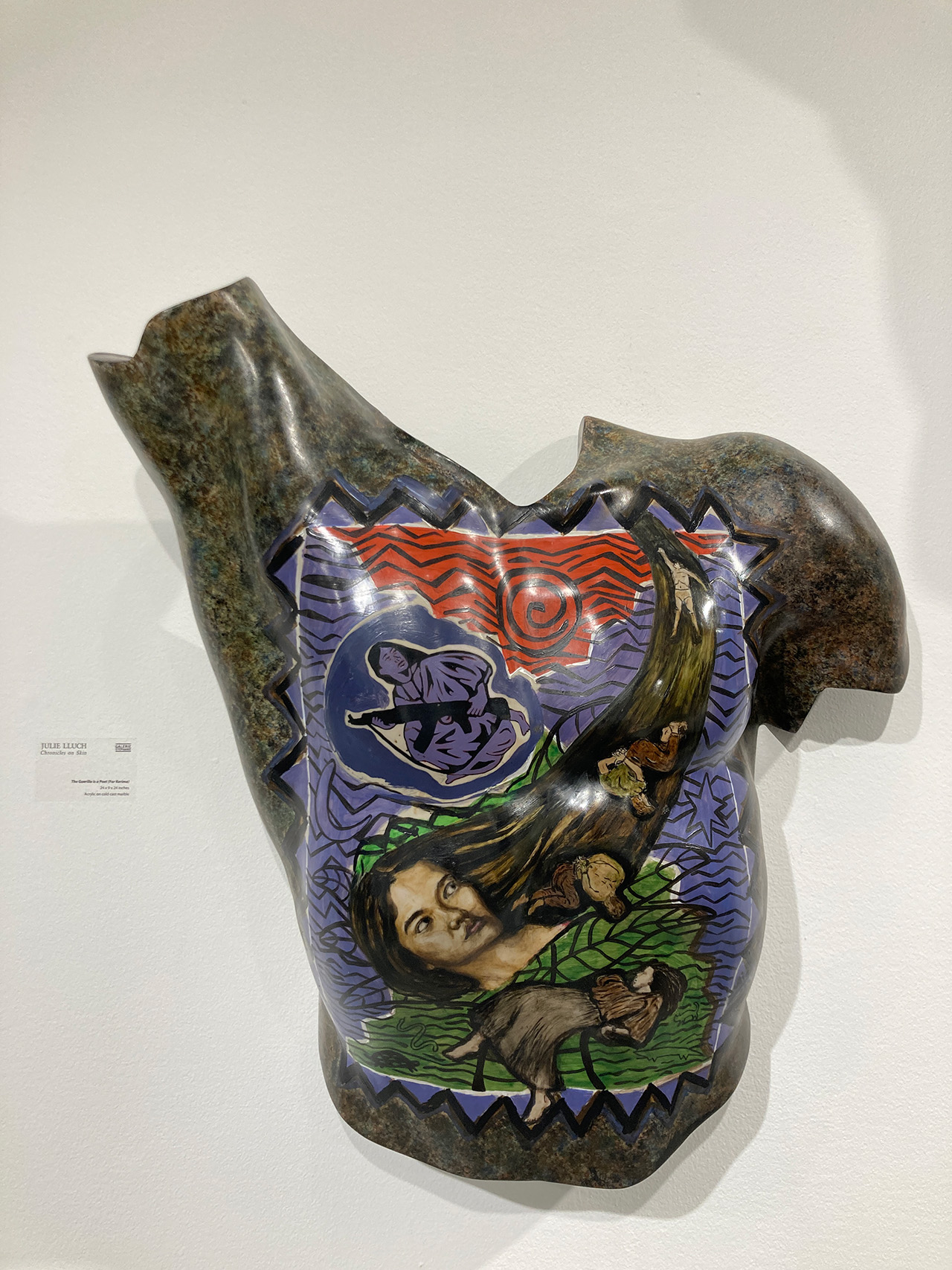
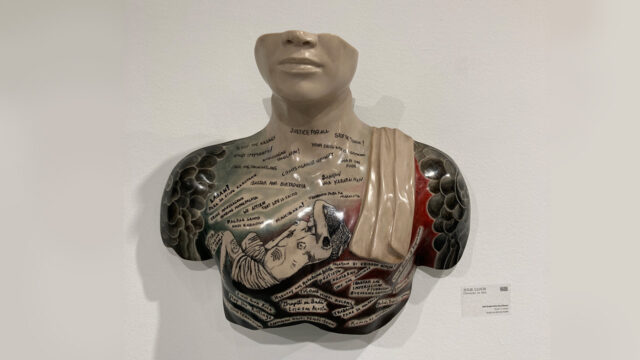
Other works depict more recent instances of violence such as Badi Grapiti (Para kay Ericson) which contains passages from Grapiti sa Badi by award-winning writer and National Democratic Front consultant Ericson Acosta, and The Guerilla is a Poet (For Kerima) referring to poet and activist Kerima Tariman — Mr. Acosta’s wife. Both were killed in separate violent clashes with the Philippine Army.

Pieces not necessarily referencing specific cases of violence but clearly depicting the oppressive way of life in the country complete the narrative which, Ms. Lluch stresses, is not necessarily chronological in its telling. Spoliarium Mandala is an entire left arm that begins at the shoulder and ends in the hand with the entire stretch covered by a dragon with a golden orb in its claw. On the claw is the dead gladiator — the focal point of Juan Luna’s Spoliarium.

Indeed, the Spoliarium is referenced throughout the collection. Ms. Lluch explains that the mold of the torso is not new but reused from an earlier piece she made of the Spoliarium’s gladiator that was used in the Art Fair Philippines.

“I just cut it up into body parts, if that means anything. I guess it means something, no? Shoulder, arm, leg, torso, it’s still related to the concept of violence to the human body,” says Ms. LLuch.

When asked if this was why the Spoliarium’s gladiator appears again and again in many of the pieces, she readily agrees. “Yes! Like a leitmotif. It is the principal inspiration because it is carried over from a last show, also with Galerie Stephanie. And for me it is a symbol of a country in distress, or a country that’s oppressed or subjugated by a foreign or a more powerful force.”

PAINTING A SCULPTURE
The collection sees a departure from her favored terra cotta. The change was facilitated by necessity as she was unable to source the Iloilo clay. Longtime followers will also take note of the delicately painted sculptures — a first for Ms. Lluch.

“I guess you can call it painting. Somebody asked me if I am melding painting and sculpture but I said no, that’s not possible. It can be only one or the other. I don’t know how far I’ve succeeded here. But I still feel that painting the way I know it is really something else. I didn’t mean to be a painter here.”

The sculpture, she explains, is the host to the painting. The mold dictated the content. She also had other figures in her studio such as those of farmers, so she chose the body parts, decided where to cut, and allowed the form to guide her in the development of the piece.

The images taken by photojournalists covering the extra-judicial killings during the previous administration’s war on drugs sparked the idea for Chronicles on Skin. The contradiction between the ghastly images of the violence set on the beautiful human form — particularly the skin — was part of the inspiration for the concept. But she found the disturbing images too crude.

“Although the subject matter is so grim — these are deaths, grief, sorrow, and anguish — but I think that’s the function of art. It makes the ugly beautiful. It makes the unbearable bearable so you can contemplate on it,” she explains.

THE FEMININE
On the other side of the gallery, however, Ms. Lluch leaves the torso to focus on the female anatomy. A nod to Georgia O’Keefe, she brings back her ever-evolving sculptures of the vagina inspired by the floral paintings of the mother of American Modernism. The pieces are identical in form but are rendered in various shades of red and blue. Some are dark. Others are shimmering. Each one is distinct.

“I’m really enamored with Georgia O’Keefe! She is one of the finest American painters. She did a lot of orchids and lilies and begonias. And the critics say that they all look like vaginas. And she was so annoyed, so angry with the critics! She really denied it! But I think she was just being coy,” Ms. Lluch laughs.

While the violence depicted on the torsos and the playful take on the vaginas may appear to be opposites, both series are rooted in the artist’s appreciation for the human form. And being what she describes as a “balanced feminist,” she proudly revels in the beauty, the complexity, and the versatility of the body to express a full range of ideas that are meant to be challenging and thought-provoking.


Kia Philippines enters electric vehicle market with EV6

KIA PHILIPPINES officially launched its new local battery electric vehicle offering called EV6 compact crossover on Monday, signaling its entry into the domestic EV market.

Manny A. Aligada, Kia Philippines president, said during the launch in Makati City on Tuesday that the new EV6 GT-Line would be priced at P3.788 million, inclusive of a portable charger, five-year or 160,000-kilometer vehicle warranty, and eight-year or 160,000-kilometer battery system warranty, whichever comes first.

He added that the EV6 will be initially available in four Kia dealerships, but will soon be available to the car brand’s 42 dealers across the country.

“The EV6 will be available in all 42 Kia dealers nationwide but we have initially assigned four dedicated Kia EV dealers located in New Manila in Quezon City, Alabang in Muntinlupa, Sto. Tomas, Batangas in South Luzon, and Pampanga in North Luzon,” Mr. Aligada said.

“These four dealers are fully equipped with tools and systems to handle any technical requirement you may have for Service, and its staff is fully trained by Kia Philippines. This full-service capability will be expanded to other dealers very soon,” he added.

Buyers of the EV6 will also enjoy five years of free preventive maintenance system and five years of free 24/7 roadside assistance.

Kia Philippines claims that the EV6 GT-Line can travel over 500 kilometers on a single charge with its long-range 77-kilowatt-hour high-voltage battery pack. The vehicle has an output of 229 PS and 350NM of torque.

The car brand added that maintaining the EV6 will also be cheaper since there would be no engine oil changes and replacement of oil filters, spark plugs, and other lubricants.

“It is estimated that you will spend about P25,000 for five years in maintaining an EV6, versus P110,000 maintenance for a similar-sized ICE car over five years,” Kia Philippines said.

Kia Philippines, a member of the Ayala Group of Companies, said that the EV6 will benefit from the group’s charging infrastructure.

“With charging options manufactured by Integrated Micro-Electronics, Inc. (part of the Ayala Group) and its partner Greenstrum, and an expanding charging system network provided by Ayala Land, all an environment-conscious owner has to do is get in and go for an exciting and worry-free drive,” Kia Philippines said.

The EV6 will be available in five colors: Moonscape, Snow White Pearl, Runway Red, Yacht Blue, and Aurora Black Pearl.

“We made sure to put the charging architecture in place long before the arrival of the EV6,” Ayala Corp. President and Chief Executive Officer Cezar P. Consing said.

“Our strategically located charging stations are proof of our commitment to electrification. We are using the whole Ayala ecosystem to support the growth and adoption of EVs in the Philippines. We expect EV take-up to grow rapidly, and EVs to be the dominant transport technology in a few years,” he added. — Revin Mikhael D. Ochave

Manila among worst cities for creatives — report

AMAURI MEJÍA /UNSPLASH

MANILA is among the worst cities for individuals working in the creative sector, according to the website Business Name Generator (BNG).

In a report dated Feb. 9, BNG said that the city of Manila is among the bottom 10 cities for creatives based on its research involving 50 cities across the world.

BNG examined the 50 cities based on several factors including the estimated number of “creative” roles available, the average annual and monthly salaries for creatives, living costs, and the number of amenities like museums, art galleries, and parks.

The data was collected between Nov. 15 and 18 last year.

Aside from Manila, which was No. 5 on the list, other cities in the 10 worst cities list were: 1. New Delhi, 2. Mumbai, 3. Johannesburg, 4. Tel Aviv, 6. Porto, 7. Medellin, 8. Athens, 9. Kuala Lumpur, and 10. Melbourne.

According to BNG, Manila has 14,644 “creative” roles available, which is actually the most in the bottom 10 list, followed by Kuala Lumpur’s 11,072. The worst city when it comes to the number of “creative” roles available was Porto with only 1,504.

The average monthly salary for those in creative roles in Manila, according to the report, is $470 — the lowest among the bottom 10. This is below the monthly cost of living — $518 — for a single person (without rent) in the city. Manila was the only city on the list in which the average salary was less than the cost of living. In the 10 worst list, Melbourne had the top monthly salary at $3,999 against a cost of living of $976.

The report added that the number of green spaces and parks in the city of Manila totaled 17, while there are 22 museums and art galleries, and there were no related classes and workshops. In all three metrics, Manila was the lowest ranked.

Meanwhile, the 10 best cities for creatives were: 1. Tokyo, 2. London, 3. Paris, 4. Chicago, 5. Toronto, 6. Singapore, 7. San Francisco, 8. New York, 9. Los Angeles, and 10. Berlin.

The top 10 highest paying cities for those in creative roles (yearly salaries) were San Francisco ($86,300), Los Angeles ($73,407), New York ($72,998), Boston ($72,319), Miami ($69,800), Chicago ($68,632), Dubai ($66,363), Copenhagen ($62,715), Singapore ($58,667), and Hong Kong ($52,533).

“Hiring creatives and fostering creativity in the workplace has never been more important, as the industry shows no signs of slowing down. Coming up with unique ideas, innovative solutions and new ways of working is key to helping supercharge organizational growth. Creative individuals have a unique ability to think outside the box — something that technology cannot replace,” BNG Spokesperson Chloe Chai said in a statement.

“With creative hubs around the world aiming to attract and retain talent, they must be able to offer an environment for individuals to flourish, by investing in the wide range of industries in that creatives play a key role, as well as paying competitive salaries that can keep up with the rising cost of living,” she added. — Revin Mikhael D. Ochave

Asian art fair aims to bounce back after COVID years

A WOMAN walks in front of a 10-meter tall monumental installation titled Gravity by Awol Erizku, ahead of Art Basel, in Hong Kong, March 17. — REUTERS/TYRONE SIU

HONG KONG —  The organizers of Art Basel Hong Kong, one of Asia’s leading contemporary art fairs, said on Tuesday they are bullish on art market prospects in the region, with China and Hong Kong now having lifted all COVID lockdown restrictions.

The annual fair, which also has iterations in Basel, Paris, and Miami Beach, runs from March 23-25 in Hong Kong.

The number of galleries has increased to 177 this year from 130 in 2022, with 32 countries and territories across Asia, Europe, the Americas, and Africa participating.

“Despite the challenges of the pandemic, the Asian art market has also remained resilient, with Greater China accounting for 20% of worldwide sales by value and ranking second as the second largest regional art market in the latest edition of the Art Basel,” Art Basel CEO Noah Horowitz told reporters.

Hong Kong attracted 56 million visitors in pre-pandemic 2019 but shops now sit vacant and Chinese visitors, who once propelled the city’s art market, have yet to return in droves.

Leading international galleries at Art Basel this year include Gagosian, Hauser & Wirth, Lehmann Maupin, Victoria Miro, Pace, Perrotin, White Cube, and David Zwirner.

In a mall near the glitzy halls of Hong Kong’s harbor front convention center where Art Basel, the show has installed a 10-meter-tall inflatable sculpture of Egyptian pharaoh Tutankhamun titled Gravity by Los Angeles-based artist Awol Erizku.

Hong Kong’s government has welcomed the art fair as it strives to reinvigorate Hong Kong’s economy after a nearly three-year slump from factors including tough COVID lockdowns, a closed border with China, and a security crackdown.

Hundreds of thousands of people have left the territory since June 2020, when a sweeping national security law was passed that has been used to curb freedoms and arrest scores of opposition democrats and shutter liberal media outlets.

Some Western governments have criticized the law as a tool of repression, but China asserts it brought stability after pro-democracy protests in 2019.

Art Basel said it had respected creative expression.

“We don’t have any censorship process in the show. We haven’t really changed the process of the show since 2013,” said Angelle Siyang-Le, the director Art Basel Hong Kong. —  Reuters

Citicore says 680-MWp solar farm to operate by 2024 

CITICORE Renewable Energy Corp. (CREC) said its 680-megawatt-peak (MWp) solar power plant in Batangas is set to start commercial operations by 2024.

“CREC is committed to invest and develop more solar plants in the long run and help expand the country’s total renewable energy capacity. In fact, we have upsized our solar energy project pipeline alone by more than three times, from 1.5 gigawatts (GW) to 5 GW, in the next five years,” CREC President and Chief Executive Officer Oliver Y. Tan said in a media release on Tuesday.

The energy company said the development of its 680-MWp solar power project will be divided into two phases over two years.

CREC said that the output of its biggest ground solar project in Batangas will provide the Luzon power grid with its needed capacity.

“With this development, CREC is helping the government achieve its long-term clean energy targets of 30% renewable energy share in 2035 and 50% in 2040 in the Philippines. No doubt, the development of this solar farm can further boost the country’s economy through local employment and additional livelihood opportunities for the host communities,” Energy Undersecretary Giovanni Carlo J. Bacordo said.

Mr. Tan also said the development of the project will also help generate about 2,400 job opportunities, which the company will mainly source from the host community.

The P21.6 billion solar power plant project sits on a 5,000,000-square-meter land parcel, the renewable energy company said.

CREC has said that it expects to spend around $800 million on capital expenditure projects in 2023. — Ashley Erika O. Jose

Arts&Culture (03/22/23)


Batino and Castrillo come to the fore at Gateway Gallery

THE EXHIBIT “Coming to Fore” presents the works of Romina Batino-Stiffler and Mierro Castrillo. Featuring Ms. Batino’s photography and Mr. Castrillo’s sculptures, the exhibit is ongoing until March 31 at the Gateway Gallery in Araneta City, Cubao, Quezon City. Ms. Batino is a contemporary digital artist who splits her time between Makati in the Philippines and Ohio in the USA. Her photographs capture the hidden splendor of everyday life — raindrops on the moonroof of a car, a dry leaf on the ground, the sun’s reflection on a dewy morning window, and the flow of water. Mierro Castrillo is the eldest son of the legendary Filipino sculptor Eduardo S. Castrillo. He took up sculpture after his father died in 2016, and he has since honed his skills. His sculptures depict everyday but very personal objects — a rooster, a bicycle, a horse — transformed with his father’s legacy in mind.


2 shows at Mo_ Space

MO_SPACE gallery at Bonifacio High Street in Taguig will open two exhibits on March 25. Both will run until April 23. At the Main Gallery will be Jan Balquin’s “the song of a bird that fell in love with its cage,” focusing on paintings which are the artist’s meditations on stillness and silence. Also opening is Veronica Peralejo’s “Collecting Fragments” at Gallery 2. Influenced by recent travels, particularly her trip to Japan, the artist creates a long table arrangement, a sort of wabi-sabi inspired rock garden. The gallery is open daily from 10 a.m. to 7 p.m.


Alpas art group remembers games Filipinos play

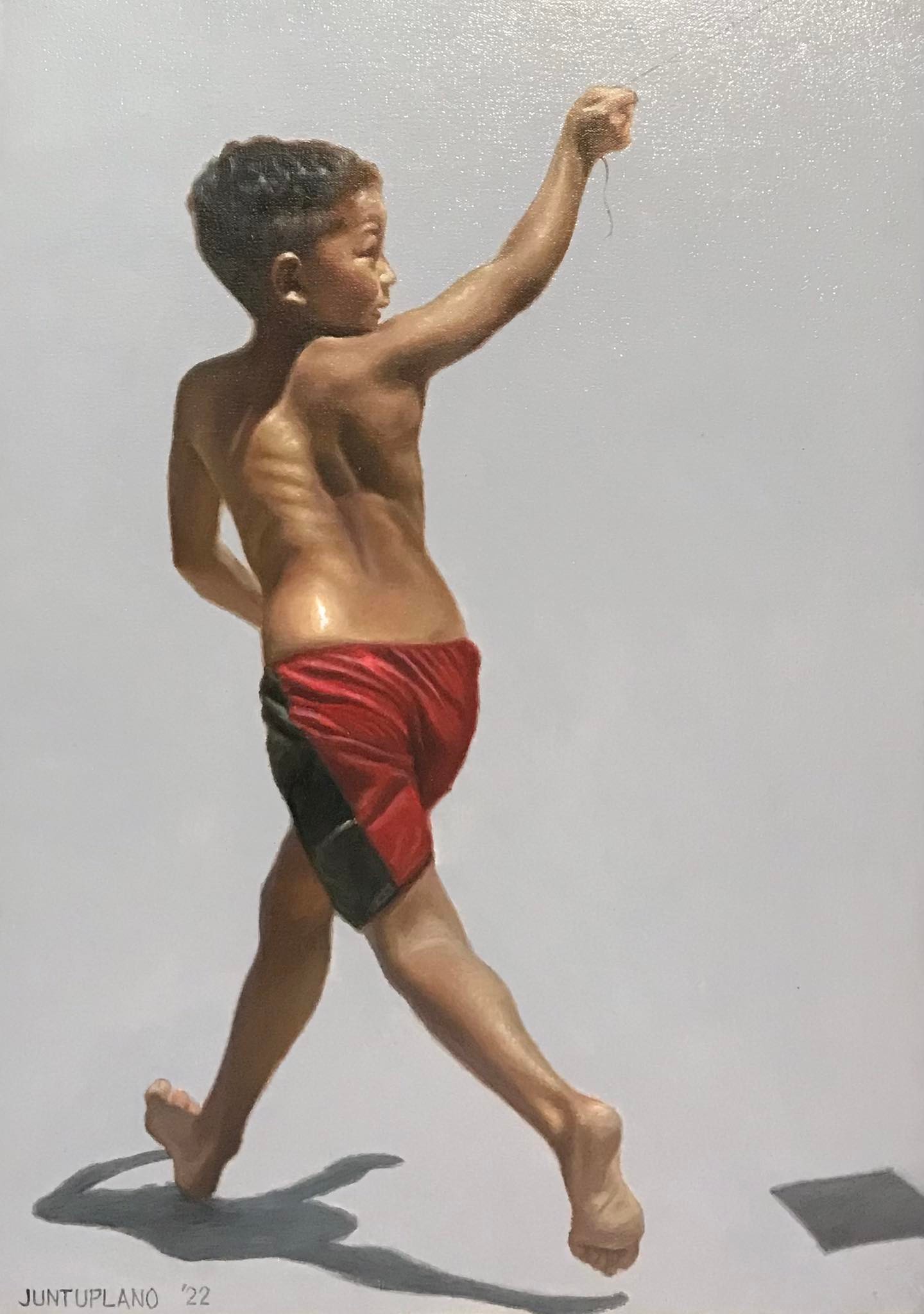
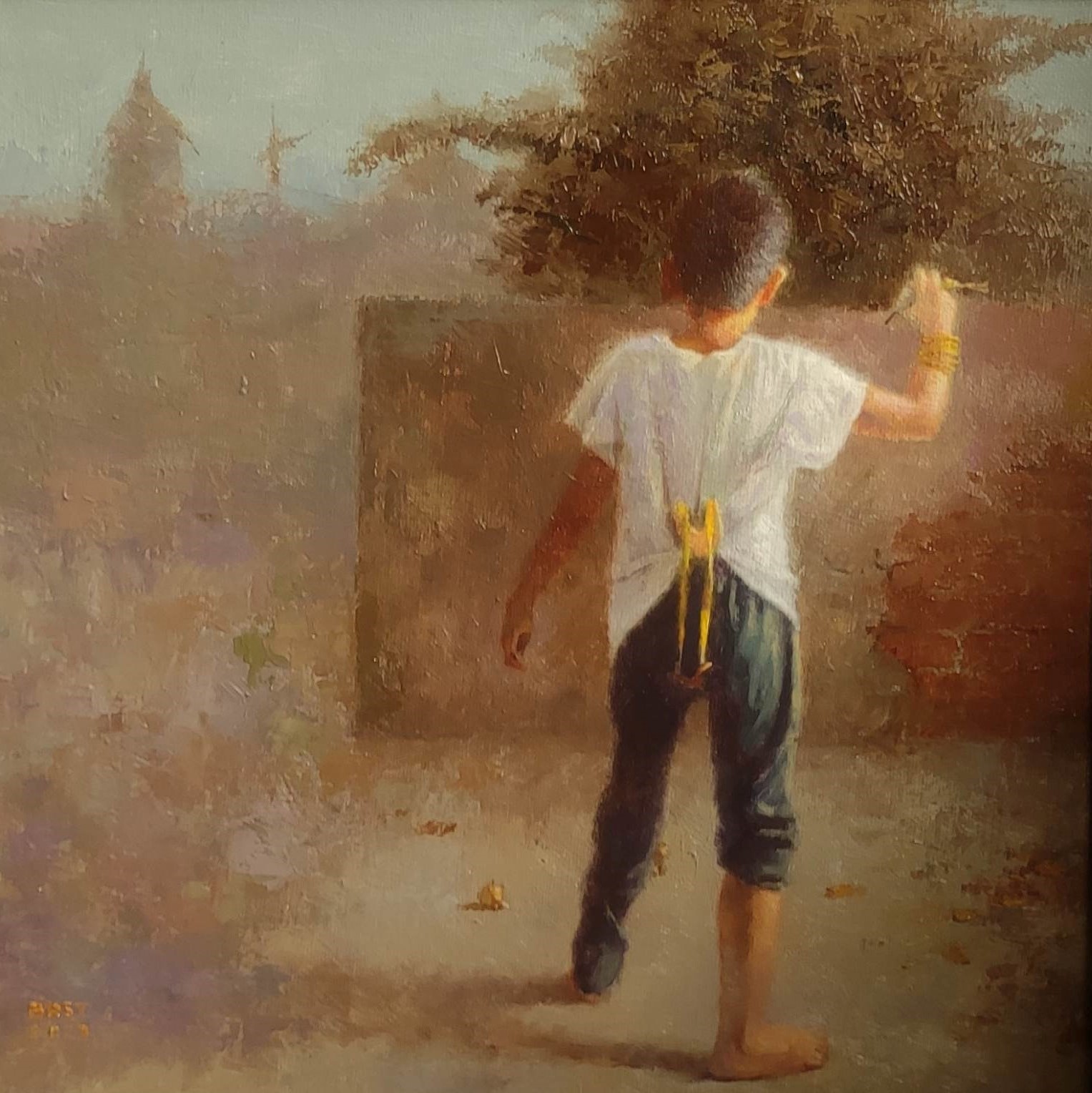
THE MEMBERS of an art group called Alpas reminisce about old Pinoy games — piko, jolen, tumbang preso, patintero, luksong-baka, agawan-base — and our innate sense of play in an exhibition called “Taym Pers!,” on view until March 31 at Robinsons Land ARTablado in Robinsons Antipolo.  ARTablado has become a literal playground as the members of Alpas hold activities in the exhibition area such as sungka, piko, etc. They even punctuated the paintings on view with old Pinoy toys — teks, pogs, and trumpo, among others.


Agnes Locsin’s Filipino dance masterwork returns

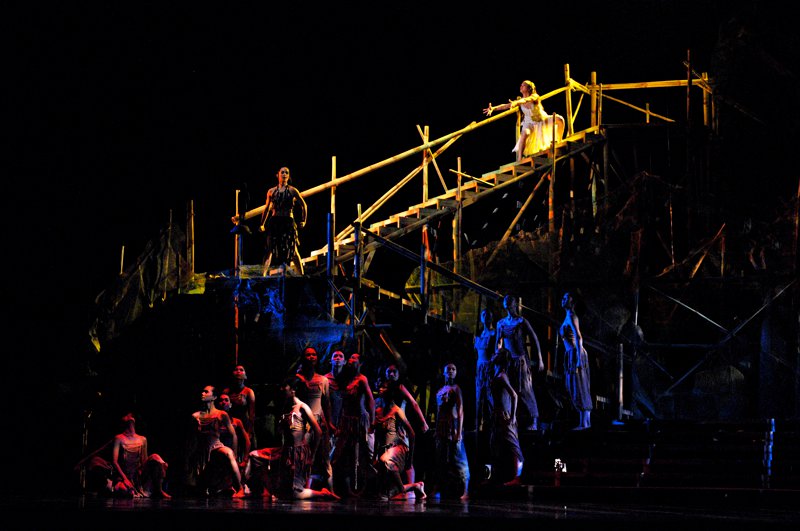
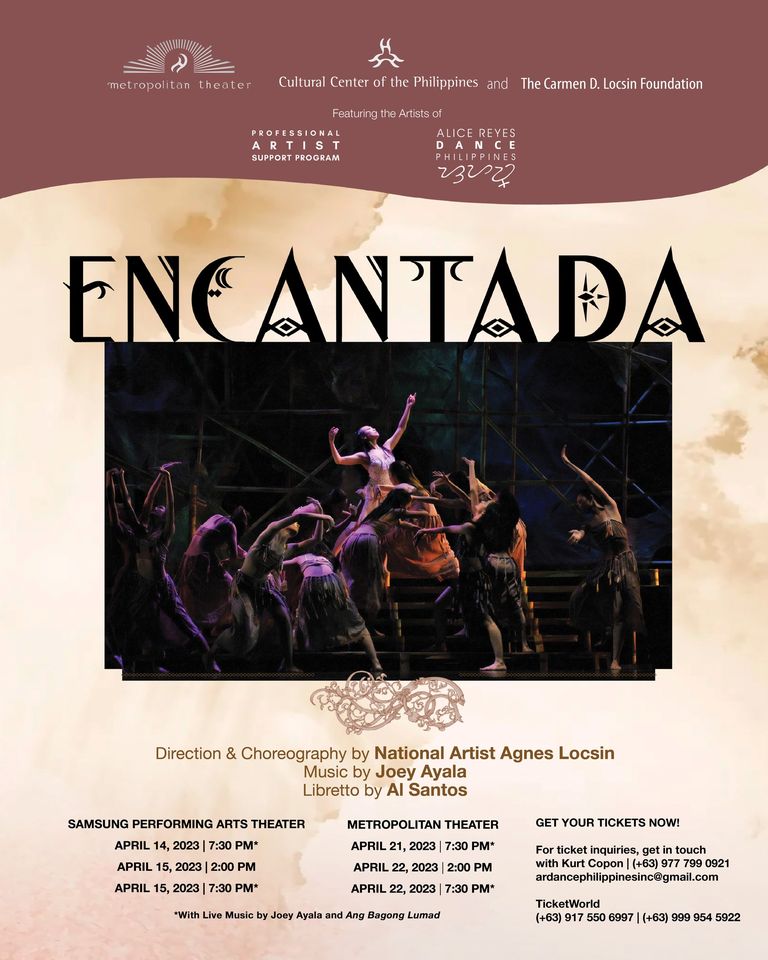
TO CELEBRATE Earth Month, Agnes Locsin’s 1992 dance Encantada goes on stage once again. A collaboration with Joey Ayala for music, Al Santos for the libretto, and the late National Artist Salvador Bernal for production design, Encantada features the artists of the Cultural Center of the Philippines’ Professional Artist Support Program and the Alice Reyes Dance Philippines (ARDP). It is a showcase of Locsin’s Neo-Ethnic Dance Style as she utilizes it to explore Filipino folklore, history, and culture, while at the same time bringing awareness to the consequences of man’s destruction of nature. Both dancers Georgette Sanchez-Vargas and Carissa Adea — who won Gawad Buhay Awards for their parts in the 2011 restaging of the ballet — will reprise their award-winning roles for the current 2023 production. Also joining the cast is Kris-Belle Paclibar-Mamangun, a highly acclaimed Filipino dancer and former member of Cirque du Soleil, who will be alternating the role of Babaylan with Adea. Encantada runs from April 14-15 at the Samsung Theater and April 21-22 at the Metropolitan Theater, with evening shows at 7:30 p.m. and matinees at 2 p.m. All evening shows will have live music performed by Joey Ayala and Ang Bagong Lumad with Bayang Barrios. This season, ARDP will also present Alice Reyes’ Ramahari (Sept. 15-16, 22-23); Carmen and Other Spirits, a mixed bill featuring Reyes’ Carmen and new works by young Filipino choreographers (Oct. 20-21, 27-28); and, Puso ng Pasko (Dec. 1-2, 22). For season subscriptions and ticket reservations, e-mail ardancephilippinesinc@gmail.com.


ABT returns to the Philippines

THE AMERICAN Ballet Theatre (ABT) Studio Company returns to the Philippines for a series of performances for the benefit of Ayala Foundation’s CENTEX program, which aims to provide quality education for underserved students while also offering opportunities to grow in the fields of music, dance, and arts. The series of shows headlines a new generation of ABT Studio Company rising stars with a special performance by pianist Cecile Licad. The series kicks off with a gala night on April 20 at the Samsung Performing Arts Theater, Circuit Makati, followed by public shows at Ayala Center Cebu and Ayala Malls Abreeza on April 22 and 23 respectively. Former ABT Principal Dancer and now Acting Artistic Director of the ABT Jacqueline Kennedy Onassis School, Stella Abrera, and ABT Studio Company Artistic Director Sascha Radetsky, will host masterclasses in STEPS Dance Studio in Makati City and Ayala Center Cebu. For more information, visit https://www.ayalafoundation.org/ and http://www.ayalamalls.com/


Anthology of stories from Martial Law Survivors launched

THE FIRST and only café bookshop in La Union, Puón will host the book launch of PANAGLAGIP: The North Remembers – Martial Law Stories of Struggle and Survival on March 25, 2-4 p.m. The book launch will feature poetry readings, book reviews, acoustic performances, talkbacks and a film screening from the book’s contributors who will be coming from Ilocos Norte, Pangasinan, Baguio, Cagayan Valley and La Union, as well as youth groups in Ilocos such as Kabataan Partylist Ilocos. PANAGLAGIP is an anthology of narratives, articles, poems, artwork and testimonies of activists and ordinary people who fought against Marcos Martial Law in Northern Luzon. The book documents eye-witness accounts and testimonies of direct experiences with the cruelty of Marcos Martial Law which are, ultimately, stories of struggle and survival. Edited by Joanna K. Cariño and Luchie B. Maranan, the book includes contributions from Liza Ann Ilagan, Luchie B. Maranan, Brenda Subido-Dacpano, Reynaldo Guillermo, Lenville C. Salvador, Mary Lou O. Marigza, Elina M. Velasco-Ramo, Romella Liquigan, Felicidad Valencia, Pilar V. Paat, Lina Ladino, Wilson Adorable, Joanna K. Cariño, Maureen B. Loste, Rudy D. Liporada, Jill K. Cariño, Jeoff Larua,Priscilla Supnet-Macansantos, Ruel Caricativo, Desiree Caluza,and Christian Patricio. The book was co-produced by Gantala Press, Samahan ng Ex-Detainees Laban sa Martial Law at Aresto-Northern Luzon (SELDA-NL), PUÓN and Alfredo F. Tadiar Library, with the support of Samahan ng Ex-Detainees Laban sa Detensyon at Aresto (SELDA), The May 18 Memorial Foundation, and PROCESS Participatory Research, Organization of Communities and Education, Toward Struggle for Self-Reliance (PROCESS). The book launch is free and open to the public. Limited seats. Secure a slot here: bit.ly/panaglagipLU .

SEC opens corporate ownership data to state entities

THE Securities and Exchange Commission (SEC) has signed a data-sharing agreement with the Bureau of Internal Revenue, the Philippine National Police, and the Philippine Amusement and Gaming Corp. to allow access to beneficial ownership information.

In a statement, the commission said the agreement will allow it “to give timely access to accurate and adequate beneficial ownership information to competent authorities, in line with the recommendations of the Financial Action Task Force (FATF).”

The agreement will also incorporate measures that protect a company’s personal and sensitive data as called for under Republic Act No. 10173 or the Data Privacy Act of 2012 along with the pertinent circular issued by the National Privacy Commission on data sharing between government agencies.

SEC Memorandum Circular (MC) no. 15 of 2019 allows the commission to collect beneficial ownership information from regulated entities. SEC MC no. 30 of 2020 expanded the requirement to foreign companies.

The commission said beneficial owners of a corporation own or have the controlling ownership interest over the corporation or have the ability to take relevant decisions within the corporation and impose those resolutions.

Additionally, the commission released SEC MC no. 1 of 2021, which provides guidelines on the prevention of the misuse of corporations for illicit activities.

The commission also released SEC MC no. 10 of 2022, which penalizes corporations for the non-disclosure and false disclosure of beneficial ownership information by increasing the penalties and imposing additional nonfinancial penalties.

“Information gathered by Commission through the aforementioned circulars play a vital role in identifying the natural person/s maintaining ultimate effective control of the corporation,” it said. — Adrian H. Halili

Filipino biologist makes case for medical cannabis

By Patricia B. Mirasol, Reporter

A FILIPINO-CANADIAN cellular biologist who claims to have saved her son from deadly seizures using cannabis therapy is pushing its use to treat certain diseases.

Texas-based Annabelle Manalo-Morgan has developed a pure form of cannabidiol without fillers that she used in 2016 to manage her son Macario’s severe seizures when he was just two days old.

Named Masaya (Filipino for happy), the product is under clinical trial in the United Kingdom, Ms. Morgan said in an e-mail on March 18.

Macario, who experienced as many as 200 seizures daily, had caught up to his other preschool classmates by the time he turned three.

Today, he can walk, run, play and speak as well as his peers, according to Ms. Morgan’s book Mighty Flower: How Cannabis Saved My Son, released on March 8.

In the book, she wrote how “our brains and bodies have the ability to move in unpatterned, unplanned and ultimately unexplained ways.”

She was referring to the brain’s capacity to change in response to life experiences, Ms. Morgan told BusinessWorld.

Ms. Morgan said she did not target one type of sickness, but instead “encouraged the cells” to rewire.

“Instead of finding a medicine to just treat my son, I wanted to find something that could allow his brain to heal on its own,” she said. “I had nothing to lose.”

Her book details how she turned to invention to help her son recover from his medical condition.

Cannabidiol is a chemical in the cannabis sativa plant, also known as cannabis or hemp. One specific form of cannabidiol is approved as a drug in the US for seizures, according to WebMD.

More than 100 chemicals known as cannabinoids have been found in the cannabis sativa plant, according to the US National Center for Complementary and Integrative Health.

Marijuana refers to the dried leaves, flowers, stems and seeds from the plant, which contains the mind-altering chemical THC and other similar compounds.

One of the earliest uses of medical cannabis was in 2737 B.C., when Chinese emperor Shen Neng prescribed marijuana tea for the treatment of gout, rheumatism, malaria and poor memory.

‘A PIECE OF THE STORY’
Philippine Senator Robinhood “Robin” C. Padilla in July filed a bill that seeks to allow the compassionate use of medical cannabis, as well as further research into its medicinal use.

Under the measure, medical cannabis in capsule and oil form may be used to address “debilitating medical conditions,” including cancer, multiple sclerosis and epilepsy.

Cannabis could also ease chronic pain, said Henrie F. Enaje, executive director of Canna Legal Philippines, which provides free legal services to nonviolent cannabis offenders.

Pain occurs in about 55% of cancer patients, according to a May 2021 study by the University of the Philippines.

“The criminalization of cannabis is the origin of all misconceptions and stigma of cannabis and its use, including those for medicinal purposes,” Mr. Enaje said in a March 16 e-mail.

The nonprofit group supports the Padilla bill, which will remove cannabis from the Philippine list of illegal drugs and make its cultivation and use legal.

Cannabis’ recreational use has inhibited the opportunity to study its medical properties, Ms. Morgan said.

“There is nothing scary about marijuana,” she said. “We just need to be responsible. If we open up to the education and research of the plant, we can then take advantage of its natural healing properties.”

Cannabis is just a piece of the story, she pointed out. “There are an endless number of compounds from other plants that we can study.”

“I’d love to see a model where a plant-based medicine is in traditional clinical trials, supported by academia and government,” Ms. Morgan said.

Megawide pays P1.07-M penalty to SEC

MEGAWIDE Construction Corp. said that it paid a penalty of P1.07 million to the Securities and Exchange Commission (SEC) for noncompliance with the Revised Securities Regulation Code (SRC).

In a disclosure to the Philippine Stock Exchange, the company said the penalty is in relation to its consolidated audited financial statements for the year ending December 2021.

Megawide said that in a letter dated Feb. 22, 2023, the SEC assessed penalties against the company “due to a material misstatement in the financial statements, and material deficiency in the annual and interim financial statements of the company.”

The total penalty assessed by the SEC amounted to P1.04 million for Megawide’s noncompliance with SRC Rule 68, while an additional penalty of P23,000 was assessed by the regulator for the company’s second offense for material disclosure deficiency.

According to Rule 68 of the SRC, a material misstatement includes failure to adopt the prescribed financial reporting framework and failure to disclose required information and other relevant information.

“The penalties imposable on an erring company for the violation of this rule shall be in addition to the fine imposable due to late or incomplete filing of other parts of any report to which the financial statements are required to be attached,” the rule read.

Meanwhile, Megawide said that it paid the penalties on March 8, which the SEC acknowledged on March 15.

On the stock market on Tuesday, Megawide’s shares closed unchanged at P2.94 apiece. — Justine Irish D. Tabile

BTr fully awards T-bonds at slightly higher rates

BW FILE PHOTO

THE GOVERNMENT made a full award of the reissued 20-year Treasury bonds (T-bonds) it auctioned off on Tuesday as the market awaits the policy decisions of the US Federal Reserve and the Bangko Sentral ng Pilipinas (BSP).

The Bureau of the Treasury (BTr) raised P25 billion as planned from the reissued 20-year bonds it offered on Tuesday as total bids reached P34.412 billion.

The bonds, which have a remaining life of 19 years and eight months, were awarded at an average rate of 6.631%, with accepted yields ranging from 6.5% to 6.745%.

The average rate of the 20-year bond was 10.60 basis points (bps) higher than the 6.525% quoted for the same series when it was last offered on Jan. 17 but 149.40 bps below the 8.125% coupon for the issue.

This was also 8 bps higher than the 6.551% quoted for the 20-year bond and 8.20 bps above the 6.549% seen for the same bond series at the secondary market prior to the auction, based on PHP Bloomberg Valuation Service Reference Rates data provided by the Treasury.

“The Auction Committee decided to fully award the reissued 20-year Treasury Bonds (FXTN 20-25) at today’s auction. With 19 years and 8 months to maturity, the reissued T-bonds fetched an average rate of 6.631%, lower than the original coupon rate of 8.125% set on its original issuance in November 2022,” the BTr said in a statement on Tuesday.

“The auction was 1.4 times oversubscribed with total tenders reaching P34.4 billion. With its decision, the Committee raised the full program of P25 billion, bringing the total outstanding volume for the series to P101.6 billion,” it added.

The Treasury made a full award of its T-bond offer at a higher average rate as the market was waiting for the result of the Fed and BSP’s policy meetings this week, a trader said by phone.

Rizal Commercial Banking Corp. Chief Economist Michael L. Ricafort likewise said in a Viber message that the average rate of the bond series was slightly higher “ahead of the Fed and BSP rate-setting meetings later this week, as markets priced in a possible +0.25 Fed rate hike on March 22, 2023 that could be matched locally on the following day.”

The Fed will hold its second policy meeting for the year on March 21-22. Markets are pricing in an increase of just 25 bps from the Fed following the failures of Silicon Valley Bank and Signature Bank.

The US central bank hiked its target interest rate by 25 bps at its Jan. 31 to Feb. 1 meeting to a range between 4.5% and 4.75%.

Since March 2022, the Fed has raised rates by a total of 450 bps.

Meanwhile, the BSP’s policy-setting Monetary Board will meet on March 23.

A BusinessWorld poll held last week showed 12 out of 14 analysts see the Monetary Board hiking rates by 25 bps on Thursday amid concerns over elevated inflation and the fallout from bank failures in the United States.   

The Philippine central bank last month raised benchmark interest rates by 50 bps for a second straight meeting, bringing its policy rate to 6%. The BSP has increased borrowing costs by 400 bps since May 2022.

The BTr wants to borrow P200 billion from the domestic market this month, or P75 billion via Treasury bills and P125 billion via T-bonds.

The government taps local and external sources to help fund its budget deficit, which is capped at 6.1% of gross domestic product this year. — A.M.C. Sy

Philippines still 2nd most impacted by terrorism in Asia-Pacific

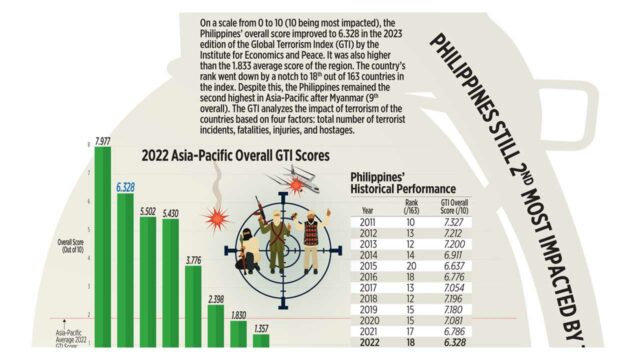
On a scale from 0 to 10 (10 being most impacted), the Philippines’ overall score improved to 6.328 in the 2023 edition of the Global Terrorism Index (GTI) by the Institute for Economics and Peace. It was also higher than the 1.833 average score of the region. The country’s rank went down by a notch to 18th out of 163 countries in the index. Despite this, the Philippines remained the second highest in Asia-Pacific after Myanmar (9th overall). The GTI analyzes the impact of terrorism of the countries based on four factors: total number of terrorist incidents, fatalities, injuries, and hostages.

Philippines still 2<sup>nd</sup> most impacted by terrorism in Asia-Pacific

Ballet dancers in sensor suits: new research explores how dance is used as a form of communication

KAZUO OTA/UNSPLASH

AUDIO guides, maps, traditional and interactive texts help people attending art exhibitions to understand the works in front of them. With dance, however, the audience’s understanding is usually taken for granted.

It’s assumed they will make sense of a performance thanks to the synopsis included in programs, or reviews published in newspapers and magazines. These supporting materials are optional and do not work during performance. However, the English National Ballet (ENB), for example, has produced versions of classical ballets for young audiences where dancers perform a shortened version of a well-known classical ballet while a narrator recites the story.

But words cannot translate everything dance expresses. Verbal and movement-based communication can convey similar meanings, but they do so in very different ways. Whereas verbal language is immediately understood, the language of dance can be lost to a general audience.

So how can dance performances become a more accessible source of cultural and social information for people who are not specialists?

Our research group focuses on Kinesemiotics, the study of meaning made by movement, an area we are developing. Our project, called The Knesemiotic Body, is carried out at Loughborough University in collaboration with researchers at the University of Bremen and the ENB.

The Functional Grammar of Dance (FGD) explains how body parts create meaning by interacting with the space and the people surrounding dancers in a performance. We used it to annotate and interpret data collected from live dance rehearsals.

The FGD draws on linguistics and semiotic theories (how people communicate through signs) and is based on “projections.” Projections are the trajectories designed by dancers when extending their body parts towards meaningful portions of the performance space.

Projections connect extended body parts to surrounding people or objects, creating a meaningful visual interaction. Imagine a dancer moving towards a lake, painted on the backdrop of a stage. They extend an arm forward towards the lake and a leg backwards towards a stage prop representing a shed. That extended arm will mean “going to lake” while the leg will mean “coming from shed.”

Projections can also be directed to the audience creating an “involving” effect. This is achieved, for example, when a dancer extends their arms towards the audience while facing them with their face and torso. This looks as if they are addressing them directly, acknowledging their presence and breaking the invisible wall between them.

Projections are like speech bubbles made by movement. Our research captured them through sensor suits that dancers wear during our data collection and we decoded them using the FGD. When we annotate the data produced by the suits, we basically fill those speech bubbles with meaning that people can understand without having background knowledge of dance. Our recordings and annotations capture not only movements, but also the intended meaning behind them.

During our sessions, we worked with two pairs of fantastic dancers: Junor Souza and Rebecca Blenkinsop from the ENB, and school graduates Elizabeth Riley and Jamie Constance.

We have achieved interesting results. By annotating choreography with our system, it is possible to discover patterns of movement-based communication. These patterns may not be immediately visible to the naked eye, but clearly inform the message the audience perceives.

We also found out that it is possible to study how movement patterns work in relation to costumes, which is especially interesting when choreographers experiment with innovative clothing and props.

For example, we worked on the effects of movement combined with elastic cloth that covered a dancer’s body almost entirely. This highlighted how a particular type of costume choice would impact on the expressive potential of movement.

Our data also highlighted how dancers playing the same role can create different versions of the same character according to variations they make in performing projections. For example, one dancer might decide to engage more with the audience than another by performing more projections that directly address the viewers.

We can also check how a dancer manages physical balance during a performance in relation to these projections, which is particularly clear in their legwork and footwork. This type of information can be particularly helpful for physical rehabilitation.

An injury can deeply affect a dancer’s or an athlete’s ability to manage body balance and our annotation highlighted the specific choices a dancer makes when managing it. The information provided by our data annotation can therefore provide valuable information on how a dancer works towards recovery.

In future our work will look at whether specific projections can help audiences with different degrees of familiarity with dance to engage with a dance performance more easily. — The Conversation via Reuters Connect

Arianna Maiorani is a Reader in Linguistics and Multimodality at Loughborough University while Chun Liu is a Research Associate at Loughborough University. Maiorani receives funding from AHRC.

ADVERTISEMENT
ADVERTISEMENT