Home Blog Page 5093

What if deglobalization is good for emerging markets?

TIRACHARDZ

Four trends are set to shape the world in the decades ahead: energy cost differentials, rising wages in China, nearshoring supply chains, and remote work. For emerging countries with the right natural resources and institutions, that means an opportunity to accelerate up the income ladder. Potential beneficiaries include Argentina, Colombia, and Mexico, as well as Malaysia and the Philippines.

Why these countries? They combine most of the ingredients of success: access to cheap energy, an abundant labor force, free trade with large parts of the global economy, and the ability to attract talent.

Conversely, Nigeria, Russia, and Sri Lanka are the worst-positioned among the 22 countries we scan. They would need to more deeply integrate into the global economy and improve their institutional frameworks to benefit from the shift in globalization.
Policy missteps can squander a country’s potential. Argentina’s strong ranking may not offset the disincentive to foreign workers and companies from tight capital controls. Colombia’s advantage is at risk if the recent political shift roils its trade agreements.

ENERGY SHOCK MAY DRIVE OFFSHORING
Access to low-cost raw materials plays a large role in determining the geographical distribution of industry. Typically, these relative prices remain stable, allowing businesses to specialize in certain countries. But every so often the global economy experiences drastic changes with the potential to drive significant relocation.

A historical example is Japan’s fertilizer business. The country exported 60% to 80% of its nitrogen fertilizers in the 1960s. But after the oil shock of the 1970s made export-oriented fertilizer manufacturing unfeasible, Japanese companies adapted by shifting production to emerging markets to capture their commodity cost advantage.

The current energy shock may drive a similar offshoring strategy in the years to come. In Europe in particular—where energy is set to stay expensive—there’s a strong incentive for companies to look elsewhere. The forward market for natural gas has prices three years from now staying five times higher than the level before Russia’s invasion of Ukraine.

One way to gauge how countries are affected by the energy shock is by the impact of the shift in relative commodity prices on their export and import prices. We use estimates of terms-of-trade changes, compiled by the International Monetary Fund. The data confirm that energy-exporting countries—Nigeria, Russia, and Saudi Arabia—have a natural advantage. But some countries that aren’t net energy exporters could still benefit from the offshoring trend. Energy-intensive industries in Germany, for instance, could move some of their production to a country where the impact of soaring energy costs is lower than at home.

Workers also matter. Demographic differences over time and across emerging markets have a significant effect on labor costs. China is a striking example. After years of boasting cheap labor as a key competitive advantage, the country now faces unfavorable demographics that are already leading to a significant rise in wages.

We gauge the outlook for labor costs by focusing on the share of the population at the prime working ages of 25 to 64 years old. Countries where this is expected to decline in the next 10 years are likely to face wage pressures as their labor force shrinks. That’s the case in China, Poland, Russia, and Thailand. Others still enjoying demographic dividends—India, Mexico, and Pakistan—are more likely to see a boost than a drag as labor cost differentials shift.

POLITICS OF NEARSHORING
Government and companies may sacrifice economic efficiency if it helps reduce their vulnerability to wars, sanctions, and supply chain disruptions. That has led administrations in advanced nations to increasingly support efforts to reshore, or at least nearshore, manufacturing. Countries that are part of large trading blocks, border major markets, and avoid trade conflicts are better nearshoring candidates.

Mexico, Peru, Poland, Turkey, and Vietnam stand out as emerging markets with the best potential access to external markets through trade agreements. The relative isolation of Nigeria, Russia, and South Africa makes it hard for them to engage in global production networks.

A final force at play is the potential for high-skilled migrants to drive emerging-market growth. Slowing growth in advanced economies and the work-from-anywhere reality could encourage workers to move to emerging markets, under the appropriate conditions. A “brain gain” would provide a welcome bump to productivity and enable the destination country to realize the benefits from input-cost advantage and the potential for nearshoring.

The Global Talent Competitiveness Index offers insight on countries’ ability to develop, attract, and retain workers. Chile, China, Poland, and Saudi Arabia stand out as most attractive to foreigners—though for China, COVID Zero has likely changed the picture. Nigeria, Pakistan, and Sri Lanka fare worse than their main emerging-market peers. — Bloomberg

BSP has to raise rates along with Fed to support peso — Medalla

REUTERS

The Philippine central bank will have to raise interest rates if the US Federal Reserve tightens policy further to support the peso and prevent the currency’s weakness from further stoking inflation, its governor said on Friday.

Bangko Sentral ng Pilipinas (BSP) has raised interest rates by 300 basis points this year to curb inflation, running near 14-year highs, and support the peso which has fallen sharply against the dollar, underpinned by aggressive US monetary tightening.

The Federal Reserve is expected to deliver a smaller rate hike in December, but economists polled by Reuters see a longer period of tightening and a higher policy rate peak as risks to the current outlook.

“If the Fed does 50, we cannot have zero right? So the question is whether it’s 25 or 50,” BSP Governor Felipe M. Medalla told Reuters in an interview in Manila.

“If you have a scenario (where) the Fed will not hike any more then I can tell you flat out, neither are we.”

BSP raised interest rates by 75 basis points on Thursday, largely to match the Fed’s three-quarter point hike this month, and is expected to hike again in December.

The Fed will likely raise rates by 50 basis points next month after four consecutive 75-bp increases, according to the Reuters poll.

Mr. Medalla reiterated the rate differentials between the United States and the Philippines should not be allowed to narrow sharply, lest the weakness in the peso would persist and push up already elevated prices of imported food and fuel.

BSP’s rate hike on Thursday brought the rate on its overnight reverse repurchase facility to 5.0%, the highest in nearly 14 years. That compares with the Fed’s policy rate of 3.75%-4%.

A shrinking rate gap has spurred an 11% decline in the peso against the dollar this year, putting the currency at the forefront of the BSP’s policy decisions. Mr. Medalla says the weak currency has become a price “shock generator.”

“If inflation is a huge problem, you don’t want the weakening of the peso to add to that further,” Mr. Medalla said.

The central bank wants to bring inflation, currently running at 7.7%, back to its 2%-4% target by the second half of next year, Mr. Medalla said.

Mr. Medalla said the economy, which grew by a faster-than-expected 7.6% in the third quarter, is strong enough to withstand the series of rate hikes, thanks largely to pent-up demand.

“The postponed spending on the capex side plus the pent up demand on (the) consumer side means we will have fairly strong demand despite the rate increases,” Mr. Medalla said.

Reuters

Capture the magic of Christmas with vivo V25 series

As soon as the sun sets and the sky darkens, houses and establishments come to life with glittering lights and dancing parols, all inviting a smartphone user to take a picture or a video of the magic of Christmas.

However, taking photos or videos in dark places remains a challenge, and what good are pictures and videos if your camera cannot give the Christmas decorations justice? Cue the vivo V25 series, the latest addition to vivo’s V smartphone lineup hailed for its night imaging capabilities. The vivo V25 series, nicknamed the Night Portrait Master, pushes the boundaries of night photography with its 64MP OIS ultra-sensing camera that has six times more light input than a regular phone camera. With this, users can take bright and high-quality photos at night, making it the perfect companion for documenting the magic of Christmas.

vivo shares its own list of tips on how you can maximize the vivo V25 series’s night imaging powers for a great and attention-stealing content this holiday season.

Shine with Christmas lights

Step under the majesty of a hundred twinkling Christmas lights and take a stunning portrait while they dance around you. During the holidays, there’s no backdrop more perfect than a waterfall of golden fairy lights.

And thanks to the vivo V25 series, one does not need to worry about pictures looking over- or underexposed with its Rear Super Night Portrait feature, which balances the light coming from one’s backdrop and the exposure needed for his or her face. Just switch on the Super Night Portrait mode and it’ll automatically adjust the camera’s brightness to produce a stunning and clear image with an excellent face and background quality.

Make the whole place shimmer and capture it on video

We are in the era of TikTok videos and IG reels. This means, pictures aren’t enough. Videos have to be added in the mix to give one’s content a little spice. But just as with capturing photos, taking videos in lowlight conditions often compromises video quality.

The vivo V25 Pro’s camera is equipped with a Super Night Video mode that is backed with a O+E stabilization system. This system helps keep your videos smooth and stable especially during exciting moments where lots of movements happen.

Whether you’re making a montage of the best Christmas spots you’ve been to or an attempt at the latest dance trend on TikTok with Christmas lights as your background, you can create smooth and noiseless videos that perfectly capture the charm of Christmas around you and your own shimmering moments.

Flex the magic of Christmas at home

For content creators, aesthetics is everything. But instead of going for a usual photo spot in a café or a park, why not add a more personal touch and flex the Christmas vibes in your home?

Turn off the light, let the garlands and your Christmas tree shine and get ready with the Super Night Mode on. This feature is powered by a raw HDR algorithm that when toggled on can capture authentic colors and deliver optimal brightness for a sharp and clear image.

With the Super Night Mode, your photos will come out in high contrast levels and no stray lights or glares so you can share clear and bright photos of your home’s Christmas decorations for all of your friends and followers to appreciate.

Take a selfie with the whole family

Nothing compares to being surrounded by the bright and smiling faces of the people that you love. The vivo V25 Series’ is equipped with up to 50MP Eye AF Selfie Camera where users can now take high-quality selfies even in dimly-lit rooms, all made possible by a technology that uses AI to improve face clarity, enhance details and the image’s overall quality. It also flexes an autofocus feature that keeps photos in focus especially when younger siblings keep moving around. Th feature also prevents blurred selfies when the focus adjusts. With this autofocus feature and its wide focus range, selfies can be taken with pristine clarity whether it’s taken close or far away.

Moreover, this smartphone takes its own magic tricks up its sleeve. The vivo V25 series boasts Photochromic 2.0 technology which uses a light molecular material that allows its back panel to change colors when exposed to sunlight or UV light. The vivo V25 Pro takes the hues of Starlight Black, sporting a million twinkling stars, and Surfing Blue that transforms from light blue sky to deep blue ocean shade.

On the other hand, the vivo V25 and vivo V25e variants shine in Sunrise Gold that shifts between golden, orange and reddish hues. These two variants under the vivo V25 series also come in Diamond Black that mimics the elegance and sparkles of black diamonds. The vivo V25 series is the only smartphone in the industry to feature this innovative color-changing technology.

Visit vivo stores and kiosks nationwide starting Nov. 15, 2022 to get a chance to win awesome and exciting freebies when you purchase the vivo V25 series.

To know more about the ongoing promotion, you may check this link: https://www.vivoglobal.ph/vivo-loca-promo-campaign/.

For more information, follow vivo’s social accounts on Facebook, Instagram, Twitter, and YouTube.


Spotlight is BusinessWorld’s sponsored section that allows advertisers to amplify their brand and connect with BusinessWorld’s audience by enabling them to publish their stories directly on the BusinessWorld Web site. For more information, send an email to online@bworldonline.com.

Join us on Viber to get more updates from BusinessWorld: https://bit.ly/3hv6bLA.

On the importance of property consultants

Few companies could have adequately prepared for the impact of the coronavirus pandemic. Fewer still could have done that on their own. The crisis that had stopped the world in its tracks had highlighted the fact that no business is an island. Industries and economies are built on collaboration and a shared vision of growth.

It is precisely this fact that underlines the significance of professional services and consultancy firms to any industry. No single executive, no matter how brilliant, can be expected to have the necessary expertise, experience, and knowledge to successfully navigate every challenge that may come their way.

Real estate is a prime example. Professional services firm McKinsey & Company found that the pandemic has led companies around the world to reassess their real estate — how much of it to have, how to use it, and how much to spend on it.

“Fortune 50 companies alone occupy 2.6 billion square feet of real estate, and some of it sat mostly empty for long stretches during the pandemic. At times in the prolonged work-from-home experiment, the media, employees, and even company leaders wondered whether large numbers of offices were necessary at all,” McKinsey wrote on its website.

“The right approach to real estate can help companies not only to grapple with the universal challenges arising in the pandemic’s wake but also to achieve their corporate goals. Marrying strategy to real estate requires a deep analysis of a company’s needs, as well as data to inform decisions. These decisions are best managed by top strategic thinkers guided by the CEO — a departure from the way companies have traditionally made real-estate choices.”

Consultants are not there to make those decisions themselves — that role falls solely on the chief executive. But what they do provide is the advice or research and analysis to help the CEO make well-informed decisions specifically targeted towards a company’s goals. Real estate consultants, in this example, can supply necessary information like the costs and benefits of each option available to the company, such as selling or leasing a property, or making investments in a particular area.

Adapting to the future of real estate

And while many companies had hoped property management to become easier after the pandemic, the reality is that many other challenges loom on the horizon.

In fact, the pandemic has only accelerated certain trends in the real estate industry, and it has shone a light on many of its underlying issues. According to Christian Ulbrich, chief executive of global real estate services firm Jones Lang LaSalle (JLL), “the convergence of multiple crises — public health, social, economic, and planetary — has served to drive home the urgency of our efforts to identify a few simple imperatives and create a set of signposts that could help the industry ‘build back better.’”

Mr. Ulbrich is also co-chair of the World Economic Forum’s (WEF) real estate industry community and one of the key contributors to ‘A Framework for the Future of Real Estate,’ produced by the WEF.

The framework shared a vision for the future of real estate: a future in which buildings provide us with comfort, are equipped for the most unprecedented of events, support our health and the planet, and are affordable and accessible for all.

As part of this vision, Mr. Ulbrich wrote that the future of real estate should be “liveable, creating suitable habitats for a rich, culturally vibrant existence.” He pointed out that in major cities around the world, people typically spend about 90% of the day indoors, making buildings instrumental in ensuring liveability through a combination of factors like a human-centric and inclusive design.

“Real estate should be sustainable, optimized for zero carbon output in every aspect from construction to operations. The environmental impact of real estate assets is highlighted by the fact that buildings account for 40% of global greenhouse gas emissions, 50% of the world’s energy consumption and 40% of raw materials. If we are to meet net zero carbon goals, we need to accelerate action; action that will require large-scale energy retrofits of older existing buildings and, crucially, the renovation or repurposing of buildings rather than demolition,” Mr. Ulbrich continued.

Part of this change should also lead to the improved resilience of real estate, so that it is capable of adapting to whatever exigencies might arise by mitigating the effects of unforeseen natural and man-made events, such as climate, financial and health crises, and preserve the cultural identity of communities.

Mr. Ulbrich said that properties need to withstand a variety of unpredictable shocks and to be flexible to adapt to changing patterns of working and living throughout their full life cycle.

“And real estate should be affordable, with housing, transportation and essential services available to all. The provision of fair access to quality space to live and do business is essential to the overall health of society. Affordability must comprise both financial access (affordable rents, low barriers to home ownership) and access to the appropriate standard of assets in terms of space, health, location and access to basic services,” Mr. Ulbrich concluded.

Real estate, alongside many other industries, is in a state of upheaval. Contemporary issues, particularly environmental, socioeconomic, and those concerned with health and safety, demand the transformation of this industry.

It is only a matter of time before governments all over the world enact policies and legislation that adhere to these demands. To ensure a long-term sustainable strategy for a company, one must be equipped with the know-how and expertise needed to deal with such changes in policy — expertise that consultancy firms can provide. — Bjorn Biel M. Beltran

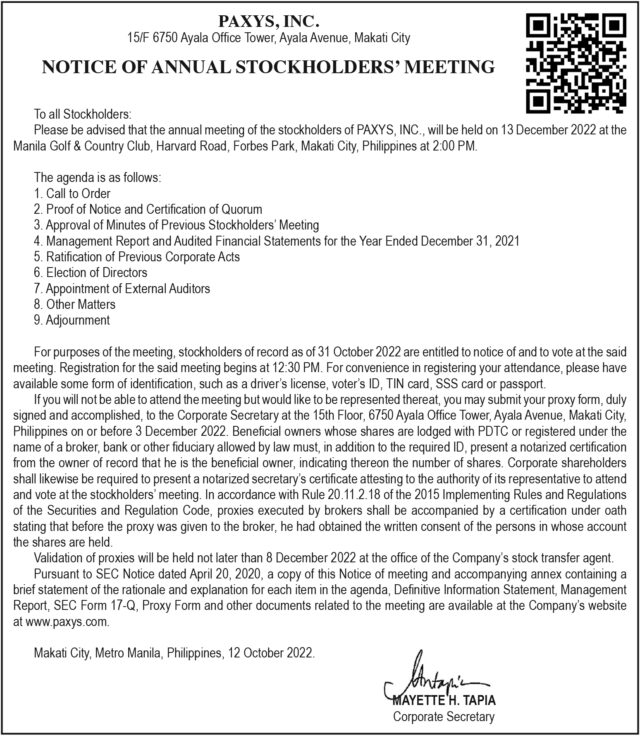
PAXYS, Inc. to conduct annual meeting of stockholders on Dec. 13


Spotlight is BusinessWorld’s sponsored section that allows advertisers to amplify their brand and connect with BusinessWorld’s audience by enabling them to publish their stories directly on the BusinessWorld Web site. For more information, send an email to online@bworldonline.com.

Join us on Viber to get more updates from BusinessWorld: https://bit.ly/3hv6bLA.

BSP delivers jumbo rate hike anew

PHILIPPINE STAR/EDD GUMBAN
The Philippine central bank raised its 2022 average inflation forecast to 5.8%, from 5.4% previously. — PHILIPPINE STAR/ EDD GUMBAN

By Keisha B. Ta-asan, Reporter

THE BANGKO SENTRAL ng Pilipinas (BSP) on Thursday raised its key interest rate for a sixth time this year to tame inflation, which it now sees rising to 5.8% by yearend. 

As telegraphed by BSP Governor Felipe M. Medalla earlier this month, the Monetary Board increased the overnight reverse repurchase rate by 75 basis points (bps) to 5%, the highest in nearly 14 years.

The move followed the 75-bp hike by the US Federal Reserve at its Nov. 1-2 meeting, which brought the policy rate to 3.75-4%.

The BSP’s rates on the overnight deposit and lending facilities were also increased to 4.5% and 5.5%, respectively.

“In deciding to raise the policy interest rate anew, the Monetary Board noted that core inflation has risen sharply in October, indicating stronger pass-through of elevated food and energy prices as well as demand-side impulses on inflation,” Mr. Medalla said.   

Headline inflation accelerated to a near 14-year high of 7.7% in October, from 6.9% in September and 4% a year earlier.

Core inflation, which discounts food and fuel prices, quickened to 5.9% in October from the revised 5% in September.

The BSP also raised its average inflation forecast for this year to 5.8%, from 5.4% . For next year, the BSP hiked the inflation forecast to 4.3% from 4.1%. These projections are still above the central bank’s 2%-4% target. 

The 2024 inflation forecast was also raised to 3.1% from 3%.

“Risks to the inflation outlook lean strongly toward the upside until 2023 while remaining broadly balanced in 2024. Upside risks are associated with elevated international food prices owing to higher fertilizer costs, trade restrictions and adverse weather conditions,” Mr. Medalla said.

He also cited supply disruptions, agricultural damage due to typhoons and possible transport fare hikes as factors that could fuel inflation.

BSP Department of Economic Research Director Dennis D. Lapid said inflation is expected to average 5.8% this year as inflation peaks in the fourth quarter.   

However, Mr. Medalla said he does not see inflation breaching 8% in November or December.

“Even if it does, it will start going down by next year. Our own forecast is that by the second half of next year, inflation will actually be closer to 3% than to 4%, of course that’s assuming that there are no new supply shocks,” he said.

Mr. Medalla said the Monetary Board saw the need for aggressive tightening to “safeguard price stability,” amid the possibility of further second-round effects, persistent inflationary pressures and upside risks to the inflation outlook.

“With the strong growth of the economy in the third quarter of 2022, domestic demand is seen to hold firm owing to improved employment outturns, investment activity and consumer spending,” he said.

The Philippine economy expanded by 7.6% in the third quarter, bringing the year-to-date average growth to 7.7%. Economic managers expect full-year GDP growth to settle within 6.5-7.5%.

“A sizeable adjustment in the policy interest rate will help insulate the economy from external headwinds and exchange rate fluctuations that could further entrench price pressures and potentially dislodge inflation expectations,” Mr. Medalla said.   

After the BSP’s announcement, the Philippine peso closed at P57.36 versus the US dollar, barely changed from its P57.35 finish on Wednesday. Year to date, the peso has weakened by P6.36 or 11.1% from its P51 close on Dec. 31, 2021. 

Asked if the BSP would continue to mirror the Fed’s tightening in the coming months, Mr. Medalla said future policy actions would be data-dependent.

“The Fed rate now is not the highest, but the four 75-bp [rate increases] have been the [fastest] for a long time and I think that’s over. Therefore, we are slowly going back to a more normal global interest rate environment,” he said.   

“We will probably do less of the two recent unusual actions the BSP did, namely the off-cycle 75 (bps) and this 75 (bps) that was announced two weeks earlier,” he added.   

The central bank has raised rates by a total of 300 bps this year.   

Following the policy announcement, economists are expecting one more rate hike at the Monetary Board’s Dec. 17 meeting.

“Given lingering inflationary pressures, we expect another 50 bps from the BSP in December, to match the move by the Fed. Stronger-than-expected Q3 GDP figure also gives the BSP some comfort in its position that the economy is resilient enough to weather policy tightening,” Oxford Economics Assistant Economist Makoto Tsuchiya said in a note.   

However, Mr. Tsuchiya said a looming recession in developed countries, high inflation, tightening global financial condition and a China slowdown cloud the outlook for the Philippines.

“BSP will likely retain its hawkish tone given its recent adjustment to inflation forecasts for both 2022 and 2023,” ING Bank N.V. Manila Senior Economist Nicholas Antonio T. Mapa said, adding that he also expects a 50-bp hike in December.

Gareth Leather, senior Asia economist at Capital Economics, said the BSP might stop hiking rates in early 2023.

“We think further tightening is likely in the near term, but with inflation having probably peaked, headwinds to the recovery mounting and the Fed’s own tightening cycle are likely to come to an end soon,” Mr. Leather said in a note.

He said the further weakness in the peso would likely be over in the next few months, and he expects the peso to appreciate against the US dollar by the second half of 2023.

“Overall, we are expecting one further 50-bp rate increase at the BSP’s final meeting of the year in December, followed by another hike in early 2023, which should mark the end of the central bank’s tightening cycle,” he added.

Miguel Chanco, chief emerging Asia economist at Pantheon Macroeconomics, said the BSP should be cautious in its inflation assessment and monetary tightening.

“Any further rate increase from these levels would be tantamount to overkill, not least because the road to target-range inflation by the middle of next year remains clear. We vehemently disagree with the board’s assessment that the recent rise in core inflation is worth paying attention to, as the Philippines’ gauge of underlying inflation still includes some volatile food and energy-related components,” he said.

“All told, we are sticking to our call that a partial unwinding of this year’s rate hikes will be pursued towards the back end of 2023.”

S&P affirms Philippines’ investment grade rating

AN AERIAL VIEW shows the Ortigas business district in Pasig City, June 10, 2022. — REUTERS

S&P GLOBAL RATINGS affirmed on Thursday the Philippines’ investment grade rating, amid the economy’s continued recovery from the pandemic.

“The Philippines’ economy is rebounding healthily, spurred by strong domestic demand as the country lifts mobility restrictions and fully reopens… We affirm our ‘BBB+’ long-term and ‘A-2’ short-term sovereign credit ratings on the Philippines,” it said in a statement.

The credit rater said it kept a “stable” outlook, reflecting expectations of economic recovery and a significant decline in the fiscal deficit in the next two years.

Under S&P’s global rating scale, “BBB+” is considered an investment grade rating, and reflects a sovereign’s “adequate capacity to meet financial commitments, but more subject to adverse economic conditions.”

The “BBB+” sovereign rating is a notch away from the “A”-level grade targeted by the government, while a “stable” outlook means the rating is likely to be maintained in the next six months to two years. 

S&P last affirmed its credit rating for the country in May 2021 with the same “stable” outlook.

“The sovereign credit ratings on the Philippines reflect the country’s above-average economic growth potential, which should drive constructive development outcomes and underpin broader credit metrics,” it said.

S&P noted the Philippines has entered the endemic phase of the coronavirus with economic activities now normalizing. Gross domestic product (GDP) growth averaged 7.7% in the first three quarters, driven by strong domestic demand.

However, the debt watcher expects GDP expanding by 6.3% this year, a tad below the government’s 6.5-7.5% GDP growth target.   

For next year, S&P expects growth at 5.7% amid a global economic slowdown, particularly in the US and China. This is below the government’s 6.5-8% goal.

“Nonetheless, economic growth should be well above the average for peers at a similar level of development, on a 10-year weighted average per capita basis. The country has a diversified economy with a strong record of high and stable growth. This reflects supportive policy dynamics and an improving investment climate,” it said.   

It added that Philippine GDP per capita could rise to $3,640 this year and $3,838 next year. Real GDP per capita growth could average about 4.6% each year over 2023-2025.

S&P said the economic recovery would help improve the Philippines’ fiscal position, which has deteriorated during the pandemic.

“However, the fiscal position will likely take longer than our forecast period to recover to pre-pandemic levels,” it said.

S&P forecasts the Philippines to bring down its general government deficit to 5% of GDP this year, from 6% in 2021. The central government deficit is also seen to narrow to 7.2% of GDP this year, against the national budget’s estimate of 7.6%.

However, the government’s efforts to provide support measures countering elevated inflation may hamper an improvement in fiscal outcome, S&P said.

“The fiscal shortfall should continue to narrow over the coming years while the economy regains its footing and the government scales back stimulus measures,” it added.

The Philippines may face difficulty in restoring the fiscal and debt settings to pre-pandemic levels in the next 12 months to two years due to rising inflation, tightening monetary policies and supply chain disruptions, S&P said.

The Philippines’ debt-to-GDP ratio stood at a 17-year high of 63.7% as of the third quarter, well above the internationally recommended threshold of 60%.

Inflation climbed by 7.7% year on year in October, the fastest in nearly 14 years and exceeded the central bank’s 2-4% target for a seventh straight month. It averaged 5.4% in the 10-month period.

To tame inflation, the Bangko Sentral ng Pilipinas (BSP) has raised borrowing costs by 300 basis points (bps) this year, including its 75-bp rate hike on Thursday. This brought the benchmark policy rate to 5%.   

Meanwhile, S&P said it might upgrade the Philippines’ credit rating if the economy recovers faster than expected and the government achieves “more rapid fiscal consolidation.”

“We may also raise the ratings if institutional settings, which contributed to a significant enhancement in the Philippines’ pre-pandemic credit metrics over the past decade, further improve,” it said.

However, S&P cautioned that a downgrade is possible if the Philippines’ recovery falters, which could lead to a “significant erosion” of the long-term growth trend.

“Indications of downward pressure on the ratings would be a sustained annual change in the net general government debt that is higher than 4% of GDP and the general government net debt stock exceeding 60% of GDP, or interest payments exceeding 15% of revenue on a sustained basis,” it said.

S&P said the “persistently large” current account deficits are another downside risk to the Philippines’ credit rating.

In the first semester, the current account balance hit a $12-billion deficit, widening from the $1.3-billion gap a year earlier.

“We believe deficits will persist over the forecast years as capital imports rebound alongside the economic recovery and higher commodity prices prevail,” the debt watcher said. 

“Nevertheless, current account deficits should moderate in the outer years. This is because competitive unit labor costs relative to peers such as Thailand and Indonesia, combined with a large, young, educated and flexible labor force should further strengthen the Philippines’ service exports,” it added. — Keisha B. Ta-asan

MWSS board OK’s water rate hike starting 2023

A man pours water in a container in Tondo, Manila, March 23. — PHILIPPINE STAR/ RUSSELL PALMA

CONSUMERS in Metro Manila will face higher water bills starting next year.

This after the Metropolitan Waterworks and Sewerage System (MWSS) board gave the go signal for Metro Manila’s two main water concessionaires to implement higher rates on a staggered basis for the next five years starting January 2023.

Patrick Lester N. Ty, chief regulator at the MWSS-Regulatory Office, said the board approved on Nov. 10 the rate rebasing adjustments for Manila Water Co. and Maynilad Water Services, Inc. that will be implemented from 2023 to 2027.

Beginning January 2023, Manila Water will increase rates by P8.04 per cubic meter, followed by a P5 hike in 2024, P3.25 in 2025, P3 in 2026 and P1.08 in 2027.

Next year, households that consume 10 cubic meters will see their monthly bills increase by P41.19 to P192.42, from P151.23 a year ago. Those consuming 20 cubic meters will pay P91.53 more to P425 from P333.47 a year ago. Those consuming 30 cubic meters will pay P187.10 more to P866.12, from P679.02 a year ago.

Manila Water earlier said the rate adjustments would fund its proposed five-year capital expenditure plan of P181 billion.

Meanwhile, Maynilad will implement a rate increase of P3.29 per cubic meter in January. This means residential customers who consume 10 cubic meters a month will see their bills increase by P5.28 to P135.70, from P130.42 in January 2022.

Households that consume 20 cubic meters and 30 cubic meters should expect monthly bills to go up by P20.29 to P509.11 (from P488.82 a year ago) and by P41.71 to P1,039.64 (from P997.93), respectively.

For the succeeding years, Maynilad will implement a P6.26 rate hike in 2024 and P2.12 hike in 2025. If there is no new water source, rates will rise by P0.84 in 2026 and P0.80 in 2027.

Maynilad said in a stock exchange disclosure the rate adjustments for 2026 and 2027 would depend on the company’s completion of the Kaliwa Dam project, which will serve as a new source of water. If the project is completed, rates will rise by P1.01 in 2026 and 2027.

These adjustments will help fund Maynilad’s plan to spend P150 billion on water and wastewater projects in the next five years.

“These rate adjustments will enable Manila Water and Maynilad to provide the highest quality of water, sanitation and sewerage services that their customers deserve,” Mr. Ty said.

Rate rebasing is done every five years, accompanied by a performance review and validation of the two companies’ projected cash flows. It also sets the water rates in a manner that allows the water suppliers to recover their expenditures.  AEOJ

Who will be the next Entrepreneur Of The Year Philippines?

The Entrepreneur Of The Year Philippines 2022 has concluded its search for the country’s most successful and inspiring entrepreneurs. The Entrepreneur Of The Year Philippines is a program of the SGV Foundation, Inc. with the participation of co-presenters the Asian Institute of Management, the Department of Trade and Industry, the Philippine Business for Social Progress, and the Philippine Stock Exchange.    

THE SEARCH for the Entrepreneur Of The Year Philippines 2022 will conclude with a much-awaited award gala at the Grand Hyatt Manila on Nov. 21.    

This year’s search has identified 18 outstanding entrepreneurs from diverse industries. SGV Foundation President Wilson Tan emphasized the importance of resilience in the face of disruption.    

“The business environment today is filled with immense challenges and opportunities. We have seen new business models, products, processes and services enter the market and become instant sensations. At the same time, we have also seen many businesses and industries struggle to evolve and survive. Yet, in the face of enormous adversity, we believe that the fundamental spirit of Filipino entrepreneurship remains as strong and dynamic as ever,” he said.

Ricardo Abelardo, Jr. took over a small canteen concessionaire with a vision of professionalizing the canteen business in the Philippines. Artemisplus Express, Inc. (Kitchen City) is now a professional food concessionaire business with P1.5 billion in revenue and more than 100 outlets. During the pandemic, he successfully launched Kitchen City Frozen Meals with its own digital platform and delivery fleet. He is now looking to expand into food express and branded food kiosks and extend their geographic reach.

Roberto Chan started trading hardware materials in Binondo, and later took over a PVC pipe manufacturing company that became Atlanta Industries, Inc. Despite many challenges, the company is now one of the country’s leading manufacturers of high-grade PVC/CPVC/HDPE/PPR pipes, fittings and profiles. A prolific inventor, he holds 41 patents for various products.

Allyxon Cua joined Accent Micro Technologies, Inc. (AMTI) as general manager and led its transformation from a single-brand personal computer business into a company offering various international brands and network solutions. Today, AMTI is one of the most dynamic and diverse companies in the local technology landscape and a digital transformation enabler. He is aiming to make AMTI the country’s go-to company for innovative technological solutions.   

Ana de Ocampo sought to fulfill a dream, as a food lover and culinary arts degree holder, when she set up a single corner bakery and café called Wildflour. Now a restaurant group, Wild Flour Bakery + Café Corp. boasts of a roster of successful restaurant concepts. She expanded into delivery options and retail products, resulting in many awards for Wildflour and for herself.    

Jacqueline Jade Gutierrez created and launched BLK Cosmetics, together with Anne Curtis, under Beauty Refinery, Inc. with the goal of providing Filipinos with affordable yet premium-quality makeup products. Despite the challenges during the pandemic, BLK continued to innovate and launch new products. BLK is now among the top five cosmetic brands in online retail and is ranked the 7th biggest cosmetics brand for a nationwide health and beauty chain.    

Raymond Jarina, together with his father and predecessor, expanded INTECO Isuzu Group of Dealerships — the pioneer Isuzu dealer in the Philippines — from a single to six dealerships in northwest Luzon. Now president and chief executive officer (CEO), he has improved the company’s systems with a focus on employees’ professional growth and customer satisfaction. He continues to build the organization into a “family that cares” for all its stakeholders.    

Lisset Laus-Velasco became chairman and CEO of Global Cars Philippines, Inc. (GCPI), the family business, after her father passed away in 2019. She started in sales, and was later involved in finance, operations, servicing and after-sales. Today, she upholds her father’s legacy and measures the success of GCPI by the happiness of its customers and its people.    

Leandro Antonio Leviste set up Solar Philippines Power Project Holdings, Inc. to bring solar energy to the country and generate cheaper, more reliable electricity. It has built solar farms in Batangas, Nueva Ecija and Tarlac and is building the world’s first large-scale solar-battery baseload project. He has been recognized as one of Asia’s bright young entrepreneurs by Forbes magazine and is one of the youngest business founders to bring a Philippine company public.   

Robert Lo grew RDF Feed, Livestock & Foods, Inc. from a single poultry farm into a major agri-food enterprise, with modern poultry and swine farms in Pampanga and Tarlac and a chain of meat shops. Learning hard lessons from economic and environmental challenges, as well as past business failures, he is driven by a personal commitment to help sustain food security, support local communities and improve the domestic agriculture sector.   

Francisco Magsaysay started making and selling homemade ice cream from his garage to avoid wasting the oversupply of milk produced by his family’s dairy farm. Since then, Carmen’s Best has become the first artisanal ice cream brand to become a household name and is now distributed through 400 channels and served on multiple airlines.    

Jeffrey Ng started Cathay Land, Inc. with a desire to convert underutilized land into modern suburban communities. Focusing first on developments in Cavite to make it a viable alternative to Manila, he is now looking to replicate this success in Central Luzon, the Visayas and Mindanao, while advocating laws and measures that help Filipinos own homes and create a conducive business environment for industry players.    

Ibrahim Nuño drew on years of experience as a project manager abroad and a civil engineer at a local bank when he used his retirement pay to start his own construction company, Metro Stonerich Corp. Now, the company is a multibillion-peso business, with a reputation for quality and affordable end-to-end construction solutions.   

George Royeca co-founded DBDOYC, Inc. (Angkas), the Philippines’ first app-based motorcycle ride-hailing platform, in response to the need for public transportation solutions and to legitimize and professionalize motorcycle taxi services. Despite multiple shutdowns, he made Angkas the vehicle for his advocacy for proper laws and regulation, while giving motorcylists a good livelihood. Angkas has received awards for service excellence and digital disruption.   

Aileen Suy and her husband took over a single poultry farm and, through business transformation and expansion, turned Ana’s Breeders Farms, Inc. into a billion-peso business. It is the only fully integrated poultry operation in Davao City. She uses the business to make a difference in the community, contributing to food supply, providing jobs and participating in social projects.     

Steve Sy jumped into e-commerce during its infancy in the Philippines, starting Great Deals E-Commerce Corp. His company is now the leading e-distributor in the Philippines, carrying multinational brands and providing services such as digital content production, customer support, warehousing and fulfillment. Great Deals has been recognized as one of the fastest-growing companies in the country and in the Asia-Pacific region.     

Maria Francesca Tan, who grew up with a knack for doing business, set up MFT Group of Companies, which provides long-term capital and transformative solutions to promising businesses. It enables businesses through shared services focused on finance, marketing, operations, and business development, among other things. 

Dennis Anthony Uy developed a keen interest in electronics and computer programming while growing up. He started a cable TV company, and later an internet service provider that would become Converge ICT Solutions, Inc. He had the foresight to jump ahead of the competition by being the first in the country to install fiber optic cable lines and offer fiber-to-the-home fixed broadband services to consumers. Converge is now recognized as the fastest-growing fiber internet service provider in the Philippines.   

Antonio Ynoc rose from humble beginnings to open a logistics business, Prime Movers Total Logistics, Inc. The company became a total logistics solution company offering full supply chain services, receiving multiple awards as an outstanding logistics vendor and entrepreneur.

From among these 18 finalists, winners will be recognized for each of these categories: Master Entrepreneur, Emerging Entrepreneur, Small Business Entrepreneur, Woman Entrepreneur, Young Entrepreneur and Technology Entrepreneur.

From among these winners, one will be named the Entrepreneur Of The Year Philippines 2022 and will represent the country at the World Entrepreneur Of The Year awards in Monte Carlo, Monaco in June 2023. 

In 2003, the very first Entrepreneur Of The Year Philippines award was accorded to Jollibee Foods Corp. President and CEO Tony Tan Caktiong, who went on to become the World Entrepreneur Of The Year 2004.   

Socorro Cancio-Ramos, founder of National Book Store, was named Entrepreneur Of The Year Philippines the year after and, followed subsequently by Lance Gokongwei, president and CEO of Cebu Air, Inc.; Senen Bacani, chairman and president of La Frutera, Inc.; Wilfred Steven Uytengsu, Jr., president and CEO of Alaska Milk Corp.; Ambassador Jesus Tambunting, chairman and president of Planters Development Bank; Tennyson Chen, president of Bounty Fresh Foods, Inc.; Erramon I. Aboitiz, president and CEO of Aboitiz Power Corp.; Jaime I. Ayala, founder and CEO, Hybrid Social Solutions, Inc. in 2012; Ben Chan, chairman of the board of Suyen Corp. in 2013; Nix Nolledo, chairman and CEO of Xurpas, Inc. in 2015; Natividad Cheng, chairperson and CEO of Multiflex RNC Philippines, Inc. in 2017; and Benjamin O. Yao, chairman, president and CEO of SteelAsia Manufacturing Corp. in 2019.

The Entrepreneur Of The Year was founded in the United States by professional services firm Ernst & Young in 1986 to recognize the achievements of the most successful and innovative entrepreneurs worldwide.    

In 2001, Ernst & Young expanded the program and launched the World Entrepreneur Of The Year awards.  The SGV Foundation, Inc. established the Entrepreneur Of The Year Philippines program in 2003.     

Media sponsors of the Entrepreneur of the Year Philippines 2022 are BusinessWorld and the ABS-CBN News Channel. Gold Sponsors are SteelAsia Manufacturing Corp., Uratex, and Navegar. Silver Sponsors are Intellicare, OneWorld Alliance Logistics Corp., and Regan Industrial Sales, Inc. Banquet Co-Presenter is PMFTC, Inc. Banquet Sponsors are Uratex, MerryMart Consumer Corp., Robert Blancaflor Group, Inc., International Container Terminal Services, Inc., Joy-Nostalg, Vista Land & Lifescapes, Inc., and Global Ferronickel Holdings, Inc.


Direk Perci keeps busy

A SCENE from the film LiveScream

Has two films out in November

TELEVISION and film producer and director Percival M. Intalan is a busy man — he released two very different films back-to-back in November. Now streaming on Vivamax Plus is the horror film LiveScream while the romantic comedy Mahal Kita, Beksman premieres in theaters this weekend.

LiveScream wrapped up in February, Mahal Kita, Beksman was completed in June.

He is currently working on three projects in post-production which are scheduled for release in 2023.

Released on Nov. 9, LiveScream follows a prankster who finds himself trapped in a dark room. Things turn bloody when a masked figure gives him instructions to use a torture wall or else his loved ones will suffer. It stars Elijah Canlas, Phoebe Walker, and Kat Dovey.

LiveScream is Mr. Intalan’s first slasher horror movie, inspired by the Japanese thriller Audition (1999).

“Marami kaming gustong gawin pero nagsisimula pa lang kami sa slasher (We wanted to do many things but we were just starting with slasher films). So, I toned it down to leave more to the imagination [of the audience],” he said at a press lunch on Nov. 9 in Tomas Morato, Quezon City.

“I’m so excited for this idea na slasher kasi tao iyung kalaban eh (the enemy is a person). Bihira gawin sa atin (It is rarely done in the Philippines),” he said, noting that in most Pinoy horror, the antagonist is supernatural.

The film was shot in the same location in Pililia, Rizal where Erik Matti’s Seklusyon was shot.

With directing his own horror films, Mr. Intalan is able to confront his fears, he said. “The horror films are based on my fears kasi takot ako sa horror (because I am scared of horror films).”

Aside from being the producer of the popular online series Gameboys (2020), Mr. Intalan directed full-length feature films Unforgettable, Distance, My Fairy Tail Love Story, and Dementia, and the TV series Born Beautiful, and produced the films Bwakaw, Barber’s Tales, I Love You With All My Hypothalamus, and box-office hits such as The Panti Sisters, Ang Dalawang Mrs. Reyes, and Die Beautiful. According to his IMDB bio, he has produced over 24 films with all the major Philippine studios.

Before co-founding the content creation company, The IdeaFirst Company, Mr. Intalan worked with GMA Network Inc., with the Walt Disney Co. as executive producer and production manager, and TV5 (Associated Broadcasting Company) where he was Vice-President for Creative Services before becoming the network’s Head of Entertainment.

CHILDHOOD INSPIRATION
The romantic comedy Mahal Kita, Beksman follows Dali (played by the brilliant Christian Bables), a fashion designer and makeup artist whom everyone assumes is gay — until he falls in love with a girl named Angel (Iana Bernardez). He then deals with everyone’s confusion, including that of his parents, at finding out that he is a straight man. The film also stars Keempee De Leon and Katya Santos.

Mr. Intalan said that the romantic comedy was inspired by his childhood.

“I was in high school [where] my friends were all openly gay. Pero nanligaw ako tapos naloka sila,” he said, explaining that his friends were surprised when he pursued a girl on whom he had a crush.

“Our hope is that Beksman finds an audience. My philosophy is you can only do your best in making the film good. What’s nice is there’s streaming already. If there are other avenues for streaming, viewers will discover that later,” he said.

As a director, Mr. Intalan relies on the skill of the actor, but goes not subscribe to using personal experience to trigger emotions.

“I explained the role, explain the story, answer their questions. But I have to rely on them to craft [the character],” he said. “I don’t give them specific instructions on how to do things. But when I motivate actors, I also don’t subscribe to using their personal experiences for them or against them to trigger a reaction.”

With his background as a producer, he says he is a director who is producer friendly. “I’m very systematic, and organized,” Mr. Intalan said, adding that he makes the most out of his shots when actors are present. Michelle Anne P. Soliman

Taylor Swift resale ticket prices soar past $28,000 amid fan frenzy

LOS ANGELES — Ticket resellers were trying to fetch as much as $28,000 per ticket on Wednesday for Taylor Swift’s upcoming US stadium tour as fans flocked online for a second day looking to score seats to see the “Anti-Hero” singer live. Presales began on Tuesday and brought millions of people to the Ticketmaster website, causing periodic outages and long online wait times.

Ticketmaster, owned by Live Nation Entertainment said the sale had prompted “unprecedented demand” that caused delays and that it worked quickly to resolve them.

The Eras Tour is Ms. Swift’s first since 2018, and it is not unusual for websites to encounter problems for hot shows or products such as collectible sneakers or video game consoles.

A new round of Swift ticket presales, for Capital One credit card holders, proceeded on Wednesday with fewer complaints on social media. Some fans said wait times stretched past three hours in online queues, and many left empty-handed when ticket allotments sold out.

Over on resale sites, some buyers were trying to cash in on the fervor. Asking prices on StubHub for an April show in Tampa, Florida, ranged from $338 to $28,350 apiece.

Ms. Swift released her latest album, the pop record Midnights, in October. She has promised hits from albums spanning her career on the Eras tour. The US tour is scheduled to start in March and end in August.

Additional tickets are scheduled to be made available to the general public on Friday. — Reuters

Prime Infra works on more gas fields in Malampaya 

BW FILE PHOTO

PRIME INFRASTRUCTURE Capital, Inc. is looking at additional gas fields within its exploration service contract with the government to possibly supply the needs of power plants, its top official said.

Prime Infra President and Chief Executive Guillaume Lucci in a media briefing on Thursday that the company had taken over the Malampaya gas-to-power project on Nov. 1 and that it had submitted a work program to the Department of Energy for a license extension.

“The work program is consistent with the previous statements that we made, which is, we are going to do the necessary to extract as much gas as we can from Service Contract 38,” he said.

He said Malampaya’s untapped potential is a combination of extracting within the same field as well as looking at additional fields within the service contract.

“There will be a number of wells drilled. We think two operational wells as well as one exploratory well, at least. So probably two to three wells,” Mr. Lucci said.

Prime Infra, through its subsidiary, is the operator of SC 38 covering the Malampaya gas field, which supplies 20% of the country’s power requirements and 27% of the Luzon grid. The gas field’s supply is expected to be depleted by 2027.

“Rest assured that we are focused on producing as much gas as we can to sustain the needs of the power plants,” Mr. Lucci said.

Prime Infra earlier announced that it was seeking the extension of SC 38, which is set to expire by 2024. Mr. Lucci did not disclose details of the company’s next action for its license extension.

“We are very confident that power plants will utilize indigenous gas before imported LNG (liquefied petroleum gas),” he said.

Mr. Lucci said that Prime Infra is also targeting to spend up to P55 billion on energy, water, waste management, and other projects. He said that the firm is well-positioned to build projects that support the country’s “urgent needs.”

“We need about, give or take, P50 [billion] to P55 billion of equity to support our projects,” Mr. Lucci said.

According to the Energy department, the Malampaya gas field off the coast of Palawan island is the biggest commercial gas discovery in the Philippines to date.

Prime Infra, a company led by businessman Enrique K. Razon, Jr., became the operator of the Malampaya project after it acquired the stake previously held by Shell Philippines Exploration B.V. — Ashley Erika O. Jose