Home Blog Page 5082

New Zealand raises concerns with China on South China Sea, Taiwan

PHILEMBASSY.NO

 – New Zealand Foreign Affairs Minister Nanaia Mahuta said on Saturday she had expressed concerns over the South China Sea and tensions in the Taiwan Strait during talks with her Chinese counterpart at the end of a visit to Beijing.

Ms. Mahuta also said in a statement she “noted New Zealand’s deep concerns regarding the human rights situation in Xinjiang and the erosion of rights and freedoms in Hong Kong”, during her meeting with Chinese Foreign Affairs Minister Qin Gang.

“Nanaia Mahuta expressed concerns over developments in the South China Sea and increasing tensions in the Taiwan Strait,” the foreign minister’s statement said.

Ms. Mahuta said she reiterated New Zealand’s condemnation of Russia’s invasion of Ukraine. China is a key ally of Russia and both have criticized the US and NATO for undermining global stability.

Ms. Mahuta arrived in China on Wednesday for the four-day trip, the first by a New Zealand minister since 2019, and also met China’s top diplomat Wang Yi as well as business and women leaders.

Mr. Wang told Ms. Mahuta that China and New Zealand had always respected and trusted each other, according to a statement by the Chinese foreign ministry.

New Zealand has long been seen as the moderate voice on China in the Five Eyes intelligence-sharing alliance also involving the United States, Australia, Britain, and Canada. But New Zealand’s tone on security and China’s growing presence in the South Pacific toughened in the past year after China and the Solomon Islands struck a security pact.

New Zealand has consistently expressed concerns about the potential militarizsation of the Pacific, amid China’s military buildup in the South China Sea.

China views democratically governed Taiwan as its own territory and has never renounced the option of using force to take the island under its control, and claims a large part of the South China Sea.

Ms. Mahuta said the countries looked forward to resuming in-person dialogue on a range of issues following a gap of several years in face-to-face contacts.

She invited Qin to visit New Zealand, and also flagged a potential visit by New Zealand Prime Minister Chris Hipkins to China, perhaps this year. Hipkins became prime minister in January after Jacinda Ardern resigned. – Reuters

Wall Street push for bank rescues clashes with Washington realities

REUTERS

 – The banking crisis set off by the swift collapse of Silicon Valley Bank has exposed a sharp disconnect between Washington and Wall Street. Bankers want faster, more aggressive action to shore up the industry, while the Biden White House and regulators argue they’ve done what they can within the limits of the law.

Some critics are asking whether the Biden administration could have contained the crisis with aggressive actions at the start.

“Policymakers have done some things that are helpful, but they haven’t broken out the big bazooka yet and we have not passed the point of major vulnerabilities,” said Edward Campbell, co-head of the multi-asset team at PGIM Quantitative Solutions. “They’re going to have to do more.”

Regional Bank stocks have been hammered since SVB’s collapse, led by First Republic. Analysts and investors worry that without more government intervention, fleeing depositors may destabilize small and mid-sized banks.

Some officials in the Biden administration, guided by the public rebuke of bailouts in the 2008 financial crisis, say they will protect depositors and the system, but do not intend to rescue individual banks or put taxpayers at risk.

The tensions between Wall Street and Washington revolve around three main points: the Federal Deposit Insurance Corporation’s (FDIC) failure to find a buyer for SVB; the Biden administration’s messaging around supporting depositors; and its focus on stricter rules for the banking sector instead of further relief.


FINDING A BUYER FOR SVB

The failure of the nation’s 16th largest bank caught regulators off guard. The FDIC shuttered the bank in the middle of a Friday, instead of waiting for markets to close.

That weekend, the administration guaranteed all SVB deposits and started an emergency liquidity facility for banks, but found no buyer.

“I can’t imagine under what set of circumstances the FDIC might have thought it was a better outcome to allow the auction to fail,” said Senator Bill Hagerty, a Tennessee Republican who was briefed by the FDIC. “We would be dealing with a bank in place right now, as opposed to a broken process,” he said.

The FDIC did not begin talking to potential buyers or allow banks to review SVB’s finances until later on Saturday, according to two industry sources.

An FDIC spokesperson declined to comment on the sales process.

Senate Banking Committee Chairman Sherrod Brown, an Ohio Democrat, said his conversations with top US regulators suggested there had been a chance for a private buyer but “apparently, the due diligence meant that either they backed out or the FDIC didn’t think they were capable.”

One government source noted that the FDIC can only pursue the least costly deals for its deposit insurance fund, which limits options for a prompt sale.

The FDIC is expected to announce next steps for SVB’s assets this weekend.


DEPOSIT MESSAGING

Led by Treasury Secretary Janet Yellen, the administration sought to reassure depositors that their money is safe, while navigating technical and legal limitations, and making clear they do not intend to bail out ailing banks.

Markets whipsawed on Yellen’s comments this week, struggling to decode how far the administration would go to protect depositors and the banking system.

The administration says it is doing all it can to protect depositors, without putting taxpayer funds at risk or bailing out banks.

“We will use tools we have to give the American people confidence that their deposits will be safe,” White House press secretary Karine Jean-Pierre said Thursday.

A Treasury spokesperson also noted that deposits have stabilized at regional banks and in some cases “modestly reversed.”

The banking industry itself is not united on how to reassure depositors.

“Certainly, people would like to see more out of the Biden administration,” said Chris Brown, a lobbyist with the firm Mindset in Washington and former House Financial Services Committee staffer. However, “what they would like to see runs the gamut,” he said.


MORE RELIEF OR REGULATION?

The banking industry is searching for sweeping relief to calm markets, while Washington is discussing how to prevent the next crisis.

“My sense right now is that regulators think everything is under control,” said Todd Phillips, a former FDIC attorney.

President Joe Biden has asked for legislation to make it easier to claw back pay and profits from stock sales for executives at failed banks. The Federal Reserve is expected to ramp up rules for regional banks.

“It is clear we do need to strengthen supervision and regulation. And I assume that there will be recommendations … and I plan on supporting them,” Fed Chairman Jerome Powell said Wednesday. – Reuters

Intel co-founder Gordon Moore, prophet of the rise of the PC, dies at 94

Intel Co-Founder Gordon Moore | Original photo by Rajiv L .Gupta | link: https://bit.ly/3z4FxRx

 – Intel Corp. co-founder Gordon Moore, a pioneer in the semiconductor industry whose “Moore’s Law” predicted a steady rise in computing power for decades, died Friday at the age of 94, the company announced.

Intel and Mr. Moore’s family philanthropic foundation said he died surrounded by family at his home in Hawaii.

Co-launching Intel in 1968, Moore was the rolled-up-sleeves engineer within a triumvirate of technology luminaries that eventually put “Intel Inside” processors in more than 80% of the world’s personal computers.

In an article he wrote in 1965, Mr. Moore observed that, thanks to improvements in technology, the number of transistors on microchips had roughly doubled every year since integrated circuits were invented a few years before.

His prediction that the trend would continue became known as “Moore’s Law” and, later amended to every two years, it helped push Intel and rival chipmakers to aggressively target their research and development resources to make sure that rule of thumb came true.

“Integrated circuits will lead to such wonders as home computers – or at least terminals connected to a central computer – automatic controls for automobiles, and personal portable communications equipment,” Mr. Moore wrote in his paper, two decades before the PC revolution and more than 40 years before Apple launched the iPhone.

After Mr. Moore’s article, chips became more efficient and less expensive at an exponential rate, helping drive much of the world’s technological progress for half a century and allowing the advent of not just personal computers, but the internet and Silicon Valley giants like Apple, Facebook and Google.

“It sure is nice to be at the right place at the right time,” Mr. Moore said in an interview around 2005. “I was very fortunate to get into the semiconductor industry in its infancy. And I had an opportunity to grow from the time where we couldn’t make a single silicon transistor to the time where we put 1.7 billion of them on one chip! It’s been a phenomenal ride.”

In recent years, Intel rivals such as Nvidia Corp. have contended that Moore’s Law no longer holds as improvements in chip manufacturing have slowed down.

But despite manufacturing stumbles that have caused Intel to lose market share in recent years, current Chief Executive Pat Gelsinger has said he believes Moore’s Law still holds as the company invests billions of dollars in a turnaround effort.

Morris Chang, the founder of Taiwan Semiconductor Manufacturing Co Ltd (TSMC), the world’s largest contract chipmaker, said Moore was a great and respected friend for more than six decades.

“With Gordon gone, almost all of my first generation semiconductor colleagues are gone,” Chang said in a statement released via TSMC.


‘ACCIDENTAL ENTREPRENEUR’

Even though he predicted the PC movement, Mr. Moore told Forbes magazine that he did not buy a home computer himself until the late 1980s.

A San Francisco native, Moore earned a Ph.D. in chemistry and physics in 1954 at the California Institute of Technology.

He went to work at the Shockley Semiconductor Laboratory where he met future Intel cofounder Robert Noyce. Part of the “traitorous eight,” they departed in 1957 to launch Fairchild Semiconductor. In 1968, Mr. Moore and Mr. Noyce left Fairchild to start the memory chip company soon to be named Intel, an abbreviation of Integrated Electronics.

Mr. Moore and Mr. Noyce’s first hire was another Fairchild colleague, Andy Grove, who would lead Intel through much of its explosive growth in the 1980s and 1990s.

Mr. Moore described himself to Fortune magazine as an “accidental entrepreneur” who had no burning urge to start a company – but he, Mr. Noyce and Mr. Grove formed a powerhouse partnership.

While Mr. Noyce had theories about how to solve chip engineering problems, Mr. Moore was the person who rolled up his sleeves and spent countless hours tweaking transistors and refining Mr. Noyce’s broad and sometimes ill-defined ideas, efforts that often paid off. Mr. Grove filled out the group as Intel’s operations and management expert.

Mr. Moore’s obvious talent inspired other engineers working for him, and, under his and Mr. Noyce’s leadership, Intel invented the microprocessors that would open the way to the personal computer revolution.

He was executive president until 1975 although he and CEO Mr. Noyce considered themselves equals. From 1979 to 1987 Mr. Moore was chairman and CEO and he remained chairman until 1997.

In 2023 Forbes magazine estimated his net worth at $7.2 billion.

Mr. Moore was a longtime sport fisherman, pursuing his passion all over the world and in 2000 he and his wife, Betty, started a foundation that focused on environmental causes. The foundation, which took on projects such as protecting the Amazon River basin and salmon streams in the United States, Canada and Russia, was funded by Mr. Moore’s donation of some $5 billion in Intel stock.

He also gave hundreds of millions to his alma mater, the California Institute of Technology, to keep it at the forefront of technology and science, and backed the Search for Extraterrestrial Intelligence project known as SETI.

Mr. Moore received a Medal of Freedom, the nation’s highest civilian honor, from President George W. Bush in 2002. He and his wife had two children. – Reuters


Apple CEO praises China’s innovation, long history of cooperation on Beijing visit

REUTERS

 – Apple CEO Tim Cook on Saturday used his first public remarks on his visit to China to praise the country for its rapid innovation and its long ties with the U.S. iPhone maker, according to local media reports.

Apple CEO Tim Cook on Saturday used his first public remarks in China in recent years to praise the country for its rapid innovation and its long ties with the US iPhone maker, according to local media reports.

Mr. Cook is in Beijing to attend the China Development Forum, a government-organized event being held again in full force after the country ended its COVID controls late last year.

Besides Mr. Cook, the event is being attended by senior government officials as well as CEOs of firms such as Pfizer and BHP.

“Innovation is developing rapidly in China and I believe it will further accelerate,” Mr. Cook was quoted by The Paper news outlet as saying.

His visit comes at a time of rising tensions between Beijing and Washington and as Apple has been looking to reduce its supply chain reliance on China and moving production to new up and coming centers such as India.

Last year, production at the world’s largest iPhone factory run by Apple supplier Foxconn was heavily disrupted after China’s zero-COVID policies fueled worker unrest.

Mr. Cook also visited an Apple Store in Beijing on Friday, pictures of which went viral on Chinese social media.

During his speech, Cook also discussed education and the need for young people to learn programming critical thinking skills, announcing that Apple plans to increase spending on its rural education program to 100 million yuan, the local media reports said. – Reuters

BPI wins record number of sustainability awards

The Bank of the Philippines Islands (BPI) secured back-to-back awards from a multitude of notable local and regional awarding entities throughout 2022. These recognitions underscore the bank’s purpose-driven and staunch commitment in promoting conscious consumerism and sustainable operations by embedding positive environmental, social, and governance (ESG) principles into its core.

BPI received a record-high 10 recognitions which further affirmed its position as the leader in sustainability in the Philippine banking industry and as among the best in the Asia Pacific region.

BPI was recognized as the Most Sustainable Bank (Philippines) by International Business Magazine Awards; Best Bank for Sustainable Finance (Philippines) by Global Finance Sustainable Finance Awards; Best Sustainable Bank (Philippines) by FinanceAsia Country Awards; Top Sustainability Advocates in Asia by Asia Corporate Excellence and Sustainability Awards; Sustainability Company of the Year – Circle of Excellence by Asia CEO Awards; and Best Bank for Sustainable Finance – Domestic, Philippines by The Asset Triple A Country Awards for Sustainable Finance.

The Bank also clinched the Financial Leadership in Sustaining Communities (Asia Pacific) citation from Global Finance Sustainable Finance Awards, House Awards Service Providers APAC: ESG Solution from Corporate Treasurer Awards, Market Leader in ESG from Euromoney Market Leaders, and Award for Sustainable Development Finance Program from Manila Bulletin’s Sustainability Recognition Night.

Jose Teodoro K. Limcaoco, BPI President and CEO, vows to further broaden the Bank’s ESG impact to consistently deliver great value to its stakeholders, guided by its culture, mission, and values.

“We are grateful for the continuing support that we receive from our clients, investors, partners, employees, and regulators — support that has helped BPI be recognized as the top bank for sustainability in the Philippines and among the leaders in Asia Pacific. These awards inspire us to develop more actionable solutions so that we, in turn, can help our clients and the communities we serve achieve their own sustainability initiatives, in line with the United Nations’ Sustainable Development Goals,” he said.

Some of BPI’s sustainability highlights last year included the launch of new sustainable products that promote responsible banking such as the BPI Sustainable Invest Funds, BPI MyBahay, Energy Transition Finance Facility, Pamilya Protect, NegosyoKo Lite, and the Green Saver Time Deposit.

BPI also doubled down on its commitment to achieving responsible operations and creating a positive impact on the environment and society by launching the BizKo and VYBE App; conducting a sustainability summit for employees; transforming three BPI offices into 100% renewable energy-powered branches; organizing sustainability trainings and learning sessions for clients. The Bank also achieved the IFC-EDGE certification of its five branches namely BPI Iloilo Solis, BPI Loyola Katipunan, BPI Guiguinto, BPI San Fernando Highway Main, and BPI North Greenhills.

Last year, BPI also organized its first Sustainability Awareness Month in June, to bring companies, communities, and citizens together to address the problem of climate change. The bank also introduced its first celebrity endorser for sustainability, actress and sustainability advocate Bea Alonzo, to spearhead its #BPISustainableWithYou campaign.


Spotlight is BusinessWorld’s sponsored section that allows advertisers to amplify their brand and connect with BusinessWorld’s audience by enabling them to publish their stories directly on the BusinessWorld Web site. For more information, send an email to online@bworldonline.com.

Join us on Viber at https://bit.ly/3hv6bLA to get more updates and subscribe to BusinessWorld’s titles and get exclusive content through www.bworld-x.com.

[EXPLAINER] Jeepney modernization: Yay or nay?

THE PHILIPPINE government should take time to study the transport modernization program and execute it properly rather than rush the whole process, according to transport experts and stakeholders.

After public utility jeepney (PUJ) drivers and operators launched a week-long strike early in March in response to the jeepney phaseout plan, the Land Transportation Franchising and Regulatory Board (LTFRB) extended the deadline to consolidate fleets to Dec. 31 from June 30.

The government should not rush the implementation of the program, said Rene S. Santiago, former president of the Transportation Science Society of the Philippines.

“Our jeepney sector evolved for 70 years. You can’t suddenly dismantle and reinvent it just like that,” he told BusinessWorld in a video interview.

Under new cooperatives to be formed before Dec. 31, the Department of Transportation (DoTr) and the LTFRB will be mandating rationalized routes and the replacement of old jeepneys.

The biggest problem is the “faulty financial analysis,” which places the cost of the modern jeepney at P2.5 million each, a steep price even with the government subsidy of P160,000, Mr. Santiago said.

According to LTFRB Technical Division Head Joel J. Bolano, the notion that individual operators will pay the amount is incorrect.

“We require consolidation… so that the consolidated franchise holder, a cooperative or corporation, will be the one to buy the new units, not an individual,” he told BusinessWorld over the phone in Filipino.

The loan subsidy from government banks or financial institutions is P160,000 per modern PUJ unit, while commercial banks can offer up to P360,000.

Transportation Secretary Jaime J. Bautista has said that the cost will be worth it due to the benefits of modern jeepneys, which are designed more like minibuses and have more headroom for passengers.

“The Euro 4 or 5 compliant engines of the new jeepneys will also be ecofriendly,” he said at a press conference. “They will reduce pollution, which is better for the environment.”

For his part, Manibela Chairman Mar S. Valbuena said the transition is the issue, not the new jeepneys.

The DoTr has to assess the routes to determine demand and income, and then manage the transition accordingly, he noted.

He added that if the financial aspect of the program fails, the burden of the expensive modern jeepneys will fall on the commuters, a concern echoed by commuter groups.

“Will the new vehicles arrive within three days of phaseout or will commuters have a hard time getting around because jeepney operators have given up their franchises?” said Primo V. Morillo, convener of The Passenger Forum.

“And, at the end of the day, who will have to pay for the modern jeepneys? It’s the commuters,” he said in an interview.

As of December 2022, the country had around 158,000 PUJs nationwide, according to the LTFRB. This is also the target number of PUJs for the December 2023 consolidation deadline.

“As of today, 62% of those units already consolidated into cooperatives or corporations,” Mr. Bolano said.

The review before the deadline will yield more detailed guidelines for the rest of the PUJ modernization program’s components, he added.

Both DoTr and LTFRB have said that operators, drivers, and commuters will be consulted over the next few months to further iron out the details of the plan.

Interviews by Patricia B. Mirasol and Brontë H. Lacsamana

Produced by Earl R. Lagundino, Joseph Emmanuel L. Garcia, and Arjay L. Balinbin

Shinagawa to open diagnostic center in BGC next month

OJ SERRANO-UNSPLASH

Shinagawa Healthcare Solutions Corp. is preparing to open a diagnostic and preventive care center in Bonifacio Global City (BGC) next month, the company’s president announced on Thursday.

The Shinagawa Diagnostic and Preventive Care Center will be the first Japan-standard health facility in the Philippines, according to Shinagawa President Masako Uemori.

Patients can have their annual physical examinations done in the morning, get their results after lunch, and then consult their result-related concerns with a doctor before going home, she told reporters.

“The major diseases in the Philippines can be avoided by doing diagnostic tests ahead of time,” she noted. “We believe that investing in preventive care is not only a wise decision but also a responsible one.”

The center will have two floors measuring 1,200 square meters and 1,500 square meters, respectively, Ms. Uemori added. For basic services, it plans to serve 150-200 patients a day.

Fujifilm will bring its equipment to the Shinagawa Diagnostic and Preventive Care Center as part of a collaboration agreement.

These include the Eluxeo Lite 6000, an endoscopy machine with flexible scope options; the Supria 128 Slice CT Scan Machine, which features low-dose scanning capabilities; and the Amulet Innovality, a mammogram machine that produces image intervals of 15 seconds.

The center will also have Fujifilm’s FDR Smart X x-ray machine and its Arietta Series ultrasound machine.

“Tonight is not a mere formality. It’s not just the signing ceremony of a strategic partnership,” said Masahiro Uehara, Fujifilm Philippines president.

“This is a symbolic pitch to the Filipino that we at Fujifilm and Shinagawa have decided to jointly bring up healthcare by ensuring our efforts… deliver high-quality solutions to patients,” he said.

Apart from health checkups, the center will offer brain exams (MRI/MRA), full body exams (CT scan), digestive exams (ultrasound/endoscopy), health exams for women (mammography/ultrasound), laboratory, and allergy tests.

It will likewise partner with health maintenance organizations in the country to lower healthcare costs.

The center is still looking for more physicians, medical technologists, and radiologic technologists to join its team.

“Our commitment to the latest technologies and Japanese standards for medical services has helped us to earn the trust of our patients, and we are proud to continue to deliver exceptional care that exceeds their expectations,” said Ms. Uemori. — Patricia B. Mirasol

PHL eyes $2-3B retail dollar bond offer next month

PHILIPPINE STAR/KRIZ JOHN ROSALES

The Philippine government is planning to launch a retail dollar bond offering next month, Finance Secretary Benjamin E. Diokno said.

“We plan to launch it maybe next month. We’re thinking along $2 to $3 billion. This will be treated as domestic debt. We are marketing this to our overseas Filipino workers and even residents in the country. You don’t even need to have a dollar account,” he said at the launch of “Australia’s Partnerships for Infrastructure initiative in the Philippines” in Pasay City on Friday.

“I’m confident it will get a good reception. It’s tax-free and it’s in dollars, so you don’t fear it will depreciate,” he added.

Proceeds from the bond offering will be used to finance the budget, Mr. Diokno said.

The Philippines’ last retail dollar bond sale was in 2021, when it raised $1.6 billion.

Mr. Diokno said that the government is also eyeing euro-denominated bonds.

The government plans to borrow P2.207 trillion this year, with 75% expected to be sourced domestically.

POGO BAN

Mr. Diokno also said that he supports the bid to ban the Philippine offshore gaming operators or POGOs.

“I’m opposed to it…(because) of the socio-economic impacts and if we look at the revenue impact, we don’t really lose anything,” he added.

The Senate Ways and Means Committee is currently investigating the benefits and costs of continued offshore gaming operations in the country.

Several lawmakers, including Senator Sherwin T. Gatchalian, have called for the government to permanently ban POGO operations in the Philippines amid cases and incidents of illegal activities, including kidnapping, tax evasion, and money laundering. — Luisa Maria Jacinta C. Jocson

Fishermen, farmers still poorest in PHL

PHILSTAR FILE PHOTO

Fisherfolk, farmers, children, and individuals residing in rural areas remained the poorest sectors in 2021, according to the Philippine Statistics Authority (PSA).

Preliminary estimates of the 2021 poverty statistics released by the PSA on Friday showed increases in all basic sectors, with fisherfolk having the highest poverty rate of 30.6%, up from 26.2% recorded in 2018. Farmers with 30% (from 31.6%) and children with 26.4% (from 23.9%) followed.

PSA said that these sectors also registered the highest poverty incidence in 2015 and 2018.

Meanwhile, migrant and formal sector workers had the lowest rate of 10.2%, higher than 2018’s 8.8%. Senior citizens with10.3% (from 9.1%) and individuals residing in urban areas with 11.6% (from 9.3%) followed.

Compared to year 2018, significant increases in the poverty incidence were recorded in most of the basic sectors. Fisherfolk had the largest increase of 4.4% percentage points. This was followed by children and persons aged 15 years and above with disability with 2.5%, and individuals residing in urban areas 2.3%).

On the other hand, the only basic sector shows improvement from 2018 to 2021 was farmers with a significant reduction in its poverty incidence of -1.6%.

In terms of magnitude of poor population, individuals residing in rural areas had the highest numbers, at 13.67 million, up from 12.64 million in 2018. Children, at 10.46 million (up from 9.34 million), and women, at 9.99 million, are next (from 8.66 million).

Persons aged 15 and above with disabilities (271,000 from 236,000), fisherfolk (348,000 from 287,000), and senior citizens (1.02 million) were the three sectors with the fewest poor people in 2021.

Cid L. Terosa, Senior Economist at the University of Asia and the Pacific, said that fishermen, farmers, children, and people living in rural areas continue to be the poorest sectors because their market incomes are low and their access to publicly provided goods and services is constrained and limited.

“Their market incomes are low because they have low and fluctuating production and productivity,” he said in an e-mailed reply to questions.

“They cannot leverage their education, training, and skills to guarantee higher productivity, sufficient income, and a stable income stream because they have little of those personal assets. Also, their inability to participate actively and independently in markets for their products reduces their income-earning capacity,” he added. — Lourdes O. Pilar

BSP focusing on inflation; exchange rate not a problem

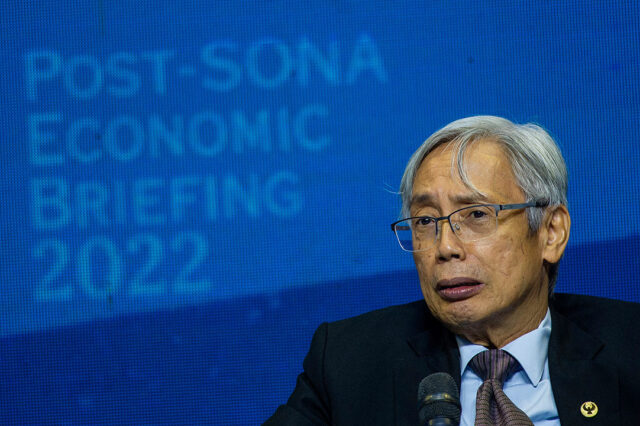
Bangko Sentral ng Pilipinas (BSP) Governor Felipe M. Medalla attends an economic briefing in Pasay City, July 26, 2022. — REUTERS

The Philippine central bank can focus on fighting inflation as the peso is not a problem, its governor said on Friday.

Robust foreign exchange inflows are supporting the peso, Bangko Sentral ng Pilipinas (BSP) Governor Felipe M. Medalla said in a speech at a thrift bankers’ event.

The BSP will do everything in its power to bring inflation below 4% next year, he said.

The central bank expects inflation to average 6.0% in 2023 and 2.9% in 2024. — Reuters

Canva unveils AI-powered tools

VISUAL communications company Canva released on Thursday a suite of new features based on artificial intelligence (AI) to help both budding creatives and professional designers accelerate the design process and produce better content.

Canva Co-Founder and Chief Executive Officer Melanie Perkins said over 15 billion designs have been created since Canva was founded a decade ago, 500 million of which have been created just in the last month.

“This company was born at a major inflection point when breakthroughs in technology opened up entirely new ways of working. Today we find ourselves at the precipice once more with AI,” she said at a virtual media event on Thursday.

Among other brand management products, the following AI-powered tools mark Canva’s tenth year:

1. Magic Design

Basically a personal design companion, this tool suggests templates based on an image or video given by the user. It curates a selection of personalized templates to be downloaded for further customization.

By selecting designs most suited to the given content, Magic Design is able to lessen the time wasted checking templates one by one.

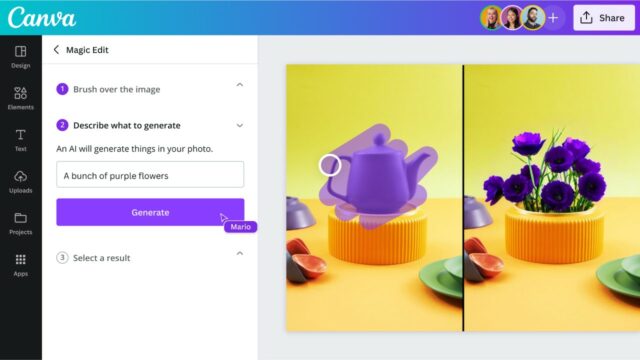
2. Magic Edit

This feature lets designers add or replace anything in an image.

Once the space is identified and the necessary replacement described using keywords, the Magic Edit tool can take this information and make the needed addition.

3. Magic Presentation

The AI in Magic Presentation allows anyone to create engaging presentations about any topic, with relevant and visually rich content already baked in.

It suggests both suitable structure and content no matter the topic, jumpstarting the creative process of making a presentation.

4. Magic Eraser

To clean up unwanted details in images, Magic Eraser uses AI to detect distractions in the given area selected. Users just have to brush over the messy space and watch as the distraction is swiftly removed.

5. Canva Assistant

With one click, Canva Assistant unlocks various other tools while editing and connects the designer to AI-powered features.

Whether it’s to search for eye-catching elements, get recommendations for images and layouts, or generate custom AI content to elevate designs, this tool can fetch any relevant design information under the sun.

6. Beat Sync

This new tool for music-related creations automatically matches video footage to the uploaded soundtrack. Beat Sync uses AI to reduce users’ manual editing time and find right moments to match the beat.

7. Translate

Canva’s latest Translate feature now automatically translates the text in designs with just a tap of a button. It offers translation to over 100 different languages.

8. Magic Write

Now accessible across the entire visual suite, from Docs to Whiteboards to Websites to Videos, this AI writing tool comes up with written content based on prompts.

Whether it’s a phrase that has to be expanded to a full paragraph or a long write-up that has to be summarized into a sentence, Magic Write saves designers the effort of modifying any form of copy. — Brontë H. Lacsamana

Beauty and quality rolled into one powerful device, meet the vivo V27 Series 5G

Finding your aesthetic and keeping in style, that’s the mark of this generation where self-expression is deeply being valued. More than their outfit, they also apply it to what they do, use, and believe, making it  a lifestyle.

As a brand that aims to bring technology that matches the needs of users today, vivo brings a series of smartphones where you can flex your style paired with a powerful performance into one premium device in the newest vivo V27 Series.

Sophistication at its finest

Elegance and confidence, that’s what we see when we meet sophisticated people. Well, it’s because they know what they want. They are  true to who they are and only go for something that matches their own unique aura. If you feel like you are this person, the newest vivo V27 Series has something that suits you. The vivo V27 5G  underwent  the industry’s first jadeite glass process giving it the jade-like finish like you are holding a precious jewel in your hands.

Apart from the exquisite gem design, vivo took inspiration from the glistening green lagoon of El Nido, Palawan to give off a touch of calming nature. With this relaxing vibe, the vivo V27 5G will surely give a chill and effortless yet expensive touch in your style.

Photo by Rommel Paras from Unsplash

Elevating its color, the vivo V27’s Emerald Green variant carries vivo’s signature Photochromic 2.0 technology giving it a mystical color-changing effect. This version is more reactive to light which makes the color-changing process faster than previous V Series models.

Adding to its sophistication is the visual fluidity brought by the upgraded camera module design and the Aura Light. This is the unique ring that illuminates soft light when you capture photos and videos. If you look into it, the Aura Light is definitely a more visually appealing addition along with the rear cameras compared to the regular phone flash.

An aesthetic of elegance and grace

We all have this friend that leaves us speechless with the elegant aura they effortlessly express.  Whether it’s their hairstyle, perfume or simply the way they talk, one thing is for sure, their every move is full of grace.

Are you that friend? If you are, the vivo V27e variant will make you subtly standout in the crowd with the Lavender Purple colorway.

To complete its elegant appearance, the Lavender Purple variant has gone through a special nanoscale lithography process to create an intricate streamer feather pattern which creates a graceful and fluid effect which complements an elegant person like you.

Simple yet strong

No one can ever go wrong with a simple look. With minimalist aesthetics getting more popular nowadays, a simple style is a go-to for many people. What’s more, this also gives a timeless classy style that everyone wants to have. Pair this with a smartphone that has a clean design to effortlessly match your vibe like the vivo V27e Glory Black variant. Its solid black color  gives off a strong and bold aura but suggests luxury and class.

The vivo V27e Glory Back got a small but sweet surprise for you. When put under the light, its design reveals little shimmers that depict a majestic night sky full of stars projecting beauty in mystery.

Slim and Lightweight for Comfortable Feel

Why choose between style and comfort when you can have both. The vivo V27 Series  prioritizes users’ comfort on top of its premium design. The vivo V27 5G variant boasts a 7.36mm 3D curved screen (the thinnest in vivo’s V Series history) with 120Hz FHD+ AMOLED screen display On the other hand, the vivo V27e variant sports a 7.7mm slim flat frame. Feel it for yourself and experience a comfortable grip even with just one hand.

Premium inside and out

The vivo V27 Series is even worth-flexing with its innovative camera features and powerful performance inside. Dubbed as The Aura Portrait Master, this series boasts a first in the industry with its camera feature, the Aura Portrait Algorithm that can give you studio-quality  photos and videos anytime and anywhere. It is equipped with its own light source along with the SONY IMX766V for high quality photos even in  poor-lighting conditions. It is also equipped with the EIS+OIS Dual Ultra Stabilization to ensure that your videos are blur and shake free.

Availability

The vivo V27 Series is now available for pre-order in vivo’s e-store nationwide priced at Php 24,999 for vivo V27 5G and Php 16,999 for vivo V27e variant. To know more about the vivo V27 series, visit vivo’s official website or follow vivo on its official social media pages on Facebook, Twitter, Instagram, YouTube, and TikTok

The vivo V27 Series is also available for installment plans via Home Credit and all major credit cards with zero percent interest. Hurry and don’t miss the chance to see and feel the premiumness of The Aura Portrait Master, the vivo V27 Series in your own hands!


Spotlight is BusinessWorld’s sponsored section that allows advertisers to amplify their brand and connect with BusinessWorld’s audience by enabling them to publish their stories directly on the BusinessWorld Web site. For more information, send an email to online@bworldonline.com.

Join us on Viber at https://bit.ly/3hv6bLA to get more updates and subscribe to BusinessWorld’s titles and get exclusive content through www.bworld-x.com.