Home Blog Page 5062

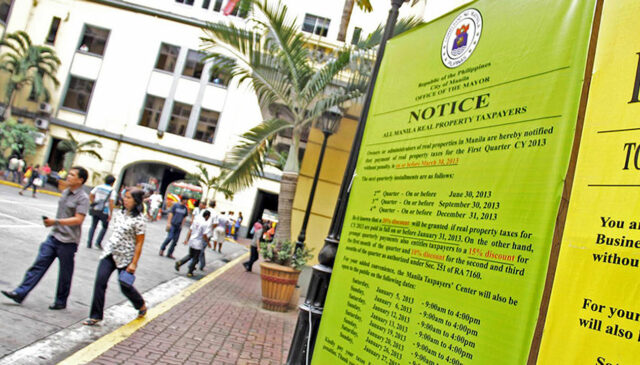
Cities with outdated property tax valuations estimated at 65%

CITIES with outdated schedules of market values (SMVs) for real property have been estimated at 65%, or 96 out of 146, the Congressional Policy and Budget Research Department (CPBRD) said.

SMVs are the basis for calculating property tax, and an outdated schedule with artificially low valuations means local government units are collecting below their potential.

“The number of overdue revisions in SMVs, correlated significantly and negatively with the RPT (real property tax) collections,” the CPBRD said in a report.

According to the report real property tax collections by cities grew only 5.3% between 2019 and 2021, lagging the cities’ rate of development. It added that the Philippines’ recurring taxes on immovable property as a percentage of total tax revenue averaged 2.1%, against Singapore’s 6.7%.

The National Capital Region (NCR) generated P31.18 billion or 39.9% of all real property taxes in 2021, leading all the regions. The City of Manila collected P5.4 billion in real property tax, the most of any local government in the NCR.

House legislators in December approved on third and final reading House Bill No. 6558 or the Real Property Valuation Assessment and Reform Act.

The bill proposes to require the updating of SMVs within two years after the measure passes, and to strengthen the Bureau of Local Government Finance (BLGF) to support the government’s tax reform agenda.

It also proposed that the valuation or appraisal of all real property whether taxable or tax-exempt be based on prevailing market values. Local governments not revising their SMVs will be subject to penalty.

Its counterpart measure, Senate Bill No. 314, is pending at the committee level.

The BLGF estimated that the measure’s passage would generate incremental revenue of between P18.6 billion and P37.5 billion.

Finance Undersecretary Maria Cielo D. Magno told a March 9 Senate hearing that local governments should have a regularly updated database of property transactions for reference in setting property valuations. — Beatriz Marie D. Cruz

MAV policy for corn ‘outdated,’ discourages competition, USDA says

DA.GOV.PH

THE US Department of Agriculture (USDA) called the Philippines’ quota system for admitting corn imports at the minimum tariff “outdated” and not conducive to competition.

The USDA’s Foreign Agricultural Service (FAS) office based in Manila said in a report that the quota system, known as the minimum access volume (MAV) in countries trading under World Trade Organization rules, disadvantages smallholder farmers and new importers.

The Philippines commits to admit corn imports of 216,940 metric tons (MT) at a tariff rate of 35% for shipments falling within the quota, and 50% for shipments in excess of the quota.

In May 2022, former President Rodrigo R. Duterte issued Executive Order (EO) 171 which reduced the Most Favored Nation tariff rate on goods including corn to mitigate the impact of the Russian invasion of Ukraine.

President Ferdinand R. Marcos, Jr. signed EO 10 extending the reduced tariff rates until Dec. 31, 2023.

According to the FAS, stakeholders singled out as “anti-competitive and potentially inconsistent with the Philippines’ commitments with trading partners” practices such as the non-enforcement of penalties for underutilized MAV quotas.

Administrative Order 9 of 1995 outlines the process for allocating import licenses or MAV Import Clearances, creating an advantage for entrenched importers.

“This provision effectively allows existing MAV licensee holders to keep their full allocation for the next year without ever having to import,” the report read.

Corn imports from ASEAN countries, though not counted under the ASEAN Trade in Goods Agreement, are classified as MAV allocations due to underutilization of the MAV.

The FAS said this practice forces new importers to import corn at out-of-quota tariff rates.

“These factors have regularly contributed to the Philippines underfilling its tariff-rate quota and curbed competitive market forces,” the FAS said.

Earlier this year, the FAS projected that corn imports in market year 2022-2023 could top 1 million metric tons, exceeding the year-earlier total by 300,000 MT due to the extension of the low-tariff regime. — Sheldeen Joy Talavera

Ukraine pitches e-gov’t, procurement, mapping apps, long-term grain contracts

REUTERS

UKRAINE has offered the Philippines applications to digitize government functions, procurement and land mapping.

“We have presented three applications which are commercialized. One application is the e-governance application. This product is already market-ready, and we even have the commercial structures prepared to engage with the interested parties here,” Denys Mykhailiuk, a counselor at the Ukrainian Embassy in Malaysia, said at a briefing at the Makati Diamond Residences on Wednesday.

“The second one is the ProZorro platform…, a procurement platform for the government,” he added. “It’s an advanced technological solution (that is) able to reduce the transaction costs and… (human intervention) in the procurement process, so it fights corruption.”

The third app digitalizes aerial and satellite images of land, Mr. Mykhailiuk said.

“It can be used for city planning (and) agriculture, so it’s widely used,” he said. “There will be no need to send thousands of people to measure the land. It will be done through images with our software.”

Ukraine submitted proposals on Tuesday to the departments of Information and Communications Technology (DICT), National Defense and Foreign Affairs.

“The next step might be the MoU (Memorandum of Understanding) between our digitalization ministry and the DICT, for example, but the ball is on the Filipino side,” he said. “We just kicked the ball to your side yesterday, and we’re waiting for a pass back.”

Ukraine is seeking to improve trade with the Philippines to remedy the 94% drop in its bilateral trade after Russia’s invasion, the counselor said.

He proposed that Ukraine supply the Philippines with more grain, one of its top exports, on long-term contract arrangements.

He said the Philippines can build up a grain bank to minimize the impact of volatile market prices for grain.

Ukraine also hoped for Philippine humanitarian assistance to those affected by the war, as well as participation in rebuilding the country.

He said the reconstruction plan involves bringing in Filipino construction workers to Ukraine.

“We will begin talks about Filipino workers to come because this reconstruction effort will need a significant increase in labor,” he said.

“Ukraine, the like majority of European states, is an aging country. Hard-working Filipinos will be very welcomed there,” he added.

Ukraine Foreign Minister Dmytro Kuleba is also expected to visit the Philippines around June or July, Mr. Mykhailiuk said.

It hopes to open an embassy in the Philippines by the end of the year, subject to budget availability as much of the Ukrainian government’s funding is currently dedicated to defense. — Alyssa Nicole O. Tan

DA lifts ban on cattle imports from Netherlands, Brazil, Spain

REUTERS

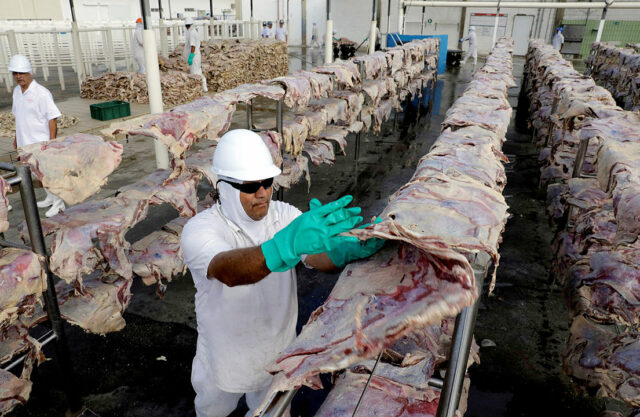
THE GOVERNMENT has lifted a ban on cattle imports from the Netherlands, Brazil, and Spain after those supplier countries were declared free of mad cow disease, formally known as bovine spongiform encephalopathy (BSE).

In separate memorandum orders dated March 28, Department of Agriculture (DA) Undersecretary Domingo F. Panganiban allowed the entry of live cattle, meat products, and processed animal proteins derived from cattle.

Mr. Panganiban said none of the infected animals entered the production system, with no such exports to the Philippines.

According to Republic Act No. 10611 or the Food Safety Act of 2023, the government is required to perform an assessment to determine whether food products pose a risk to consumer health.

The ban on imports from the Netherlands was imposed on Feb. 17 due to reported cases of atypical BSE in Dutch cattle. The outbreak was declared resolved on March 13.

The ban on imports from Brazil was issued on March 22 after detection of the disease in the municipality of Maraba. No additional outbreaks have since been reported.

The ban on imports from Spain was imposed on March 6 after reported cases of BSE in the city of Pontevedra, which were declared resolved on the same day.

According to Mr. Panganiban, authorities from the three countries have provided evidence of their food safety measures that are in line with guidelines set by the Philippines.

He said the World Organisation for Animal Health considers the BSE risk in the three countries to be negligible, though shipments must be certified by their respective veterinary authorities. — Sheldeen Joy Talavera

The perks of being single

In the movies or TV or literature, we have become accustomed to people with extraordinary ability. They defy gravity in red capes, control thunder with enchanted hammers, and so on. We call them “superheroes,” whose mission is to save mankind from evil.

In real life, we also encounter people who accomplish extraordinary things without superpowers. We call them parents. Our parents have been invaluable to us all our lives, being there when we took our first breath, our first bike ride, our first heartbreak, our graduation. However, not all of us are fortunate enough to have both parents guide us through life. Some only have single parents. The path single parents take to raise their children may be different and a bit harder because there is one less person to help.

As such, Congress passed Republic Act (RA) 11861 or the Expanded Solo Parents Welfare Act to further support solo parents in rearing their children. The benefits include discounts and value-added tax (VAT) exemptions on their basic needs.

Thus, the Bureau of Internal Revenue (BIR) released Revenue Regulations (RR) No. 1-2023 to set the guidelines for the tax privileges granted to establishments offering the 10% discount on their sales to solo parents of goods identified under RA 11861; and VAT exemption on the sale of identified goods to solo parents by VAT-registered taxpayers.

PRODUCTS COVERED BY THE INCENTIVE
The products subject to 10% discount and VAT exemption include baby’s milk, food supplements and micronutrient supplements, sanitary diapers, medicine, vaccines, and other medical supplements. These include generic or branded products.

The purchase must be for the exclusive use and enjoyment or availment of the qualified child/children who are not more than six years old. The purchase of medicine, vaccine, and other medical supplements, must be supported by a prescription from the physician.

The incentives apply to a solo parent’s purchases from drug stores, pharmacies, groceries, and similar establishments.

ELIGIBILITY OF SOLO PARENTS FOR INCENTIVES
In order to qualify for tax incentives, the solo parent’s income must not exceed P250,000 per annum. Further, the child or children must be six years of age or under.

The solo parent must present his/her Solo Parent Identification Card (SPIC) and Solo Parent Booklet (SPB) to business establishments when making a purchase. The SPIC and SPB is to be issued by the Solo Parent Office or Solo Parent Division of their city or municipality.

TAX TREATMENT OF THE 10% DISCOUNT
Business establishments are entitled to claim the discounts granted to Solo Parents as deductions in their Income Tax Return (ITR).

As an example, if a VAT-registered grocery store sells milk at a selling price (before discount) of P200, the discount is computed as:

Selling Price (VAT-exempt) — P 200
Less: 10% Discount — 20
Amount Payable by Solo Parent — P 180

In a sale to a qualified solo parent, milk must be VAT exempt. The discount, which is based on the selling price, may be claimed as a deductible against gross income in the year the discount is granted.

Sales reported in the ITR must be the undiscounted selling price, i.e., sales before the discount. Contrary to an ordinary sales discount, however, the solo parent discount must be reported as an expenses, instead of a reduction from sales. As a guide, RR 1-2023 provides the journal entry to record the sale:

Cash — 180
Solo Parent Discount Expense — 20
Sales — 200

The discount will be treated as an ordinary and necessary expense as part of itemized deductions. This means that it cannot be claimed if the seller opts for the Optional Standard Deduction (OSD) during the taxable period.

Further, the following requirements must also be satisfied:

• the gross selling price and the sales discount must be separately indicated in the sales invoice;

• only the actual amount of discount granted or sales discount not less than 10%, whichever is higher, based on the gross selling price can be deducted from the gross income (net of VAT, if applicable) for income tax purposes, and from gross sales, for VAT or other percentage tax purposes;

• the seller must record the sales inclusive of the discount granted;

the discount can only be allowed as deduction for the same taxable year that it is granted; and

• for each sale, the business establishment giving the sales discount must keep a separate and accurate record of the sales, which is to include the name of the solo parent, SPIC number, name/s of the qualified child/ren, gross sales, sales discount granted, date of transaction, and invoice number.

VAT EXEMPTION
The sale is to be presented under Line Item 18 (Exempt Sales/Receipts) in the Quarterly VAT Return (i.e., BIR Form 2550Q). In addition, the input tax attributable to the exempt sale is not allowed as an input tax credit. Instead, such input tax can be claimed as an expense deduction for income tax purposes.

WHAT’S NEXT FOR SOLO PARENTS?
RR 1-2023 is a welcome development not just for the solo parents but also for their children. The very first people who get to witness their hard work and sacrifices in family building are their children. I can say this because I myself am a child of a solo parent. While my mother is no longer able to benefit from the tax incentives from this expanded law, I am certain she is glad that somehow, the solo parent’s role in the society is being acknowledged and valued.  After all, not all heroes wear capes.

The views or opinions expressed in this article are solely those of the author and do not necessarily represent those of Isla Lipana & Co. The content is for general information purposes only, and should not be used as a substitute for specific advice.


Edmund James E. Opinio is a senior associate at the Client Accounting Services department of Isla Lipana & Co., the Philippine member firm of the PwC network.

+63 (2) 8845-2728

edmund.james.opinio@pwc.com

US to transfer two patrol ships to Philippines amid China tensions

U.S. 5th Fleet leaders and Sailors salute during the U.S. national anthem at a decommissioning ceremony in Bahrain for USS Chinook (PC 9), March 28, 2023. The event marked the end of the patrol craft’s 28 years of U.S. naval service. — MASS COMMUNICATION SPECIALIST 2ND CLASS JACOB VERNIER

THE US Navy on Tuesday said it would transfer two Cyclone-class patrol ships stationed in Bahrain to the Philippines, amid China’s increasing assertiveness in the South China Sea.

USS Monsoon and USS Chinook, which it used for almost three decades, were decommissioned on March 28, the US Naval Forces Central Command said in a statement posted on its website.

Monsoon and Chinook are slated for transfer to the Philippine Navy,” it said, noting that officials from the Philippines had attended the decommissioning ceremony.

Monsoon was initially commissioned by the US Navy in 1994 and was recommissioned in 2008 after it served four years in the US Coast Guard, according to the statement. Chinook was commissioned in 1995.

“Monsoon and Chinook are the last of a group of 10 ships designed for shallow-water operations that were stationed in Bahrain,” the US Navy said.

It was not clear in the US Navy statement whether the two ships had been donated to the Philippines, but Naval News said in a report the ships “are likely being transferred via excess defense articles, most likely from a 2021 offer.”

Excess defense articles are articles owned by the US Department of Defense and US Coast Guard that are no longer needed and declared excess by the US Armed Forces, according to a website post by the US Department of Commerce’s Bureau of Industry and Security.

“This excess equipment may be offered at reduced or no cost to eligible foreign recipients on an ‘as is, where is’ basis in support of US national security and foreign policy objectives,” it said.

“I’m also proud that we are turning over great ships to our Philippine partners,” Anthony Webber, commander of Task Force 55, which oversees operations for the US 5th Fleet’s surface forces, said in the statement.

China last week accused the US of worsening tensions by boosting military deployment in the Asia-Pacific region.

Countries in the region should remain vigilant and avoid being coerced or used by the US, Chinese Foreign Ministry spokesman Wang Wenbin told a news briefing in Beijing, based on a transcript posted on the agency’s website on March 22.

He also reiterated his opposition to a decision by Philippine President Ferdinand R. Marcos, Jr. to increase US access to military bases in the Southeast Asian nation under their 2014 Enhanced Defense Cooperation Agreement (EDCA).

Mr. Wang said physical consultations between the Foreign ministries of China and the Philippines would let both sides have an “in-depth communication on properly handling maritime disputes and advancing practical maritime cooperation.

‘MARITIME SECURITY’
Last month, the Philippine government said it would allow the US to access four more military bases. Projects at five existing EDCA sites were almost finished, it added. Under the 2014 pact, Philippine military bases may be used for joint training, pre-positioning of equipment and building facilities such as runways, fuel storage and military housing.

Philippine and Chinese envoys met in Manila on March 23 for their seventh Bilateral Consultation Mechanism on the South China Sea, their first since a global coronavirus pandemic started in 2020.

The South China Sea, a key global shipping route, is subject to overlapping territorial claims involving China, Brunei, Malaysia, the Philippines, Taiwan and Vietnam. Each year, trillions of dollars of trade flow through the sea, which is also rich in fish and gas.

More than 40 Chinese boats were still roaming near Thitu Island in the South China Sea, the Philippine Coast Guard said weeks after it accused its Chinese counterpart of endangering the crew of a resupply ship in an incident that has stoked long-running diplomatic tensions over China’s expansive claims in the waterway.

Mr. Marcos has asked the Philippine Army to boost relations with its foreign counterparts, highlighting the importance of international ties amid increasing Chinese assertiveness in Philippine-claimed areas in the South China Sea.

Local foreign policy think tanks and experts have been urging the Philippine government to partner with as many countries as possible to deter China’s expansive activities at sea.

The Philippines and Bahrain are members of a top naval partnership in the world called Combined Maritime Forces, according to the US Navy.

Forces from the US-led organization’s 38 members operate across 3.2 million square miles (5.1 million square kilometers) of international water space in the Middle East, it said. “The partnership ensures maritime security and stability in some of the world’s most important shipping lanes.”

The Philippines has been eyeing several security partnerships with other countries, including a tripartite security pact with Japan and the US.

The Southeast Asian nation was also in talks to include Australia and Japan in its planned joint South China Sea patrols with the US. – Kyle Aristophere T. Atienza

Marcos told to work with ICC in probe of drug war

PHILIPPINE STAR/MICHAEL VARCAS

By John Victor D. Ordoñez, Reporter

THE BIGGEST labor coalition in the Philippines on Wednesday asked the government of President Ferdinand R. Marcos, Jr. to cooperate with the International Criminal Court’s (ICC) probe of his predecessor’s deadly war on drugs even if it means offending a political ally.

“The government’s decision to sever ties with the ICC is counterproductive as it sends a wrong message to the international community that justice prevailed under the previous administration,” Nagkaisa said in a statement.

“The president should have acted as a real statesman by ditching his fear of offending a political ally rather than lose face before the international community,” it added.

Carol Claudio, the executive assistant of Presidential Communications Office chief Cheloy Velicaria-Garafil, did not immediately reply to a Viber message seeking comment.

Mr. Marcos on Tuesday said the government would “disengage” with the ICC after the tribunal rejected its plea to suspend the probe of ex-President Rodrigo R. Duterte’s anti-illegal drug campaign.

“We don’t have a next move, that is the extent of our involvement with the ICC,” he told a news briefing. “That ends all our involvement with the ICC.”

Mr. Duterte canceled Philippine membership in the ICC in 2018. Mr. Marcos has said the Philippines would not rejoin the international tribunal, noting that the probe is a threat to Philippine sovereignty.

In an eight-page decision dated March 2, the court’s Appeals Chamber said the Philippines had failed to persuade the tribunal to suspend the probe.

The ICC said its investigation should not prevent the Philippines from continuing its own probe of rogue cops in the state’s deadly war on drugs.

Solicitor General Menardo I. Guevarra said the country is not legally and morally bound to cooperate with the international tribunal.

“This ruling will have serious and far-reaching consequences for our country,” he said in a Viber message on Tuesday. “It places us in the same class of rogue nations where the rule of law is not respected.”

The ICC in January reopened its investigation into killings and so-called crimes against humanity under Mr. Duterte’s drug war. It said it was not satisfied with Philippine efforts to probe human rights abuses during the period.

The Philippine government asked the chamber to suspend its probe of the drug war, citing the lack of authority on the part of the ICC prosecutor. It also said it encroaches on Philippine sovereignty.

ICC prosecutor Ahmad A. Khan on Feb. 16 told the ICC the Philippines had not raised new arguments to justify halting the probe.

Meanwhile, Senator Francis N. Tolentino said he would lawyer for Ronald M. dela Rosa, Mr. Duterte’s police chief and now a senator, in case he is prosecuted by the international tribunal.

“I accept the letter, the proposal of Senator Dela Rosa to lawyer for him,” Mr. Tolentino told a news briefing, based on a transcript sent to reporters.

“My role there would be to ensure the protection of Senator Dela Rosa not just within the confines of the ICC because we are claiming that they don’t have jurisdiction [over us], but even locally.”

He said he would seek Senate President Juan Miguel F. Zubiri’s permission to lawyer for Mr. Dela Rosa.

Mr. Dela Rosa has said the ICC’s probe was an insult to the Philippine justice system, adding he would rather be tried under local courts.

‘OBLIGATION’
Last month, Senators Robin C. Padilla and Senator Jose “Jinggoy” Estrada filed resolutions seeking the “unequivocal defense” of Mr. Duterte.

Former President and Pampanga Rep. Gloria Macapagal Arroyo and more than a dozen congressmen made a similar call on Feb. 16, saying the Philippines had a functioning justice system.

“The Marcos administration is bent on protecting his predecessor, Duterte, and some of his associates who are now in the government,” Arjan P. Aguirre, who teaches political science at the Ateneo de Manila University, said in a Facebook Messenger chat.

“This is used by Marcos in keeping the alliance with Vice-President Sara Duterte-Carpio intact.”

The United Nations (UN) Human Rights Committee has said the Philippines should comply with international human rights mechanisms and cooperate with its investigation.

The UN Commissioner for Human Rights last year said the government’s probe of human rights violations in connection with the drug war lacked transparency.

At least 6,117 suspected drug dealers had been killed in police operations, according to data released by the Philippine government in June 2021. Human rights groups estimate that as many as 30,000 suspects died.

Amnesty International said in a report on March 27 drug war killings continued under the Marcos administration.

There were 324 drug-related killings in the Philippines last year, 175 of which occurred after Mr. Marcos took office in July, it said, citing a study by the University of the Philippines and Belgium’s Ghent University.

The Philippines has accepted 200 recommendations from the UN Human Rights Council, including investigating extralegal killings and protecting journalists and activists.

“We believe that the investigation is not a violation of Philippine sovereignty, but rather an obligation under international law which forms part of the law of the country,” Nagkaisa said.

US ship with ROV arrives in Philippines to help contain oil spill

DENR PHOTO

A UNITED STATES ship equipped with a remotely operated vehicle (ROV) has arrived in the Philippines to help contain an oil spill in the waters of Oriental Mindoro province south of the capital.

The anchor handling ship named Pacific Valkyrie arrived at Subic Bay, Zambales in central Luzon on Tuesday morning, the Office of Civil Defense said in a statement late Tuesday.

It said the US vessel carried a submersible ROV, which would conduct a video and sonar survey of the oil tanker that sank and caused the spill on Feb. 28.

“The ROV can take still photographs and carry a payload of 150lbs,” the office said. It has function manipulators capable of work at depth and auxiliary servos for hydraulic tool operations.”

It said the survey would be used in determining solutions “to salvage the vessel and its content.”

The US government is also expected to send 11,000 feet of 26-inch absorbent harbor boom, which will be used to prevent the oil from spreading, and personal protective equipment.

Experts from the US Coast Guard, National Oceanic and Atmospheric Administration and US Navy are also expected to participate in the cleanup.

MT Princess Empress, was carrying 800,000 liters of industrial fuel oil when it sank in the waters of Naujan, Oriental Mindoro last month, harming coastal communities and fish sanctuaries.

In a Wednesday update, the Philippine Coast Guard said it had collected more than 10,000 liters of oily water mixture and 131 sacks of oil-contaminated materials during its oil spill response operations that started on Mar. 1.

It had also collected 3,71.5 sacks of oil-contaminated materials during its shoreline response operations.

Meanwhile, the coast guard said in a separate statement the US Navy’s Hydros ROV would start operations on Apr. 3.

It said the US government would provide a crane and launching system in the deployment of the machine. — Kyle Aristophere T. Atienza

CoA orders dissolution of state-owned infra investment company 

PHILIPPINE STAR/MICHAEL VARCAS

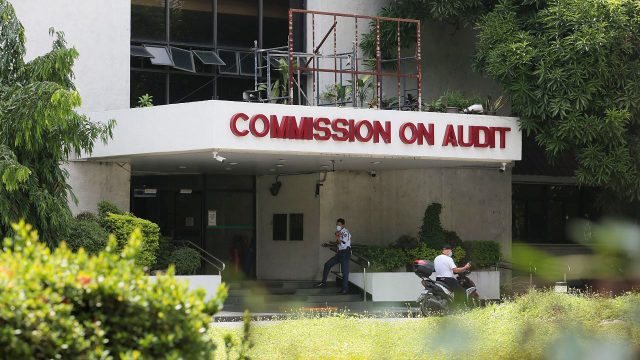
THE COMMISSION on Audit (CoA) has again recommended the immediate dissolution of a government-owned infrastructure investment company that has been inactive for more than 10 years but continues to incur expenses.  

In a 2022 audit report released March 23, CoA told the National Development Company-Philippine Infrastructure Corp. (NPIC) to formally classify itself as an inactive or non-operational government-owned and -controlled corporation.  

The indecisiveness of the corporations management whether to pursue its corporate dissolution or apply for reactivation in its prolonged inactivity while continuously incurring expenses aggregating to P17.53 million for the last 15 years,the report said.  

CoA previously recommended the abolition of the NPIC in its 2021 annual audit report.  

It said closing the NPIC is more practical and cost-efficient.”  

It also noted that the companys dividends from its 2021 net earnings were not declared and remitted to the national government, violating Republic Act No. 7656, which mandates all state-owned corporations to remit its additional revenues to the government.  

State auditors also recommended that NPIC declare and remit its dividends on time to avoid penalties and other charges.  

Audits show that the NPIC had a net income of P439,216 in 2022, higher than its P390,130 net earnings in 2021.  

The NPIC was created in 2005 to develop, package, structure, and/or manage investments in infrastructure projects and commercial ventures.   

It is a wholly owned subsidiary of the National Development Company and is attached to the Department of Trade and Industry. Beatriz Marie D. Cruz 

Marcos calls for laws to end malnourishment as PHL rolls out P9.7-B nutrition program 

PNA-MALACANANG

PRESIDENT Ferdinand R. Marcos, Jr. on Wednesday urged lawmakers to create laws that will stamp out malnutrition in the long term as the government launched a World Bank-funded nutrition program that will be rolled out in over 200 towns nationwide.   

Let me also take this opportunity to enjoin our lawmakers for their assistance in this endeavor by helping us develop and enshrine into law policies that will help eradicate malnutrition and uplift the standards of primary health care and nutrition in the Philippines,” he said in a speech during the launch of the Philippine Multisectoral Nutrition Project (PMNP).  

The four-year program is financed by a $178.1-million or about P9.7-billion loan approved by the World Bank last year. 

The lead implementers of the program are the Health department, which will handle about 70% of the fund, and the Social Welfare department with 30%.  

The PMNP aims to increase the utilization, expand the coverage and improve existing interventions to promote better health for children and women,National Economic and Development Authority Secretary Arsenio M. Balisacan said during the launch, which was livestreamed by the state broadcast network. 

It aims to implement nutrition-specific and nutrition-sensitive interventions and improve key behaviors and practices known to reduce stunting in targeted localities.   

Last year, the Philippines was 69th out of 121 countries in the Global Hunger Index. Although this is considered as having a moderate level of hunger, we still face significant issues,Health officer-in-charge Maria Rosario S. Vergeire said at the event.   

Around 30% of Filipino children under the age of five are stunted. 

Our issues with nutrition go beyond access to food, these are affected by health, education, livelihood, social welfare and governance. We are aware of the intergenerational effect of malnutrition,she said.   

Stunting in children was lessened by as much as 8% three years after a similar project was implemented in other countries, Ms. Vergeire told reporters on the sidelines of the event.  

LGUs (local government units) can only access the grants if they reach the targets they will be setting,she said, vowing to extend assistance to localities that are lagging behind.

Social Welfare Secretary Rexlon T. Gatchalian, for his part, said the project will boost public participation in identifying nutrition and health problems, and designing solutions.  

Through community-based nutrition service delivery, we can reach more people and make it more available to those who face barriers to healthcare, he said. 

The president cited the impact of malnutrition on the countrys human resources given its long-term adverse developmental effects on peoples learning ability, academic performance, all the way to productivity and employment opportunities and it also carries with it hereditary implications.Kyle Aristophere T. Atienza and Luisa Maria Jacinta C. Jocson 

Bangsamoro drafts 6-year rehabilitation plan for 10 typhoon-hit towns 

BANGSAMORO GOVT MILG

A REHABILITATION plan for 10 Bangsamoro towns that were most affected by a strong typhoon in October last year is now being drafted, including strategies to ensure climate change resilience, the regional government said.   

The six-year recovery and rehabilitation plan is led by the Bangsamoro Planning and Development Authority (BPDA) in partnership with the World Bank.   

An initial overall planning session was held last week with representatives from the Bangsamoro ministries, regional government agencies, and some local government officials. 

These participants have successfully drafted the plans framework that comprises the medium to long-term goals, outcomes, sectoral objectives, and strategies,the BPDA said in a statement on Tuesday.   

A series of local-level consultations is also scheduled in the provinces of Maguindanao, Basilan, Sulu, and Tawi-Tawi.  

This inclusive process will further ensure the projects long-term viability and enhance its benefits to locally impacted communities and other stakeholders,the BPDA said. 

The 10 municipalities hit hardest by severe tropical storm Nalgae, locally named Paeng, were: Datu Blah Sinsuat, Datu Odin Sinsuat, Sultan Mastura, Upi, Guindulungan, and Parang in Maguindanao; Balabagan in Lanao del Sur; Maluso in Basilan; Patikul in Sulu; and Bongao in Tawi-Tawi. 

The Bangsamoro Autonomous Region in Muslim Mindanao (BARMM) recorded 62 deaths, mostly in the town of Datu Odin Sinsuat in Maguindanao Del Norte due to a landslide that buried a village. 

More than 10 were listed as missing while 38 people were injured.     

A total of 371 houses were destroyed and 480 were partially damaged, based on data from the Bangsamoro Disaster Risk Reduction and Management Council.  

Damage in infrastructure and agriculture reached about P586 million. Marifi S. Jara 

81 Filipino overseas workers facing death penalty cases — DFA 

DEPARTMENT OF FOREIGN AFFAIRS FACEBOOK PAGE

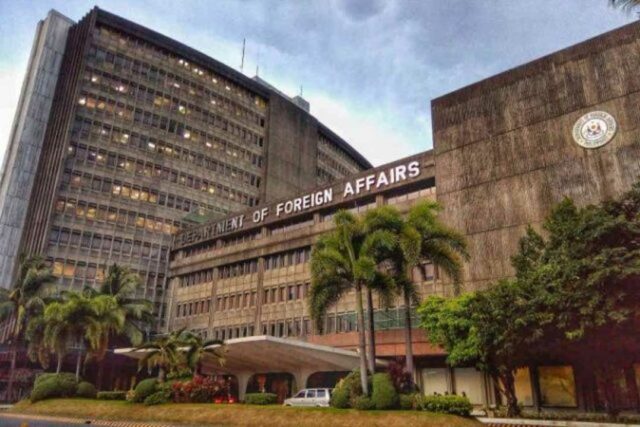
THE DEPARTMENT of Foreign Affairs (DFA) reported on Wednesday that 81 Filipino workers abroad have pending cases that are punishable by death.  

The DFA continues to work hard and exhausts all diplomatic channels available to ensure that no death penalty sentence is executed against any of our kababayans (countrymen),states a data sheet from the Assistance to Nationals program.   

It cited accomplishments in recent years involving the acquittal of one Filipino in Saudi Arabia and another in the United Arab Emirates, who were both on death row for murder.   

The DFA also said the death sentence on two Filipinos in Saudi Arabia were commuted in 2022 to nine years in prison. 

The department also obtained 354 pardons from 2018 to 2022, with most cases filed due to drug trafficking, prostitution and theft. 

It also reported that it has secured 135 acquittals through its legal assistance fund in 2022.  

Of the total, 132 were from the Middle East, two from Asia, and one from Africa. 

The 2022 figures should be appreciated vis à vis the fact that, for the first half of 2022, most countries in Asia and the Middle East were still practicing strict COVID-19 control protocols,the DFA said.  

A total of 556 acquittals were secured from the Middle East, Asia, Africa and America between 2018 to 2022.  

Most of the acquittals involved retaliatory cases filed against household service workers in the Middle East for theft, absconding and breach of trust.     

The DFA said legal assistance given to overseas Filipinos start even before the commencement of actual trials.”  

Such services would include representing the accused Filipino during custodial investigation, explaining to the Filipino the nuances of a particular case, making representations to the police investigators or the prosecutor for the dismissal of the complains, as well as reporting to the embassy or consulate developments of a particular case,it added. Alyssa Nicole O. Tan 

ADVERTISEMENT
ADVERTISEMENT