Home Blog Page 504

Advancing orthopedic surgery through technology
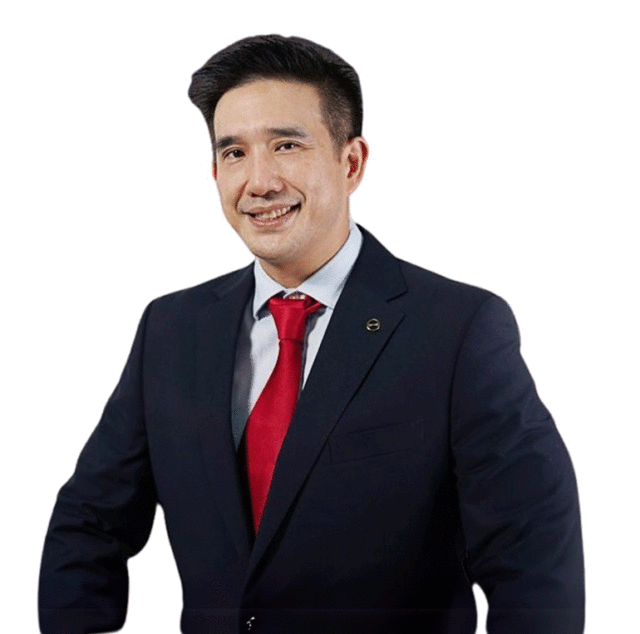
Dr. Alan Cheung, orthopedic surgeon at Mount Elizabeth Novena Hospital

Orthopedic issues affect millions of people worldwide, from young athletes recovering from sports injuries to older adults dealing with degenerative joint conditions.

Dr. Alan Cheung, an orthopedic surgeon at Mount Elizabeth Novena Hospital, says the nature of these conditions often varies by age. Younger individuals typically experience ligament and meniscus injuries. Shoulder injuries are also common, especially among those involved in contact sports or repetitive overhead movements.

Older adults, however, face joint wear-and-tear, leading to osteoarthritis. Dr. Cheung attributes the rise in osteoarthritis to increased life expectancy, explaining that cartilage, like a car tire, does not regenerate. Once it wears out, joint stiffness and pain set in, often leading to joint replacements.

“Osteoarthritis is more common now worldwide because people are living longer,” the surgeon explained. “If you live long enough, your joints will wear out, and that usually starts in our early 50s. The average age of someone having a joint replacement of their knee or hip is usually in their 60s.”

Genetics also contributes in the development of osteoarthritis. People with a family history of joint problems are more likely to experience similar issues.

“If you look at your parents and they have bad knees, unfortunately, you could also have bad knees,” said Dr. Cheung. “But at least you can be more aware and try to do things to prevent or reduce the risk of osteoarthritis from happening.”

Sports injuries, when ignored or improperly treated, can accelerate joint degeneration, according to the orthopedic surgeon. Over time, the wear-and-tear on the joint progresses can lead to chronic pain and mobility issues.

“[Individuals] who neglected or ignored injuries years ago, their joint wears out quicker over time; so they [may develop] osteoarthritis at an earlier age,” he added.

Enhancing precision and recovery

Dr. Cheung’s expertise in advanced robotic surgery, including the use of MAKOplasty, Robodoc, and NAVIO systems, places him among the few surgeons in Asia trained in these cutting-edge technologies. These systems offer a more precise and personalized approach to surgery — something unimaginable a few decades ago.

For patients with severe osteoarthritis, traditional treatments like physiotherapy or injections may not provide relief. When these conservative methods fail, joint replacement surgery becomes necessary.

“In the past, [surgeries] were all done manually by hands and using the human eye. But nowadays, we have more advanced robotic technology so that surgeons like me can come along and plan very carefully,” he noted. “Using robotic technology in surgery is similar to solving a complex equation. You can do it by hand on a paper or with an abacus, but using a computer makes it more accurate, faster, and ultimately get better results in the long term.”

Robotic systems allow surgeons to perform intricate procedures with higher precision. They also minimize the amount of tissue removed, reducing the risk of complications.

Such surgeries, according to Dr. Cheung, involve less trauma to the body and, in many cases, a faster return to normal activity. Patients can often begin walking almost immediately after surgery, as the technology promotes smoother healing.

“Patients have misconceptions about surgery that it’s going to take a long time, it’s going to be extremely painful, and it will take a long, long time to recover,” he added. “But [robotic-assisted surgery] can be a very effective way of taking away the pain almost instantly, and the recovery can be pretty rapid.”

Prioritizing healthcare needs

For many, the thought of surgery brings uncertainty about what will happen, what to expect during recovery, and how it will change their lives. Dr. Cheung understands that the decision to undergo surgery is not an easy one, especially when patients have exhausted all other options.

“I describe how the process works very carefully so patients understand,” he explained. “Once you understand what’s going to happen, then you don’t have to fear the unknown.”

Dr. Cheung uses video testimonials from patients who have undergone the procedure to show how quickly they return to normal life. He personally introduces new patients to those who have successfully undergone similar surgeries.

On the other hand, the surgeon emphasizes the importance of addressing joint pain and sports-related injuries early, urging individuals to take proactive steps to safeguard their health.

“Don’t ignore your pain. If you do, you may have just picked up an injury that will trouble you 20 years down the line. At least see a physiotherapist or a sports doctor to get it checked out thoroughly,” he advised. “For older individuals, get checked out regularly every year to make sure things aren’t deteriorating at a rapid pace.”

Dr. Cheung is one of the key figures at Mount Elizabeth Novena Hospital, which offers patients access to cutting-edge care.

“The expertise here is unparalleled,” he noted. “We have doctors who trained all over the world, like in the United Kingdom, the United States, and Australia.”

Located in Singapore, Mount Elizabeth Hospital is known for its world-class medical facilities. Patients can expect top-tier care, equipped with advanced medical technologies, including robotic systems that are often unavailable in many other countries.

For inquiries, please contact Mount Elizabeth Hospital’s patient assistance center, IHH Healthcare Singapore — Philippine Office, located at G/F-B, Marco Polo Hotel, Meralco Avenue and Sapphire Street, Ortigas Center, Pasig City 1600; e-mail manila.ph@ihhhealthcare.com; or call 0917-526-7576.


Spotlight is BusinessWorld’s sponsored section that allows advertisers to amplify their brand and connect with BusinessWorld’s audience by publishing their stories on the BusinessWorld Web site. For more information, send an email to online@bworldonline.com.

Join us on Viber at https://bit.ly/3hv6bLA to get more updates and subscribe to BusinessWorld’s titles and get exclusive content through www.bworld-x.com.

Metro Manila Film Festival 2025: Not my story, but why do I cry?

By Joseph L. Garcia, Senior Reporter

Movie Review
Call Me Mother
Directed by Jun R. Lana
Produced by Star Cinema, The IdeaFirst Company, and Viva Films
MTRCB Rating: PG

WE USUALLY CRY when watching movies because something there happened to us, or someone we know — or at the very least, the film presents a premise that might remotely hit close to home. I started crying in the last 35 minutes of Jun Robles Lana’s latest work, Call Me Mother — which was strange and mildly irritating, because I knew damn well none of the things in the movie have happened to me, or anyone I know. Maybe that’s what a great performance does; and perhaps that’s one of Mr. Lana’s gifts, because suddenly, this story of queer parenthood is suddenly mine (I don’t even have a dog).

The movie opens with a talking heads-segment anchored by a coterie of real-life beauty queens (pageant-spotters would have a field day) introducing the character of Twinkle de Guzman (played by Vice Ganda). Twinkle is their pageant “mother,” the coach engineering their success in the pageant world. The death of their mother’s actual mother causes Twinkle to adopt his mother’s ward, dropping his responsibilities at work to raise the baby himself. A Vice Ganda-coded scene (the baby chokes on a pearl, and Vice, clad in only a towel, runs in the streets to ask for help; only to step onto a skateboard to bring the baby to the hospital himself) ends emotionally, solidifying the love he might actually have for an adopted baby, in his heart now fully his own.

In a boardinghouse, Twinkle raises the baby, growing into a child now named Angelo, with an unconventional family (including his own queer “mother” played by John Lapus — here strangely resembling the late Jaclyn Jose, perhaps as a tribute; and a bevy of young folks whose names I didn’t bother with). Angelo is raised in love and affection, and save for economic difficulties due to Twinkle’s irregular employment, all is well.

An opportunity to work abroad in Hong Kong Disneyland prompts Twinkle to start the legal adoption process so he can bring Angelo with him. To do this, he needs the signature and cooperation of Angelo’s birth mother. Unfortunately, she’s Twinkle’s ex-student: the glamorous, recently engaged Mara de Jesus (played by Nadine Lustre).

Mara has her own agenda: despite giving up her child in the pursuit of fame and success, the country’s top pageant crown remained out of her reach. The two hammer out a deal to get Mara her crown, and Twinkle the legal rights to the child. Twinkle’s chief fear becomes real: that a bond would form between birth mother and child, and that’s the rest of our movie.

Of course the Vice Ganda stamp of comedy is ever-present in the film. By now the comedian has proven that he’s an expert in camp and physical comedy, but his skill in seriousness is always a pleasant surprise. His recent turn in drama in another Lana work, the director’s offering for last year’s Metro Manila Film Festival And The Breadwinner Is… is easily knocked out of the park by this one. Truly, no one does drama better than a comedian who does a volte-face — those tasked to cheer up the world (perhaps because they’ve seen so much of its pain).

Mr. Lana’s work is often a chaotic teeter-totter of comedy and drama, and the stars are right in the middle, furiously juggling. This film, opening as a comedy and ending as straight drama, blends this formula more gracefully than in his other work. In tune with Vice Ganda’s volte-face, Ms. Lustre’s dramatic chops are added dimension by showing off her own skill in comedy (perfectly illustrated in a scene with a bicycle). If anything, she should have done more funny scenes in the film, just so Vice’s performance would have an equal parallel.

In another turn, the normally villainous Chanda Romero becomes an effective, soothing, kindly adoption counselor, a light touch and the face of the law in the film. The child playing Angelo, Lucas Andalio, was excellent, and might just bring home an award this year. The cast, however, is bloated by new stars whose presence in the film could have been erased without making much of a difference.

More than the fine performances in the film, the script is genuinely thought-provoking. Yes, it joins the canon of other Filipino adoption stories — perhaps a spiritual successor of specifically queer Ang Tatay Kong Nanay, then starring Dolphy, but a Vilma one is on the tip of my tongue; among others. This one is a stylish update of those stories.

Of course, like many stories that have come before it, this adoption story wants to ask: what does it really mean to be a mother? The film is rich in imagery of the Virgin Mary, the mother against whom the rest of the world is measured. The mothers in this story are all different: there are work mothers, queer mothers, birth mothers, bad mothers; etc. This story, however, dares to ask what’s better: a life fueled by pure, raw, love, or one made unwrinkled also by love, but mostly ease and convention?

The film saw a full house when I watched it in the cinema; the audience applauded while the credits rolled. I wiped my tears as I stepped out of the theater with some embarrassment, that I was such easy work for such a story. However, in the dark, I couldn’t see anyone else crying. But groups and groups of people filed out of the theater, and I noted tears on at least one person out of every group of three. Maybe this wasn’t our story — but we all have a mother, don’t we?

Peso seen range-bound amid thin trading volume

PHILSTAR FILE PHOTO

THE PESO is expected to move sideways against the dollar this shortened trading week as market activity is likely to be sluggish amid the holidays and the lack of fresh leads.

On Friday, the local unit gained by 14 centavos to close at P58.71 per dollar from its P58.85 finish on Tuesday, data from the Bankers Association of the Philippines showed.

Week on week, the peso slipped by a centavo from its P58.70 close versus the greenback on Dec. 19.

Remittance inflows likely helped lift the peso on Friday, Rizal Commercial Banking Corp. Chief Economist Michael L. Ricafort said in a Viber message.

“The US dollar-peso exchange rate corrected slightly lower… in view of the upcoming series of holidays until new year, when there could still be some residual seasonal increase in OFW (overseas Filipino worker) remittances and conversion to pesos to finance Yuletide- and New Year-related holiday spending,” he said.

Philippine financial markets will be closed on Dec. 30 and 31 and Jan. 1 for Rizal Day and the New Year holidays. Trading will resume on Friday (Jan. 2).

The dollar index, which measures the US currency against six rivals, rose 0.08% to 98.03 on Friday, Reuters reported. The Japanese yen softened against the dollar as investors remained on watch for potential intervention to shore up the currency.

“There’s no major catalyst and then it’s yearend, so market activity is thin,” a trader said in a phone interview, adding that this consolidation will likely continue this week as there are only two trading days.

For Monday, the last trading day of 2025, Mr. Ricafort said the local unit could move between P58.55 and P58.85.

For the whole week, he expects the peso to trade between P58.50 and P58.95, while the trader said the peso could range from P58.50 to P59 against the greenback. — Katherine K. Chan

Philippine Startup Week 2026 to align with ASEAN priorities under DICT-led ISA Committee

Following the successful conclusion of Philippine Startup Week (PHSW) 2025, the Innovative Startup Act (ISA) Committee, now chaired by the Department of Information and Communications Technology (DICT), has outlined plans to align Philippine Startup Week (PHSW) 2026 with broader ASEAN priorities.

During this year’s edition, the chairmanship of the ISA Steering Committee formally transitioned from the Department of Science and Technology (DoST) to the DICT. The committee, working alongside the Department of Trade and Industry (DTI) and the National Development Company (NDC), oversaw the staging of PHSW 2025, which focused on innovation, partnerships, and national economic impact. 

PHSW 2025 featured keynote sessions, startup pitching activities, and industry discussions highlighting technology- and business-driven solutions, with the program including community-led events across various regions. Filipino startups were also recognized through showcases and awards, while participants engaged in networking sessions with local and international ecosystem enablers.

The week-long event comprised eight main conferences, 39 community-driven events, and showcases involving nearly 150 startups. Almost 2,000 participants took part nationwide, with core activities hosted at the Philippine Innovation Hub in Marikina from Nov. 11 to 14.

Looking ahead to 2026, the ISA Committee said the Philippines’ upcoming ASEAN Chairmanship presents an opportunity to position PHSW as a platform for regional collaboration. Under the DICT’s leadership, the committee aims to align the event with ASEAN priorities in digital transformation, innovation, and cross-border cooperation.

Officials said PHSW 2026 is intended to help Philippine startups scale beyond the domestic market by creating stronger links with investors, corporations, and policy makers across Southeast Asia. In line with ASEAN’s regional theme, “Navigating Our Future, Together,” the event is expected to place greater emphasis on cross-border collaboration and regional ecosystem integration.

Building on previous editions, PHSW 2026 is set to continue convening government agencies, industry leaders, investors, academic institutions, development partners, and high-growth startups. Organizers said next year’s program will focus on emerging technologies, social impact, sustainability, and digital innovation, with the aim of strengthening the competitiveness and regional relevance of the Philippine startup ecosystem.


SparkUp is BusinessWorld’s multimedia brand created to inform, inspire, and empower the Philippine startups; micro, small and medium enterprises (MSMEs); and future business leaders. This section will be published every other Monday. For pitches and releases about startups, e-mail to bmbeltran@bworldonline.com (cc: abconoza@bworldonline.com). Materials sent become BW property.

Win a brand-new Santa Fe in ‘Hyundai Grand Holidays Promo’

PHOTO FROM HYUNDAI MOTOR PHILIPPINES

BUYERS OF a qualified Hyundai vehicle at any authorized dealership until Jan. 31, 2026 will get a chance to win a brand-new Santa Fe 2.5T Calligraphy AWD through the Hyundai Motor Philippines, Inc. (HMPH) “Grand Holidays Promo.” Each unit purchased nets one raffle entry.

“Our Grand Holidays Promo is our way of expressing gratitude to our customers who continue to place their trust in Hyundai. This season, we want to give Filipinos a chance to welcome the new year with something truly exceptional: an SUV that embodies innovation, comfort, and modern mobility. This encapsulates our goal to make Hyundai ownership a meaningful experience for all our customers,” said HMPH Managing Director Cecil Capacete.

Customers need to complete the official raffle registration form upon vehicle release, which will be provided via QR code by their chosen dealership. Only fully registered and validated entries will qualify for the draw. The raffle draw and official winner announcement will be held in February 2026. For the full mechanics, visit https://www.hyundai.com/ph/en. Get more information through @HyundaiMotorPhilippines on Facebook and Instagram.

Filinvest Land settles P5-billion bonds

Filinvest City, Alabang, Muntinlupa — FILINVESTLAND.COM

GOTIANUN-LED Filinvest Land, Inc. (FLI) said it has redeemed P5 billion worth of four-year fixed-rate bonds that matured on Dec. 21.

In a stock exchange disclosure on Friday last week, FLI said the bond proceeds were invested in its residential projects in Quezon City and Mandaluyong City amid strong demand.

Projects financed by the bond issuance include the 34-storey One Filinvest tower in the Ortigas area and the Activa mixed-use development in Cubao, Quezon City, which is scheduled to begin operations in 2026.

Bond proceeds were also allocated to the Studio 7 tower in Quezon City, which houses the 8,120-square-meter office of the Department of Information and Communications Technology.

The Philippine Depository & Trust Corp. facilitated the bond redemption as registrar and paying agent, with payment made on Dec. 22, it said.

FLI Chief Operating Officer and Chief Financial Officer Ana Venus A. Mejia said the redemption reflects the company’s continued financial discipline and alignment with its long-term capital strategy.

“This shows our unwavering commitment to financial prudence and demonstrates our ability to manage obligations and to invest in our core developments nationwide,” she said.

FLI’s portfolio includes office towers, mid-rise and high-rise residential developments, townships, mixed-use developments, malls, and leisure projects.

The company has also developed large-scale townscapes, including the 300-hectare (ha) Havila; 677-ha Timberland Heights; and 60-ha Manna East in Rizal; 335-ha Ciudad de Calamba in Laguna; 51-ha Palm Estates in Talisay City, Negros Occidental; and the 58-ha City di Mare in Cebu City.

FLI is developing two townships in Clark, Pampanga — the 288-ha Filinvest New Clark City within the Clark Freeport Zone, and the 201-ha Filinvest Mimosa+ Leisure City, which it is developing in partnership with its sister firm, Filinvest Development Corp.

In the first nine months, FLI posted a 5% increase in consolidated net income to P3.64 billion, driven by the strong performance of its real estate and leasing segments.

FLI shares last closed at 74 centavos apiece on Dec. 23. — Beatriz Marie D. Cruz

AI and Philippines’ economic strategic directions

STOCK PHOTO | Image from Freepik

By Cesar Polvorosa, Jr.

(Part 2)

Transcending the existing roadmap requires a grounded and adaptive national strategy.

The first and most important pillar is human capital. The Philippines must invest heavily in producing AI engineers, data scientists, cloud architects, cybersecurity specialists, computational modelers, and machine learning researchers. This demands a coordinated national talent initiative that spans scholarships, graduate programs, industry mentorships, and international partnerships designed to build an AI-capable workforce within a decade. The universities cannot carry this burden alone; they need sustained funding, industry integration, and curricular modernization.

The second pillar is infrastructure. A national AI ecosystem requires reliable broadband, energy stability, data center capacity, and secure cloud environments. Without addressing high electricity costs and grid vulnerabilities, large-scale AI adoption — especially in manufacturing, data analytics, and AI model training — will remain constrained. Investments in renewable energy, intelligent grids, and regional connectivity are thus inseparable from any credible AI strategy.

The third pillar is industrial alignment. The Philippines must prioritize sectors that yield the greatest productivity gains and strategic leverage: IT-BPM, manufacturing, agriculture, transport and logistics, financial services, and health. AI applied in these sectors can increase resilience, expand exports, enhance food security, and reduce economic vulnerabilities. Philippine Industrial Policy should therefore work in tandem with AI policy, offering incentives for technology upgrading, targeted industries, workforce reskilling, and AI-enabled enterprise transformation.

A fourth pillar is MSME — micro, small, and medium-sized enterprises — integration. MSMEs account for 99.6% of Philippine firms, meaning AI adoption confined to large enterprises is exclusionary. A responsive strategy must include MSME AI adoption grants, pooled professional services, and simplified access to cloud tools and technical support. Otherwise, AI adoption will remain shallow and geographically imbalanced.

Finally, regulatory readiness must be strengthened. AI requires clear rules regarding transparency, accountability, data protection, algorithmic fairness, and safety. The Philippines must move from voluntary ethical principles to enforceable standards and sector-specific guidelines. A national AI governance authority modeled after successful country cases would streamline regulation, harmonize standards, and build public trust.

VULNERABILITIES AND OPPORTUNITIES
The rise of AI will redefine Philippine economic structures, creating both winners and losers. Understanding industry-level vulnerabilities and opportunities is crucial for policy and strategy.

The most vulnerable industries are those dependent on routine, rules-based, and repetitive tasks. First among these is the voice-based segment of the Information Technology and Business Process Management (IT-BPM) sector like call centers, where conversational AI and automated customer service systems have already begun replacing first-level support functions. Unless the industry shifts rapidly toward higher-value analytics, cybersecurity, and augmented professional services, job displacement could intensify. Second, clerical and administrative work in both the public and private sectors faces pressure from automation tools capable of handling documentation, record management, and transactional processing. Third, segments of retail, banking, and insurance reliant on manual verification and standardized processes may experience accelerated automation unless they innovate toward AI-augmented decisioning and customer intelligence.

On the other hand, several industries possess exceptional potential for AI-driven growth. The IT-BPM sector remains well positioned to evolve into a hub for AI operations, data annotation, machine learning model monitoring, and knowledge-intensive professional services. Manufacturing, particularly electronics, automotive components, semiconductors, and food processing, can benefit from AI-driven quality control, predictive maintenance, and supply-chain optimization. Agriculture, long constrained by low productivity, offers some of the highest national returns on AI adoption through precision farming, climate modeling, disease surveillance, and logistics intelligence. Healthcare presents major opportunities through AI-assisted diagnostics, telemedicine, pharmaceutical analytics, and hospital workflow optimization. Logistics and e-commerce can achieve significant efficiency gains through route optimization, inventory prediction, and intelligent warehousing.

The distribution of opportunities and vulnerabilities underscores a central truth: AI is not inherently job-destroying or job-creating; its effects depend on effective adaptation. With the right strategy, the Philippines can transition vulnerable industries into higher-value segments while expanding opportunity sectors into engines of economic transformation.

GOVERNANCE, ETHICS, AND THE STATE’S ROLE
A competitive AI system requires not only technological capability but strong governance. The Philippines must articulate a coherent regulatory framework that protects data privacy, and mandates transparency in automated decisions. The government also has a responsibility to ensure that AI adoption does not exacerbate inequality. Public institutions must invest in accessible digital services, inclusive training programs, and community-based digital literacy. AI should enhance, not undermine, democratic governance and social equity.

Public-sector AI capacity is central to this vision. Government agencies need skilled personnel, interoperable systems, and modern procurement processes. AI can revolutionize disaster response, healthcare delivery, tax administration, transportation planning, and social protection — but only if government institutions themselves become AI-ready.

CONCLUSION
The National AI Strategy Roadmap provides an important foundation, but the Philippines must transcend planning and visioning to comprehensive execution. The global race toward AI-driven productivity, competitiveness, and innovation is accelerating, and the country cannot be stifled by incremental progress. A responsive strategy — one rooted in talent development, infrastructure upgrading, industrial alignment, MSME integration, and strong governance — will determine whether AI becomes a missed opportunity that widens existing economic gaps with neighboring countries or a catalyst for inclusive and accelerated national progress.

(Read Part 1 here: AI and Philippines’ economic strategic directions https://tinyurl.com/2729j69f)


Cesar Polvorosa, Jr. is professor of Economics and International Business at a Canadian University. He is an occasional contributor to current affairs publications including the Philippine Star and Interaksyon. His literary publications in North America and Asia have been anthologized.

Metro Manila Film Festival 2025: A boring apocalypse

By Joseph L. Garcia, Senior Reporter

Movie Review
Rekonek
Directed by Jade Castro
Produced by Reality MM Studios
MTRCB Rating: PG

PLANES DROPPING OUT of the sky, families becoming insolvent, fires breaking out everywhere; the world coming undone. These are our predictions as to what would happen should the internet ever go away globally in a flash: and yet Rekonek thinks this 21st century apocalypse could be a comforting scenario. The film thinks that the collapse of the digital world simply means going back to analog and spending time with your feelings. Not only do we think that notion is naive, this film doesn’t even execute the (wrong) vision well.

The internet around the world fizzles out right in the middle of the Christmas season (in a country purported to spend Christmas for three months, that could mean anything). An internet couple played by Angel Guardian and Kokoy de Santos has their spark sputter along with the data signal; the vlogging family Crowder (played by the real life Villarroel-Legaspi acting family: dad Zoren, mom Carmina, grown-up twins Mavy and Cassy) have to find new things to do. In the case of Mr. De Santos and Ms. Guardian, I had to look their names up and match their faces: a fate reserved for many members of the cast. However, the cast is sufficiently stacked in star power: Gloria Diaz plays a feminine Scrooge, Gerald Anderson and Charlie Dizon play a couple whose breakup is interrupted by the internet shutdown, Bela Padilla and Andrea Brillantes play OFWs (overseas Filipino workers) of differing economic statuses, in the same boat (at one point quite literally), both stranded in Thailand and trying to make it home.

The film is composed of several interconnected story arcs, a plot device also seen in the beloved Christmas movie Love Actually. However, the vignettes these characters appear in within Rekonek are badly paced. Scenes ended and moved to the next arc before I could make an emotional connection, making this feel like an overlong doomscroll. The timelines are messed up: what is a day in one arc is a number of days in another, making the story hard to track.

The actors don’t help much either. I zoned out in the scenes with the young and new actors. Ms. Diaz played this like a Sunday lunch, and Mr. Anderson did the same (though we wished Ms. Dizon’s character was fleshed out more; we’ve seen her brilliance somewhere else). Mr. Legaspi and his wife play archetypes like in their commercials, though we have to say that their twins have a twinkling of some acting skill in them: unfortunately, it only comes out when the twins are acting next to each other, and no one else. We have some affection for Alexa Miro’s Paula arc (an online scammer who has to start from scratch), but only because we love a good tart-with-a-heart tale. The only person on set who looked like she did her homework was Ms. Padilla, who, incidentally, looked like the only one who actually saw the internet outage as the crisis that it was.

Whatever lessons this film may have had are lost to me in the ending (family? friendship? Don’t open unfamiliar links?), which only reminded me that I DO need the internet. So, I guess skip the movie, unplug your Wi-Fi router, and spend time with your family instead.

BSP securities fetch higher average rate

BW FILE PHOTO

THE CENTRAL BANK’S one-month securities saw its average rate go up on Friday, even as the offering was oversubscribed.

Total bids for the Bangko Sentral ng Pilipinas’ (BSP) 29-day bills reached P86.74 billion, exceeding the P80 billion auctioned off and the P80.828 billion in tenders for the P90 billion in 28-day securities offered the previous week.

This was equivalent to a bid-to-cover ratio of 1.0843 times, higher than the 0.8981 ratio seen the prior week.

As a result, the central bank made a full award of its offering.

Accepted yields were from 4.65% to 5%, narrower than the 4.5% to 5% seen in the previous auction. This caused the weighted average accepted rate of the one-month securities to go up by 3.41 basis points to 4.7842% from 4.7501%.

The BSP has not auctioned off the 56-day bills for nearly two months or since Nov. 3. Meanwhile, the tenor offered on Friday was adjusted from the usual 28-day maturity due to a holiday.

The central bank uses the BSP securities and its term deposit facility to mop up excess liquidity in the financial system and to better guide short-term market yields towards its policy rate.

The BSP bills also contribute to improved price discovery for debt instruments while supporting monetary policy transmission.

In August, BSP Governor Eli M. Remolona, Jr. said they are gradually shifting away from the issuance of short-term papers to manage liquidity as they want to boost activity in the money market.

The central bank started auctioning off short-term securities weekly in 2020, initially offering only a 28-day tenor and adding the 56-day bill in 2023.

Data from the central bank showed that around 50% of its market operations are done through its short-term securities. — Katherine K. Chan

Advancing the Philippines’ transition to clean energy

The DoE brought a solar-powered mobile energy system to a school in Balabac Island, Palawan. — Photo from facebook.com/DOEgovph

The Philippines’ energy transition is gaining tangible momentum as the Department of Energy (DoE) advances policies that are reshaping how power is generated, traded, and consumed.

In 2025, the agency’s push for clean energy adoption and carbon reduction has moved beyond long-term ambition into measurable progress, marked by accelerated growth, increased consumer participation, and stronger private sector confidence.

At the heart of the DoE’s strategy is the commitment to increase the share of renewable energy (RE) in the power generation mix to 35% by 2030 and 50% by 2040. These targets, outlined in the Philippine Energy plan, are designed not only to reduce greenhouse gas emissions but also to strengthen energy security in an economy highly exposed to fuel price volatility and climate risks.

Green energy auctions

One of the DoE’s flagship instruments for catalyzing renewable adoption has been the Green Energy Auction Program (GEAP).

Earlier in September, the Fourth Green Energy Auction (GEA-4) attracted overwhelming interest from energy developers and investors. Preliminary results showed over 9.4 gigawatts (GW) of renewable capacity subscribed against a 10.6-GW target, with final approvals pushing past 10 GW across solar, wind, and integrated energy storage systems.

Such volumes of capacity gather not only for project pipelines but also perspective capital flows, job creation, and localized supply-chain activity.

Moreover, these contracted projects carry long-term implications for carbon emissions, estimated to avoid hundreds of millions of metric tons of carbon dioxide equivalent over the lifetime of power purchase contracts.

Unlocking new financing channels

Last October, the department issued a landmark departmental circular establishing general guidelines for generation, management, and monitoring of carbon credits within the energy sector.

This framework is intended to unlock economic and environmental benefits by enabling stakeholders, especially private investors, to participate in high-integrity carbon markets while ensuring emission reductions are real, measurable, and verifiable.

Under the circular, carbon credit projects will follow rules that prevent double counting and align with international best practices, enhancing trust in the Philippine energy carbon market.

The DoE also convened public consultations with over a hundred energy sector stakeholders to refine the policy and foster inclusive participation.

These developments coincide with broader initiatives such as the piloting of transition credits to facilitate the early retirement of coal-fired plants by monetizing future emissions, a novel carbon market mechanism being tested in partnership with international organizations and investors.

Institutionalizing resilience and disaster-ready solutions

Energy resilience in a typhoon-prone archipelago like the Philippines is integral to sustainable development. The DoE, in collaboration with the United States Agency for International Development (USAID), has delivered mobile energy systems (MES) powered by solar and battery storage to off-grid and disaster-vulnerable communities.

These systems are designed to provide reliable, decentralized power during emergencies, reducing dependence on fossil fuels and strengthening community resilience.

Challenges and opportunities

Despite these strides, the DoE acknowledges that challenges remain. Infrastructure bottlenecks, grid integration complexities for variable renewables, and refining non-price criteria for success in the upcoming auctions persist as issues requiring continued collaboration between regulators, grid operators and investors.

Moreover, the journey to carbon reduction is not solely in power generation. Programs encompassing biofuels and energy efficiency, microgrid provisioning for underserved areas, and innovating financing mechanisms such as blended finance and carbon finance are essential complements.

By aligning regulatory clarity with investor confidence and climate commitments, the DoE is positioning the country to further harness sustainable technologies, unlock capital flows, and reduce greenhouse gas emissions. — Krystal Anjela H. Gamboa

Suzuki Dzire, Fronx excel in Department of Energy fuel run

Posing with the Suzuki Dzire, Fronx and the Department of Energy certifications on the vehicles’ fuel economy are Suzuki Philippines (SPH) Automobile Division General Manager Norihide Takei (right) and SPH Homologation, Pre-delivery Inspection, Warehouse, and External Affairs Group Head Joey Ang. — PHOTO FROM SUZUKI PHILIPPINES, INC.

SUZUKI PHILIPPINES, INC. (SPH) recently reported that the Suzuki Dzire Hybrid GLX CVT and Suzuki Fronx Hybrid SGX AT posted “strong performances” at the recently concluded Department of Energy (DoE) 2025 Fuel Eco-Run (FER) held at the Tarlac-Pangasinan-La Union Expressway (TPLEX).

The DoE Fuel Eco-Run aims to promote fuel-efficiency awareness among motorists and encourage automotive manufacturers to develop vehicles that help reduce fuel consumption and emissions. Suzuki participated under the internal combustion engine (ICE) category, showcasing “two of its fuel-efficient hybrid models” in the Philippine market.

Based on the official results released by the DoE, the Suzuki Dzire Hybrid GLX CVT achieved 36.10-kpl gasoline-equivalent fuel economy, highlighting its class-leading efficiency for daily city and long-distance driving. Meanwhile, the Suzuki Fronx Hybrid SGX AT recorded 24.69kpl.

“These results affirm Suzuki’s philosophy of delivering practical and efficient vehicles that respond to real-world driving conditions,” said SPH Automobile Division General Manager Norihide Takei. “The DoE Fuel Eco-Run is an important platform that objectively measures fuel efficiency, and we are proud that both the Dzire Hybrid and the Fronx Hybrid demonstrated strong performance under standardized testing.”

He added, “Fuel efficiency is not just about savings, it is about sustainability and responsible mobility. Through models like the Dzire Hybrid and Fronx Hybrid, Suzuki continues to support the government’s efforts toward energy conservation while providing Filipinos with reliable, economical vehicles they can depend on every day.”

Suzuki Philippines also expressed its appreciation to the DoE for recognizing the brand’s participation and support in promoting energy-efficient transportation. The company said it remains committed to offering vehicles that combine efficiency, reliability, and value, aligned with the evolving needs of Filipino motorists.

For more information, check out any authorized Suzuki Auto dealership nationwide or visit https://suzuki.com.ph/auto/. For daily updates on Suzuki, like Suzuki Auto PH’s Facebook page (SuzukiAutoPH), follow SuzukiAutoPH on X, and @suzukiautoph on Instagram.

Suntrust shares rise amid Megaworld stake sale

SUNTRUSTRESORTHOLDINGS.COM

SHARES of Suntrust Resort Holdings, Inc. (SUN) rose last week, buoyed by heightened investor interest and sentiment-driven buying following Megaworld Corp.’s disposal of its stake.

The integrated resort developer ranked as the third most actively traded stock last week, with 1.56 billion shares worth P945.78 million changing hands from Dec. 22 to 26 on the local bourse.

Suntrust shares closed at P0.76 apiece, up 26.7% from the previous week. The stock outperformed the property sector’s 3.6% gain and the Philippine Stock Exchange index’s (PSEi) 2.4% increase.

Year to date, however, the stock has declined by 15.6%, underperforming the property sector’s 3.2% contraction and the PSEi’s 7.1% drop.

Wendy B. Estacio-Cruz, head of equity research at Unicapital Securities, Inc., said the rally was “largely driven by technical and sentiment factors rather than fundamentals.”

“Megaworld’s disposal of more than 23% of Suntrust’s shares initially posed a potential overhang, but because the sell-down was executed at a clear price level of P0.60 and did not push the stock lower, the market interpreted it as largely priced in,” she said.

Juan Alfonso G. Teodoro, equity trader at Timson Securities, Inc., echoed this view, noting that the ownership shift prompted heightened trading activity and drew significant investor interest as the market adjusted to the change.

In a Dec. 19 disclosure, Megaworld said it disposed of 900 million common shares in Suntrust Resort Holdings, Inc. through the open market. The shares, which accounted for a 12.4% stake in Suntrust, were sold at P0.60 per share for a total of P540 million.

This was followed by a separate disclosure on Dec. 23 stating that Megaworld disposed of 814.67 million common shares in Suntrust through the open market at the same price level. The shares represented an 11.2% interest in the resort developer.

“Megaworld’s large share sales increased the supply of Suntrust shares in the market and led to heavier trading during the week, which usually puts some pressure on the stock in the short term,” said Mr. Teodoro.

Ms. Estacio-Cruz said reduced selling pressure allowed buyers to lift the stock, sparking a modest recovery driven by sentiment rather than fundamentals.

For the coming week, Mr. Teodoro advised that “investors should watch out for any new company announcements or PSE disclosures, keep an eye on any further Megaworld share sales, follow updates on the Westside City resort project, and monitor SUN’s daily stock price and trading activity.”

Meanwhile, Ms. Estacio-Cruz said investors should also watch whether the P0.60 level holds, as a breach below this threshold may indicate renewed selling pressure.

Suntrust posted a P26.28-billion attributable net loss in the third quarter, widening by 7,966.4% year on year and bringing its nine-month attributable loss to P26.59 billion.

For the nine-month period ended September, total revenues fell by 7% to P8.84 million from P9.50 million a year earlier.

Mr. Teodoro expects a fourth-quarter net loss of about P10.30 billion and a full-year net loss of approximately P1.05 billion.

“This reflects the continuing losses seen over the past few years, though the large Q3 loss may possibly make the figure higher than usual,” he said.

He placed next support levels between P0.70 and P0.75, with resistance between P0.85 and P0.90. Ms. Estacio-Cruz pegged key support between P0.58 and P0.60, with resistance at P0.65 and stronger resistance between P0.68 and P0.70. — Heather Caitlin P. Mañago

ADVERTISEMENT
ADVERTISEMENT