Home Blog Page 5034

ESCAP sees slower PHL growth this year
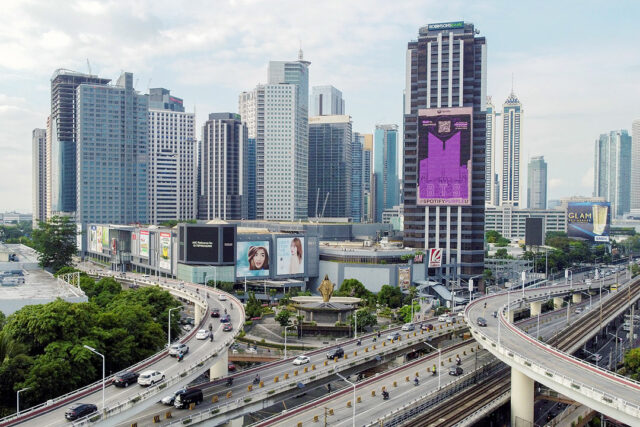
AN AERIAL VIEW shows the Ortigas business district in Pasig City, June 10, 2022. — REUTERS

By Luisa Maria Jacinta C. Jocson, Reporter

The Philippine economic growth is expected to slow to 5.5% this year amid global headwinds and persistently high inflation, the Economic and Social Commission for Asia and the Pacific (ESCAP) said in its latest report. 

“Post-pandemic economic growth in developing Asian and Pacific (APAC) countries weakened considerably in 2022 and is expected to remain weak in 2023, amid the global economic slowdown, unprecedented inflation and uncertainty brought about by the war in Ukraine,” Armida Salsiah Alisjahbana, Under-Secretary-General of United Nations and ESCAP Executive Secretary said in the “Economic and Social Survey of Asia and the Pacific 2023” report. 

ESCAP’s latest estimate is lower than the 6.7% gross domestic product (GDP) growth forecast it gave in April last year. This is also below the government’s 6-7% target and slower than the 7.6% expansion in 2022. 

Based on ESCAP’s estimates, the Philippines will be the second-fastest growing economy in Southeast Asia this year, alongside Cambodia (5.5%) and just behind Vietnam (6.3%). 

“The overall economic performance in developing countries in APAC  is likely to remain weak in 2023 to 2024 amid global economic slowdown, elevated inflation across the board and war-induced uncertainty,” Hamza Ali Malik, ESCAP director of the Macroeconomic Policy and Financing for Development division, said in a virtual briefing discussing the report on Wednesday. 

For 2024, ESCAP sees the Philippine economy expanding by 5.7%, below the 6.5-8% target set by the government. 

Meanwhile, ESCAP sees Philippine inflation at 4.3% this year, higher than its earlier forecast of 3%. It expects inflation to ease to 3% in 2024. 

The central bank forecasts that full-year inflation will average 6% this year, before slowing to 2.9% in 2024. 

“The impact of higher interest rates in controlling the elevated rate of inflation is not expected to materialize fully in 2023. Furthermore, positive economic developments, such as the opening of the Chinese economy in 2023, are likely to keep inflation under pressure; increases in pent-up demand, however, may in turn lead to surges in commodity and energy prices,” ESCAP said. 

The report also cited weakened currencies, higher import costs, and natural disasters, such as frequent typhoons in the Philippines, as drivers of inflation. 

To tame inflation, the BSP raised interest rates by 425 basis points (bps) since May 2022. This brought the policy rate to 6.25%, the highest in nearly 16 years. 

Meanwhile, ESCAP expects growth in developing APAC economies to average 4.2% this year, lower than the 5% estimate it gave earlier.  

“However, this outlook remains fraught with uncertainty and is uneven across the region. In addition to declining exports, the growth prospects are clouded by the extent of expected monetary policy tightening in the major developed economies,” it said. 

ESCAP also sees inflation in the region hitting 5.9% this year, higher than its previous forecast of 4.1%. 

“Inflation is expected to remain at the elevated level of 5.9% in 2023. Although both demand and supply factors are responsible for high inflation in most economies, it is difficult to pin down their relative contribution. Likely upward pressure on wages due to high inflation, and thus inflationary expectations, cannot be ignored either,” the report said. 

It also noted that central banks in the region must “balance the management of expectations about inflation amid supply driven factors while they minimize the adverse impacts of higher interest rates on the prospects for economic recovery.”  

For 2024, ESCAP expects GDP growth in the region to rebound to 4.7%, while inflation is seen to ease to 4.4%. 

DEBT SUSTAINABILITY
Meanwhile, ESCAP said that there is a need to implement better fiscal and debt management amid increasing interest rates and the looming global economic slowdown. 

“As fiscal firepower is shrinking in the APAC region, it is time to rethink the relationship between public debt and development financing. The view that high debt levels are necessarily detrimental to economic growth has been challenged in recent years. On the other hand, development deficits and climate risks, if left unaddressed, will have serious implications for growth and the sustainability of public finance,” ESCAP said. 

According to estimates by ESCAP, APAC developing countries would require an average annual investment of $1.5 trillion, an additional 5% of the region’s 2018 GDP in order to meet the sustainable development goals (SDG) target by 2030. 

“The bulk of this would have to come from public resources. The requirements have certainly increased since then, especially for least developed countries. Climate-related financing needs will also put significant strain on public finances in the region. Importantly, countries most vulnerable to climate change and with the highest development deficits have the most limited fiscal space,” it added. 

ESCAP also cited studies that showed there is no consensus on the “optimal level of public debt.” 

One study showed there was a “significant and positive impact of public debt” on GDP growth in six ASEAN countries from 1995-2015, specifically in Indonesia, Malaysia, the Philippines, Singapore, Thailand and Vietnam. 

ESCAP Economic Affairs Officer Vatcharin Sirimaneetham said that debt can be a “powerful tool for development if used judiciously and with a long-term horizon.” 

Mr. Sirimaneetham said that current methodologies on debt sustainability are often short-term, which leads to the government cutting on spending. This results in unemployment and limited government access to financial resources for SDGs, among others. 

He also cited other ways to boost fiscal space, such as ramping up revenues. 

“Public revenue generation by strengthening tax revenue collection, including through direct taxes. Also raising non-tax revenues and scaling up development transfers now rather than providing debt relief later,” he added. 

The ESCAP report said that “sizable revenue potentials can be realized through the broadening of the tax base and overall improvements in tax administration.” 

“Indeed, modernizing and rationalizing tax systems (Cambodia, Maldives, Myanmar, Nepal, the Philippines), introducing new broad-based taxes (Maldives, Myanmar, Samoa, Tonga), incorporating the informal sector and small and medium-sized enterprises into the formal tax regime (Cambodia), improving tax and customs administration (Armenia, Cambodia, Myanmar, Nepal, the Philippines) and removing excessive tax exemptions (the Philippines) were among the major drivers behind the most impressive country-level revenue increases in recent years. This momentum is likely to continue,” it added. 

In the Philippines, the National Government’s (NG) outstanding debt hit a record-high P13.75 trillion as of end-February. 

The country’s debt-to-GDP ratio stood at 60.9% as of end-December, still slightly above the 60% threshold considered manageable by multilateral lenders for developing economies. 

The government aims to cut the debt-to-GDP ratio to less than 60% by 2025, and further to 51.5% by 2028. 

Globe to pursue climate action strategies

BW FILE PHOTO

Globe Telecom, Inc. said it will continue to implement climate action strategies to support the government’s energy efficiency efforts.

“We are committed to driving energy efficiency in our operations and reducing our carbon footprint through various programs and initiatives. The implementation of intelligent monitoring systems is an important part of this effort, and we are pleased to see the positive impact that they bring to our business and the planet,” said Gerard Ortines, head of Globe’s network solutions and capex management.

Globe has also implemented data center infrastructure management, which automates the monitoring of energy consumption and improves data center design.

The company also vowed to continue working on innovative technology and solutions to help combat climate change as it supported the United Nations’ sustainability agenda, which includes the target to cut greenhouse gas emissions by 50% by 2030 and achieve net zero by 2050.

Meanwhile, Globe said it has retained its score of B in the 2022 CDP assessment, formerly Carbon Disclosure Project.

The company said the score of B indicates that it was able to attain its environmental management processes in addressing relevant risks in its operations, while also reducing its carbon footprint. — Ashley Erika O. Jose

Alternergy keen to participate in green energy auction

Alternergy Holdings Corp. is interested in participating in the second round of the green energy auction (GEA 2) program, the renewable energy company said on Wednesday. 

In a statement, Alternergy Chairman Vicente S. Perez said that the entry of additional renewables within the next three years highlights the government’s push toward the development of renewable energy (RE) sources. 

He said that to date, Alternegy has 29 active RE service contracts in its pipeline projects with ongoing development activities. 

“We are excited for the GEA 2 and will be pooling our resources to ensure a piece from the 11,600-MW (megawatt) capacity to be bid out,” Mr. Perez said. 

The renewable energy company is targeting to develop up to 1,370 MW including wind, offshore wind, solar, run-of-river hydro, and battery storage projects in the next five years.

“The entry of additional 11,600 MW of new capacity in the next three years through GEA 2 shows the strong push by the administration of President [President Ferdinand R. Marcos, Jr.] towards the development of renewable energy sources,” Mr. Perez said. 

The Energy department is set to conduct the second round of GEA in June with 11,600 MW in capacity on offer. Of this capacity, 3,600 MW are targeted for installation in 2024; 3,600 MW for 2025; and 4,400 MW for 2026. — Ashley Erika O. Jose

Philippines’ 2022 GDP unchanged at 7.6% 

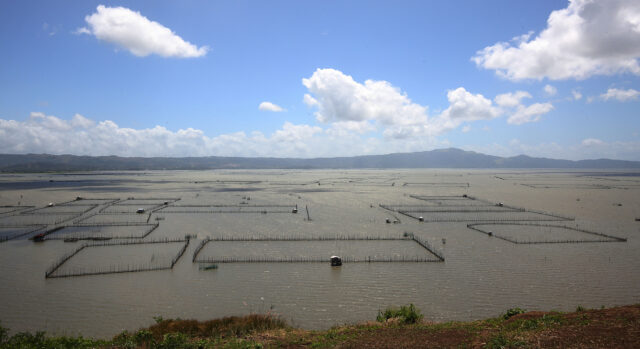
Fish cages in Laguna de Bay are seen from Cardona, Rizal Province, March 30, 2022. — PHILIPPINE STAR/MICHAEL VARCAS

THE PHILIPINE Statistics Authority (PSA) said on Wednesday it kept the gross domestic product (GDP) growth rate for 2022 and 2021 unchanged. 

PSA data showed GDP — the value of all finished goods and services produced in the country at a given period — rose by 7.6% last year, as initially reported on Jan. 26. This was the fastest economic growth since the 8.8% reading in 1976. 

The 2021 GDP growth was also unchanged at 5.7%. 

However, the PSA revised the fourth quarter 2022 GDP expansion to 7.1%, a tad slower than the 7.2% preliminary estimate. The fourth quarter print was lower than the 7.7% growth in the third quarter of 2022, and the 7.9% print in the same three months in 2021. 

The PSA also maintained the gross national income — the sum of the nation’s GDP and net primary income from the rest of the world — unchanged at 9.9% and 1.7% in 2022 and 2021, respectively. 

There were no changes to the growth in services (9.2%) and agriculture (0.5%) in 2022, but industry sector’s expansion was revised downwards to 6.5% from the 6.7% it initially reported. 

For the fourth quarter, the growth of industry sector was also lowered to 4.6% from the 4.8% previously reported. 

The PSA also downwardly revised the growth rates of following industry subsectors: mining and quarrying (1.8% from 4.2%), manufacturing (3.9% from 5.6%) and construction (6.2% from 6.3%). 

On the expenditure side, growth in government spending was revised to 4.9% in 2022 from 5% preliminary figure. Household consumption growth was unchanged at 8.3% in 2022. 

Also unchanged were government spending and household consumption figures for the fourth quarter. 

For trade in goods and services, the PSA revised the imports growth in the fourth quarter to 7%, from 5.9% previously. Exports growth was unchanged at 14.6% in the fourth quarter. 

On an annual basis, exports growth was revised to 10.9% from 10.7% previously, while imports growth was upgraded to 13.9% from 13.1% previously. 

Gross capital formation, the investment component of the economy was lowered to 13.8% from 16.8% in 2022. For the fourth quarter, gross capital formation growth was downwardly revised to 3.8%, from the preliminary estimate of 5.9%. 

National account revisions are based on approved revision policy, which is consistent with international standard practices, the PSA said. – Abigail Marie Pelea Yraola 

Meralco assures continuous services during Holy Week

Manila Electric Co. (Meralco) has assured its customers of uninterrupted electricity services during the Holy Week.

In a statement, Joe R. Zaldarriaga, Meralco’s spokesperson and vice president for corporate communications, has assured continuous services within Meralco’s franchise area.

“With the Holy Week break coinciding with the dry months, Meralco urged its customers to continue practicing energy efficiency to help manage their consumption, which historically increases by 10% to 40% during summer,” Meralco said in a media release on Wednesday.

Mr. Zaldarriaga said that it is important for consumers to practice energy efficiency to help manage consumption.

The power utility giant also said that its personnel will also be on standby to attend to electricity-related customer concerns.

“We are one with the nation in observing a solemn and safe Holy Week and we would like to assure our customers that Meralco personnel will remain on standby to respond to concerns and emergencies,” Mr. Zaldarriaga said.

On Monday, Meralco announced that it had secured an additional de-loading capacity under its interruptible load program (ILP) as part of its efforts in ensuring reliable electricity services on expected higher demand during the summer period.

ILP participants own power-generating facilities that they can tap when the electricity grid operator warns of deficient reserves, thus reducing overall demand from the grid.

Meralco’s controlling stakeholder, Beacon Electric Asset Holdings, Inc., is partly owned by PLDT Inc. Hastings Holdings, Inc., a unit of PLDT Beneficial Trust Fund subsidiary MediaQuest Holdings, Inc., has an interest in BusinessWorld through the Philippine Star Group, which it controls. — Ashley Erika O. Jose

AirAsia to fully implement e-travel card starting April 15

NEWSROOM.AIRASIA.COM

AirAsia Philippines reminded its guests that it will start the full-scale implementation of the new e-travel card beginning April 15.

In a press release on Wednesday, the low-cost carrier said that the e-travel card will replace the paper-based arrival and departure card previously used by passengers.

“Implementing the e-travel card for departing and arriving guests was a mandate from the government; we are greatly supporting it to ensure our guests’ seamless travel,” AirAsia said.

The airline has stressed the importance of accomplishing the e-travel card through social media advisories, email and text messages that it sent out to travelers.

Starting April 15, passengers are required to register through the etravel.gov.ph information system and web-based online platform.

After registering, the guest should download the personal QR code that will be provided which will be presented to airport officers for verification.

AirAsia said it anticipates a surge in passenger volume starting April 5, which it expects to be higher compared with last year.

“Thousands of AirAsia guests are heading out to various domestic and international destinations to take advantage of last-minute Holy Week vacation plans,” the airline said.

To manage this, the airline has increased staffing at Ninoy Aquino International Airport’s Terminals 3 and 4. It will also be putting up self-check-in kiosks by the terminal entrance.

“Providing seamless and hassle-free air travel has always been our priority. Holy Week is an important season for Filipino families and it is our joy and pride to be able to serve our kababayan yearning to spend this long weekend in their provinces,” AirAsia Communications and Public Affairs Country Head Steve F. Dailisan said. — Justine Irish DP. Tabile

TDF yields slip as inflation eases in March 

YIELDS on the central bank’s term deposits inched down on Wednesday after headline inflation eased to a six-month low. 

The term deposit facility (TDF) of the Bangko Sentral ng Pilipinas (BSP) attracted bids amounting to P364.717 billion on Wednesday, well above the P230 billion on the auction block as well as the P299.538 billion seen a week ago for a P240-billion offer. 

Broken down, tenders for the seven-day papers reached P213.053 billion, higher than the P130 billion auctioned off by the central bank and the P173.232 billion in bids for a P140-billion offer seen the previous week. 

Banks asked for yields ranging from 6.5% to 6.6655%, lower than the 6.55% to 6.7124% band seen a week ago. This caused the average rate of the one-week deposits to decrease by 2.04 basis points (bps) to 6.6359% from 6.6563% previously. 

Meanwhile, bids for the 14-day term deposits amounted to P151.664 billion, above the P100-billion offering and the P126.306 billion in tenders seen on March 29. 

Accepted rates were from 6.5% to 6.6772%, lower than the 6.572% to 6.6985% margin recorded a week ago. With this, the average rate for the two-week deposits inched down by 1.09 bps to 6.6465% from 6.6574% logged in the prior auction. 

The BSP bank has not auctioned off 28-day term deposits for more than two years to give way to its weekly offerings of securities with the same tenor. 

The term deposits and the 28-day bills are used by the BSP to mop up excess liquidity in the financial system and to better guide market rates. 

Term deposit yields went down as inflation eased in March, Rizal Commercial Banking Corp. Chief Economist Michael L. Ricafort said in a Viber message. 

Preliminary data from the Philippine Statistics Authority (PSA) released on Wednesday showed headline inflation eased to 7.6% from 8.6% in February. Still, this was significantly higher than the 4% print a year ago. 

March inflation was the slowest since the 6.9% print in September 2022. This was below the 8.1% median in a BusinessWorld poll conducted last week and near the lower end of the 7.4-8.2% forecast of the BSP for March. 

However, price pressures remained high as core inflation climbed to 8% from 7.8% in February. This is its highest clip since 8.2% in December 2000. 

For the first quarter, the consumer price index settled at 8.3%, higher than the central bank’s full-year forecast of 6% and the 2-4% target band. 

BSP Governor Felipe M. Medalla last month said if inflation comes out better than expected in March and April, the Monetary Board may consider pausing its rate hike cycle at its May 18 meeting. 

The BSP has raised benchmark interest rates by 425 bps since May last year, bringing its key rate to a near 16-year high of 6.25%. 

Mr. Ricafort said expectations of a 25-bp hike or pause from the US Federal Reserve in its next meeting on May 2-3 were also priced in by investors. 

The US central bank increased the fed funds rate by 25 bps to 4.75-5% last month. The Fed has now raised 475 bps since March 2022. — Keisha B. Ta-asan 

Peso strengthens on PHL CPI, US jobs data    

BW FILE PHOTO

THE PESO rose against the dollar on Wednesday as Philippine headline inflation slowed in March and following the release of weaker US jobs data. 

The local currency closed at P54.40 versus the dollar on Wednesday, appreciating by 9.5 centavos from Tuesday’s P54.495 finish, data from the Bankers Association of the Philippines’ website showed. 

The peso opened Wednesday session at P54.45 per dollar. Its intraday best was at P54.31, while its worst showing was at P54.54 versus the greenback. 

Dollars traded climbed to $1.24 billion on Wednesday from the $889.7 million recorded on Tuesday. 

Philippine financial markets will be closed from April 6-11 for non-working days in commemoration of Holy Week and the Day of Valor. 

The peso climbed against the dollar as inflation eased further in March, Rizal Commercial Banking Corp. Chief Economist Michael L. Ricafort said in a Viber message. 

“The peso appreciated after the March local headline inflation level was recorded lower at 7.6%, below market expectations of 8%,” a trader likewise said in an e-mail. 

Headline inflation eased to 7.6% from 8.6% in February, preliminary data released by the Philippine Statistics Authority on Wednesday showed. Still, this was faster than the 4% print in the same month last. 

The March consumer price index (CPI) was the slowest since the 6.9% recorded in September 2022. 

For the first three months, headline inflation averaged 8.3%, higher than the Bangko Sentral ng Pilipinas’ (BSP) forecast of 6% and the 2-4% target for the year. 

A second trader said the peso was supported by a weaker dollar following weaker US jobs data. 

The US dollar was stuck near two-month lows on Wednesday as weak economic data bolstered views that the Federal Reserve is near the end of its tightening cycle, Reuters reported. 

The dollar index, which measures the currency against six peers, eased to a fresh two-month low of 101.43, after dropping 0.5% overnight. It was last at 101.57. 

Data showed US job openings dropped to their lowest level in nearly two years in February, suggesting that labor market conditions were finally easing. 

Job openings, a measure of labor demand, were down 632,000 to 9.9 million on the last day of February, the monthly Job Openings and Labor Turnover Survey, or JOLTS report, showed.  

The peso appreciated as “markets priced in lower odds of another 25-basis-point (bp) Fed rate hike on May 3, 2023 at about 50% chance … that could be matched locally to maintain comfortable interest rate differentials to help stabilize the peso exchange rate and overall inflation,” Mr. Ricafort added. 

The US Federal Reserve hiked its target interest rate by 25 bps at its March 21-22 meeting to a range between 4.75% and 5%. 

Since March 2022, the Fed has raised rates by a total of 475 bps. 

For its part, the BSP hiked benchmark interest rates by 25 bps in its March 23 review, bringing its key rate to 6.25%. 

The Philippine central bank has raised rates by a cumulative 425 bps since May 2022.  

PESO SEEN RISING
Meanwhile, MUFG Global Markets Research expects the peso to start strengthening against the dollar in the second half on expectations of a narrower current account deficit. 

“Overall, we think the peso will be more resilient in 2023 compared with last year, but will not outperform regional Asian currencies,” MUFG Global Markets Research said in a report on Tuesday. 

“Key for the peso’s outlook is our expectation for a narrower current account deficit in 2023, driven by lower oil prices, slower domestic demand, coupled with resilient business process outsourcing services exports and remittances,” it said. 

It sees the peso closing the second quarter at P55 per dollar, weaker than its P54.36 finish in the first quarter. 

The local unit could then strengthen to P54 against the greenback in the third quarter and end the year at P53.50 a dollar. 

For the first quarter of 2024, the peso could end at P53 a dollar. 

MUFG Global Markets Research said it expects Philippine gross domestic product (GDP) to expand by 6% this year as pent-up demand from the economy’s reopening after the pandemic begin to fade, with elevated inflation and higher interest rates also expected to affect consumption. 

“We view this development as good from a macro stability perspective, as the economy was running a little too hot last year,” it said. 

Philippine GDP grew by 7.6% in 2022. 

MUFG Global Markets Research also expects the central bank to hike borrowing costs by another 25 bps in its May 18 meeting to bring its key rate to 6.50% and then keep its policy settings steady thereafter. — AMCS with Reuters 

Lawmaker files bill seeking to prohibit fees, charges on dormant accounts 

A LAWMAKER has filed a bill seeking to prohibit the imposition of fees and charges on dormant accounts, saying these are an additional financial burden for depositors. 

House Bill No. 7664 filed by Cagayan De Oro Rep. Rufus B. Rodriguez proposes to stop banks from charging service, maintenance or any other fees on dormant accounts. 

The bill defines dormant accounts as current or checking accounts that have no deposit or withdrawal activity for three years or savings accounts left untouched for five years. 

The Bangko Sentral ng Pilipinas’ Manual of Regulations for Banks tags as dormant current or checking accounts showing no activity for one year and savings accounts with no deposits or withdrawals for two years. 

“The practice of these banks, as authorized by the Bangko Sentral ng Pilipinas is to charge fees on these dormant accounts, usually in an amount ranging from P300 to P500 per month,” Mr. Rodriguez said in the bill’s explanatory note. 

“One explanation as to why banks charged dormancy fees is that banks may have anticipated a certain amount of activity on each account, which can generate fee income for them. And because of the inactivity, they see these dormant fees as a way to replace the expected income that they lost to the detriment of the depositor,” he said. 

Mr. Rodriguez said these charges and fees must not be imposed on depositors as banks already earn interest when they use deposits to fund their loans. 

Under the bill, banks are required to review and segregate dormant accounts at least once every semester. 

“As a matter of policy, banks shall exert all efforts to prevent checking and savings accounts from becoming dormant. When it becomes apparent that an account is inactive, a short letter should be sent to the depositor encouraging him to use his account. In case of checking accounts, the banks shall ensure that the monthly statement of accounts reach the depositors,” it said. 

The bill also proposes to turn over unclaimed deposit balances in dormant accounts to the National Treasury. 

“After one year has lapsed without any activity on any account, the bank shall send a notice to the depositor informing him of said inactivity. Thereafter, banks shall regularly send notices to the depositor every six months,” it said. 

“Three months prior to the expiration of the periods as stated in Section 1 of this Act, the bank shall send a final notice to the depositor informing him of the impending deposit of his account to the National Treasury,” it added. 

The bill is pending with the House committee on banks and financial intermediaries. — B.M.D. Cruz 

Shares rise as inflation eases further in March 

BW FILE PHOTO

PHILIPPINE STOCKS climbed on Wednesday following the release of data showing that headline inflation eased further in March. 

The bellwether Philippine Stock Exchange index rose by 16.47 points or 0.25% to close at 6,488.51 on Wednesday, while the broader all shares index went up by 4.78 points or 0.13% to end at 3,486.74. 

“The local bourse gained as March’s inflation rate eased compared to February’s figure. However, investors remained cautious as the core inflation in March was at 8.00%, higher than February’s 7.8%,” Philstocks Financial, Inc. Research Analyst Claire T. Alviar said in a Viber message. 

“Philippine shares outperformed the region as headline inflation for March came in better than expected at 7.6%,” Regina Capital Development Corp. Head of Sales Luis A. Limlingan said in a Viber message. 

Headline inflation eased to 7.6% from 8.6% in February, preliminary data released by the Philippine Statistics Authority on Wednesday showed. Still, this was faster than the 4% print in the same month last. 

March inflation was the slowest since the 6.9% recorded in September 2022 and was near the lower end of the 7.4-8.2% forecast of the Bangko Sentral ng Pilipinas (BSP) for the month. 

However, core inflation climbed to 8% from 7.8% in February, the highest since 8.2% in December 2000. 

For the first quarter, headline inflation settled at 8.3%, higher than the BSP’s forecast of 6% and the 2-4% target for the year. 

“Meanwhile, US equities slumped, ending the fourth successive streak, amid concerns on the broader economy. The OPEC+ (Organization of the Petroleum Exporting Countries and their allies including Russia) production cut likewise adds up to the uncertainty and the current sentiment of investors,” Mr. Limlingan added. 

On Tuesday, the S&P 500 declined by 0.58% to end at 4,100.68 points; the Nasdaq dropped by 0.52% to 12,126.33 points; and the Dow Jones Industrial Average went down by 0.59% to 33,403.04 points. 

Back home, almost all sectoral indices went up on Wednesday except for mining and oil, which decreased by 231.65 points or 2.12% to 10,674.15. 

Meanwhile, holding firms climbed by 50.97 points or 0.80% to 6,350.39; financials rose by 6.90 points or 0.38% to 1,781.03; services increased by 2.32 points or 0.14% to 1,612.66; industrials went up by 1.90 points or 0.02% to 9,290.89; and property increased by 0.65 point or 0.02% to 2,743.97. 

Value turnover went down to P3.38 billion on Wednesday with 1.08 billion shares changing hands from the P3.99 billion with 2.40 billion issues traded on Tuesday. 

Advancers outnumbered decliners, 93 versus 71, while 59 names closed unchanged. 

Net foreign buying stood at P43.80 million on Wednesday versus the P238.40 million in net selling recorded on Tuesday. — A.H. Halili 

Marine scientists see slick near world-famous Coron 

IMAGE BY GIULIANO GABELLA VIA UNSPLASH

MARINE researchers from the University of the Philippines (UP) have detected a potential oil slick near Coron, Palawan province southwest of the capital, more than a month after a fuel tanker sank off the waters of Oriental Mindoro and caused an oil spill. 

There were possible oil slicks 12 kilometers off Coron, the UP Marine Science Institute said in an April 3 bulletin, citing a satellite image from the United States National Oceanic and Atmospheric Administration taken on April 2. 

“The slicks seen measured at about 19 kilometers in length and about 3 km in width,” it said, noting that winds were weak when the image was taken,” making it highly possible for thicker slicks to form due to less breakage from calmer waves.” 

It was not known whether the slicks had come from the sunken tanker, MT Princess Empress in Mindoro, the institute said. 

On Wednesday, Coron Municipal Disaster Risk Reduction and Management Office chief Fernando Lopez said local authorities had not monitored any traces of oil in their waters. 

“We have not seen any oil spill or oil slick here in Coron,” he told ABS-CBN Teleradyo in Filipino. “We went to the area suspected of having an oil spill, which is about 12 kilometers away from the shoreline, but the sea was good.” 

He said rough waves could have made it difficult for them to spot the oil slick. 

The local government had sought an aerial survey of the area to validate the report, he said, adding that Coron authorities have prepared spill booms in case the oil spill reaches their town. 

Coron, one of the country’s top tourist destinations, is known for World War II-era wrecks that are popular with divers, and its limestone karst landscape. 

The tanker was carrying 800,000 liters of industrial oil when it sank off Naujan, Oriental Mindoro on Feb. 28. The Philippine Coast Guard with the help of international experts was still conducting clean-up operations. 

On Wednesday morning, a Korean ship arrived at the port of Manila, unloading 20 tons of sorbent pads and snares, 1,000 meters of solid flotation curtain boom and 2,000 sets of personal protective equipment. 

“The supplies will be sent to the affected region promptly,” the South Korean Embassy in Manila said in a statement. 

Four experts from the Korea Coast Guard’s emergency response team and consul and staff members of the Korean Embassy had joined forces on March 28 by providing technical support for operating response equipment in coordination with the Philippine and US coast guards. 

“During their five-day operation in affected areas in Mindoro, the Korean team shared their expertise to address the oil spill, as well as assisted the affected residents with aid supplies including drinking water and safety guidelines,” the embassy said. – Kyle Aristophere T. Atienza 

DoJ indicts main suspect in Philippine governor’s murder 

@HOUSEOFREPSPH

GOVERNMENT prosecutors have indicted the main suspect in the murder of the governor of Negros Oriental in central Philippines and 26 other victims, according to the Department of Justice (DoJ) 

The bodyguard of Arnolfo T. Teves, Jr., a congressman of the province, was charged with nine counts of murder for the death of the governor and eight others; 13 counts of frustrated murder; and four counts of attempted murder, DoJ said in a statement on Wednesday. 

The Office of the Provincial Prosecutor of Negros Oriental will handle the cases in connection with the murder of Governor Roel R. Degamo, it added. 

Law enforcers arrested the suspect, who underwent inquest proceedings at DoJ on Monday, during a National Bureau of Investigation (NBI) operation on March 27 in the village of Madlad in nearby Antique province. 

Prosecutors would amend the charge sheet, which indicted other suspects in the killing, to include the supposed mastermind, the agency said. 

“The case is 99% finished,” Justice Secretary Jesus Crispin C. Remulla said in the statement. “It is only a matter of time before we can put this to bed.” 

Authorities had 12 suspects in custody and the case was close to being solved, Interior and Local Government Secretary Benjamin C. Abalos, Jr. told a news briefing on Monday. 

Justice Secretary Jesus Crispin C. Remulla earlier said Mr. Teves could be one of the masterminds, being a political rival. The congressman, who is overseas and has refused to come home because of supposed threats, had denied involvement in the crime. He has been slapped with a 60-day suspension by the House of Representatives for failing to report back to work after his travel authority expired on March 9. 

Mr. Degamo and eight others, including two village leaders, were killed while 15 were wounded when armed men opened fire at his residential compound, where cash aid was being distributed on March 4.  

TASK FORCE DEGAMO
More than 30 cases related to the killing have been filed before a Bayawan City regional trial court, Mr. Abalos earlier said. 

The Supreme Court had transferred the cases related to the murder after Mr. Remulla’s request to move them to Manila, citing the risk of a hostile environment in the province for those involved. 

Meanwhile, President Ferdinand R. Marcos, Jr. has formed a task force that will keep order in the province Negros a month after Mr. Degamo was killed in his house. 

The task force, named after late governor, would “prevent the spread and escalation of violence elsewhere in the Philippines and to maintain peace and order on Negros Island, with due regard to the fundamental civil and political rights of the people,” the presidential palace said in a statement. 

It will be headed by Interior and Local Government Secretary Benjamin de Castro Abalos, Jr. and co-headed by Mr. Remulla and Defense Secretary Carlito G. Galvez, Jr., the Presidential Communications Office said. The task force commanders are the chiefs of the national police, Armed Forces of the Philippines and National Bureau of Investigation. 

The task force will also intensify campaigns against private armed groups and loose firearms. Under Administrative Order No. 6, the body will rationalize efforts of various agencies to “ensure a whole-of-government approach in the prevention, investigation, prosecution and punishment of violence on Negros Island.” 

The palace said the Department of Social Welfare and Development would extend relief assistance to the families of the victims, while the Department of Health will provide psychological rehabilitation to affected people. The presidential assistant for the Visayas will coordinate with the task force to enlist the full support of all stakeholders. – John Victor D. Ordonez and Kyle Aristophere T. Atienza 

ADVERTISEMENT
ADVERTISEMENT