Home Blog Page 5019

Low metal prices loom as some mining firms face cost pressures

BW FILE PHOTO

THE mining industry faces a period of declining prices for industrial metals a year after some companies had to deal with increased costs, analysts said.

“Prices of industrial metals have settled lower, and we can theorize that several mining companies will be affected by that,” Luis A. Limlingan, head of sales at Regina Capital Development Corp., said in a Viber message.

The filing of full-year earnings to the stock exchange indicated that some mining companies suffered losses last year due to cost pressures and poor weather, which dampened output.

“Two factors that would significantly affect their revenue would be the reopening of the global economy and, more important, where the price of industrial metals will go towards in the remaining months of 2023,” said Mr. Limlingan.

Philex Mining Corp. reported an earnings drop of nearly 27% to P1.8 billion on a 5.5% decline in revenue to P9.26 billion.

Global Ferronickel Holdings, Inc. reported a decline in attributable income of 0.65% to P1.96 billion. Revenue slipped 13% to P6.73 billion.

Atlas Consolidated Mining and Development Corp. reported a 16.6% decline in net profit to P3.22 billion on higher operating costs. Revenue fell 4.4% to P17.68 billion.

Benguet Corp.’s net profit fell 6.3% to P1.33 billion in 2022, off a 5% rise in revenue to P4.03 billion.

This year, Mr. Limlingan said most miners are forecasting favorable weather, allowing them more days of operation.

PROFIT GAINS
The mining companies that reported higher profit in 2022 were buoyed by higher ore prices, as well as the impact of foreign exchange movements.

The Mines and Geosciences Bureau (MGB) said nickel ore prices remained elevated at between $3.70 and $11.86 per pound in 2022, with gold at $1,802.82 per troy ounce.

On the other hand, the price of copper fell to $4 while silver fell to $21.76 per troy ounce.

The value of metallic mineral output grew 31.73% to P238.05 billion, the MGB said.

Apex Mining Co., Inc. posted the highest growth in attributable income last year of 316.1% to P3.34 billion. Consolidated revenue rose 39% to P10.31 billion. Gold and silver revenue both rose to P6.97 billion and P455.81 million, respectively.

Nickel Asia Corp., the country’s largest producer of lateritic nickel ore, posted a 1.5% increase in attributable net income to P7.93 billion. It reported a 2.2% increase in revenue to P2 billion.

In a Viber message, Rizal Commercial Banking Corp. Chief Economist Michael L. Ricafort said that geopolitical risks caused metal prices to rise last year.

Both Mr. Ricafort and Mr. Limlingan cited the reopening of China, the country’s biggest market on nickel supply, as a possible prop for demand.

“There are also proposals to tax mineral ore exports, similar to Indonesia, to encourage more smelting/mineral processing investments and facilities to be established in the country as well as raise additional tax revenues,” Mr. Ricafort said.

Chamber of Mines of the Philippines Chairman Michael T. Toledo said another driver for the industry is the Philippines’ intention to reduce carbon emissions.

He said that this will trigger the demand for raw materials for the production of electric vehicles (EVs) and renewable energy facilities. 

In January, the Palace approved a zero-tariff scheme for EV imports for five years to jump-start EV production amid hopes many components will eventually be produced here.

He said the industry is still waiting on “the enactment of a responsive mining fiscal regime that would allow mining to provide a consistent revenue stream” for the country and host communities. — Sheldeen Joy Talavera

PHL notifies WTO of safeguard measures probe into LPG steel cylinder imports 

REUTERS

THE Philippines has officially notified the World Trade Organization (WTO) of its plan to conduct a safeguard measures investigation into imported liquefied petroleum gas (LPG) steel cylinders.

“On April 4, 2023, the Philippines notified the WTO’s Committee on Safeguards that it initiated on April 4, 2023, a preliminary safeguard investigation on LPG cylinders,” the WTO said in its website.

The notification is required by Article 12.1 (a) of the WTO Agreement on Safeguards, the Philippines said in its notice.

A WTO member is required to notify the Committee on Safeguards upon initiating an investigatory process relating to serious injury or threat thereof and the reasons for it; making a finding of serious injury or threat thereof caused by increased imports; and taking a decision to apply or extend safeguard measures.

The Department of Trade and Industry (DTI) announced on March 29 that it initiated the investigation following a petition filed by Ferrotech Steel Corp., claiming that the surge in imported LPG steel cylinders has caused serious injury to domestic industry.

Ferrotech has proposed 10 years of safeguard measures for steel cylinder imports.

“The DTI, acting under Section 6 of Republic Act 8800 or the Safeguard Measures Act, has made an evaluation of the application and found the existence of a prima facie case that will justify the initiation of a preliminary safeguard measures investigation on imports of LPG steel cylinders falling under ASEAN Harmonized Tariff Nomenclature Code 73.11 from various countries,” Trade Secretary Alfredo E. Pascual said in the notice.

According to the DTI, the investigation will cover the 2017 to 2021 period, during which China was the source of 98.9% of imported LPG steel cylinders.

The Bureau of Customs estimates that LPG steel cylinder imports increased 24% to 15,942 metric tons (MT) in 2019 and 45% to 23,058 MT in 2020. Import volume fell 13% to 19,990 MT in 2021.

The DTI added that the Philippines imported 10,827 MT as of the end of July 2022, equivalent to 54% of 2021 levels.

The Philippines charges a 10% most-favored-nation tariff rate on LPG cylinder imports. — Revin Mikhael D. Ochave

Ease of paying taxes measure poised to eliminate outdated tax code provisions

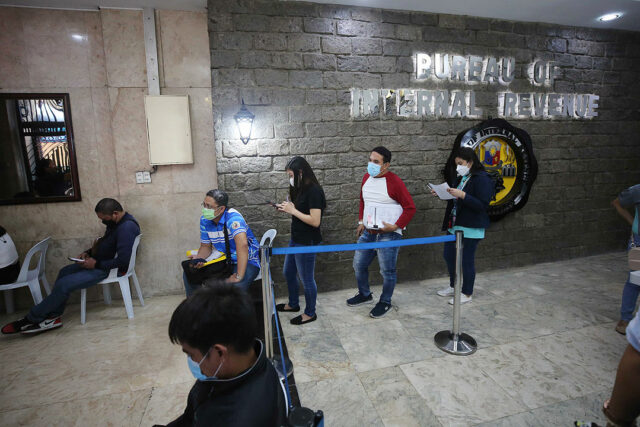
People line up to file their income tax returns at the Bureau of Internal Revenue office in Intramuros, Manila, April 18, 2022. — PHILIPPINE STAR/ RUSSELL A. PALMA

THE proposed Ease of Paying Taxes Act is expected to boost taxpayer compliance and increase government revenue, though the bill’s contradictory and outdated provisions need to be sorted out, analysts said.

“Simplifying tax procedures will help lower taxpayers’ costs in time, money, and mental distress. This will promote compliance that will eventually be helpful in raising money to fund strategic projects,” InvestEd Philippines Finance Executive Daniel C. Penkian said in a text message.

“Simpler taxation can improve compliance by reducing inadvertent non-payment of taxes. To some extent, taxpayers are unable to comply with the regulations because of complexities, which could have been remedied if our tax laws are as simpler,” he added.

House Bill No. 4125, or the proposed Ease of Paying Taxes Act, amends sections of Republic Act No. 8424, otherwise known as the National Internal Revenue Code of 1997, as amended.

The bill, a priority measure of the administration, was passed by the House of Representatives in September and is currently pending at a Senate committee.

It aims to modernize tax administration and improve collection efficiency by encouraging proper and easy compliance at the least cost.

It also seeks to adopt best practices and replace antiquated rules such as restrictions on venue for filing and payment, while customizing policies for various types of taxpayer.

The Secretary of Finance, upon the recommendation of the Bureau of Internal Revenue (BIR) Commissioner, will also be granted the authority to overhaul or create new taxpayer classifications.

Current tax law only recognizes a single category grouping the largest taxpayers.

Large taxpayers are defined as establishments with VAT paid or payable of at least P100,000 for any quarter of the preceding taxable year; with excise tax paid or payable of at least P1 million for the preceding taxable year; with annual income tax paid or payable of at least P1 million for the preceding taxable year; or with withholding tax payment or remittance of at least P1 million for the preceding taxable year.

Froilyn P. Doyaoen-Pagayatan, tax counsel of Gorriceta Africa Cauton & Saavedra law offices, said that the proposed legislation of the basis for classification of taxpayers would make tax administration “contemporaneous with economic conditions and more uniform.”

“The proposal that taxpayers not classified as large or medium taxpayers are not required to withhold taxes would reduce the burden of tax compliance on these taxpayers, who will be allowed to focus on their operations.  It would also allow the BIR to focus on large and medium taxpayers in the enforcement of withholding tax obligations,” she added.

“Classifying taxpayers into large, medium, and small based on the taxpayer’s capacity to comply with tax rules, the amount and types of taxes being paid, gross revenue, volume of transactions, wage and employment levels, and other economic and financial considerations is another form of efficiency,” Mr. Penkian added.

Mr. Penkian said that the bill’s plan to introduce a small and medium taxpayer classification and a corresponding BIR special unit will “improve service and tax administration for both.”

“Institutionalizing simplified tax returns and processes will significantly help smaller taxpayers as most of them don’t usually have the same level of resources (tax accountants, lawyers, pool of compliance staff) as compared with large taxpayers,” he added.

However, Ms. Doyaoen-Pagayatan noted that the criteria for large taxpayers was established over two decades ago and that “the foregoing threshold amounts would be low under present economic circumstances.”

“Hence, such criteria could lead to classification of taxpayers as large even if, considering their present economic capabilities, they would not be able or would find it difficult to fulfill the additional compliance requirements which are the consequences of being classified as large taxpayers, such as the obligation to withhold,” she added.

She also cited Revenue Memorandum Order (RMO) No. 17-2017, which classifies as medium-sized taxpayers the top 500 non-individual taxpayers of the 12 top revenue regions in terms of collection that satisfy the criteria for large taxpayers but have not been designated as such by the BIR Commissioner.

“It is clear that under RMO No. 17-2017, the classification of a taxpayer as medium depends largely on the collection performance of the revenue region where a taxpayer is registered. This leads to lack of uniformity and equity in the enforcement of tax rules as it is possible that a taxpayer, otherwise classified as medium taxpayer, would escape being classified as such simply because of its place of registration,” she said.

The proposed bill also introduces a Taxpayer’s Bill of Rights.

“This proposes the enumeration of additional fundamental rights to further promote fair treatment of taxpayers and put guardrails in place to protect them against wrongful assessments,” Mr. Penkian said.

Ms. Doyaoen-Pagayatan said the inclusion of the bill of rights is “laudable” but most items are “mostly abstractly stated that prosecution and conviction of Bill of Rights violators may be challenging.”

“The Bill of Rights seems to be more of policy statements than specific criminal acts,” she added.

The Ease of Paying Taxes Act also creates a Taxpayer’s Advocate Office.

“It is worthwhile to highlight that the Taxpayer’s Advocate Office is intended to be independent from the BIR though the plan was to have the office directly report to the BIR Commissioner. There may be an issue of independence if that is the case,” Mr. Penkian noted.

“With respect to the Tax Advocacy Office, its proposed function is to protect and promote the rights of taxpayers and to identify systemic problems in the BIR and propose solutions to address such problems.  However, (the bill) proposes that the Tax Advocacy Office shall report directly to the BIR Commissioner. The power and control of the BIR Commissioner over the Tax Advocacy Office may affect the independence and objectivity of the latter in the performance of its functions,” Ms. Doyaoen-Pagayatan added.

The bill also allows taxpayers to file returns or pay taxes anywhere, particularly with any authorized agent bank, Revenue District Office (RDOs), or collection agent, except in cases specified by the commissioner.

“The bill will further reduce the burden of paying taxes and will provide protection to the taxpayers.  Reducing the burden means the taxpayers can pay taxes in RDOs and banks outside the principal place of business, removing the restrictions on payment venue, which will be easier for the taxpayers to comply with,” Res Werkes Phils., Inc. Chief Financial Officer Jonathan Q. Sibug said in an e-mail.

Mr. Penkian said that this will also “greatly help taxpayers save time in declaring and paying their dues resulting in flexibility and efficiency.”

“It’s about time that we remove the requirement that taxes must be paid in the BIR offices or banks within the jurisdiction of the taxpayer’s legal residence, principal place of business or principal office. Companies are highly concerned about the customer experience; so the government should be concerned about the taxpayer-experience,” he added.

Ms. Doyaoen-Pagayatan added that if the bill were passed and tax payments are allowed anywhere, this would “significantly lighten the burden of tax compliance especially for taxpayers that are not large or medium taxpayers.” — Luisa Maria Jacinta C. Jocson

E-governance legislation expected to address corrupt practices not curbed by digitalization

ILOILO CITY GOVERNMENT 

A PROPOSED e-governance bill is expected to address the blind spots of the government’s current digitalization effort in curbing corruption, analysts said.

“E-governance can only be successful if government makes a commitment to use e-governance tools to ensure efficient, transparent and accountable public services,” Terry L. Ridon, a public investment analyst and convenor of think tank InfraWatch PH, said via e-mail.

Mr. Ridon said that the current state of digitized government has not yet clamped down on corrupt practices and inefficient services.

“We are mindful of the failure of (the current set-up of) e-governance in several agencies in preventing corrupt practices, such as in the Bureau of Customs in which organized smuggling continues to persist despite the institution of mandated digitization mechanisms,” Mr. Ridon said.

He also said that expanding e-governance “should help stop current concerns relating to the offloading of Filipino travelers due to unreasonable delays in the passport control process,” referring to an incident at the Ninoy Aquino International Airport in which a passenger missed a flight due to an immigration officer’s excessive questions.

Digitizing government documents should “limit the intervention of fixers and middlemen,” Sherwin E. Ona, a political science and development studies professor at De La Salle University, said in a Viber chat.

“Well-designed online services can result in faster turnaround time for transactions, and fewer opportunities for corruption due to the transparent nature of information and communications technology services,” he said.

The bill cleared third reading at the House on March 6. Its counterpart measure in the Senate is currently at the committee level.

 House Bill No. 7327 tasks the Department of Information and Communications Technology (DICT) with creating an E-Government Master Plan.

The measure also proposes to create the Philippine Infostructure Management Corp., a government-owned and -controlled corporation under the DICT to implement infrastructure programs like the National Broadband Plan, the Free Wi-Fi for All, and the expansion of the National Government Data Centers and Government Cloud.

 If passed into law, the digitization of a paper-based documents and information is expected to “encourage government cooperation with the private sector in providing resources, assets, and services,” Information and Communications Technology committee chairman and Navotas City Rep. Tobias M. Tiangco said during plenary deliberations on the bill.

According to Mr. Ridon, E-governance serves as an “institutional check” in the procurement process (at) all levels of government, ensuring that public officials cannot interfere during the course of public bidding as soon as terms of reference and bidding documents are issued.

He added that government itself is the “ultimate roadblock” in ensuring efficiency and transparency through e-governance “if it fails to rein in malevolent actors in public service who might reject implementing e-governance tools for illicit ends.”

Deputy Minority Leader and ACT Teachers’ Party-list Rep. France L. Castro, one of the legislators who voted against the bill, said e-governance may increase state surveillance of the public and place citizens who lack digital access at a disadvantage.

“It will widen and worsen the digital divide among Filipinos,” Ms. Castro said during a March briefing.

To address this, Mr. Ona said that the measure must guarantee the protection of personal data through serious implementation of the data privacy law and cybersecurity protocols.

“The usual approach is infrastructure driven. This should not be the case for e-governance (as) it must be sensitive to the critical needs of its citizens,” he said. — Beatriz Marie D. Cruz

Significance of prescriptive period of assessment

Most taxpayers have six days left before the deadline for filing the Annual Income Tax Return (AITR) for the calendar year 2022, the last day for which is April 17. With the filing of the AITR, the power of the Bureau of Internal Revenue (BIR) to assess and examine whether correct taxes were paid begins. However, the power of the BIR to assess deficiency taxes is not limitless.

Taxes are the lifeblood of the government and must be collected without hindrance. Taxes are the government’s primary means of generating the funds needed to support its operations and see to the general well-being of the people.

Nevertheless, the Supreme Court (SC) held that, in the case of Kepco Philippines Corp. v. Commissioner of Internal Revenue (CIR), G.R. Nos. 225750-51, the power of taxation should be exercised with caution to minimize the proprietary rights of a taxpayer. It must be exercised fairly, equally, and uniformly, lest the tax collector kill the goose that lays the golden egg. To maintain the general public’s trust and confidence in the government, this power must be used justly and not treacherously.

The National Internal Revenue Code (NIRC), as amended, provides protection to taxpayers against tax audits by the BIR. Among the rules that protect taxpayers are the Statute of Limitations, which refers to the period during which the BIR can assess and collect taxes. The prescriptive period in making an assessment depends upon (a) whether a tax return was filed, (b) whether the tax return filed was either false or fraudulent, or (c) whether a waiver of the statute of limitations was executed.

GENERAL RULE ON PRESCRIPTIVE PERIOD OF ASSESSMENT
Section 203 of the NIRC provides that an assessment of internal revenue tax under ordinary circumstances must be made within three years counted from the period fixed by law for the filing of the tax return or the actual date of filing, whichever is later.

Thus, the three-year period starts to run differently for the various tax types. For example, an annual income tax return for a taxpayer observing the calendar year filed on April 15 will start the clock on the prescriptive period on this day. However, for a quarterly VAT return filed on April 25, the period is counted from that date.

Similarly, the Court of Tax Appeals (CTA), En Banc, held in the case of CIR v. Carmona, C.T.A. EB Case No. 1324, that the Final Assessment Notice issued on July 25, 2011 and received by the taxpayer on Aug. 11, 2011, for all the pertinent quarters for the year 2007 was invalid. The CTA counted the three years from the various dates that the quarterly VAT Returns and the Income Tax Returns were filed. The BIR had only until Jan. 31, 2011 and April 15, 2011, at the latest, within which to issue the FAN against the taxpayer for deficiency VAT and Income Tax, respectively. As such, BIR’s right to assess the taxpayer within the three-year prescriptive period had prescribed.

Consequently, taxpayers should check the prescriptive period for each tax type as some may prescribe earlier than others.

EXCEPTIONS
The exceptions to the three-year prescriptive period of assessment are (1) in case of extraordinary circumstance and (2) the execution of a waiver of the statute of limitations.

I. Extraordinary circumstance

The first exception is found in Section 222 (a) of the NIRC which explains that BIR may assess the tax within a period of 10 years from the discovery of a false or fraudulent return with the intent to evade tax or failure to file a return. This basically makes these circumstances imprescriptible, as the 10-year period starts from discovery. Hence, there may be assessments that can be made decades after the taxable years because of fraud or a failure to file a return.

However, it is important to note that the BIR cannot simply avail of this period without including the basis for its allegations of falsity, fraud, and omissions committed by the taxpayer in the assessment notice.

The SC held in the case of CIR v. Fitness by Design, Inc., G.R. No. 215957, that to avail of the extraordinary period of assessment in Section 222 (a) of the NIRC, the Commissioner of Internal Revenue has the burden of proving that the facts exist to evidence fraud. In this case the assessment for taxable year 1995 was issued only in 2004. However, the Supreme Court did not apply the 10-year period for the failure of the Commissioner to prove that the taxpayer deliberately failed to reflect its true income in 1995.

Nonetheless, the SC ruled in the case of CIR v. Estate of Toda, Jr., G.R. No. 147188, that “fraud” in its general sense, is deemed to comprise anything calculated to deceive, including all acts, omissions, and concealment involving a breach of legal or equitable duty, trust, or confidence justly reposed, resulting in the damage of another, or by which an undue and unconscionable advantage is taken of another. In this case, the SC applied the 10-year prescriptive period. The BIR was able to prove that the sale of the property first to Altonaga then to Royal Match, Inc., was merely a tax ploy, a sham, and without business purpose and economic substance. Doubtless, the two sales were executed to mislead the BIR with the end in view of reducing the consequent income tax liability and without any business purpose. In effect, the transactions resulted more in the mitigation of tax liabilities than for legitimate business purposes which constitutes tax evasion.

II. Waiver of statute of limitations

The second exception is provided under Section 222 (b) of the NIRC which allows the execution of the waiver of the defense of prescription. The waiver is a bilateral agreement between a taxpayer and the BIR to extend the period of assessment to a certain date beyond the three-year period. There is no limitation as to the length of the extension as long as it is agreed upon by the taxpayer and the BIR. In addition, the extended period may be further extended by the execution of another before the expiration of the original or the first extension. Hence, it is not uncommon to expect the BIR to request a new waiver before the current waiver expires.

In case the BIR requests a waiver, the taxpayer should always assess whether a waiver is advantageous to him or if it will just unnecessarily lengthen the assessment process. Factors to consider may be the time needed to produce the additional documents requested by the BIR, if any, or additional time needed to discuss and controvert the remaining findings of the BIR.

Nevertheless, the waiver of the statute of limitations is not a waiver of the right to invoke the defense of prescription. In the case of Universal Weavers Corp. v. Commissioner of Internal Revenue, G.R. No. 233990, the SC ruled that a waiver of the statute of limitations under the NIRC, to a certain extent, is a derogation of the taxpayers’ right to security against prolonged and unscrupulous investigations conducted by revenue officers. Make no mistake, it is not a renunciation of the right to invoke the defense of prescription. The SC further ruled that it is, therefore, imperative that the waiver is carefully and strictly construed and duly compliant with the present guidelines and procedural requirements prescribed by the BIR to serve its purpose of affording protection to the taxpayer.

In summary, the purpose of the statute of limitations on the assessment is to safeguard the interest of the taxpayer from unreasonable examination, investigation, or assessment. Accordingly, the government must assess internal revenue taxes on time to prevent extending indefinitely the period of assessment. Taxpayers must be given the assurance that they will no longer be subjected to further investigation for taxes after the expiration of the reasonable periods set by law. Thus, when the assessment is issued beyond the prescriptive period, the government’s right to collect deficiency taxes also prescribes. Simply put, the failure of the BIR to comply with the aforesaid prescriptive periods ends its power to assess and starts the taxpayers’ right to invoke prescription.

Let’s Talk Tax is a weekly newspaper column of P&A Grant Thornton that aims to keep the public informed of various developments in taxation. This article is not intended to be a substitute for competent professional advice.


Penelope Germaine D. Sernande is an associate from the Tax Advisory & Compliance division of P&A Grant Thornton, the Philippine member firm of Grant Thornton International Ltd.

pagrantthornton@ph.gt.com

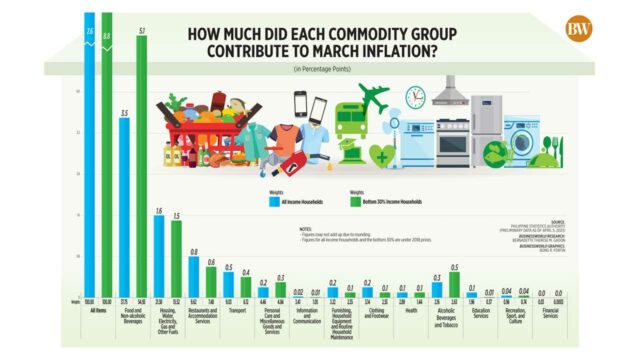
How much did each commodity group contribute to March inflation?

Philippine headline inflation cooled in March to the slowest in six months, amid lower prices of food and transport, the statistics agency said. Read the full story.

How much did each commodity group contribute to March inflation?

Lastimosa plotting Game 2 resurgence for misfiring TNT

JOJO LASTIMOSA — PBA MEDIA BUREAU

TNT COACH Jojo Lastimosa rued the Tropang Giga’s uncharacteristic poor shooting on Easter Sunday, which he felt largely contributed to their 102-90 setback in the championship series opener against Barangay Ginebra.

“We couldn’t make shots,” he said post-game.

A usually efficient scoring machine, TNT struggled to a low 90 points on a 38.9% (35-of-90) field goal marksmanship, including a poor 25.7% (9-of-35) three-point clip.

Such numbers were a far cry from their pre-finals conference average of 115.9 points and glossy shooting accuracy of 47.7% overall and 37.8% from deep.

In contrast, the Gin Kings knocked down 43.3% of their attempts (39-of-90), highlighted by 41.7% three-point-shotmaking (15-of-36) en route to the Game 1 victory.

“If we only made shots it could have been different. And my team relies so much on our offense. Of course, defense is always going to be there in the finals. But if you can’t make shots, you have no chance. And (Ginebra) hit theirs,” said Mr. Lastimosa.

There’s also a need for big man Poy Erram to be more assertive for a TNT frontline that took another hit when Justin Chua went down with a knee injury in the first quarter and joined Kelly Williams on the sidelines.

Mr. Erram finished with four points, six rebounds and two assists in a 19-minute stint marred by disqualification on six fouls and incessant complaining to the referees.

“Poy’s got to do a better job of controlling his emotions…I was actually pissed at him; his teammates were actually getting on him because he’s beginning to be a distraction by complaining too much,” said Mr. Lastimosa. “And we need Poy in the game now that’s Justin’s out and Kelly’s out.”

TNT has three days to work it out before facing the three-peat-seeking Gin Kings again tomorrow in a must-win second match at the Smart Araneta Coliseum. — Olmin Leyba

Pinays shoot for 2nd round of Olympic qualifying tourney

PFF

THE PHILIPPINES guns for a spot in the second round of the Asian Football Confederation (AFC) Women’s Olympic Qualifying Tournament when it faces Hong Kong Monday night in Hisor, Tajikistan.

Victorious over Pakistan (4-0) and host Tajikistan (8-0), the Filipinas can seal their advance to the next phase of the qualifiers for Paris 2024 as Group E winners with at least a draw against Hong Kong.

The Pinay booters and their counterparts from Hong Kong carry identical six points on two wins but hold a big edge in goal difference, 12 versus 5. Hong Kong defeated Tajikistan (3-0) and Pakistan (2-0).

“Hong Kong are on six points just like us so we expect it to be a tough game, a very close game. But if we play well, I’m confident we can get the job done,” said Philippine coach Alen Stajcic.

If successful in the 4 p.m. game (7 p.m. Manila time), the Filipinas will join the six other group winners from Round 1 and seeded teams North Korea, Japan, Australia, China and South Korea in continuing the Olympic chase in the second round. — Olmin Leyba

UAAP recruiting wars shift into high gear

RAFFY CELIS AND MICHAEL ASORO

KATIPUNAN rivals Ateneo de Manila University and University of the Philippines continued their relentless offseason build-up with more prized recruits, setting up a possible heavyweight collision anew in the UAAP Season 86 men’s basketball tournament.

The Blue Eagles and the Fighting Maroons, who took turns in ruling the past two UAAP finals, scooped up top high school reinforcements from Sacred Heart School-Ateneo de Cebu and San Beda, respectively, as they fill their stables for a potential trilogy later this year.

Ateneo officially secured the commitment of Raffy Celis and Michael Asoro from their sister school in Cebu, a day after UP acquired the services of San Beda-Rizal stalwart Chris Hubilla.

The Blue Eagles’ acquisition of two Magis Eagles in Celis and Asoro came on the heels of the decision of Jared Bahay, another Ateneo de Cebu standout and the country’s No. 1 ranked high school player, to take his talents to rival UP instead.

Mr. Bahay, Mr. Celis and Mr. Asoro formed an unstoppable troika for Ateneo de Cebu en route to a back-to-back championship in CESAFI and a semifinal finish in the Smart-NBTC National Finals, featuring the best high school teams here and abroad.

The versatile winger Mr. Celis and gunner Mr. Asoro will bolster the wards of coach Tab Baldwin, who landed a top overseas recruit last year in Filipino-Australian big man Mason Amos, who has suited up for Gilas Pilipinas.

Mr. Hubilla, albeit not eligible until Season 87 with still a year left in high school, joined a stacked Fighting Maroons lineup with Mr. Bahay, Lebron Lopez, Luis Pablo and Seven Gagate.

The 20-year-old Mr. Hubilla, Mr. Gagate and Luis Pablo from College of St. Benilde-La Salle Green Hills all made the NCAA Season 98 Mythical Team with Mr. Pablo winning the Season MVP award. — John Bryan Ulanday

Arca, Largo top under-18 Chess championships

GR STOCKS-UNSPLASH

CHRISTAIN GIAN KARLO ARCA and Franchesca Largo provided a clear glimpse of the future of Philippine chess as they topped the premier Under-18 (U-18)division of the National Age Group Chess Championships grand finals in Dipolog City over the weekend.

Mr. Arca, just 14 years old, showed he can hang with the big boys as he ruled the U-18 open section by edging top seed Mark Jay Bacojo, with both finishing with 10.5 points apiece after 11 rounds, though Arca clinched via tiebreaker in this weeklong tournament bankrolled by Dipolog City Mayor Darel Dexter Uy.

It was another feather in the cap for Mr. Arca, who topped the semis edition of this same age class last month, the boy’s U-14 section of the Eastern Asian Youth Chess Championship in Bangkok, and the GM Balinas youth tilt last year, that reinforced expectations that he will be a future board number one for the country.

The 17-year-old Ms. Largo, for her part, swept all her 13 games to run away with the girls’ U-18 crown.

Other winners were Jersey Marticio and Tyrhhone James Tabernilla (U-16), Kaye Lalaine Regidor and Keith Adriane Ilar (U-14), Mar Aviel Carredo and Zhaoyu Capilitan (U-12) and Mary Janelle Tan and Steve Zacky Bolico (U10). — Joey Villar

NBA postseason matchups: Clippers, Warriors earn wins

THE LOS ANGELES Clippers and Golden State Warriors earned road wins on Sunday, clinching the last two automatic Western Conference playoff berths on the final day of the regular season.

The Clippers (44-38) edged the Suns 119-114 to seal the West’s fifth seed. Phoenix (45-37), which already was locked into the fourth seed, sat out all of its star players.

The result will see the Clippers and Suns square off in a first-round playoff series beginning on April 16 in Phoenix. The Warriors (44-38) demolished the Portland Trail Blazers 157-101 to secure the sixth seed in the West. Golden State finished with the same record as the Clippers, and the teams split their four-game season series, but Los Angeles is No. 5 thanks to a superior division record.

The Los Angeles Lakers (43-39), Minnesota Timberwolves (42-40) and New Orleans Pelicans (42-40) wound up at Nos. 7, 8 and 9, respectively, in the West. The Lakers beat the visiting Utah Jazz 128-117, and the Timberwolves topped the visiting Pelicans 113-108. The Timberwolves will visit the Lakers in the first Western Conference play-in game on Tuesday.

The winner of that contest will advance to the playoffs as the No. 7 seed. The Oklahoma City Thunder (40-42) will visit the Pelicans for a play-in game on Wednesday. The winner of that game advances to a road matchup against the Timberwolves-Lakers loser, with the victor in that Friday contest sealing the No. 8 seed.

The Denver Nuggets (53-29) finished atop the Western Conference standings, and they will open the postseason vs. the No. 8 seed. The second-seeded Memphis Grizzlies (51-31) will match up against the No. 7 seed.

The Warriors will open the playoffs against the third-seeded Sacramento Kings (48-34) on Saturday.

The Eastern Conference play-in event will start with the Atlanta Hawks (41-41) visiting the Miami Heat (41-41) on Tuesday. The winner seals the No. 7 seed and a playoff matchup against the second-seeded Boston Celtics (57-25). The Chicago Bulls (40-42) will square off with the host Toronto Raptors (41-41) on Wednesday for the right to visit the Hawks-Heat loser Friday.

The Friday winner will move on to face the top-seeded Milwaukee Bucks (58-24).

Two Eastern Conference playoff matchups are set: The third-seeded Philadelphia 76ers (54-28) will oppose the sixth-seeded Brooklyn Nets (45-37) beginning Saturday, the same day the fourth-seeded Cleveland Cavaliers (51-31) and the fifth-seeded New York Knicks (47-35) begin their series.

Rahm channels idol Seve Ballesteros to win Masters

AUGUSTA, Georgia — Rock-steady Jon Rahm, channeling Spanish great Seve Ballesteros on his late hero’s birthday, survived a marathon day and scored an emotional Masters win at Augusta National on Sunday, denying LIV Golf a watershed victory.

Mr. Rahm, who started the day four off the lead, rallied behind a final round three-under 69 for a winning total of 12-under 276 and a decisive four-shot victory over LIV standard bearers Brooks Koepka and evergreen Phil Mickelson.

The win was Rahm’s fourth this season, earning him a second career major to go along with his 2021 US Open title. He also reclaims the number one world ranking from defending champion Scottie Scheffler.

Mr. Koepka, who sat atop the leaderboard for three rounds, simply could not get in gear at the end, labouring to a three-over 75, while 52-year-old Mr. Mickelson, winner of three Green Jackets, turned back the clock and carded the round of the day — a sensational seven-under 65 — and finished tied for second.

Coming on what would have been Mr. Ballesteros’ 66th birthday and the 40th anniversary of the Spanish talisman’s second of two Green Jacket wins, Mr. Rahm soaked up a rousing ovation as he walked up the 18th fairway with a four-stroke cushion.

Fighting to keep his composure, the 28-year-old sealed victory with a 4-foot par putt, capping a marathon day of golf that started at sunrise and finished in the Georgia twilight.

“History of the game is a big part of why I play and one of the reasons why I play, and Seve being one of them,” Mr. Rahm said. “For me to get it done on the 40th anniversary of his win, his birthday, on Easter Sunday, it’s incredibly meaningful.

“To finish it off the way I did — a Seve par, it was in a testament to him, and I know he was pulling for me today, and it was a great Sunday.”

After two days of play interrupted by lashing rain and ferocious winds that toppled trees, the field of 53 returned to the water-logged course on Sunday to complete the third round.

Mr. Koepka, who led Mr. Rahm by four shots overnight, was ahead by two at the end of the round.

LIV Tour tournaments are contested over 54 holes and if the action in Augusta had ended after the conclusion of the third round, Mr. Koepka would have been slipping into a Green Jacket.

Unfortunately for Mr. Koepka, the majors require 72 holes to find a winner. By the time the two men reached the turn of the fourth round, the Spaniard in front by two had taken charge.

With Mr. Koepka going 22 holes without a birdie, Mr. Rahm delivered the knockout blow with back-to-back birdies at 13 and 14 to go five up with four to play. — Reuters

ADVERTISEMENT
ADVERTISEMENT