Home Blog Page 5018

Pinays shoot for 2nd round of Olympic qualifying tourney

PFF

THE PHILIPPINES guns for a spot in the second round of the Asian Football Confederation (AFC) Women’s Olympic Qualifying Tournament when it faces Hong Kong Monday night in Hisor, Tajikistan.

Victorious over Pakistan (4-0) and host Tajikistan (8-0), the Filipinas can seal their advance to the next phase of the qualifiers for Paris 2024 as Group E winners with at least a draw against Hong Kong.

The Pinay booters and their counterparts from Hong Kong carry identical six points on two wins but hold a big edge in goal difference, 12 versus 5. Hong Kong defeated Tajikistan (3-0) and Pakistan (2-0).

“Hong Kong are on six points just like us so we expect it to be a tough game, a very close game. But if we play well, I’m confident we can get the job done,” said Philippine coach Alen Stajcic.

If successful in the 4 p.m. game (7 p.m. Manila time), the Filipinas will join the six other group winners from Round 1 and seeded teams North Korea, Japan, Australia, China and South Korea in continuing the Olympic chase in the second round. — Olmin Leyba

UAAP recruiting wars shift into high gear

RAFFY CELIS AND MICHAEL ASORO

KATIPUNAN rivals Ateneo de Manila University and University of the Philippines continued their relentless offseason build-up with more prized recruits, setting up a possible heavyweight collision anew in the UAAP Season 86 men’s basketball tournament.

The Blue Eagles and the Fighting Maroons, who took turns in ruling the past two UAAP finals, scooped up top high school reinforcements from Sacred Heart School-Ateneo de Cebu and San Beda, respectively, as they fill their stables for a potential trilogy later this year.

Ateneo officially secured the commitment of Raffy Celis and Michael Asoro from their sister school in Cebu, a day after UP acquired the services of San Beda-Rizal stalwart Chris Hubilla.

The Blue Eagles’ acquisition of two Magis Eagles in Celis and Asoro came on the heels of the decision of Jared Bahay, another Ateneo de Cebu standout and the country’s No. 1 ranked high school player, to take his talents to rival UP instead.

Mr. Bahay, Mr. Celis and Mr. Asoro formed an unstoppable troika for Ateneo de Cebu en route to a back-to-back championship in CESAFI and a semifinal finish in the Smart-NBTC National Finals, featuring the best high school teams here and abroad.

The versatile winger Mr. Celis and gunner Mr. Asoro will bolster the wards of coach Tab Baldwin, who landed a top overseas recruit last year in Filipino-Australian big man Mason Amos, who has suited up for Gilas Pilipinas.

Mr. Hubilla, albeit not eligible until Season 87 with still a year left in high school, joined a stacked Fighting Maroons lineup with Mr. Bahay, Lebron Lopez, Luis Pablo and Seven Gagate.

The 20-year-old Mr. Hubilla, Mr. Gagate and Luis Pablo from College of St. Benilde-La Salle Green Hills all made the NCAA Season 98 Mythical Team with Mr. Pablo winning the Season MVP award. — John Bryan Ulanday

Arca, Largo top under-18 Chess championships

GR STOCKS-UNSPLASH

CHRISTAIN GIAN KARLO ARCA and Franchesca Largo provided a clear glimpse of the future of Philippine chess as they topped the premier Under-18 (U-18)division of the National Age Group Chess Championships grand finals in Dipolog City over the weekend.

Mr. Arca, just 14 years old, showed he can hang with the big boys as he ruled the U-18 open section by edging top seed Mark Jay Bacojo, with both finishing with 10.5 points apiece after 11 rounds, though Arca clinched via tiebreaker in this weeklong tournament bankrolled by Dipolog City Mayor Darel Dexter Uy.

It was another feather in the cap for Mr. Arca, who topped the semis edition of this same age class last month, the boy’s U-14 section of the Eastern Asian Youth Chess Championship in Bangkok, and the GM Balinas youth tilt last year, that reinforced expectations that he will be a future board number one for the country.

The 17-year-old Ms. Largo, for her part, swept all her 13 games to run away with the girls’ U-18 crown.

Other winners were Jersey Marticio and Tyrhhone James Tabernilla (U-16), Kaye Lalaine Regidor and Keith Adriane Ilar (U-14), Mar Aviel Carredo and Zhaoyu Capilitan (U-12) and Mary Janelle Tan and Steve Zacky Bolico (U10). — Joey Villar

NBA postseason matchups: Clippers, Warriors earn wins

THE LOS ANGELES Clippers and Golden State Warriors earned road wins on Sunday, clinching the last two automatic Western Conference playoff berths on the final day of the regular season.

The Clippers (44-38) edged the Suns 119-114 to seal the West’s fifth seed. Phoenix (45-37), which already was locked into the fourth seed, sat out all of its star players.

The result will see the Clippers and Suns square off in a first-round playoff series beginning on April 16 in Phoenix. The Warriors (44-38) demolished the Portland Trail Blazers 157-101 to secure the sixth seed in the West. Golden State finished with the same record as the Clippers, and the teams split their four-game season series, but Los Angeles is No. 5 thanks to a superior division record.

The Los Angeles Lakers (43-39), Minnesota Timberwolves (42-40) and New Orleans Pelicans (42-40) wound up at Nos. 7, 8 and 9, respectively, in the West. The Lakers beat the visiting Utah Jazz 128-117, and the Timberwolves topped the visiting Pelicans 113-108. The Timberwolves will visit the Lakers in the first Western Conference play-in game on Tuesday.

The winner of that contest will advance to the playoffs as the No. 7 seed. The Oklahoma City Thunder (40-42) will visit the Pelicans for a play-in game on Wednesday. The winner of that game advances to a road matchup against the Timberwolves-Lakers loser, with the victor in that Friday contest sealing the No. 8 seed.

The Denver Nuggets (53-29) finished atop the Western Conference standings, and they will open the postseason vs. the No. 8 seed. The second-seeded Memphis Grizzlies (51-31) will match up against the No. 7 seed.

The Warriors will open the playoffs against the third-seeded Sacramento Kings (48-34) on Saturday.

The Eastern Conference play-in event will start with the Atlanta Hawks (41-41) visiting the Miami Heat (41-41) on Tuesday. The winner seals the No. 7 seed and a playoff matchup against the second-seeded Boston Celtics (57-25). The Chicago Bulls (40-42) will square off with the host Toronto Raptors (41-41) on Wednesday for the right to visit the Hawks-Heat loser Friday.

The Friday winner will move on to face the top-seeded Milwaukee Bucks (58-24).

Two Eastern Conference playoff matchups are set: The third-seeded Philadelphia 76ers (54-28) will oppose the sixth-seeded Brooklyn Nets (45-37) beginning Saturday, the same day the fourth-seeded Cleveland Cavaliers (51-31) and the fifth-seeded New York Knicks (47-35) begin their series.

Rahm channels idol Seve Ballesteros to win Masters

AUGUSTA, Georgia — Rock-steady Jon Rahm, channeling Spanish great Seve Ballesteros on his late hero’s birthday, survived a marathon day and scored an emotional Masters win at Augusta National on Sunday, denying LIV Golf a watershed victory.

Mr. Rahm, who started the day four off the lead, rallied behind a final round three-under 69 for a winning total of 12-under 276 and a decisive four-shot victory over LIV standard bearers Brooks Koepka and evergreen Phil Mickelson.

The win was Rahm’s fourth this season, earning him a second career major to go along with his 2021 US Open title. He also reclaims the number one world ranking from defending champion Scottie Scheffler.

Mr. Koepka, who sat atop the leaderboard for three rounds, simply could not get in gear at the end, labouring to a three-over 75, while 52-year-old Mr. Mickelson, winner of three Green Jackets, turned back the clock and carded the round of the day — a sensational seven-under 65 — and finished tied for second.

Coming on what would have been Mr. Ballesteros’ 66th birthday and the 40th anniversary of the Spanish talisman’s second of two Green Jacket wins, Mr. Rahm soaked up a rousing ovation as he walked up the 18th fairway with a four-stroke cushion.

Fighting to keep his composure, the 28-year-old sealed victory with a 4-foot par putt, capping a marathon day of golf that started at sunrise and finished in the Georgia twilight.

“History of the game is a big part of why I play and one of the reasons why I play, and Seve being one of them,” Mr. Rahm said. “For me to get it done on the 40th anniversary of his win, his birthday, on Easter Sunday, it’s incredibly meaningful.

“To finish it off the way I did — a Seve par, it was in a testament to him, and I know he was pulling for me today, and it was a great Sunday.”

After two days of play interrupted by lashing rain and ferocious winds that toppled trees, the field of 53 returned to the water-logged course on Sunday to complete the third round.

Mr. Koepka, who led Mr. Rahm by four shots overnight, was ahead by two at the end of the round.

LIV Tour tournaments are contested over 54 holes and if the action in Augusta had ended after the conclusion of the third round, Mr. Koepka would have been slipping into a Green Jacket.

Unfortunately for Mr. Koepka, the majors require 72 holes to find a winner. By the time the two men reached the turn of the fourth round, the Spaniard in front by two had taken charge.

With Mr. Koepka going 22 holes without a birdie, Mr. Rahm delivered the knockout blow with back-to-back birdies at 13 and 14 to go five up with four to play. — Reuters

Arsenal denied huge win as Liverpool rallies from 2 goals down to draw

LIVERPOOL, England — Arsenal’s grip on the Premier League title race was loosened as Liverpool produced a storming comeback to snatch a 2-2 draw in super-charged clash at a raucous Anfield Sunday.

The north Londoners were heading for a first league win at Liverpool since 2012, an eighth successive league win and a massive three points in their quest to win the league as they powered into a 2-0 lead.

But Liverpool woke from their slumber and with the crowd cranking up the volume, they surged back and Roberto Firmino headed an 87th-minute equalizer that sparked delirium in the stands and would have been heartily cheered by fans of Manchester City too.

It could have got even worse for Mikel Arteta’s side too as Mo Salah, who scored Liverpool’s first goal and then missed a second-half penalty, blazed a late chance over and was then denied brilliantly by Arsenal goalkeeper Aaron Ramsdale.

Mr. Ramsdale then made an even more miraculous save from Ibrahima Konate in a breathless period of stoppage time.

When the dust settled on a rambunctious contest that had everything, Arsenal, bidding for a first title since 2004, lead Manchester City by six points but the reigning champions have a game in hand and also face Arsenal at home later this month.

Arsenal have 73 points from 30 games, while Liverpool are eighth with 44 points.

A game which began in somber mood as the 34th anniversary of the Hillsborough disaster was marked by a moment of silence, exploded into life and even included an alleged elbow by an assistant referee on Liverpool’s Andy Robertson.

“Wow! Very intense game. The game was under control but after that we concede a really sloppy goal and the game shifted momentum,” Arsenal manager Mr. Arteta said. “It became a very transitional game, very chaotic. Liverpool could score three or four. It is true we could have scored two or three so maybe at the end the score is fair.”

Arsenal had taken an early lead when forward Gabriel Martinelli wriggled through in the eighth minute after a flowing move involving Bukayo Saka and managed to squeeze in a shot under pressure past Liverpool keeper Alisson.

With Liverpool in disarray, Mr. Martinelli then crossed for Gabriel Jesus to head home in the 28th minute. 

Arsenal were cruising but everything changed when Gunners midfielder Granit Xhaka and Liverpool’s Trent Alexander-Arnold got involved in an ugly scuffle. Suddenly the decibel level went up and Salah pulled one back in the 42nd minute when Diogo Jota ran on to a pass from Curtis Jones and sent in a cross that Jordan Henderson stretched to poke forward and the Egypt striker finished off.

“When the Anfield crowd is sleeping, don’t wake them up. Leave them be. Xhaka woke the crowd up,” former Manchester United defender and Sky Sports analyst Gary Neville said.

Liverpool took charge after the break and were awarded a penalty in the 58th minute after Rob Holding fouled Jota. But Salah missed his second successive penalty as he fired wide.

His blushes were partially spared though as Firmino, on as a substitute, rose to head in Alexander-Arnold’s cross.

Asked what the result did for their title hopes, Arteta said: “We move on. Convince them to keep playing like we did in the first 30 minutes.” Reuters

A potential Nobel prize for Marcos

ALI VICOY / PPA POOL

In May last year, a month before Bongbong Marcos was to be inaugurated as the 17th president of the Philippines, his sister, Senator Imee Marcos, expressed the hope that the family would finally be given the platform to clarify the legacy of their father. She said: “We have been there, the truth is our return to the palace is not that important. What is most important to us is our name, the family name that has become so controversial and so difficult at times to bear. The legacy of my father is what we hope will be clarified at last.”

In his conversation with World Economic Forum (WEF) President Borge Brende in Davos, Switzerland on Jan. 19, President Ferdinand R. Marcos, Jr. said: “I was determined not to go into politics. I could see the sacrifices he had to make to do a good job. But after we came back from the United States, after exile, the political issue was Marcos. And for us to defend ourselves politically, somebody had to enter politics and be in the political arena so that not only the legacy of my father but even our own survival required that somebody go into politics.”

The Marcos family has had the platform to clarify the legacy of the patriarch for almost a year now, but all they have said about the widespread corruption and rampant abuse of human rights with which their father’s martial law regime is associated is that it is “all political propaganda.” That is no clarification. The widespread corruption during the Marcos regime is supported by testimonies of their father’s own accomplices in the plunder of the national coffers and by documentary evidence. The rampant abuse of human rights is also backed up by the accounts of surviving victims of torture and by the admission of guilt by some of the violators of human rights.

Deposit slips signed by President Ferdinand E. Marcos and First Lady Imelda Marcos showed that the couple had $356 million (P19 billion) in deposits in Swiss banks, which according to the Philippine Supreme Court was manifestly disproportionate to their aggregate salaries as government officials. US Customs Service records showed that the Marcos family had brought to Hawaii after fleeing Manila in February 1986 22 crates of cash worth $717 million, deposit slips in foreign banks worth $120 million, 300 crates of assorted jewelry with an undetermined value, $4 million worth of unset precious gems, $7.7 million of jewelry including a 150-carat Burmese ruby, a 12 x 4 ft. box crammed with real pearls, a three-foot solid gold statue covered with diamonds, $200,000 worth of gold bullion, nearly $1 million in Philippine pesos and 65 Seiko and Cartier watches.

No clarification, no explanation on how the Marcos couple had gotten so much money and collected so much valuable jewelry has been made because none is possible other than the fabulous wealth was ill-gotten. What Ferdinand Marcos the elder had done could no longer be undone. He has been long gone. His deeds are history. His reign is recorded in the Guinness Book of Records as “the greatest robbery of a government.”

The family name Marcos will remain controversial and difficult to bear, as Ms. Imee intimated. But the name can be restored to respectability if the son and namesake does the reverse of what his father did.

There was once a name that was difficult for some to bear — Benigno Simeon Aquino. The name became associated with betrayal when the man who first bore the name collaborated with the enemy, the Japanese occupation government. The son who also bore the name Benigno Simeon Aquino did the reverse. He fought fiercely and relentlessly the man who oppressed and robbed the Filipino people, He lost his life in the process. The nation now honors him. The anniversary of his death is now a national holiday.

There is also the story of another name, Alfred Nobel. When Ludwig Nobel died in Cannes, France in 1888, one French newspaper headlined the report as “The Merchant of Death is dead,” mistaking Ludwig for his brother Alfred, the inventor of dynamite and other more powerful explosives. Alfred was aghast when he read the obituary. So, that is how he would be remembered, he realized. To leave behind a better legacy, Alfred Nobel bequeathed much of the fortune he amassed from his inventions to the establishment of the Nobel Prizes — the awards to those who have conferred the greatest benefit to mankind.

Ms. Imee said back in May last year: “I think now is the time to show what we can still do for the country.” Her brother, President Bongbong Marcos, could have done something great for the country on March 29. On that day, he joined the leaders of the United States and 72 other nations in declaring: “We the leaders of the Summit for Democracy, reaffirm our shared belief that democracy — government reflecting the effective participation and will of the people — is humanity’s most enduring means to advance peace, prosperity, equality, sustainable development and security.  Democracy is necessary to ensure that every voice is heard, that the human rights of all are respected, protected and fulfilled, online and offline, and that the rule of law is upheld.  We recognize that democracy can take many forms, but shares common characteristics, including free and fair elections that are inclusive and accessible; separation of powers; checks and balances; peaceful transitions of power; an independent media and safety of journalists; transparency; access to information; accountability; inclusion; gender equality; civic participation; equal protection of the law; and respect for human rights, including freedoms of expression, peaceful assembly and association.”

But President Marcos botched the opportunity to do something great for the country when subsequently he disassociated from the declaration’s reference to the International Criminal Court. The declaration included this commitment: “We commit to fight against impunity and promote accountability for violations of international law, particularly genocide, war crimes, the crime of aggression and crimes against humanity, including where such crimes involve sexual and gender-based violence.  We acknowledge the important role played by the ICC as a permanent and impartial tribunal complementary to national jurisdictions in advancing accountability for the most serious crimes under international law.”

The dissociation made the president’s affirmation of his belief in democracy disingenuous. In January, the ICC pre-trial chamber reopened its investigation into the extrajudicial killings under former President Rodrigo Duterte’s bloody war on drugs because it was not satisfied with the efforts of the country’s social justice system to probe the human rights abuses during Mr. Duterte’s term as mayor of Davao City and during his presidency.

But Ferdinand Marcos, Jr. can still do the country great if he reverses all the dictatorial acts of President Rodrigo Duterte, like instructing the Justice secretary to proceed to the prosecution of those identified by witnesses as perpetrators of extrajudicial killings and to drop all charges against Leila de Lima, reinstate Maria Lourdes Sereno at least as associate justice if not as chief justice of the Supreme Court, persuade the House of Representatives to grant ABS-CBN a franchise, and to order the Securities and Exchange Commission to review the revocation of Rappler’s license to operate.

Maria Ressa was awarded the Nobel Peace Prize for merely standing up to President Duterte. President Bongbong Marcos can also win the Nobel Peace Prize if he reverses all the dictatorial acts of Mr. Duterte and fulfill all his commitments in the Declaration of Democracy without disassociation and reservation. If he wins the Nobel Peace Prize then the name Marcos would no longer be difficult to bear.


Oscar P. Lagman, Jr. is a retired corporate executive, business consultant, and management professor.

Who is malnourished?

BETH MACDONALD-UNSPLASH

When we hear the world “malnourished,” the images that come to mind are emaciated children from poor communities waiting for their next Nutribun or porridge. This malnutrition problem has stunted the growth of our children in the past decades. Children do not grow to their full potential physically and mentally because of bad or no food. This is brought about by the rising poverty incidence or lack of access to nutritious food.

On the other end of the malnutrition spectrum are those who are obese and unhealthy due to bad nutrition. This may include consumption of convenience food, including instant noodles, canned or processed food and fried food from fast-food chains. Convenience stores also offer quick meals for the working class, but largely sugar- and fat-laden choices.

The Management Association of the Philippines (MAP) has created a Shared Prosperity Committee to encourage our corporate members to help address this malnutrition problem. After all, many of the food companies can do corporate social responsibility efforts as a collaboration project with their peers to slowly but surely address our malnutrition situation. These children will compose our future workforce so it is in our best interest to help educate them by feeding them well. Education or knowledge transfer won’t be effective if a child can’t think due to hunger or lack of nutrition. In fact, many accounts relate that children can’t absorb what teachers teach them because they are hungry when they go to school. This is why the Department of Education has feeding programs to incentivize parents to let children attend school, if only for stomachs to be fed and next, for brains to be fed as well. We hope this program continues nationwide.

Next is really looking at nutrition from locally available fresh food instead of convenience or processed food. In Bukidnon, children get to drink fresh milk because there is a dairy industry in the area. In other places, locally abundant food should be supplied by communities, cooperatives and farmers’ associations under the community participation program of the Government Procurement Board, as shared with us at a recent UN Women Roundtable on gender-responsive procurement. And under the Magna Carta for SMEs, 10% of government spending must be enjoyed by MSMEs that can supply food to these feeding programs. It just takes awareness of how local government units can help local producers while giving children healthy food. This should be an easy way to solve the malnutrition problem, with the help of MAP members who can help mobilize these activities.

Stunted growth is a real problem, not only because these children will grow up short physically but also mentally challenged to learn and take on new information in this rapidly progressing world of the internet and metaverse. How will our future workers cope? We must be concerned about how to stop the malnutrition problem if we are to think of our company’s sustainability in the next 20 years, at least.

When I dined at a restaurant in faraway Marilog, Davao, I was pleased to see mostly diminutive young women from the Matigsalog tribe serve and wait at tables in this farm-to-table restaurant. Though lacking in height, they were so adept at working with the digital Point of Sale system, espresso machines and other equipment in this modern food facility. I thought they could be taught because they are all clean slates undisturbed by gadgets and social media and true enough, the owner confirmed that he could train these indigenous people with absolutely no culinary background.

Thank God for good natural food, their brains developed to adapt to modern needs, despite the probable lack of other nutrition or stimuli earlier in their lives. I could not help but commend the chef-owner for painstakingly training newbies and fresh out-of-school youth to have responsible jobs at his restaurant.

But malnutrition does not happen only in far-flung areas. We also see it in urban places because of easy access to convenience food. Kids no longer eat fresh fruits and vegetables because these may not be included in their food budgets. Children do not eat balanced meals because their parents are financially challenged even if they have double incomes.

I remember the film where an immigrant family in the USA could afford two burgers for 99 cents (P54) but could not afford fruits and vegetables. So they subsist on fastfood, which has become the main reason for rising diabetes in young people as well as obesity. That is also now happening in our country. Sit in a mall for an hour and observe how many obese youth you can find among mall goers. I always observe what they order at restaurants and I’m convinced fastfood is the main cause of this growing problem.

So, as employers of these future workers, we should address this problem. We will soon have a working citizenry made up of malnourished children in rural and urban areas whose mental abilities will be impaired and whose potential may be hampered simply by lack of good, healthy and nutritious food sources. We can find simple solutions to this growing challenge and threat to the sustainability of our enterprises. We must start now if we are to ensure the availability of a healthy and bright workforce in the future.

MAP’s plan for Shared Prosperity is timely and worth working on, all for our own good, too.


Chit U. Juan is co-vice chairman of the MAP Environment Committee. She is president of NextGen Organization of Women Corporate Directors and founder of the ECHOstore Sustainable Lifestyle. She is a member of the global Slow Food community promoting good, clean and fair food.

map@map.org.ph

pujuan29@gmail.com

Philippines to offer more investor returns than Europe

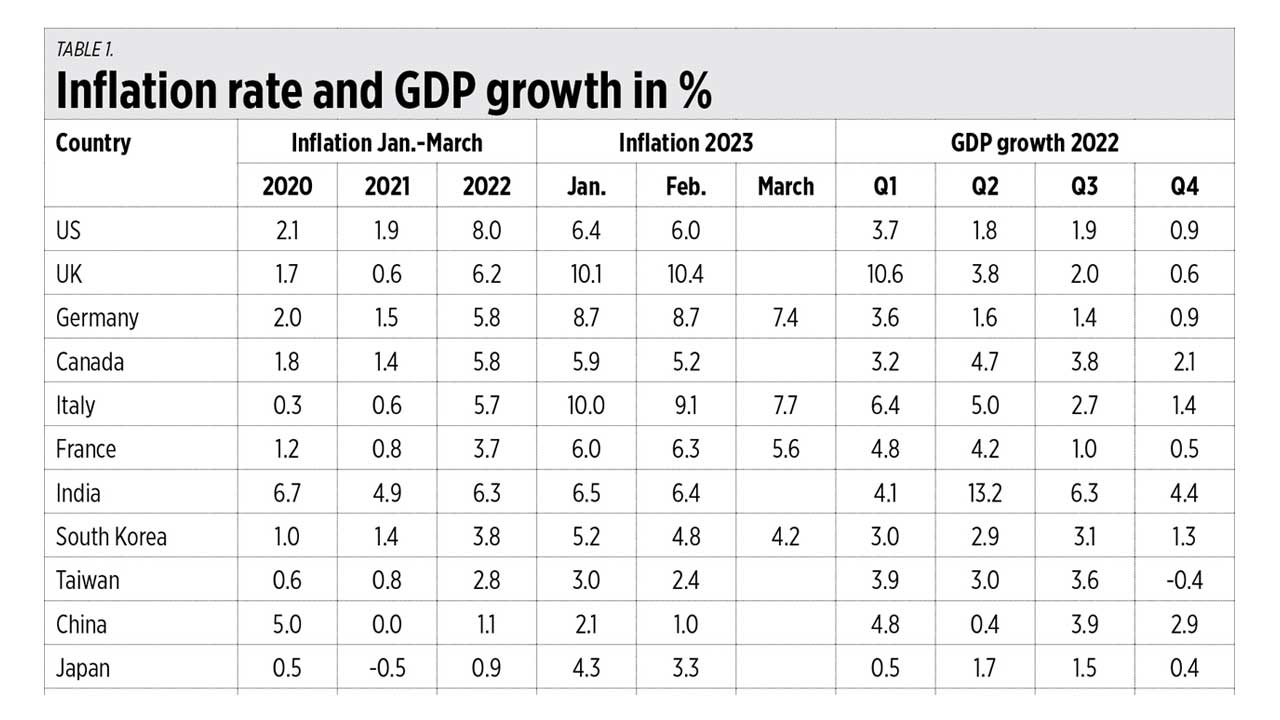
After four months of Philippine inflation at 8% and above, dipped to 7.6% in March, a welcome development. But this is more of European level than East Asian as East Asians had inflation of only 1% to 6.3% in February.

On April 12, the Philippines’ economic and infrastructure teams will hold another Philippines Economic Briefing, this time in Washington DC. The economic team is composed of Finance Secretary Benjamin E. Diokno, Budget Secretary Amenah F. Pangandaman, National Economic and Development Authority Secretary Arsenio M. Balisacan and central bank Governor Felipe M. Medalla.

The US-Canada-Europe economies are generally in bad shape, suffering from high inflation and low, decelerating GDP growth. I computed the average first quarter or January-March inflation rates of countries in 2020-2022, and the US and UK lead in this very bad trend. Many businesses there would experience losses or flat revenues and will consider moving to emerging economies where growth is generally faster and inflation is lower (Table 1).

The Philippine economic and infrastructure teams should further assure US-based investors that their money and resources will have better returns here than in Europe or other continents, or at least comparable returns as in other East Asian economies.

In projecting future inflation rates, the “base effect” of the consumer price index (CPI) is an important consideration because inflation is the percent change in CPI a year ago. So, the high Philippines inflation in January to March was partly due to low CPI base a year earlier. With high CPI base from April to December 2022, we can expect lower inflation or percent change in CPI this coming April to December.

The transportation and storage sector accounts only for 3-4% of total GDP but it is an important enabler of production of more goods and services. More mobility of fertilizers and crops, fishery and livestock, steel and cement, people and services across islands and provinces means more growth in agriculture, manufacturing, construction, tourism and other sectors and hence, in overall GDP.

In 2020, GDP contraction was 9.5%, but the transportation and storage sector’s contraction was deeper at -30.6%. In 2021 and 2022 recovery, GDP growth was 5.7% and 7.6% but the sector’s growth was 6.3% and 23.9%, respectively. The main enemy of transportation and overall GDP growth is lockdown dictatorship that was unleashed in the Philippines in 2020 and 2021.

With the “pull up” effect of transportation in overall GDP, we should have bigger, more modern airports, seaports and rail system in the country. The big exodus of people from Metro Manila and neighboring provinces to other provinces during the Holy Week long holidays, moving by air, sea and land highlighted once again the role of the Department of Transportation.

I checked the transportation projects both solicited and unsolicited, from the Public-Private Partnership (PPP) Center. There are many huge projects and the big private proponents are San Miguel Corp. (SMC, Ramon Ang), Prime Assets (Manny Villar group) and GMR-Megawide (Table 2).

Transportation Secretary Jaime Bautista as a member of the infrastructure team that will also fly to Washington DC this week to complement the presentations by the economic team in the economic briefing has a big challenge and opportunities in his shoulder when he speaks and meets with US-based investors and infrastructure players. Good luck, Secretary Jimmy.

There are already many PPP projects in urban rail transportation. They are mainly transportation and real estate projects at the same time. We need bigger, more modern seaports and modern, bigger shipping lines that will transport more trucks, cars and people across islands faster and safer.

We also need bigger, more modern international airports in more provinces and more airlines that will transport foreign visitors and investors to these provinces. The newly amended Public Service Act will make it easier and safer for foreigners to invest in airports and seaports, airlines and shipping lines, power and other infrastructure in the country.

More investments mean more jobs and less poverty. Growth and job creation in the Philippines will become more broad-based, more geographically dispersed and more economically sustainable. And there will be more political empowerment, more economic freedom in more provinces and their people.


Bienvenido S. Oplas, Jr. is the president of Bienvenido S. Oplas, Jr. Research Consultancy Services, and Minimal Government Thinkers.

minimalgovernment@gmail.com

Bridging faith and business

PHILIPPINE STAR/ MICHAEL VARCAS

A sanctuary of flora and fauna lies in the mountains of Rizal. Masungi Georeserve is a picturesque terrain of limestone and verdure. It contains wildlife, rope trails and rock-climbing routes. My favorite part of the conservation area is the long and wide rope bridge called Great Hammock or duyan. Our path was from the hanging net atop a slope to the Yungib ni Ruben way below. It required balance and courage to merit a respite with a breathtaking view.

Bridges are pathways from one side to another. They symbolize connection and unity.

Educational institutions serve as bridges to knowledge, character, and work. In universities, we capacitate students to become competent professionals. And in our college, we prepare them to be socially responsible practitioners.

In an introductory class in the doctoral program, our professor informed us that our college “aims to bridge faith and business practice.” Those words struck a chord with me. I understood it as living by one’s faith in business transactions.

As a new faculty, I embarked on cascading our organizational mission. I strove to convey the message through my corporate social responsibility and governance classes. This subject aimed to expand social and environmental awareness and refine moral sensitivity before ethical dilemmas. I was uncertain of how I communicated and how they assimilated the course objectives, so I required my students to submit a reflection paper before the end of the term.

I summarize the highlights of their reflection into four points.

• Exercise social and environmental responsibility. “Businesses have a moral obligation to ensure their operations are ethical and sustainable at every stage of their supply chain,” said Pranay, one of my students. Companies ought to discover the practices of their suppliers; and squash child labor, discrimination, and any harm on nature.

• Think ethically before acting. Actions have consequences on the organization, people and the environment. Business is not only for profit. It is important “to make decisions that lead toward the common good and not only for one’s gain,” Louie stressed.

• Be grateful for what you have and optimize your talents. Christianne said. “God has given us many talents. It is up to us to decide how to use them. Let us not waste these opportunities and set our eyes on greater things for the greater good of society.” Ralo added that we humans have the wisdom and capability to innovate and regain lost resources.

• Hold tight to your moral values in doing business. Juliana noted that “as a child of God, I believe we should not let money control us.” Jeff also shared his resolve to “work with a value system strongly anchored on morally right ethics and good conduct.”

The students developed ideas on working with ethical principles. Moreover, Maynard, Bianca, Nathaniel and many others started to adopt a sustainable lifestyle. They shifted from driving to commuting and walking, reduced power consumption, reused and recycled bags, thought twice before buying, researched companies and patronized only sustainable products. Nicole said: “With consumerism prevalent nowadays, it took a lot of effort to move away from that mindset and be purposeful in what I buy.” Finally, several students motivated relatives and friends to perform acts of kindness and conservation. Aya encouraged her mom to control her temper when dealing with employees. Regarding a family trip, Isha recalled, “instead of swimming, my cousins and I chose to do a beach clean-up.”

The effort to bridge faith and business is not only for teachers and students.

The document entitled Vocation of the Business Leader: A Reflection by the Dicastery for Promoting Integral Human Development invites all business leaders to bear witness to God’s kingdom. It enjoins entrepreneurs and managers to create good goods, good work and good wealth for human dignity and the common good.

A reflective pause will help us digest these aspirations. Inspired by the document, we should examine and ask ourselves: Why am I in business? Do I share my prosperity to improve society? How do I uplift the lives of others? How can my company reduce waste and contribute to a green environment? How do I integrate Gospel principles into my work?

Like the Great Hammock bridge, bridging faith and business requires steadiness and virtue. And it promises the delight of discovering a purposeful life. I wish you all had a meaningful Holy Week.


Maria Adiel H. Aguiling is an assistant professorial lecturer at the De La Salle University, RVR College of Business. She is a trustee of the Foundation for Professional Training, Inc.

maria.adiel.aguiling@dlsu.edu.ph

Marcos rules out use of military bases to attack neighbor China

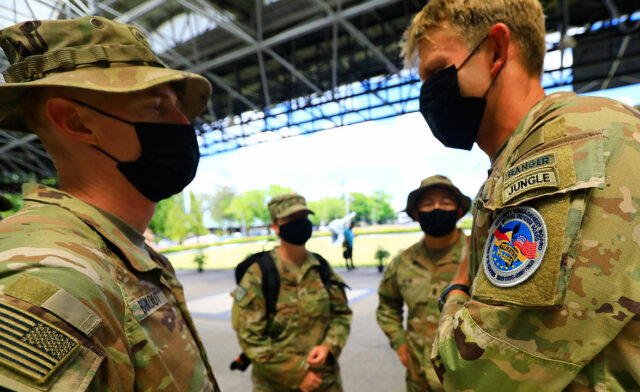
US Army rangers and their Filipino counterparts at the Balikatan war games in March 2022. — PHILIPPINE STAR/WALTER BOLLOZOS

By Kyle Aristophere T. Atienza, Reporter

PRESIDENT Ferdinand R. Marcos, Jr. on Monday ruled out the use of Philippine military bases, access to which by American troops under a 2014 military pact has been widened, to launch offensives.

“We will not let our bases be used for whatever offensive actions,” he told reporters on the sidelines of a commemoration event for Filipino heroes of World War II.

The president said sites under the Philippines’ 2014 Enhanced Defense Cooperation Agreement (EDCA) with the US are aimed to help the Philippines.

In February, Mr. Marcos gave the US access to four more military bases under EDCA on top of the five existing sites.

China has criticized the EDCA expansion, accusing the US of endangering “regional peace and stability.”

“The result will inevitably be increased military tension,” Foreign Ministry spokeswoman Mao Ning told a news conference earlier this month.

But Mr. Marcos downplayed China’s fears, saying there’s no need to worry as long as no offensives take place.

“If no one attacks us, then they should not worry because we will not fight them,” he said, adding that the government is only “continuing to strengthen the defense of our territory and the republic.”

Senator Ronald M. dela Rosa, vice-chairman of the Senate defense committee, said China’s warning was a strategy to “discourage us from honoring our commitment” to the US.

“We should not be unfazed,” he told a news briefing on Monday, adding that the government should not let China bully the Philippines. Mr. Dela Rosa is among the lawmakers highly critical of the EDCA expansion.

Three of the four new EDCA locations will be in northern Philippines — Naval Base Camilo Osias in Sta Ana, Cagayan; Lal-lo Airport, also in Cagayan; and Camp Melchor Dela Cruz in Gamu, Isabela.

Cagayan is about 1,000 kilometers away from self-ruled Taiwan, which is being claimed by China. Balabac Island in Palawan, which is facing the South China Sea, is also on the list.

Philippine Defense spokesman Arsenio R. Andolong earlier said the Philippines aimed to finish the construction of the five existing EDCA sites by 2024. Washington has allotted more than $83 million (P4.5 billion) for the approved projects at these sites.

Mr. Andolong said building works at the five sites, which are in Cebu, Cagayan de Oro, Palawan, Nueva Ecija and Pampanga, had been delayed by the coronavirus pandemic and after former President Rodrigo R. Duterte’s termination of the country’s visiting forces agreement with the US.

The former president, who led a foreign policy pivot to China, restored the agreement a year later after a meeting with US Defense Secretary Lloyd James Austin III.]

Mr. Marcos’ assurance that EDCA sites would not be used for offensives assumes the US would not provoke Chinese aggression or fight back in case of an attack, said Hansley A. Juliano, a political economy researcher studying at Japan’s Nagoya University.

“It is also just a polite diplomatic code. Both China and the Philippines know you don’t stockpile arms or invite allies if you’re actually friends,” he said in a Facebook Messenger chat.

TRAINED GUNS
Lucio B. Pitlo III, a research fellow at the Asia-Pacific Pathways to Progress Foundation, said Mr. Marcos’s remarks on China’s warning “might convey that Manila is not giving Washington a carte blanche.”

It might also mean there would be discussion on how EDCA would be implemented, “including the number of US troops and types of weapons and equipment that will be posted there,” he said via Messenger chat.

EDCA, a supplementary deal to the 1999 visiting forces agreement, allows the US to rotate its troops in the Philippines and build and operate facilities on agreed locations for both their military forces.

Filipino troops and their American counterparts hold annual military drills in Philippine territories that are called “Balikatan” (shoulder-to-shoulder) exercises.

At the weekend, foreign policy experts said the Philippines should brace for more objections from China as Manila and Washington hold their largest-ever Balikatan exercises this month.

More than 17,600 members of the Armed of the Philippines and US military will participate in the war games on April 11 to 28. There will be observers from Japan, South Korea, the United Kingdom, France, India and Southeast Asian countries.

The drills will include live-fire exercises near disputed waters of the South China Sea, including a plan to sink a decommissioned fishing boat in San Antonio, Zambales on the main island of Luzon.

San Antonio is about 140 miles from Scarborough Shoal, a Philippine feature in the South China Sea that is claimed by Beijing. In 2016, an international court ruled that both traditional Chinese and Filipino fishermen have the right to fish there. China has ignored the ruling.

Mr. Marcos, 65, has vowed to pursue an independent foreign policy, which has been criticized especially after his government announced the EDCA expansion.

During the presidential campaign, he was accused of taking a friendly stance toward China, which has rejected the United Nations-backed arbitral ruling that voided its claims to more than 80% of the South China Sea.

“What can be decided by goodwill, diplomatic transmissions and even trade agreements are not always guaranteed when guns are trained at each other in the high seas,” Mr. Juliano said.


Manila’s weekly COVID infection rate tops limit

Local and foreign tourists are seen in Puka Beach in Boracay, Aklan, April 6, 2023. — PHILIPPINE STAR/MIGUEL DE GUZMAN

THE weekly coronavirus infection rate in Manila and nearby cities has hit 6.5%, above the 5% threshold recommended by the World Health Organization (WHO), according to the OCTA Research Group.

The positivity rate in Metro Manila increased on April 8 from 4.4% a week earlier, OCTA fellow Fredegusto P. David said in a report.

Based on the report, Misamis Oriental province in southern Philippines had the highest positivity rate at 16.3%, followed by Camarines Sur at 14%, Palawan at 13.6%, Davao del Sur at 12.2% and Rizal at 11.8%.

Isabela in northern Philippines came in sixth at 10.9%, followed by South Cotabato at 10.2%, Cavite at 9.3%, Cebu at 7.7% and Negros Occidental at 7.6%.

Benguet was also on the list at 6.3%, Laguna at 4.9%, Zamboanga del Sur at 4.3%, Pampanga at 3.6%, Bulacan at 3%, Batangas at 2.9%, Pangasinan at 2.7% and Iloilo with 2.5%.

Mr. David said the national positivity rate was 7.1% as of April 4.

Filipinos had a long weekend during the Holy Week after President Ferdinand R. Marcos, Jr. declared April 6,7, and 10 as regular holidays, giving them time to visit beaches, parks and other tourist spots.

Authorities have yet to detect a new surge in infections after the government relaxed many COVID-19 restrictions including quarantine rules for travelers.

OCTA earlier cited a decline in the country’s coronavirus testing output.

In its weekly COVID-19 report released on March 30, the World Health Organization said globally, nearly 3.6 million new cases and more than 25 000 deaths were reported on Feb. 27 to March 26, a decrease of 27% and 39%, respectively, from the past 28 days.

“Despite this overall downward trend, it is important to note that several countries have recently reported significant increases in cases,” it said, adding that as of March 26, more than 761 million confirmed cases and about 6.8 million deaths had been reported globally.

The WHO has also been citing delays and declines in testing outputs globally.

“Current trends in reported COVID-19 cases are underestimates of the true number of global infections and reinfections as shown by prevalence surveys,” it said in the March 30 report. “This is partly due to the reductions in testing and delays in reporting in many countries.” — Kyle Aristophere T. Atienza