Home Blog Page 4997

Bank giants ride rate rises, keep storm clouds at bay

NEW YORK — US banking heavyweights reaped windfalls from higher interest payments in the first quarter, brushing off a crisis prompted by the collapse of two regional lenders and setting aside billions of dollars in case loans turn sour as the economic outlook dims.

First-quarter 2023 earnings from JPMorgan Chase & Co., Citigroup, Inc. and Wells Fargo & Co. beat Wall Street expectations on Friday as consumer and corporate spending held up in the face of rate rises, although all three saw signs of a slowdown and made provisions accordingly.

“Goliath is Winning,” Wells Fargo analyst Mike Mayo said in a note citing a “uniquely strong quarter” for JPMorgan, calling it “a port in the storm” during recent banking sector tumult.

JPMorgan shares soared 7.6% in their biggest one-day percentage gain since November 2020.

Banks are building up rainy day funds as fears of an economic slowdown mount from the US Federal Reserve’s aggressive interest rate hikes to tame inflation as well as the recent turmoil fueled by the failures of two mid-sized banks.

JPMorgan CEO Jamie Dimon warned that while the US economy remains robust, last month’s banking crisis with the sudden collapse of Silicon Valley Bank (SVB) and Signature Bank could make lenders more conservative and hurt consumer spending.

“The storm clouds that we have been monitoring for the past year remain on the horizon, and the banking industry turmoil adds to these risks,” Mr. Dimon said.

Citigroup, which also beat Wall Street expectations as it earned more from borrowers paying higher interest on loans, said it was prepared for a mild recession in the US.

“It’s now more likely that the US will enter into a shallow recession later this year,” Citigroup CEO Jane Fraser told analysts on a conference call. “That could be exacerbated in depth and duration in a more severe credit crunch.”

Still, she said “the biggest unknown” was the impact of US interest rates and how talks in Washington on the US debt ceiling play out.

Shares of several banks surged after the results, and the S&P 500 bank index closed up 3.5%. Citigroup surged 4.8%. Wells Fargo investors were less impressed, pushing its shares down 0.05%.

Regional banks shares dragged on the index with its biggest losers, Zions Bancorp and First Republic Bank, both falling more than 3%. After falling sharply earlier in the day PNC Financial Services Group, which reported an 18.5% rise in first-quarter profit, managed to eke out a 0.36% gain.

The KBW regional bank index finished down 2.2%.

One area where it has proven harder for the big banks to profit in 2023 has been investment banking, which was reflected in JPMorgan’s business with a 24% fall in revenue at the unit as dealmaking dries up in the face of high interest rates, inflation and fears of a recession.

TROUBLE AHEAD?
JPMorgan beat market expectations with a 52% rise in profit to $12.62 billion, or $4.10 per share, in the three months to the end of March, while its loan loss provisions increased by 56% from last year to $2.3 billion. Net interest income, a measure of how much a bank earns from lending, surged 49%.

The bank also reported a surge in deposits in the first quarter, as fears over the health of regional lenders drove customers to move their money to bigger banks.

Citigroup set aside $241 million to cover potential loan losses compared to a reserve release of $138 million a year ago.

Wells Fargo set aside $1.21 billion in the quarter to cover potential loan losses, compared to a release of $787 million a year earlier.

Wells Fargo said its provision included a $643 million rise in the allowance for credit losses, reflecting an increase for commercial real estate lending, primarily office loans, as well as an increase for credit card and auto loans.

“While most consumers remain resilient, we’ve seen some consumer financial health trends gradually weakening from a year ago,” Mike Santomassimo, Wells Fargo finance chief, told analysts. The company is taking action “to position the portfolio for a slowing economy,” he said.

In another key part of the financial services sector, BlackRock IncBLK.N — the world’s largest asset manager — reported an 18% drop in first-quarter profit but beat analysts’ estimates as investors continued to pour money into its funds, cushioning the hit to fee income from the banking rout that rocked global markets.

More banking results are due over the coming week, including Bank of America BAC.N and Goldman Sachs GS.N on Tuesday and Morgan Stanley MS.N on Wednesday.

Investors are also anxiously awaiting reports from several regional banks — the hardest-hit group during the banking tumult last month — for more clarity on the outlook ahead for them.

Financial broker Charles Schwab is expected to report a rise in revenue when it announces results on Monday, followed by Western Alliance Bancorp on Tuesday.

Zions reports on Wednesday.

First Republic, which was shored up by a group of 11 lenders that injected $30 billion into it after its shares plunged during the crisis last month, is due to report results on April 24. — Reuters

From virtual tours to online bookings: The role of satellite internet in tourism’s digital transformation

Kacific offers fast, reliable, and secure broadband connectivity to Matinloc Resort.

Tourism was hit hard by the pandemic, but as the world recovers, businesses look to meet new demands and capture growth opportunities. As a result, reliable internet connectivity has become more essential than ever for tourism operators. And, with satellite internet powering guest experiences, marketing, online transaction, and service delivery, the industry is witnessing a post-pandemic boom.

In 2022, the Philippines exceeded its target of 1.7 million visitors, with 2.65 million international arrivals and a whopping 2,465.75% increase in tourism industry revenue. Based on a Statista survey conducted in June 2022, Boracay and Baguio emerged as the top choices for domestic travel destinations in the previous year. Other popular local destinations such as Siargao, El Nido, and Coron in Palawan are expected to remain popular this 2023. As tourists flock back to resorts and hotels, they expect to stay connected with the world. This is where satellite internet comes in – offering fast, reliable, secure connectivity for tourism businesses to meet customer needs.

Connectivity – more than a lifeline for resorts 

With reliable connectivity, tourism operators can simplify each stage of the process for them and their customers. For example, instead of relying on traditional payment methods that require customers to be onsite, resorts can offer online payment options for guests, which can make the payment process more convenient and secure. This can help reduce the risk of fraud and chargebacks and increase guest satisfaction. With online booking systems, resorts can better manage their reservations and availability in real time.

Guests and employees of Mpire Siargao stay connected easily through Kacific’s VSAT.

The Mpire Resort Siargao faced a significant challenge with its internet connection, which was slow and unreliable. As a result, guests were frequently frustrated, and the resort’s reputation was at risk. However, Mpire’s situation improved dramatically with the help of Bambunet, a local internet service provider affiliated with Kacific. Working together, Mpire and Bambunet identified an internet plan that met the resort’s requirements and installed a VSAT terminal on the premises. The outcome of this collaboration was a game-changer for the resort. The new connection was fast, reliable, and the satellite internet significantly improved the experience of the resort’s guests. As a result, the resort’s business saw a positive transformation and its reputation was enhanced.

Meanwhile, Matinloc Resort in the Palawan region, known for its stunning location and on-site offerings, has been able to attract guests online, provide complimentary Wi-Fi, stay packages and a range of payment methods, including credit cards and online banking, thanks to the internet connectivity provided by Bambunet. Moreover, with 24-7 local support from Bambunet, the resort can confidently offer its guests more services, like conference and meeting facilities, and support revenue growth with online utilities.

What makes Kacific broadband service so appealing to the tourism industry is its ability to overcome the challenges of remote locations and lack of infrastructure by using small, easily installed antenna dishes to provide high-speed Ka-band internet coverage. Tourism operators can connect up to 60 users on plans with 100Mbps in download and 20Mbps in upload speeds. In addition, responsive local support from an extensive network of ISPs and distributors, and flexible, affordable payment options ensure the best customer experience.

Kacific’s ISPs offer a wide range of plans to meet tourism enterprises’ needs.

Bambunet offers unlimited plans at P10,530 in the Philippines. Kacific’s terminals are designed to be simple and are offered for a one-time terminal fee of P34,000 for most of the plans.

Satellite technology is also less physically vulnerable than traditional internet infrastructure when hit with bad weather, a norm in the Philippines during the monsoon season, thus making it a reliable choice for resorts and hotels in remote locations. With Kacific broadband offers supported by local ISPs, these resorts can confidently operate, adopt online marketing best practices, and expand their offerings to keep up with the growing tourism industry.

Contact Bambunet powered by Pipol Broadband at 0966 193 1966 or email vsat@bambunet.com to learn more.

For more information on Kacific’s satellite technology, visit www.kacific.com.


Spotlight is BusinessWorld’s sponsored section that allows advertisers to amplify their brand and connect with BusinessWorld’s audience by enabling them to publish their stories directly on the BusinessWorld Web site. For more information, send an email to online@bworldonline.com.

Join us on Viber at https://bit.ly/3hv6bLA to get more updates and subscribe to BusinessWorld’s titles and get exclusive content through www.bworld-x.com.

NCR construction materials retail price growth slowed in March

Workers are seen installing steel at a construction site in Santa Cruz, Manila, Oct. 26, 2022. — PHILIPPINE STAR/EDD GUMBAN

By Lourdes O. Pilar, Researcher

THE RETAIL price growth of construction materials in Metro Manila slowed to 4.1% year on year in March, the Philippine Statistics Authority (PSA) reported on Friday.

This marks the slowest rate of growth in over a year, according to PSA data.

Based on preliminary PSA data, the rise in March construction materials retail price index (CMRPI) eased from 5.4% in February and 4.8% in March last year. 

Metro Manila's construction materials retail price index

The 4.1% reading in March was the lowest since February 2022 when retail construction materials prices grew at 3.3%. This was also the seventh consecutive month of slower annual growth rate.

During the first quarter, the CMRPI was up 5% from 3.7% comparable three months last year.

The PSA attributed the continued slowdown of CMRPI to the slowdown of the following commodities: miscellaneous construction materials, where price growth slowed to 6.2% from 9.3% in February; plumbing materials (2.2% from 4%); and tinsmithry materials (4.7% from 5.9%).

Lower annual increases in March were also seen in the indices of the carpentry materials (3.3 % from 3.8%), electrical materials (2.4% from 3.1%), and masonry materials (3.6% from 4%). Growth in the painting materials and related compounds steadied at 5.6%.

“The slowest year-on-year increase in the retail prices of construction materials in Metro Manila, at 4.1%, the slowest in more than a year, was largely brought about by the decline in global commodity prices in recent months,” Rizal Commercial Banking Corp. Chief Economist Michael L. Ricafort in an e-mail.

“Furthermore, the stronger peso exchange rate versus the US dollar recently, among the strongest for the peso in more than 8.5 months, also helped ease import prices, thereby leading to some easing in the wholesale prices of construction materials,” added Mr. Ricafort.

Mr. Ricafort added that inflation and interest rates had also dragged investments and overall demand, including construction activities, thereby partly slowing down prices of construction materials.

Preliminary data from the PSA showed annual headline inflation eased to 7.6% from 8.6% in February. However, this was faster than the 4% print a year ago. March inflation was the slowest since the 6.9% print in September 2022.

Core inflation, which strips out volatile prices of food and fuel, quickened to 8% in March from 7.8% in February.

“The further reopening of the local economy towards greater normalcy and continued increase in infrastructure spending would still be bright spots for the economy, thereby could still support the demand for construction materials, going forward,” Mr. Ricafort said.

Deadline looms:  Around 10% of taxpayers yet to file annual income tax returns 

PHILIPPINE STAR/KRIZ JOHN ROSALES

AROUND 10% of registered taxpayers still have to file their 2022 annual income tax returns by the April 17 deadline, according to the Bureau of Internal Revenue (BIR).

“As of now, what we know is less than 10% (are still expected to file their taxes), [but] the turnout of filing has been okay,”  BIR Commissioner Romeo D. Lumagui, Jr. said in a press briefing on Friday.

“So far, our campaigns have been effective, better than pre-pandemic levels,” he added.

The agency expects to generate around P1.1 trillion from the annual tax filing, up by around 11-12% from last year’s collection.

The BIR said there are around 3.8 million individual registered taxpayers, not including businesses.

Taxpayers who do not make the Monday deadline will face penalties, such as an imposition of 12% interest and a 25% surcharge.

“We are well aware that filing and paying taxes can be a challenge for some taxpayers, that’s why we’re exploring ways to streamline processes and make it easier and more convenient for taxpayers to comply with their tax obligations,” Mr. Lumagui said.

The BIR has implemented initiatives to aid taxpayers in meeting the deadline, such as extending authorized agent bank working hours to 5:00 p.m., creating tax assistance centers, and expanding payment channels.

This year, the agency set a P2.6-trillion revenue target, 11% higher than the P2.34 trillion it collected last year.

The BIR collects about 70% of government revenues.—Luisa Maria Jacinta C. Jocson

BoI investment approvals hit P463 billion in Q1 

PHILIPPINE STAR/MICHAEL VARCAS

THE BOARD of Investments (BoI) has seen a 155% rise in approved investments for the first quarter (Q1) to P463.3 billion, with 68 approved projects, mainly in the renewable energy sector. 

Local investment approvals for the period showed a significant increase of 68%, amounting to P297.9 billion, compared to the P177.3 billion recorded in the same period last year, the BoI said in a statement on Friday.

Meanwhile, foreign investment approvals saw a massive surge of 3,722%, reaching P165.4 billion compared to P4.33 billion recorded last year.

The BoI is an investment promotion agency under the Department of Trade and Industry (DTI).

According to the BoI, the renewable energy sector had the highest investment approvals among sectors during the period, increasing by 156% to P440 billion, followed by manufacturing, which surged by 416% to P17 billion.

Other leading sectors in terms of investment approvals include administrative services at P3.7 billion, transportation and storage at P1.2 billion, and agriculture at P929 million. The investment approvals in the first quarter were expected to generate 16,719 local jobs.

Trade Secretary and BoI Chairman Alfredo E. Pascual said the first quarter investment approvals reflected the stronger investor interest in the Philippines.

The BoI is on track to meet its P1.5 trillion investment target for 2023, he noted.

“With investment prospects being very positive, and as we continue to receive serious interest from global investors, we are definitely on track to meeting our new annual investment target of P1.5 trillion,” Mr. Pascual said.

Among the top projects approved in the first quarter were the P392.4-billion offshore wind farm projects of German-owned wpd Philippines in Cavite, Negros Occidental, and Guimaras, followed by the P36.9-billion solar energy project of Filipino-owned Barracuda Energy Corp. in the Ilocos Region.

Mr. Pascual said the BoI is eyeing more investments in renewable energy following the amended implementing rules and regulations of Republic Act No. 9513, or the Renewable Energy Act, which allowed full foreign ownership in renewable energy projects.

“The number of renewable energy projects coming in is concrete evidence that we are on our way to becoming a global hub for sustainability and green projects, aligned with the national government’s policy of promoting cleaner and more sustainable sources of energy,” Mr. Pascual said.

On foreign investments, Germany contributed the most at P157 billion, followed by the Netherlands at P2.7 billion, the United States at P1.2 billion, Japan at P524 million, and the United Kingdom at P293 million.

Locally, investments in Western Visayas had the biggest share at P293.3 billion, followed by Calabarzon at P112.7 billion, Ilocos Region at P38.7 billion, Davao Region at P3.6 billion, and Eastern Visayas Region at P3.6 billion.

Mr. Pascual attributed the higher approved investments in the first quarter to the country’s economic performance.  The gross domestic product (GDP) in the first three months is seen to grow by 7.1%, he noted.

The GDP data is set to be released by the Philippine Statistics Authority on May 11.

“The steady growth is proof of the government’s resolve to further improve the country’s business environment through investment-friendly policies. We shall continue with our aggressive investment promotion campaigns as investments are also set to provide higher quality and better-paying jobs for Filipinos,” Mr. Pascual said. —Revin Mikhael D. Ochave

Consumers less pessimistic in first quarter — BSP

PHILIPPINE STAR/ MICHAEL VARCAS

Consumers were less pessimistic in the first quarter due to their positive outlook on the availability of more jobs and permanent employment, higher income, and continued recovery from the public health crisis, according to the Philippine central bank.

The consumer confidence index (CI) fell 10.4% in the first three months of the year, better than the 14.6% drop in the previous quarter, according to a statement issued by the Bangko Sentral ng Pilipinas (BSP) on Friday.

This was, however, the 11th consecutive quarter of pessimism, or since the 54.5% drop in the third quarter of 2020.

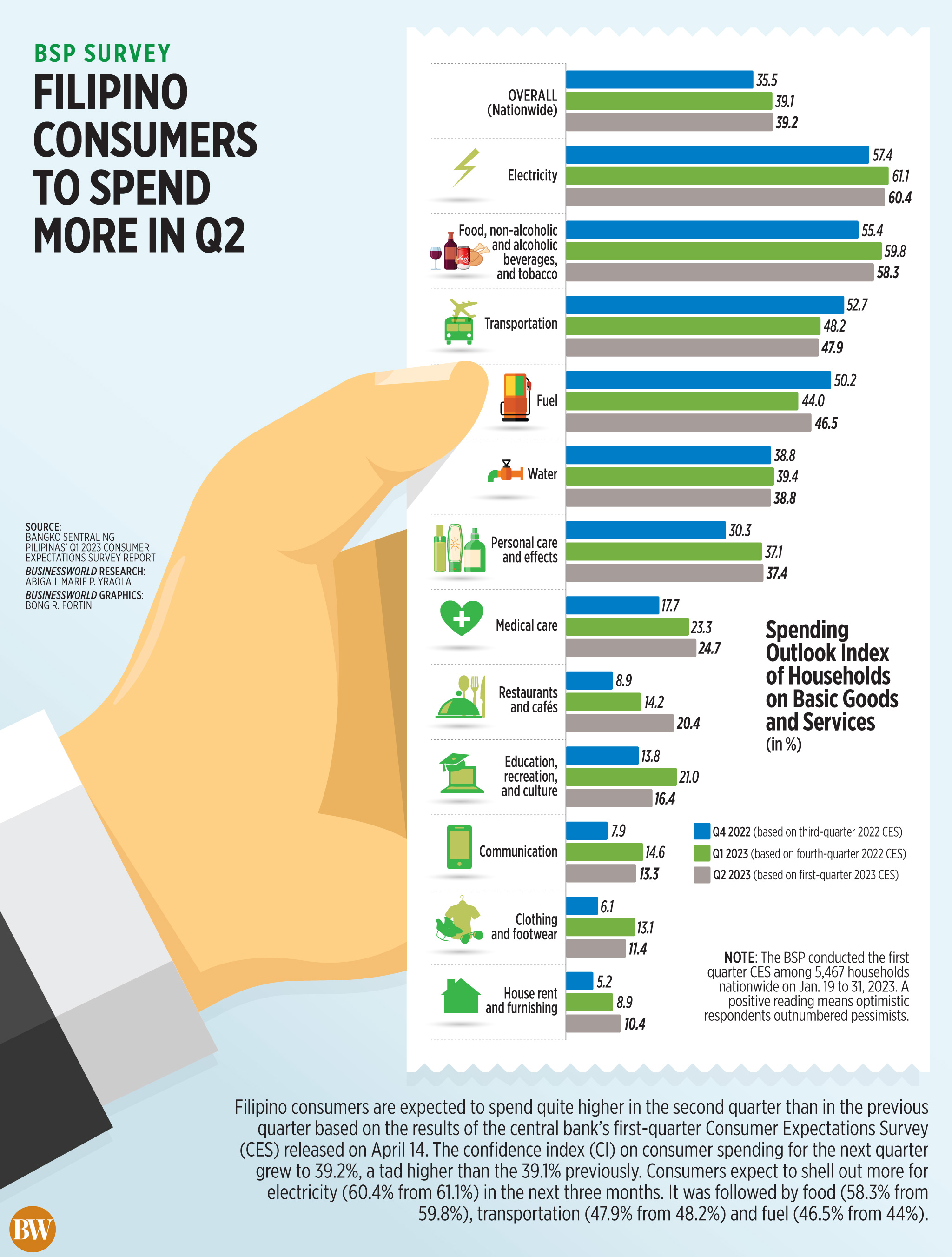
BSP survey: Filipino consumers to spend more in Q2

The number of households with optimistic views increased, but this was still outnumbered by those with pessimistic views.

For the second quarter, the index remained positive but fell to 7.5% from 9.5% the previous quarter.

Meanwhile, consumer confidence for the next 12 months inched up to 22.7% from 21.7% in the previous quarter.

According to the BSP, consumer sentiment was less pessimistic across all income groups in the first quarter.

“Consumers cited that their improved outlook for Q1 2023 was due to their optimism about more available jobs and permanent employment; higher income from wages/salaries, remittances, and other sources; and positive developments in the country’s COVID-19 situation such as the relaxation of vaccination, testing, and masking requirements, fewer COVID-19 cases, and post-pandemic recovery of businesses as workers return to their office,” the BSP said.

Consumers expect rising interest rates, persistent inflation, and low unemployment rate in the near term.

“For Q1 and Q2 2023, and the next 12 months, consumers anticipate that the interest rate may increase, the peso may depreciate against the US dollar, and the unemployment rate may decline,” the central bank said.

“Consumers also expect that the inflation rate may rise for the reference periods. In particular, consumers are expecting that the inflation rate may average at 6.2% for the next 12 months, which is above the upper end of the National Government’s inflation target range of 2-4% for 2023-2024,” it added.

Inflation slowed to 7.6% in March from 8.6% in February. However, this still marked the 12th straight month that inflation breached the BSP’s target.

To tame inflation, the BSP has raised rates by 425 basis points since May 2022, bringing the benchmark rate to 6.25%.

The central bank interviewed 5,467 consumers for the survey, held between Jan. 19 to 31. — Luisa Maria Jacinta C. Jocson

Swinging Sixties fashion designer Mary Quant dies aged 93

Image source: https://bit.ly/408wfPq

 – Fashion designer Mary Quant, often credited with popularizing the miniskirt that helped define Britain’s “Swinging Sixties” era, has died aged 93.

Born and brought up in Blackheath, south east London, Quant helped pioneer bold new styles during the 1960s – a decade in which fashion, music and art subculture challenged and forever changed Britain’s post-war national identity.

“It’s impossible to overstate Quant‘s contribution to fashion,” the Victoria and Albert Museum, which held a 2019 exhibition focused on her work, said in a statement.

“She represented the joyful freedom of 1960s fashion, and provided a new role model for young women. Fashion today owes so much to her trailblazing vision.”

A self-taught designer, Quant opened a west London boutique called Bazaar in the 1950s alongside her fashion entrepreneur husband Alexander Plunket Greene and their business partner.

Bazaar grew to be hugely popular by offering shoppers something drastically different to mainstream stores and high-end designers.

Her influence on fashion reached its height with the arrival of the miniskirt, whose above-the-knee hemline – often rising far above the knee – became a symbol of the rebellious youth culture and sexual liberation of a new generation.

Quant‘s own look was as compelling as her designs and she sported a famous trademark “bob” haircut.

In 1966 she was awarded an national honor for her contribution to the fashion industry, collecting the award from the Queen in a typically bold outfit – a short cream-colored dress and a beret – which caused a stir in the national press.

“A leader of fashion but also in female entrepreneurship – a visionary who was much more than a great haircut,” former British Vogue editor Alexandra Shulman wrote on Twitter. – Reuters

Summer Metro Manila Film Festival 2023: Tense, thrilling, full of talent

Romnick Sarmenta and Elijah Canlas in a scene from About Us But Not About Us.

By Brontë H. Lacsamana, Reporter 

Movie Review
About Us But Not About Us
Directed by Jun Robles Lana
MTRCB Rating: R13

It’s exciting to witness a Filipino film pulling off the challenge of having a few characters in a single location immersed in deep conversation. Given this minimalistic approach, the fact that About Us But Not About Us is able to keep you on the edge of your seat is a feat.

But the plot is a different story. It follows a literature professor and his student who meet at a restaurant for lunch. At first, it seems like the two men engaging in what looks like a controversial teacher-student relationship is already a juicy situation on its own. We eventually learn that that barely scratches the surface.

Things take darker and darker turns when the two characters continue speaking, about a person close to them who committed suicide, and later about secrets that they’re only now admitting to each other. This entire tense exchange takes place over the course of their meal.

Romnick Sarmenta (who won best actor at the MMFF Awards Night for playing Eric, the professor) and Elijah Canlas (who won a special jury prize for his role as Lance, the student) are understandably the stars of the show. They bring to life not just their own characters, but even the third character involved in their story who is not present. They throw sharp verbal blows at each other, and we, the captive audience, fully feel the impact.

Director Jun Robles Lana, already well-respected and acclaimed in the local movie industry for films like Barbers’ Tales and Big Night! definitely took a chance and tried something new, to very strong effect.

The film is technically masterful and riveting. It dominated the 1st Summer MMFF, bringing home 10 awards including best cinematography, screenplay, production design, editing, sound, musical score, and best director for Lana.

And deservedly so — cinematographer Neil Daza adjusts the camera to reflect the shifting psyches of each character as every twist is revealed. Editor Lawrence Ang and sound designers Fatima Salim and Immanuel Verona help build the tension as ordinary moments melt into thrilling exchanges.

The dialogue is believable for a conversation involving talented writers in academia, even veering towards slightly annoying in its endless glorification of literary achievement. Like, who just throws the phrase “The Next Great Filipino Novel” around? This makes it look like being in a Creative Writing department automatically makes one full of yourself and it successfully alienates people who aren’t literary minded.

Besides that, it’s technically a commendable feat. All the detail put into the film is proof that Lana’s take on 12 Angry Men and My Dinner With Andre, which are highly praised “single-location conversation films,” is a worthwhile addition to the genre.

This film, however, runs into a propblem that the other two don’t — the concept of mindful representation. It’s an issue that matters to the Lesbian, Gay, Bisexual, Trans Plus (LGBT+) movement. With many people in the world already wary, judgmental, or worse, downright hostile towards the LGBT+ community, should there be representations of problematic gay people who are unable to solve their issues?

What’s interesting is that this is even brought up by the third character, Marcus, who isn’t physically present in the film, but who is breathed into life by the excellent career-best combo of Sarmenta and Canlas. The three main characters have many issues and badly need therapy, much like many people in the world regardless of sexuality, but their role in this world is a weighty one.

Though the film suggests that problematic gays on film can be portrayed in complex, nuanced, and intriguing ways, perhaps it would have been even more of a win if this concluded on a less defeatist note.

US, Mexico agree to ramp up fight against fentanyl and arms trafficking

 – Mexico and the United States on Thursday agreed to ramp up the fight against fentanyl trafficking, as well as Mexico‘s Sinaloa and CJNG drug cartels and their supply chains, in joint bid to reduce consumption of the powerful opioid.

The deal came after a meeting of officials from both countries in Washington.

Both countries have in recent weeks asked China to help curb the shipment of precursor chemicals coming from the Asian country, in order to prevent production of the synthetic drug responsible for thousands of deaths in the United States.

“That’s our goal,” said Mexican Foreign Minister Marcelo Ebrard in a video released by his office, without mentioning the origin of these chemicals.

The White House said this week it plans to expand efforts to disrupt the illicit financial activities of drug traffickers involved in the fentanyl trade by using more sanctions to obstruct their access to the US financial system.

Mr. Ebrard said the Mexican delegation also asked Washington for a task force to monitor and “substantially” reduce the flow of arms from the United States to Mexico.

Mexico is appealing in a $10 billion civil lawsuit seeking to hold US gun makers responsible for facilitating the trafficking of deadly weapons across the border to local drug cartels. It argues that combating this is a shared responsibility. – Reuters

World Bank’s new boss must push ahead on reforms, fight poverty-French minister

REUTERS

 – France’s development minister said on Thursday she will tell the World Bank’s expected next president, Ajay Banga, to maintain the bank’s anti-poverty mission while forging ahead with next steps by October in its evolution to fight climate change and other global crises.

Chrysoula Zacharopoulou told Reuters in an interview that she wants Banga, the former CEO of Mastercard, to use an international finance summit in Paris to develop ideas and plans for expanding climate finance and harnessing private sector funds.

Ms. Zacharopoulou, a Greek-born gynecologist and former European Parliament member who was appointed France’s Minister of State for Development, Francophonie and International Partnerships 11 months ago, is due to meet with Banga on Friday during World Bank and International Monetary Fund meetings in Washington.

“What I am going to tell him – or what I’m going to encourage him – is that he will have our support in his mission to finalize an ambitious reform of the World Bank by Marrakech, using the June summit in Paris like an important step,” Ms. Zacharopoulou said, referring to the World Bank and International Monetary Fund annual meetings in Morocco in October.

“This is the first thing. The second is that we have to continue to fight extreme poverty,” she said. “That means the poorest countries and their populations have to remain at the center of the agenda of the World Bank and of all of us.”

France on June 22-23 is hosting the “Summit for a New Global Financial Pact,” which aims to boost crisis financing for vulnerable countries in the Global South.

Ms. Zacharopoulou said the conference would focus on ways to create innovative new financing resources for climate change, public health, biodiversity and other public goods and to build political momentum for changes beyond a $5 billion annual lending increase adopted this week by World Bank shareholders.


DE-RISKING INVESTMENTS

Ms. Zacharopoulou said that there was a major focus on bringing in private sector funds to scale up climate financing to the vast amounts needed to meet emissions reduction goals.

“Public money has a role to play in de-risking investments in the most vulnerable countries. We can use the public money to de-risk but the private sector has to come,” she said.

Mr. Banga was a “good match” for the World Bank job, with strong private sector finance and management experience. Because he was born and educated in India, “He knows well about the challenges of emerging and developing countries.”

But Mr. Banga, who has promised to deliver more lending resources beyond the initial balance sheet changes, will attend the Paris finance summit only a few weeks after he is expected to start in early June.

Ms. Zacharopoulou said Mr. Banga would be able to build on the work of World Bank staff who advanced the bank’s initial reform steps in just six months.

“Starting from this important moment, he has some momentum to put his signature on it and give his vision,” she said. “I think that he will have all of the international community with him.” – Reuters

US says Photoshop maker Adobe to pay $3 million to settle kickback allegations

Adobe Logo

 – Photoshop maker Adobe Inc. has agreed to pay $3 million to settle US kickback allegations involving federal software sales, the US Justice Department said in a statement on Thursday.

The settlement resolves allegations that Adobe made improper payments under its Solution Partner program to companies that had a contractual or other relationship with the government that allowed them to influence federal purchases of Adobe software, the Justice Department said.

Between January 2011 and December 2020, Adobe allegedly paid the companies a percentage of the purchase price of the software, according to the Justice Department.

The United States contends that these payments constituted prohibited kickbacks that resulted in Adobe causing false claims for payment to be submitted to federal agencies.

The company said on Thursday that it had cooperated with the government since it began its probe in 2018 and was pleased “to have this matter behind us.”

“Those who do business with the government are prohibited from paying kickbacks, which can result in unnecessary purchases and increase costs to taxpayers,” said Brian Boynton, head of the Justice Department’s civil division.

“We will continue to use all appropriate tools to safeguard the integrity of the federal procurement process,” Boynton said. – Reuters

Russia says Black Sea grain deal may be nearly over

STOCK PHOTO | Image by Couleur from Pixabay

 – Russia on Thursday said there would be no extension of the UN-brokered Black Sea grain deal beyond May 18 unless the West removed a series of obstacles to the export of Russian grain and fertilizer.

The Ukraine grain Black Sea export deal was brokered by the United Nations and Turkey in July last year to help alleviate a global food crisis worsened by conflict disrupting exports from two of the world’s leading grain suppliers.

“Without progress on solving five systemic problems … there is no need to talk about the further extension of the Black Sea initiative after May 18,” the Russian foreign ministry said in a statement.

“We note that, despite all the high-sounding statements about global food security and assistance to countries in need, the Black Sea Initiative both served and continues to serve exclusively commercial exports of Kyiv in the interests of Western countries,” the ministry said.

To help persuade Russia to allow Ukraine to resume its Black Sea grain exports last year, a separate three-year agreement was also struck in July in which the United Nations agreed to help Russia with its food and fertilizer exports.

Russia said the two agreements were “interconnected parts of one ‘package'”, and scolded the UN Secretariat for what it said was a distortion of the facts.

UN spokesman Stephane Dujarric said “discussions, communications are still going on with the parties” and that UN officials were determined to ensure the implementation of both deals.

He said in relation to Russia‘s exports “there’s still a lot of critical issues that need to be resolved over payments and other technical issues” that UN officials were trying to fix.

But he noted that “there’s been some concrete results that contribute to larger grain trade volumes, lower freight rates and an increased number of ships that have called at Russian ports for fertilizer and lowering in insurance.”

“So we’ve made some progress, but we continue to push to make more,” Dujarric said.


RUSSIAN DEMANDS

Western powers have imposed tough sanctions on Russia over its Feb. 24, 2022, invasion of Ukraine. Its food and fertilizer exports are not sanctioned, but Moscow says restrictions on payments, logistics and insurance are a barrier to shipments.

The foreign ministry said Russian Agricultural Bank (Rosselkhozbank) had to be reconnected to the SWIFT payment system, that supplies of agricultural machinery and parts needed to be resumed and that restrictions on insurance and reinsurance needed to be lifted.

Other demands include access to ports, the resumption of the Togliatti-Odesa ammonia pipeline that lets Russia pump the chemical to Ukraine’s port, and the unblocking of assets and the accounts of Russian companies involved in food and fertilizer exports.

“The removal of obstacles to domestic agricultural exports was supposed to take place within the framework of the implementation of the Russia-UN Memorandum,” the ministry said.

Russia said there had been a failure of the inspection regime of ships carrying grain from Ukraine.

“Currently, 28 vessels carrying more than 1 million tons of food are awaiting inspection in the territorial waters of Turkey,” the foreign ministry said.

It accused UN staff in the Joint Coordination Center of refusing to draw up an inspection schedule.

“In turn, an even more difficult situation has developed around the registration of bulk carriers,” the ministry said, denying that Russia was responsible for any of the congestion and accusing Ukrainian port officials of accepting bribes to accelerate registration.

ADVERTISEMENT
ADVERTISEMENT