Home Blog Page 4981

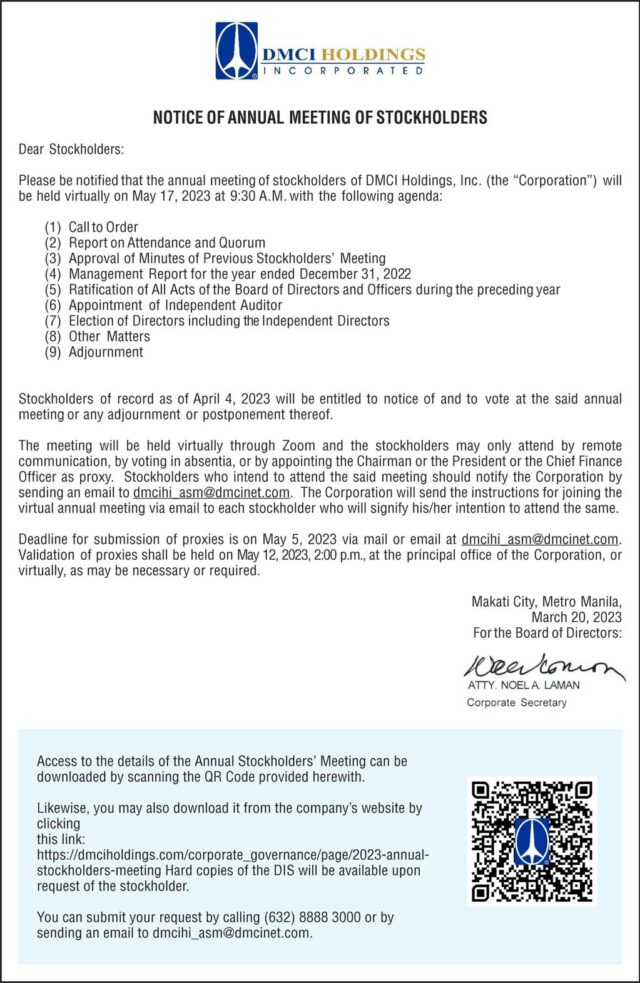
DMCI Holdings, Inc. to hold annual stockholders’ meeting virtually on May 17


Spotlight is BusinessWorld’s sponsored section that allows advertisers to amplify their brand and connect with BusinessWorld’s audience by enabling them to publish their stories directly on the BusinessWorld Web site. For more information, send an email to online@bworldonline.com.

Join us on Viber at https://bit.ly/3hv6bLA to get more updates and subscribe to BusinessWorld’s titles and get exclusive content through www.bworld-x.com.

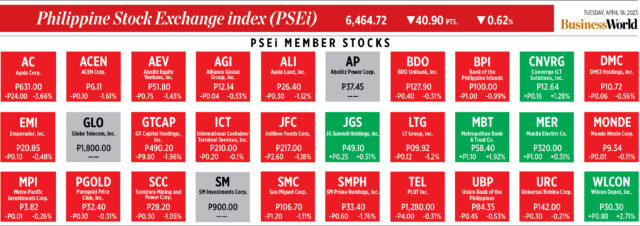
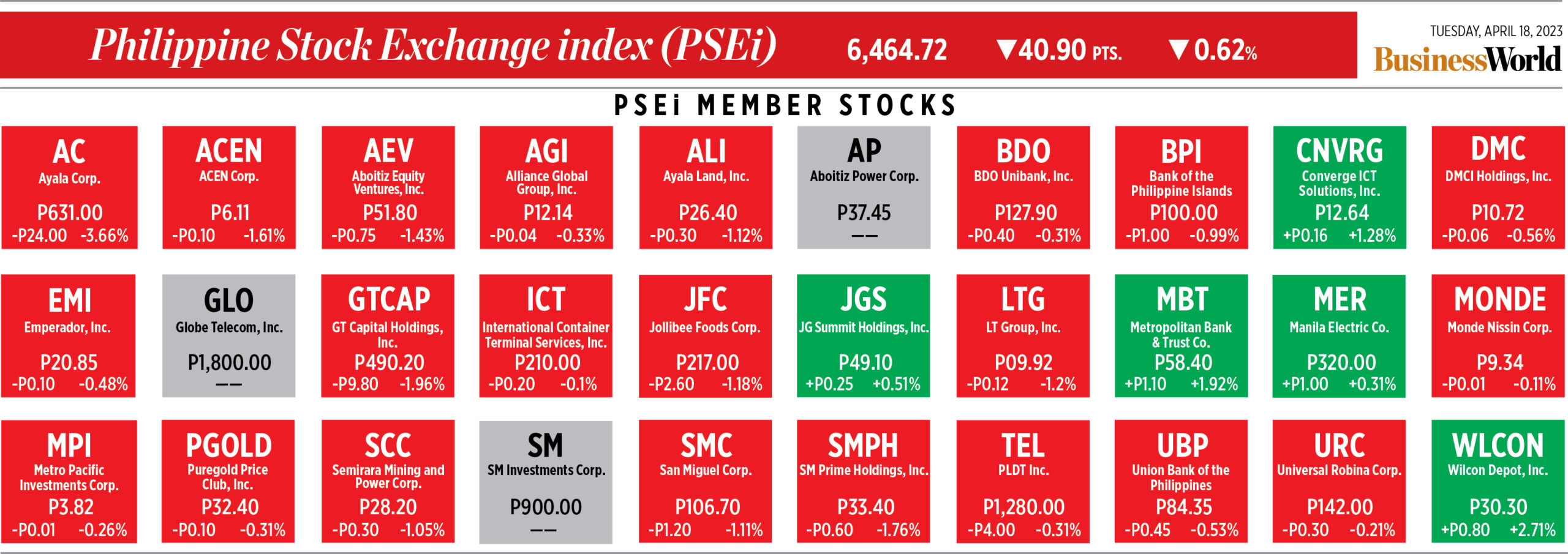
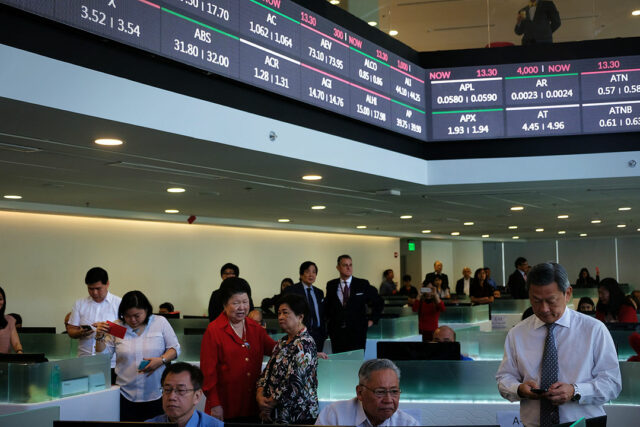
How PSEi member stocks performed — April 18, 2023

Here’s a quick glance at how PSEi stocks fared on Tuesday, April 18, 2023.


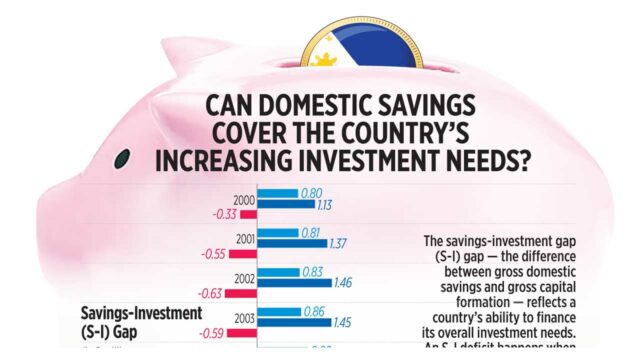
Can domestic savings cover the country’s increasing investment needs?

The savings-investment gap (S-I) gap — the difference between gross domestic savings and gross capital formation — reflects a country’s ability to finance its overall investment needs. An S-I deficit happens when a country’s investment expenditures exceed its savings, that leads a country to borrow to fund the gap. In 2022, the country’s savings rate — gross domestic savings as share of gross domestic product (GDP) — reached 12% (P2.39 trillion) while the investment rate stood at 23.1% (P4.61 trillion) of GDP, resulting in a P2.22-trillion deficit. This was the widest gap on record or since the earliest record in 2000.

Can domestic savings cover the country’s increasing investment needs?

Soundgarden, singer’s widow settle court fight over unreleased recordings

SOUNDGARDEN’s fifth album, Down on the Upside, was released on May 21, 1996.

GRUNGE music pioneers Soundgarden and Vicky Cornell, the widow of lead singer Chris Cornell, have settled a legal dispute over the late singer’s unreleased recordings, according to a joint post from their Instagram accounts on Monday.

They said the “amicable” settlement marked a new partnership between Soundgarden and Cornell’s estate that will allow fans to “hear the final songs that the band and Chris were working on.”

An attorney for Ms. Cornell confirmed the settlement but declined to offer details. A representative for Soundgarden declined to comment. Soundgarden’s label, Universal Music Group, did not immediately respond to a request for comment.

Vicky Cornell, who administers her late husband’s estate, first sued Soundgarden in 2019 in Miami federal court before the case was later moved to the band’s home state of Washington. She claimed the band members withheld the estate’s share of royalties to “strong arm” her into giving them unreleased recordings Chris Cornell made before his death in 2017.

Her lawsuit argued that Cornell recorded the songs separately from the band and that he was their sole owner. The band countersued her for refusing to turn over the recordings, which it said were meant for a Soundgarden album for UMG. — Reuters

Peso tumbles to P56:$1 level

ANGIE REYES-PEXELS

THE PESO closed at the P56-per-dollar level for the first time this year on Tuesday due to concerns over a narrowing differential amid a potential pause in the Bangko Sentral ng Pilipinas’ (BSP) tightening cycle while the US Federal Reserve continues to raise rates.

The local currency closed at P56.14 versus the dollar on Tuesday, declining by 29 centavos from Monday’s P55.85 finish, data from the Bankers Association of the Philippines’ website showed.

This was the peso’s first time to finish at the P56 level and worst close in more than three months or since ending at P56.20 on Dec. 28, 2022.

The local unit opened Tuesday’s session at P56 per dollar. It recorded an intraday best of P55.98, while its worst showing was at P56.23 versus the greenback.

Dollars traded rose to $1.418 billion on Tuesday from the $1.375 billion recorded on Monday.

The peso continued to weaken amid hints of a pause in the BSP’s rate hikes as early as next month, a trader said in a Viber message.

“Probably this time, some players were caught short-squeezed given the strength of upward move. A pause from the BSP but the Fed is still poised to hike [will result in] a narrower yield differential,” the trader said.

The central bank may consider pausing its monetary tightening next month if inflation does not pick up in April, BSP Governor Felipe M. Medalla said last week.

Mr. Medalla said a pause in interest rate increases was possible “if the April CPI (consumer price index) is not higher than the March CPI” or if there is “zero or negative month-on-month inflation.”

Headline inflation eased for a second consecutive month in March to 7.6% from 8.6% in February.

For the first quarter, inflation averaged 8.3%, higher than the BSP’s 6% forecast and 2-4% target for the year.

The Monetary Board last month hiked benchmark interest rates by 25 basis points (bps), bringing the yield on its overnight reverse repurchase facility or its key rate to 6.25%.

Since May 2022, the BSP has raised borrowing costs by a total of 425 bps. Its next meeting is on May 18.

Meanwhile, the US central bank has hiked borrowing costs by a total of 475 bps since March 2022, with the fed funds rate now at a range between 4.75% and 5%.

The Fed’s next policy meeting will be held on May 2-3.

“The peso weakened anew following reports that US House Republicans have secured legislative support to temporarily suspend the US debt limit,” a second trader said.

US House of Representatives Speaker Kevin McCarthy on Monday outlined spending cuts he said his fellow Republicans would demand in exchange for voting to raise the federal government’s $31.4-trillion debt ceiling, avoiding a potentially catastrophic default, Reuters reported.

His proposals included cutting spending to last year’s levels, capping growth at 1% per year and reversing some of President Joseph R. Biden’s policy goals, ideas that Republicans, who control the House, have been floating for weeks that have been rejected by Democrats, who control the Senate and White House.

The peso continued to decline as the dollar lingered among one-month highs and against a stronger Japanese yen, Rizal Commercial Banking Corp. Chief Economist Michael L. Ricafort said in a Viber message.

The dollar index fell 0.3% to 101.76 on Tuesday, while the dollar dropped by 0.2% to 134.28 Japanese yen.

For Wednesday, the peso could rebound against the dollar ahead of potentially better inflation data out of Europe, the second trader said.

The second trader expects the peso to trade between P56.00 and P56.25 per dollar on Wednesday, while the first trader gave a P55.85 to P56.40 forecast range. For his part, Mr. Ricafort sees the peso moving from P56.05 to P56.25. — AMCS with Reuters

PHL stocks drop as peso returns to P56:$1 level

BW FILE PHOTO

PHILIPPINE SHARES declined on Tuesday due to slower remittances growth in February and as the peso continued to weaken against the dollar.

The benchmark Philippine Stock Exchange index (PSEi) fell by 40.90 points or 0.62% to close at 6,464.72 on Tuesday, while the broader all shares index went down by 18.02 points or 0.51% to end at 3,471.52.

“The local bourse dropped as the slower cash remittance growth in February and the depreciation of the peso against the dollar weighed on sentiment,” Philstocks Financial, Inc. Research Analyst Claire T. Alviar said in a Viber message.

“In February, overseas Filipinos’ cash remittances grew by 2.4%, lower than January’s 3.5%. Moreover, the depreciation of the peso versus the dollar added to the negative sentiment. Earlier, the peso reached the P56 level against the dollar,” Ms. Alviar added.

Money sent home by overseas Filipino workers rose by 2.4% year on year to $2.57 billion in February, data released by the Bangko Sentral ng Pilipinas (BSP) on Monday showed.

For the first two months of the year, cash remittances grew by 3% year on year to $5.331 billion.

The BSP expects remittances to grow by 3% this year.

Meanwhile, the peso closed at P56.14 against the dollar on Tuesday, down by 29 centavos from Monday’s P55.85 finish.

This was the peso’s weakest close and was its first time ending at the P56-per-dollar level in more than three months or since it finished at P56.20 on Dec. 28, 2022.

AB Capital Securities, Inc. Vice-President Jovis L. Vistan said investors may stay on the sidelines until early May as they wait for market-moving events.

“That will be the time where we will be loaded with major market-moving events like the FOMC (Federal Open Market Committee) decision on interest rates, Philippine April inflation, and first quarter corporate earnings results,” Mr. Vistan said.

“For now, the PSEi will move within 6,400 to 6,500,” he added.

The next FOMC meeting will be held on May 2-3.

All sectoral indices closed lower on Tuesday. Property dropped by 34.35 points or 1.25% to 2,693.25; mining and oil declined by 134.60 points or 1.21% to 10,937.43; holding firms fell by 53.67 points or 0.84% to 6,304.62; industrials decreased by 34.17 points or 0.36% to 9,285.69; financials went down by 3.39 points or 0.18% to 1,791.85; and services lost 0.68 point or 0.04% to close at 1,606.97.

Value turnover went down to P3 billion on Tuesday with 770.44 million shares changing hands from the P4.39 billion with 1.07 billion issues traded on Monday.

Decliners outnumbered advancers, 114 versus 61, while 55 names closed unchanged.

Net foreign selling rose to P142.88 million on Tuesday from P59.57 million seen on Monday. — A.H. Halili

Green energy auction 2nd round to put 3,600 MW up for bid

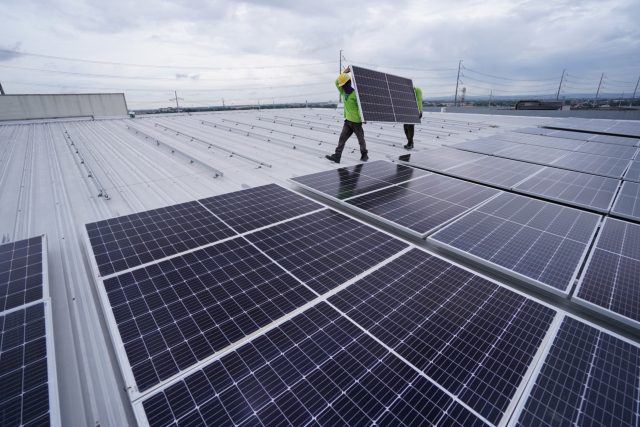
Solar panels are being installed on the roof of a mall. — GREEN HEAT HANDOUT PHOTO

THE Department of Energy (DoE) will offer 20-year supply contracts for the 3,600 megawatts (MW) on offer in the second round of the green energy auction program (GEAP) in June, according to the terms of reference (ToR) issued by the DoE on Tuesday.

The 20 years will run from the start of commercial operation of the renewable energy (RE) project.

Ground-mounted solar projects will account for the 2,025 MW of the auction; onshore wind 1,200 MW; roof-mounted solar 235 MW; and biomass 140 MW.

For 2025, the installation target is also 3,600 MW, with ground-mounted solar accounting for 2,140 MW; onshore wind 1,170 MW; roof-mounted solar 260 MW; and biomass 30 MW.

For 2026, the installation target is 4,400 MW, consisting of 2,550 MW in capacity for ground-mounted solar, 1,350-MW onshore wind; 300-MW floating solar; 110-MW roof-mounted solar; 30-MW waste-to-energy; and 10-MW biomass.

“Qualified suppliers intending to participate in this auction round are expected to register with the DoE in accordance with the applicable ToR by submitting complete requirements,” the DoE said.

The GEAP aims to promote RE as a major source of energy via the competitive selection of RE output.

The DoE said the GEAP will help the government reach its target of 35% RE share by 2030 and 50% by 2040.

Natural gas facilities accounted for the biggest share of committed projects, or those that have secured funding, in Luzon for the 2023-2027 period.

As of Feb. 28, the DoE said natural gas facilities accounted for 3,500 MW; followed by coal-fired plants with 3,280.40 MW; solar 2,432.88 MW; energy storage systems 1,504 MW; wind 260 MW; hydro 146.87 MW; geothermal 66 MW; oil 11.04 MW and biomass 8.60 MW. — Ashley Erika O. Jose

Farmers call on NFA to procure palay at P20/kilo to build emergency stocks

PHILSTAR FILE PHOTO

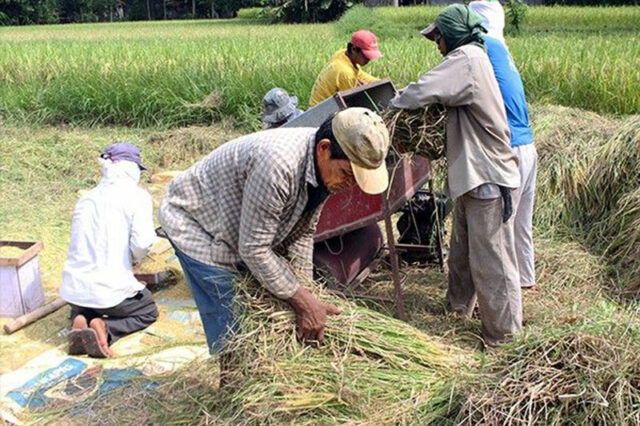
FARMERS called on the National Food Authority (NFA) to raise its procurement price for palay (unmilled rice) to P20 per kilogram, saying it should build its buffer stock from domestic rice rather than imports.

“The buffer stock can be built up even without importing through local procurement. What is needed is for the NFA to have the political will to buy palay from farmers,” Kilusang Magbubukid ng Pilipinas Chairperson Rafael V. Mariano said in a Viber message.

The Palace recently announced a proposal to import 330,000 metric tons (MT) of rice to meet the NFA’s buffer stock mandate.

Under Republic Act No. 11203 or the Rice Tariffication Law, the NFA has been stripped of its power to import rice and has been reduced to maintaining an emergency inventory from domestically-grown rice. The government has instead made separate import arrangements through selected trading companies to build up the NFA’s inventory.

Agriculture Undersecretary Mercedita A. Sombilla confirmed yesterday that the NFA no longer imports rice to build up a buffer stock and advised the agency to source more grain from farmers.

Mr. Mariano said that the NFA should increase its buying price for palay to a minimum of P20, and receive funding sufficient to procure between 20% and 25% of the domestic harvest.

He said the NFA can generate volumes equivalent to the proposed rice imports by buying 520,000 MT of palay from farmers and mill it at an assumed recovery rate of 65%.

In a briefing, Agriculture Deputy Spokesman Rex C. Estoperez said any decision to increase the procurement price lies with the NFA Council.

Mr. Estoperez said there are no current proposals to increase the NFA’s procurement funding, adding that the NFA can maximize its haul by seeking out growing areas with low farmgate prices.

“To increase the procurement price of the National Food Authority, (Sen. Cynthia A. Villar) has said there is funding, so it’s up to the NFA and the NFA Council to recommend,” he said.

The NFA Council is headed by President Ferdinand R. Marcos, Jr., who is also the Secretary of Agriculture. NFA Administrator Roderico R. Bioco is the vice-chairman.

Mr. Estoperez said that the NFA intends to make offers competitive with those of private traders to build its buffer stock.

“For now, farmgate prices are high because of the dry cropping season; therefore (the NFA) should concentrate on areas with lower farmgate prices,” he said.

Samahang Industriya ng Agrikultura Executive Director Jayson H. Cainglet said that the government should go beyond offering competitive prices to build up inventories.

He proposed more purchasing of wet palay, which commands between P17 and P18 per kilo, as against dry palay priced at P21-P22 per kilo. He added that drying facilities can then be engaged from local government units and private millers.

He added that DA agencies can regulate imports by slowing the issue of sanitary and phytosanitary import clearances during critical periods of the growing cycle.

According to the Bureau of Plant Industry, the Philippines imported over 3.82 MT of rice in 2022, against 2.77 MT a year earlier.

In a statement on Monday, the DA said it expects the rice supply to remain stable even with El Niño looming.

The DA said that the Philippines had an ending palay inventory in the first quarter of about 5.66 million MT, equivalent to 51 days’ consumption.

This will increase following the inflows of rice from the March and April harvests, it said.

As of Tuesday, DA price monitors reported that imported well-milled rice sells for P40-P46 per kilo at public markets with the domestic equivalent selling for P39-P40.

Imported regular-milled rice fetched between P37 and P44 per kilo while domestic regular-milled rice sold for between P34 and P40 per kilo. — Sheldeen Joy Talavera

Philippines targets rice self-sufficiency by 2027

PHILSTAR FILE PHOTO

THE PHILIPPINES, the world’s second-biggest rice buyer behind China, aims to be fully self-sufficient in production of the staple crop by 2027, the Agriculture department said on Tuesday.

The pledge comes after previous administrations have failed to achieve the target due to policy missteps and the impact of more destructive weather dampening local productivity.

The Philippines currently imports more than 3 million tons of rice annually, mainly from Vietnam, to supplement local supply and keep prices stable.

Under a revamped five-year program, President Ferdinand R. Marcos, Jr.’s administration has identified “key strategies” to enhance production, including climate change adaptation and using digital technology.

The Department of Agriculture (DA) said in a statement it was seeking full rice self-sufficiency by 2027, or a year before the end of the President’s six-year term. Mr. Marcos is also the agriculture secretary.

The domestic rice supply is expected to stabilize at 24.99 to 26.86 million tons under the program.

The plan also aims for annual rice price increases to be limited to less than 1%, a 54% increase in the income of farmers and the maintenance of sufficient buffer stocks.

The DA said domestic rice supply currently remains sufficient and sought to allay concerns about a looming El Niño weather event, which can cause a severe dry spell.

With inflation remaining high, driven mainly by food costs, the government is looking to ensure that rice availability in particular is not hampered.

The National Food Authority, which maintains the grain stockpile, has proposed importing 330,000 tons of rice to cover an expected deficit in its buffer stock. Mr. Marcos has yet to approve the proposal. — Reuters

Capacity-building seen as main bottleneck to digitalizing agriculture

REUTERS

THE major bottleneck to digitalizing agriculture is capacity-building in the communities where new technology is targeted for adoption, analysts said.

“Capacity-building is always a challenge, especially when it comes to digital,” Henry James M. Sison, founder and chief farming officer of startup Agro-DigitalPH, said on Tuesday in a webinar organized by the Bangko Sentral ng Pilipinas (BSP) and the Southeast Asian Regional Center for Graduate Study and Research in Agriculture.

“Digital, in this context, needs to match the target locations. Adoption is on the basis of them being able to monetize what they have. You need to shepherd these communities,” he added.

Noppadon Khiripet, principal researcher at the National Electronics and Computer Technology Center in Thailand, said that “every technology that we build needs to have a specific user in mind.”

Jose Ildefonso U. Rubrico, professor at the Department of Mathematics, Physics and Computer Science at the University of the Philippines Mindanao, also noted the importance of capacitating cooperatives and partner institutions on how to use specific tools and technology.

Mr. Sison said that Agro-DigitalPH “starts by organizing communities into an association and cooperative; once this is done, it’s easier to leverage existing extension services in place. We don’t want to do something from scratch. We see the industry as an entire ecosystem, so if there are entities that provide production intervention and other types of programs, we usually partner with line agencies of the government to get these communities up to speed,” he said.

Some effort must also be expended in persuading the target communities to adopt technology, he added.

“How do you tell farmers and fishers that digital is the direction? It’s a hard sell. It’s a matter of working with community developers and training the trainers so they are the ones who talk on our behalf. We believe in building enterprises in the localities,” Mr. Sison said.

“Sometimes, some people in these communities have suspicions. It’s unavoidable that these things happen. That’s why it’s helpful to have people they know like someone from the Provincial Agriculture Office (PAGRO) to help out,” Mr. Rubrico added.

Mr. Sison also recommended the creation of a national, regional, or community database to monitor planting schedules and monitor prices.

“Farmers have to let the government understand what they’re planting for the season so that the governing body can say if we’ve planted too much of this thing, so we avoid peaks of supply or if we don’t have any at all. If this information is made public, we can stabilize prices,” he added.

Technology such as drones, satellites, and remote-sensing can help farmers make better data-driven decisions.

“For smallholder farms, just getting a bird’s eye view of their farm is a big deal. It makes it easier for them to visualize what’s happening and to identify the boundaries between cooperative members. It can also be useful in asking for assistance from government agencies; it can be used as proof (of farming activity),” Mr. Rubrico said.

In Thailand, Mr. Noppadon said that farmers use satellite images to monitor major crops like sugarcane or cassava with a high degree of accuracy.

Mr. Sison said the Agro-DigitalPH platform offers production management modules to integrate and record crops.

“What’s been a challenging experience for us is translating what a value chain is and telling your smallholder farmer how to consolidate and coordinate planning schedules and giving them the background on post-harvesting, to make sure the goods coming out can be easily bought,” he said.

“Without even technology, increasing productivity was already an alien concept to them. This is the reality on the ground,” he added. — Luisa Maria Jacinta C. Jocson

Impact of China reopening seen limited for Asia-Pacific banks

REUTERS

THE reopening of China’s economy is expected to benefit only a few banking systems in the Asia-Pacific (APAC), Moody’s Investor Service said.

“Benefits will be smaller for banks in other parts of the region because China’s economic recovery will be led by domestically oriented services and consumption, while the global economic slowdown and the effects of elevated inflation and higher interest rates in most APAC economies will loom large,” it said in a report on Tuesday.

Among the banking systems that will see only “small” benefits from China’s reopening are those of the Philippines, Bangladesh, India, Japan, South Korea, Malaysia, Pakistan, Taiwan, Vietnam, Indonesia, China, Australia, and New Zealand.

“These economies are also less reliant on exports to mainland China for overall expansion,” Moody’s said.

“A broader recovery of domestic consumption in China that can lead to greater demand for imports from other economies will be more gradual. This is because the Chinese consumers remain cautious on spending due to concerns on their income stability and the country’s weakening exports,” it added.

With spending remaining moderated, Moody’s also noted that there will likely be no significant increase in demand from China, which would not benefit commodity-producing economies such as Australia, Indonesia and New Zealand. 

“This means China’s reopening will provide little upside for banks in those countries, which have already benefited from sharp rises in commodity prices,” it said.

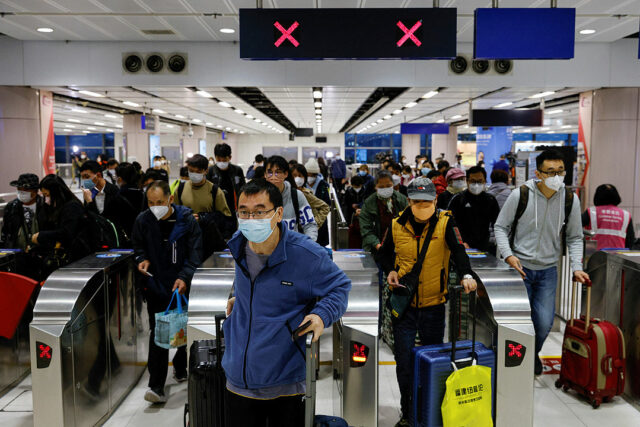
It also highlighted the lack of significant impact from easing travel restrictions in China.

“Positive effects of the end to travel restrictions by the Chinese government will also be modest for Asia-Pacific economies and their banking systems in general because apart from Hong Kong, Macau and Thailand, the region as a whole does not rely on Chinese visitors or tourism significantly for economic growth,” it added.

However, the report noted that the reopening will benefit the banking systems of Hong Kong, Macau, Mongolia, and Thailand, given their “close economic ties to China through shared borders or tourism.”

“Multinational banks with sizable operations in Hong Kong and mainland China will also benefit,” it added.

Moody’s said that banks in Hong Kong, Macau, Mongolia and Thailand will benefit most from the normalized movement of goods and travelers.

“Hong Kong’s exports will improve as restrictions on truck movements between Hong Kong and mainland China are lifted, while tourism in Hong Kong will rebound when Chinese visitors return. Mongolia’s exports to China will recover after the latter relaxed border controls,” it said.

“Thailand and Macau will get relief from the return of Chinese tourists, who were key to tourism prior to the pandemic. This will ease pressure on the banks’ asset quality,” it added. — Luisa Maria Jacinta C. Jocson

Trade department offers assistance to companies seeking to leverage RCEP

REUTERS

THE Department of Trade and Industry (DTI) said it will offer assistance to companies seeking to maximize the benefits from the Regional Comprehensive Economic Partnership (RCEP).

Trade Assistant Secretary Allan B. Gepty, the Philippines’ lead RCEP negotiator, said the DTI will organize an international trade forum to help “empower Philippine industries not just through RCEP but the other preferential trade arrangements we have entered into,” he said, referring to the European Union’s Generalized Scheme of Preferences Plus.

The DTI is also set to launch its export development plan for 2023 to 2028 in June.

The sessions the DTI plans to conduct with potential users of RCEP include briefings on how to find export markets, business matching, and joining value chain networks, which will give enterprises “an opportunity to tie up with companies who are linked to the global value chain,” Mr. Gepty told the Senate special oversight committee on RCEP.

“The campaign will be designed to be more strategic and precise depending on the competencies of our regions and provinces,” he told the committee.

The DTI will also launch an international trade relations assistance center and an import monitoring system that will give early warning of surging imports.

The Senate gave its concurrence to RCEP on Feb. 21, making the Philippines the last to ratify the trade deal following delays caused by worries about the impact on the agriculture sector.

RCEP members represent a third of the global economy. The participating countries are Australia, China, Japan, New Zealand, South Korea, and the Association of Southeast Asian Nations (ASEAN).

RCEP is expected to take effect in the Philippines on June 2.

Agriculture Undersecretary Mercedita A. Sombilla said the department plans to expand the Bureau of Animal Industry’s livestock price and volume watch operation to all agricultural commodities to provide “real time updates of the supply and demand situation (and) prices of agricultural products.”

Ms. Sombilla added that the private sector, through the Philippine Council for Agriculture and Fisheries, will “help in the participatory, monitoring and tracking of Department of Agriculture (DA)-funded programs and projects and their interventions in the regional and local levels.”

Its committees focus on rice, high-value crops, livestock, fisheries, and corn products.

Raul Q. Montemayor, chairman of the Federation of Free Farmers (FFF) said the agriculture sector’s RCEP preparations still require more “dedicated, in-depth discussion.”

“Most of these are old programs and frankly they do not work, because our deficit is just increasing,” Mr. Montemayor told the panel. The Philippines’ agricultural trade deficit widened to $3.22 billion in the fourth quarter of 2022.

United Broiler Raisers’ Association President Elias Jose M. Inciong called for a revival of a market information system, making it open to farmers, fisherfolk, cooperatives, traders, processors, the DA, and local governments.

“We have been asking for its resurrection in this administration since July 2022,” Mr. Inciong told BusinessWorld, referring to the National Information Network (NIN), as authorized by Republic Act No. 8435 or the Agriculture Fisheries Modernization Act of 1997.

The NIN is expected to address inconsistencies in agencies’ agricultural data. “When you plan and decide, you base it on data that everybody agrees on,” he said.

Anthony Aguirre, Foreign Affairs undersecretary for Multilateral Affairs and International Economic Relations, said the RCEP instrument of ratification was submitted to the ASEAN on April 3.

The DTI has completed a draft executive order and a customs memorandum order which will take effect on the same day as RCEP.

The schedule of tariff commitments has been transposed to the current tariff lines and is set for approval by the National Economic and Development Authority, according to Mr. Gepty.

FFF National Manager Leonardo Q. Montemayor told the committee that groups opposing RCEP will launch on May 8 the Bantay RCEP, a watchdog that will monitor its implementation as well as campaign for support for local products.

RCEP is “not a magic pill but it’s important to have a roadmap done immediately,” Senate President Pro-Tempore Lorna Regina B. Legarda, who heads the oversight committee, said.

RCEP is projected to generate 1.4 million jobs for the country by 2031, Senate President Juan Miguel F. Zubiri said. — Beatriz Marie D. Cruz


ADVERTISEMENT
ADVERTISEMENT