Home Blog Page 4973

Asia-Pacific lenders can deal with US, euro banking turmoil — S&P

FINANCIAL INSTITUTIONS in the Asia-Pacific (APAC) region can withstand secondary effects from the volatility in the global banking sector, S&P Global Ratings said in a report.

S&P Global Ratings in a report dated April 19 said that banks in the region can mitigate the “knock-on effects” caused by the banking sector turmoil in the United States and Europe last month. 

“Of the about 380 banks and nonbank financial institutions that we rate in the region, we anticipate no rating actions directly related to the Silicon Valley Bank (SVB) collapse. Direct exposures remain negligible,” S&P said. 

“We remain cautious, however, as previous banking crises indicate that the effects of banking sector contagion effects can take some time to fully play out,” it said.

The credit watcher noted that the Asian financial crisis of 1997 took months after the bankruptcy of Finance One, the largest finance company in Thailand during that time.

It also said the Lehman Brothers bankruptcy and the global financial crisis happened six months after Bear Stearns was sold to JPMorgan in 2008.

For the current crisis, secondary effects appear to be manageable for Asia-Pacific banks, S&P Global Ratings said.

“These effects include, but are not limited to, increasing risk aversion by investors. This ultimately is manifesting in higher funding costs for banks. Furthermore, additional Tier 1 issuance in coming months is likely to be more costly, and for some will be outright difficult,” S&P said.

FUNDING STRENGTH
Funding has also been a strength across banking jurisdictions in the region, the credit watcher said. The industry’s funding in 10 of the 18 banking systems in the region has either very low or low risk ratings.

“Furthermore, we cannot identify a rated bank in Asia-Pacific that has a very similar deposit base to SVB. SVB serviced a corporate client base centered in the tech, health, and life sciences sectors; its customer base was highly concentrated in commercial deposits,” S&P said.

A significant proportion of total deposits in Asia-Pacific banks are mostly deposits from domestic households, the debt watcher said.

Liquidity levels are also ranked “adequate” across the top 60 banks in the region, S&P added. 

“Certain macro and sector-wide funding and liquidity indicators underpin our view that banks in Asia-Pacific should stay relatively resilient if contagion effects amplify,” it said. 

“A significant escalation and acceleration of contagion effects including an erosion of confidence well beyond US regional banks or in the aftermath of the Credit Suisse takeover by UBS would undoubtedly contribute to negative ratings sentiment,” S&P added.

Still, the credit watcher maintained its “cautiously optimistic” growth outlook for Asia-Pacific this year, mainly driven by China’s reopening.

“For other economies, a stronger China will soften but not offset the hit of slower growth in the US and Europe, the fading boost of domestic re-opening post the pandemic, and higher interest rates,” the debt watcher said.

S&P expects the Asia-Pacific region to grow by 4.6% this year and 4.7% in 2024, it earlier said.

Meanwhile, S&P sees the Philippine economy expanding by 5.8% this year, slower than the government’s 6-7% growth target as well as the 7.6% recorded in 2022. — Keisha B. Ta-asan

JG Summit Holdings, Inc. to hold annual stockholders’ meeting on May 15


Spotlight is BusinessWorld’s sponsored section that allows advertisers to amplify their brand and connect with BusinessWorld’s audience by enabling them to publish their stories directly on the BusinessWorld Web site. For more information, send an email to online@bworldonline.com.

Join us on Viber at https://bit.ly/3hv6bLA to get more updates and subscribe to BusinessWorld’s titles and get exclusive content through www.bworld-x.com.

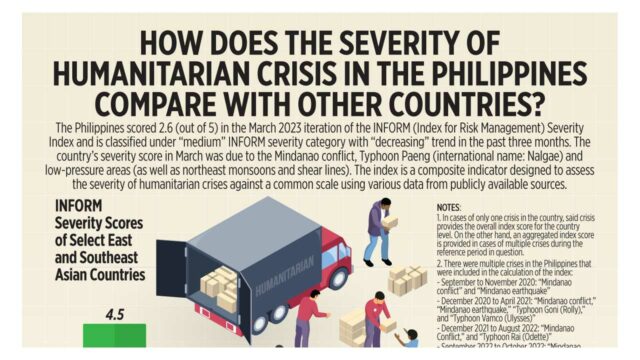
How does the severity of humanitarian crisis in the Philippines compare with other countries?

The Philippines scored 2.6 (out of 5) in the March 2023 iteration of the INFORM (Index for Risk Management) Severity Index and is classified under “medium” INFORM severity category with “decreasing” trend in the past three months. The country’s severity score in March was due to the Mindanao conflict, Typhoon Paeng (international name: Nalgae) and low-pressure areas (as well as northeast monsoons and shear lines). The index is a composite indicator designed to assess the severity of humanitarian crises against a common scale using various data from publicly available sources.

How does the severity of humanitarian crisis in the Philippines compare with other countries?

Rust filming to restart 18 months after Alec Baldwin shooting

Alec Baldwin in a scene from Rust. — IMDB

PRODUCTION of the Western Rust will restart on Thursday in Montana, 18 months after actor Alec Baldwin fired a live round that killed cinematographer Halyna Hutchins during filming in New Mexico.

Mr. Baldwin will be back on set two weeks before the start of a court hearing in New Mexico to decide whether he should stand trial for a felony charge of involuntary manslaughter over Ms, Hutchins’ death in October, 2021.

Filming will resume at Montana’s Yellowstone Film Ranch set, according to Melina Spadone, a lawyer for Rust Movie Productions.

Mr. Baldwin in October settled a lawsuit with the cinematographer’s husband, Matt Hutchins, under which filming would restart with the same principal actors and the same director, Joel Souza, who was wounded in the 2021 shooting. Under the deal, Mr. Hutchins became an executive producer on the movie. — Reuters

Universal Robina Corp. to hold annual meeting of stockholders on May 15


Spotlight is BusinessWorld’s sponsored section that allows advertisers to amplify their brand and connect with BusinessWorld’s audience by enabling them to publish their stories directly on the BusinessWorld Web site. For more information, send an email to online@bworldonline.com.

Join us on Viber at https://bit.ly/3hv6bLA to get more updates and subscribe to BusinessWorld’s titles and get exclusive content through www.bworld-x.com.

Supreme Court rules in favor of seafarer in disability case

BW FILE PHOTO

THE Supreme Court has granted the disability claim of a seafarer who injured his leg while on duty, ruling that an invalid final medical assessment of his injury makes the disability permanent under law.

In a 16-page decision made public on April 17, the tribunal ordered North Sea Marine Service Corp., Ships Leisure S.A.M., and Silversea Cruise Ltd. to pay Alexei Joseph P. Grossman disability benefits worth $60,000 with 10% interest and legal fees.

“There being no final and definite assessment of petitioner’s fitness to work or permanent disability within the prescribed periods… Which thus precludes him from pursuing his usual work as a seafarer, his disability has, by operation of law, become total and permanent,” Associate Justice Antonio T. Kho, Jr. said in the ruling.

The ruling upheld the findings of the Office of the Voluntary Arbitrators (VA), which said he was entitled to the disability benefits. The VA decision was later reversed by the Court of Appeals.

The appellate court had said the seafarer failed to prove that the conditions of his work led to his injury.

Under the Labor Code, a disability is total and permanent if the employee is unable to perform any “gainful” duties for a continuous period exceeding 120 days.

Only doctors chosen by employers may determine if a worker sustained permanent disability during employment.

Mr. Grossman was employed as a galley utility crew member of the Silver Whisper vessel for eight months in 2016.

In July 2016, he suffered a leg injury which led to surgery that resulted in a deformity of his left leg.

A company-approved doctor said Mr. Grossman’s injury was not a work-related illness and the cause was still unknown.

The High Court agreed with the VA that the company-approved doctor’s assessment had been submitted beyond the 240-day treatment period required under the Philippine Overseas Employment Administration’s rules, which made it void.

“The court is hard-pressed not to agree with the VA’s observation that the same was a ‘mere afterthought’ which can no longer overcome petitioner’s entitlement to disability benefits,” it said. — John Victor D. Ordoñez

BPI Q1 earnings climb on lower loss provisions

A view of a bank building in Manila, July 1, 2014. — REUTERS/ROMEO RANOCO

BANK of the Philippine Islands (BPI) saw its net income rise by 52% year on year to P12.1 billion in the first quarter amid improved net interest earnings and as it set aside lower loan loss provisions.

“The solid performance was attributable to average asset base expansion, margin growth, and lower provisions,” BPI said in a disclosure to the local bourse on Thursday.

Its first-quarter net profit translated to a return on equity of 15.4% and a return on assets of 1.88%.

BPI’s financial statement was unavailable as of press time.

The bank’s revenues rose by 25.1% year on year to P31.7 billion last quarter.

BPI said this came on the back of a 27.2% increase in its net interest income to P24.2 billion as its average asset base grew by 10% and its net interest margin rose by 52 basis points to 3.94%.

“Further boosting revenues was the 18.6% jump in non-interest income to P7.6 billion, driven by higher credit card billings and charges, securities trading gains, and fees from investment banking project finance deals,” the lender said.

Meanwhile, operating expenses increased by 19.7% to P15.1 billion as it spent on “manpower structural increases, milestone payments for digitalization initiatives, targeted marketing campaigns and rewards redemptions, and higher transaction-related processing fees.”

BPI’s cost-to-income ratio stood at 47.5% in the quarter.

The bank’s loan portfolio grew by 13.6% to P1.7 trillion amid a 12.6% increase in corporate loans, a 38.7% rise in credit card loans and a 16.4% expansion in auto loans.

Despite the increase in loans, BPI said it saw “continued strength in asset quality,” with its nonperforming loan (NPL) ratio improving to 1.82% as of March from 2.38% a year prior.

Meanwhile, its NPL coverage ratio stood at 176.71%.

Loan loss provisions declined by 60% to P1 billion from the P2.5 billion recorded a year prior “as asset quality has been on an improving trend.”

On the funding side, deposits with the bank rose by 13.6% year on year to P2.1 trillion, with its current and savings account or CASA ratio at 70.3%.

BPI’s loan-to-deposit ratio stood at 77.3%.

Total equity was at P331.6 billion at end-March, with the bank posting a common equity Tier 1 ratio of 15.7% and a capital adequacy ratio of 16.6%, both above regulatory requirements.

Assets rose by 12.4% to P2.7 trillion as of March.

BPI’s shares climbed by P2.60 or 2.59% to close at P102.80 each on Thursday. — A.M.C. Sy

Ninja Van rolls out supply management solutions for MSMEs 

EXPRESS logistics company Ninja Van Philippines has rolled out a suite of supply chain management solutions that seek to improve the operations of micro, small, and medium enterprises (MSMEs).

In a statement on Thursday, Ninja Van said the Logistics+ supply chain management suite consists of solutions for warehousing and fulfillment, international cargo transportation, procurement support, and cross-border payment solutions.

The solutions assist MSMEs in Southeast Asia to navigate their various networks of suppliers, manufacturing partners, transportation providers, and financial service providers and help them focus on their businesses.

“According to the Philippine Statistics Authority (PSA), around 99.5% of businesses operating in the country are MSMEs. These businesses make up a key segment that Ninja Van empowers through Logistics+,” the company said.

Ninja Van claims that over 30,000 MSMEs in Southeast Asia are already using its Logistics+ solutions.

One of the solutions includes Ninja Fulfillment, which provides end-to-end warehousing and fulfillment capabilities for MSMEs that lack warehousing and inventory storage facilities.

“These capabilities cover regular inbound, storage, outbound, and returns services, as well as customized warehouse management solutions, that can all be easily integrated with the merchants’ chosen marketplaces,” Ninja Van said.

“Beyond regular picking, packing, and sorting, Ninja Fulfillment also provides value-added services like unstuffing, kitting and bundling, and custom packaging while allowing same-day handover to Ninja Van’s last mile services to further cut the time from inbounding to delivery,” it added.

Aside from Ninja Fulfillment, the company also provides Ninja Cross Border, which offers international cargo transportation by land, air, and sea.

Locally, the Ninja Cross Border solutions help Filipino consumers to purchase from e-commerce platforms such as Lazada, TikTok Shop, Amazon, SHEIN, and other global brands.

“Ninja Cross Border can also tailor end-to-end solutions to serve shippers’ business-to-business and business-to-consumer needs by leveraging the Ninja Van Group’s established presence and network in Southeast Asia and China,” the company said.

Ninja Van also offers an end-to-end procurement solution for SMEs called Ninja Direct, as well as Ninja Financial Services, which allows cross-border payments and offers embedded financing options with flexible payment terms.

“We want to go beyond last-mile deliveries and provide complete logistics solutions to take the hassle out of our shippers’ experience. As a regional player with a strong local thrust, we also want to help expand the Filipino MSMEs’ access to solutions that can help them unlock other opportunities,” Ninja Van Philippines Chief Commercial Officer Sabina Lopez-Vergara said.

Ninja Van is an express logistics company that provides delivery solutions for various businesses in Southeast Asia. It has presence in Singapore, Malaysia, Philippines, Indonesia, Vietnam, and Thailand. — Revin Mikhael D. Ochave

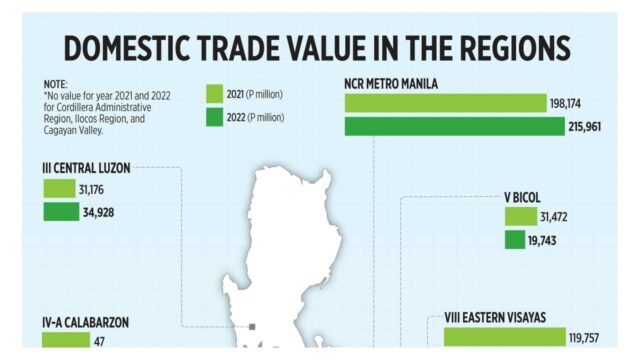
Domestic trade value in the regions

Domestic trade value in the regions

Harry Styles, Kate Bush among nominees for Ivor songwriting awards

HARRY STYLES with the Album of the Year award at The 2023 Brit Awards, at the 02 Arena in London, Feb. 12. —MATT CROSSICK/EMPICS ENTERTAINMENT VIA REUTERS

LONDON — Singers Harry Styles and Kate Bush are among the nominees at next month’s Ivors, the annual awards honoring songwriters and screen composers.

Kate Bush is being recognized for her 1985 song “Running Up That Hill” which enjoyed a resurgence in popularity last year thanks to Netflix show Stranger Things, the UK-based Ivors Academy said on Tuesday evening.

The track will compete against Mr. Styles’ mega hit “As It Was” in the most performed work category, which also includes Glass Animals’ “Heat Waves” and two songs by hitmaker Ed Sheeran, “Shivers” and “Bad Habits.”

Mr. Sheeran won the category last year with “Bad Habits” and it is the first time the same song has been nominated for the award two years running.

Mr. Styles has three nominations overall, including best song musically and lyrically for “As It Was” and songwriter of the year alongside his collaborator Kid Harpoon.

That category also includes singer Florence Welch, Wet Leg duo Rhian Teasdale and Hester Chambers, George Daniel and Matty Healy of pop rock group The 1975 and rapper Central Cee with collaborator Young Chencs.

Album of the year contenders include rock group Arctic Monkeys’ The Car, Irish post-punk band Fontaines D.C.’s Skinty Fia and Nigerian-born artist Obongjayar’s Some Nights I Dream of Doors.

Rapper Little Simz’s album No Thank You and music collective Sault’s “11” are also nominated, both with credits for singer-songwriter Cleo Sol and producer Dean “Inflo” Josiah Cover. The duo have three nominations overall.

Tom Odell’s “Best Day of My Life,” Katie Gregson-Macleod’s “complex,” Sault’s “Stronger,” and Florence + the Machine’s “King” complete the Best Song Musically and Lyrically category.

“The music nominated for an Ivor Novello this year is testament to the power and range of British and Irish songwriting and screen composing,” Tom Gray, chair of The Ivors Academy, said in a statement. “It’s a superlative list.”

Box office hit Avatar: The Way of Water and psychological drama Don’t Worry Darling are among the nominees for best original film score.

Named after the early 20th century Welsh composer, actor and entertainer Ivor Novello, the Ivor Awards were first handed out in 1956. This year’s awards take place on May 18 in London. — Reuters

Mondelez Philippines aims for plastic neutrality through partnership with PCX

Mondelez Philippines and Plastic Credit Exchange are partnering in support of the EPR Law. In the picture to mark this collaboration are (L-R) Mondelez Philippines’ past Corporate and Government Affairs Country Manager Atty. Joseph Fabul, Mondelez Philippines VP and Managing Director Aleli Arcilla, and Plastic Credit Exchange Founder Nanette Medved Po.

The Extended Producer Responsibility (EPR) Act of 2022, passed in July of the previous year, is a law which mandates companies to participate in waste management programs. Simply put, certain companies who produce and use plastic are obligated to collect an equivalent volume back through diversion programs like recovery and recycling. In support of this new law, snacks maker Mondelez Philippines has partnered with Plastic Credit Exchange (PCX) to recover and divert the equivalent of 100% of its plastic packaging footprint used for its food products sold in the market.

Mondelez Philippines is the maker of beloved heritage snack brands like Oreo, Tang, Toblerone, Cadbury Dairy Milk, Eden Cheese, and Cheez Whiz. The company’s purpose is to empower people to snack right with a mission to lead the future of snacking by offering the right snack, for the right moment, made the right way.  Snacking made right means focusing where the company can make a bigger difference and deliver greater long-term and positive impact. The Company’s strategy and goals in addressing these key focus areas are central to supporting growth around the world, including reducing the company’s environmental footprint. To this end, the Company aims to use less packaging, better packaging, and support waste collection systems.

In 2022, ahead of the implementation of the EPR law, the Company was able to collect 243,000 kilos of plastic waste, which is equivalent to the weight of two blue whales.

Achieving 100% Plastic Waste Collection in 2023

Under the EPR Law, identified companies are required to collect back 20% of their plastic output by the end of 2023. To support the passing of the law and to reduce its impact on the planet, Mondelez Philippines is partnering with PCX for the recovery and diversion of 100% of the equivalent of its yearly plastic packaging output. This means that for the year 2023, the company aims to ensure that 100% of the amount of plastic packaging used for their products and sold in the market are part of resource recovery programs. This commitment comes ahead of the requirements of the EPR law and is something the Company will uphold moving forward.

“We fully support and laud the passing of the Extended Producer Responsibility act,” shares Aleli Arcilla, Mondelez Philippines Managing Director. “We share the belief of our lawmakers that optimal EPR laws are a practical and efficient contribution for waste management systems. We intend to go above and beyond compliance as early as this year by ensuring we are 100% plastic neutral by the end of 2023. To this end, we thank our partner PCX for providing us with the capability to carry out our commitments and transform them into concrete actions.”

Waste Diversion: How it Happens

PCX partners with organizations who collect and divert post-consumer plastic waste within a credible, traceable, transparent, environmentally sound, and socially responsible framework. The organization is geared towards promoting various solution sets that aim to remove plastic away from nature, and effective reduction and disposal of plastic waste in the Philippines. By working with waste collectors, recyclers, and diverters in the country, the organization is able to help companies like Mondelez Philippines achieve their sustainability goals and ensure fewer plastic ends up in oceans, waterways, and landfills. Most importantly, PCX is able to channel investment to grow and strengthen the circular plastic economy in the country. A circular plastic economy means that plastic is not treated as waste, but rather is viewed as a resource that can be reused and repurposed. This model aims to eventually eliminate plastic waste and pollution.

“It is wonderful to welcome Mondelez Philippines to the PCX community of passionate and committed private sector partners who together aim to deliver meaningful change to this urgent and important issue,” says Nanette Medved Po, Founder of PCX.

Adds Atty. Joseph Fabul, former Country Manager for Corporate and Government Affairs of Mondelez Philippines, “Through this commitment, we are showing support for the EPR Law and encouraging other companies and industries to do the same. Plastic waste reduction and collection is everyone’s responsibility. Let us work to create a cleaner and waste-free Philippines as our legacy to future generations.”


Spotlight is BusinessWorld’s sponsored section that allows advertisers to amplify their brand and connect with BusinessWorld’s audience by enabling them to publish their stories directly on the BusinessWorld Web site. For more information, send an email to online@bworldonline.com.

Join us on Viber at https://bit.ly/3hv6bLA to get more updates and subscribe to BusinessWorld’s titles and get exclusive content through www.bworld-x.com.

When a company is ghosted by applicants

Many of our job vacancies can’t be filled because applicants who agree to come in for an interview are ghosting us. What’s happening? — Rain Drop.

There are many reasons why applicants ghost recruitment managers. The most common reasons, according to Justin Lowe, include the following:

One, applicants are selecting from multiple lucrative job offers and may have already chosen one.

Two, personal emergencies prevent them from going forward with the interview.

Three, they are unprofessional and believe that ghosting will not hurt their career.

Four, they feel they’re not good communicators who might not do well in an interview, and are expressing it through self-rejection.

Five, ghosting is normal for the younger generations. Boomers, for instance, did it too, except those cases tended to be a lack of technology to communicate with a prospective employer in the event of emergencies.

Today there is no cogent reason to miss out on an interview. In addition to Lowe’s explanations, I also find the candidate’s ego to be boosted by follow-up text messages or calls offering to re-schedule the interview.

Some young people can get a certain “high” for the resulting attention they receive.

Whatever the reason, I find it improper for job applicants to not honor an interview appointment. The only acceptable reason for me is illness, a vehicular accident or an emergency of equivalent severity.

MANPOWER PLANNING
When I was looking for jobs decades back, I took every opportunity to honor all interview appointments. Back then I received word of my job interviews via telegram by companies like PT&T and RCPI. Of more recent vintage are messages from potential employers sent via my trusty Motorola pager. Sometimes I accepted invites for the wrong reasons.

My intention was to practice answering all IQ tests and rehearse my replies to killer interview questions hurled at me along the way. That built my confidence. I say I accepted interviews for the wrong reasons because I was gainfully employed at the time, even at 19.

What’s the solution to your problem? Accept ghosting as part of the risk of offering employment. Shrug it off. You can’t control everything. Be proactive by focusing on what you can do to fill all the vacancies or prevent them from happening with the following approaches:

One, establish a dynamic manpower plan. This is the first step in getting the right people, at the right time and in the right place. The plan must be linked with an organization’s business forecast. When your organization has a plan for its operations for the current year and beyond, you can identify its manpower needs for the short and long term.

It will require an honest self-assessment of staff strengths and weaknesses to allow identification of jobs that can be outsourced to temps or project workers.

Two, analyze all factors affecting future demand. What are the plans for expansion? What new products or services are expected for launched in several months? How about the competition? What are the prospects for a merger or buyout to achieve economies of scale?

Is a new technology that promises to reduce manpower requirements? How many workers are due to retire in the next few years? Who are the workers receiving red circle pay, and who are currently above their pay scale and yet doing the job of lower-ranking personnel?

Three, consider all internal supply considerations. This means having a dynamic succession plan based on promoting from within. If no one can step up in an emergency vacancy, then your organization is in deep trouble. Hiring an external candidate can be demotivating to the current workforce.

It’s best to have an apprenticeship program to identify potential candidates if the work is complex and can’t be learned within six months. You can sometimes get by rely on casuals, temps or project workers as a stopgap while they acquire special skills from your organization.

Last, discover your weaknesses in attracting candidates. It’s about managing your organization’s online reputation. Check the job portals where you advertise your vacancies and gather feedback from applicants and current workers. Chances are you will discover many negative views about you and the organization.

Applicants might balk at the lack of clarity in your ads. You may have confused them with illegal requirements specifying age or gender for certain positions. This is a red flag for many people and a sign that they’re dealing with unprincipled management.

In conclusion, when your applicant has ghosted you, then rejoice. In the words of Steven Levitt and Stephen Dubner, you’ve become successful in “letting the garden weed itself,” if you know what I mean.


Bring Rey Elbo’s leadership program called “Superior Subordinate Supervision” to your management team. Or chat with him on Facebook, LinkedIn, Twitter or e-mail elbonomics@gmail.com or via https://reyelbo.com

ADVERTISEMENT
ADVERTISEMENT