Home Blog Page 4926

Batangas, Negros, Davao are next stops for JICA-backed disaster management program

DAVAO CITY FACEBOOK PAGE

LOCAL governments in the provinces of Batangas and Negros Occidental, and Davao City will be covered by the second phase of a disaster management enhancement program supported by the Japan International Cooperation Agency (JICA).  

In a statement on Tuesday, JICA said it recently met with the Office of Civil Defense (OCD) to start stage 2 of the Disaster Risk Reduction (DRR) and Management Capacity Enhancement Project.  

Our cooperation with the Philippines aims to elevate disaster resiliency starting from the local government level,said Yanagiuchi Masanari, senior representative of JICA Philippines.  

While monitoring remains a challenge, the cooperation between OCD and other related agencies in harmonizing guidelines on the formulation of DRR plans is equally important in order to promote proper disaster planning for local government units,he said.  

The first phase of the program intended to boost the Philippinesdisaster resiliency against climate change involved the development of guidelines on using hazard information and risk assessment, and disaster plans based on disaster risk information were developed.  

Monitoring and evaluation, and capacity development were rolled out in selected local governments in Laguna and Bohol.  

JICA said the cooperation with OCD localizes the Sendai Framework for Disaster Risk Reduction 2015-2030 adopted by United Nations member countries, which highlights the critical role of local governments in disaster management.  

We are already seeing the harsh impact of climate change through the intensity of natural disasters, such as increasing human casualties and economic losses. Its therefore becoming more important to ensure that local government units are able to incorporate the risks and right information in disaster planning since they are in the frontlines when disasters happen,Mr. Yanagiuchi said.  

Philippine government data show that the countrys economic losses from natural disasters reached P463 billion from 2010-2019. Marifi S. Jara 

More than 4,500 jobseekers hired on the spot at DoLE job fairs 

PHILIPPINE STAR/EDD GUMBAN

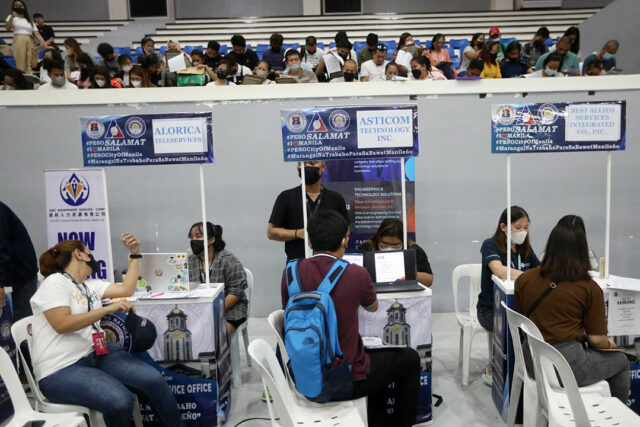
THE DEPARTMENT of Labor and Employment (DoLE) on Tuesday said 4,728 jobseekers were hired on the spot at its ongoing Labor Day job fairs.  

As of 11 a.m. on Tuesday,  DoLE data sent to reporters on Viber showed that majority of the positions filled included service crew, cashier, and administrative and service contractor personnel, among others.  

A total of 1,603 jobseekers were provided training opportunities by the Technical Skills and Development Authority (TESDA), the labor agency said.  

There were 30,837 registered jobseekers at DoLE’s job fairs held in shopping malls nationwide that started on Sunday. The fairs were participated in by 1,286 local employers offering 126,173 job vacancies.  

President Ferdinand R. Marcos, Jr. on Sunday said he is optimistic about creating more jobs given the improved employment numbers in the past month.  

Unemployment in February went up by 4.3% month on month to 2.48 million. Job quality improved that month as underemployment, a measure of Filipinos seeking more work, fell to 12.9% from 14.1% in January and 14% a year earlier. John Victor D. Ordoñez 

2022 bar passers take oath

SUPREME COURT PIO

THE ALMOST 4,000 passers of the 2022 bar exams took their oath on Tuesday before Supreme Court associate justices and signed their names in the official list of Philippine lawyers. 

“A good lawyer must strive to have a delicate medley of virtue and skills,” Associate Justice and 2022 bar chairperson Benjamin S. Caguioa said at the ceremony held at the Philippine International Convention Center in Pasay City streamed live on YouTube. 

“Lawyers should be conscious that laws are weapons as much as they are tools and must have a recognition that people on the opposite side of the court are people with stories too.”  

Last year’s bar exams had a passing rate of 43.47% with 3,992 passers out of 9,183 examinees.   

The 2020/21 bar was the first to be conducted digitally and with multiple testing sites nationwide.   

The tribunal had moved this year’s exams to September, earlier than the usual November to allow for an earlier release of results. 

Associate Justice and 2023 bar exams chairperson Ramon Paul L. Hernando said this would help passers seek employment earlier. 

Chief Justice Alexander G. Gesmundo had said the bar exams would continue the digital format to take full advantage of new technology. John Victor D. Ordoñez

DLSU, NU eye quick finals rematch against Santo Tomas, Adamson

UAAP

Games Today
11 a.m. — DLSU vs FEU (men’s stepladder)
1 p.m. — DLSU vs UST (women’s Final Four)
3 p.m. — NU vs AdU (women’s Final Four)

AND then there were four.

Top-seeded De La Salle University (DLSU) and reigning champion National University (NU) eye to arrange a quick finals rematch as Adamson University (AdU) and University of Santo Tomas (UST) attempt to play spoilers in the UAAP Season 85 women’s volleyball Final Four Wednesday at the Smart Araneta Coliseum.

Armed with twice-to-beat incentives, the Lady Spikers and the Lady Bulldogs set to finish off their counterparts right then and there to set a second straight finals duel.

De La Salle takes on tormentor Santo Tomas at 1 p.m. while NU goes up against Adamson at 3 p.m. after the first phase of the men’s stepladder semis at 11 a.m. featuring No. 3 Far Eastern University (FEU) and No. 4 De La Salle.

The survivor in the first phase of the men’s royal rumble gains a shot at No. 2 UST in another knockout set with two-time champion NU already waiting in the best-of-three finals after sweeping the eliminations, 14-0.

But the brightest spotlight is on De La Salle and UST with top MVP contenders in Eya Laure and super rookie Angel Canino slugging it out at the centerstage.

“We’ll be ready vs UST,” said De La Salle deputy Noel Orcullo as De La Salle aims to land a sweet vengeance on UST.

The Lady Spikers got decked by the Golden Tigresses in four sets last month that proved as their lone loss in what could have been a perfect campaign and an outright finals ticket as well.

Against tougher odds this time in a win-or-go home battle, UST is out to weave that same magic in order to stay alive.

NU, this time, may be thriving in a different path after an automatic finals appearance in Season 84 with a sweep but the approach remains the same.

“We need to bring our game. We need to get back to ourselves and stay focused on the ultimate goal,” said reigning MVP Mhicaela Belen.

Adamson likewise has its sights locked on that ultimate prize, even if it means gunning for a herculean feat of eliminating the reigning queens.

“This is an opportunity for greatness,” said coach Jerry Yee, who is out to extend his winning tradition over at the UAAP from the NCAA with College of St. Benilde. — John Bryan Ulanday

Team Philippines have quality bets and heart as it goes to battle in Cambodia Southeast Asian Games

EJ OBIENA — REUTERS

THE COUNTRY’S greatest Olympic athlete of all time may not be in tow but Team Philippines won’t be lacking in quality bets and heart as it goes to combat in the May 5-17 Cambodia Southeast Asian Games (SEAG).

In the absence of Tokyo Games gold-winning weightlifter Hidilyn Diaz, who is focusing on her qualifying tourney for Paris 2024 at this time, world champion gymnast Carlos “Caloy” Yulo and other world-beaters banner the 840-strong contingent in the Phnom Penh meet that officially opens Friday.

Two more medalists from that historic Olympic campaign in the Japanese capital — silver earners Nesthy Petecio and Carlo Paalam — banner the crack boxing contingent as it seeks to continue with its productive harvest in the biennial SEAG.

From that Tokyo Olympiad pool also comes world No. 3 pole-vaulter EJ Obiena in athletics and lady boxer Irish Magno, who are expected to make waves in these Games.

The Billiard sport delegation is filled with cue greats like Efren Bata Reyes and Rubilen Amit. But Mr. Reyes is competing in men’s carom as fellow former world champ Carlo Biado fights for the gold in the 9-ball singles and doubles, along with Johann Chua. With women’s pool scratched off, Ms. Amit is enlisted to play in the carom events with Chezka Centeno.

Jiu Jitsu world champ Meggie Ochoa and World Games winner Junna Tsukii of karate take the cudgels for the Philippine martial artists.

Ms. Diaz’s beloved weightlifting squad offers good prospects themselves, as the pride of the Philippines herself stated.

Vanessa Sarno, the defending SEAG champion and 2020 Asian titlist tipped as Ms. Diaz’s heir apparent, guns for back-to-back in Phnom Penh in a starring role along with Olympian Elreen Ando and promising Kristel Macrohon.

Philippine volleyball’s “Phenom” Alyssa Valdez headlines the popular volleybelles, who underwent training in Japan in line with their medal bid.

Ms. Valdez has been chosen to serve as flag-bearer for the Philippine Sports Commission-backed delegation in Friday’s opening rites. She leads a female-oriented Philippine representation in the parade of nations.

“Alyssa (Valdez) best fits our goal of an almost all-female delegation in the opening ceremony,” Philippine Olympic Committee (POC) President Rep. Abraham “Bambol” Tolentino said yesterday. “She’s not only the face of Philippine volleyball, but Philippine sports as well.”

Some of the top basketball pros of the land like Justin Brownlee and Christian Standhardinger are also on board for Gilas Pilipinas, whose driving force is regaining the lost gold in the sport closest to the heart of Filipinos.

Meanwhile, action continues for the early birds in Cambodia today.

The Filipinas, on the heels of their historic qualification to the FIFA Women’s World Cup and triumph in the Asean championship, begin their hunt for a milestone SEAG women’s football gold today. The Pinay booters face Myanmar at 7:30 p.m. (8:30 p.m. in Manila) at the Army Stadium in a Group A opener.

Coach Alen Stajcic is tempering his expectations against traditional powerhouses like Vietnam and Thailand.

“Vietnam are the favorites to win this tournament. We’re just growing at the moment and we know we have a long way to go to catch up,” he said.

“Vietnam, Thailand and Myanmar have been strong for a long time. We respect that they have better history, Hopefully, this tournament will show that we’ve closed the gap even more. Over time, we want to keep progressing not just in Southeast Asia but also in the world.” — Olmin Leyba

Philippines joins the breakaway World Boxing group from the International Boxing Association

INTERNATIONAL Boxing Association (IBA) President Umar Kremlev blasted the national federations who broke away from the body to form a new world boxing federation, describing the officials as ‘black sheep’ and ‘hyenas’ who do not belong in sport.

A group including the United States and Britain announced a new federation — World Boxing — last month in a breakaway aimed at securing the troubled sport’s Olympic future while seeking recognition from the International Olympic Committee (IOC).

With representatives from Germany, Britain, the Netherlands, New Zealand, the Philippines, Sweden and the US, World Boxing has an interim executive board and said there would be no bar on any national federation being a member of both bodies.

But Russian Mr. Kremlev, who is in Tashkent for the IBA men’s world championships, said the IBA is the only international association that governs the sport.

“We say that there’s always a black sheep in our family, there are always people who go their own ways… Someone tried to register an international association from their garage, why should we even consider them,” Mr. Kremlev told a news conference.

“Those who want to leave and go to another association, all I can say is: we have only one association. We have the right to govern boxing and the IBA has the right to organize tournaments.

“Some officials decided they wanted to create their own association, but I think it’s all clear and simple. Some sports functionaries are like hyenas, like predators, they need to understand that they do not belong to sport.”

The United States tops the all-time Olympic boxing medal table with 50 golds and 117 medals while Britain is third.

USA Boxing terminated its IBA membership last week, committing its “full support” to World Boxing’s efforts to seek provisional recognition of the IOC.

The Russian-led IBA — suspended by the IOC in 2019 over governance, finance, refereeing and ethical issues — has defied IOC guidance and lifted a ban on Russian and Belarusian boxers competing under their flags last October.

The strained relations between the IOC and the IBA, which was sponsored by Russian energy giant Gazprom, further soured after Moscow’s invasion of Ukraine last year.

An independent investigation had found that the IBA was on the “verge of financial ruin” due to mismanagement by the previous administration until Gazprom’s sponsorship saved the body.

However, Mr. Kremlev said Russia’s state-controlled gas giant was no longer a sponsor after the contract expired.

“Our contract with Gazprom ended in December 2022. We are grateful to them for helping us in a difficult period,” he said.

“In June or July, we will have a new sponsor, but as of now there is no contract with Gazprom.

“We did not terminate the (Gazprom) contract as there were obligations to complete… Most federations were against Gazprom being sponsor, but at the (IBA) Congress there were no objections.”

Boxing’s place in the Olympics after next year’s Paris Games remains uncertain, with the sport not on the initial program for Los Angeles 2028, pending reforms demanded by the IOC. — Reuters

Wolfsburg beat Arsenal in extra time to set up Champions League final with Barca

LONDON — VfL Wolfsburg beat Arsenal 3-2 in extra-time with a 119th-minute winner from Pauline Bremer in the second leg of their women’s Champions League semi-final at Emirates Stadium on Monday to win 5-4 on aggregate and set up a summit clash with Barcelona.

Twice champions Wolfsburg will meet the 2021 winners in the final in Eindhoven on June 3 after the Spanish champions eliminated Chelsea to reach the showpiece match for a third straight year.

With nothing to separate the two sides deep into extra time, the German team silenced the home crowd in the 119th minute when their high-pressing yielded an error for the goal.

Jule Brand pinched the ball from a tired Arsenal defense and laid it on a plate for Bremer to tap in from close range as Wolfsburg booked a spot in their sixth European final after losing the last three in 2016, 2018 and 2020.

“I feel empty at the moment. It was a very tough game and it’s tough to concede a goal like that, but I’m so proud of how the team has done in the Champions League,” Arsenal’s Stina Blackstenius told DAZN.

An Arsenal side depleted by injuries fought back from 2-0 down to level the tie in the first leg in Wolfsburg but, roared on by a crowd of 60,063, it was the home side that took the lead in the 11th minute through Ms. Blackstenius.

Arsenal won the ball in their own half to launch a swift counter-attack and Ms. Blackstenius was put through by Lia Walti, with the Swedish forward jostling for the ball and capitalizing on a defensive mix-up to put the ball into the net.

But Wolfsburg levelled from a free kick when skipper Alexandra Popp, returning from injury, headed the ball into the path of Jill Roord and goalkeeper Manuela Zinsberger saw the shot from the former Arsenal midfielder too late to make a save.

Ms. Blackstenius scored again barely two minutes into the second half but VAR came to Wolfsburg’s rescue to rule the goal out for offside and 10 minutes later the German side scored from a corner when Ms. Popp popped up at the near post with a header.

Arsenal levelled the tie again when Lotte Wubben-Moy retrieved a Wolfsburg clearance and crossed into the box for fellow defender Jen Beattie to direct a header past the keeper to force extra time where Wolfsburg’s stamina shone through.

“I’m overwhelmed, it was a tough game with extra time. I thought it was going to go to penalties but we won,” Ms. Roord said. “Credit to Arsenal, they’ve been through a lot as a team but they made it super hard. At the end they could have won, we could have won. We were the lucky ones… I’m looking forward to playing in the final in my own country.”

Barca, who won the league this season with a perfect record, also reached the European final last year where they lost to Olympique Lyonnais. — Reuters

Upset

The Celtics should have had the match in the bag. As hosts of Game One of their semifinal round series against the Sixers, they had the benefit of a capacity crowd of 19,156 cheering their every move. More importantly, they faced opponents handicapped by the absence of presumptive Most Valuable Player awardee Joel Embiid. They were rightly installed as double-digit favorites with the top dog of the red, white, and blue sidelined due to a sprained lateral collateral ligament in his right knee, and all they had to do was live up to expectations.

For a while there, the Celtics looked only too ready to do so. They came out scorching, with their silky smooth touch enabling them to build a 12-point lead close to the end of the second quarter. And, significantly, they remained accurate until the final buzzer, winding up with a 58.7% clip from the field (including 38.5% from beyond the arc). Considering that they likewise won the battle of the boards (38 to 28) and had more assists (26 to 17) and less fouls (10 to 20), casual observers would not have been faulted for concluding that victory was theirs.

Unfortunately, the Celtics played fast and loose with their possessions, coughing up 10 more turnovers than the Sixers to effectively negate their pluses. The competition was also more ready to cop the so-called 50-50 balls, resulting in a whopping 15 more field goal attempts. Most of all, however, the latter had the benefit of a focused James Harden, who, in coming up with dagger after dagger en route to 45 points, showed that, even past his prime, he can still put together a virtuoso offensive performance.

No doubt, the Celtics will learn from their mistakes and aim to be better tomorrow. That said, there can be no glossing over the fact that they wasted a golden opportunity to stamp their class. They’re supposed to be superior even with the Sixers at full strength, so for them to absorb a setback, especially with All-Stars Jayson Tatum and Jaylen Brown scoring an efficient 62 on 35 shots, is a downer. Meanwhile, Harden and Company are energized by the triumph. As he noted in the aftermath, “We came in here to win. Whether [Embiid] comes back or not [in Game Two], we’re going to be ready to go.” Indeed.


Anthony L. Cuaycong has been writing Courtside since BusinessWorld introduced a Sports section in 1994. He is a consultant on strategic planning, operations and human resources management, corporate communications, and business development.

How to ‘Build Better More’

PAOLO SYIACO-UNSPLASH

(Part 1)

Future generations will think well of the economic program of the Duterte Administration for two major reasons: the herculean task of bringing up the percentage spent on infrastructure to GDP from the measly 2-3% in the past to 5-6% under the last Administration. The second is the equally difficult task of curing our political leaders of their decades-long ultra-nationalistic mindset of restricting the presence of foreign investors in the country. This was accomplished by amending the Public Service Act (PSA) so that today and in the coming years, foreigners can own as much as 100% of critical infrastructures, telecom, renewable energy, and transport facilities (especially trains, subways, and airports).

The Build, Build, Build program of the Duterte Administration did much to compensate for more than 30 years of government neglect of such countryside infrastructure as farm to market roads, bridges, tollways, and other facilities badly needed by farmers to improve their incomes from the small farms that they acquired through the Comprehensive Agrarian Reform Program (CARP). The CARP failed miserably to improve the lot of the small farmers, not because of land fragmentation in itself, but because of the almost criminal negligence of the State in not providing the agrarian reform beneficiaries with all the facilities that they needed to make their small farms productive. This failure of the Philippine State to help the small farmers stands out in stark contrast with the very successful agrarian reform programs of our neighbors such as Thailand, Vietnam, and Malaysia whose governments lavished their farmers with all the infrastructure assistance that they needed.

The Build, Build, Build program under the Duterte Administration has done much to make amends for such neglect by the Philippine State. It was gratifying to witness that the bulk of the government budget on infrastructure in the last Administration was spent not in the urban centers like Metro Manila and Metro Cebu, but in the countryside, especially in regions that are lagging behind. It was a policy of the Build, Build, Build program that infrastructure that would benefit urban dwellers, such as expressways and tollways as well as international airports, were assigned to such private sector conglomerates as San Miguel Corp., Metro Pacific, Megawide, DM Consunji, and others through public-private partnership (PPP) arrangements, with participation of some foreign companies like GMR from India and Acciona from Spain.

The Administration of President Ferdinand R. Marcos, Jr. has the good intention of continuing the Build, Build, Build program under the new tagline of “Build Better More.” I find the change of name of the program appropriate because as the country transitions from low-middle income to high-middle income this year, we cannot continue just building roads, bridges, and tollways. We have to move on to higher quality and more sophisticated infrastructure like railways (bullet trains someday), subways, world-class international airports, telecom facilities, renewable energy, etc. Indeed, in the next two decades, we must build better and more. It is pointless for us to talk about being a major center in the Indo-Pacific region for data centers, international tourism, and high-value IT-BPM services unless we significantly improve our telecom services, international airports, and renewable energy sector. We have to go beyond roads, tollways, and bridges if we are to be part of Industrial Revolution 4.0 that is underway all over the world.

The Marcos Jr. Administration is putting on a brave front by telling the whole world that they can continue investing 5-6% of GDP in infrastructure development. In fact, the National Economic and Development Authority (NEDA), the government’s economic planning agency, has identified some 3,600 infrastructure projects worth $372 billion that are supposed to be implemented under the present Administration. Recently, NEDA came out with a shorter list of 206 priority projects worth $159 billion that are ready for implementation in partnership with the private sector through the PPP scheme. A good number of these ready-to-go projects are in telecommunications, domestic shipping, railways and subways, airline, expressways and tollways, and airports. Sovereign wealth funds and independent pension funds may own up to 30% of the capital of a public service classified as a critical infrastructure. Newly approved are 194 infrastructure flagship projects (IFPs) amounting to $170 billion. Among these are 48 projects that will be funded via PPPs; 82 projects to be funded via Official Development Assistance (ODA); 63 to be fully funded by the National Government; with the remaining still seeking sources of funding. To get a flavor of some of these flagship projects, 35 are transport facilities, 22 are road networks, four are airports, three are agricultural infrastructure, two are health facilities, two are irrigation systems, and two economic zone infrastructure.

While we should congratulate the present Administration for coming out with these very concrete projects in their Build Better More program, we should ask the concerned officials in the Cabinet to make a reality check about the sources of funding for these ambitious projects.

It is well known that our government is buried deeply in debt and does not have the same ability to borrow as the Duterte Administration, which had a debt-to-GDP ratio half the present ratio of over 60%. To make matters worse, interest rates have increased significantly because of the efforts of the Central Bank to lower historically high inflation rates. Add to these obstacles the way the Philippine savings to GDP ratio has plummeted to abysmal levels of 9-10% (in contrast with 25-30% of our neighboring East Asian countries).

Despite some sanguine announcements that the 5-6% ratio of infrastructure to GDP can be maintained under the present Administration, a more realistic range is 2-3%, back to the historical average before the Build, Build, Build program of President Duterte.

The only way the 5-6% ratio can be maintained is to attract many Foreign Direct Investments in the coming years. This is a realistic target because of the amendment of the PSA that allows as much as 100% foreign equity in strategic infrastructure. There are countries like Spain, Japan, South Korea, and Taiwan that have abundant long-term capital and some of the largest infrastructure companies in the world that find the Philippines a very attractive market for their capital, experiences, and technology. Some of them have already been very active in investing in the Philippines and partnering with local companies in the building of power plants, bridges, airports, telecom facilities, and other flagship projects. The Government, with the strong support of the private business sector, should be very active in attracting these global infrastructure companies to invest here.

It is encouraging that the President has signed Executive Order (EO) 18 to establish what is called the Green Lane for strategic investments. Strategic investments refer to highly desirable projects, foreign direct investments, and projects or activities under the Strategic Priority Plan. EO 18 will establish One-Stop-Action-Center for Strategic Investments (OSAC-SI) by August this year. This office will facilitate and fast track all FDIs and other investments from abroad in strategic sectors, particularly infrastructure, renewable energy, and large-scale agribusiness ventures. As a response to a complaint made by the President himself about red tape and many obstacles that face foreign investors, EO 18 will ensure efficient processing for the issuance of a permit or license to do business in the Philippines not to be longer than three working days for simple transactions, seven working days for complex transactions, and 20 working days for highly technical transaction upon the receipt of the complete application.

(To be continued.)


Bernardo M. Villegas has a Ph.D. in Economics from Harvard, is professor emeritus at the University of Asia and the Pacific, and a visiting professor at the IESE Business School in Barcelona, Spain. He was a member of the 1986 Constitutional Commission.

bernardo.villegas@uap.asia

‘A deep friendship’: The Philippines, the US, and the rules-based international order

PHILIPPINESTAR/ WALTER BOLLOZOS

This week’s meeting between President Ferdinand Marcos, Jr. and United States President Joseph Biden at the White House comes at a critical time.

The meeting took place just a few days after the Philippine Coast Guard (PCG) reported another instance of bullying from China. On April 28, the PCG released a statement saying there were over 100 Chinese vessels in the West Philippine Sea. These include Chinese maritime militia vessels, a People’s Liberation Army Navy corvette, and two China Coast Guard (CCG) vessels.

The PCG also said two of its vessels — the BRP Malapascua and BRP Malabrigo — were involved in a “confrontation” with CCG vessels near Pag-asa Island and Ayungin Shoal where one of them engaged in “dangerous maneuvers” to block the PCG patrol.

Such actions and rhetoric from the Chinese highlight the importance of this week’s bilateral meeting between the Philippine and US presidents.

“The US remains ironclad in our commitment to the defense of the Philippines, including the South China Sea,” said President Biden. “We’re going to continue to support the Philippines’ military modernization goals.”

And it’s not only a partnership, Biden added. “We share a deep friendship, one that has been enriched by millions of Filipino Americans in the communities all across the United States of America.”

The US president recalled Marcos’ statement during their meeting in New York last year, when the latter said the relationship between the two countries has to continue to evolve as we face the challenges of this new century.

“Together, we’re tackling climate change, we’re accelerating our countries’ transition to clean energy, we’re standing up for our shared democratic values and workers’ rights, and the rule of law,” Biden said.

Biden also announced that the US is sending a first-of-its-kind presidential trade and investment mission to the Philippines. The economic cooperation between the two countries, he said, is mutually beneficial and will continue to deepen.

“I can’t think of any better partner to have than you.”

*****

The Marcos-Biden meeting and the latest encounter with the CCG serve as serious context for the last town hall discussion organized by Stratbase ADR Institute together with the US Embassy in the Philippines, which tackled the relevant subject of “Modernizing Philippine Defense Capabilities and Elevating Security Partnerships.”

Former Armed Forces Chief of Staff Gen. Emmanuel Bautista talked about the new Enhanced Defense Cooperation Agreement (EDCA) sites, as well as the opportunities and challenges in the Philippine security landscape. General Bautista, who was chief of staff when the EDCA was signed in 2014, said the challenges are: winning the information war, advancing the Philippine narrative, and achieving continuity. He said we should stand on the moral high ground attained with our arbitral victory and build on the enhanced economic component brought about by EDCA.

The general said any dialogue with China should be from the position of a co-equal, not a subservient nation.

Brett Blackshaw, political counselor for the US Embassy in the Philippines, talked about “Enhancing Maritime Security Cooperation within the US-Philippine Alliance.” He said that as we have seen too often, a policy of appeasement does not work. The Philippines needs to display confidence and develop capabilities so it can stand up for its rights. He also emphasized the importance of transparency — shining a light and letting the world know of acts of harassment or pressure coming from another state.

Stratbase ADRI Trustee and Program Convenor Dr. Renato de Castro urged the Marcos administration to formulate a national security strategic policy that addresses the very real Taiwan threat, and to lock our modernization plan with that of our allies.

The former Director for Strategic Plans and Policy of the US Indo-Pacific Command, Major General Joaquin Malavet USMC (Ret), shared his views on “Leveraging Indo-Pacific Cooperation for a Rules-Based International Order.” He pointed out that EDCA would help bring about thriving communities and induce business investments and true public-private partnership around the designated sites.

Dr. Virginia Bacay Watson, Professor at the Daniel K. Inouye Asia-Pacific Center for Security Studies, believes that we need to rethink the concept of defense modernization to bring it up to speed with new and emerging threats.

*****

A Stratbase-commissioned Pulse Asia survey, conducted in late 2022, revealed that eight in 10 Filipinos believe that the Marcos administration must strengthen our military capability to effectively address the issues in the West Philippine Sea, and conduct joint maritime patrols and military exercises with allied countries. The survey also showed that the United States continues to enjoy the trust of most Filipinos — 84% — as we defend our sovereignty. The results have been consistent since we first tracked this in 2016. The US is followed by Japan and Australia with 52% and 25%, respectively.

This is how our people feel about China’s blatant disrespect for our sovereign rights that our leaders must heed. We look upon our leaders to steer the nation as we face the complex and multi-polar challenges of the times, not only as a nation but as part of the Indo-Pacific region and as part of the community of law-abiding, peace-loving, rights-respecting nations. Building our defense capabilities and strengthening our ties with like-minded states like the US are key strategies toward this end.

If our beloved chairman, former Ambassador and Secretary Albert del Rosario, were still with us, he would have eagerly listened and passionately shared his thoughts. ADR, our friend, mentor, and inspiration, demonstrated unwavering commitment to the cause of protecting our sovereignty and building linkages with our allies. Indeed, when he passed away last month, he left a void in each of our hearts. But he has motivated us to be relentless in fighting for peace and security in a rules-based international order.

We are happy to continue his legacy and live up to that challenge.


Victor Andres “Dindo” C. Manhit is the president of the Stratbase ADR Institute.

Dealing with a bully

MORGAN-UNSPLASH

Finally, seven years after the Hague UN Arbitral ruling denying China’s claimed ownership of part of the South China Sea (now the West Philippine Sea), Senator Risa Hontiveros has publicly advocated a multilateral approach to dealing with China’s increasing aggressiveness and outright assertiveness in waters that belong to us.

We have lost seven years because Rodrigo Duterte, our president for six years, chose the lame-brained “bilateral” approach favored by China, for what reason other than personal matters, it is hard to believe. After all, Duterte’s acknowledged “economic adviser” who lived in Davao was no less than a Chinese citizen. And Duterte constantly talked and behaved like a lackey to Xi Jinping whom he openly idolized.

China is a permanent member of the United Nations Security Council, along with other winners in World War II (including the USA and Russia), so, there is a limit to what the UN can do to discipline it. Japan and Germany, both losers in that war, are not in the council.

Better late than never. We must now single-mindedly mobilize a broader alliance with other nations interested in protecting sovereignty and respect for the international rule of law, notably the United Nations Convention on the Law of the Sea (UNCLOS) and the Arbitral Ruling in The Hague. Because it was our country that filed and won the case in The Hague, the Philippines has the moral authority to mobilize an alliance to ensure The Hague ruling is respected.

There are clearly neighboring countries that would be easy to mobilize: Vietnam, which has admirably asserted itself versus China on its territorial waters; Indonesia, whose female cabinet member threw a bomb at Chinese ships trespassing on its marine territories; and Malaysia which has territorial claims in the area. The ASEAN has been inhibited by Cambodia’s support for China’s claims, and, incredibly enough, of our own President Duterte’s down-playing of our victory in The Hague. The USA has made its position clear and its Balikatan exercises and the joint military bases here are indications of where it stands. Japan, Korea, and Australia should not be difficult to invite. Very likely the European Union would be interested in supporting an alliance for the rule of international law in the seas. The bigger and more powerful the alliance we can mobilize, the more likely we can inhibit China’s bullying. As long as we stand alone as a small and poor country, we are likely to get more and more bullied by an increasingly powerful and huge nation.

We cannot underestimate the harm that our passivity and inaction can cause to our country. Our fisher folk are already suffering from being banned from harvesting in our own waters, even having their lives threatened. Let us not forget the time when it was the Vietnamese who rescued our fishermen who almost drowned in our own waters when the Chinese ship bumped their boat and abandoned them when it sank.

The West Philippine Sea is believed to be rich in natural resources, including gas and oil. The Chinese are certainly interested in owning these. They have already taken much of the richness of our coral reefs, thus damaging our marine environment. For political security reasons, in order to control the sea lanes, they have already turned many islets into military bases, with nary a complaint from our former president whose behavior I consider no less than treasonous. He even stated that he hoped we could become a province of China!

We have certainly lost much steam. But again, better late than never. We cannot waste any more time. We have too much to lose. In fact, we have already lost so much of our territorial rights.

Beyond making statements, we need to proceed to action. Sadly, the patriot, former Foreign Affairs Secretary Albert del Rosario, who with full support from President Benigno “Noynoy” Aquino led the legal team that won at The Hague, has passed away. In addition to his colleague Justice Antonio Carpio, we need more leaders to push our National Government to mobilize our alliances. It is necessary for our survival as a sovereign nation.

Let us hope that President Marcos Jr. will have the wisdom, courage, and sense of urgency and purpose to pursue these initiatives, sooner rather than later. We have already lost too much time and access to our precious resources.


Teresa S. Abesamis is a former professor at the Asian Institute of Management and fellow of the Development Academy of the Philippines.

tsabesamis0114@yahoo.com

Insurance Commission releases guidelines to institutionalize consumer protection

EDUARDO SOARES-UNSPLASH

To further strengthen the consumer protection framework, the financial regulators under Republic Act No. 11765 or the “Financial Products and Services Consumer Protection Act” (FCPA) took turns releasing the rules to effectively carry out the provisions of the law.

Early this year, the Securities and Exchange Commission published its draft rules on the financial consumer protection law and asked all interested parties to submit their comments. In March, the Bangko Sentral ng Pilipinas (BSP) issued BSP Circular No. 1169 or the Rules of Procedure for the Consumer Assistance Mechanism, Mediation and Adjudication of Cases in the BSP. In the same month, the Insurance Commission issued, adopted, and promulgated the Implementing Rules and Regulations (IRR) of the FCPA through Insurance Memorandum Circular No. 2023-01.

Under the FCPA and according to its mandate to safeguard the rights and interests of the insuring public, the Commission formulated its standards and rules applicable to specific financial products and services within its jurisdiction. Such financial products and services include insurance, pre-need, Health Maintenance Organizations (HMOs), and digital financial products and services offered and delivered by financial providers and regulated entities.

Termed Insurance Commission-Regulated Entities (ICRE) under the IRR, appropriate mechanisms are imposed on these entities with the aim of reinforcing consumers’ confidence in the financial market and fostering the stability of the Philippine financial system. Towards this end, measures are in place to protect the following rights of financial consumers:

Right to fair and equitable treatment. To ensure every financial consumer is treated fairly, honestly, and professionally at all stages of the transaction, ICREs shall conduct suitability and affordability assessments and ensure fairness of terms and conditions of the financial products and services offered. Moreover, ICRES must evaluate the products and services to make sure that they are appropriately targeted to consumers’ needs, understanding, capacity, and risk appetite.

Right to disclosure and transparency. Among the objectives of the IRR is to ensure adequate consumer protection against unfair business practices. Hence, every financial consumer must have the right to receive clear, concise, and full disclosure of all information relative to a financial product or service that is being offered to them — starting with advertising materials.

ICREs shall ensure that their advertising materials are not false, misleading, or contain deceptive statements or omit key information that may materially and/or adversely affect the decision of the consumer to avail themselves of a service or acquire a product. Regardless of whether it is prepared by them or by their intermediaries, ICREs shall be bound by all statements made in the marketing and sales materials relative to their offered products and services.

Further, all the significant terms and conditions of a financial product or service shall be disclosed by the ICRE to the consumers, as may be applicable: a.) information on risks, return, or possible warnings, b.) any waiver of rights and limitations of liabilities, c.) consumer’s rights and responsibilities, d.) consequences of failure to meet obligations, e.) rights and responsibilities of ICREs, f.) involvement of authorized agents, g.) cancellation of financial product or service, and h.) full price or cost of the financial product or service including all interest, fees, charges, and penalties, and whether they can change over time. The consumers shall be notified of any changes in key features, terms and conditions previously approved by the Commission, at least 30 days before its implementation. Moreover, financial products or services with a coverage period longer than 30 days are required to have a cooling-off or free-look period which enables the consumers to return or cancel the policy or contract.

The financial consumers shall be provided with a copy of each of the documents signed by them immediately after the transaction has been completed. For products or services offered through digital means, ICREs shall provide printed copies of records upon their request.

Right to privacy and protection of client data. Financial transactions and personal data disclosed shall be kept confidential and secured consistent with the provisions of the Data Privacy Act of 2012, its IRR, and other issuances of the National Privacy Commission. ICREs shall also adopt and implement information security standards to ensure the safety and protection of the confidentiality, integrity, availability, authenticity, and non-repudiation of clients’ information and financial transactions.

Right to protection of consumer assets against fraud and misuse. ICREs must provide clear information on the action taken or to be taken about a complaint, inquiry, or request from a financial consumer involving fraud and unauthorized transactions.

Right to timely handling and redress of complaints. In addition to the preceding right, ICRES are required to establish their Consumer Assistance Management System (CAMS) to receive, record, evaluate, resolve, and monitor consumer complaints, inquiries, or requests. A range of consumer assistance channels such as walk-in or personal visits, centralized web portals, mobile applications, social media, letters, e-mails, and telephones must be always made available.

While ICRES may provide for their own periods for addressing consumer concerns, response to inquiries should not be later than the next business day. For complaints or requests, acknowledgment must be made within two working days from receipt. Processing (assessment and investigation) and resolution as well as the communication of the said resolution to the requesting consumer must then be made within nine to 47 working days from receipt of the complaint or request depending on its difficulty or complexity.

As part of the transitory clause, ICREs shall be given a reasonable period to conduct a gap analysis of their current consumer protection practices vis-a-vis the IRR provisions and create an Action Plan duly approved by the ICREs’ Board of Directors to achieve full compliance with the said rules. In no case, however, will the compliance process be longer than one year and six months from the effectivity of the IRR.

Otherwise, failure to comply with the FCPA, its IRR, and other relevant laws and regulations will warrant enforcement and administrative sanctions on ICREs and their directors, trustees, officers, employees, or agents.

The views and opinions expressed in this article are those of the author. This article is for general informational and educational purposes only and not offered as and does not constitute legal advice or legal opinion.


Gillian Ruth A. Grancho is an associate of the Angara Abello Concepcion Regala & Cruz Law Offices (ACCRALAW), Davao Branch.

(6382) 224-0996

gagrancho@accralaw.com

ADVERTISEMENT
ADVERTISEMENT