Home Blog Page 4918

New York repatriates three antiquities to Yemen after seizing them from Met board member

NEW YORK will return three antiquities worth $725,000 to the people of Yemen, Manhattan District Attorney Alvin Bragg announced on Friday, as part of a criminal investigation into a Manhattan-based private collector.

The antiquities — including an alabaster ram from the 5th century B.C.E., which was looted during the Yemeni Civil War in 1994 — were seized from the Manhattan apartment of Shelby White, a board of trustees member of the Metropolitan Museum of Art in New York.

The investigation into White by the Manhattan Antiquities Trafficking Unit “has allowed dozens of antiquities that were ripped from their countries of origin to finally return home,” Mr. Bragg said. “These are just three of nearly 1,000 antiquities we have repatriated over the past 16 months.”

The district attorney’s office thanked Shelby for cooperating in the investigation.

In December, the Art Newspaper, a trade publication, reported that the Manhattan district attorney’s office had seized $24 million worth of antiquities from White’s apartment.

The Yemeni pieces will be on temporary display at the Smithsonian Institute in Washington until Yemeni authorities can safely repatriate them. — Reuters

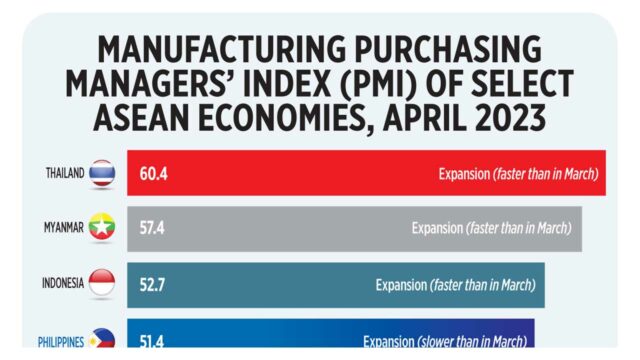
Manufacturing Purchasing Managers’ Index (PMI) of select ASEAN economies, April 2023

PHILIPPINE MANUFACTURING activity eased to an eight-month low in April as new orders and output both rose at a slower pace, S&P Global said. Read the full story.

Manufacturing Purchasing Managers’ Index (PMI) of select ASEAN economies, April 2023

Nonbank lenders bridge funding for small businesses — Asialink

NONBANK financial institutions (NBFIs) have been stepping in to provide the funding needs of small businesses, the head of a financing firm said, citing the double-digit growth of loans recorded last year.

“MSMEs (micro-, small-, and medium-sized businesses) remain underserved by banks. The huge gap is being bridged by NBFIs,” said Asialink Finance Corp. Chief Executive Robert B. Jordan, Jr. in a media release on Tuesday.

He described the gap as “glaring” based on the composition of MSMEs as against the country’s businesses, which he placed at 99% or 996,000 as of 2020.

Mr. Jordan said that in 2022, NBFI’s released P10.5 billion in loans, or higher by 25% compared with the earlier year’s level. The funds reached 24,000 clients, 70% of which are MSMEs, he said.

“It gave them access to loans at a time when they desperately needed access to funds to keep themselves afloat amid a very challenging environment,” he added.

In the media release, Asialink cited data from the Asian Development Bank showing loans to MSMEs by microloan organizations, pawnshops, and other NBFIs reaching $4.9 billion in 2020. It said that banks in comparison lent about $10.3 billion to MSMEs or just 2.4% of all loans they extended to borrowers.

The company also said that among Southeast Asia’s largest economies, the Philippines had the least funding support for MSMEs in terms of bank loans.

Formed in June 1997, Asialink has been serving the unbanked and underserved sector, Mr. Jordan said. It started with a capitalization of P3 billion and has since grown to employ 800 people through more than 100 branches nationwide.

Asialink said it has been focusing on MSMEs that need loans using their used vehicles as collateral.

Gov’t partially awards T-bill offer

BW FILE PHOTO

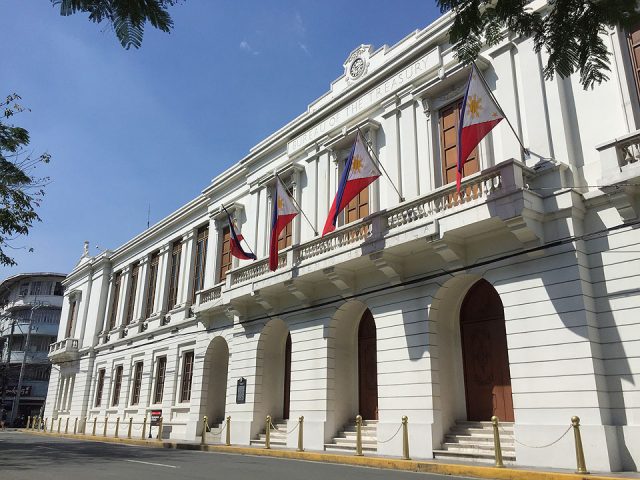
THE GOVERNMENT made a partial award of the Treasury bills (T-bills) it auctioned off on Tuesday as investors continued to ask for higher yields for the shorter tenors.

The Bureau of the Treasury (BTr) raised just P6.915 billion from its offer of T-bills on Tuesday, lower than the P15-billion program, even with total bids reaching P22.123 billion.

Broken down, the Treasury borrowed just P1.915 billion via the 91-day T-bills despite tenders for the tenor reaching P5.075 billion, above the P5-billion plan. The average rate of the three-month papers rose by 13.10 basis points (bps) to 6% from the 5.869% seen at last week’s auction, with the Treasury only accepting bids with this yield.

Meanwhile, the government made a full P5-billion award of the 363-day securities, with demand at P9.888 billion. The one-year paper was awarded at an average rate of 6.247%, inching up by 3.8 bps from 6.209% the previous week, with accepted rates ranging from 6.100% to 6.299%.

On the other hand, the BTr did not award any 181-day debt papers even as bids  for the tenor stood at P7.16 billion, above the P5-billion program. Had the government made a full award, the average rate of the six-month T-bill would have gone up by 23.70 bps to 6.23% from 5.993% last week as investors asked for yields ranging from 6.129% to 6.3%.

The six-month and one-year tenors were adjusted from the usual 182 days and 364 days, respectively, as their maturity falls on a holiday.

At the secondary market on Tuesday, the 91-, 182-, and 364-day T-bills were quoted at 5.8194%, 6.012%, and 6.1419%, respectively, based on PHP Bloomberg Valuation (BVAL) Service Reference Rates data provided by the BTr.

“Results were mixed in today’s Treasury bill auction as the Auction Committee decided to fully award bids for the 363-day T-bill while partially awarding the 91-day T-bill and rejecting bids for the 181-day T-bill. The 363-day security fetched an average rate of 6.247% while the 91-day T-bill was capped at 6%. Meanwhile, the average rate for the 181-day T-bill reached 6.23%, had it been awarded,” the BTr said in a statement on Tuesday.

“The auction was 1.5 times oversubscribed, attracting P22.1 billion in total tenders. With its decision, the committee raised P6.9 billion of the P15-billion offering,” it added.

T-bill rates seen on Tuesday were within expectations as investors continued to demand yields closer to the Bangko Sentral ng Pilipinas’ (BSP) key rate, with inflation seen staying elevated despite slowing from multi-year highs seen previously, a trader said in a Viber message.

“The continued increase in T-bill auction yields was consistent with the recent increase in short-term PHP BVAL yields, especially since April 2023, moving closer to the local policy rate of 6.25%,” Rizal Commercial Banking Corp. Chief Economist Michael L. Ricafort said likewise in a Viber message.

The BSP has raised borrowing costs by 425 bps since May 2022 to help bring down elevated inflation, with its policy rate now at 6.25% — the highest in nearly 16 years.

The central bank last week said April inflation likely settled within the 6.3-7.1% range, slower than the 7.6% in March.

If realized, this would surpass the BSP’s 2-4% target for the 13th consecutive month.

April inflation data will be released on Friday.

“The Treasury bill auction yields again mostly higher week-on-week (except for the six-month tenor where all bids were rejected) ahead of the widely expected 25-bp Fed rate hike on May 3, 2023,” Mr. Ricafort added.

The US Federal Reserve is holding its policy review on May 2-3.

In March, it hiked borrowing costs by 25 bps, bringing its target interest rate to the 4.75% to 5% range.

The US central bank has increased rates by a total of 475 bps since March 2022.

On Wednesday, the BTr will auction off P25 billion in reissued 10-year Treasury bonds (T-bonds) with a remaining life of five years and eight months.

The Treasury wants to raise P175 billion from the domestic market this month, or P75 billion via T-bills and P100 billion via T-bonds.

The government borrows from local and foreign sources to help fund its budget deficit, which is capped at 6.1% of gross domestic product this year. — A.M.C. Sy


Writing for health

The public perception of the importance of vaccines for children declined during the coronavirus disease 2019 (COVID-19) pandemic in 52 out of 55 countries, according to the Vaccine Confidence Project published by UNICEF. The study found that the importance of vaccines for children declined by about 25% in the Philippines.

The UNICEF report warned against the growing threat of vaccine hesitancy. A number of factors have been cited including uncertainty about the response to the pandemic, growing access to misleading information, declining trust in expertise and political polarization. It added that vaccine hesitancy in the Philippines could be attributed to cultural factors, as well as concerns on vaccine safety.

UNICEF’s Catherine Russel noted that scientists had rapidly developed COVID-19 vaccines that saved countless lives. However, fear and disinformation about all types of vaccines circulated as widely as the virus itself. “[These] data [are] a worrying warning signal. We cannot allow confidence in routine immunizations to become another victim of the pandemic. Otherwise, the next wave of deaths could be of more children with measles, diphtheria, or other preventable diseases,” she said.

From the recent UNICEF disclosure, it appears that more needs to be done to promote accurate and timely information and dispel myths and misinformation about the value of vaccination.

Amidst the raging COVID-19 pandemic, I started writing for BusinessWorld to serve as one of the platforms for medically verified health information. George Orwell, nom de plume of Eric Arthur Blair, penned an essay in which he identified four reasons why people write.

In his piece “Why I write,” Orwell said people write out of sheer egoism or aesthetic enthusiasm. Another reason is historical impulse or the desire to see things as they are and to establish facts and keep them for posterity purposes. Finally, Orwell said people write for political purpose. It is their aspiration to change thoughts, behaviors and actions for a certain cause. 

I write both for history and political purpose. Health is one matter that this column fiercely advocated for to record the once-in-a-generation health crisis, as well as emphasize the important lessons that can be learned from the pandemic so that they will never be forgotten.

In relation to writing for history, one of the crucial messages that this column has highlighted together with the International Federation of Pharmaceutical Manufacturers and Associations (IFPMA) is that vaccines help save millions of lives around the world each year. It is estimated that vaccines prevent 4 to 5 million deaths yearly. Vaccines can also lower the burden of care on families and healthcare systems, reduce disruption to our lives and livelihoods, lower health inequities and contribute to broader well-being and productivity. The fact that vaccines can help save lives, bring back mobility and reopen schools and the economy can be well demonstrated in the country’s fight against COVID-19.

On writing for political purpose, I have often stressed that the lessons learned from the pandemic should constantly be repeated in the public discourse. Failing to remember these valuable lessons can mean committing the same mistakes and suffering from graver consequences in the future.

The first lesson from the biopharmaceutical industry perspective is that innovations from test kits, vaccines to treatments have saved lives. Moving beyond COVID-19, the value of biopharmaceutical innovation can be applied to other communicable and noncommunicable diseases that continue to affect Filipinos. As we transition from the pandemic phase, we can start putting a spotlight on diseases that were neglected due to COVID-19. Policies that are conducive to innovation should also be in place.

The second important lesson is that public and private partnerships have enabled the development and manufacturing upscaling of needed diagnostics, vaccines and medicines. Moving beyond COVID-19, public-private partnerships can be applied to areas that could enable responsive regulatory processes, more efficient supply chains and deeper funding mechanisms so that Filipinos can access needed vaccines and medicines in their time of need.

The final lesson to move forward is the need to strengthen our health systems. This requires more investment in healthcare. The employment of efficient referral networks, availability of medicines and vaccines and massive information campaigns have proven crucial as families, communities and the nation fight back against COVID-19. Moving forward, health systems can be strengthened with the full rollout of the Universal Healthcare Act, National Integrated Cancer Control Act and other laws.

I will always be grateful to BusinessWorld and its editor-in-chief, Wilfredo G. Reyes (whom I call Wolfy), as well as my current editor Norman P. Aquino, for giving me the precious space to inform the public about crucial information they need to make informed decisions. I am compelled to write for health because the pandemic has shown us that it has wider implications on people’s movement, education, security, business and the economy.

Allow me to conclude by quoting Cicero: Salus populi suprema lex esto. The health of the people should be the supreme law. No matter how well-intentioned we are in providing incentives to stimulate our economy, overlooking investments in public health will only keep us moving in place.

To get ahead, the road should be paved by a healthy population.


Teodoro B. Padilla is the executive director of the Pharmaceutical and Healthcare Association of the Philippines, which represents the biopharmaceutical medicine and vaccine industry in the country. Its members are in the forefront of research and development efforts for COVID-19 and other diseases that affect Filipinos.

Ed Sheeran calls copycat claims ‘insulting’ in ‘Thinking Out Loud’ trial

A SOMETIMES-RILED Ed Sheeran on Monday denied copying Marvin Gaye’s classic “Let’s Get it On” in his second day of testifying to jurors in a copyright trial in Manhattan federal court, calling the claim “insulting.”

As he had last week, the British singer-songwriter played guitar and sang from the witness stand to underscore his testimony, telling jurors his song “Thinking Out Loud” had actually been inspired by Irish musician Van Morrison.

“I find it really insulting to devote my whole life to being a performer and a songwriter and have someone diminish it,” said Mr. Sheeran, who is being sued by heirs of Gaye’s co-writer Ed Townsend.

Lawyers for the heirs last week displayed a video of Mr. Sheeran transitioning seamlessly between “Thinking Out Loud” and “Let’s Get it On” in a live performance they said amounted to a confession that he had ripped off the song.

Mr. Sheeran said he and other performers frequently perform such “mash ups,” and that he had on other occasions combined “Thinking Out Loud” with Van Morrison’s “Crazy Love” and Dolly Parton’s “I Will Always Love You.”

He also said that an expert witness for the heirs, in transcribing his song, had altered it to make the chords and melody more like “Let’s Get It On.”

“I don’t know why he’s allowed to be an expert,” he said.

Mr. Sheeran became combative under cross-examination by Patrick Frank, a lawyer for the heirs. He ridiculed Frank’s questions about how often Mr. Sheeran collaborates with others in writing songs, which he said was common practice.

“You’re not, like, breaking new ground here,” he said.

Mr. Sheeran’s co-writer Amy Wadge took the stand after his testimony concluded, telling jurors about their friendship and collaboration of 17 years. She also denied copying “Let’s Get It On” and pointed to other songs with the same chords as “Thinking Out Loud,” including Shania Twain’s “You’re Still The One.”

If Mr. Sheeran is found liable, there will be a second trial to determine the damages amount. — Reuters

Trust assets of nonbanks rise to P1.49 trillion in 2022

TRUST ASSETS held by the nonbank sector increased by 10.37% to P1.49 trillion in 2022, data from the Bangko Sentral ng Pilipinas (BSP) showed. 

This is higher than the P1.35 trillion in 2021 and 4.92% above the P1.42 trillion in the previous quarter.

The increase was likely because of the improved financial literacy of the investing public, as well as the continued growth in capital markets, Rizal Commercial Banking Corp. Chief Economist Michael L. Ricafort said.

“[The increase] may be attributed to the need for more investment-related products that offer variable returns (higher risks, higher returns) that are booked under Trust, as alternative to and a way to diversify from traditional deposits that offer fixed interest rate income,” Mr. Ricafort said.

A trust business refers to any activity from a trustor-trustee relationship wherein a trustee is appointed by a trustor to administer, hold, and manage their funds and/or properties to the benefit of the trustor.

Banks or nonbank institutions such as investment houses can be designated to have a business unit to perform trust functions.

Mr. Ricafort said tapping the services of professional fund managers in trust units with proven track records in investment returns is more convenient for investors.

“Depending on the risk profile, investment-related products with variable returns (not guaranteed, either higher returns or even risk of losses, depending on market conditions) serviced by Trust units, while traditional deposits that have fixed interest rates are serviced by banks,” he said.

Central bank data showed nonbanks with trust authority from the BSP recorded P1.22 trillion in net financial assets last year, up by 9.9% from the P1.11 trillion in 2021.

Total net loans also grew by 35.9% to P51.09 billion in 2022 from P37.59 billion in 2021.

Nonbanking trusts’ deposits in banks went up by 8.18% to P199.29 billion as of end-December 2022, from the P184.22 billion in the comparable year-ago period.

Meanwhile, nonbanks’ trust liabilities decreased by 9.3% to P573.42 billion last year, from the P632.44 billion in 2021.

Unit investment trust funds also declined by 14.8% to P329.83 billion from P387.21 billion.

There are currently five nonbank financial institutions with quasi-banking functions, such as investment houses with trust functions, that are being monitored by the BSP.

About 1,334 nonbanks without quasi-banking functions are being supervised by the central bank, two of which are investment houses with trust functions. — Keisha B. Ta-asan

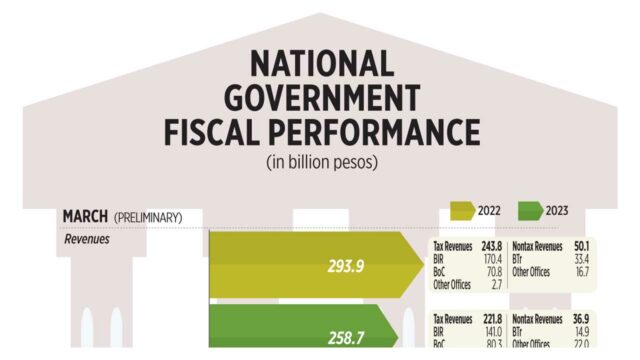
National Government fiscal performance

THE NATIONAL Government (NG) fell short of its budget deficit ceiling in the first quarter, after missing its spending target. Read the full story.

National Government fiscal performance

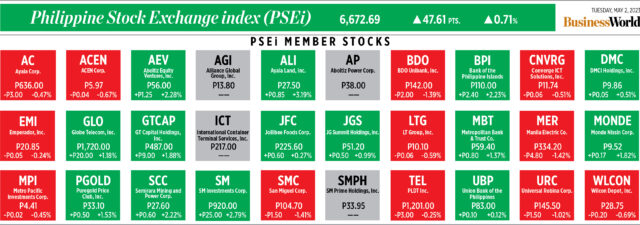
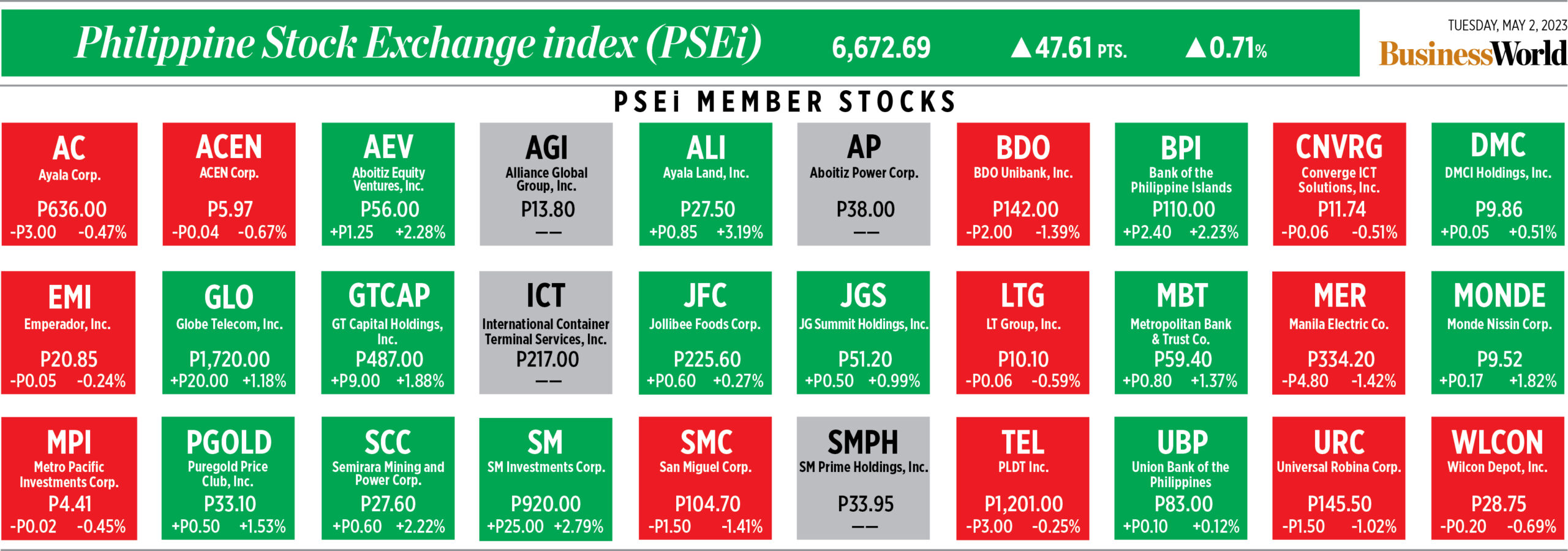
How PSEi member stocks performed — May 2, 2023

Here’s a quick glance at how PSEi stocks fared on Tuesday, May 2, 2023.


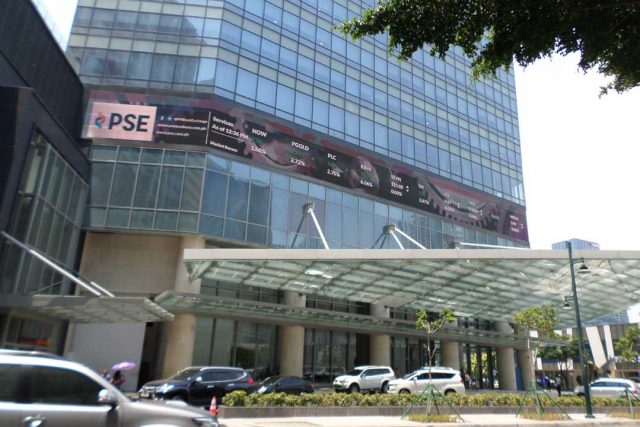
PHL stocks climb as market awaits inflation data

BW FILE PHOTO

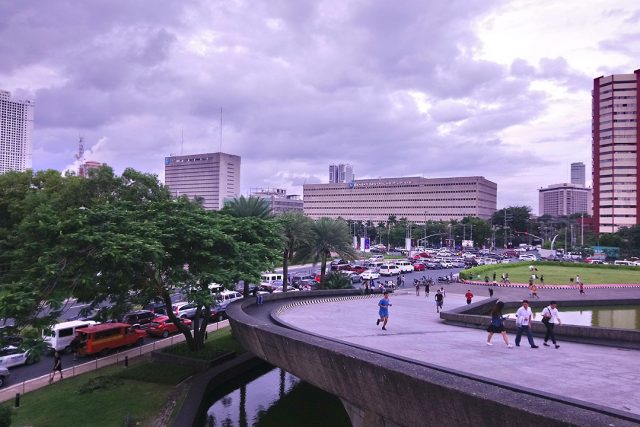
LOCAL SHARES climbed on Tuesday amid strong corporate financial results and as investors await the US Federal Reserve’s policy decision and the release of April Philippine inflation data this week.

The benchmark Philippine Stock Exchange index (PSEi) went up by 47.61 points or 0.71% to close at 6,672.69 on Tuesday, while the broader all shares index rose by 14.16 points or 0.4% to 3,546.69.

“Philippine shares got off to another great start as investors have been cheering the local earnings trickling along with placing bets on the April CPI (consumer price index) coming on Friday,” Regina Capital Development Corp. Head of Sales Luis A. Limlingan said in a Viber message.

“Share prices moved higher after the long weekend break. Technically, momentum picked up after the PSEi managed to initially hold support at its 20-day exponential moving average… Fundamentally, investors are hopeful that the US FOMC (Federal Open Market Committee) may be at the tail end of its rate-raising actions. Investors are also hopeful that local April inflation will continue to trek lower,” AB Capital Securities, Inc. Vice-President Jovis L. Vistan said in a Viber message.

The market was closed on Monday for Labor Day.

Inflation likely further eased in April amid lower food prices, electricity rate cuts, and favorable base effects, analysts said.

A BusinessWorld poll of 14 analysts yielded a median estimate of 7% for April inflation, settling near the upper end of the 6.3-7.1% forecast range of the Bangko Sentral ng Pilipinas (BSP) for the month.

If realized, this would be slower than the 7.6% in March, but faster than the 4.9% in April 2022. This will also be the slowest in seven months, or since the 6.9% inflation rate in September last year.

However, it would surpass the BSP’s 2-4% target range for the 13th consecutive month.

April CPI data will be released on Friday.

Meanwhile, the Fed is holding its policy meeting on May 2-3.

Markets expect the US central bank to raise rates by another 25 basis points (bps) this week and are awaiting hints on their next policy moves.

The Fed has hiked borrowing costs by 475 bps since March 2022, with its target interest rate now at 4.75%-5%.

Sectoral indices were split on Tuesday. Holding firms climbed by 92.62 points or 1.44% to 6,498.41; property went up by 25.24 points or 0.92% to 2,760.73; and financials rose by 0.96 point or 0.05% to 1,919.09.

Meanwhile, mining and oil declined by 50.66 points or 0.47% to 10,535.88; industrials fell by 24.08 points or 0.25% to 9,481.81; and services dropped by 1.73 points or 0.1% to close at 1,603.47.

Value turnover declined to P4.08 billion on Tuesday with 1.17 billion shares changing hands, from the P8.34 billion with 899.96 million issues traded on Friday.

Advancers outnumbered decliners, 103 versus 83, while 48 names closed unchanged.

Net foreign buying fell to P67.1 million on Tuesday from P435.61 million on Friday. — A.H. Halili

Peso inches higher vs dollar on oil price drop, stock mart gains

BW FILE PHOTO

THE PESO inched up against the dollar on Tuesday due to lower global oil prices as well as gains at the local stock market.

The local currency closed at P55.34 versus the dollar on Tuesday, rising by four centavos from Friday’s P55.38 finish, data from the Bankers Association of the Philippines’ website showed.

The local unit opened Tuesday’s session weaker at P55.48 per dollar. Its worst showing for the day was at P55.50, while its intraday best was at P55.26 versus the greenback.

Dollars traded went down to $1.057 billion on Tuesday from the $1.24 billion recorded on Friday.

The local currency was supported by a drop in global crude oil prices and the Philippine Stock Exchange index’s (PSEi) rise, Rizal Commercial Banking Corp. Chief Economist Michael L. Ricafort said in a Viber message.

Oil prices fell in Asian trade on Tuesday, extending losses seen in the previous session, as weak economic data from China and expectations of a US interest rate increase weigh on the market.

Brent crude was down 0.3% or 24 cents to $79.07 a barrel by 0615 GMT, while US West Texas Intermediate crude fell 0.3% or 25 cents to $75.41 a barrel. Both benchmarks fell by more than $1 in their last session.

Meanwhile, the PSEi went up by 47.61 points or 0.71% to close at 6,672.69 on Tuesday. The all shares index also gained 14.16 points or 0.4% to end at 3,546.69.

The peso mostly traded sideways with a downward bias amid a lack of catalysts, a trader said in a Viber message.

For Wednesday, the trader said the peso could be supported by expectations of a pause in the Bangko Sentral ng Pilipinas’ (BSP) tightening cycle amid easing inflation.

BSP Governor Felipe M. Medalla said last month that if inflation eased further in April, the Monetary Board could consider pausing its rate hikes at its May 18 meeting.

The central bank has raised borrowing costs by a total of 425 basis points since May 2022.

On Wednesday, the trader sees the peso trading between P55.30 and P55.60 against the dollar, while Mr. Ricafort expects it to move from P55.20 to P55.40. — A.M.C. Sy with Reuters

Gov’t advises airlines to rework May 17 schedules for shutdown

REUTERS

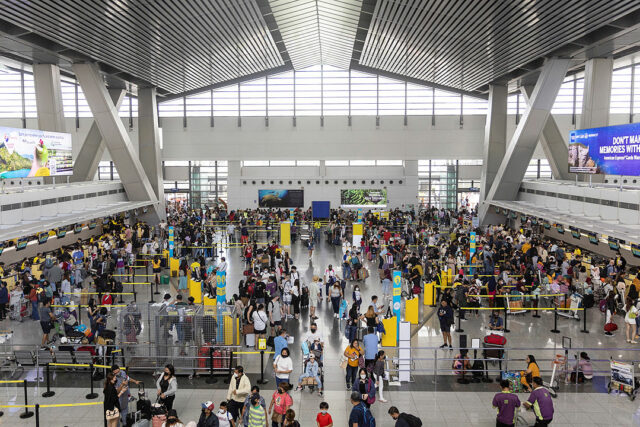
THE Civil Aviation Authority of the Philippines (CAAP) said the airspace shutdown for equipment maintenance scheduled for the morning of Wednesday, May 3, will not affect flights, but added that airlines have been advised to rework their schedules around a longer shutdown scheduled for May 17.

“The airlines are ready… they received the information from us,” CAAP Spokesperson Eric B. Apolonio said by phone, referring to the disruptions on both dates.

“There will be no flights affected on May 3. For May 17, immediately we informed them two weeks ahead so that the airline stakeholders and the airport authorities will be able to adjust their schedules, especially flights, because we really need to set up between 12 midnight to 6 a.m.,” he added.

In an advisory, the CAAP said that it will be conducting corrective maintenance activities at the Philippine Air Traffic Management Center on May 3 from 2 a.m. to 4 a.m. and on May 17 from 12 midnight to 6 a.m.

Maintenance is scheduled for the air traffic system’s automatic voltage regulators, while the uninterruptible power supply (UPS) systems are due for replacement, and the air traffic management system A/B power supply needs upgrading.

When asked whether the May 17 shutdown could be cut short if the maintenance activity takes less time than expected, he said: “Yes definitely because unang-una ’yung hanggang 6 a.m. may allowance just to be sure (the 6 a.m. end-time incorporates an allowance period). Pero actually makakaya namang mas maaga kaya lang mas mainam na ’yung fixed sa 6 a.m. para in case may issues pa kaming kailangan i-correct, hindi na kami maga-adjust (An earlier finish is possible, but the 6 a.m. projected finish was declared in the event some unexpected issues arise that need to be corrected).”

If maintenance concludes before 6 a.m., “we will immediately lift the notice to airmen so that flights can continue earlier,” he added.

Mr. Apolonio said that the New Year’s glitch which shut down Philippine airspace pointed the need to maintain the UPS.

“We need to replace parts. We have purchased them through emergency (procurement) to correct the problem and to create redundancy,” he said.

The CAAP said it will be installing two additional UPS units that are expected to make a repeat of the Jan. 1 disruptions less likely. — Justine D. Tabile

ADVERTISEMENT
ADVERTISEMENT