Home Blog Page 4914

Lack of charging stations seen as main objection to EV adoption

REUTERS

GASOLINE and diesel-powered vehicles remain overwhelmingly preferred in the Philippines, with reluctance to adopt electric vehicles (EVs) based on the dearth of charging stations, consulting firm Deloitte said, citing the results of a survey.

The survey indicated that 72% of respondents in the Philippines preferred internal combustion engine (ICE) vehicles, Deloitte said in a statement on Thursday.

The 72% level of support for ICE on Thursday is down 10 percentage points from a year earlier but remains the highest in the region, ahead of Indonesia (59%), and Vietnam (49%), according to the company’s 2023 Global Automotive Consumer Study.

Only 25% of respondents in the Philippines indicated interest in EVs. The highest level of interest was recorded in Singapore (62%) and Thailand (60%).

According to Deloitte, the study was conducted between September and October and involved over 26,000 consumers in 24 locations including Southeast Asia. At least 1,000 responses were incorporated into the study for each country in the region.

Fredieric B. Landicho, Deloitte Philippines managing partner and chief executive officer, said the survey results showed that there is a need for “robust infrastructure” to support EVs before expecting consumers to make the switch.

“We’re not just talking about convenient charging sites. We have to consider if we have the right workforce to service these vehicles wherever the owners may need that assistance,” Mr. Landicho said. 

The Philippines has been pushing for increased EV adoption following the issuance of Executive Order (EO) No. 12 in January, which reduced the tariff on certain EVs to zero for five years to make prices more accessible.

The vehicles covered by the order are cars, buses, vans, trucks, kick scooters, self-balancing cycles, bicycles, and pocket motorcycles with auxiliary motors not exceeding 250 watts and with a maximum speed of 25 kilometers per hour. Excluded from the EO were electric motorcycles, which remain subject to the 30% tariff.   

Republic Act No. 11697 or the EV Industry Development Act, lapsed into law in April 2022. The law requires vehicle fleet owners, including the government, to observe a 5% EV quota. — Revin Mikhael D. Ochave

PHL, US reaffirm mutual defense support amid ‘emerging threats’

PHILIPPINE STAR/KRIZ JOHN ROSALES/PPA POOL

By Kyle Aristophere T. Atienza, Reporter

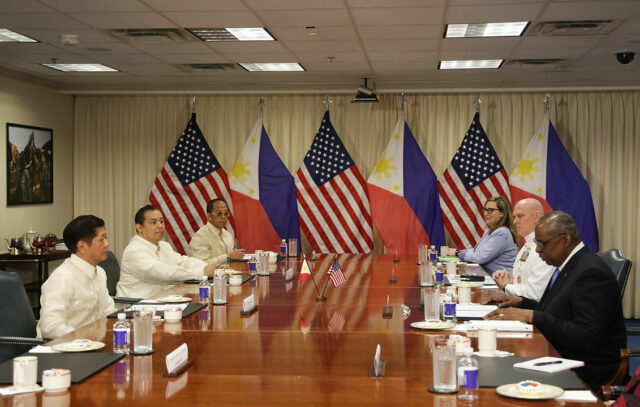
THE PHILIPPINES and the United States have adopted new Bilateral Defense Guidelines, reaffirming that any armed attack on Philippine security forces anywhere in the South China Sea would force the two countries to invoke a 1951 treaty.

In the six-page document, the two countries reconfirmed the “continued relevance” of the US-Philippines Mutual Defense Treaty (MDT) in addressing “current and emerging threats.”

Both countries acknowledged that the “continued modernization” of the US-Philippines alliance is “essential” to keeping the Indo-Pacific region “free, open, secure, stable and prosperous.”

Under the guidelines, the two countries will enhance their coordination and bilateral planning.

It states that consistent with the MDT, “the countries intend to maintain close consultations when either the territorial integrity, political independence, or security of either of the Parties is threatened by an external armed attack in the Pacific.”

Either country may request support “when it assesses that a threat is imminent or when indicators of an armed attack may arise.”

The two countries should also expand information-sharing “on the principal threats and challenges confronting the alliance to identify at the earliest possible stage any indications of threats to the peace and security of the United States and the Philippines.”

Aside from the MDT, the new guidelines also bank on other pacts, including the 1998 Visiting Forces Agreement, 2014 Enhanced Defense Cooperation Agreement, and 2017 Mutual Logistics Support Agreement, among others.

The guidelines also aim to help modernize the Philippines’ defense capabilities, with the US set to work “closely” on the Philippines’ defense budget planning, including the development of a Security Sector Assistance Roadmap “to identify priority defense platforms and force packages over the next five years.”

The two countries will also expand investments in non-material defense capacity building in the form of education and training exchanges, among others.

Under the guidelines, the US and the Philippines also seek to deepen interoperability and people-to-people ties by orienting bilateral exercises and activities towards improving combined ability to deter and counter armed attacks on ground, air, maritime, or amphibious forces on either country in the Pacific Area, including the South China Sea.

It also covers “threats in space and cyberspace, while expanding the scope, scale, and complexity of such exercises and training.”

In line with the two countries’ goal to combat transnational and non-conventional threats, Washington and Manila will boost cyber defense and cyber security cooperation “to secure critical infrastructure and build protection against attacks emanating from state and non-state actors.”

They will also identify opportunities to develop the armed forces’ capacity to support civilian-led responses to natural disasters and other humanitarian crises.

They also want to expand capacity-building activities to respond to chemical, biological, radiological, and nuclear-related attacks as well as counter the proliferation of weapons of mass destruction.

Under the new guidelines, Washington and Manila also want to contribute to global and regional peace and security by, among others, participating in multilateral fora, particularly under the auspices of the Association of Southeast Asian Nations (ASEAN).

These include the ASEAN Defense Ministers’ Meeting-Plus and ASEAN Regional Forum defense-related meetings.

Further, the two countries will identify appropriate opportunities for third-party participation and observation from other nations’ armed forces.

CHINESE OPPOSITION
Meanwhile, China firmly opposes any country citing bilateral treaties to interfere in the South China Sea and undermine China’s territorial interests and rights, the foreign ministry said on Thursday.

“The South China Sea is home to all regional countries and should not be a hunting ground for external forces,” ministry spokesperson Mao Ning told a regular briefing when asked about a US move to reaffirm its decades-old security alliance with the Philippines.

A lawmaker, meanwhile, said the Philippines should increase its joint patrols with neighboring Asian countries to deescalate tensions with China.

“Military agreements will just exacerbate the current situation,” House Deputy Minority Leader and ACT Teachers’ Party-list Rep. France L. Castro said at a Kamuning Bakery Café media forum on Thursday.

Ms. Castro said the Philippines must lobby at international bodies like “the Asian Parliamentary Assembly and the Inter-Parliamentary Union to condemn such actions and active incursions of China in our territory.”

“It is also best to increase coast guard patrol as well as coordinate the launch of joint patrols with countries who also have claims in the (South China Sea) like Vietnam, Malaysia, Indonesia, Brunei, and Taiwan,” Ms. Castro added.

She said that joint patrols and international pressure are “peaceful yet assertive ways to defend our territory.”

A fisherfolk group also expressed opposition to the renewed US-Philippine pact, saying increased military exercises just add to their losses from China’s aggression. 

Ronnel Arambulo, spokesperson of Pambansang Lakas ng Kilusang Mamamalakaya ng Pilipinas (PAMALAKAYA), told BusinessWorld that fishermen are already losing 70% of their income from Chinese harassment at sea, and US presence adds to their difficulties.

“It is clear to us that these agreements (between the US and the Philippines) will only worsen the struggles of fisherfolk because it will damage the fishing sites,” he said in Filipino.

President Ferdinand R. Marcos, Jr., speaking to US senators led by foreign relations committee chair Robert Menendez, said defense and security engagement remains the key pillar of US-Philippines relations, according to a statement on Thursday from the Presidential Communications Office.

Mr. Marcos also expressed his government’s intention to deepen cooperation with the US in the areas of supply chain, health and health security, environment, energy security, and interconnectivity.

The meeting was part of Mr. Marcos’ five-day visit to Washington and followed separate dialogues with US President Joseph R. Biden and US Vice President Kamala Harris. — with Beatriz Marie D. Cruz and Reuters

Local rights groups upset as violations glossed over in Marcos-Biden meeting

PHILIPPINE STAR/ MICHAEL VARCAS

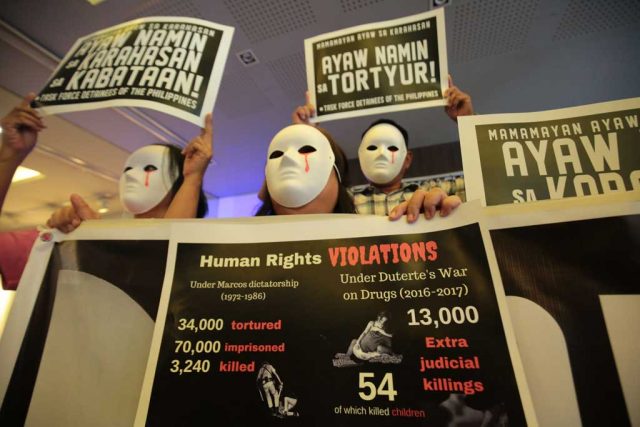
LOCAL groups have expressed disappointment at the lack of emphasis on the Philippines’ human rights situation during the May 1 meeting between US President Joseph R. Biden and President Ferdinand R. Marcos, Jr.

There were no substantial agreements made to ensure that past and emerging human rights concerns in the Philippines, including problems faced by human rights advocates working on the ground, would be addressed, the group In Defense of Human Rights and Dignity Movement (iDEFEND) said in a Facebook Messenger chat.

“We think the pronouncements are all broad and vague. While they say that there is a need for the advancement of human rights in the country, we think that it wasn’t considered in the partnerships and agreements set.”

During their bilateral meeting in Washington on May 1, the two leaders “shared democratic values that strengthen our alliance immeasurably,” the White House said in a fact sheet.

“Promoting respect for human rights and rule of law, and ensuring civil society leaders and members of marginalized communities are safe from violence, are key priorities for the US-Philippines relationship,” it said. 

It said the US wants to contribute to the Philippines-United Nations (UN) Joint Programme for Human Rights.

The two countries will establish a bilateral Labor Working Group, which is in line with their trade and investment framework agreement.

However, iDEFEND said such agreements “between governments should emanate from real and actual knowledge of what’s happening on the ground.” 

The group said the two countries also failed to ensure that the expansion of their 2014 Enhanced Defense Cooperation Agreement (EDCA) would not lead to human rights violations and disruption of culture and livelihood in host communities.

“We’ve already had actual cases where justice was never really served. Disruptions in the communities’ lives and livelihoods were never addressed and in fact, were undermined as they push through with these (military) exercises,” iDEFEND said. “So the fact remains that this cooperation agreement between the US and the Philippines is a one-sided deal that only benefits one party while exploiting and affecting the lives of the citizens.”

Mr. Biden also did not bring up “existing struggles” on the ground between communities and mining companies, noting that there were “actual atrocities” that needed attention from the government.

“Yet, the only thing they can say is ‘improve governance standards in the mining industry’.”

The Philippine Alliance of Human Rights Advocates (PAHRA), in a separate Messenger chat, said, “The result of the May 1 meeting between the two leaders only shows that human rights are not the center of US foreign policy under the Biden administration.”

PAHRA and iDEFEND have been calling on the US government and the international community to exert pressure on Mr. Marcos to pave the way for the release of ex-senator Leila M. de Lima, who has been in detention since her arrest in 2017 on drug trafficking charges, which critics and European lawmakers have said are baseless and meant to harass her.

Since April 2022, most of the key witnesses have recanted their testimonies against Ms. De Lima, saying they were coerced by government officials under former President Rodrigo R. Duterte, whose deadly drug war is now being investigated by the International Criminal Court.

PAHRA, meanwhile, noted that press freedom issues in the Philippines were also sidelined during the Marcos-Biden meeting.

On Tuesday, the National Union of Journalists of the Philippines said human rights violations against media practitioners continue under the Marcos administration.

It noted that as of April 30, there were 60 reported cases of harassment, red-tagging and other cases of censorship against Philippine journalists.

The latest World Press Freedom index by Reporters Without Borders said the Philippines remained a “difficult” country for journalists despite the improvement in its 2023 scores.

Maria Ela L. Atienza, former head of the University of the Philippines’ political science department, said the White House statement indicating US commitment to help protect civil society leaders and members of marginalized communities against violence “could be indicative of the strong pressure on the Philippines not only from the US and other countries but the UN and civil society groups to uphold human rights and address many related issues the Marcos administration has continued or inherited from the previous administration.”

“Of course, the meeting covered a comprehensive agenda for the two countries’ partnership. Human rights was not the only agenda but it was part of the meeting,” she said in a Viber message.

“Now, we have to see how both countries are really committed to all these so-called commitments and points of the partnership.”

‘STRATEGIC BLACKMAILING’
Mr. Biden had promised to promote accountability for governments that abuse human rights when the US was elected to the Human Rights Council 2021 for a three-year term.

However, Mr. Biden himself had been criticized for failing to discuss human rights when he met leaders of several Middle Eastern countries in July 2022.

“He was criticized during his visit and for apparently ingratiating himself with leaders of Saudi Arabia and Israel, close allies of the US, despite the killing of Al Jazeera correspondent Shireen Abu Akleh in May 2022 and Washington Post columnist Jamal Khashoggi in 2018,” PAHRA explained.

Human Rights Watch earlier said that since Mr. Marcos took office in June, Washington has significantly increased assistance to the Philippines “primarily through defense spending.”

Mr. Marcos in February expanded the EDCA, giving Washington access to four more military bases on top of the five existing sites.

The Philippine leader, 65, is the son of the late dictator Ferdinand E. Marcos, who was toppled by a popular uprising in February 1986 after his government plundered public coffers and committed human rights violations, which have been documented by various domestic and international organizations.

Mr. Biden, who was a senator in 1986, was part of a committee that declared the 1986 snap elections in the Philippines fraudulent.

Observers have said the US president may not keenly look at the younger Marcos’ commitment to human rights because Washington needs Manila as it counters China’s influence in the region.

Arjan P. Aguirre, a political science professor at the Ateneo de Manila University, called the phenomenon “strategic blackmailing.”

“Biden has just announced his plan for reelection, and he intends to politicize the tension with China for this purpose,” he said, noting that the Biden government will “guarantee” that issues confronting the Marcos family including their ill-gotten wealth case “won’t be raised against the Marcos government in the near future.”    

Cleve V. Arguelles, president of research firm WR Numero, said the Philippine leader’s political baggage would likely shape his foreign policy decisions.

His willingness to be seen on the global stage could be part of “restorationist” agenda seeking to rebrand the image of his family.

Ms. Atienza said Mr. Marcos may be trying to replicate his father’s dealings with other countries, including the US, which had backed the elder Marcos during his presidency.

“Marcos Sr. presented himself as a leader at ease in the international community. His regime was supported by the US and its allies during the Cold War period,” she said. “[But] times have changed and international relations are more complex now.”

“Marcos Jr. has more difficulties, with [western] allies also calling on the Philippines to observe the rule of law, strengthen democratic institutions and processes, and uphold human rights.” — Kyle Aristophere T. Atienza


US, Saudi companies may hire Filipino workers displaced by Sudan conflict 

DEPARTMENT OF MIGRANT WORKERS

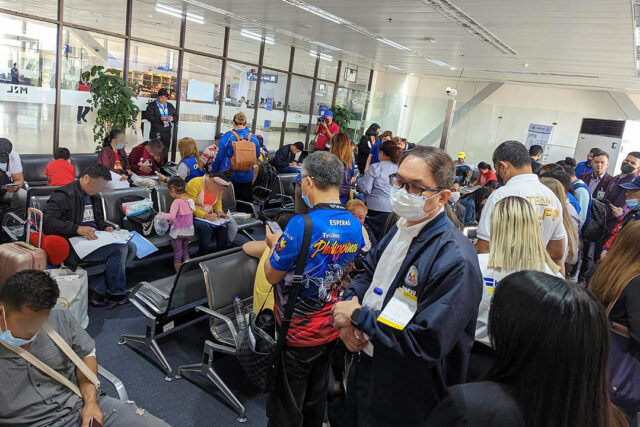
COMPANIES in the United States and Saudi Arabia as well as a local diversified corporation are interested in hiring Filipino workers who were repatriated from war-torn Sudan, according to the Philippine migrant workers department.  

Theyre willing to look at the profilesof Filipino workers rescued from Sudan, Migrant Workers Secretary Susan V. Ople was quoted as saying in a Palace statement on Thursday.  

There are employers in the US and also in the cruise ship industry and in Saudi Arabia that are very much interested and would like to see the profiles of our workers from Sudan,she said.  

The Philippine agency is now preparing the workers profiles, she said.  

Among the companies that showed interest include MedPro International, Magsaysay Maritime Corp., and Carnival Corporation.   

Ms. Ople said the agency is also working with PEACEME, a recruitment industry association geared towards employment in the Kingdom of Saudi Arabia as well as the middle eastern country’s Ministry of Human Resource and Social Development.   

Ms. Ople said the displaced Filipino workers received $200 each from the Department of Migrant Workers (DMW) while they were transiting in Egypt.   

Each worker will also receive P100,000 financial assistance from the DMW and the Overseas Workers Welfare Administration.  

Of the 340 Filipinos who were set to be repatriated to Manila from Sudan, 77 have already landed in Saudi Arabia as of Thursday. 

A batch of 83 Filipinos were expected to arrive in Riyadh on the same day. Kyle Aristophere T. Atienza

Oil spill-affected Mindoro coastal towns to get fishing ground sharing scheme 

PHILIPPINE COAST GUARD

THE NATIONAL Government will provide a fishing ground sharing scheme for coastal towns in Oriental Mindoro that are still affected by a major oil spill from a sunken fuel tanker.   

The Department of Interior and Local Government (DILG) and the Bureau of Fisheries and Aquatic Resources will adopt a cluster approach to ensure that all affected fisherfolk will have a place to go and congestion in one fishing area will be avoided,DILG Secretary Benjamin Abalos, Jr. said in a statement.   

Under the plan, residents of the municipalities of San Teodoro and Baco may fish in the municipal waters of Paluan and Abra De Ilog in Occidental Mindoro. Tayabas Bay and Mindoro Strait have also been proposed as fishing areas for the two affected municipalities.  

Fishermen from Calapan City, Naujan, and Pola may sail out to the municipal waters of Boac, Gasan in Marinduque, as well as Tayabas Bay, according to the DILG. 

Fishermen from Pinamalayan, Gloria, and Bansud may catch fish in the municipal waters of Concepcion in Romblon and portion of Mindoro Strait, it added. 

The last cluster, which includes fisherfolk from Bongabong, Roxas, Mansalay, and Bulalacao, may go to Tablas Strait and the municipal waters of San Jose and Magsaysay in Occidental Mindoro.   

Mr. Abalos said the duration of the sharing program will be determined by the results of continuing fish and water testing.   

As soon as the fish samples are okay and there is no more contamination of Polycyclic Aromatic Hydrocarbons in the affected areas of Oriental Mindoro, the fisherfolk can already do their fishing activities in their own territorial waters,he said.   

The DILG said it will also review existing policies on the management of municipal waters.   

Mr. Abalos, meanwhile, called on local governments in coastal areas to include oil spills and other similar incidents in their contingency plans, and make it a Seal of Good Local Governance requirement. 

Fuel tanker MT Princess Empress was carrying 800,000 liters of industrial oil when it sank off Naujan, Oriental Mindoro on Feb. 28, affecting fish sanctuaries and the livelihood of fisherfolk.  

Local governments in Oriental Mindoro, including the provincial government, have yet to file any legal suit against the tanker’s owner, RDC Reield Marine Services. 

A coalition of various sectors that advocate for the protection of the Verde Island Passage has been calling on the National Government to speed up efforts to contain the oil spill and hold accountable those responsible for it.Kyle Aristophere T. Atienza

San Juan City taps Starpay e-wallet for illegal parking fee payment

THE SAN JUAN City government has partnered with electronic wallet services platform Starpay for the payment of illegal parking fees.   

In a statement on Thursday, Starpay said it recently signed a memorandum of agreement with San Juan Mayor Francis M. Zamora to provide a digital option for motorists caught violating parking rules.   

Under the agreement, motorists can pay the fine through online transaction by scanning Starpay’s QRPH code, which allows all major banks and e-wallets to also settle the payment via the QR Code.    

When they show their proof of payment to the traffic enforcers, the clamps on their vehicles will be removed. This allows for more convenience since vehicle owners need not go to the city hall to settle their fines,Starpay said.    

The San Juan local government imposes a P500 fine for illegally parked motorcycles; P1,500 for cars, AUVs and jeepneys; and P2,000 for cargo trucks, delivery vans, and passenger buses.    

Motorists caught trying to remove the wheel clamp will be charged another P5,000.   

Each traffic enforcer will have their own dedicated QR code. When the QR code is scanned by the motorist, they can input the fine, convenience fee and the payment purpose. Vehicle owners can use Starpay or other e-wallet systems,Starpay Product Head Ryan Uy said.   

The convenience fee for Starpay is P25.00, while for other e-wallets its P50,he added.    

Mr. Zamora, meanwhile, warned that clamped vehicles with unpaid fines after the five-hour grace period will be towed.    

Illegally parked vehicles along Mabuhay Lanes and city roads will be clamped by authorities, as provided under the amended San Juan City Wheel Clamping Ordinance No. 70, Series of 2022 and Metropolitan Manila Development Authority (MMDA) Resolution No. 10, Series of 2010.    

San Juan is in the middle of Metro Manila and most of the motorists are just passing through. This leads to a high rate of transient vehicles. It is important that our motorists practice discipline,Mr. Zamora said. Revin Mikhael D. Ochave  

Ukraine attempted to assassinate Putin by drone — Kremlin

Russian President Vladimir Putin — KREMLIN.RU

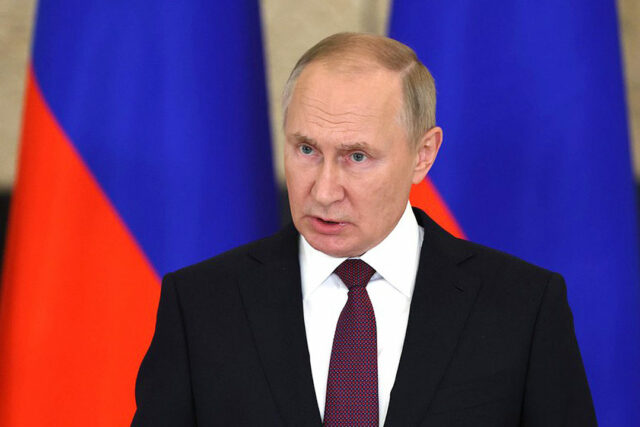
MOSCOW/KYIV — Russia accused Ukraine on Wednesday of a failed attempt to assassinate President Vladimir Putin in a drone attack on the Kremlin citadel in Moscow, and threatened to retaliate.

Ukrainian President Volodymyr Zelensky said Kyiv had nothing to do with the reported overnight incident.

“We don’t attack Putin, or Moscow, we fight on our territory,” Mr. Zelensky told a press conference during a visit to Finland, of the war against Russian occupiers.

A senior aide to Mr. Zelensky called the accusation a sign that the Kremlin was planning a major new attack on Ukraine, at a time of potential turning point in the war as Kyiv prepares to mount a long-anticipated counteroffensive.

Shortly after the Kremlin announcement, Ukraine reported alerts for air strikes over the capital Kyiv and other cities.

Russia said that two unmanned aerial vehicles were aimed at the Kremlin.

“As a result of timely actions taken by the military and special services with the use of radar warfare systems, the devices were put out of action,” a Kremlin statement said.

“We regard these actions as a planned terrorist act and an attempt on the president’s life, carried out on the eve of Victory Day, the May 9 Parade, at which the presence of foreign guests is also planned.”

Fragments of drones were scattered in the Kremlin grounds but there were no injuries or damage, it said.

Mr. Putin himself was safe. The RIA news agency said he had not been in the Kremlin at the time, and was working on Wednesday at his Novo Ogaryovo residence outside Moscow.

“The Russian side reserves the right to take retaliatory measures where and when it sees fit,” the Kremlin added.

Former Russian president Dmitry Medvedev, now deputy head of Russia’s Security Council, said the incident “leaves us no option but to physically eliminate Zelensky and his clique”.

SMOKE OVER KREMLIN
Two of numerous videos published on Russian social media channels show two objects flying on the same trajectory toward one of the highest points in the Kremlin complex, the dome of the Senate. The first seemed to be destroyed with little more than a puff of smoke, the second appeared to leave blazing wreckage on the dome.

Reuters checks on time and location indicated that the videos could be authentic, though some Western analysts said it was possible Russia might have staged the incident to pin the blame on Kyiv and justify some kind of crushing response.

Ukrainian presidential adviser Mykhailo Podolyak said the drone accusation, along with an announcement that Russia had caught suspected saboteurs in Ukraine’s Russian-occupied Crimea region, “clearly indicates the preparation of a large scale terrorist provocation by Russia in the coming days”.

In Washington, the White House said it was aware of reports that Russia had accused Ukraine of attacking the Kremlin with drones to try to kill Mr. Putin but could not authenticate the allegations.

Russia says it launched its “special military operation” to counter a threat from Kyiv’s relations with the West. Ukraine and its allies call it an unprovoked war of conquest by Moscow, derailed by a failed assault on the capital Kyiv early last year and Ukrainian advances in the second half of 2022.

Over the past five months, Ukrainian ground forces have kept mostly to the defensive, while Russia launched a huge, largely unsuccessful winter assault, capturing little new ground.

KHERSON SHELLED, 18 KILLED
In Ukraine’s southern Kherson region on Wednesday, 18 civilians were killed and 46 injured in heavy Russian shelling that hit a hypermarket, a railway station and residential buildings, Ukrainian officials said.

At least 12 of those killed were in Kherson city, which has been repeatedly shelled from areas of Kherson province occupied by Russia. The dead included three engineers trying to repair damage to the power grid from earlier Russian bombardments.

“When the enemy can achieve nothing on the battlefield, it strikes at peaceful cities,” Ukrainian military spokesperson Serhii Cherevatyi said.

Elsewhere, oil depots were ablaze in southern Russia and Ukraine alike as both sides escalated a drone war ahead of Kyiv’s promised spring counteroffensive against Russian forces.

Ukraine said it had shot down 21 of 26 Iranian-made drones in an overnight volley.

Ukraine and Russia have both been carrying out long-range strikes since last week in apparent anticipation of a Ukrainian counteroffensive, which Mr. Zelensky said would begin soon, aided by supplies of sophisticated Western weaponry.

Moscow says it has struck military targets, though it has produced no evidence to support this. Kyiv, without confirming any role in incidents in Russia or Crimea, says destroying infrastructure is preparation for its planned ground assault.

Mr. Zelensky visited Finland on Wednesday, his fourth known trip abroad since Russia’s full-scale invasion. Leaders of Denmark, Iceland, Norway and Sweden also attended his visit.

Mr. Zelensky said his goals were to beef up Ukraine’s military and secure an eventual place in the NATO alliance, a goal endorsed by the five Nordic nations in a statement.

Mr. Blinken said later the US government had authorized another $300 million worth of arms and equipment for Ukraine. — Reuters

WHO experts weigh if world is ready to end COVID emergency

PHILIPPINE STAR/EDD GUMBAN

LONDON — A panel of global health experts were set to meet on Thursday to decide if COVID-19 is still an emergency under the World Health Organization’s (WHO) rules, a status that helps maintain international focus on the pandemic.

The WHO first gave COVID its highest level of alert on Jan. 30 2020, and the panel has continued to apply the label ever since, at meetings held every three months.

However, a number of countries have recently begun lifting their domestic states of emergency, such as the United States. WHO Director-General Dr. Tedros Adhanom Ghebreyesus has said he hopes to end the international emergency this year.

There is no consensus yet on which way the panel may rule, advisors to the WHO and external experts told Reuters.

“It is possible that the emergency may end, but it is critical to communicate that COVID remains a complex public health challenge,” said Professor Marion Koopmans, a Dutch virologist who is on the WHO panel. She declined to speculate further ahead of the discussions, which are confidential.

One source close to negotiations said lifting the “public health emergency of international concern,” or PHEIC, label could impact global funding or collaboration efforts. Another said that the unpredictability of the virus made it hard to call at this stage.

“We are not out of the pandemic but we have reached a different stage,” said Professor Salim Abdool Karim, a leading COVID expert who previously advised the South African government on its response.

Karim, who is not on the WHO panel, said if the emergency status is lifted, governments should still maintain testing, vaccination and treatment programmes.

Others said it was time to move to living with COVID as an on-going health threat, like HIV or tuberculosis.

“All emergencies must come to an end,” said Lawrence Gostin, a law professor at Georgetown University in the United States who follows the WHO.

“I expect WHO to end the public health emergency of international concern. If WHO does not end it… [this time], then certainly the next time the emergency committee meets.” — Reuters

UN pressures Sudan’s generals after humanitarian aid looted

KHARTOUM — The United Nations (UN) pressed Sudan’s warring factions on Wednesday to guarantee safe passage of humanitarian aid after six trucks were looted and air strikes in the capital undermined a supposed truce.

UN aid chief Martin Griffiths said he hoped to have face-to-face meetings with Sudan’s warring parties within two to three days to secure guarantees from them for aid convoys to deliver relief supplies.

The meeting could take place in Khartoum, the capital, or another location, Mr. Griffiths told Reuters in a phone interview from Jeddah, Saudi Arabia, following a visit to Port Sudan intended to plan a large-scale relief operation.

“It’s important to me that we meet physically, face-to-face to discuss this, because we need it to be a public, accountable moment,” he said.

The UN has warned that fighting between the army and the paramilitary Rapid Support Forces (RSF), which erupted on April 15, risks causing a humanitarian catastrophe that could spill into other countries. Sudan said on Tuesday that 550 people had died, with another 4,926 wounded, so far in the conflict.

Air strikes were heard in Khartoum and the adjoining cities of Omdurman and Bahri on Wednesday, even as the two sides had agreed to extend a series of shaky and broken truces for a further seven days from Thursday.

In Khartoum, millions were still trying to shelter from open warfare between an army using air strikes and heavy artillery and RSF forces embedded in residential neighborhoods.

Most hospitals were out of service and many areas were without power and water as supplies of food and fuel dwindled.

With international mediators pressing for peace talks, Sudan’s army said it would send an envoy for talks with South Sudan, Kenyan and Djibouti leaders.

Aid has been held up in the nation of 46 million people where about one-third had already relied on relief assistance.

Speaking earlier, Mr. Griffiths said he had been told by the UN’s World Food Programme that six of their trucks travelling to the western region of Darfur had been looted en route, despite assurances of safety and security.

Mr. Griffiths, in the Reuters interview, said he spoke by phone to army leader Abdel Fattah al-Burhan and RSF commander Mohamed Hamdan Dagalo, commonly known as Hemedti, on Wednesday to tell them that specific aid corridors and airlift operations were required.

“We are very clear now in our operational requirements as to what we need in terms of commitments from them,” he said.

PRESSURE GENERALS, SAYS UN
In Nairobi, UN Secretary-General Antonio Guterres said the international community must tell the two leaders the situation is unacceptable. The two generals must face pressure to stop fighting, begin dialogue and allow a transition to civilian government, he said.

Burhan’s envoy, Dafallah Alhaj, said in Cairo the army accepted talks but there would be no face-to-face discussions with the RSF and communication would be through mediators.

South Sudan has said both sides have agreed to the ceasefire and to send representatives to talks. Mr. Hemedti said in a tweet on Wednesday he was committed to “opening and securing safe corridors.” RSF later in a post on Facebook claimed its forces “still control 90% of the three cities of Khartoum” and said it affirmed a “full commitment to the declared humanitarian truce.”

About 100,000 people have fled Sudan with little food or water to neighbouring countries, the UN says.

The conflict has spread to Darfur where the RSF emerged from tribal militias that fought beside government forces to crush rebels in a war dating back 20 years.

The army and RSF joined forces in a coup two years ago and had shared power as part of an internationally backed transition towards free elections and civilian government. — Reuters

The other side of poverty

Families do their chores in front of their shanties along a road in Tondo, Manila, Aug. 21, 2022. — PHILIPPINE STAR/ MIGUEL ANTONIO DE GUZMAN

Last Thursday, the Yuchengco Center, through its president, our old friend Dr. Milton Amayun, invited us to speak on what the Bible has to say about eliminating poverty in the Philippines. It was a tall order because many of us come from the worldview that poverty, like income inequality and low standard of living, is nothing more than a symptom of a broken system, an inexorable outcome of bad governance. Corruption in public service pulls back economic growth and prevents broader inclusive access to both political and business opportunities.

We agreed with that assessment, but we immediately clarified that Scripture actually goes beyond that.

True, as South Africa’s Nelson Mandela once quipped, “poverty is not an accident, like slavery and apartheid, it is man-made and can be removed by the actions of human beings.” But that point actually makes poverty intractable because when men have abandoned decency and integrity in public service, addressing poverty becomes an impossible task. At least when we fight the windmills, we see them when they actually give up. And when working men start with cheap talk rather than hard work, and those in authority fight poverty with generics of commitment, poverty gets more entrenched even in the mindset of those who are considered poor.

Three things are important about poverty.

First, poverty has never been the plan of God for men. Based on the biblical worldview, God created the heavens and the earth for men, and it is His ultimate plan for them to take dominion and benefit from God’s wonderful creation. This is clear in Genesis. In Jeremiah 29:11, God assured us that His plan is not to harm us but to prosper us and to secure our future. In fact, in Deuteronomy 8:18, God gave us the power to get wealth. If indeed, God wants us to prosper and He gave us the power to get wealth, there is no reason to believe that poverty is part of God’s plan.

Second, poverty is actually a curse. It derives from man’s disobedience that, in Deuteronomy 28, consists of not doing God’s commandments and His statutes. Obedience ensures blessings. That means the right conditions for planting and harvest will happen, rains will come at the right season, the works of our hands will prosper. It’s not fair to conclude that God is unreasonable because if we grant the premise that He created everything, it is His rules of engagement that must be followed.

And finally, Jesus Himself bore the curse of sin, including that of poverty, to deliver men from its curse. He became poor so that we may become rich. How did Jesus become poor sounds mysterious because there is no evidence that Jesus and his family were poorer than those of most other families during His time. He became poor by voluntarily becoming a man, giving up His rights and privileges as God. He became subject to human limitations. Jesus was therefore exalted that even those who believe in Him will do greater works than He had done, as Philippians 2:5-11 clarifies.

True, the Philippines has succeeded in reducing poverty in the last 30 years following our respectable economic growth and structural transformation in the Philippine economy. Job opportunities became more accessible and poverty incidence declined from 49.2% in 1985 to 16.7% in 2018. But income inequality seems to persist. The so-called income Gini coefficient of 42.3% betrays the fact that we have one of the highest income inequalities in the world. The wealthiest 1% among us capture 17% of all income generated while the bottom 50% have to share only 14%. No wonder, our resiliency was not enough to reverse the impact of the pandemic. Poverty worsened from 16.7% to 18.1% in 2021.

This means some 20 million Filipinos live below the monthly P12,030 poverty threshold. The same Philippine Statistics Authority Family Income and Expenditure Survey of 2021 also documents that over 6.5 million Filipinos are so poor their income is not enough to meet just the basic food needs amounting to at least P8,379 per month.

How does one become poor?

Both the Old Testament and the New Testament explain the origin of poverty. Being lazy, working half-heartedly, or refusing to work could lead to poverty as 2 Thessalonians 3:10 teaches us. Engaging in vices and foolish behaviors; nurturing pride and forgetting God especially in times of plenty; hiding one’s sins; loving money and being greedy; being selfish and being stingy; and being fearful are the other drivers of poverty. Finally, generational curses also bring about material deprivation. Exodus says that if our ancestors were once upon a time engaged in idolatry or demonic activities, it is likely that succeeding generations will find it difficult to break through. As Derek Prince once likened sin to a dam, sin can hold back waters of blessings.

We presented some anecdotal evidence on how God or religion is doing in the Philippines, while admitting the difficulty of rigorously establishing robust correlation between religious conviction and poverty incidence. But one can see that the national Social Weather Survey of November 2020 found that 73% of adult Filipino respondents said religion is very important while 15% found it not at all important.

What should interest us are two things. One is the actual decline of those who still hold on to religion as important to 73% from the previous 83%, as polled in December 2019 despite the surge of the pandemic. The other is the increase from 7% to 15% of those who said religion is not important at all. In fact, this is consistent with the dwindling of weekly attendance in religious services to a minority.

Fighting poverty from a biblical perspective actually corresponds perfectly with current worldview of poverty and how to address it, with some differences.

No one should dispute that the principle of planting seed and harvest, of sowing and reaping, is of practical application even in the secular world. Investing plenty and wisely should come back with a lot of vengeance.

We recall the story of Kenneth Copeland who at the time was a student at Oral Roberts University in Tulsa, Oklahoma. He wanted to partner with Kenneth Hagin who preached about sowing and reaping. Hagin challenged the audience to partner with him and plant a seed in his ministry. Copeland did not have anything with him except a pencil that came with the offering envelope. So much desiring to partner with Hagin, Copeland put the pencil, that which was everything he had, inside the offering box. Before the end of the day, someone gave Copeland a $10 bill.

The biblical admonition not to be fearful, as 2 Timothy 1:7 and Luke 8:50 would remind us, corresponds to taking risks in order to leverage on vast business opportunities. Good stewardship in Matthew 25:14-30 and Proverbs 22:7 being rewarded is a prime mantra in all business settings that warrant higher salaries, fat bonuses, and profit sharing. It should not be a puzzle that modern management techniques have invariably biblical provenance.

What differentiates the biblical worldview from the contemporary worldview is perhaps the principle of making God our business partner. Tithing and offering to God means returning to Him what is due Him as our business partner, not something that He should be thankful for. Abraham in Genesis offered a tenth of his spoils from war to the High Priest Melchizedek while declining the offer of the king of Sodom to keep his wealth. Abraham boldly refused lest people should say his wealth came from Sodom. For his act of faith, Abraham did not only produce a son in Isaac, but he was also rewarded vast riches of inordinate value.

In this connection, God will also bless the occupation and business of those who align their priorities with God and His word, those who keep their righteousness in everything they do and those who give to the poor.

God’s plan is to transform the nations and kingdoms of this world into the nations and kingdom of God, Revelation 11:15. The mandate for the people of God to preach the Gospel, to disciple nations, to baptize, and to teach everything Jesus taught us can only be executed if God’s people are one in helping expand God’s kingdom through direct involvement in politics and business, in arts and culture, in education and health. Money is needed to spread His word.

Poverty will never glorify God because it is a solid impediment to His vision to see the nations transformed and the hearts and mind of men renewed.


Diwa C. Guinigundo is the former deputy governor for the Monetary and Economics Sector, the Bangko Sentral ng Pilipinas (BSP). He served the BSP for 41 years. In 2001-2003, he was alternate executive director at the International Monetary Fund in Washington, DC. He is the senior pastor of the Fullness of Christ International Ministries in Mandaluyong.

ASEAN+3 should unlock more capital for sustainable infrastructure

SHAWNANGGG-UNSPLASH

COVID-19 has brought severe hardships to peoples and communities across the globe, but for the economies of the Association of Southeast Asian Nations (ASEAN), a resilient recovery is underway.

Driven by strong exports, sound macroeconomic policies, and effective policy buffers, ASEAN economies registered growth of 5.6% in 2022 and are on track to together become the world’s fourth-largest trading block by 2030.

The future looks promising, but ASEAN economies must not lose sight of headwinds like climate change, geopolitical tensions, and the ever-present possibility that a future pandemic that could derail their recovery.

At the heart of ASEAN’s resilient and dynamic growth is quality infrastructure development, which in turn lays the foundation for economic development. Infrastructure underpins all vital aspects of economic activity and is crucial to economic and social prosperity.

ASEAN’s development needs include social infrastructure like healthcare and education, as well as climate-smart investments to help deliver a fair, affordable, and secure transition away from fossil fuels. Finding the right mix between addressing ASEAN’s energy transition needs and its continued economic transformation will be key.

The demand for infrastructure financing is immense and far beyond what governments alone can provide. According to a 2017 Asian Development Bank study, developing Asia will need $13.8 trillion in infrastructure investment between 2023 and 2030. With many critical assets needed for the post-pandemic period, infrastructure demand will continue to grow.

Closing the infrastructure gap will be critical for improving connectivity, facilitating trade and investment, enhancing competitiveness, and fulfilling commitments to move the region forward toward meeting the UN Sustainable Development Goals. This is true for developing economies as well as developed ones, and it is well recognized by every country in the ASEAN+3 grouping, which includes the People’s Republic of China, Japan, and the Republic of Korea, alongside ASEAN’s 10 member states.

There is more than $200 trillion of private capital invested in global capital markets today. Accessing these funds will be key for addressing ASEAN’s critical infrastructure financing needs. To unlock this support, ASEAN governments should raise the attractiveness of the region as a destination for infrastructure investment.

To start with, governments should bolster investor confidence by demonstrating that their legal, regulatory, and institutional frameworks are strong and consistent. Governments should also ensure that their capacity to prepare, design, and implement infrastructure projects is well developed, that their investment climate is favorable and that attractive returns for investors are possible.

Importantly, ASEAN+3 economies are starting to adopt innovative mechanisms to de-risk project financing and widen their investment funding pools. One such innovation is the use of blended finance to reduce risks and enhance the bankability of projects that might not otherwise appeal to commercial investors.

Working with Indonesia and the Philippines as leading partners, ADB’s recently established Energy Transition Mechanism will take advantage of low-cost capital from various concessional, public and private sources to incentivize the early retirement or repurposing of coal power plants. This will be an important step toward helping the region achieve net-zero emissions by 2050.

Likewise, the ASEAN Catalytic Green Finance Facility aims to de-risk and enhance credit for green infrastructure projects. It has attracted $2 billion in cofinancing from development partners, including some from outside the region, to support new bankable and environmentally sustainable projects.

ASEAN+3 economies are also advancing innovations like the use of disaster risk insurance to address the effects of climate change. The Southeast Asia Disaster Risk Insurance Facility provides technical assistance and disaster-risk financing solutions for ASEAN countries.

In addition, the launch of social bonds under the ASEAN Social Bond Standards has mobilized much-needed private capital to help meet the food security, job creation and economic advancement needs of local communities in the region.

As a trusted development partner of ASEAN+3 economies for close to six decades, the ADB has an important role to play in investing in quality social infrastructure, leveraging digital and innovative technologies, and working with ASEAN+3 members with a sense of common purpose to raise funds for a resilient and sustainable net-zero future.

Providing a road map for future success, ASEAN+3 finance ministers and central bank governors jointly launched a report with the ADB about innovative financing solutions for infrastructure investments in the ASEAN+3 region in conjunction with the start of the bank’s annual meeting on Tuesday.

The report offers unique ASEAN+3 perspectives on the priorities, challenges and opportunities for infrastructure investment in developing Asia. It also presents fit-for-purpose financing models and critical success factors from case studies, providing replicable solutions to help deepen private-sector engagement in the region.

Building resilient and sustainable infrastructure for the future is critical. It is time to act and together forge stronger partnerships with the private sector to deliver a brighter future for our children and generations to come.


Masatsugu Asakawa is president of the Asian Development Bank. Sri Mulyani Indrawati is Indonesia’s minister of finance. Indranee Rajah is Singapore’s minister in the Prime Minister’s Office and second minister for finance and national development. Shunichi Suzuki is Japan’s minister of finance and minister of state for financial services. Indrawati and Suzuki are 2023 co-chairs of the ASEAN+3 Finance Process.

US service sector still growing; inflation may remain elevated

WASHINGTON — The US services sector maintained a steady pace of growth in April as new orders increased amid a surge in exports, but businesses continued to face higher prices for inputs, indicating that inflation could remain elevated.

Despite darkening clouds gathering over the economy as the lagged effects of higher interest rates start to have an impact, services businesses in the Institute for Supply Management (ISM) survey on Wednesday were fairly upbeat.

That bolsters economists’ expectations that any recession this year will likely be mild and short.

The ISM’s nonmanufacturing purchasing managers’ index (PMI) edged up to a reading of 51.9 last month from 51.2 in March. A reading above 50 indicates growth in the services industry, which accounts for more than two-thirds of the economy. Economists polled by Reuters had forecast the nonmanufacturing PMI ticking up to 51.8.

Fourteen services industries reported growth, including accommodation and food services, utilities, public administration as well as transportation and warehousing. The three industries reporting a contraction were mining, agriculture, forestry, fishing and hunting, and wholesale trade.

Finance and insurance companies described business conditions as “steady,” adding that they were “preparing for planned expansion in the third quarter.” 

Businesses in the professional, scientific, and technical services industry reported that they were “well on track to still see significant growth in production through calendar year 2023, as well as 2024 and 2025.”

Retailers described business trends as “stable year to date,” noting that “inventory levels are coming more in line to match the new lower demand trends.”

Businesses running down inventories contributed to curbing economic growth in the first quarter. Economists believe that businesses facing a recession with lean stocks put them in a better position to rebuild inventories should the need arise.

The Federal Reserve raised its benchmark overnight interest rate by another 25 basis points to the 5%-5.25% range on Wednesday, and signaled it might pause the U.S. central bank’s fastest monetary policy tightening campaign since the 1980s.

TIGHTER CREDIT CONDITIONS
In addition to higher borrowing costs, banks have tightened lending, which could make credit inaccessible to households and small businesses. A standoff to raise the federal government’s $31.4-trillion borrowing cap also poses a grave risk to the economy. Treasury Secretary Janet Yellen warned on Monday that the government could run out of money within a month.

The services sector is being supported by consumers shifting spending from goods, which are typically bought on credit.

The ISM reported on Monday that its measure of national manufacturing contracted for a sixth straight month in April, though at a slower pace.

A gauge of new orders received by services businesses increased to 56.1 from 52.2 in March. Comments from companies included “demand outpacing forecasts” to “new requests for services from customers.” A measure of export orders jumped to 60.9 from 43.7 in March.

With demand solid, services inflation persisted. A measure of prices paid by services businesses for inputs nudged up to 59.6 from 59.5 in March. Services prices tend to be stickier and less responsive to rate hikes.

Some economists view the ISM services prices paid gauge as a good predictor of personal consumption expenditures (PCE) inflation. The Fed, which has a 2% inflation target, tracks the PCE price indexes for monetary policy.

But services sector employment growth slowed further, more evidence that the labor market was softening. The government reported on Tuesday that there were 9.6-million job openings at the end of March, the lowest level since May 2021.

The labor market is, however, not slowing fast enough to tame inflation. The ADP National Employment Report showed on Wednesday that private payrolls increased by 296,000 jobs in April after rising 142,000 in March. The surge was driven by a 154,000 increase in leisure and hospitality employment.

The government’s closely watched employment report on Friday is likely to show nonfarm payrolls increased by 180,000 jobs in April after rising 236,000 in March, according to a Reuters survey of economists. The unemployment rate is seen climbing to 3.6% from 3.5% in March.

“We expect payrolls to remain positive for now,” said Rubeela Farooqi, chief U.S. economist at High Frequency Economics in White Plains, New York. “But the pace should moderate as the lagged and cumulative effects of monetary policy spread more broadly through the economy. — Reuters

ADVERTISEMENT
ADVERTISEMENT