Home Blog Page 4905

Fewer luxury shoppers but bigger spenders as Chinese return to Europe

SHANGHAI/PARIS — China’s five-day Labor Day holiday in early May was once a good excuse for a quick European jaunt — with a side of luxury shopping on the agenda.

But with flights remaining limited after China’s border reopening in January, European luxury stores will need to wait longer for the return of masses of tourists they once depended on for growth.

That may matter less to the bottom line of luxury firms than previously thought, although brands and investors are struggling to get a handle on the Chinese consumer recovery as domestic and overseas shopping habits shift after three unusual pandemic-hit years.

When it comes to high-end shopping overseas, retail industry executives and analysts say it may be more important to consider the type of Chinese visitors to Europe rather than just the numbers.

Air ticket prices from China to Europe are up to 80% more expensive than pre-pandemic, according to travel data firm ForwardKeys, and the number of travelers over the May holiday period was 64% lower than in 2019.

Those trickling back to Europe are mostly business travelers and wealthier people who have the means to travel “a bit differently,” LVMH Managing Director Antonio Belloni said in an interview.

Chinese visitors to places like Paris and Milan now tend to be bigger spenders who are less sensitive to flight prices and more likely to secure visas because they can demonstrate larger amounts in their bank accounts, said Agility Research and Strategy Managing Director Amrita Banta.

The average transaction value by Chinese travelers in Europe in March was 28% above 2019 levels, UBS said, citing data from VAT refund provider Planet.

Cartier-owner Richemont, Hermes, and LVMH were best placed to benefit from wealthy Chinese shoppers, UBS added.

LVMH’s Mr. Belloni said changing travel trends after the pandemic meant Chinese tour groups would likely be the last to return, if they did at all.

Executives have been pressed by investors about how stores would cope with a sharp uptick in traffic, but Mr. Belloni said a more gradual return suited the retailer.

“No one is ready to manage a complete change in traffic flows, whether its stores, hotels, or airplanes,” he said.

Overall, luxury companies are focusing on courting wealthier shoppers with higher purchasing power, including at Gucci-owner Kering, which is banking on new ultra-high-end “salons” offering merchandise priced at up to $3 million.

Luciano Santel, the chief corporate and supply officer at luxury retailer Moncler, on Wednesday told analysts that Chinese travelling to Europe still represented a “small contribution, but it is growing week after week.”

Exane BNP Paribas research released just before the Labor Day holiday said industry insiders in Paris and Milan reported Chinese consumers represented the third-largest spend after French and Americans — and sometimes the second-largest at stores in tourist areas.

As wealthy Chinese return to Europe and other foreign destinations, the appeal of China’s Hainan Island, a duty free shopping hotspot, appears to be waning among top luxury spenders.

Imke Wouters, retail and consumer goods partner at consultancy Oliver Wyman, said discussions with sales staff in Hainan revealed that as many as 70% of those shopping for high-end goods on the tropical island were making their very first luxury purchase.

China’s “higher income, top luxury spenders (are) already travelling abroad again,” she said, leading to an observable lower per-capita spend in Hainan.

COMPARISONS WILL BE TOUGH
Luxury firms have reported the beginnings of a consumer comeback since February, led by Hainan, after China’s border reopened and the country’s wave of COVID-19 infections subsided.

The sector’s biggest players, LVMH and Birkin bag maker Hermes have benefited most, as reflected in their global sales growth over the first quarter, up 17% and 23% respectively.

But comparisons will be clouded by the weak performance within mainland China last year, when there were sporadic COVID lockdowns that depressed spending and a major shutdown of Shanghai in the second quarter.

“It will be important this year to look at how companies are performing in comparison with the sector overall,” said Jonathan Yan, a Shanghai-based principal at consultancy Roland Berger. “Double-digit growth won’t mean a lot on its own.”

Oliver Wyman’s Wouters said 2022 was a strangely depressed year, but 2021 was a year of unusual growth after the initial outbreak in 2020 led to a massive reshoring of luxury spending to China.

Comparisons with 2019, when as much as 70% of the luxury spend of Chinese consumers was made abroad, are also largely irrelevant, with analysts predicting a return to that level of spending overseas is unlikely, even in the longer term.

“If you speak with luxury brands, they are kind of struggling to see what’s actually the baseline to compare with,” Mr. Wouters said. — Reuters


Another onion trial growing site established in Davao de Oro after Davao del Sur pilot

FARMER Yoy Saban shows off their onion harvest from his farm in Davao del Sur. — DA-DAVAO

THE Agriculture department’s Davao office is expanding onion production in the region with a 5,000-square meter trial farm in Monkayo, Davao de Oro.

Abel James I. Monteagudo, the Department of Agriculture’s (DA) Davao regional director, said the DA organized a trial planting, which it called an “onion derby,” at the site last week to determine which varieties are best suited to local conditions.

“The derby is like a contest to determine which seeds are good (for the region’s soil and climate). There are four players that planted together in the same area,” he said during the Agribiz Media Forum at SM Lanang Premier last week.

“Through this onion derby, seed companies can showcase their best varieties and technologies, and find out what variety can grow in particular climate conditions,” he added.

Onion is not a traditional crop in the region, whose main commodities are banana, coconut and other high-value fruits as well as staples such as rice, corn, and vegetables.

Mr. Monteagudo said an onion harvest is due in a few months, and arrangements are being worked out for direct purchase by SM supermarket branches in the region.

Mr. Monteagudo said the trial will eventually address issues with onion supply and demand in the region.

DAVAO DEL SUR
Magsaysay and Matanao, Davao del Sur have started producing red bulb onions at a 1,190-square meter site with assistance from the DA regional office’s P1-million Spring Development Project.

“This cropping season, I harvested 600 kilos of bulb onion. This can be sold at P130 per kilo,” farmer Yoy Saban was quoted as saying in a statement issued by the DA.

“I am encouraging my fellow B’laans to return to the community and once again cultivate their idle land,” he said.

A series of earthquakes in 2019 triggered landslides in upland areas of Magsaysay, prompting members of the B’laan indigenous group to abandon their farms.

Another farming community in Matanao has seen improved productivity after the communist insurgency in the area receded.

“That was something that could never happen when sitios in that barangay were still under control of the New People’s Army,” Ezra L. Balagtey of the Army’s 39th Infantry Battalion said on Friday during the closing ceremony for the three-month Peace and Development Alternative Literacy System project, an inter-agency intervention program for areas declared as “peace zones.”

“Their productivity has also improved because they can now move freely in their farms without fear of getting caught in rebel-military encounters,” Matanao Mayor Vincent F. Fernandez said.

The community is home to B’laans and migrants from the Visayas whose means of livelihood is rice and vegetable farming and propagation of fruit trees.

Rodulfo T. Lauda, chairman of Barangay Donganpekong, said traders now come to the area to buy produce without fear for their safety.

“There has been a big improvement compared to the time when there were armed men around collecting money and asking for food at gunpoint,” he said.

Davao’s regional peace council declared the region free from communist insurgency in October 2022. — Maya M. Padillo and John M. Unson

Metrobank books higher net income in Q1

BW FILE PHOTO

METROPOLITAN Bank & Trust Co. (Metrobank) saw its net profit rise by 31.25% in the first quarter as its loan book expanded and as it posted higher margins and “healthy” fee income amid better asset quality.

The lender’s attributable net income stood at P10.482 billion at end-March, higher than the P7.986 billion seen in the same period last year, based on its quarterly report submitted to the local bourse on Friday.

This translated to a return on average equity of 13.13% and a return on average assets of 1.47%, up from 10.27% and 1.24%, respectively, in the prior year.

“Metrobank’s solid performance in the first three months of the year reflects our continued efforts to capture opportunities of a growing economy while we strive to keep our balance sheet strong against risks of volatile market conditions,” Metrobank President Fabian S. Dee said in a statement.

“For the rest of the year, we will continue making progress in further improving our products and services and implement strategies in line with our promise of keeping our customer in good hands,” Mr. Dee added.

The lender’s net interest income rose by 28.85% year on year to P24.869 billion from P19.301 billion “lifted by higher loans and a 54-basis-point hike in net interest margin to 3.9%,” Metrobank said.

The bank saw interest earnings from loans rise by 49.57% to P23.588 billion. Interest income and trading and investment securities also climbed by 89.33% to P10.207 billion.

Meanwhile, other income inched down by 2.32% to P8.126 billion from P8.319 billion.

This, as net gains from trading, securities, and foreign exchange went down by 8.32% to P2.117 billion. Meanwhile, income from service charges, fees, and commissions went up by 13.4% to P4.087 billion from P3.604 billion.

On the other hand, operating expenses grew by 13.53% to P16.895 billion amid higher taxes, increased spending on technology, and transaction-related expenses.

“The strong revenue growth, nonetheless, offset the impact of rising expenses, thus improving the cost-to-income ratio to 51.6% from 54.1% from the year before,” the lender said.

Provisions for credit and impairment losses amounted to P2.39 billion in the first quarter, up by 16.59% year on year.

The bank’s gross loans grew by 12.5% year on year, “driven by a 12.7% rise in commercial loans and 11.8% expansion in consumer loans,” it said.

“Our consumer loans business was mainly driven by a 30% growth in net credit card receivables and 10.7% rise in auto loans,” Metrobank added.

Despite the increase in loans, its non-performing loan (NPL) ratio improved to 1.79% at end-March from 2.16% a year prior.

“Moreover, NPL cover further improved to 189.3%, solidifying the bank’s buffer against any risks to the portfolio,” it said.

On the funding side, deposits grew to P2.36 trillion from P2.22 trillion a year prior. Low-cost current and savings accounts or CASA accounted for 62.1% of total deposits, Metrobank said.

Its loans to deposits ratio rose to 62.78% from 61.87%.

Metrobank’s assets stood at P2.879 trillion as of end-March, up by 8.9% year on year from P2.644 trillion a year prior.

Total equity stood at P319.986 billion, inching up by 5.31% year on year.

Its common equity Tier 1 ratio stood at 16.77% in the first quarter, down from 17.6% the year prior. Its capital adequacy ratio also went down to 17.61% from 18.45%.

Its liquidity coverage ratio was at 237.8%.

As of March 31, the bank had 952 branches, as well as 1,281 automated teller machines (ATMs) in branches and 1,035 ATMs off-site.

Metrobank’s shares rose by P1.30 or 2.20% to end at P60.30 apiece on Friday.

Lexus Philippines expects ‘good’ sales showing this year

LUXURY car brand Lexus Philippines is expecting a good sales performance this year on the back of improving vehicle supply, according to one of its officials.

“This year, I think we are really selling well. We have [a] long line of customers waiting. But then last year, there was a lot of restriction in terms of the supply. But the supply is now coming in, so we expect a good performance this year,” Toyota Motor Philippines Corp. First Vice-President for Vehicle Sales Operations Danilo C. Cruz told BusinessWorld on the sidelines of a vehicle launch event last week.

According to Mr. Cruz, Lexus Philippines was able to sell 861 units last year despite the supply restrictions, higher than the 568 units sold in 2021. Lexus is the luxury division of Japanese car manufacturer Toyota.

Lexus Philippines’ sales in 2022 were led by its offerings such as the IS compact executive sedan, which the car brand claimed was the “best-selling luxury subcompact passenger car” in the country.

Mr. Cruz said Lexus Philippines has yet to finalize its target sales figure for this year as the car manufacturer tries to stabilize supply and estimate local customer demand.

“We don’t have a number yet. We are still working on the supply. Under normal circumstances, we can estimate. But we’re dependent so much on what Japan will give us,” Mr. Cruz said.

“We’re looking at customer demand. We’ll always try to get the customer demand and see how we take it on a monthly basis,” he added.

Last week, Lexus Philippines launched its RZ 450e battery electric sport utility vehicle as it bolsters the company’s product offerings amid the surge of electric vehicles in the country. — Revin Mikhael D. Ochave

Suzuki, Autohub Group open 3S facility in Taguig

PHOTO BY KAP MACEDA AGUILA

By Kap Maceda Aguila

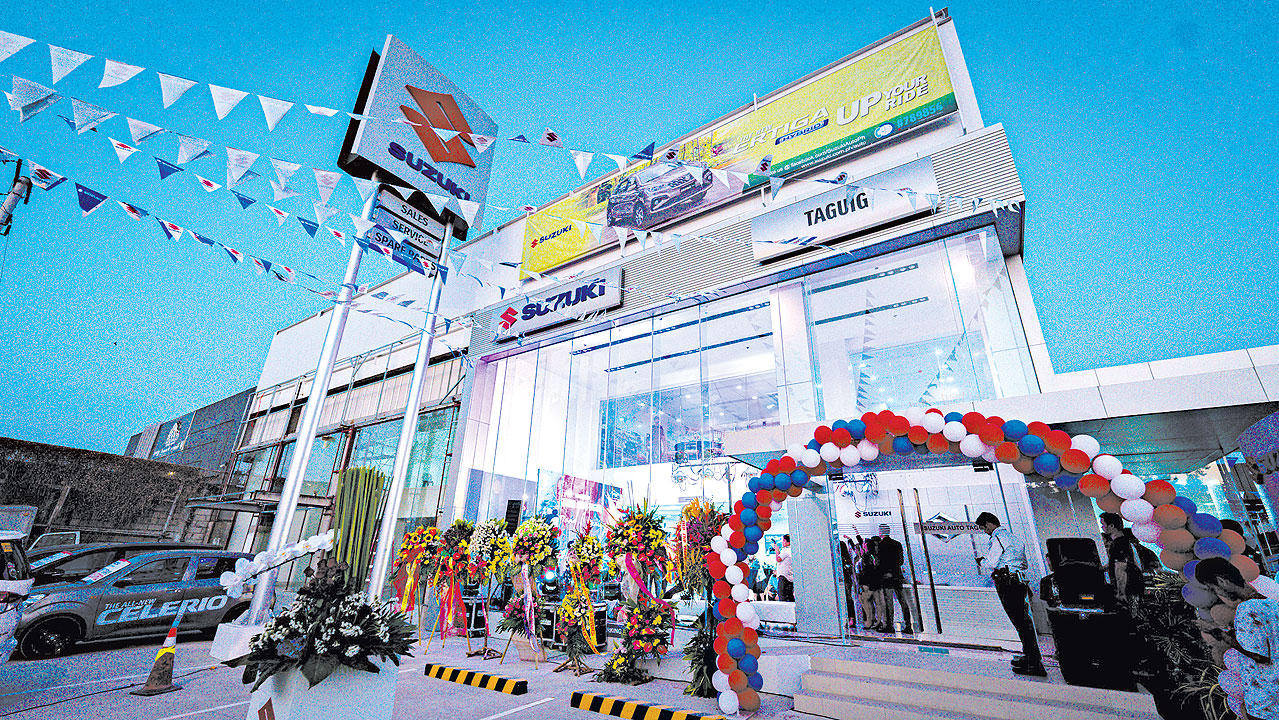
THE FOOTPRINT of Suzuki Philippines, Inc. (SPH) continues to grow as it recently opened its 72nd dealership. Suzuki Auto Taguig — located at 1050D Levi B. Mariano Avenue in Barangay Ususan — rises on a 1,130-sq.m. lot and is operated by the Autohub Group.

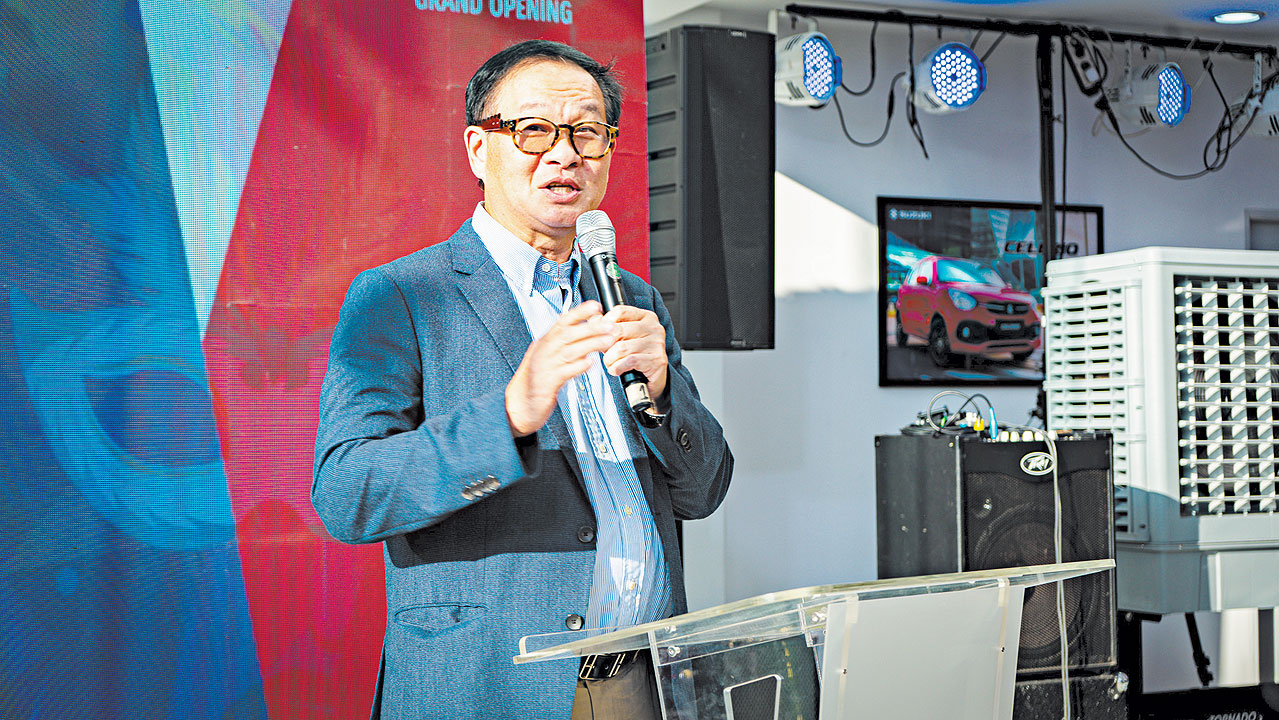
In an interview with “Velocity,” Autohub Group President Willy Tee Ten said that the showroom can accommodate up to three display units, and six cars may be worked on simultaneously in the service area, which has four lifters. “The whole property we’ve leased here is 5,000 sq.m.,” he said. “And this represents just a portion of that.”

As for the choice of location, Mr. Tee Ten averred, “First, if you look at the area, you’ll see a lot of residential villages. It’s already a big township.” Still, he admitted it’s “a big risk” because there are no other dealerships in the locale.

“But it’s near Taytay and South Luzon Expressway. The people here are well to do, so while there’s a risk, we can say we have a captured market,” the executive explained. “We’re looking at the potential. I believe the Suzuki brand can do well in this area… more so in the next few years, as roads being constructed now going to the different parts of Rizal, so I think the potential is really good.”

A 3S (sales, service, and spare parts) facility, Suzuki Auto Taguig will have, for now, the benefit of a satellite dealership at the Bonifacio Global City, which was opened in 2021. “We are keeping that until the lease ends,” Mr. Tee Ten said to this writer. “I don’t know if we can or we will renew it. It depends on the cost of the lease. The good news is that we have a permanent facility here in Taguig; that (BGC location) will be out satellite showroom. We hope we can keep extending the lease… right now we’re safe for three or four years.”

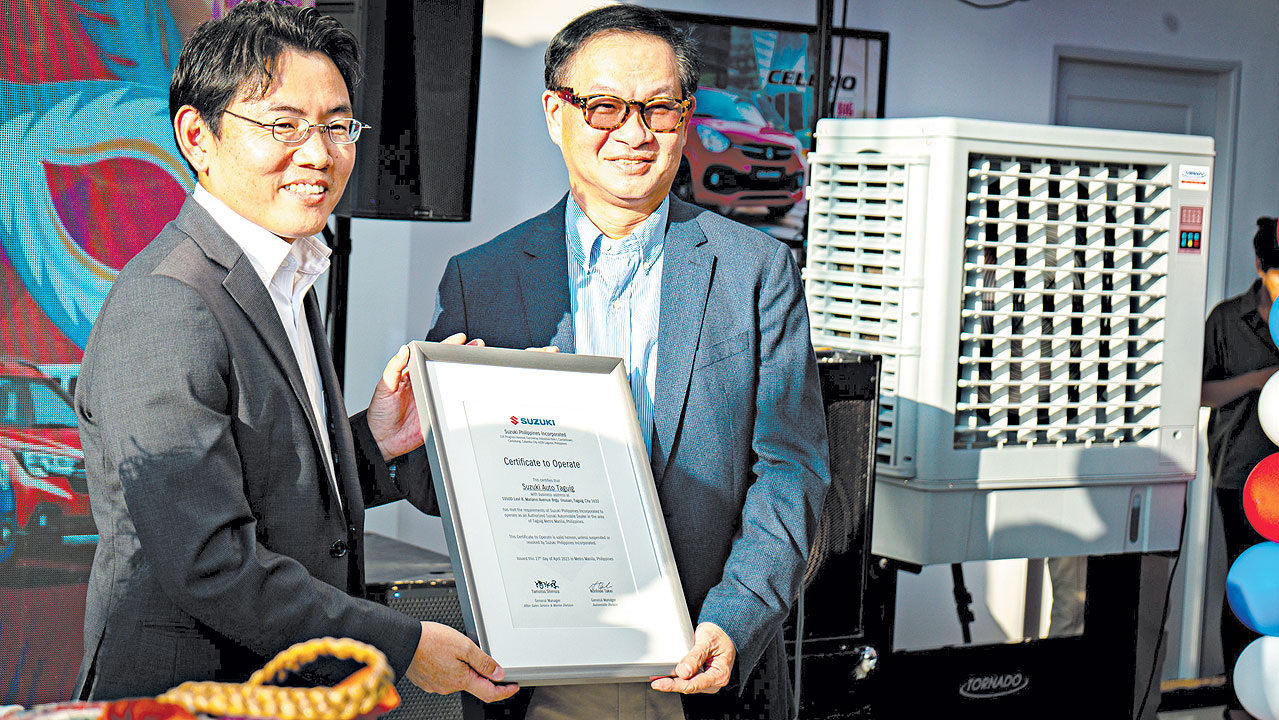
Meanwhile, SPH Director and General Manager for Automobile Norihide Takei declared, “Suzuki Auto Taguig is a very welcome and much awaited addition to our current expansion program this year. Not only does it give us another location to showcase our cars and after-sales services, the dealership (gives) us better access and a formidable presence in the second-most important business district in Metro Manila.”

Suzuki Auto Taguig is open from 8:30 a.m. to 6 p.m. during weekdays and from 9 a.m. to 6 p.m. on weekends. Customers may contact 0917-815-0762 or suzukiautotaguig@autohubgroup.com.

For more information, visit http://suzuki.com.ph/auto or the company’s Facebook account (SuzukiAutoPH) and Twitter account (suzukiautoph).

Four next-gen fashion innovators

REPAMANA by Darius Jireh Juson

FROM commentaries on toxic work culture and a sustainable industry, all the way to escapism and biomimicry, the messages from the newest fashion innovators are echoed when they continue to push the boundaries of a burgeoning young fashion scene through their thought-provoking debut collections.

These four emerging talents, the latest graduates of the Fashion Design and Merchandising (FDM) students of the De La Salle-College of Saint Benilde, aim to make a mark in the field.

John Andrei Sumpayco breaks the limits of tailored wear in his collection “Chaos Equilibrium.” Examining the Japanese concept of karoshi or death from overwork, his menswear series embodies the intense work culture in Japan, as it seeks to create a balance between formality, deprivation and leisure.

His distorted and distressed twist on the traditional suit displays meticulous craftsmanship achieved through classic embroidery, to fabric painting and coffee dyeing, to even more unorthodox touches such as slash and spread plus cigarette burning.

Darius Jireh Juson makes a step towards a more sustainable industry in his collection REPAMANA. A call for circular economy, his anti-fast fashion womenswear line has a strong focus on functionality, versatility, and longevity.

It features upcycled modular garments that can be restyled and reused in multiple ways, all of which are made from discarded textiles — cotton, silk, and denim — accentuated with natural plant-derived dyes and found objects.

Ma. Angelica Alegre encapsulates the eye-catching charm of butterflies in Mariposa. A study on biomorphism and biomimicry, her RTW pieces mirror the intricate patterns, structure, and coloration of the beautiful insects.

The bold swatches and textures, highlighted with lenticular effects and Arashi Shibori pleats, invite wearers and viewers alike to reconnect with the wonders of nature.

Fredric Isaac Leysa explores fashion as escapism in Nocturne. A seamless marriage of pleats and prints, this posh eveningwear collection was created as a journey into the polarities of dreams and nightmares, to embrace the beauty of the surreal and the macabre as sources of solace.

Each piece is an exhibition of diverse compositions and detailed construction achieved through the quintessential chevron pleating technique.

EU approves $1.61 billion for Dutch government to buy out farmers, cut nitrogen pollution

REUTERS

AMSTERDAM — The European Commission said it approved two Dutch plans worth a combined 1.47 billion euros ($1.61 billion) to buy out livestock farmers to reduce nitrogen pollution, saying they are permissible under state aid rules.

The Dutch need to reduce excess nitrogen levels, caused in part by decades of intensive farming, a problem that has led to courts blocking important construction projects until the issue is resolved.

Discontent over government plans to address the problem until now date led to a major defeat for Prime Minister Mark Rutte’s governing coalition in regional elections in March.

Farm buyouts are seen as an important step toward a comprehensive plan to address the issue.

In the schemes approved by the European Union’s (EU) executive body, the Netherlands reserved the money to compensate farmers who voluntarily close farms located near nature reserves.

The plans will have “positive effects that outweigh any potential distortion of competition and trade in the EU,” the Commission said in a statement approving the aid. — Reuters

Earnings data, long-term deals in Australia lift ACEN’s shares

ACEN Corp.’s shares rose last week, thanks to bullish market sentiment after its first-quarter earnings results and its unit in Australia securing long-term contracts for its solar projects.

Data from the Philippine Stock Exchange showed a total of 78.37-million shares worth P473.43 million being traded from May 2 to 5. Local financial markets were closed on May 1 in observance of the Labor Day holiday.

Shares in the Ayala-led renewable energy platform increased by 2.7% week on week, finishing at P6.17 apiece on Friday from their P6.01 closing on April 28. The rise is a welcome development as the stock has fallen by 19% since the beginning of the year.

“The company’s disclosure on securing long-term service agreements for two of its solar projects in Australia plus the net consolidated income reaching 5x year-on-year growth as of first quarter of 2023 has made it one of the most active stocks this week,” Diversified Securities, Inc. Equity Trader Aniceto K. Pangan said in a Viber message.

“As of now, we can expect growth to be sustained with the commissioning of its new power plants. As newly commissioned plants are to be added to their current capacity, we may expect growth to continue but still await its stable operation,” added Mr. Pangan.

As analysts await the stability of ACEN’s newly commissioned power plants, revenue estimates were not provided, Mr. Pangan said.

Mercantile Securities Corp. Head Trader Jeff Radley C. See said ACEN’s overall market sentiment “has been bullish since it has been growing its portfolio of energy companies.”

“The stock is trading near the low end of the range coming from a high of P8.30 from the start of 2023,” he said in a Viber message.

The company reported an attributable net income of P2.44 billion in the first quarter, more than threefold the increase from P752.45 million in the same period last year, driven by higher net generation on better wind resources.

In the same period, ACEN also recorded a 23.5% increase in its consolidated revenues to P9.14 billion from P7.40 billion amid brisk electricity sales.

In a stock exchange disclosure, ACEN said its unit in Australia had secured 20-year service contracts for its solar projects at a price that protects it from low wholesale electricity prices.

The energy service agreements are for ACEN Australia’s 720-megawatt (or 936-MW direct current [MWdc]) New England solar project and 400-MW (520 MWdc) Stubbo solar project. The contracts were secured through the New South Wales (NSW) government trustee’s inaugural tender for renewable generation and long-duration storage.

The New England and Stubbo solar projects can supply power to about 435,000 households once fully operational, helping the NSW government in reaching its target of a 50% remissions reduction by 2030.

The listed energy platform of the Ayala group has about 4,200 MW of attributable capacity spread across the Philippines, Vietnam, Indonesia, India, and Australia. The firm said that its renewable share of capacity stood at 98%, among the highest in the region.

ACEN eyes to be the largest listed renewables platform in Southeast Asia, aiming to achieve 20 gigawatts in attributable renewable energy capacity by 2030. The company is also committed to the transition of its generation portfolio to 100% renewable energy by 2025 and to become a net zero greenhouse gas emissions company by 2050.

Mr. Pangan pegged the company’s major stock support this week at P5.80 per share while its initial major resistance at P6.55 per share.

Mr. Pangan pegged the company’s major stock support at P5.80 per share while an initial major resistance at P 6.55 per share.

“We can expect investors’ interest on the company going through this week,” he said.

Mr. See said investors are buying the stock “as the selling pressure is slowly subsiding.” He placed the stock support level at P5.88 per share, while resistance levels are P6.50 and P7.00 per share. — Lourdes O. Pilar

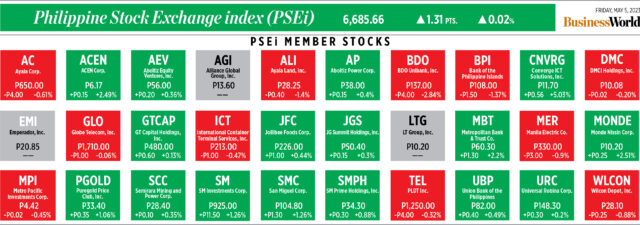
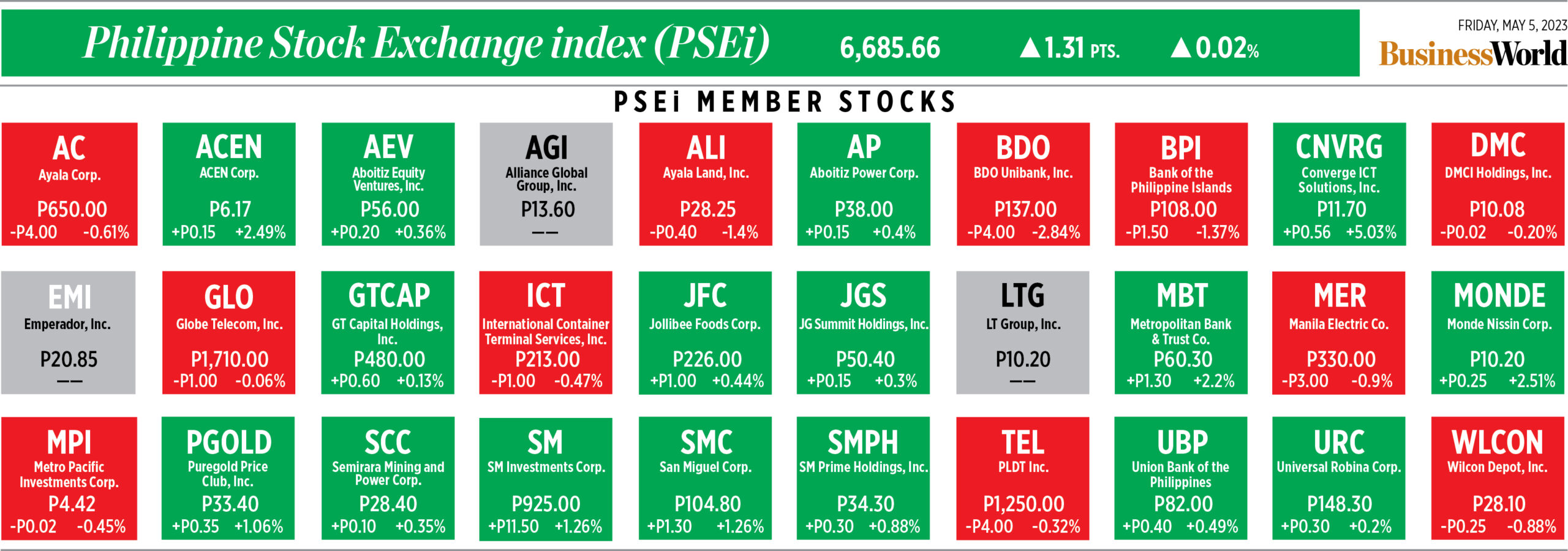
How PSEi member stocks performed — May 5, 2023

Here’s a quick glance at how PSEi stocks fared on Friday, May 5, 2023.


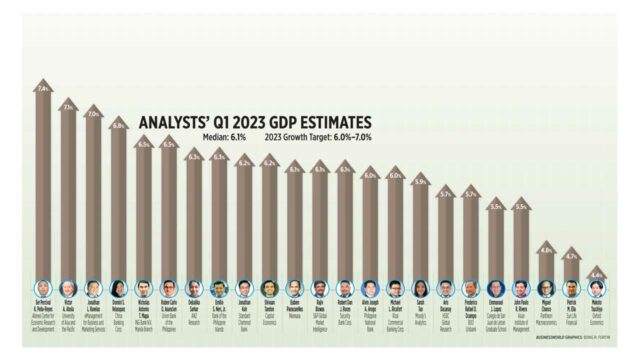
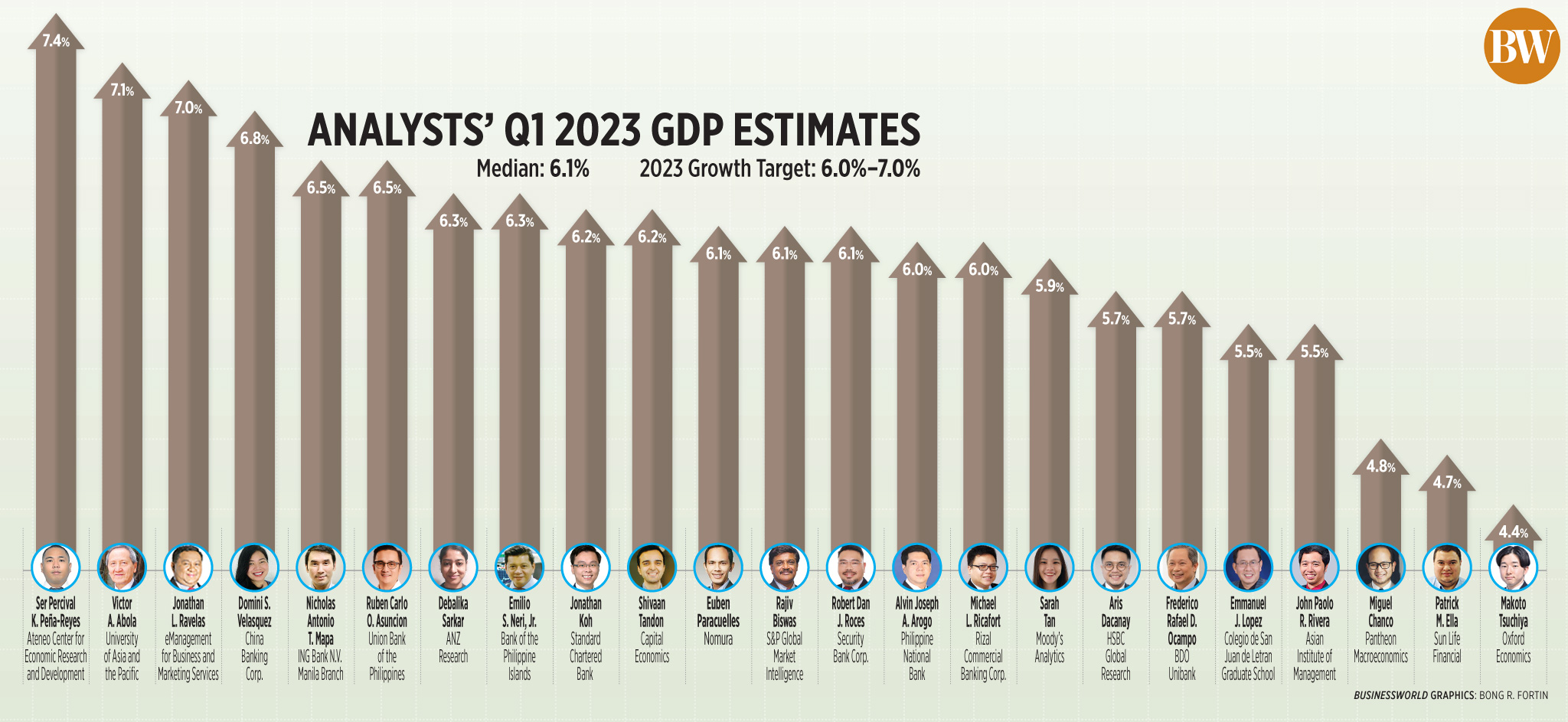
Analysts’ Q1 2023 GDP estimates

PHILIPPINE annual economic growth likely slowed in the first quarter, as elevated inflation and higher interest rates may have dampened consumer spending. Read the full story.

Analysts’ Q1 2023 GDP estimates

Peso likely to trade sideways ahead of 1st quarter GDP report

BW FILE PHOTO

THE PESO is expected to trade sideways against the dollar this week after headline inflation eased in April, and ahead of the release of key economic data at home and in the United States.

The local currency closed at P55.30 versus the dollar on Friday, rising by five centavos from Thursday’s P55.35 finish, data from the Bankers Association of the Philippines’ website showed.

Week on week, the peso strengthened by eight centavos from its P55.38 finish on April 28.

The peso opened Friday’s session at P55.38 per dollar versus the dollar. Its worst showing was at P55.42, while its intraday best was at P55.16 versus the greenback.

Dollars traded went down to $1.29 billion on Friday from the $1.37 billion seen on Thursday.

The peso appreciated against the dollar on Friday amid bets of a pause in the Bangko Sentral ng Pilipinas’ (BSP) rate hike cycle after headline inflation slowed in April, Rizal Commercial Banking Corp. Chief Economist Michael L. Ricafort said in a Viber message.

“The better peso performance can be attributed to the better-than-expected CPI (consumer price index) print. Although, the gains of the peso were tempered by the possibility of a rate pause,” a trader likewise said in a Viber message.

Consumer prices rose by an annual 6.6% in April, slowing from 7.6% in March but faster than 4.9% in the same month last year, preliminary data from the Philippine Statistics Authority (PSA) released on Friday showed.

The April headline print was the slowest in eight months or since the 6.3% in August 2022 and was within the BSP’s 6.3-7.1% estimate for the month.

Still, this was the 13th straight month that inflation breached the central bank’s 2-4% target for the year.

For the first four months, inflation averaged 7.9%, higher than 3.7% seen a year ago and above the BSP’s 6% forecast for 2023.

BSP Governor Felipe M. Medalla last month said the Monetary Board will likely look at pausing its tightening cycle at its May 18 review if inflation slowed further in April.

For this week, the trader said the peso could move sideways against the dollar following the slower inflation print and as investors anticipate the release of first-quarter Philippine gross domestic product (GDP) data and US economic reports.

The peso could be affected by April US CPI data to be released on May 10 and the April US producer price index report on May 11, as well as latest jobless claims data, Mr. Ricafort added.

The PSA will release first-quarter Philippine GDP data on May 11.

Economic growth likely eased in the first three months of the year as the boost from pent-up demand following the coronavirus pandemic continues to fade and amid elevated inflation that has resulted in higher interest rates, analysts said.

A BusinessWorld poll of 23 economists conducted last week yielded a median estimate of 6.1% for first-quarter GDP growth.

If realized, this would be slower than revised 7.1% growth in the fourth quarter of 2022, and the 8% expansion recorded in the same period last year.

The government targets 6-7% GDP growth for this year. The economy expanded by 7.6% in 2022.

For this week, the trader sees the peso moving between P55 and P56 per dollar, while Mr. Ricafort expects it to trade from P55 to P55.50. — AMCS

ADVERTISEMENT
ADVERTISEMENT