Home Blog Page 4878

Where to next? An exciting adventure into the world of work awaits with vivo V27 Series

The next generation of young blood will soon enter the workforce, with some schools already holding graduation rites this month. College and senior high school graduates are asking themselves existential questions like what to do next with their lives. But they wouldn’t be alone: Many in the workforce are also thinking about the career path to pursue.

As with any new experience, navigating the world of work is equally thrilling and scary, humbling and enlightening. To make the most out of this journey, you will need a reliable partner that can always bring out the best in you, like the latest smartphone from vivo, the vivo V27  Series. Boasting the innovative Aura Portrait Algorithm with Sony IMX 766V – a customized camera sensor for vivo, and a flagship performance frontlined by its 12GB RAM that can run up to 30 apps smoothly, learn more how this premium device can guide you towards your next big step ahead.

Highlight the me in resume

Your resume, from the content to the overall look, is a reflection of yourself. As a general rule, it’s best to keep it clean and straightforward while also reflective of your personality or character. If you’re a fresh grad, highlight academic performance and extra-curricular activities such as seminars, leadership conferences, trainings and accomplishments. But maybe there’s no need to include awards won from fourth grade.

If you already have previous work experience, highlight work accomplishments, skills developed and trainings completed. Feel free to get a tad personal and mention your interests as long as they are related to the job or will not make you look bad in the end. One thing to remember: You want the employer to know your qualifications, not your life history so 10 pages of resume will not cut it.

Take a lesson from the vivo V27 Series about the minimalist approach. From its camera layout, color to overall build, vivo knows when to show more by doing less. With their slim and lightweight frame at 7.36mm for vivo V27 5G variant and 7.7mm for its vivo V27e variant, the vivo V27 Series is built to go with you anywhere you go but is sturdy enough for all your needs. The uncomplicated and straightforward camera layout is a testament to vivo’s commitment to balancing functionality and beauty as inspired by the Bauhaus design philosophy. Of course, with the Photochromic 2.0 technology that changes your phone case’s color when placed under the sun, you really don’t need to complicate the design as that color-changing technology is impressive enough!

Go hard on your soft skills

Any reasonable recruiter or employer will not expect an extensive body of work from a fresh grad, so don’t get stressed out if you cannot present an impressive portfolio just yet. Instead, highlight your school accomplishments and other skills. Communication, problem solving, adaptability and teamwork may not be as quantifiable as good grades, but they are just as, if not more, important in a professional setting. Cite examples of when you took the initiative to lead an important group project or event. Tell stories of how you showed integrity or perseverance during your internship and paint a picture of how your experiences can be of use to the company you’re applying to.

The same goes for applicants moving from one job to the next. Highlight the soft skills.

Overall, reliability is what people are looking for. Just like with the vivo V27 Series. With its 12GB+8GB Extended RAM and 256GB ROM, you can take your organization skills notches higher. Manage and maintain your work files with ease with bigger storage space. Tick off everything on your to-do lists with its all-day battery with 66W FastCharge technology that powers up the phone to 50 percent in just 19 minutes.

Work has gone digital and so should you

These days, there is no job that doesn’t require some form of digital skill. Supplement your soft skills with more digital capabilities. Start looking for free digital courses. Most courses have flexible schedule and will let you manage your own time, including assignments and projects.

After a series of interviews and aptitude tests, you finally bagged that first job. If your work involves handling content or you simply want to capture moments in your new world, the vivo V27 Series packs powerful cameras that go beyond megapixel sizes. Powered by the innovative Aura Portrait     Algorithm, this smartphone is every new employee’s partner in taking cinematic and picturesque videos and pictures, perfect not only for documenting your journey but also for impressing colleagues with your IG reels and Facebook stories.

With the vivo V27 Series, you can produce a vlog with ease with the phone’s detailed on-screen instructions with tips and handy editing tools – and that’s from daytime ‘til dark! Its EIS+OIS Dual Ultra Stabilization feature and Sony IMX 766V sensor make every photo and video balanced, centered and stable each time.

As you start the next chapter of your life, you will realize that the road to success is not a straight and smooth road but one with difficulties and challenges as well as triumphs and small wins. As you answer the question “Where to next?,” you’d realize The simple yet difficult at times answer is this: Forward. Always forward.

Start your work journey with ease with the vivo V27 Series. Get this powerful smartphone on vivo’s official websiteShopeeLazada and TikTok shops.


Spotlight is BusinessWorld’s sponsored section that allows advertisers to amplify their brand and connect with BusinessWorld’s audience by enabling them to publish their stories directly on the BusinessWorld Web site. For more information, send an email to online@bworldonline.com.

Join us on Viber at https://bit.ly/3hv6bLA to get more updates and subscribe to BusinessWorld’s titles and get exclusive content through www.bworld-x.com.

Agriculture posts surprise Q1 growth

A man arranges fish on a drying bed in Noveleta, Cavite. — PHILIPPINE STAR/EDD GUMBAN

PHILIPPINE AGRICULTURAL production posted a surprise 2.1%  growth in the first quarter, the Philippine Statistics Authority (PSA) said on Wednesday.

Data from the PSA showed the value of production in agriculture and fisheries at constant 2018 prices expanded by an annual 2.1% to P428.69 billion in the January-to-March period.

This was a turnaround from the 0.3% decline in the first quarter of 2022 and the 1% contraction in the fourth quarter of 2022.

Performance of Philippine Agriculture“This was due to the annual increases in the value of production of crops, livestock, poultry, and fisheries,” the PSA said.

Analysts earlier said they expected flat agricultural output for the first three months of 2023.

At current prices, the value of production in agriculture and fisheries rose by 14.1% to P569.94 billion in the first quarter, faster than the 2.2% in the same period a year ago and 9.3% in the fourth quarter of 2022.

Agriculture usually contributes around a tenth to the Philippines’ overall gross domestic product (GDP). The PSA is scheduled to release first-quarter GDP data this morning (May 11).

Raul Q. Montemayor, national manager of the Federation of Free Farmers, said farm output growth was coming from a “very low base” in the first quarter of 2022.

“Compared to the low output in the first quarter of 2022, it appears that there was a significant growth in the first quarter of 2023. But in fact, we just got back to approximately 2021 output levels for crops,” he said in a Viber message.

Mr. Montemayor noted that natural calamities, animal diseases, and “pro-import policy of the government” have hurt farmgate prices, and discouraged farmers from expanding production.

Crops, which made up 57.8% of the total farm output, expanded by 1.7%, reversing the 1.7% decline in the same quarter last year, and the 1% dip in the fourth quarter.

Growth in crops production was mainly due to the 5.2% increase in paddy rice (palay), and 3.2% jump in corn.

“First and second-quarter rice production will be good enough to last us until the next harvest during the wet season which is around August and September,” said Danilo V. Fausto, president of the Philippine Chamber of Agriculture and Food, Inc.

Despite palay output growth, Mr. Fausto noted that additional imports may be needed for any shortage caused by the upcoming El Niño and other natural calamities.

PSA data showed an increase in output for tobacco (14.4%), onion (6.4%), cassava (5.2%), cabbage (5.2%), abaca (3.2%), tomato (3%), mango (2%), coconut (1.6%), coffee (1.3%), among others.

However, there was a decline in the output of several crops such as sugarcane (-17%), sweet potato (-7.5%), rubber (-5.3%), and potato (-4.4%).

United Sugar Producers Federation President Manuel R. Lamata attributed the drop in sugarcane production to the impact of climate change, as well as high prices of fertilizer, fuel and labor.

At current prices, the value of crop production increased 14% to P306.5 billion in the first quarter.

LIVESTOCK, POULTRY
Livestock production, which made up 14.4% of total farm output, increased by 4.1% in the first quarter. This was an improvement from the 1% contraction in the first three months of 2022, and the 2.5% growth in the previous quarter.

Hog and cattle production expanded by 5.1% and 1.9%, respectively. However, lower output was seen for dairy (-11.4%), goat (-3.6%), and carabao (-1.2%).

At current prices, the value of livestock production rose 3.2% to P92.86 billion in the first quarter.

Meanwhile, poultry output, which accounts for 15.1% of total agriculture production, grew by 3.2% in the first quarter. This is slower than the 12.3% growth in the same period in 2022, but faster than the 2.5% increase in the fourth quarter.

PSA data showed higher production of duck eggs (3.8%), chicken (3.3%), and chicken eggs (2.8%). In contrast, duck production fell 0.3%.

At current prices, the value of poultry production jumped by 18.3% to P88.9 billion in the first quarter.

“The two largest subsectors (chicken and hogs) are slowly recovering, so you can see a steady growth in the volume of production from 2021,” Mr. Montemayor said.

However, he noted hogs output may have not fully recovered from the African Swine Fever outbreak, while the poultry sector is still recovering from avian influenza.

“Imports are discouraging many producers from expanding and investing. This includes smuggling, misdeclaration and undervaluation of imports,” Mr. Montemayor added.

At the same time, fisheries output inched up 0.3% in the first quarter, from the 5.8% decline in the same period in 2022 and the 6.7% drop in the previous quarter.

A double-digit rise in production was seen for squid (18.2%), tilapia (10.8%) and blue crab or alimasag (10.5%), while higher output was recorded for milkfish or bangus (6.6%), big-eyed scad or matangbaka (5.9%), yellowfin tuna or tambakol (5%), and grouper or lapu-lapu (4.1%).

Double-digit declines were registered in mudcrab or alimango (-37.6%), bigeye tuna or tambakol (-35%), frigate tuna or tulingan (-29%), slipmouth or sapsap (-24.8%), tiger prawn (-24.2%), and threadfin bream or bisugo (-23%).

At current prices, the value of fisheries output increased 25.1% to P81.68 billion in the first quarter.

Asis G. Perez, former director of the Bureau of Fisheries and Aquatic Resources and convenor of Tugon Kabuhayan, said the output for tilapia and milkfish increased since there was low production in the same period last year.

“Some ingredients like processed animal protein (PAP) were not available to us so from the first quarter of 2022 to the fourth quarter, we were negative. Now we’re just returning or trying to get back to the previous number, but we’re not yet there especially for bangus,” Mr. Perez said.

He expects the fisheries sector to continue to recover this year, with the arrival of PAP which is an animal by-product used as a raw material for fish feed.

“We are confident for we have the feed ingredients and then the situation will be better and most likely continue to return from our previous fisheries performance,” Mr. Perez said.

Last December, the DA lifted the ban on imports of PAP from Italy, which accounts for 60-70% of the country’s annual PAP imports of 300,000 metric tons.

The Department of Agriculture (DA) is targeting 2.5% farm output growth this year. — Sheldeen Joy Talavera

February FDI inflows highest in 14 months

US dollar banknotes are seen in this photo illustration taken Feb. 12, 2018. — REUTERS

By Keisha B. Ta-asan, Reporter

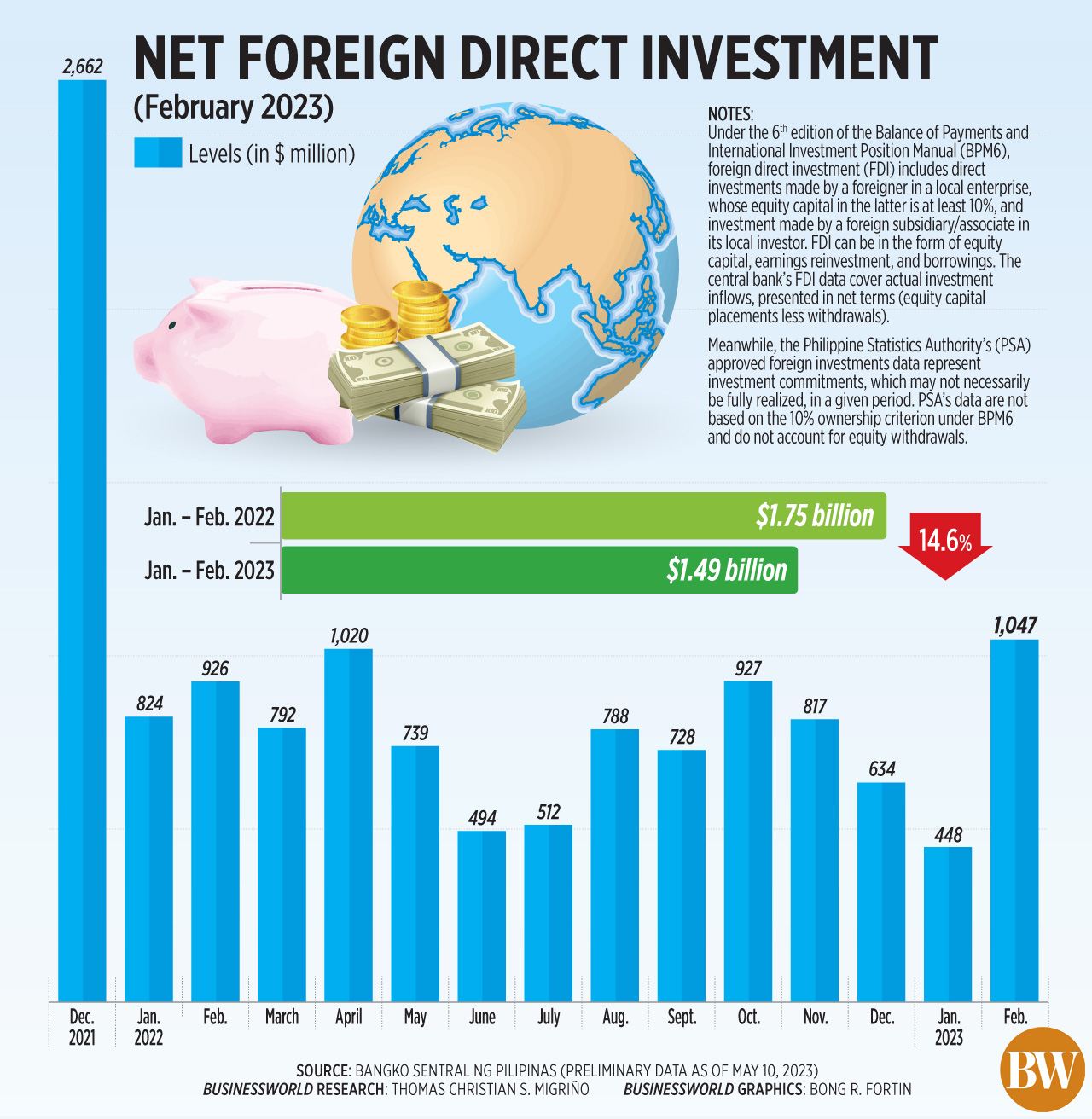
FOREIGN DIRECT INVESTMENT (FDI) net inflows rose by 13% in February to its highest level in 14 months, amid improving investor sentiment towards the Philippines.

Data released by the Bangko Sentral ng Pilipinas (BSP) on Wednesday showed that FDI net inflows climbed to $1.05 billion in February from $926 million in the same month in 2022.

Net inflows of FDIs in February was more than double the $448-million inflows seen in January.

Net foreign direct investment

This was also the highest level in 14 months, or since the $2.66-billion net inflows in December 2021.

“FDI is up on improved sentiment with [the Philippines’] potential for growth, as well as the efforts of the economic managers to attract these,” Security Bank Corp. Chief Economist Robert Dan J. Roces said in a Viber message.

Since the start of the year, President Ferdinand R. Marcos, Jr. has made several trips to Japan, Switzerland (for the World Economic Forum), China and most recently, the United States as part of efforts to woo investors.

Around $13 billion worth of investment commitments were made during the Japan visit in February, according to officials.

The BSP attributed the year-on-year increase in FDI to the higher non-residents’ net investments in debt instruments, which offset the drop in net equity capital placements and reinvestment of earnings.

BSP data showed non-residents’ net investments in debt instruments of local affiliates jumped by 19.4% to $910 million in February, from $762 million a year ago.

On the other hand, investments in equity and investment fund shares declined by 16.7% in February to $136 million from $164 million in the same month in 2022.

Non-residents’ net investments in equity capital (other than reinvestment of earnings) dropped by 23.6% to $74 million in February from $97 million a year ago. Equity capital withdrawals surged by 101% to $38 million, while placements slid by 3.1% to $113 million.

“The jump in February [FDIs] can be traced largely to an increase in debt instruments and to a lesser extent, fresh equity placements,” ING Bank N.V. Manila Senior Economist Nicholas Antonio T. Mapa said in an e-mail.

The equity placements were mainly from Japan, the United States, and the Cayman Islands. These were invested mostly in manufacturing, real estate, electricity, gas steam and air-conditioning supply, and financial and insurance industries.

Reinvestment of earnings also slipped by 6.5% to $62 million year on year in February.

DECLINE
Meanwhile, total FDI net inflows declined by 14.6% to $1.49 billion in the January-to-February period, from the $1.75-billion net inflows in the same period last year.

Investments in equity capital other than reinvestment of earnings slumped by 18.1% to $167 million in the first two months. Placements rose by 11.7% to $261 million, while withdrawals surged by 215% to $94 million.

Reinvestment of earnings dipped by 1% to $137 million in the two-month period.

Also, investments in debt instruments dropped by 15.4% to $1.19 billion in the January-to-February period.

BSP Governor Felipe M. Medalla said there is strong interest for the Philippines from foreign investors.

“[But] whether when it will be actually translated to actual foreign direct investments will depend on many things,” he said in an interview with The Banker on the sidelines of the Asian Development Bank (ADB) annual meetings in Seoul, South Korea.

Still, Mr. Medalla said there is optimism that the current administration’s policies and recent economic reforms will help attract more foreign investments.

“More and improved diplomatic relations recently, especially with developed countries that are the biggest sources of foreign investments, would help improve the FDI data in the coming months,” Rizal Commercial Banking Corp. Chief Economist Michael L. Ricafort

For ING’s Mr. Mapa, still-robust economic growth could help attract more FDIs into the country.

“The influx of foreign currency could provide an additional source of foreign exchange as well as work to fund productive ventures in the country, hopefully leading to job creation,” he said.

Gov’t seeks $500-million climate risk loan from WB

RESIDENTS are seen fleeing their homes due to floods, Oct. 23, 2020. The Philippines is one of the most disaster-prone countries in the world. — PHILIPPINE STAR/ MICHAEL VARCAS

THE PHILIPPINE GOVERNMENT is eyeing a $500-million loan from the World Bank (WB) to strengthen its resilience against climate-related disasters.

The Philippines Disaster Risk Management and Climate Development policy loan, which includes an option for a catastrophe deferred drawdown, is expected to be approved by the World Bank board on Sept. 21.

In a document uploaded on its website, the World Bank said the loan aims to strengthen the capacity of the Philippine government in managing disaster and climate risks in the education and health sectors.

The Philippines ranked first globally for having the highest disaster risks, according to the World Risk Index 2022.

Disasters have killed over 10,000 people, affected around 103 million, and caused as much as P409 million in economic losses for the Philippines between 2010 and 2019, the multilateral lender said.

The World Bank said the policy loan focuses specifically on the education and health sectors due to “their high exposure and vulnerability to disasters, climate change, and public health emergencies, and their essential role in human capital accumulation, economic growth, and poverty reduction.”

The loan will fund projects aimed at improving the resilience of school infrastructure, protect learners against natural hazards, enhance emergency preparedness, and promote learning continuity.

One of the targets is to implement disaster and climate contingency plans for 80% of schools in the Greater Manila Area.

It also aims to build disaster and climate-resilient school infrastructure, noting that around 21,018 schools were destroyed by disasters over the last six years.

The World Bank said the loan will also fund projects strengthening health-related infrastructure.

“The target is the development of a multi-year investment plan by the Health department that integrates disaster, climate, and public health emergency resilience measures in the health facilities with the annual budget submitted to the Department of Budget and Management for endorsement to Congress (2024 to 2026),” it said.

It also seeks to create a more streamlined reporting mechanism for National Government agencies and local government units, with event-based reporting and response initiation reduced from seven days to two days.

“These reforms are vital in ensuring that the country is able to maintain continuity in critical sectors,” it added.

The World Bank was the country’s third-largest source of official development assistance (ODA) as of 2021. World Bank loans and grants represented 24% of total ODA or $7.66 billion, data from the National Economic and Development Authority showed.

This year, the National Government expects to obtain around $19.1 billion worth of ODA — $9.2 billion worth of loans from multilateral development partners and  $9.8 billion in loans from bilateral lenders. — Luisa Maria Jacinta C. Jocson

PHL may find it difficult to return to pre-pandemic growth momentum

PHILIPPINE STAR/EDD GUMBAN
Economic managers are targeting 6-7% gross domestic product (GDP) growth this year. — PHILIPPINE STAR/EDD GUMBAN

THE PHILIPPINES may find it difficult to return to its pre-pandemic growth momentum despite signs of recovery, according to the central bank chief.

Bangko Sentral ng Pilipinas (BSP) Governor Felipe M. Medalla said the Philippines had a strong recovery last year but still this was lower than what could have been if the pandemic did not happen.

“Our growth prospects are good. The negative side of it; our economy is significantly lower from what could have been if there had been no pandemic. It will take a long time before we are able to recover,” he said in an interview with The Banker. A video of the interview was uploaded on The Banker’s website.

The Philippine Statistics Authority (PSA) is set to release its first-quarter gross domestic product (GDP) data today (May 11).

A BusinessWorld poll of 23 economists conducted last week yielded a median GDP estimate of 6.1% for the first three months of the year.

If realized, this would be slower than the revised 7.1% growth in the previous quarter, and the 8% growth in the first quarter of 2022.

Last year, the economy grew by 7.6%.

“We are able to recover the output levels, but it’s very hard to recover the old growth path. The new growth path will be higher than 2019 but lower than what could have been,” Mr. Medalla said.

The economy contracted to 9.5% in 2020, reflecting the impact of the pandemic. Philippine GDP grew by 6.1% in 2019.

Mr. Medalla also said inflation was a lot harder to address than he initially thought, adding that above-target inflation could last for up to 18-19 straight months.

April marked the 13th straight month that inflation breached the central bank’s 2-4% target range.

Headline inflation rose by an annual 6.6% in April, from 7.6% in March. It was the slowest in eight months or since the 6.3% print in August 2022.

The BSP has been aggressively tightening monetary policy, raising 425 basis points (bps) since May last year to 6.25%. Since then, supply shocks are beginning to wane and inflation is expected to be below 4% by the end of the year.

“Despite that, the economy remains strong and the increase in policy rate has not caused negative effects in financial stability. In other words, we are able to use our interest rate policy to totally address inflation,” Mr. Medalla said.

The BSP currently sees full-year inflation at 6% for 2023, before easing to 2.9% in 2024.

Meanwhile, Mr. Medalla noted the next policy move of the US Federal Reserve is another factor to consider when the BSP decides to cut rates.

“Despite the fact that our inflation is falling faster than the US, we may be more reluctant to cut [policy rates] because cutting may result in significant peso depreciation,” he said.

Mr. Medalla said the country has “more than adequate” dollar reserves that could help mitigate the volatility in the foreign exchange market.

When US Federal Reserve delivered four 75-bp hikes in a row last year, the peso slumped to a record-low of P59 against the dollar in October 2022. This “forced” the BSP to sell about 8% of the country’s dollar reserves, he said.

BSP data showed the country’s gross international reserves (GIR) fell to $93 billion in September last year. The BSP was able to replenish the dollar reserves this year as it stood at $101.51 billion as of end-April.

“Right now, unless there are large changes in US interest rates, I think we’re all right. Listening to what the Fed is saying, they will no longer have large changes in the policy rate and in fact they may pause after the last increase of 25 (bps),” Mr. Medalla said.

The US Federal Reserve delivered a 25-bp rate hike at its policy meeting last week. It has now raised borrowing costs by 500 bps since March last year, bringing the Fed fund rate to 5-5.25%. — Keisha B. Ta-asan

Sy conglomerate reports 33% profit rise to P17B 

SM INVESTMENTS Corp. (SMIC) posted a consolidated net income of P17.3 billion in the first quarter, up 33.1% from a year ago, as the Sy-led conglomerate recorded double-digit revenue growth.

“This year has started well, continuing the strong momentum of 2022. We are well-positioned for continued growth and prepared for any macroeconomic uncertainties. Meanwhile, the whole group is pushing ahead with regional expansion plans to serve more Filipinos,” SM Investments President and Chief Executive Officer Frederic C. DyBuncio said in a statement.

SMIC’s consolidated revenues for the quarter increased by 21% to P138.2 billion from P113.8 billion in the same period last year. Its banking units BDO Unibank, Inc. and China Banking Corp. accounted for 47% of net earnings, followed by SM Prime Holdings, Inc. at 26%, SM Retail, Inc. at 17% and portfolio investments at 10%.

BDO reported a net income of P16.5 billion, up 41% year on year, driven by solid loan and deposit growth, robust fee-income generation and improved asset quality.

China Bank’s income inched up by 3% to P5 billion due to its robust asset base expansion, strong net interest income and lower credit provisions.

SMIC’s property unit, SM Prime booked a consolidated net income of P9.4 billion, up 27% from P7.4 billion in the previous year. Consolidated revenues went up by 20% to P28.7 billion from P23.9 billion.

Local mall revenues increase by 88% to P15.4 billion from P8.2 billion, while rental income jumped by 72% to P13 billion due to an increase in tenant sales, foot traffic, and full rental fee charging.

Meanwhile, the company’s residential business group, led by SM Development Corp. (SMDC), booked 29% lower revenues to P8.5 billion from P12 billion.

Its sales take-up rose by 15% to P35.8 billion from P31.1 billion, translating into a 23% increase in unit sales to 7,523 for the three-month period from 6,110 the prior year.

SM Prime’s other businesses, which include offices, hotels, and convention centers, recorded total revenues of P3.2 billion, up 59% from P2 billion the prior year.

Meanwhile, SM Retail recorded a 51% rise in net income for the quarter to P 3.9 billion from P2.6 billion the previous year.

Revenues for the period rose by 22% to P91.2 billion from P74.5 billion as consumers’ purchasing power remained stable despite higher inflation.

“Notably, the department store business was strong as improving employment continued to support spending. Food retailing was likewise strong with constant spending on food essentials. Specialty retail growth was also driven by discretionary spending on fashion, accessories and sports items,” SMIC said.

For its portfolio investments, the company said that these continued to contribute to revenues and net income for the first quarter. It did not give exact figures.

SMIC said it expects the portfolio businesses “to make a bigger contribution” to the group’s revenues and earnings over time. Its shares rose 0.86% or P8 to P943 apiece on Wednesday. — Adrian H. Halili

Ayala income up 31% to P10B on units’ strong results

AYALA Corp. booked a 30.9% increase in attributable net income for the first quarter to P10.22 billion from P7.81 billion the previous year as most of its businesses reported higher earnings, the company said on Wednesday.

“One of our priorities is to end 2023 with profits above pre-COVID levels. Given our first quarter results, our constructive outlook for the year remains intact,” Ayala President and Chief Executive Officer Cezar P. Consing said in a statement.

Consolidated revenues for the quarter went up by 19.7% to P78.97 billion from P65.98 billion in the same period last year.

Ayala’s banking business Bank of the Philippine Islands (BPI) reported a 52% increase in net income to P12.1 billion, driven by sustained loan and margin growth, increased fee income, and lower loan loss provisions.

BPI’s total revenues for the quarter rose by 25% to P31.7 billion due to an increase in net interest and noninterest income, which went up by 27% and 19%, respectively.

Ayala Land, Inc. saw a 42% increase in net income for the three-month period to P4.5 billion, while revenues jumped by 26% to P30.9 billion due to higher contributions from all its business lines.

Commercial leasing revenues amounted to P10.1 billion, up 57% on improved mall tenant sales, stable demand for new office spaces, and a boost in hotels and resorts.

Ayala Land’s topline for property development inched up by 8% to P17.1 billion due to higher residential completions, bookings, and the sale of office units.

Its residential sales reservation rose by 15% to P27.7 billion due to resilient demand despite elevated interest rates. It launched three new projects during the January-to-March period amounting to P8.6 billion.

Meanwhile, Globe Telecom, Inc. reported a 47% decline in net income in the first quarter to P7.3 billion due “to a one-time net gain of P8.5 billion on the partial sale of Globe’s data center business in the same period last year.”

Revenues from digital service went up 80% to P1.4 billion due to strong results from its businesses.

Total service revenues, likewise, increased by 2% to P40 billion on the back of growing data and digital service revenue.

Ayala’s power segment, ACEN Corp., booked a net income of P2 billion, five times higher than in the same period last year, due to strong revenue growth.

ACEN’s consolidated revenues gained 23% to P9.1 billion driven by “higher net generation from wind sources and the commissioning of new power plants in the Philippines and Australia.”

Ayala shares rose by 0.76% or P5 to P666.5 apiece on Wednesday. — Adrian H. Halili

Megaworld net income rises 33% on sustained business recovery

MEGAWORLD Corp. on Wednesday reported an attributable net income of P4.1 billion in the first quarter, up 33% from last year, driven by improvements in all its core businesses.

In a stock market disclosure, the listed township developer saw a 24% jump in consolidated revenues to P16.2 billion in the three-month period.

“We start the year strong as we continue sustaining the recovery momentum of our businesses and finally grow past our pre-pandemic performance for the first time since the pandemic began in 2020. This affirms our position in the industry and ability to quickly adapt in this new environment and capture opportunities,” Kevin Andrew L. Tan, Megaworld chief strategy officer said in a statement.

“As we move forward, we are now focused on sustaining our strong growth and look to close the year with a record performance for Megaworld,” Mr. Tan added.

Real estate sales went up by 17% for the quarter to P9.4 billion on the back of higher project completion rates, while residential pre-sales rose 71% to P39.6 billion. The increase was driven by the renewed demand for projects in McKinley West and Uptown Bonifacio in Taguig City.

Leasing revenues saw an 18% growth during the three-month period to P4.4 billion due to the better performance of the mall segment.

Megaworld Premier Offices booked a 5% increase in rental income to P3.1 billion in the first quarter from the P3 billion recorded the previous year on the back of growing tenants from traditional, business process outsourcing, and emerging businesses.

Megaworld Lifestyle Malls, its mall segment, reported 73% higher revenue for the quarter at P1.2 billion due to full rent collection and higher spending.

Meanwhile, Megaworld Hotels & Resorts reached a top line of P813 million as of March, up 62% from last year, driven by the growth of its in-city hotels, meetings, incentives, conferences, and exhibitions or MICE operations, and strong revenues from food and beverage.

Megaworld has 30 master-planned integrated urban townships, integrated lifestyle communities, and lifestyle estates across the country.

At the stock exchanges, its shares rose by 1.01% to P2 apiece. —  Adrian H. Halili

DMCI Holdings income  falls 32% to P7.6B on past year’s high base

DMCI

DMCI Holdings, Inc. reported on Wednesday that its attributable net income fell by 32% in the first quarter to P7.62 billion from P11.26 billion in the previous year’s all-time high result.

The “high base effect” saw its revenues fall by 25% to P33.03 billion from P43.76 billion.

“We anticipate some earnings slowdown this year since we’re coming off a very high base. Our construction and real estate businesses are also still recovering from the impacts of the pandemic,” said DMCI Holdings Chairman and President Isidro A. Consunji in a statement.

“Overall, our results should still be better than our pre-pandemic level. We’re also expecting significant growth in our power businesses and Maynilad [Water Services, Inc.],” he added.

DMCI Holdings attributed the revenue decline to “lower commodity shipments, easing coal prices, reduced construction accomplishments, fewer real estate accounts that qualified for revenue recognition and higher real estate sales cancellations.”

Its top contributor during the three-month period were Semirara Mining and Power Corp., DMCI Project Developers, Inc. (DMCI Homes), and Maynilad. They accounted for 88% of total core income.

Semirara’s net income for the first quarter fell by 40% to P9.03 billion from P15.03 billion as the company reported “all-time high quarterly earnings” during the same period last year.

Its coal segment reported a 51% decline in net income to P6.69 billion from P14.22 billion due to lower revenues and a slower decline in cash costs. Its top line amounted to P15.49 billion, down 40% from P25.72 billion.

Its power segment’s net income more than doubled to P2.09 billion from P774 million. Its revenues increased by 59% to P7.66 billion from P4.81 billion previously.

DMCI Homes booked a 20% decline in net income for the period to P1.16 billion from P1.45 billion from the previous year.

The company’s revenues for the quarter also fell by 18% to P4.85 billion from P5.95 billion due to higher sales cancellations and fewer prior-year sales that qualified for recognition.

Maynilad saw a 55% increase in net income to P2.11 billion from P1.36 billion, driven by better revenues, profit margins and finance income.

Meanwhile, other business units DMCI Mining Corp. and D.M. Consunji, Inc. booked lower net income to P463 million and P263 million, down 15% and 26%, respectively.

DMCI Power Corp.’s core net income contribution for the quarter rose by 2% to P134 million from P132 million. It did not disclose its net income for the first quarter.

“The DMCI Group anticipates mixed results across its portfolio owing to challenging macroeconomic conditions, slowing global growth, and operating headwinds,” the company said.

At the stock exchange, DMCI shares fell by 0.63% or P0.06 to close at P9.46 apiece. — A. H. Halili

Petron’s net income declines 5.6% to P3.4B on rising costs

PETRON Corp. registered a net income of P3.4 billion in the first quarter, down by 5.6% from P3.6 billion last year, due to the oil company’s higher expenses.

In a stock exchange disclosure, Petron recorded consolidated revenues of P188.8 billion, 9.6% higher than the P172.3 billion registered a year earlier, because of sustained fuel demand.

“It’s still a promising start to the new year,” Petron President and Chief Executive Officer Ramon S. Ang said in a statement on Wednesday.

For the January-to-March period, the company’s fuel demand and sold volumes were recorded at 28.6 million barrels, 11.3% higher than the 25.7 million barrels in the same period last year.

Commercial sales went up by 13% due to higher demand from the aviation sector, which pushed jet fuel sales to nearly double from last year.

Petron’s combined retail sales from the Philippines and Malaysia jumped by 12% on increased mobility.

“The consistent rise in fuel demand and better industry conditions, combined with our efficiency and volume-generating measures contributed to our results in the first quarter. Despite external challenges, we remain confident in our ability to navigate the highs and lows of this industry as we work on achieving a full financial recovery this year,” Mr. Ang said.

The company said that despite the 16% decrease in crude prices for the first quarter, it managed to report an operating income of P8.4 billion, fueled by higher sales volume and strong regional refining margins.

Petron said that the increase in financing cost was partly tempered by the mark-to-market valuation of its commodity hedges.

Meanwhile, the company is strengthening its sustainability programs through several projects in the pipeline, including the construction of its coco-methyl ester (CME) plant in its Petron Bataan Refinery Complex.

It is also working on intensifying its efficiency and sustainability programs to reduce its environmental footprint.

“We’ve never been more proactive in our sustainability commitment. As the industry leader, lessening our resource utilization and impacts on the environment are fully integrated into our operations. And these projects not only contribute to this end, but they also make us a more resilient, sustainable, and socially responsible oil company,” Mr. Ang said.

At the local bourse on Wednesday, shares in the company fell by two centavos or 0.59% to end at P3.35 apiece. — Ashley Erika O. Jose

Co-Led holdings firm books 14% higher profits

COSCO Capital, Inc. posted a 14.4% increase in its consolidated net income to P3.1 billion in the first quarter from P2.7 billion recorded the same period last year, the company said in a regulatory filing on Wednesday

Thee listed retail holding firm of Lucio L. Co reported a 16% growth in consolidated revenues to P47.5 billion during the quarter from P40.7 billion due to contributions from all its business segments.

“The group continued to benefit from the economic recovery amidst the prevailing macroeconomic challenges by way of higher revenue growth across all its business segments which indicates the recovering consumer demand,” the company said.

“Better bottom-line results were due to a combination of the gross margin enhancements thru stronger supplier support, sustained strategic cost and expense management leading to a slower growth in expenses versus revenues,” it added.

Its grocery business Puregold Price Club, Inc. and S&R Membership Shopping Club contributed 78% to net income for the three-month period.

Its grocery business saw net income jumped to P2.4 billion, up 12% from the same period last year. Its top line, likewise, went up by 15% to P44.4 billion driven by higher sales during the quarter.

“Topline growth momentum continued as consumption was robust even as inflationary pressures persisted,” it said.

Puregold booked P30 billion while S&R Warehouses recorded P14.4 billion in revenues during the period, up 12% and 23%, respectively.

Its liquor distribution unit The Keepers Holdings Inc. reported a net income of P420 million, up 26.5% from the previous year due to strong sales performance from its imported brandy, wines, spirits, and specialty beverages.

The Keepers amounted to 13% to the total net income for the three-month period.

Consolidated revenues amounted to P2.9 billion a 33.6% jump from the same period last year driven by a 30% growth in the volume of cases sold.

“This was driven principally by the continued robust performance of Alfonso, which has already surpassed its pre pandemic levels, premiumizing market and on-premise channel rebound,” the company said.

Elimac Prime Holdings, Inc. grew by 9% in net income for the period to P247 million from P227 million the same period last year. Its rental revenues jumped by 8.7% to P488 million due to easing mobility restrictions.

It contributed 9% to total net income for the quarter.

Meanwhile, its specialty retail unit, Office Warehouse, Inc. reported 74% surge in net income for the first quarter to P28 million from P16 million the previous year. Revenues from the company amounted to P556 million, up 42.5% due to strong business recovery. — Adrian H. Halili

Bloomberry net profit quadruples to P3B on gaming demand

BLOOMBERRY Resorts Corp.’s net income in the first quarter rose by more than four times to P2.98 billion from P686.67 million a year ago on strong domestic and international demand, which increased its gaming volumes.

“Our performance was highlighted by a 338% increase in consolidated net income to P3 billion, driven by still strong domestic demand and increased participation by international patrons from around the region,” Bloomberry Chairman and Chief Executive Officer Enrique K. Razon, Jr. said in a statement.

“Solaire Resort Entertainment City’s VIP, mass tables and slots segments all posted substantial gains as gaming volumes expanded,” he added.

Bloomberry, through its subsidiaries, owns and operates Solaire and Jeju Sun Hotel & Casino.

The company’s top line rose in the first three months of the year to P12.83 billion, up by 78.5% from P7.19 billion in the same period last year.

Bulk of its revenues came from its gaming segment, which recorded P10.82 billion, an increase of 72.4% from the P6.28 billion booked in 2022.

At Solaire, the company registered a total gross gaming revenue (GGR) of P16 billion in the first quarter, up by 80% from the P8.9 billion booked in 2022. This has also surpassed its pre-pandemic first quarter total GGR which was P13.6 billion.

“GGR growth continued to be supported by strong domestic demand and an increasing participation of international patrons,” the company said.

The company recognized a year-on-year growth in Solaire’s VIP rolling chip volume, mass table drop, and slot coin-in at P168.23 billion, P12.07 billion, and P83.96 billion, respectively.

GGR from each segment also grew with VIP tables accounting for P6.4 billion, mass tables for P4.89 billion, and slots for P4.76 billion.

Meanwhile, Jeju Sun recorded a GGR of P1.2 million in the first three months of the year, reversing the P8.5-million loss it incurred last year.

Its hotel, food and beverage segment jumped by almost three times to P1.05 billion in the first quarter, from P376.26 million last year.

Revenues from Bloomberry’s retail and other business segments climbed 80% to P969.72 million from January to March this year, from P528.75 million in the previous year.

The company’s operating expenses during the quarter rose by 54% to P8.07 billion from P5.24 billion in the same period in 2022.

In the three months to March, the company’s consolidated cash operating expenses reached P7.2 billion, up 67% from the P4.3 billion booked last year.

“The increase in cash operating expense was due to higher gaming taxes, cost of sales, and salaries, consistent with the improved level of business activity at Solaire,” the company said.

Banking on the further recovery of travel, Mr. Razon said that the company is seeing “continued growth.”

“We remain optimistic about continued growth as the recovery of international travel progresses and further augments domestic spending in our VIP and mass gaming segments, as well as in our hotel, food and beverage and retail businesses,” he said.

On Wednesday, shares in Bloomberry increased by 66 centavos or by 6.38% to P11 apiece. — Justine Irish D. Tabile

ADVERTISEMENT
ADVERTISEMENT