Home Blog Page 4846

Implementing rules of law vs online sexual abuse of children inked 

THE IMPLEMENTING rules and regulations (IRR) of a law that protects children against online sexual abuse and exploitation was signed Thursday, the Social Welfare department announced.

“The DSWD (Department of Social Welfare and Development), as one of the signatories of the IRR, will remain vigilant in making sure that the provisions will be strictly implemented and never abused,” Social Welfare Secretary Rexlon T. Gatchalian said in his speech during the signing ceremony.

The Anti-Online Sexual Abuse and Exploitation of Children Act lapsed into law on July 30 last year.

Justice Secretary Jesus Crispin C. Remulla, also a signatory to the IRR, told the same event that the Philippines remains a primary destination for online sexual abuse and exploitation of children, citing poverty and widespread internet access as factors.

“It is the responsibility of all, from the government to everyday citizens, to protect the innocence and well-being of our future: The Filipino children,” he said.

The OSEAC law will also establish the National Coordination Center against Online Sexual Abuse Against Children, which will be overseen by the country’s council against trafficking, the DSWD said in the statement.

The IRR also elaborates on the duties and responsibilities of the private sector such as internet service providers in preventing exploitation of children.

An online sexual offenders registry for foreign nationals and Filipinos will also be created under the law.

The United Nations Children Fund (UNICEF)  lauded the legislation, saying it would help ensure children will safer in cyberspace.

“UNICEF with government and its partners will also be supporting the strengthening of the child protection system that prevents and addresses violence in all settings,” it said in a statement.

Citing a study it conducted last year, UNICEF said about 20% of children aged 12-17 were prone to online sexual abuse and exploitation, with 23% of children who are victims not telling anyone of the harm they experienced.

In a statement, the National Privacy Commission backed the finalized guidelines for the law, saying the measure encourages multi-sectoral collaborations.

“This collaborative approach facilitated invaluable dialogue and insights, undoubtedly contributing to the IRR’s comprehensiveness and effectiveness,” it said.

Mama Fatima Singhateh, United Nations special rapporteur on the sale and sexual exploitation of children, said in December that the Philippines lacked trained officials at the village level to monitor reports of child sexual abuse.

Last month , the country’s council against human trafficking said it would enhance its cooperation with partner government agencies to apprehend more human traffickers.

Mr. Remulla has said he would ask telecommunication companies to enforce filters to block malicious websites and payments possibly linked to child abuse.

Data from the Interior and Local Government department showed authorities conducted 227 operations against online sexual exploitation and convicted 67 people behind illegal websites from 2017 to July 2022.

The National Bureau of Investigation said last year that the Philippine Internet Crimes Against Children Center had rescued 134 sexually exploited children and arrested 15 offenders from 51 operations since 2021.

“Likewise, the DSWD will continue to craft relevant plans, policies, and programs to address the evolving need for better protection, recovery, and reintegration of victim-survivors,” Mr. Gatchalian said. — John Victor D. Ordoñez

Excise tax collection below target due to illegal tobacco — BIR

BOC PHOTO

By Revin Mikhael D. Ochave, Reporter

THE CONTINUED proliferation of illicit tobacco products is hampering efforts to meet the government’s excise tax collection target, the Bureau of Internal Revenue (BIR) said on Thursday.

“That’s one of the main problems with excise tax, it’s the proliferation of illicit tobacco. (There is) around a 20% shortfall for excise tax (in the first four months). A large part of that shortfall is attributable to tobacco,” Commissioner Romeo D. Lumagui, Jr. said at the sidelines of the Economist Impact’s Global Anti-Illicit Trade Summit in Taguig City.

The BIR is aiming to collect P352.9 billion from excise taxes this year.

“That’s why we’re aggressive in our enforcement activities on tobacco products,” Mr. Lumagui said.

“We will also file criminal cases against them. We issued a revenue memorandum circular on floor prices. If the prices of retail cigarettes are below the floor price, excise taxes are not paid. You cannot sell below that amount,” he added.

The BIR last week adjusted the floor prices of cigarettes, heated tobacco, vaporized nicotine, and non-nicotine products based on its new memorandum circular. The new floor price for a pack of cigarettes is now at P114.60 while a ream is at P1,146.

The circular also specified that the floor price for a pack of heated tobacco product is now P120.40, while a pod of nicotine salt is P200 for 2 milliliters (ml) and P354.97 for 4 ml.

Mr. Lumagui said the BIR will talk to online platforms and merchants for stricter guidelines in relation to illicit cigarettes.

“We’re doing our best and I’m optimistic we can get that, we’re doing everything we can. We will continue to do our raids and filing of cases involving illicit trade,” Mr. Lumagui said.

“With the cooperation of other entities, like online platforms, because a lot of online platforms allow the selling of these illicit products. With their cooperation, I’m sure it will be very helpful for us,” he added.

CONFISCATED GOODS
Meanwhile, Philippine National Police (PNP) Criminal Investigation and Detection Group Acting Director Romeo M. Caramat, Jr. said that some P11.68 billion worth of smuggled and counterfeit goods have been confiscated from 2019 to end-April 2023.

The police conducted 1,190 operations, arrested 1,511 individuals, and filed 962 cases from 2019 to end-April this year relating to the anti-illicit trade, he said.

The confiscated smuggled items with the highest value was a combination of bags, motor vehicle parts, and others worth P10.04 billion, followed by tobacco products and cigarettes at P1.49 billion, onions at P137.61 million, sugar at P858,000, and rice at P500,750.

“Illicit trade increased due to online selling, since it is being done on a cyber-platform,” Mr. Caramat said.

“We expect that there is more illicit trade happening in the country since these figures are just those that were reported to us,” he added.

PHL Navy to test new surface-to-air missile, anti-submarine chopper 

PHILIPPINE NAVY

THE PHILIPPINE Navy will showcase on Friday its capability to deter potential maritime or aircraft attacks, testing a surface-to-air missile and antisubmarine helicopter near the South China Sea. 

President Ferdinand R. Marcos, Jr. would witness the live-fire demonstration, which will take place off the coast of San Antonio, Zambales, according to a Navy press release. 

The Navys Mistral 3 surface-to-air missile is set to hit and destroy a drone serving as a mock target. A Bullfighter chaff decoy, which could protect naval vessels up to the size of frigates against anti-ship missiles, would also be deployed during the sequence.  

The Navy will also showcase the capabilities of the AW159 anti-submarine warfare naval helicopter, which will utilize its compact-FLASH (folding light acoustic system for a helicopter) dipping sonar and BlueShark torpedo to detect, locate, and neutralize stealthy submarine.  

Compact-FLASH dipping sonar has an effective detection range of up to 1,000 meters and a maximum operating depth of 300 meters. 

Mistral 3 surface-to-air missiles, which are equipped with 90-millimeter high-explosive warheads, have a range of more than three nautical miles and speed of 2.7 Mach.  

The weapons that will be used during Fridays event were acquired through the Navys Frigate Acquisition Project Lot 2B, with a budget of around P670 million,the Navy said.  

San Antonio, Zambales is about 140 miles from Scarborough Shoal, which China claims. In 2016, an international court ruled both Chinese and Filipino fishermen have the right to engage in traditional fishing there. China has ignored the ruling.   

The highlight of this years Balikatan (shoulderto-shoulder) exercises between the Philippines and United States armed forces conducted last month involved the sinking of a World War II-era Philippine Navy ship 12 nautical miles off the coastal waters of San Antonio.  

The exercise featured US and Philippine weapon systems including the High-Mobility Artillery Rocket Systems (HIMARS) and Avenger air defense systems, which delivered coordinated fires on the target ship.  

The exercises alarmed China, saying the US-Philippine defense ties should never interfere in South China Sea disputes. Kyle Aristophere T. Atienza 

Marcos signs law amending fixed terms for top military posts 

PHILIPPINE STAR/KRIZ JOHN ROSALES

PRESIDENT Ferdinand R. Marcos, Jr. on Wednesday approved Congressional amendments to a 2022 law that set a fixed term for key military positions. 

Mr. Marcos signed Republic Act (RA) No. 11939 on May 17, just four months after reports of rumblings in the Armed Forces of the Philippines (AFP) leadership, which were considered as “unintended consequences” of RA No. 11709, a law on professionalizing and modernizing the military. 

Under the new law, the AFP chief-of-staff would only have a maximum tour of duty of three consecutive years unless sooner terminated by the president.

Those who shall serve a maximum of two consecutive years include the service commanders of the Philippine Army (PA), Philippine Air Force (PAF), and Philippine Military Academy (PMA), all of whom will not be eligible for any position in the AFP unless promoted to the chief of staff post.

They must have at least one year remaining of active service before the compulsory retirement for them to be eligible for appointment or promotion to the grade of brigadier general, commodore or higher rank. 

Under the new law, the AFP chief of staff and heads of the army, navy, airforce, and academy shall compulsory retire upon completion of a tour of duty or upon relief by the President.

It said the second lieutenant or ensign, lieutenant general or vice general and any enlisted personnel shall retire at the age of 57 or upon accumulation of 30 years of satisfactory active duty. 

Those commissioned under the Presidential Decree 1908 and appointed in the Corps of Professors shall retire upon reaching the age of 60 or upon completion of 20 years of satisfactory active duty.  

The law increased to five years from three the maximum tenure of military officers with the rank of brigadier general or commodore, and to 10 years from eight years the maximum tenure of colonel or captain rank.  

Reports of destabilization plots circulated in January after an unexpected change of command at the military with the reappointment of General Andres C. Centino as chief of staff five months after Mr. Marcos appointed Bartolome Vicente O. Bacarro to the post.

The instability pushed Defense officer-in-charge Carlito G. Galvez, who assumed the post left by Jose Faustino, Jr. amid the rumblings, to lobby for amendments to RA No. 11709, which was signed by former President Rodrigo R. Duterte in April last year.  

Congress passed the law in March.

Mr. Galvez, who at the time said the rumblingsin the AFP were actually more of a tampo (hurt feelings) by the troops over the law more than anything else,said short-term appointments for top generals which were enabled by the Duterte law had caused a disturbance among junior military officers.

“The President may lengthen the tenure-in-grade of officers in the permanent grades of captain, major, and lieutenant colonel, or their equivalent, up to two promotional cycles when necessary, to maintain the desirable officer rank structure and uphold the progressive professional development of the officer corps,” according to the new law.  

It also modified the officer grade distribution in line with the AFP modernization program, adjusting the percentage for general or flag officers to 1.25% and for first lieutenant or lieutenant junior grade and second lieutenant and ensign to 42.75%.  

The law tasked the Defense agency to craft the rules and regulations needed to implement its provisions within 30 days from its effectivity, which will happen five days after its publication in the Official Gazette. Kyle Aristophere T. Atienza 

Gov’t releases P7.68B for targeted cash transfer 

PHILIPPINE STAR/EDD GUMBAN

THE GOVERNMENT has approved the release of P7.68 billion for its targeted cash transfer (TCT) program. 

In a statement on Thursday, the Department of Budget and Management (DBM) said the fund will cover the remaining two months of the financial aid program, with each of the 7.6 million beneficiaries to get P500 per month. 

Earlier this year, Department of Finance Secretary Benjamin E. Diokno said that the government was allocating P9.3 billion for the cash transfer program.

We have recomputed the TCT fund requirements based on the recalibrated number of targeted beneficiaries for the two-month period amounting to P7.68 billion,Budget Undersecretary Goddes Hope O. Libiran said in a Viber message. 

Last year, the government released a total of P19.43 billion under the TCT program. 

The program was launched in June last year to help mitigate the impact of rising fuel prices and commodities on the most vulnerable households. Luisa Maria Jacinta C. Jocson

PHL, Kuwait discuss migration issues 

A DELEGATION of Philippine government officials engaged in bilateral talks on migrant work issues with their Kuwait counterparts on May 16-17, the Philippine Department of Foreign Affairs (DFA) said on Thursday. 

“On issues related to services being rendered to our migrant workers, the delegation explained that all actions taken by the Philippine Embassy and the Philippine Government are solely to ensure the safety and welfare of our own nationals,” the DFA said in a statement.

It said the Philippines expressed its openness to constructive dialogue on how to address issues concerning overseas Filipino workers (OFWs).

This comes after Kuwait’s suspension of work and entry visas for Filipinos on May 11. Only Filipinos already with valid visas may enter Kuwait starting May 10.  

The DFA earlier said it hoped to reach a “mutually satisfactory solution” to issues between the countries, including the visa suspension. 

In January, Migrant Workers Secretary Maria Susana “Toots” V. Ople initiated a reassessment of the Philippines-Kuwait bilateral labor agreement after the murder of a Filipina domestic worker in the Middle Eastern country. 

“The DFA and DMW (Department of Migrant Workers) wish to assure our migrant workers in Kuwait as well as their families of the government’s full support and assistance,” the DFA said.  

Money sent home by OFWs rose by 3% in March with $2.67 billion remitted that month, amid the improving economic conditions in host countries, according to the Bangko Sentral ng Pilipinas. John Victor D. Ordoñez

Tourism chief says 5-year plan paves way for sector’s transformation, employment opportunities

PHILIPPINE STAR/KRIZ JOHN ROSALES

THE RECENTLY approved National Tourism Development Plan (NTDP) 2023-2028 will give a boost to the transformation and employment opportunities in the sector, the countrys top tourism official said.    

As a whole, the NTDP shall provide a guide for our regions as well in the efforts of our President to spread countrywide development through tourism,Tourism Secretary Maria Esperanza Christina G. Frasco said in a statement on Thursday.   

And what our fellow Filipinos can expect is that they will be given the opportunity to have tourism employment via the development of tourism circuits and to continue to push for tourism across our regions and provinces,she added.    

President Ferdinand R. Marcos, Jr. approved earlier this week the five-year plan, which aims to establish a Philippine tourism industry anchored on Filipino culture, heritage and identity which aims to be sustainable, resilient and competitive in order to transform the country as a tourism powerhouse.”   

The Department of Tourism (DoT) aims to generate 34.7 million tourism-related jobs and record 51.9 million international arrivals by 2028 as part of the NTDPs targets.   

Ms. Frasco said the NTDP would help address issues faced by the local sector, adding that tourism is one of the few industries that could generate opportunities and livelihoods in remote communities.    

So, it is by unlocking all of these roadblocks that we would be able to fully develop the tourism industry guided by the NTDP,Ms. Frasco said.   

For 2023, the DoT is eyeing to attract 4.8 million international tourist arrivals, P316 billion worth of inbound tourism revenue, and P1.93 trillion in domestic revenue.    

As of May 15, the Philippines has logged 2.029 million international visitors, while P168.5 billion in visitor receipts were generated from January to April.    

REVENGE SPENDING
The Tourism Congress of the Philippines (TCP), the industrys private sector consultative body, is also upbeat about higher revenues from visitors.  

Globally, the trend is not just revenge travel, but what is also happening is revenge spending,TCP President Roberto Z. Zozobrado said in a Viber message to BusinessWorld on Wednesday.  

The DoT recorded P168.52 billion in inbound visitor receipts from January to April this year, almost eight times the over P19 billion generated in the same period last year when international borders were just reopened.     

For 2022, total tourism revenue amounted to P1.74 trillion, which the industry expects to definitely surpass this year.   

Mr. Zozobrado said he is optimistic that tourist arrivals and revenues will continue to increase, especially with certain Asia Pacific markets. 

Remember, China is just starting to show its strength in arrival numbers once again, and its known that theyre big spenders,he said.  

Ateneo de Manila University economics professor Leonardo A. Lanzona, however, cautioned that the valuable relief that the tourism sector is getting is largely arising from the peoples hangover from three years of on-and-off lockdowns. 

However, as the hangover wears out, it seems unlikely that travelers are going to increase spending consistently, and so these revenues are eventually going to diminish,he said in an e-mail interview.  

Loleth G. So, Hotel Sales and Marketing Association (HSMA) president, said in a Viber call that while revenge travel wont last forever, its a good way to carry the wave and transition to a post-pandemic stage. 

To be ready for the plateauing of revenge travel, were preparing to cater to the meetings, incentives, conferences, and exhibitions (MICE) market that will sustain occupancy levels and revenue,Ms. So said. 

In 2021, the tourism sector contributed 5.2% to the Philippinesgross domestic product, a minimal rise from 5.1% in 2020. These contributions in the past two years are still significantly lower than the 12.7% seen in 2019.  

According to Mr. Lanzona, the government should not just pour huge investments in tourism, but also in industry and technology-based sectors, which do not rely on labor to expand.  

The expansion of tourism remains dependent on labor and face-to-face transactions. Thats why its more productive to place investments in industry and technology, where capital itself creates output independent from the labor being employed,he said.  

HSMAs Ms. So said that while the government is striving to improve infrastructure and technology in ways that will also benefit tourism, the sector itself must find ways to keep growing as revenge travel subsides.  

This includes readying affordable stay and travel packages, contracting corporate accounts, and partnering with destination management companies, she said.  

Its great for us that all this tourist spending is happening right now but, at the same time, we must prepare by laying the foundation already with our partners in business,she added. Revin Mikhael D. Ochave and Brontë H. Lacsamana

Slain mayor’s lawyer acknowledges no direct evidence yet linking Teves to murder  

SCREENGRAB FROM REP TEVES FACEBOOK PAGE

THE EVIDENCE in the murder complaint against a Philippine congressman linked to the murder of Negros Oriental Governor Roel R. Degamo is mostly circumstantial, the lawyer of the slain provincial governor said on Thursday.  

“It is based on the totality of evidence rule,” Levy Baligod, who lawyers for the Degamo family, told CNN Philippines.   

“Even though there is no direct evidence according to the NBI (National Bureau of Investigation) investigation linking Negros Oriental Rep. Arnolfo A. Teves, Jr. to the killings, more than three circumstantial pieces of evidence would point to the fact that he was one of the masterminds.”  

Agents of the NBI on Wednesday filed a multiple murder complaint against the suspended congressmen, a copy of which has yet to be made public. 

The congressman, who had gone into hiding overseas, is accused of conspiring to murder Mr. Degamo and eight others on March 4. Fifteen people were also hurt during the shooting at the late governors residential compound.  

Mr. Teves has denied involvement in the crime and cited threats against him and his family. 

The Degamo family lawyer said some witnesses in the case had told him that they were offered bribes after a preliminary investigation hearing at the Department of Justice (DoJ).  

Justice Secretary Jesus Crispin C. Remulla said on Wednesday that Mr. Teves has to come home so he could answer the complaints before government prosecutors.  

Ferdinand S. Topacio, the congressmans lawyer, said he had received information that some witnesses have recanted their testimonies against his client.  

Its about time,he said on Wednesday, commenting on the filing of the complaints. They [DoJ] claim to have solid evidence but I have heard from various sources that some witnesses have recanted their testimonies.”  

Last month, the House of Representatives suspended the congressman for 60 days for failing to report back to work after his travel authority expired on March 9.  

Speaker Ferdinand Martin G. Romualdez last week urged the suspended congressman to return to the Philippines and face the charges.  

Mr. Teves has asserted his innocence saying he would return to the Philippines when he feels safe.  

“The investigation shouldve been done first before their judgment,Mr. Teves told a virtual news briefing on April 17. Ill go home when I feel safe.” John Victor D. Ordoñez

Peace dividends: Economic, social projects inspire local terror group members to give up arms

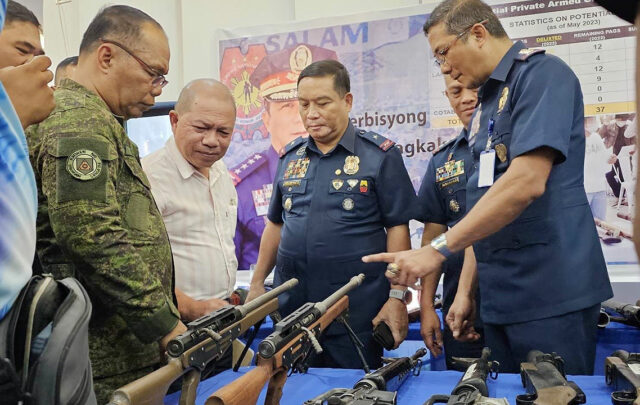
POLICE and army officials inspect some of the firearms turned in by members of the Bangsamoro Islamic Freedom Fighters who surrendered to the Bangsamoro Police Regional Office on May 12. — JOHN M. UNSON

By John M. Unson, Correspondent  

COTABATO CITY More than 70 members of local terrorist groups have laid down their arms in recent weeks, inspired by comrades who have surrendered earlier and are now living peaceful, productive lives back in their communities.   

Alim Kitem Ansao, one of the 50 members of the outlawed Bangsamoro Islamic Freedom Fighters (BIFF) who pledged allegiance to the government on May 12 at the Bangsamoro police regional headquarters, said he and his two siblings agreed to surrender after learning that their village in Midsayap, Cotabato was one of the beneficiaries of multi-million farming equipment grants from the Bangsamoro government. 

“We were told by BIFF recruiters in 2017 that we have to fight the government because it is only good at making the lives of Muslims in Mindanao difficult,he said in an interview on Wednesday.   

We realized they were wrong when we started hearing about the construction of barangay (village) halls and roads by the Bangsamoro government. It was then we started planning secretly to surrender to the police and so it happened indeed,Mr. Ansao said in the Maguindanaon language. 

One of Mr. Ansaos companions, Badruddin Sangid Mongkas, said he agreed to surrender, with the help of Muslim preachers in Maguindanao del Sur, after learning that three of his cousins have returned to their home village after availing of livelihood support from the agriculture, local government and social welfare ministries of the Bangsamoro government.  

“I then heard each of them are now earning clean money from corn farming, enough for their schooling and other needs. They are back in high school and want to proceed to college, if possible,” Mr. Mongkas said.  

FISHING
Nine of the BIFF surrenderees were trained in making improvised explosive devices by the Malaysian terrorist Zulkifli bin Hir, also known as Marwan, according to Bangsamoro Police Regional Director Allan C. Nobleza.  

Marwan was killed in a clash with pursuing personnel of the police’s elite Special Action Force (SAF) in Mamasapano on Jan. 25, 2015, an incident that also left 44 SAF personnel, 13 members of the Moro Islamic Liberation Front (MILF) and four villagers dead.   

Hassan Samarudin Tantung, one of the bomb-makers, said what encouraged him to surrender was the construction of a barangay hall in their village at the border of Pigcawayan, Cotabato and Sultan Kudarat, Maguindanao del Norte. 

“There was no barangay justice system in our place before. Surely there will soon be with this barangay hall existing there now,he said.  

His father also received a small, motorized boat with fishing equipment, which he now uses in the pawas, the local term for marsh which generally refers to the resource-rich 220,000-hectare Liguasan Delta. 

Cotabato Gov. Emmylou Taliño Mendoza said she is expecting the surrender soon of more BIFF and Dawlah Islamiya members in isolated barangays that used to be under her province and are now part the Bangsamoro Autonomous Region in Muslim Mindanao (BARMM).    

“I support all of these socio-economic programs of BARMM in its 63 barangays in my province because an increase in the rice and corn production in these areas will also bring progress to the main trading centers in the towns where these barangays belong,” she said.  

Ms. Mendoza, a Christian, has been a staunch supporter of Malacañangs separate peace deals with the MILF and the Moro National Liberation Front.  

The MNLF and the MILF have large communities in the 63 BARMM barangays in Cotabato, now grouped together as the Bangsamoro Special Geographic Area (SGA).   

Residents of the SGA voted in favor of the inclusion of their barangays into BARMM’s core territory in a plebiscite in early 2019.  

Army 6th Infantry Batallion Commander Alex S. Rillera said while there are still a few remaining hardcore BIFF members, the national and Bangsamoro governmentsprojects have significantly helped them secure the surrender of almost 300 BIFF and Dawlah Islamiya members since 2020. 

“When our men in the field convinced them to surrender, they used as examples how Malacañang and the BARMM governments, the municipal and provincial officials in provinces that we cover had cooperated in ushering those who surrendered ahead of them back to their barangays,” he said. 

DoJ: Marcos can reorganize executive branch to fast-track national ID rollout 

THE DEPARTMENT of Justice (DoJ) said it is within President Ferdinand R. Marcos, Jr.s authority to reorganize the executive department to fast-track the roll-out of the digital national identification cards (national IDs).  

The reorganization would involve the transfer of some functions of the Philippine Statistics Authority (PSA) to the Department of Department of Information and Communications Technology (DICT).  

“Jurisprudence has likewise recognized this continuing power of the President to reorganize the offices and agencies in the executive department in line with the Presidents constitutionally granted power of control over executive offices,” Justice Secretary Jesus Crispin C. Remulla said in a five-page legal opinion dated May 16 addressed to Executive Secretary Lucas P. Bersamin.  

Citing Supreme Court jurisprudence, he said the president has the power to “effect less radical or less substantive changes” to the structure of his office.  

In April, Mr. Marcos said during a Cabinet meeting that he wants to fast-track the roll-out of digital national IDs, ordering the DICT and the PSA to accelerate the distribution.  

Earlier this month, Senator Minority Leader Aquilino Martin “KoKo” D. Pimentel III sought to probe the delayed distribution. 

Republic Act No. 11055 or the Philippine Identification System Act (PhilSys) passed in 2018 provides for a single digital ID system for all citizens to ease transactions, access to social services, and boost financial inclusion.   

“Taking into consideration the foregoing and bearing in mind the objective of the PhilSys Act, which will ultimately result in the promotion of the general welfare and accessibility of public service, the President may, thus, exercise his power of control over the executive branch and reorganize it as he deems proper,” Mr. Remulla said. John Victor D. Ordoñez

NGCP confident of hurdling proposed audit of operations

JEROME CMG-UNSPLASH

THE National Grid Corp. of the Philippines (NGCP) said it is confident that a review of the power grid’s privatization will find that the company introduced many improvements to the transmission system.

“NGCP is fully cognizant that its franchise is a privilege granted to it by government. We remain ready to answer any and all questions raised concerning how we do business,” Cynthia P. Alabanza, spokesperson of NGCP.

She made the remarks after the Presidential Communications Office announced that Senator Rafael T. Tulfo had asked President Ferdinand R. Marcos, Jr. to reassess NGCP’s performance, opening the door to a possible renationalization.

Ms. Alabanza said that the NGCP will follow the legal process and will continue to comply with all lawful directives while pursuing the company’s mandate.

Mr. Tulfo, who is also the chairman of the Senate’s energy panel, has said that he specifically wants to look into NGCP ownership and assess possible threats to national security.

A consortium led by Henry Sy, Jr. and Robert Coyiuto, Jr. won a 25-year concession to run the power transmission network in December 2007. State Grid Corp. of China owns a 40% stake in NGCP.

“We are confident that the improvements we have introduced and the P300 billion we have invested in strengthening the transmission system will be recognized,” Ms. Alabanza said.

Since it took over the transmission system from the government in 2009, the grid operator has expanded the transmission network, the NGCP said.

The company described the government-run transmission system as “aging” when it took over.

“NGCP’s P300 billion grid expansion, reinforcement, and upgrading initiatives from 2009 to present, as well as those in the pipeline, are meticulously planned by our engineers and updated year after year with careful consideration for the needs of every single area in the country,” NGCP said.

Between 2009 and 2022, the company completed about 56 projects deemed vital to the energy sector.

“We continue to be hopeful that improvements in all three sectors of the power delivery system are in sync with each other, so that one sector is not made to be the sole or principal solution to challenges in the other sectors,” NGCP added, referring to the industry’s major segments of generation, transmission, and distribution.

“This is a system, and to make it robust, resilient and responsive to the needs of a fast-growing economy, the direction and coordination must be clear, equally implemented, and objectively pursued. Our stakeholders can be assured that we remain committed to improving and delivering reliable power transmission services,” it said.

The Department of Energy (DoE) said it plans to audit the NGCP’s performance following the tripping of transmission lines which raised red and yellow alerts over the Luzon power grid on May 8.  

The NGCP has said it welcomes the audit if it is carried out within the regulatory framework, adding that the company has been subjected to numerous audits.

Energy Undersecretary Rowena Cristina L. Guevara said that the Energy department has met with the Power Sector Assets and Liabilities Management Corp. (PSALM), National Transmission Corp. (Transco), and Energy Regulatory Commission (ERC) in anticipation of an NGCP review.

“Basically, we have virtually met. The group will consist of DoE, PSALM, Transco and ERC. We have a starting paper but we still have to discuss because we don’t [have] a special order from the Secretary forming us,” Ms. Guevara told reporters on the sidelines of an energy conference.

She said the performance audit will review NGCP’s Transmission Development Plan, among others. — Ashley Erika O. Jose

Napocor targets off-grid areas for RE expansion

BW FILE PHOTO

THE National Power Corp. (Napocor) said it will focus its efforts in expanding renewable energy (RE) on off-grid areas, which are served by its Small Power Utilities Group (SPUG).

“We hope the first 25% will happen next year, then we’ll work on the 75% after that,” Fernando Martin Y. Roxas, Napocor president, told reporters on the sidelines of The Future Energy Solar Show Philippines 2023. He was referring to the targets for RE share in SPUG operations.

Currently, Mr. Roxas said renewable energy in SPUG operations consists of only 2%. He hopes to hit close to 100% in the four years after 2024.

SPUG serves remote areas typically by deploying diesel generators, making the group vulnerable to fuel price swings.

He said that Napocor is looking at many renewable energy technologies at the moment, with solar power currently in favor.

“We will start with solar, because that is easier, then we will work our way to other technologies,” Mr. Roxas said.

He noted that solar power suffers from shortcomings like intermittency, the loss of power generation capacity when the sun is unavailable.

In January, Napocor announced a plan to cut back on SPUG operations due to the high price of diesel fuel, but deferred implementation after a series of consultations. — Ashley Erika O. Jose