Home Blog Page 4844

Playoff Jimmy

The term “Playoff Jimmy” has been liberally used since the start of the 2023 postseason, and with reason. For the Heat, it’s because their best player has had a knack for showing up when they most need him. He willed them back from a fourth-quarter deficit against the Bulls in the play-in match to secure the eighth seed, and then put up ridiculous numbers to promptly made short work of the top-ranked Bucks in the first round. He then did the same to the Knicks in the conference semifinals, starring in all five games he was able to play. And against the Celtics yesterday, he was again at the forefront of a spirited second half run to prevail in Game One of the West Finals.

Considering Butler’s performances and the extreme efficiency he has displayed therein, it’s no surprise that not a few quarters have deemed him their “hero.” Significantly, he has tried to shy away from the spotlight. “I ain’t nobody’s hero, man,” he said after the Heat became just the second in 11 years to defeat a Number One seed in the first round of the playoffs. “I’m just a decent basketball player that’s so fortunate to be able to put on a Miami Heat uniform and compete with these incredible teammates.”

Well, Butler has been just as “decent” since then. Yesterday, he presided over a Heat onslaught in the third quarter, and then buried the Celtics for good with a backbreaking three in the last minute of the close contest. When asked in the aftermath how he has managed to continually exceed himself, he contended that “I’m playing at an incredible level because [my teammates] are allowing me to do so. They are not putting a limit on my game. They are trusting me with the ball.” And why wouldn’t they? He has delivered in every way so far.

So far in the 2023 Playoffs, the Heat have opened a series with an emphatic win on the road. They’re now just three triumphs from grabbing a spot in the National Basketball Association Finals, a development not even their most loyal fans thought possible in light of their regular season travails. And if they’re close, it’s because Butler has reached unprecedented heights. The sample size may be small, but the body of work is nonetheless remarkable — one unmatched in the storied annals of the black and red.

The Heat still have much to do, and the Celtics will undoubtedly bounce back. That said, they can at least approach the challenge with confidence. For all the supposed talent gap, they have Butler on their side, and, for them, it’s what ultimately matters.


Anthony L. Cuaycong has been writing Courtside since BusinessWorld introduced a Sports section in 1994. He is a consultant on strategic planning, operations and human resources management, corporate communications, and business development.

On monetary policy: Some known unknowns

PHILIPPINE STAR/ WALTER BOLLOZOS

This broadsheet reported last Monday that the “Bangko Sentral ng Pilipinas (BSP) was widely expected to maintain the key benchmark interest rate at 6.25% on Thursday, amid easing inflation and slowing economic growth.” By the time this column comes out today, the BSP would have already affirmed who among the 18 analysts had the better read of BSP monetary policy.

With BSP forecasting inflation for 2023 and 2024 at 6.0% and 2.9%, respectively, many of our friends subscribe to the idea that the three-month easing of headline inflation from its peak of 8.7% in January should signal for a pause. This is a crucial point. With economic growth losing some momentum in the first quarter 2023, a pause might be preparatory to a possible reduction in the policy rate now at 6.25%. 

True, real policy rate is now positive with a 6.0% forecast for 2024 but the margin is too slim at 25 basis points, and should the US Fed opt for another rise, it’s the peso that would have to roll with the punches with ultimate hit on inflation itself. Those talks about our exports getting more competitive with a weaker peso may need to be recast because market share and product quality are more critical.

Strict inflation targeting would be tempted to prefer immediately scaling down the policy rate but the monetary authorities are more flexible in considering several other drivers of price dynamics before finally easing.

It’s correct to focus on the downtrend in headline inflation as one metric of the direction of interest rate policy. But year-to-date inflation averages an uncomfortable 7.9% against the target of 2-4%. Core inflation, stripped of the more volatile food and energy components, remains pretty stubborn as it barely moved from 8.0% in March to 7.9% in April, with a year-to-date average of 7.8%. This is the focus of monetary policy, that which captures the summation of demand conditions.

It’s sad to see real GDP coming down from its peak of 12.0% in the second quarter 2021 but there should be no love lost. The intent of monetary policy has always been to keep inflation low and stable, and to ensure it is maintained even with some hit on economic growth. That is the primary mandate of the BSP. After all, no one is complaining because at 6.4%, real GDP in the Philippines is one of the highest among emerging and developing countries in Asia. It also outperformed the median forecast of 6.1% among market analysts.

Arguing that a further 25-basis point increase in the BSP policy rate could further upset our growth path negates our claim that the Philippine economy has been resilient in the last two decades. We have managed to build a stronger footing through a series of strategic policy and structural reforms even through the debilitating years of the pandemic.  As a result, we have been seeing total factor productivity rising and economic efficiency improving.

To be sure, they cannot be reversed by an appropriately cautious monetary policy.

What can subvert it is misguided public policy, market loss of confidence, or even an unmitigated inflationary situation that could leave many hungry and kept out of the mainstream of education and other economic opportunities.

Corresponding credit rating downgrades are just formalities.   

This is how we might interpret the news about the preliminary views of the International Monetary Fund (IMF) mission for the Article IV consultation led by our friend Shanaka Jay Peiris. While the mission expects a significant slowdown in the economic expansion of the Philippine economy from the Fund forecast of 6.0% for 2023 to 5.5-6.0% for 2024, its recommendation for sustained tightening is unmistakable. Peiris was quoted saying “Risks to inflation remain on the upside, and a continued tightening bias may be appropriate until inflation falls decisively within the 2-3% target range.”

We cannot afford to lose sight of the Fund’s observation that “the main downside risks to the (growth) outlook continue to be persistently high core inflation, depreciation pressures amid tighter global conditions…”

High core inflation means demand remains strong and some restraint is necessary. At the same time, persistently high inflation also undermines economic activity especially private consumption which accounts for some 70% of total output. Depreciation pressures against the peso would derive from diminishing differential between local and foreign interest rates. Finally, tight global conditions indicate the need for maintaining cautious monetary policy as a matter of insurance.

What then could change the inflation landscape?

There are many unknowns, but at least we know some of them.

We have no doubt the BSP is aware that there has been a series of petitions for wage hikes. Last month, at least eight petitions for jacking up the minimum wage have been filed in four out of 17 regions. These petitions are pending in the tripartite wages and productivity boards of Metro Manila, Calabarzon, Western Visayas and Central Visayas with some asking for P100 peso or about 20% increase.

This month saw more wage hike petitions for more specific sectors. There are at least 58 bills in the lower house and 21 in the Senate urging for higher wages, the sheer number of which shows the strong support from legislators. Wage erosion due to high inflation is the common basis of the petitions in favor of government nurses for 75% adjustment, while the others were for public school teachers. The leaders of both houses of Congress have been reported to have pledged to pass the proposed legislations shortly.

If labor productivity is not at par with the proposed wage adjustment, this could be inflationary.

With El Niño already around, with a promise of higher heat intensity, a significant portion of food items in the consumer basket is bound to show renewed price pressures. This is abetted by sustained expansion in both domestic liquidity or M3 and domestic credits.

Unfortunately, we are seeing again possible delays in mitigation through prompt importation of rice, sugar and other key food commodities. For sugar, although the idea has been approved by the President, shipments are expected to arrive in September.

We agree that the authorities cannot be too careful because local production and sales should not be affected. We are just worried, however, that overthinking could result in actual delays and forced increase in food prices.

Finally, we don’t wish to be disappointed by another power failure in the country’s various airports because that would destroy our tourism business and jobs around it. That could also restrain growth. But power failure is anathema not only to production but also to prices. A more strategic maintenance of our power plants should be done to avoid previous blackouts that hit Luzon several years ago that affected more than a million customers including production plants and factories. Rotating power interruptions is no solution at all if we are to sustain economic growth and keep inflation low and stable.

The President and the Senate are now contemplating of taking back control of the National Grid Corp. of the Philippines (NGCP) “if necessary” as a matter of national security. The Senate is investigating reports that China “has the capability to remotely access the country’s national grid and sabotage it.” Since NGCP is the sole power grid operator, power transmission should be both secured and sustainable.

These are some of the unknowns that we know. Needless to say, the BSP has a much broader and deeper understanding of the inflation dynamics in the Philippines. It is now looking into big data and data analytics to transcend statistical limitations posed by long lags in collecting data on economic activities, and in considering additional indicators of price pressures in real time.

Its continued independence should assure the civil society and the business community that its decision on monetary policy is well anchored. Such independence also cements international confidence in our demonstrated capacity to manage inflation.

As citizens, low and stable inflation is our recompense.


Diwa C. Guinigundo is the former deputy governor for the Monetary and Economics Sector, the Bangko Sentral ng Pilipinas (BSP). He served the BSP for 41 years. In 2001-2003, he was alternate executive director at the International Monetary Fund in Washington, DC. He is the senior pastor of the Fullness of Christ International Ministries in Mandaluyong.


Why natural disasters seem worse than our direst predictions

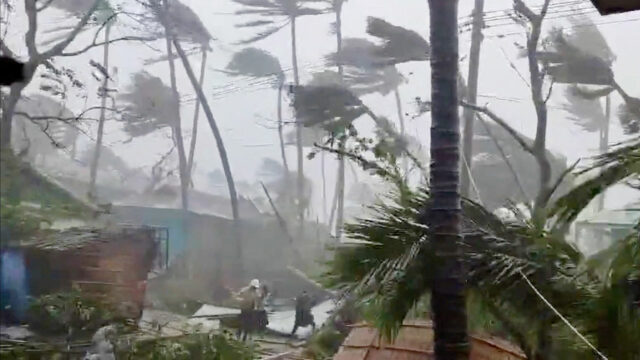
PEOPLE walk near damaged structures amid strong winds and rain caused by Cyclone Mocha in Sittwe, Myanmar in this screen grab from a handout video released May 14, 2023. — REUTERS

IN JUST the past week, the coast of Myanmar has been hit by the equal-strongest cyclone ever seen in the northern Indian Ocean. A record heatwave spread across Southeast Asia, while the mercury in Beijing and Portland, Oregon, rose to the mid-30s Celsius (mid-90s Fahrenheit). With temperatures in Europe increasing twice as fast as the global average, parts of Spain are turning arid decades earlier than expected. A vast Antarctic glacier may be susceptible to collapse far sooner than anyone realized. The speed of change is head-spinning.

Scientists have spent decades batting away accusations from denialists that they were exaggerating the risks of warming. Now they’re facing the opposite problem. “Some of the impacts of climate change are playing out faster and with a greater magnitude than we predicted,” Michael E. Mann, a climatologist at the University of Pennsylvania, told the UK’s Channel 4 News during Europe’s summer heat wave last year.

It’s tempting, in the face of unexpected natural disasters, to ask “why weren’t we warned?” Though the progress of global warming is still closely tracking predictions climate scientists made decades ago, its specific effects can shock even those who’ve dedicated their lives to studying it. Part of the answer lies in the broadness of the techniques used to make verifiable forecasts about an uncertain future. Another part, in the way that our brains, which evolved to help primates make quick judgements, can still misinterpret statistical data.

Our minds latch on to the most easily-available snippets of information, even if we lack the tools to interpret them properly. Global warming of 1.09C (where we are now), 1.5C (the level climate diplomats are targeting, likely to soon be out of reach), and 2.8C to 3.2C (where we’re currently headed) can’t help but seem mild to people who notch their home thermostats up and down by similar amounts in the course of a day. For experts versed in the science of climate impacts, those numbers conjure up images of mounting, devastating changes to weather, ecosystems and human societies. Lay people, on the other hand, may find it almost beyond comprehension to connect such dry numbers to the real-world disasters they represent.

That disconnect is made worse by the fact that it’s hard to foretell the sorts of short-term disasters that dominate news headlines. You will search scientific literature in vain for predictions of what, for instance, the highest-ever temperature recorded in Delhi will be by the year 2050. Here, instead, is how one 2018 paper on temperature extremes describes its methodology:

The climate of our planet is simply too complex and dynamic to forecast individual events more than a few days in advance. Even moving from global models toward regional ones that give finer-grained detail has been the subject of vast controversy among climatologists, due to disagreements about the usefulness and value of such calculations. Switching from simulations with 100 square-kilometer (39 square-mile) pixels to more granular ones with 1 sq km pixels is the current state of the art, according to Julie Arblaster, a professor at Australia’s Monash University who researches climate extremes. Even that is pushing the limits of our processing power, scientific knowledge and academic labor force.

The emerging science of weather attribution means we are now relatively confident in showing the influence of human-caused climate change on large-scale events like drought, heatwaves and extreme rainfall. Carrying out similar analyses for smaller disasters, such as cyclones, tornadoes, and storms, however, remains far more challenging. On top of that, long-range predictions tend to focus more on the increasing frequency of extreme weather, rather than the intensity of record-breaking events. It’s the latter, though, which are more likely to grab the imagination of human brains that have evolved to fear abnormally bad weather as an immediate threat to life and limb.

Science can’t yet provide the high-resolution forecasts that would be needed to make detailed policy for specific areas, says Arblaster. “That local scale of asking what it will be like in Melbourne in 2040 — that’s a difficult question to answer at the moment.”

We’ll have to learn to live with this. The way that climatologists interpret environmental data and the way lay people think about natural disasters are fundamentally different, and often incompatible, systems of information. That lies at the root of the challenges we face in getting the public to comprehend the momentous implications of global warming. In a world where everything seems measurable and quantifiable, scientists can’t provide forecasts with the level of visceral detail that the average person needs to grasp the enormity of the changes unfolding before our eyes.

Rather than dismissing the fears of climate scientists as “alarmism,” we should take their manifest alarm seriously. It may well be our best guide to the damage we are doing to our world.

BLOOMBERG

Understanding the Blockchain Council and its role in revolutionizing digital innovation in the country

SHUBHAM DHAGE-UNSPLASH

We’ve discussed many aspects of cryptocurrency and NFTs, and it’s been exciting to see all the developments both locally and internationally. And to add to your growing knowledge of the landscape, I thought this week we would talk about the Blockchain Council of the Philippines. They are necessary players in Philippine crypto, and understanding their role may help you further on your journey.

The Blockchain Council is a group of people who have come together to explore and support this exciting technology called blockchain. Blockchain is like a digital ledger that keeps track of information securely and transparently.

The council’s main goal is to create an environment where new businesses using blockchain can grow and succeed. We want to help anyone working with blockchain by providing them with access to resources and any assistance that may need in pushing for the use and adoption of blockchain.

The Blockchain Council of the Philippines was born during the inaugural Philippine Blockchain Week, where its 15 founding board directors were inducted and sworn in by DICT Secretary Ivan Uy. Our vision:  to be the prime mover and the largest organization that drives the adoption of blockchain and Web3 technologies for the Philippines. We will be able to achieve this by staying true to our mission of educating, engaging, and collaborating with the Philippine blockchain ecosystem stakeholders, from the government and Web3 developers, and businesses to civil society, NGOs, and the Filipino people as a whole, to ensure the safe, secure and proper use of Web3 technologies into everyone’s day-to-day lives.

As of this writing, the Blockchain Council is now drafting its membership code and rules, as we plan to accept members from the Web3 community come June. With a bigger membership, we will be able to run our projects and advocacies, from our educational campaigns, to our roundtable discussions with government and business leaders, and to our own Philippine Block Awards.

The main objective of the council is to drive innovation and collaboration in the blockchain space. It seeks to explore the potential applications of blockchain technology in areas such as payments, remittances, and digital identity verification.

In light of its drive for innovation, the council actively advocates for the benefits of blockchain technology and has made moves to educate stakeholders about its capabilities. It intends to raise awareness among businesses, government agencies, and the general public, highlighting the advantages of blockchain in terms of security, efficiency, and transparency.

Of course to sustain blockchain technology in the country, the council aims to develop a supportive policy framework for blockchain adoption, by actively engaging with regulatory bodies. And in collaboration with government agencies the goal is that regulations in place will continually foster the growth of blockchain technology while simultaneously addressing any concerns related to security and compliance.

Also, since one of the blockchain’s main tenets is decentralization, the council emphasizes the importance of collaboration and intends to work closely with banks, financial institutions, technology companies, and other relevant stakeholders. By fostering partnerships, the council aims to facilitate knowledge sharing, research, and development, ultimately driving the adoption of blockchain technology in the banking and finance sector.

Currently, the council comprises banking tech experts and leaders who bring our industry knowledge and experience to guide and support the adoption of blockchain technology. Our collective expertise is expected to contribute to the growth and advancement of blockchain in the Philippines.

To achieve its goals, the council plans to organize events, seminars, and workshops to engage stakeholders and promote the understanding and utilization of blockchain technology. The formation of the Blockchain Council of the Philippines has received support from the government and industry players who acknowledge the transformative potential of blockchain technology across various sectors.

Ultimately, the council seeks to create a conducive environment for blockchain adoption, drive economic growth, and educate stakeholders about the benefits of distributed ledger technology. If you have any ideas or thoughts to help the Blockchain Council, just hit us up on our social media.


Dr. Donald Lim is the founding president of the Blockchain Association of the Philippines and the lead convenor of the Philippine Blockchain Week. He is also the Asian anchor of FintechTV.

What is the ‘Quad’ Alliance and why doesn’t China like it?

FLICKR/OFFICIAL U.S. NAVY IMAGERY

AS THE White House tries to demonstrate that the war in Ukraine hasn’t distracted America from pressing priorities in Asia, it’s once again looking to “the Quad.” The informal grouping brings together the US, Japan, India and Australia in an alliance of democracies with shared economic and security interests that span the Pacific and Indian Oceans. The point officially is to maintain a “free and open Indo-Pacific,” but the unstated priority is countering China’s growing power, which rankles the leadership in Beijing. The Quad has its critics, who question the group’s sometimes-ambiguous goals and ask how effective it can be given that some members are wary of provoking China. Still, it’s set to become more relevant as US-China tensions persist and Russia’s invasion of its neighbor sharpens Western security alliances.

1. Why are we talking about it?

The group has seen new momentum under the administration of US President Joe Biden, who plans to travel to Japan May 17. He scrapped plans for a visit to Australia, prompting a cancellation of the Quad meeting in Sydney on May 24. The four leaders will instead meet in Japan on the sidelines of the Group of Seven summit days earlier. When the leaders gathered for a summit in Tokyo last year, they announced a program aimed at curbing illegal fishing across the Indo-Pacific amid growing concern about the activities of Chinese vessels. That followed a virtual conference in 2021 — the first-ever gathering of the Quad leaders, which resulted in a pledge to fund India to accelerate production of Covid-19 vaccines and distribute them across Asia. The group wasn’t always this active. It lay dormant for years before being revived in 2017 by the US under then-President Donald Trump, whose government was intent on confronting China. Yet Trump’s erratic diplomacy left some allies hesitant to line up behind the US on China. When Biden replaced Trump, he pledged to work more closely with allies while continuing a tough stance on China.

2. What are the group’s origins?

After the four nations formed a “core group” that helped coordinate relief operations following the devastating Boxing Day tsunami in the Indian Ocean in 2004, Shinzo Abe, who was then Japan’s prime minister, called for a more formal, so-called Quadrilateral Security Dialogue in 2007. That year, the group met on the sidelines of the annual Asia-Pacific forum convened by the Association of Southeast Asian Nations. The same year, the Quad nations plus Singapore participated in an expanded version of the Malabar naval exercises in the Bay of Bengal, which normally engage US and Indian forces. But after a promising start, the Quad effectively fell apart the next year.

3. Why did it falter?

It depends on whom you talk to, but interest waned amid concerns about alienating China. Australia’s former Prime Minister Scott Morrison has blamed a predecessor, the Mandarin-speaking, former diplomat Kevin Rudd — now Australia’s ambassador in Washington — for a “policy to disconnect from the Quad.” But Rudd, writing in 2019, argued it wasn’t that simple. The Quad lost favor with power brokers in Japan, Rudd said, after Abe resigned the same year he proposed the grouping and especially after his party lost power in 2009. Rudd wrote that US officials didn’t even bring up the Quad when he visited as prime minister in 2008 and that his Indian counterpart at the time, Manmohan Singh, pledged not to be part of any initiative to contain China. Yet by 2017, with nationalist governments in power in Japan and India, circumstances had changed again. Before Biden came to power, China had engaged in a bloody spat with India on their disputed Himalayan border and launched punishing trade measures against Australia for proposing an investigation into the origins of the coronavirus that causes Covid-19, which was first detected in the Chinese city of Wuhan. Beijing’s growing assertiveness has not just driven the US and India closer together, but has fueled New Delhi’s interest in the Quad, according to one US official. 

4. What does China say about the Quad?

China has lambasted the Quad as a mechanism to contain its global rise. China’s Foreign Ministry has accused the group of being dedicated to undermining China’s interests. In April, ministry spokesperson Wang Wenbin said the group “is steeped in the obsolete Cold War and zero sum mentality and reeks of military confrontation,” adding that it “runs counter to the trend of the times and is doomed to be rejected.”

5. What do other critics say?

Some have accused the Quad of being a talking shop that nevertheless cannot speak with one voice and that lacks any real institutional structure, according to a Congressional Research Service report. Others fear it could eventually morph into an Asian NATO that would provoke a Chinese response. Indian officials have been both wary of poking China and skeptical of Australia’s heretofore close ties with Beijing, writes Tanvi Madan, a senior fellow with the Brookings Institution. In a symbolic move in 2020, however, India appeared to overcome its hesitation and invited Australia to again join the Malabar exercises.

6. What is the Quad’s agenda?

At their summit in Tokyo in May 2022, the leaders issued a statement promising a “free and open Indo-Pacific that is inclusive and resilient,” signaling an intent to act on an array of pressing global challenges. That includes big issues like climate change and cyber security as well as specific domains such as cooperation on infrastructure — a likely riposte to Chinese President Xi Jinping’s Belt and Road Initiative. That campaign has helped build roads and power stations across Asia but has been the subject of heavy criticism, including accusations that China is luring poor countries into debt traps. Even as the Quad remains cautious of triggering Beijing, it’s just part of a still-emerging approach to Asia: In 2021, the UK and US struck a separate defense accord with Australia — known as Aukus — to equip that country with nuclear submarines, a development that came after China’s pressure campaign against it.

BLOOMBERG

AI threatens humanity’s future, 61% of Americans say — Reuters/Ipsos poll

The logos of Microsoft Corp. and OpenAI, as well as the ChatGPT 4 name, are seen in this photo illustration. — PHOTO ILLUSTRATION BY JONATHAN RAA/NURPHOTO VIA REUTERS CONNECT

THE SWIFT growth of artificial intelligence (AI) technology could put the future of humanity at risk, according to most Americans surveyed in a Reuters/Ipsos poll published on Wednesday.

More than two-thirds of Americans are concerned about the negative effects of AI and 61% believe it could threaten civilization.

Since OpenAI’s ChatGPT chatbot became the fastest growing application of all time, the widespread integration of AI into everyday life has catapulted AI to the forefront of public discourse. ChatGPT has kicked off an AI arms race, with tech heavyweights like Microsoft and Google vying to outdo each other’s AI accomplishments.

Lawmakers and AI companies are also concerned: OpenAI CEO Sam Altman on Tuesday testified before US Congress, voicing concerns about potential misuse of the technology and asking for regulation.

“There’s no way to put this genie in the bottle. Globally, this is exploding,” said Senator Cory Booker, one of many lawmakers with questions about how best to regulate AI during a Senate panel on the uses of AI Tuesday.

The Reuters/Ipsos poll found that the number of Americans who foresee adverse outcomes from AI is triple the number of those who don’t.

According to the data, 61% of respondents believe that AI poses risks to humanity, while only 22% disagreed, and 17% remained unsure.

Those who voted for Donald Trump in 2020 expressed higher levels of concern; 70% of Trump voters compared to 60% of Joseph R. Biden voters agreed that AI could threaten humankind.

When it came to religious beliefs, Evangelical Christians were more likely to “strongly agree” that AI presents risks to humanity, standing at 32% compared to 24% of non-Evangelical Christians.

“It’s telling such a broad swath of Americans worry about the negative effects of AI,” said Landon Klein, director of US policy of the Future of Life Institute, the organization behind an open letter, co-signed by Tesla CEO Elon Musk, demanding a six-month pause in AI research. “We view the current moment similar to the beginning of the nuclear era, and we have the benefit of public perception that is consistent with the need to take action.”

While Americans are concerned about AI, crime and the economy rank higher in the list of kitchen table issues: 77% support increasing police funding to fight crime and 82% are worried about the risk of a recession.

Those in the industry said the public should understand AI’s benefits more.

“The concerns are very legitimate, but I think what’s missing in the dialogue in general is why are we doing this in the first place?” said Sebastian Thrun, a computer science professor at Stanford who founded Google X. “AI will raise peoples’ quality of life, and help people be more competent and more efficient.”

The positive applications of AI, such as revolutionizing drug discovery, are not as visible as ChatGPT, said Ion Stoica, a UC Berkeley professor who also co-founded AI company Anyscale.

“Americans may not realize how pervasive AI already is in their daily lives, both at home and at work,” he said.

The online poll of 4,415 US adults was conducted between May 9 and May 15. It has a credibility interval, a measure of accuracy, of plus or minus 2 percentage points. — Reuters

In China, domestic travel recovery is marred by anti-spending ‘special forces’

TRAVELERS walk with their suitcases at Beijing Daxing International Airport in Beijing, China April 24, 2023. — REUTERS

SHANGHAI — When graduate student Cai Zhishan decided to spend her Labor Day holidays in northern China, she wished she had enough money to hire a car for the more-than 4,000-kilomter round trip — the equivalent of driving from New York to Los Angeles.

Instead, she chose “traveling like special forces,” a new trend in China that has emerged as a symptom of the underlying weakness in household consumption, and which is casting a shadow over a post-pandemic recovery in domestic tourism.

Ms. Ms. Cai, 22, mostly took slow trains and buses as she made her way from the city of Hangzhou where she studies, around the northern Shanxi province, and back.

To get to the ancient temples, pagodas and grottoes she wanted to visit, she walked roughly 30,000 steps a day. For accommodation, she chose overnight trains and cheap hostel beds.

Over nine days, she spent just 2,500 yuan ($362).

“I don’t have much money, but I like to travel,” Ms. Cai said. “I can control the expenses, to go to many places for the least amount of money, but it is really tiring.”

On social media, the hashtag “special forces travel” — which refers to an aggressive assault on a tourist area to see and do as much as possible for as little money one can spend — went viral before and during the Labor Day break starting in late April.

Cai was inspired by the online discussions, like many other Chinese travelers who surprised with their thriftiness.

Ministry of Culture and Tourism data showed a boom in domestic travel this year, as many Chinese made up for the three years of COVID-19 restrictions that kept them largely stuck at home.

During the May holiday break, which for most Chinese covered the April 28-May 3 period, 274 million trips were made, up 19% from 2019 before the pandemic.

But total spending was 148 billion yuan ($21 billion), on par with 2019, meaning travelers spent an average of 540 yuan in 2023 versus 603 yuan in 2019.

In another sign of tight pockets, international trips by Chinese tourists this year remain a fraction of pre-pandemic levels.

“Chinese overall are not ready to spend as much as before and, even if the government tries … to entice consumption and reduce excess savings, I doubt it will manage,” said Alicia Garcia-Herrero, chief economist for Asia-Pacific at Natixis Research.

“People need jobs and higher wages to start spending big again.”

Domestic consumption, which Chinese policymakers want to play a greater role in powering the world’s second-largest economy, has recovered since COVID restrictions were lifted in December, but has consistently underwhelmed so far this year.

China’s struggling property market, record high youth unemployment and broader worries over job stability, as well as government parsimony on wages, pensions and medical benefits are keeping consumers cautious, analysts say.

Data on Tuesday showed retail sales up 18.4% in April from last year, when Shanghai was under lockdown, undershooting expectations of a 21.0% rise. Consumer confidence has bounced from last year’s record lows, but remains below the range of the previous two decades.

One travel blogger, who posts on the Instagram-like social media app Xiaohongshu under the name of Icecube, told Reuters he slept overnight in a public toilet to save money on a trip to Huangshan mountain in the southern Anhui province.

“It’s worth it,” said the blogger, who declined to give his real name.

“Although I suffered a little, I spent the least money possible to see beautiful scenery. In the future, I may consider adding a little to the budget to improve accommodation conditions.”

For those betting on consumption gathering speed as the year progresses, maybe not all is lost.

Beijinger Xing Zicong, 23, tried to visit the historical silk road city of Xi’an on a shoestring, but found it too uncomfortable and ended up spending more money than planned.

“Maybe I didn’t wear the right shoes, but my feet started to hurt after walking more than 10,000 steps,” she said, joking that she exemplified “the battle-scarred version of special forces travel.” — Reuters

Montana to become first US state to ban TikTok

REUTERS

MONTANA Governor Greg Gianforte on Wednesday signed legislation to ban Chinese-owned TikTok from operating in the state to protect residents from alleged intelligence gathering by China, making it the first US state to ban the popular short video app.

Montana will make it unlawful for Google and Apple’s app stores to offer TikTok within the state, but will not impose any penalties on individuals using the app. The ban is to take effect Jan. 1, 2024, and is almost certain to face legal challenges.

TikTok, owned by Chinese tech company ByteDance, did not respond to a Reuters question asking if it planned legal action.

Earlier, TikTok issued a statement saying that the new law “infringes on the First Amendment rights of the people of Montana by unlawfully banning TikTok,” and said it will “continue working to defend the rights of our users inside and outside of Montana.”

TikTok, which has over 150 million American users, has faced growing calls from US lawmakers and state officials to ban the app nationwide over concerns about potential Chinese government influence over the platform.

The app has become wildly popular with teens. According to the Pew Research Center, 67% of US teens ages 13 to 17 use TikTok, and 16% of all teens say they use the app almost constantly. TikTok has said that the “vast majority” of its users are over the age of 18.

In March, a congressional committee grilled TikTok CEO Shou Zi Chew about whether the Chinese government could access user data or influence what Americans see on the app. But calls to ban TikTok nationwide or give the Biden administration new powers to crack down or ban TikTok have not advanced in Congress.

Mr. Gianforte, a Republican, said the bill will further “our shared priority to protect Montanans from Chinese Communist Party surveillance.”

TikTok has repeatedly denied that it has ever shared data with the Chinese government and has said the company would not do so if asked.

FREE SPEECH ‘TRAMPLED’
Montana, which has a population of just over 1 million people, said TikTok could face fines for each violation and additional fines of $10,000 per day if it violates the ban.

The short video app can be downloaded in app stores on Apple, Inc. and Google devices. Apple and Google, a unit of Alphabet, Inc., could also face fines of $10,000 per violation, per day if they violate the ban.

Apple and Google did not immediately respond to requests for comment.

The American Civil Liberties Union (ACLU) slammed the law as “unconstitutional” and noted that it will go into effect on Jan. 1 if the courts do not act.

“With this ban, Governor Gianforte and the Montana legislature have trampled on the free speech of hundreds of thousands of Montanans who use the app to express themselves, gather information, and run their small business in the name of anti-Chinese sentiment,” Keegan Medrano, policy director at the ACLU of Montana, said in a statement.

An attempt by former President Donald Trump to ban new downloads of TikTok and WeChat through a Commerce Department order in 2020 was blocked by multiple courts and never took effect.

TikTok’s free speech allies include several Democratic members of Congress, including Representative Alexandria Ocasio-Cortez, and First Amendment groups like the American Civil Liberties Union.

Industry group NetChoice general counsel Carl Szabo also criticized the new law. “The government may not block our ability to access constitutionally protected speech — whether it is in a newspaper, on a website or via an app.” he said in a statement, adding that Montana “ignores the US Constitution, due process and free speech.”

Mr. Gianforte, who had sought to convince the state legislature to broaden the ban to other social media applications that provide certain data to foreign adversaries, also prohibited the use of all social media applications that collect and provide personal information or data to foreign adversaries on state government-issued devices.

TikTok is working on an initiative called Project Texas, which creates a standalone entity to store American user data in the US on servers operated by US tech company Oracle. — Reuters

China urges Australia to help find crew of capsized fishing boat

CARLOS DE SOUZA-UNSPLASH

SYDNEY —  China’s ambassador to Australia urged Canberra on Thursday to step up its rescue efforts to help locate the 39 missing crew members on board a Chinese shipping boat that capsized in the Indian Ocean early this week.

President Xi Jinping has ordered that all efforts be made to search for the missing crew, which includes 17 Chinese nationals, 17 Indonesians and five from the Philippines, state media reported on Wednesday.

“This is within Australia’s search and rescue area … we wish our Australian colleagues will co-ordinate with other international or foreign vessels or ships near the area to help to search and rescue to save as many lives as possible,” Ambassador Xiao Qian said at a press conference.

Mr. Xiao thanked Australian authorities for sending three airplanes and four ships to the area, located about 5,000 kilometers (3,100 miles) off the country’s west coast.

“I’m hopeful that the efforts not only continue … but also will be enhanced,” the ambassador said.

The capsized fishing boat had been found but no survivors were located so far, he said.

China is coordinating with several countries including Indonesia, Sri Lanka and Maldives with the rescue mission.

The distant-water fishing vessel Lupeng Yuanyu 028, owned by Penglai Jinglu Fishery Co Ltd. based in Shandong province, capsized early on Tuesday, state-run CCTV reported. It was not immediately known why it sank. — Reuters

Earth-sized alien planet gripped by widespread volcanism

WASHINGTON — An Earth-sized planet orbiting a dim star in our galactic neighborhood is offering some of the best evidence to date of volcanism beyond our solar system, with observations suggesting a rugged and rocky world tormented by constant eruptions.

Scientists said on Wednesday the planet, the third detected orbiting this particular star, is likely covered with volcanoes — similar to Jupiter’s moon Io, the most volcanically active body in our solar system. In our solar system, Earth and Venus are volcanically active, as are some of Jupiter’s moons.

The planet’s volcanism was not directly observed but rather inferred due to its significant gravitational interaction with the larger of the two other planets orbiting the dim star. The gravitational tug from the larger planet may squeeze and flex the newly identified one, heating up its interior and causing surface volcanic activity, similar to Io, the researchers said.

Planets beyond our solar system are called exoplanets.

“There is not yet any direct observational evidence of exoplanet volcanism, but this planet is a particularly likely candidate,” said University of Kansas astronomy professor Ian Crossfield, one of the authors of the research published in the journal Nature.

It is a planet that does not rotate — with one side perpetually in daylight and the other in darkness.

“On the dayside, it is too hot for liquid water, so it is likely very dry and hot — likely a desert. On the night side, there is possibly a large icy glacier,” said study co-author Björn Benneke, head of the astronomy group at the University of Montreal. 

“The most interesting region is near the terminator region where the day and nightside meet. Here, water from the nightside glacier can melt and possibly form liquid surface water. In addition, there is likely volcanism all around the planet, even under the ice on the nightside and possibly under the water near the terminator,” Mr. Benneke said.

The planet is located in the Milky Way about 86 light-years away from our solar system in the direction of the constellation Crater. A light year is the distance light travels in a year, 5.9 trillion miles (9.5 trillion km).

It is slightly larger than Earth and orbits very close to a red dwarf star — a type much smaller than our sun, with relatively low mass and temperature — completing its elliptical journey around it in only 2.8 days.

Its surface temperature appears to be slightly warmer than Earth. It is situated on the inner edge of what is called the habitable zone, or Goldilocks zone, around the star — not too hot and not too cold, perhaps able to maintain liquid water on the surface and harbor life.

“I imagine a rugged, young surface for the planet after many millions of years of constant volcanic activity. Since the gravitational effects don’t care about day and night side, I also suspect the volcanic activity to be evenly spread over the planetary surface,” said University of California, Riverside planetary astrophysicist and study co-author Stephen Kane.

“Since the planet is so volcanically active, it is still contributing gases to the atmosphere from the interior. As such, the planet probably still has an atmosphere. The planet is unlikely to be habitable, however, since the total amount of energy makes for a quite hostile environment. Who knows? Life may find a way,” Kane added.

Its orbit is sandwiched between the two other planets — the innermost one about 20% bigger than Earth and the outermost one about 250% the size of our planet.

The researchers spotted the planet using NASA’s Transiting Exoplanet Survey Satellite (TESS) and the now-retired Spitzer Space Telescope, as well as some ground-based observatories.

“There are still many unknowns regarding volcanism and how long a planet can maintain outgassing processes,” Mr. Kane said, referring to the release of trapped gas that occurs with eruptions. “We only recently confirmed that Venus, Earth’s twin planet, is volcanically active.” — Reuters

Seven Filipinos recognized in ‘Forbes 30 Under 30 Asia’ 2023

FORBES.COM

SEVEN Filipinos made it to this year’s Forbes 30 Under 30 Asia list, which features young entrepreneurs, trailblazers, and innovators in Asia and Australia under the age of 30.

The Filipinos in the eighth edition of the list are:

  • Aaron Villegas, co-founder of finance tracker app Lista;
  • Isabel Sicat, co-founder of sustainable high fashion brand Toqa;
  • David Marquez, co-founder of delivery platform Shipmates; and 
  • Rui Aguiar, King Alandy Dy, Jeff Tan, and Jig Young, co-founders of supply chain automation start-up Expedock

“Despite a challenging year marked by global economic uncertainty and a drop in VC (venture capital) funding, this year’s Forbes 30 Under 30 Asia entrepreneurs continued to innovate and thrive,” Rana Wehbe Watson, Forbes 30 Under 30 Asia editor, said in the release.

The three hundred were selected out of over 4,000 submissions to Forbes Asia, which also gets recommendations from industry veterans. 

There are 30 notable honorees for each of the 10 categories: The Arts (Art & Style, Food & Drink), Entertainment & Sports, Finance & Venture Capital, Media, Marketing & Advertising, Retail & Ecommerce, Enterprise Technology, Industry, Manufacturing & Energy, Healthcare & Science, Social Impact, and Consumer Technology

Judging criteria include funding and/or revenue, social impact, scale, inventiveness, and potential. 

Ranging from startup founders to artists, athletes, and scientists, it’s their “collective creativity and determination” that inspires optimism, according to Ms. Watson.

Others featured in the list for 2023 are K-pop girl bands Le Sserafim and NewJeans; Thai actor Metawin Opasiamkajorn; content creator Wonjeong Seo; mental health advocate Chan Sheung Yee; Hayden Marks, whose Melbourne Bushfood products feature Australia’s native ingredients; Chinese film director Chen Jianying who won the Golden Palm Award at the 75th Cannes Film Festival; Mayank Kale and Amrit Singh, cofounders of Loop Health; and Lester Li, founder of Singapore’s King of Fried Rice. 

The average age of Asia’s under 30s list is 27 years. Collectively, they have reached a total funding of over $1.6 billion and have more than 220 million social media followers.

Twenty countries and territories were represented for this year’s Asia Pacific list. India came out on top with 75 honorees, followed by China with 34 and Japan with 33. —Brontë H. Lacsamana

Philippines’ military chief visits remote islands near disputed Spratlys

 – When the Philippine military chief addressed a small contingent of navy officers on a remote island in Palawan province near the disputed Spratly archipelago in the South China Sea, he reminded them their mission was to “ensure there is peace”.

But he also told them they have a “very important” role to play in guarding Philippine waters against intruders – and assured them of more resources and troops as the Philippines shifts its focus from internal security to territorial defense.

“We make sure that we are deployed where we are needed. In Palawan, we are needed here because this is a strategic location, so we have to be prepared,” Mr. Centino said after sharing a feast with troops over a banana leaf-lined table bedecked with crabs, chicken, rice, fruits and slices of roasted pig.

Mr. Centino’s visit at the Narciso del Rosario naval station, site of a new beaching ramp and staging area, was his second stop in the Balabac group of islands, where he also inspected a 300-hectare Philippine air base.

The Balabac air base, whose location Mr. Centino called “very strategic” was one of four new sites the United States was given access to in February under a 2014 defense pact, which came at a time of concern over China’s conduct in the South China Sea and tension over self-ruled Taiwan.

The 2014 Enhanced Defense Cooperation Agreement (EDCA) allows for joint training, pre-positioning of equipment and the building of facilities such as runways, fuel storage and military housing, but not a permanent presence.

Some local government officials have expressed reservations over the expanded EDCA, but Billy Adriano, a resident of Balabac, said he welcomed it because “that will help in the security of the country”.

Manila has started building a 3-km (1.9-mile) runway at the air base, which will also host humanitarian assistance and disaster relief facilities and barracks that Americans could use under the EDCA.

“This is surrounded by islands, and this is where foreign vessels from international waters will enter and pass through our SLOCs (sea lines of communications),” Mr. Centino said of the air base’s location.

“If we have to defend (our territory), we have to be able to detect and identify intrusions,” Mr. Centino said, recalling an incident in which a foreign vessel slipped into the Sulu Sea near Palawan.

He did not say what vessel, but the Philippines in March 2022 said it detected a Chinese navy reconnaissance ship off the Cuyo Group of Islands within the Sulu Sea, where it entered and lingered without permission, ignoring demands to leave.

China claims sovereignty over almost the entire South China Sea with a “nine-dash line” on maps that stretches more than 1,500 km off its mainland and cuts into the exclusive economic zones of Vietnam, the Philippines, Malaysia, Brunei and Indonesia. An international arbitral ruling in 2016 dismissed that line as having no legal basis.

“It is important we are able to monitor to detect who is coming in and out… if hostile or friendly forces,” Mr. Centino said. – Reuters

ADVERTISEMENT
ADVERTISEMENT