Home Blog Page 4840

Manila Water’s Calawis supply project to be completed in June

MANILA WATER Co., Inc. expects its P8.2-billion Calawis water supply system project to be completed next month.

In a statement on Thursday, the east zone water concessionaire said the Calawis project will provide an additional 80 million liters per day of treated water to about 919,784 population in Antipolo City and nearby towns.

The project is part of the company’s water supply masterplan, which it said aims to establish reliable water supply and ensure water security within its service areas in the coming decades.

The water treatment plant in Antipolo will also lessen Manila Water’s dependency on Angat Dam.

Manila Water said that although the company is still preparing for the full operations of the Calawis project, it has already supplied treated water to some areas in Antipolo.

“Manila Water was able to establish good relationship with relevant Local Government Units, the Department of Environment and Natural Resources, the Department of Public Works and Highways, the affected Indigenous People — the Dumagat Remontados of Antipolo City, and the National Commission of Indigenous People which enabled us to proceed with a successful development of the project,” Vince Siat, Manila Water’s Senior Project Manager said in a statement.

Manila Water serves Metro Manila’s east zone network, which is made up of Marikina, Pasig, Makati, Taguig, Pateros, Mandaluyong, San Juan, portions of Quezon City and Manila, and several towns of nearby Rizal province. — Ashley Erika O. Jose

At Cannes, independent film firms optimistic as streamers stumble

MEMBERS of the film festival jury Paul Dano, Denis Ménochet, Brie Larson, Ruben Östlund, Damian Szifron, Julia Ducournau, Atiq Rahimi, Maryam Touzani and Rungano Nyoni attend the screening of Jeanne du Barry during the opening ceremony at the 76th annual Cannes Film Festival at Palais des Festivals on May 16, in Cannes, France. —REUTERS

CANNES — Independent film companies facing a market upended by the entry of streaming services are showing some optimism heading into this year’s Cannes Film Festival as the Netflix era has begun flattening out and audiences start trickling back into cinemas post-pandemic.

While buyers are being cautious about purchasing volumes amid a shaky global economy, they are showing up at festivals and being active -— a trend that Todd Brown, head of international acquisitions at US-based XYZ Films, said he expects to continue.

Cannes may make headlines for its glitz and glamor, but as the world’s largest event for buying and selling movie rights, its importance to the industry is unparalleled.

Some 12,500 industry professionals involved in buying, selling, or producing movies in some form show up at the market, where almost 4,000 films and projects are put on display and hundreds of millions of dollars’ worth of deals are done.

Except for a handful of titles that will do well no matter what, the market is pretty competitive this year, said Laura Wilson, head of acquisitions at Britain-based Altitude Films.

“It doesn’t feel like a buyers’ or sellers’ market,” she said.

Both Mr. Brown and Ms. Wilson said they are betting on audiences returning to the cinema. “Ultimately, we are optimistic about theatrical,” said Ms. Wilson.

AMC Entertainment Holdings Inc. this month reported positive quarterly results boosted by The Super Mario Bros. Movie, and the world’s largest cinema chain operator said it expected The Little Mermaid, Guardians of the Galaxy Vol. 3, and Spider-Man: Across the Spider-Verse to generate box-office sales for the rest of the year.

However, Brian O’Shea, CEO at The Exchange, based in Los Angeles, did not see as much cause for optimism in the numbers.

“The box office that is beneficial to independent film is depressed” as it is primarily older viewers, who wanted to avoid getting sick during the coronavirus pandemic, and have become used to watching movies from the comfort of home, he said.

“It’s a transitional time on the business side as the traditional business model that independent buyers use sees lessened value,” said Mr. O’Shea.

Global film companies like the Walt Disney Co., Paramount, and Warner Bros. joined the streaming revolution to counter the threat posed by Netflix, Inc. to traditional TV but are now facing a crowded market where the competition to increase subscriber numbers is fierce.

“Everybody’s been really focused on the shock impact of the streamer contraction … but the other thing it does for traditional theatrical distribution is narrow the focus of what the streamers are doing and what kind of film they want to do and how they want to do them, so for everything else there’s … space for counterprogramming,” Mr. Brown said.

The similarity among much of the content offered on streaming platforms leaves theater audiences wanting something different, an unmet appetite that independent companies could fulfil, he said.

Proof of that argument is how well last year’s Triangle of Sadness and Joyland did in Europe, and Everything Everywhere All at Once in the United States and worldwide. “Those are movies that are radically not streamer movies,” said Mr. Brown.

However, in one sign that streamers are focusing more on cinema in a bid to stand out from the crowd, Apple, Inc. will premiere Martin Scorsese’s Killers of the Flower Moon starring Leonardo DiCaprio at Cannes and has teamed up with Paramount to release the film in theaters before streaming it globally in October.

“Something good is happening, and I’m sure other streaming services will follow suit,” Cannes Film Festival director Thierry Fremaux said in an interview with Le Film francais magazine in April. — Reuters

Higher enrollments lift STI profits

STI EDUCATION Systems Holdings, Inc. reported on Thursday that its attributable net income during the three months ending March rose 47.4% to P352.39 million from P239.09 million a year ago.

In the company’s financial statement, it reported a 24.1% jump in revenues during the quarter to P982.2 million from P791.55 million, driven by a 14% increase or 11,683 in the total number of students for the school year (SY) 2022-2023.

STI Holdings’ fiscal year starts on July 1 of every year and ends on June 30 of the following year to coincide with its school year.

The bulk of revenues during the January-to-March period was contributed by tuition and other school fees, which jumped by 26.5% to P891.85 million from P704.91 million in the same period last year.

Cost and expenses for the period likewise rose by 14.1% to P596.02 million from P522.19 million, driven by an increase in general administrative expenses to P327.42 million.

For the nine months ending March, the company recorded a 95.5% surge in attributable net income to P578.69 million from P295.94 million.

The company now has 94,312 enrollees versus the 82,629 students taken in during SY 2021-2022.

Its units STI Education Services Group, Inc.’s wholly owned and franchised schools registered an enrollment of 81,697 students, 12% or 8,947 more than the enrollment in SY 2021-2022.

STI West Negros University registered the biggest increase in enrollments at 35%.

The company’s top line for the period went up by 27% to P2.42 billion from P1.91 billion in the same period last year, also propelled by an increase in the enrollment mix of the group.

Its tuition and other fees during the nine-month period hit P2.14 billion, up 24.4% from P1.72 billion in the same period last year.

STI Holdings’ cost and expenses for the period went up 15.9% to P1.75 billion from P1.51 billion the previous year. This was due to a 17.8% rise in its general and administrative expenses for the period to P961.23 million from P815.79 million in the same period the prior year.

“Schools also reported revenues from other sources as a result of increased enrollments and more frequent face-to-face classes,” the company said.

STI Holdings has three subsidiaries, namely: STI Education Services Group, STI West Negros University, and iAcademy.

On Thursday, STI shares closed unchanged at P0.35 apiece. — Adrian H. Halili

InstaPay, PESONet transactions rise at end-April

STOCK PHOTO | Image by David Dvořáček from Unsplash

THE VALUE and volume of electronic fund transfers done through PESONet and InstaPay rose as of end-April from a year ago, data from the Bangko Sentral ng Pilipinas (BSP) showed.

The combined value of transactions done via the BSP’s automated clearing houses InstaPay and PESONet climbed by 30.1% to P3.80 trillion as of end-April from P2.92 trillion in the same period in 2022.

In terms of volume, total transactions coursed through the clearing houses grew by 28.5% to 247.77 million in the first four months of the year from 192.83 million in the comparable year-ago period.

Rizal Commercial Banking Corp. Chief Economist Michael L. Ricafort said the increase in transactions was mainly due to the convenience offered by banks’ digital facilities. 

“These have further given greater choices and power for the depositing public to move their funds from one bank or financial institution to another with greater ease, and better aligning with global best practices,” Mr. Ricafort said. 

Central bank data showed the value of PESONet transactions rose by 25.5% to P2.36 trillion as of April from P1.88 trillion at end-April 2022.

The volume of transactions done through the payment gateway stood at 29.4 million, 11.4% higher than the 26.4 million seen in the same period last year.

Meanwhile, the value of transactions that went through InstaPay grew by 39.4% year on year to P1.45 trillion at end-April from P1.04 trillion in the comparable year-ago period.

The volume of InstaPay transactions also climbed by 31.1% to 218.3 million from 166.4 million in 2022.

PESONet and InstaPay are automated clearing houses launched in December 2015 under the central bank’s National Retail Payment System.

PESONet caters to high-value transactions and may be considered as an electronic alternative to paper-based checks.

Meanwhile, InstaPay is a real-time, low-value electronic fund transfer facility for transactions up to P50,000 and is most useful for remittances and e-commerce.

BSP Deputy Governor Mamerto E. Tangonan said in a TV interview on Thursday that transactions through the central bank’s digital payment systems are credited quickly.

“[For] our instant payment system, the industry processes more than half a billion transactions a year and growing,” Mr. Tangonan said.

“Even the central banks in the region would want to bring that advantage and extend that through people-to-people transactions between these ASEAN (Association of Southeast Asian Nations) countries,” he added.

The BSP wants 50% of total retail transactions done digitally and to bring at least 70% of Filipino adults into the financial system by this year under its Digital Payments Transformation Roadmap.

The share of digital payments in the total volume of retail transactions rose to 30.3% in 2021 from 20.1% in 2020 as consumers and businesses used more online channels amid mobility restrictions due to the coronavirus pandemic.

Meanwhile, the value of payments done online made up 44.1% of total retail transactions in 2021, higher than the 26.8% share a year prior. — Keisha B. Ta-asan

Lessons from Star Trek: Picard – a cybersecurity expert explains how a sci-fi series illuminates today’s threats

STAR TREK

(Editor’s note: This article contains plot spoilers.)

SOCIETY’s understanding of technology and cybersecurity often is based on simple stereotypes and sensational portrayals in the entertainment media. I’ve written about how certain scenarios are entertaining but misleading. Think of black-clad teenage hackers prowling megacities challenging corporate villains. Or think of counterintelligence specialists repositioning a satellite from the back of a surveillance van via a phone call.

But sometimes Hollywood gets it right by depicting reality in ways that both entertain and educate. And that’s important, because whether it’s a large company, government, or your personal information, we all share many of the same cybersecurity threats and vulnerabilities. As a former cybersecurity industry practitioner and current cybersecurity researcher, I believe the final season of Star Trek: Picard is the latest example of entertainment media providing useful lessons about cybersecurity and the nature of the modern world.

So how does Star Trek: Picard relate to cybersecurity?

THE NATURE OF THE THREAT
The show’s protagonist is Jean-Luc Picard, a retired Starfleet admiral who commanded the starship Enterprise-D in a previous series. Starfleet is the military wing of the United Federation of Planets, of which Earth is a member. In Season 3, the final season, Picard’s ultimate enemy, the Borg, returns to try conquering humanity again. The Borg is a cybernetic collective of half-human, half-machine “drones” led by a cyborg queen.

The Borg has partnered with other villains and worked for over a decade to deploy hidden agents able to compromise the DNA data contained in the software underpinning the transporter — a teleportation device used regularly by Starfleet personnel. Over many years, a certain subgroup of Starfleet personnel had their DNA altered by using the transporter.

Thus, in launching their final attack, the Borg is able to instantly activate thousands of “drones” to do its bidding in the form of altered, compromised Starfleet personnel. As Geordi La Forge, the Enterprise-D’s engineer, notes, “They’ve been assimilating the entire fleet this whole time, without anyone ever knowing it.”

The Borg’s prolonged, stealthy infiltration of the federation is indicative of how today’s most effective cyberattackers work. While it’s relatively easy to detect when hackers attempt to breach a system from the outside, experts worry about the effects of an enemy infiltrating critical systems from within. Attackers can put malicious code in software during manufacturing or in software updates, both of which are avenues of attack that do not arouse suspicion until the compromised systems are activated or targeted.

This underscores the importance of ensuring the security and integrity of digital supply chains from product development at the vendor through product deployment at client sites to ensure no silent “drones,” such as malware, are waiting to be activated by an adversary.

Equally important, Star Trek: Picard presents the very real and insidious nature of the insider threat faced by today’s organizations. While not infected with a cybernetic virus, recently arrested Massachusetts Air National Guard airman Jack Teixeira shows the damage that can occur when a trusted employee has malicious intent or becomes co-opted and inflicts significant damage on an employer.

In some cases, these compromised or malicious individuals can remain undiscovered for years. And some global adversaries of the US, such as China and Russia, are known for taking a long-term perspective when it comes to planning and conducting espionage activities — or cyberattacks.

HUMANS REMAIN THE WEAKEST LINK
“Synchronistic technology that allows every ship in Starfleet to operate as one. An impenetrable armada. Unity and defense. The ultimate safeguard.”

With these words, humanity’s military defenders activated a feature that linked every Starfleet vessel together under one unified automated command system. While intended to serve as an emergency capability, this system — called Fleet Formation — was quickly hijacked by the Borg as part of its attack on Earth. In essence, Starfleet created a Borg-like defense system that the Borg itself used to attack the federation.

Here, the most well-intentioned plans for security were thwarted by enemies who used humanity’s own technologies against them. In the real world, capabilities such as on-demand real-time software updates, ChatGPT, and centrally administered systems sound enticing and offer conveniences, cost savings, or new capabilities. However, the lesson here is that organizations should not put them into widespread use without carefully considering as many of the potential risks or vulnerabilities as practical.

But even then, technology alone can’t protect humans from ourselves — after all, it’s people who develop, design, select, administer, and use technology, which means human flaws are present in these systems, too. Such failings frequently lead to a stream of high-profile cybersecurity incidents.

RESILIENCY IS NOT FUTILE
To counter the Borg’s final assault on Earth, Picard’s crew borrows its old starship, Enterprise-D, from a fleet museum. The rationale is that its ship is the only major combat vessel not connected to the Borg collective via Starfleet’s compromised Fleet Formation protocol and therefore is able to operate independently during the crisis. As La Forge notes, “Something older, analog. Offline from the others.”

From a cybersecurity perspective, ensuring the availability of information resources is one of the industry’s guiding principles. Here, the Enterprise-D represents defenders in response to a cyber incident using assets that are outside of an adversary’s reach. Perhaps more important, the vessel symbolizes the need to think carefully before embracing a completely networked computing environment or relying on any single company or provider of services and connectivity for daily operations.

From natural disasters to cyberattack, what’s your plan if your IT environment becomes corrupted or inaccessible? Can your organization stay operational and still provide necessary services? For critical public messaging, do governments and corporations have their own uncorruptible Enterprise-D capabilities to fall back on, such as the fediverse, the decentralized microblogging platform that is immune to the impulsive manipulations of Twitter’s ownership?

PREPARE FOR THE UNKNOWN
The Star Trek universe explores the unknown in both the universe and contemporary society. How the crews deal with these experiences relies on their training, the appreciation of broad perspectives, and ability to devise innovative solutions to the crisis of the week. Often, such solutions are derived from characters’ interests in music, painting, archaeology, history, sports, and other nontechnical areas of study, recreation, or expertise.

Similarly, as modern digital defenders, to successfully confront our own cyber unknowns we need a broad appreciation of things beyond just cybersecurity and technology. It’s one thing to understand at a technical level how a cyberattack occurs and how to respond. But it’s another thing to understand the broader, perhaps more systemic, nuanced, organizational, or international factors that may be causes or solutions, too.

Lessons from literature, history, psychology, philosophy, law, management, and other nontechnical disciplines can inform how organizations plan for and respond to cybersecurity challenges of all types. Balancing solid technical knowledge with foundations in the liberal arts and humanities allows people to adapt comfortably to constantly evolving technologies and shifting threats.

Dystopic metaphors in fiction often reflect current social concerns, and the Star Trek universe is no different. Although rooted in a science fiction fantasy, Star Trek: Picard provides some accurate, practical and understandable cybersecurity reminders for today.

Season 3, in particular, offers viewers both entertainment and education — indeed, the best of both worlds. — The Conversation via Reuters Connect

Richard Forno is a Principal Lecturer in Computer Science and Electrical Engineering, University of Maryland, Baltimore County, USA. He has received research funding related to cybersecurity from the National Science Foundation and the Department of Defense during his academic career.


2GO Group set to voluntarily delist from PSE starting July 17

2GO Group, Inc. has filed a petition to finally delist from the main board of the Philippine Stock Exchange (PSE) effective on July 17.

In a regulatory filing on Thursday, 2GO said the voluntary delisting was proposed by and is fully supported by its two major shareholders, SM Investments Corp. (SMIC) and Trident Investments Holdings Pte. Ltd.

The move is the final step in the company’s bid to go private, which started on Feb. 28, when the board of directors of SMIC approved the holding of a voluntary tender offer for up to 378,817,279 common shares or 15.39% of the issued and outstanding common stock of 2GO.

The tender offer started on March 15 and ended on April 28, during which tendering shareholders of 2GO were allowed to offer all or a portion of their shares in the company to SMIC for P14.64 apiece.

The shares were priced based on a fairness valuation report prepared by BPI Capital Corp. The tender offer was conducted by SMIC with a view to the voluntary delisting of 2GO’s common shares from the main board of the stock exchange.

During 2GO’s annual stockholders’ meeting on April 18, shareholders owning 2,409,564,081 common shares or 97.86% of the outstanding common stock of the company voted in favor of the voluntary delisting with no shareholder voting against the move.

SOCResources, Inc. to conduct annual meeting of stockholders on June 16


Spotlight is BusinessWorld’s sponsored section that allows advertisers to amplify their brand and connect with BusinessWorld’s audience by enabling them to publish their stories directly on the BusinessWorld Web site. For more information, send an email to online@bworldonline.com.

Join us on Viber at https://bit.ly/3hv6bLA to get more updates and subscribe to BusinessWorld’s titles and get exclusive content through www.bworld-x.com.

RRR cut to boost banks’ profits, lending

THE PLANNED CUT in banks’ reserve requirement ratio (RRR) could increase banks’ profits as this would allow them to use more of their cash to fund their loans.

Banks that are more aggressive in expanding their loan book could benefit more from the planned RRR cut, Fitch Asia-Pacific Financial Institutions Director Tamma Febrian said in an e-mail.

“As a general comment, we believe that a reduction in reserve requirement would generally be mildly positive for the banking sector as it will release some liquidity in the system, while also allowing the banks to channel the fund to more productive assets such as loans or higher yielding bonds,” Mr. Febrian said.

Bangko Sentral ng Pilipinas (BSP) Governor Felipe M. Medalla this week said they could cut banks’ reserve ratios within the year to help loosen monetary conditions.

A cut in banks’ reserve requirements is a move intended to be an operational adjustment to facilitate the central bank’s shift to market-based instruments for managing liquidity in the financial system.

The BSP earlier committed to bring down the ratio for big banks to single digits by this year. The ratio for big banks is 12%, one of the highest in the region.

Reserve requirements for thrift and rural lenders are 3% and 2%, respectively.

Mr. Febrian said under Fitch’s base case scenario, they see an increase of about 3-4 basis points (bps) in banks’ net interest margins for every 100-bp cut in reserve requirement.

Instead of a quick reduction in the RRR, a gradual pace would help prevent imbalances in liquidity and allow the system to absorb the excess funds steadily, he added.

Depending on the magnitude of the reduction and the scope of fee-waivable transactions, banks could opt to reduce fees for digital payments, Mr. Febrian said. Banks could also continue to diversify their fee-generating revenue sources to help offset potential losses from cutting digital transaction fees, even without an RRR cut.

“We think that these potential losses can also be offset by the banks’ continued effort to diversify their fee-generating revenue sources such as wealth management and credit card, among many others, over the medium term,” he said.

“Lowering [the] RR would help free up liquidity that can be used by banks for fresh loans. It would make allocation of deposits more market based,” ING Bank N.V. Manila Senior Economist Nicholas Antonio T. Mapa added in a Viber message.

He said banks can make better business from fresh loans instead of the fee-based segment.

The RRR for big banks could be reduced to 8-10% from the current 12%, he added. — A.M.C. Sy

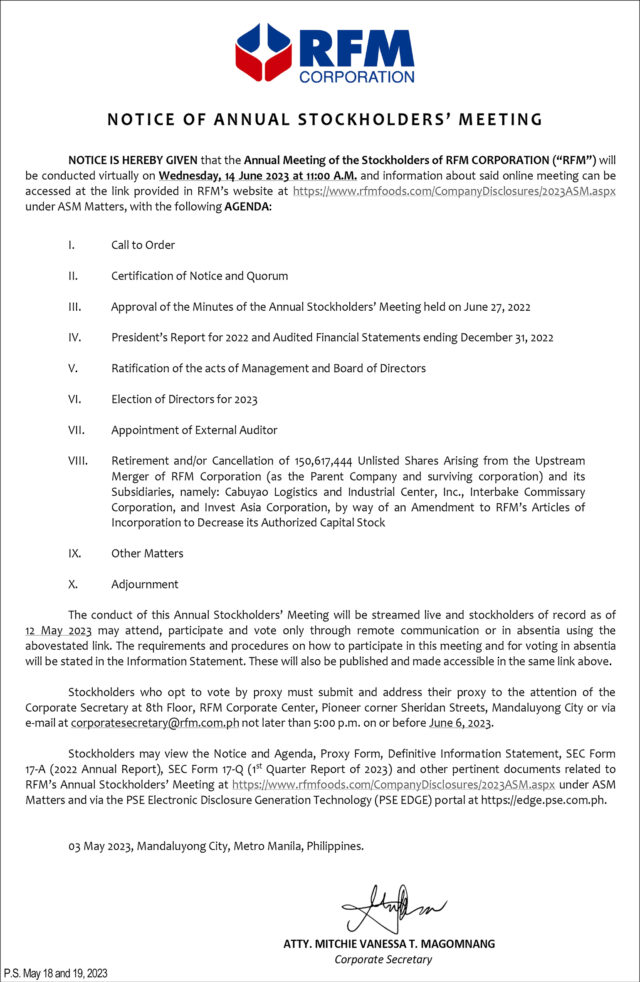
RFM Corp. to conduct annual stockholders’ meeting virtually on June 14


Spotlight is BusinessWorld’s sponsored section that allows advertisers to amplify their brand and connect with BusinessWorld’s audience by enabling them to publish their stories directly on the BusinessWorld Web site. For more information, send an email to online@bworldonline.com.

Join us on Viber at https://bit.ly/3hv6bLA to get more updates and subscribe to BusinessWorld’s titles and get exclusive content through www.bworld-x.com.

Discovery World ventures into solar

UNSPLASH

DISCOVERY World Corp. said on Thursday that its executive committee had approved the subscription to the capital stock of its subsidiary that will hold solar energy assets.

In a regulatory filing, the company said its executive panel in a meeting on May 18 cleared the move, identifying the unit as Viper Energy Corp., which it will fully own.

It described Viper Energy as “a holding company primarily for solar energy assets in its operating sites and also for future solar energy projects” that the group may undertake.

Discovery World, which is engaged in the hotel and resort business, will subscribe to 2 million shares of the unit with a par value of P1.00 each or a total of P2 million. The subscription is subject to the Securities and Exchange Commission’s approval of the incorporation of Viper Energy.

Discovery World develops, invests in, owns, acquires, administers, constructs and operates hotels, resorts, apartelles, condominiums, townhouses, buildings, and other tourist-related structures.

As of last year, the company derived its revenues from the operations of Discovery Shores Boracay, Club Paradise, Shoppes at Vanilla Beach, Discovery Fleet, and Discovery Hospitality. 

In the first quarter, it trimmed its net loss attributable to the parent firm’s shareholders to P18.86 million, down from a loss of P43.66 million, after its revenues nearly doubled to P247.94 million.

The bulk of its first-quarter top line came from room revenues at P181.72 million, up 91.4% from P94.94 million in the same period last year.

In its quarterly financial report, the company said it saw steady growth in domestic tourism resulting in an increase in the group’s hotel and resort occupancies.

It added that with the gradual return of foreign tourists in the local market, the company is “in a good position to recover from the pandemic and sees an upward economic trajectory in the years ahead.”

Discovery World said it was preparing for the launching of a new 11-hectare real estate development project “in the southern region of the Philippines.”

On Thursday, shares in the company fell by 4.58% or P0.07 to close at P1.46 each.

The new Kardashians? Sylvester Stallone and family star in reality TV show

REUTERS

NEW YORK — Hollywood star Sylvester Stallone has a new project — starring in his own reality TV show with his family. 

The veteran Rocky and Rambo actor, his wife Jennifer and their three daughters -— Sophia, Sistine, and Scarlet — are following in the footsteps of other celebrity families such as the Osbournes and Kardashians, in having cameras follow them as they go about their daily lives. 

The Family Stallone, which premieres on Paramount+ this week, features scenes of Mr. Stallone on set filming television series Tulsa King as well as at home with his family. There are celebratory moments as well as more intimate family scenes. 

“So what you see here is what you get. This is what we’ve been wanting to do for a long time, which is share our life a little bit because it’s entertaining,” Mr. Stallone told Reuters in a joint interview with Jennifer and their daughters. 

“It also has a message that no matter what you have, we may have all the trappings of wealth and we’re very fortunate, we still have the same issues and the same wants and the same needs and the same requirements for love and so it’s there for everyone to see.” 

The family said the idea for the show stemmed from Sistine and Sophia’s podcast Unwaxed. 

“We’ve featured our whole family on it and everyone was so shocked that they were just so funny and relatable and gave great business advice,” Sistine said. “I think people just kept wanting to see more and more.” 

Asked about comparisons to hit show The Kardashians, Stallone said: “I think the Kardashians were brilliant in what they did and very original, we’re taking a different tack. But the main thing is you don’t try to copy someone. That’s who they are, we are who we are and that’s what I think gives the audience a variety.” — Reuters 

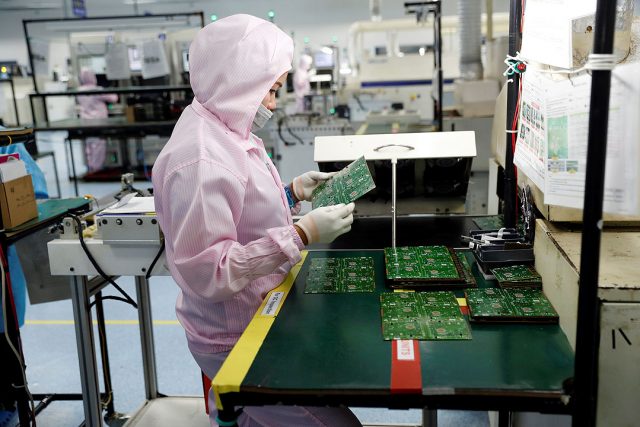
Labor says manufacturing best bet for job creation

REUTERS

By John Victor D. Ordoñez, Reporter

THE GOVERNMENT needs to further support manufacturing to boost job creation and improve job quality, labor groups said.

“Only through industrialization can we push our economy to a higher level, create more productive and supposedly decent jobs and make it possible for us to realize full employment,” Josua T. Mata, secretary general of Sentro ng mga Nagkakaisa at Progresibong Manggagawa, said in a Viber message.

He was reacting to a May 16 Pulse Asia survey which indicated about 90% support for strengthening industry.

Some 61% of the respondents also supported more upskilling and reskilling programs for workers, while 50% backed more incentives to remain competitive with other countries.

“We (also) believe that the manufacturing sector will generate more livelihood opportunities and quality jobs,” Jose G. Matula, president of the Federation of Free Workers (FFW), said in a Viber message.

Mr. Matula said the government should embrace technology that raises manufacturing productivity, such as automation and artificial intelligence.

Mr. Matula proposed tax breaks and subsidies to encourage domestic and foreign investment in manufacturing.

“A robust industrial policy concentrating on the revival of the home-grown manufacturing industries and development of the agricultural sector is a step in the right direction for the economy,” Renato B. Magtubo, chairman of Partido Manggagawa, said in a Viber message.

Stratbase ADR institute President Victor Andres C. Manhit on Wednesday called for the government to prioritize attracting manufacturing investment.

“We can sustain economic gains by being more focused on investment,” he said at a webinar on Tuesday. “Part of that is… to reinvigorate the manufacturing sector.”

Month on month, manufacturing employment grew by 102,000 jobs in March.

The jobless rate in March eased to 4.7% from 4.8% a month earlier. Job quality improved that month as the underemployment rate — a measure of workers seeking further employment or longer hours — fell to 11.2%, the lowest level in 18 years.

“FFW calls for continued investment in infrastructure development, including reliable power supply, efficient transportation networks, and well-equipped industrial zones, which are crucial for the growth and competitiveness of the manufacturing sector,” Mr. Matula said.

ADVERTISEMENT
ADVERTISEMENT