Home Blog Page 476

Suzuki PHL, DES Strong Motors join Int’l Coastal Cleanup activity

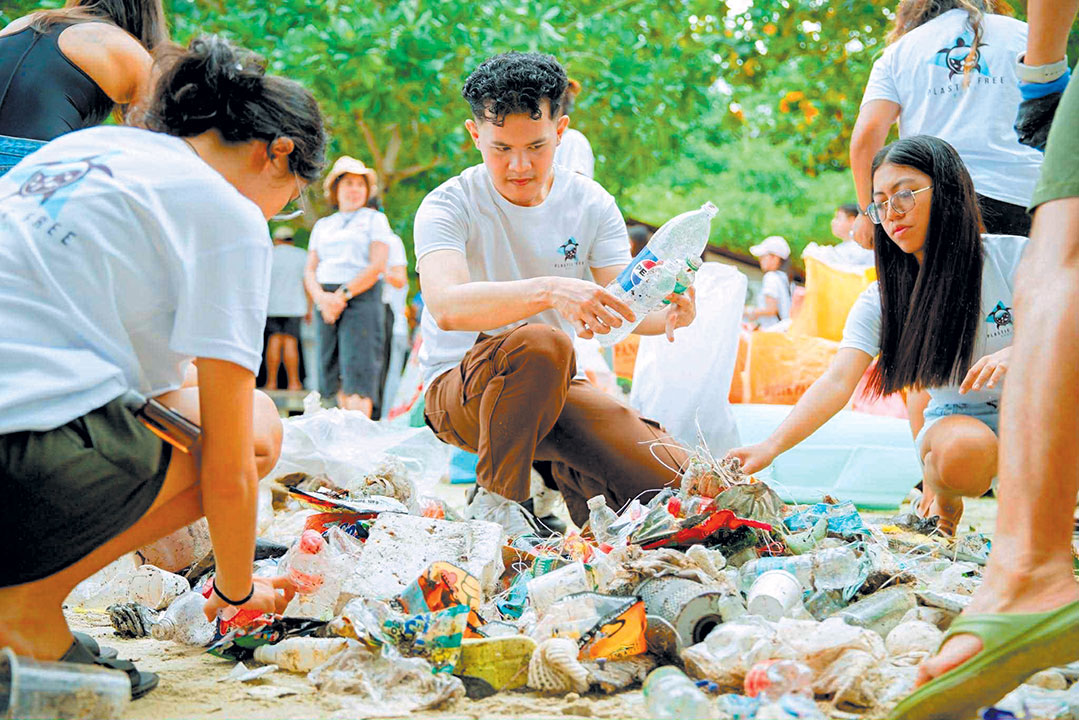
More than 1,200 participants were engaged in separate activities: coastal cleanup, marine debris removal, and segregation and audit. — PHOTO FROM SUZUKI PHILIPPINES, INC.

SUZUKI PHILIPPINES, INC. (SPH), through the united efforts of its Marine, Automobile, and Motorcycle divisions, joined the International Coastal Cleanup (ICC) Drive 2025 held recently in Panglao, Bohol. In partnership with DES Strong Motors Corp., Suzuki’s authorized dealer of Suzuki Marine, Automobile, and Motorcycle products in the area, the initiative underscored Suzuki’s strong advocacy for environmental stewardship and sustainable community engagement.

This year’s ICC, spearheaded by The Bellevue Resort in Panglao, brought together more than 1,200 participants ranging from students, community groups, and local government units to other like-minded companies and organizations. “The strong presence of the youth highlighted the importance of environmental awareness and the need for collective action in safeguarding our natural resources,” said Suzuki Philippines.

Representing the company were Suzuki Philippines General Manager for After-Sales Service and Marine Division Yukio Sato and Suzuki Philippines Director and General Manager for Automobile Division Norihide Takei. They actively joined employees of DES Strong Motors during the cleanup, which was carried out through three focused efforts. The Doljo Beach Team conducted a two-kilometer shoreline sweep, the Underwater Team worked on marine debris removal, and the Segregation and Audit Team, led by Plastic Free Bohol, ensured proper waste classification.

The collective effort resulted in the recovery of 194 sacks of non-biodegradable waste weighing 954.38 kilograms, composed of plastics, glass, metal, and hazardous materials. Proper handling and disposal were facilitated with the support of the Panglao LGU.

Beyond being a cleanup, the event became a shared experience of responsibility and unity for the environment. Participants exchanged stories, took part in engaging activities, and received Suzuki merchandise as tokens of appreciation.

Massive corruption amidst ‘open government’

STOCK PHOTO | Image from Freepik

At the Open Government Partnership (OGP) Global Summit on Oct. 9, the Philippine government, represented by Budget Secretary Amenah Pangandaman, accepted an award “for its commitment to improve data availability, interoperability, and public participation in procurement” in the Asia and Pacific Region. The Philippines was also the winner in the OGP’s anti-corruption category.

This is the biggest irony, however — while the Marcos administration accepted these awards, it is also receiving massive backlash over the largest corruption scandal in Philippine history.

The OGP was launched in 2011 with the Philippines as one of eight government members of the steering committee. Nearly 15 years later, the Philippines has still failed to adequately meet two of four OGP “Core Eligibility Criteria” for membership — “Asset Disclosure” and “Access to Information.” A third eligibility criteria — “Fiscal Transparency” — has turned into a myth, too, given recent exposs on unprogrammed funds and congressional insertions used for corruption in flood control projects and perhaps other expenditure items. It has failed to inspire strong traction on the fourth eligibility criteria of “Citizen Engagement.”

On Sept. 16, 2011, before the OGP launch in New York, the Right to Know, Right Now! (R2KRN) Coalition had called out the Philippine government in a statement titled “Double Talk on FOI: Gov’t long on promises, short on political will.” In it, the R2KRN pointed out the striking irony of the Philippines committing to the OGP while refusing to pass a Freedom of Information (FOI) law. Years later in 2020, the Office of the Ombudsman put the asset records of senior public officials under lock and key. The irony and double talk on OGP linger to this day in the Philippines.

The OGP had the effect, perhaps unintended, of posing new challenges to the homegrown FOI movement. It disproportionately promoted Western-driven frameworks of open budget and open data. International support and technical assistance, at least in the Philippine case, shifted strongly toward fiscal openness and data platforms and ignored nationally grounded right-to-information advocacy and practice. It may well be the shared experience of other national FOI movements.

OGP’s stress on “open data” and “national action plans,” which are hardly vetted among broad numbers of citizens, are useful only to a limited extent. They have proffered them as the dominant frame for “openness,” or the visible and supposedly measurable proof of reform.

The downside is that the OGP has de-emphasized the hard political work of guaranteeing access to information by law and citizen practice. Supposedly strong performance on disclosure and budget scorecards has come with weak gains on legal rights and participatory practice. The outcome, therefore, has been uneven — governments claim star-performance reforms by OGP’s limited metrics, even as citizens have yet to see their real and meaningful impact, by the OGP’s “Grand Values” notably: Improving Public Services, Increasing Public Integrity, More Effectively Managing Public Resources, Creating Safer Communities; and Increasing Corporate Accountability.

Today, the Philippines ranks high in the Open Budget Survey on Oversight and Transparency, but dismally low on Public Participation. This confirms what we see on the ground: budgets may be disclosed, but governance is not truly open. Citizens still lack a fully operational legal guarantee of their right to information, and participation remains tokenistic.

From these, what emerges is a budget cycle with strong built-in safeguards, by law, but distorted and porous and systemically gamed and captured by crooks, in practice:

Preparation and authorization: congressional “insertions” and ballooning unprogrammed appropriations redirected funds away from public priorities. Even balances of government corporations like the Philippine Health Insurance Corp. or PhilHealth were swept away from their intended purposes, and likely diverted towards pork barrel allocations.

Execution: Procurement safeguards have collapsed into collusion. “In-house” contracting by Department of Public Works and Highways insiders, license-lending for royalty fees, and simulated bidding turned competition rules into farce.

Accountability: Oversight bodies have been compromised. Portions of project funds were allegedly set aside for auditors, and even a Commissioner of the Commission on Audit has been implicated in soliciting projects.

In short, every safeguard of the budget cycle has been bent by the very actors entrusted to enforce them. The checks and balances that have been touted by the OGP and the Department of Budget and Management — as the Philippines’ OGP steering committee chair — have become opportunities for plunder. This bantay-salakay dynamic, where watchmen turn raiders, has hollowed out the system.

Just as important, it is most concerning that amid this festering discourse on corruption, OGP Philippines has been silent, unable or unwilling to collectively confront the incessant public rebuke of how its member agencies from government may have had a role in the plunder.

The consequences are concrete: Ghost projects, substandard infrastructure projects, and wasted funds that directly endanger the safety and lives of citizens.

This is a danger we see for OGP as well: It might just serve governments as a convenient shield to flaunt that they are scoring quite well internationally, even while betraying true openness and accountability at home. We earnestly hope that this will not be the tragedy of OGP: Heroes elsewhere, heels in their home territory.

We share these reflections not to diminish the OGP’s value, but to exhort it to reflect once again its founding principles and promises.

Open government must begin with the people’s right to know. Open budgets and open data are valuable tools, but they cannot substitute for legally guaranteed and operational access to information and genuine citizen power in decision-making.

OGP’s value will be greatest when it deepens the power of citizens to hold institutions to account, not when it serves as an international certificate that paper and digital records exist while rights and participation remain weak.


Jenina Joy Chavez, Nepomuceno Malaluan, And Malou Mangahas are co-convenors of the Right to Know, Right Now! (R2KRN) Coalition.

Grandeur and good

THE RED CHARITY GALA 2025 featured renowned designer Rhett Eala (third from the left) with the co-founders Kaye Tinga (second from left) and Tessa Prieto (third from right), joined by Piolo Pascual (second from right), Ben Chan (rightmost), and model Jasmine Maierhofer (leftmost).

THE RED CHARITY GALA on Oct. 4 raised funds for the Assumption HS ’81 Foundation, Hope for Lupus Foundation and the Philippine Red Cross; and also for the survivors of the recent earthquake in Cebu. Jewelry, art, and vacations were auctioned off for several hundred thousands of pesos at The Manila Peninsula’s lobby, and guests were treated to a fashion show by Rhett Eala at the Rigodon Ballroom.

Rhett Eala celebrated 35 years in fashion at the show, showing off a few signatures and then a little bit of something new. Having studied in Europe and worked for a bit in New York, in the 1990s, he began a line at Rustan’s, and then started dressing celebrities, socialites, and beauty queens.

The show began with a feathered skirt, a ruffled trailing cape, and his signature tassels. There were hints of 1950s Balenciaga in a baby doll dress, followed by a white asymmetrical dress in a crumpled fabric, then ruched at the headline. This was followed by a black version — the initial palette was in black and white, inspiring visions from the Ascot scene in 1964’s My Fair Lady.

We saw a rather shapeless pinstripe jumpsuit on a man, a lovely pleated white dress with a pink sash, and a dress with a balloon-hem bodice paired with a wide skirt. There was definitely a touch of vintage here: think gold vines on a black drop-waist robe de style.

We could see his signatures — several of his gowns at the show featured his trademark fringe and tassels, showing verve and life with every movement. It’s remarkable — in a lot of Mr. Eala’s clothes, there’s life even in the drabbest grays (evident in a silk moire gown accented by a lime green sash). Mr. Eala also played a bit with yin and yang, seen in black and white mirrors of the same dresses, and as seen in cage dresses (an innovation for him).

We saw a lot of attention to detail, evident in all-over pleats and jackets shaped to look like roses.

The show moved on to brighter colors later, evident in a shiny peacock-colored tiered fringed flapper gown, as well as three strapless dresses accompanied by hooded cloaks, in the gradient colors of the sunrise. We particularly liked a red tiered fringe dress, accessorized with a red fan in the shape of lips.

There was a bit of commotion on the runway when actor Piolo Pascual walked out in a blue velvet jacket. Titas screamed, and even former Miss Universe and patroness of the arts Margie Moran had to crack a smile.

The show ended with a model in a gown almost like a qipao, with the mandarin collar and a slit down the bust, in red silk moire accessorized by puffed lilac gauntlets and a magenta hat. Mr. Eala came out on the runway to a trance-y remix of the Eraserheads’ “Alapaap.”

In an interview backstage, he said of his designs that night, “It’s about my past life, and my life now. My old silhouettes, which I was known for, and then I introduced new silhouettes.” — JL Garcia

SEC clears Megawide’s P2.97-B preferred shares offering

MEGAWIDE.COM.PH

THE Securities and Exchange Commission (SEC) has approved Megawide Construction Corp.’s follow-on offering of up to 20 million preferred shares.

In a meeting on Oct. 9, the Commission En Banc rendered effective the company’s registration statement, with an oversubscription option of up to 10 million additional shares, subject to Megawide’s compliance with certain remaining requirements, the SEC said in a statement on Friday.

The preferred shares are cumulative, non-voting, non-participating, non-convertible, redeemable, and perpetual, and will be offered at up to P100 apiece.

If fully subscribed, the offering is expected to generate net proceeds of up to P2.97 billion, which Megawide intends to use for debt refinancing, partially financing projects in the pipeline, and general corporate purposes.

The offer period is scheduled from Oct. 30 to Nov. 10, with listing on the Philippine Stock Exchange’s main board targeted for Nov. 19, according to the latest timetable submitted to the SEC.

PNB Capital and Investment Corp., RCBC Capital Corp., and Security Bank Capital Investment Corp. will serve as joint issue managers, joint lead underwriters, and joint bookrunners for the offering.

At the local bourse on Friday, Megawide’s shares rose by four centavos, or 1.33%, closing at P3.05 apiece. — Alexandria Grace C. Magno

Brazil green coffee exports fall 18% in September

REUTERS

SAO PAULO — Brazilian green coffee exports fell some 18% in September compared to the same month a year earlier, totaling 3.45 million 60-kg bags, exporters’ group Cecafe said, as the impact of US tariffs reduced shipments.

Brazil, the world’s top coffee producer and exporter, shipped 2.97 million bags of arabica beans abroad last month, down around 10% year on year, while exports of the robusta variety tumbled some 47% to near 489,700 bags.

Cecafe head Marcio Ferreira said in a statement a decline was already expected given the rough yearly comparison, as Brazil exported a record coffee volume in 2024.

“The decline was exacerbated by the 50% tariff imposed by US President Donald Trump on Brazilian coffee,” Mr. Ferreira added, noting the US was traditionally the main importer of Brazilian coffee.

The US however, which had already lost the lead to Germany in August, when the 50% tariffs imposed by Mr. Trump on the imports of most Brazilian goods took effect, was also outpaced by Italy in September, Cecafe said.

Brazil’s coffee exports to the US fell almost 53% from a year earlier in September, to around 333,000 bags, according to Cecafe data, including green and industrialized coffee.

Despite that, in the year through September, the US still holds the position as the main buyer of the Brazilian coffee. — Reuters

Peso may trade sideways as markets eye US

PHILIPPINE STAR/ MIGUEL DE GUZMAN

THE PESO may move sideways against the dollar this week as players await developments regarding the US government’s ongoing shutdown.

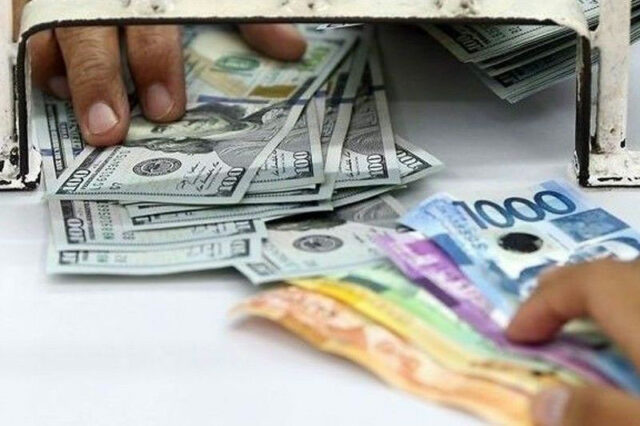
On Friday, the local unit closed at P58.24 per dollar, slipping by half a centavo from its P58.235 finish on Thursday, data from the Bankers Association of the Philippines showed.

Week on week, the peso fell by 36.5 centavos from its P57.875 close on Oct. 3.

“The dollar-peso closed a tad high, initially going up to a P58.43 high, tracking the dollar’s dollar strength amid political uncertainty in Japan and France,” a trader said in a phone interview.

However, the yen later recovered due to verbal cues from the Bank of Japan on possible intervention in the foreign exchange market, the trader added.

In the Asian session, Japan’s yen was jolted out of its slide and the Nikkei dropped 1% on news the Komeito party was quitting its coalition with the Liberal Democratic Party, Reuters reported.

Later in the day, the dollar index, which measures the greenback against a basket of currencies including the yen and the euro, fell 0.41% to 98.98, with the euro up 0.41% at $1.161. Against the Japanese yen, the dollar weakened 0.71% to 151.98.

The peso also remained under pressure on Friday following the Bangko Sentral ng Pilipinas’ (BSP) surprise move to cut rates on Thursday, Rizal Commercial Banking Corp. Chief Economist Michael L. Ricafort said in a Viber message.

For this week, the trader said the foreign exchange market will monitor developments in the US as its government remains closed in the absence of a spending plan. Players will also look for leads from US economic data releases and comments from US Federal Reserve officials over the weekend.

The trader sees the peso moving between P58 and P58.50 per dollar this week, while Mr. Ricafort expects it to range from P57.90 to P58.40.

The US government remains shut as a congressional impasse has so far yielded few signs of progress or serious negotiation. This has resulted in a data blackout, with official government economic indicators postponed for the time being.

Still, data from independent sources continues unabated. The University of Michigan released its preliminary take on October consumer sentiment, which is drifting along near historic lows as high prices and weakening job prospects remain at the forefront of consumer worries.

In the absence of official data, investors look to the US Federal Reserve for clues regarding near-term interest rate cuts.

Fed Governor Christopher Waller said that while private employment data continues to show labor market weakness, the central bank should act with caution when reducing the Fed funds target rate as it evaluates the economy.

St. Louis Fed President Alberto Musalem echoed that sentiment, saying that another rate cut could be warranted as insurance against a weakening labor market. “I believe that we have to tread with caution” before monetary policy becomes too accommodative, he said. — A.M.C. Sy with Reuters

How Minimum Wages Compared Across Regions in September

(After Accounting for Inflation)

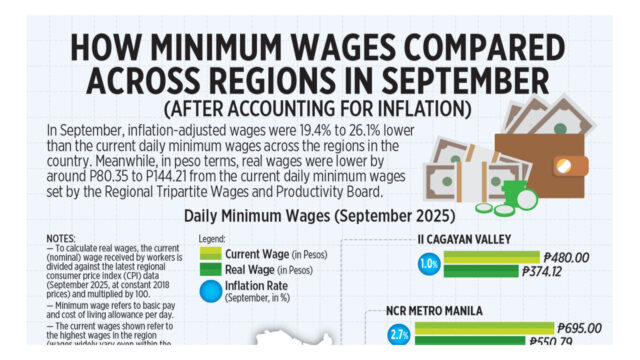
In September, inflation-adjusted wages were 19.4% to 26.1% lower than the current daily minimum wages across the regions in the country. Meanwhile, in peso terms, real wages were lower by around P80.35 to P144.21 from the current daily minimum wages set by the Regional Tripartite Wages and Productivity Board.

How Minimum Wages Compared Across Regions in September

HMPH holds ‘Hyundai Cars and Hoops’

Team Hyundai Philippines participants at the basketball court of the Parqal Mall in Parañaque City — PHOTO FROM HYUNDAI MOTOR PHILIPPINES

HYUNDAI MOTOR PHILIPPINES, INC. (HMPH) recently hosted “Hyundai Cars and Hoops,” a lifestyle event that “fused the passion for cars with the excitement of the country’s most beloved sport.” Held at the Parqal Mall in Parañaque City, the event gathered members of Team Hyundai Philippines (THP) in celebration of the car club’s 16th year.

The activity “showcased the vibrant culture of local Hyundai enthusiasts through a car meet,” while also highlighting some Filipino-style basketball via three-on-three matches. Attendees also had the opportunity to have their vehicles checked for free by expert and certified Hyundai technicians, experience Hyundai’s latest models first-hand with test drives of the Elantra N Line and Santa Fe Hybrid, as well as enjoy interactive indoor games and activities over coffee.

“We at HMPH are proud to celebrate community, especially with our beloved car club, Team Hyundai Philippines. Through ‘Hyundai Cars and Hoops,’ we are able to recognize the strong bond within THP while also highlighting the fun and dynamic lifestyle that comes with being part of the Hyundai family — showing that our brand brings unique experiences and aligns with the various lifestyles of our customers,” said HMPH Managing Director Cecil Capacete.

Return stolen wealth to the people

STOCK PHOTO | Image by Vectorjuice from Freepik

The Parish of San Pascual Baylon and the National Shrine of Nuestra Señora de la Inmaculada Concepcion de Salambao in Bulacan announced that they will be returning a Nissan Navara pick-up truck donated by former Department of Public Works and Highways (DPWH) 1st District Engineer Henry Alcantara, following reports linking him to alleged corruption in government flood control projects.

Radio Veritas Asia reported on Sept. 23 that the parish accepted the vehicle on June 1, 2024, “in good faith” — to help facilitate the pilgrimage of the image of the Virgin of Salambao to different parishes. “We are now taking the necessary steps to return it properly, to the rightful person, or institution, through the appropriate legal process. This decision follows the guidance of the Diocese of Malolos and the Catholic Bishops’ Conference of the Philippines.” It added that “If this caused concern to the Church and the faithful, we sincerely apologize.”

The parish does not know if Alcantara’s donation of the pick-up truck had anything to do with the raging controversy over anomalous flood control projects, which first came to light during President Ferdinand Marcos, Jr.’s State of the Nation Address (SONA) on July 28.

Mahiya naman kayo (You should be ashamed),” President Marcos said in his SONA, referring to contractors and officials involved in kickbacks linked to failed flood control projects. He spoke during the season for typhoons and the monsoon rains, which severely flooded Metro Manila and many other areas in the country.

Senator Panfilo Lacson publicly stated on July 25, that “as much as half of the P2 trillion ($40.61 billion) allocated for flood control over 15 years may have been lost to corruption, with only 40% of project funds translating into actual construction.” Suspicions were drawn to the P142.7 billion ($2.9 billion) insertion in the 2025 national budget, allegedly added during a conference led by former Senate President Francis Escudero (Philippine Daily Inquirer, August).

On Aug. 11, Mr. Marcos Jr. revealed the initial findings from an audit which found that P100 billion ($2.03 billion), or around 20% of his administration’s flood control project expenditures, went to only 15 contractors from a total of 2,409 accredited contractors for both local and national flood control projects. The audit also flagged projects collectively worth more than P350 billion ($7.11 billion) which did not specify the exact flood control structure built or repaired, as well as several projects at different locations which disclosed identical designs and materials, the Presidential Communications Office (PCO), reported.

The viral “lifestyle” videos of rags-to-riches contractor-couple Curlee and Sara Discaya — with their 40 luxury cars garaged under a multi-storey Great Gatsby-esque mansion — and stories of other contractors who got fantastically rich, built up the intense drama. The public has become aware of the flood control modus operandi and the individuals who are alleged to have perpetuated the stealing and looting of government funds in the DPWH. The televised Senate Blue Ribbon Committee hearings brought revelations of involvement of government functionaries and lawmakers, and elicited self-incriminating confessions from the contractors themselves, as political adversaries not too subtly cast aspersions on each other. “Sharing schemes,” commissions, and bribery were detailed, such that quarrels started among the lawmakers implicated versus the accusative “clean” ones.

“The six construction companies founded by the Discaya couple and their son bagged 345 solo and joint projects worth a whopping P25.2 billion. That’s three times the P8.6 billion allocated for ‘housing and community amenities’ in the proposed 2025 budget. Taken together, all nine Discaya-linked companies bagged 421 projects totaling P31 billion. That’s more than the annual net revenues clocked by Ayala Land in recent years,” the Philippine Center for Investigative Journalism (PCIJ) said in its Aug. 8 estimates of the magnitude of the flood control anomalies. Their collection of over 40 luxury vehicles was estimated by Philstar.com to be worth between P337 million and P465 million.

The family and relations of Ako Bicol congressman Zaldy Co with their four linked companies bagged 149 flood control contracts worth P15.7 billion between 2022 and 2025, the PCIJ tallied in the same report. “A niece, Claudine Co, described by entertainment site PEP as a vlogger-influencer-singer, known for her travel diaries, fashion hauls, and everyday glimpses of luxury, lives a royal lifestyle that includes a P25-million Mercedes Benz SUV, rides on private planes, and apartment hunting in Paris.”

On Oct. 4, new DPWH Secretary Vince Dizon (who replaced Manuel Bonoan who had resigned) announced the referral of cases of bid manipulation and bid rigging to the Philippine Competition Commission (PCC) for the possible filing of charges under Republic Act 10667. The cases involve 12 flood control projects of five contractors. Among them are the Discayas, who could face fines totaling as much as P300 billion due to bid rigging in 1,200 flood control projects, the DPWH was quoted as saying in The Philippine Star.

“Baguio City Mayor Benjamin Magalong said some lawmakers are paid 30% to 40% of the contract costs by well-connected firms that bag contracts. According to [Senator Panfilo] Lacson, some legislators got kickbacks from congressional insertions and unprogrammed appropriations for public works projects in the national budget,” the PCIJ reported.

At least 18 members of the 20th Congress have ownership or other connections to companies that have public works contracts. PCIJ’s initial list (tallied from the exposés of witnesses in the Senate Blue Ribbon Committee) includes six senators, 15 congresspersons, and nine government officials who had control or influence over the operations of the flood control projects.

On Oct. 6, “a ‘frustrated’ Senator Panfilo Lacson resigned as Chairman of the Senate Blue Ribbon Committee,” the Philippine Star announced. In a letter, Mr. Lacson wrote, “In the course of the current investigation, which has implicated some senators in the flood control mess, a number of our colleagues have expressed disappointment with the ‘direction’ of the Blue Ribbon Committee.” Some senators accused him of “zeroing in” on colleagues while protecting House lawmakers linked to ghost or substandard infrastructure projects, an allegation Mr. Lacson denied. Senator Erwin Tulfo, Vice-Chair of the Blue Ribbon Committee, became acting Chairman.

Before Mr. Lacson, Baguio City Mayor Benjamin Magalong tendered his resignation as a special adviser to the Independent Commission for Infrastructure (ICI) on Sept. 26. “The Palace’s pronouncements concerning my designation, which run contrary to the terms of my appointment, have undermined the role and mandate entrusted to me,” Mr. Magalong wrote to Mr. Marcos Jr. Mr. Magalong might have been perceived to be coming in too strong in his personal “investigations” on the flood control scams.

In one of his last acts as Secretary of Justice (before he was appointed Ombudsman on Oct. 9), Jesus Crispin Remulla signed an Immigration Lookout Bulletin Order (ILBO) on 33 incumbent and former members of Congress, private individuals, and officials of other government agencies implicated in the ongoing investigation into flood control anomalies. An ILBO only instructs immigration officers to closely monitor the travel of subject individuals; it is not a Hold Departure Order, which restricts travel.

The separate and official ICI, made up of Rogelio Singson, Rosanna Fajardo ,and chair Andres Reyes, Jr., will continue to hold its hearings on alleged irregularities in flood control and other public works projects despite mounting calls for transparency, the Philippine Star said.

“In a strongly worded statement (released Oct. 7) the CBCP (Catholic Bishops’ Conference of the Philippines), led by its president Pablo Virgilio Cardinal David of Kalookan, said the people are watching the probes closely, and ‘any move to change Senate leadership or redirect investigations now would only heighten public suspicion of a cover-up.’

“We urge both Congress and Malacañang to prove that they serve the common good, not partisan power. Let the truth flow freely. Let the ICI do its work — thoroughly, transparently and without fear or favor,” the CBCP said. The bishops said they “strongly oppose any attempt to preempt or derail the investigation through backroom deals, leadership takeovers or selective justice. ‘Nothing is concealed that will not be revealed, nor secret that will not be known. Therefore, whatever you have said in the dark will be heard in the light,’ the Bible says in St. Luke 8:17.”

But more than exposing the corruption, the CBCP had made clear early on that obtaining true justice for the billions of pesos lost to substandard and ghost flood control projects, does not end with those responsible going to prison. “True justice, however, demands more than punishment. It also calls for restitution: that stolen wealth be returned to the public coffers from which it was taken,” Cardinal David said.

“Many of those implicated will not be impoverished by such reparation, yet the nation remains poor if the funds are not restored. Retribution in this sense is not personal vengeance, but the rightful act of giving back what was stolen, so that the people may finally benefit from resources meant for their welfare,” he said according to the Philippine Star on Sept. 8.

Diyos ko po (Oh my God)! That might be the reason for the heightening conflicts among the “parties-in-interest” in these investigations — the retribution and restitution that must settle and close the issues. At one Blue Ribbon hearing, there was a heated exchange of intransigent stands on the return of stolen wealth or legal “forfeiture” by those found guilty, before or after the filing of court cases — the committee was sharply divided on the timing of the forfeiture, which could open “opportunities” for the accused to keep the stolen wealth — specially if the accused would be made a “state witness.”

A network of thieves and accomplices who have systematically worked out a “business model” for the plunder of the people’s money must protect and preserve themselves, perhaps cover up for each other, as Cardinal Ambo and many of the people instinctively feel. Alas, the “network” is just so finely and strongly interwoven; insecure and anxious people have many questions in their minds.

Control or power is the strongest temptation to greed, especially when there are loose administrative and operating controls. In the strict hierarchy and ranking in government, misplaced allegiances and forced deference to authority can accommodate divergence from rules and policies. “Mass cash deliveries to the now-sacked engineers of the DPWH, including P457 million last March, may signal the involvement of higher-level players in the ongoing flood control project scandal,” Senator Lacson said when he was still Blue Ribbon chair (Manila Times).

We pray to God that they return the stolen wealth to the Filipino people.


Amelia H. C. Ylagan is a doctor of Business Administration from the University of the Philippines.

ahcylagan@yahoo.com

Habi expands, diversifies in new venue

HABICOUNCIL FB ACCOUNT

THIS YEAR’S Likhang Habi Fair was bigger than before, moving from its former site in Glorietta’s activity center to the Space Events Hall of nearby One Ayala in Makati.

From the previous 100 booths, they expanded to 116, according to an interview with Rambi Katrina Lim, Secretary of Habi: The Philippine Textile Council, during the fair. The fair ran from Oct. 10 to 12.

“The reason why we moved here was because the space in Glorietta was no longer going to be available in the regular capacity because there are a lot of renovations,” she said.

More than the increased number of vendors (which also included food vendors this time, such as chef Sau del Rosario’s Cafe Fleur), there was a push for vendors to innovate: “The vendors that have been with us also diversified the products they’re selling.” We saw this in some booths, such as with Aruga Handwovens spreading out from babywearing slings and scarves to jackets and separates (related story: https://www.bworldonline.com/arts-and-leisure/2022/10/10/479386/rescuing-a-weaving-tradition-from-the-brink-of-extinction/ ).

Ms. Lim also said that they had more vendors coming from the Visayas and Mindanao regions, but also, “We’re seeing that a lot of grassroots communities are willing to invest in coming to the fair,” she said. “They see that there is potential.”

The fair also added new programs such as styling demos and talks, with topics such as the application of handwoven textiles outside fashion, the journey of entrepreneurs in that space, and young voices advocating heritage in fashion.

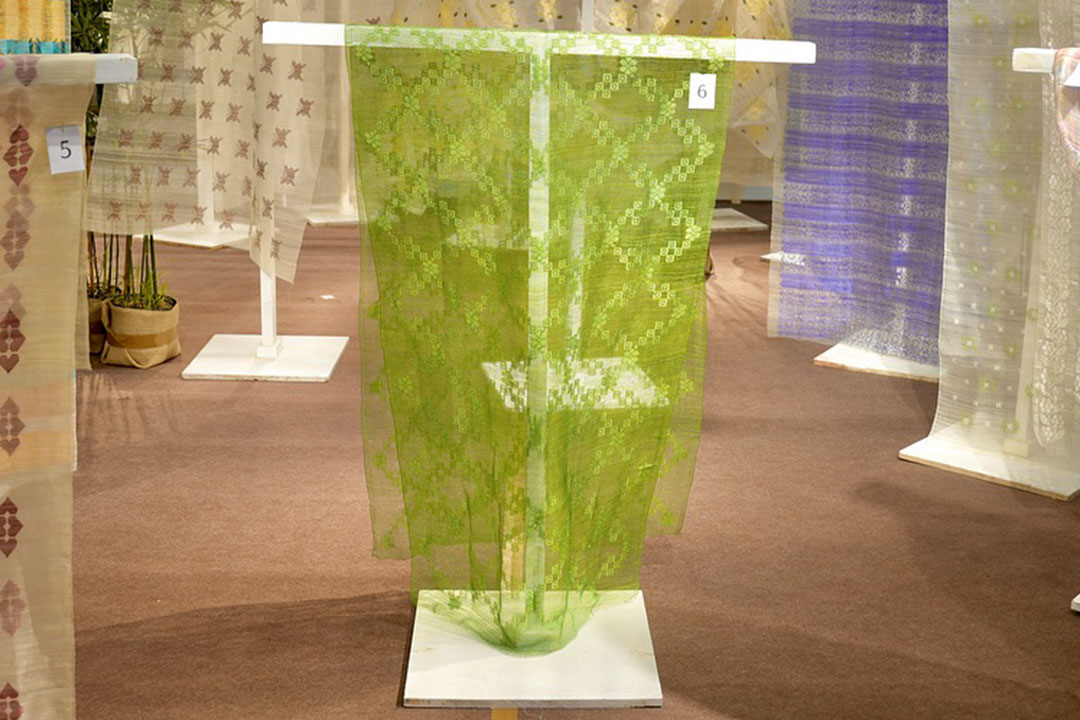
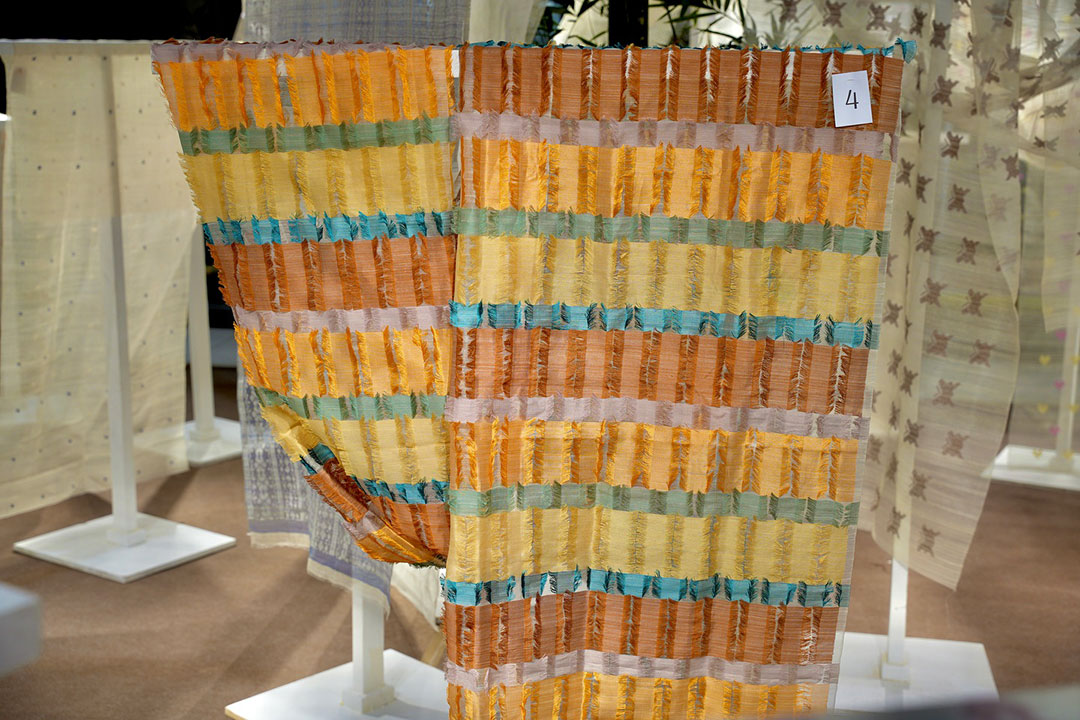
On display as well were the entries and winners of the 8th Lourdes Montinola Piña Weaving Competition and the 4th Eloisa Hizon Gomez Abaca Weaving Competition.

“The talks are also preparation — we’re hosting the ASEAN Textile Symposium in 2028,” said Ms. Lim.

Habi has already done a lot — in reviving industries and introducing new eyes to traditional craft — and it’s that that becomes the measure of their success. “The fair is a market encounter more than a bazaar. The vendors, the weaving entrepreneurs are able to meet their market. They’re able to adjust their products to what the market wants.

“It’s about purpose. It’s about relevance.”

The winners of the 8th Lourdes Montinola Piña Weaving Competition were:

• Liniwan Category – Liniwan by Rosemarie Loveras

• Pure Piña Category – Pure Piña with Dot Dots by Melanie Palmon

• Natural Fiber Blends with Piña (Seda/Jusi/Cotton/Abaca) Category – Sampaguita Bloom in Contrast by Raquel Eliserio

• Filip+Inna Innovation Award – Aurora Piña by Pablina and Jeana

• Young Weaver Award – Piña Silk Suksok with Ringgi by Zyrel A. Regusta

The winners of the 4th Eloisa Hizon Gomez Abaca Weaving Competition had yet to be announced as of press time. — JLG

PAL expects new aircraft by December or January

BW FILE PHOTO

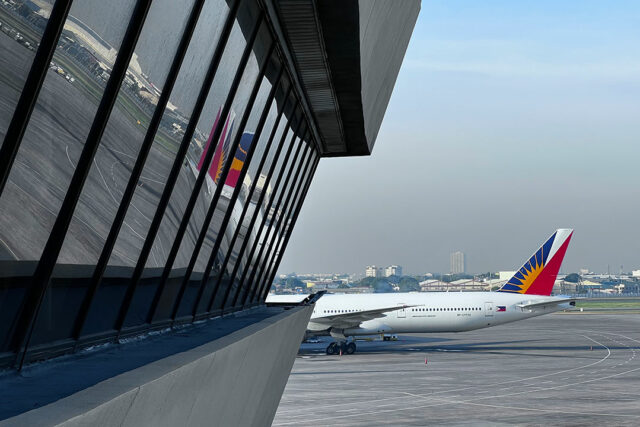
FLAG CARRIER Philippine Airlines (PAL) expects to receive its Airbus A350-1000 by December or January, as it also moves to refurbish older aircraft under its fleet modernization and growth plans.

“I think we are still working on the final delivery date, but it would be either December or January. We are still waiting for Airbus to give the final delivery date,” PAL President Richard Nuttall told reporters on the sidelines of an aviation forum last week.

The new aircraft will be deployed on flights to New York, PAL Executive Vice-President and Chief Operating Officer Carlos Luis L. Fernandez said.

In May, the airline said it was preparing for the delivery of nine Airbus A350-1000s and 13 A321 New Engine Option (NEO) aircraft, which will be deployed on nonstop flights to North America and other international destinations.

The company is also planning to refurbish all of its older fleet, Mr. Nuttall said, noting that it has started the refurbishment of its Airbus A321ceo aircraft.

Last month, PAL began deploying its first refurbished aircraft as part of a retrofitting program that will see 18 planes operating across Asia through 2027.

The program covers 18 Airbus A321ceo aircraft, which will operate on routes to Tokyo (Haneda and Narita), Osaka, Jakarta, Bali, and Guam starting this year, and on other key markets in PAL’s Asian network by 2026-2027.

PAL has said the rollout is part of its fleet modernization program, with three refurbished aircraft scheduled this year, nine by 2026, and six in 2027.

“After that, we are going to be looking at the 330s and 777s. It is going to probably take about three years before we can start… We got the same supply chain issues on engines and everything else. As soon as those seats are available, we will be refurbishing and we are looking at doing it on 330s and 777s,” Mr. Nuttall said.

For the planned refurbishment of Airbus A330 and Boeing 777 aircraft, Mr. Nuttall said initial estimates are between $14 million and $15 million for the Airbus A330 and more for the Boeing 777.

“It is still a lot of money, but it is cheaper than buying a new aircraft,” he said.

PAL is also planning to launch new routes and increase frequencies to some domestic points.

“We are strengthening Manila’s long-haul and regional banks, while building Cebu into a true inter-island and international hub. This means not only operating long-haul flights but also expanding domestic services that feed into our international waves,” Mr. Fernandez said at a forum.

He said PAL will open new connections such as Cebu-Guam, Cebu-Calbayog, and increase flights from Cebu-Siargao and Cebu-Busuanga.

“We do have the ability to adjust to the demand. The domestic has been booming,” Mr. Nuttall said. — Ashley Erika O. Jose

Malaysian coffee chain plans investment of P400 million for Visayas-Mindanao expansion

MALAYSIA’s OldTown White Coffee said it is investing P400 million to expand its footprint in the Visayas and Mindanao over the next five years.

“The investment will cover the opening of 20 OldTown White Coffee outlets, with 10 planned for Mindanao and 10 for Visayas,” Del Mundo Group, which is the Philippine licensee of the coffee chain, said in a statement sent over the weekend.

Originating from Ipoh, Malaysia, the coffee chain operates over 200 outlets in Malaysia and is also present in Singapore, Indonesia, and Hong Kong.

“We are optimistic about our continued expansion in the Visayas and Mindanao, especially in Zamboanga, which we see as a growing hub for business and tourism,” according to Nelson del Mundo, chief executive officer of Del Mundo Group.

“We believe that bringing our trusted restaurant concepts here will not only create jobs and opportunities for local communities but also contribute to the area’s vibrant dining landscape,” he added.

The company recently opened a first store on Pasonanca Road in Tumaga, Zamboanga City.

“This expansion represents more than just growth — it’s about sharing a beloved café experience that blends heritage, comfort, and community,” Del Mundo Group Chief Operating Officer Matt Ablis said.

“We are excited for Zamboangueños to experience OldTown’s signature coffee and meals that celebrate both tradition and modern taste,” he added.

Del Mundo Group also operates brands such as Mesa Filipino Moderne, Ramen Bari Uma, Buchiton, Hayashi Yakiniku, and South Korea’s Cravy. — Justine Irish D. Tabile