Home Blog Page 477

1,400 pass PMA entrance exams

BAGUIO CITY — More than 1,400 passed this year’s nationwide entrance examinations for the Philippine Military Academy (PMA), with young women claiming the top spots.

Leading the list of over 1,400 successful examinees is Amanda Isabel T. Guzman from the Philippine Science High School in Bicol Region.

Out of 33,640 online applicants, 24,671 who qualified took the exam between July and September 2025 in 48 testing centers across the country.

A total of 1,436 passed, giving a 5.82% passing rate — an increase from last year’s 5.02%. This rise reflects a growing interest among the youth to serve in the Armed Forces of the Philippines (AFP).

Also among the top three were Gwen Kyla P. Phalashol from the Philippine Science High School – Central Mindanao Campus and Aafia Khim Alzeynaah P. Lomondaya from Albert Einstein School Inc.

Their achievements highlight the increasing presence and excellence of young women in military leadership paths.

The successful examinees will now move on to a strict selection process that includes medical, physical, and psychological evaluations.

Those who will be accepted will belong to the PMA Class of 2030, which will begin training in May next year. — Artemio A. Dumlao

Couple missing in Bukidnon

Emergency responders continued search on Sunday afternoon, Oct. 19, for the couple buried in a landslide in Manuel Quezon, Bukidnon. — PHOTO FROM MANUEL QUEZON MUNICIPAL DISASTER RISK REDUCTION AND MANAGEMENT OFFICE

COTABATO CITY — Rescuers are searching for a couple in a tricycle that fell from a stretch of a highway on a high ground in Manuel Quezon, Bukidnon late on Saturday after a heavy downpour in the area.

Officials of the Manuel Quezon Municipal Disaster Risk Reduction and Management Office and the Bukidnon Provincial Police Office separately told reporters at noon on Sunday, that Ely S. Ubatay and his wife, Thelma B. Ubatay, were in their green tricycle, on their way home to Barangay Kahusayan in nearby Kitaotao town in Bukidnon, when a portion of the highway in the Overview Area in Barangay Palacapao suddenly collapsed.

The soil and rocks from the steep side of the highway fell, along with the tricycle of the Ubatays, into a lowland some 90 meters below.

Rescuers had found the damaged tricycle of the Ubatays partly covered by debris from the high side of the thoroughfare and were still searching for the two of them until Sunday afternoon.

Units of the Police Regional Office-10 and the Bureau of Fire Protection in Bukidnon have teams assisting in the search and rescue operation of the Manuel Quezon local government unit. — John Felix M. Unson

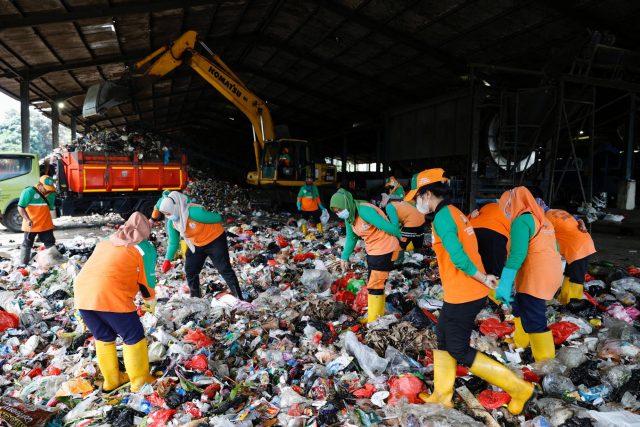
Pioneer incentives eyed for waste-to-energy projects

REUTERS

THE DEPARTMENT of Energy (DoE) is looking to grant incentives for pioneering waste-to-energy (WTE) projects, including exemptions from the competitive selection process (CSP) and priority dispatch on the spot market.

In a draft circular, the DoE is proposing that pioneer WTE projects be exempt from CSP regardless of capacity. The CSP policy requires distribution utilities to procure power through a transparent and competitive bidding process at a least-cost basis.

Pioneer WTE projects are also under consideration for priority dispatch in the Wholesale Electricity Spot Market (WESM), the trading floor  where power distributors procure their supply when their long-term power supply deals are not sufficient to meet their requirements.

Under the proposal, a WTE developer may choose to incentives schemes under either the Renewable Energy Act, which provides sector-specific incentives, or under the CREATE MORE Act (Corporate Recovery and Tax Incentives for Enterprises to Maximize Opportunities for Reinvigorating the Economy Act), which provides broader and more flexible incentives.

The government is also tasked with ensuring that the pioneer WTE project with off-take arrangements under the Green Energy Auction Program has sufficient feedstock through deals with highly urbanized cities (HUCs), local government units, or other government entities.

The Energy Regulatory Commission will be tasked with formulating the price-setting scheme that will establish the tariff range for electricity generated from WTE facilities.

Meanwhile, the transmission network provider and system operator will have to coordinate with the developer in the course of planning, construction, grid connection, and operational integration.

“The integration of WTE in the power generation mix represents a strategic approach to addressing the dual challenges of growing energy demand and increasing solid waste generation,” the DoE said.

WTE is the process of converting non-recyclable waste materials into usable heat, electricity, or fuel using various technologies.

To be qualified as pioneer WTE projects, the facility must be constructed and installed not later than 2027.

Earlier this month, the DoE announced that it will conduct a special auction round in January designed for WTE projects that will source their waste feedstock within Metro Manila and HUCs.

There will also be a succeeding auction round for biomass and WTE technologies by the second quarter of 2026.

The DoE views WTE project development as one of the strategies to address solid waste management while also mitigating floods and providing a supply of “clean energy.” — Sheldeen Joy Talavera

Spending seen directed to more value-added items amid luxury slump

ECONOMY SECRETARY Arsenio M. Balisacan — PHILIPPINE STAR/KRIZ JOHN ROSALES

ECONOMY SECRETARY Arsenio M. Balisacan said the slowdown in luxury spending due to the public works corruption scandal could mean that consumption will be redirected to locally sourced goods and services.

“I like that there’s a slowdown in those areas because these are very import-dependent anyway. The value added is low,” he told reporters on the sidelines of an event on Oct. 16.

Luxury spending at any rate does not generate much economic activity.

“If our consumers are shifting to locally produced goods that are not as luxurious, then it creates more economic activity,” he added.

Foundation for Economic Freedom President Calixto V. Chikiamco said sales of luxury or ultra-high-end condominiums are slowing down, indicating a dampening mood in the entire luxury sector.

“It’s not going to affect the entire economy as the luxury segment is a tiny part of it but it will certainly affect luxury goods purveyors,” he said.

Separately, Mr. Balisacan said the government is reviewing rice tariff policy, adding that he met with Trade Undersecretary Allan B. Gepty to discuss the tariff review after farmers lobbied to restore the rate to 35% from the current 15%.

“We are concerned about high prices of rice (and the impact on) our poor consumers,” he said.

“But we are also concerned about the impact of high prices of rice on inflation, which can impact on macroeconomic fundamentals.”

Agriculture Secretary Francisco P. Tiu Laurel, Jr. has said that the government will extend the rice import suspension until the end of this year but keep tariffs at 15%. 

Mr. Balisacan also noted that the 30% fall in global rice prices should be factored into the decision.

Officials are weighing how to balance stabilizing consumer prices, managing inflation, and protecting farmer incomes, Mr. Balisacan said.

“Our farmers bore the burden of that, their farmgate prices have also come down so much and that’s what we need to address, how we can provide and ensure that our farmers remain profitable in their enterprises,” he said.

However, Mr. Balisacan said the tariffs alone are not enough to help farmers and may “need other tools.”

“For example, directly subsidizing the price received by our farmers would be one such policy goal or instrument to ensure that the benefits of world prices and the tariff reduction are shared by everyone,” he said. — Aubrey Rose A. Inosante

Typhoon Opong ruins harvest at Instagram worthy Masbate farm

PHOTO FROM LOPEZ ECOFARM

By Andre Christopher H. Alampay

LOPEZ ECOFARM, a family business in Masbate, had been counting on the upcoming fruit and vegetable harvest before Typhoon Opong (international name: Bulaoi) transited the island province in late September.

Rosalinda Lopez, who had been sharing sustainable farming techniques and showing off her produce on the farm’s Instagram account, said via messenger that the typhoon struck during fruiting season, not only ruining the upcoming harvest, but setting back her retirement project of rehabilitating her inherited land.

Ms. Lopez, who moved back to Masbate in 2022, had been determined to practice regenerative agriculture and sustainable permaculture practices since taking the reins.

She is a bit of an outlier at the Malipayon Farmers Association in Barangay Usab, Masbate City, which is 250-strong. Her peers typically plant cacao, bananas, and spring onions, but she followed her own path by cultivating star apple (kaimito), turmeric, and papaya.

Ms. Lopez tends to shun the modernized farming practices championed by the Department of Agriculture (DA), and prefers more sustainable, less costly infrastructure such as bamboo sheds, paths overgrown with moss and greenery, and a biodiverse garden, which welcomes species like snakes and birds instead of chasing them away.

The DA initially estimated overall losses to agriculture caused by Opong at P1.3 billion. Masbate, which is administratively part of the Bicol Region, was one of the provinces cleared to receive food and financial aid by President Ferdinand R. Marcos, Jr.

Ms. Lopez said the community was not prepared for the strength of the typhoon’s winds.

“Almost all farmers were severely affected with no roofs on their homes, and somehow there has been a delay in the cash aid.” she said.

Although food aid has been distributed, she said farmers really need repair kits, nails, wood, and roofing material.

“A lot of trees fell down. Most of the trees and big branches went directly to the roofs.”  she said.

Following the damage to her farm, Ms. Lopez is fortifying it to be more disaster resilient, installing screen doors, a rainwater catchment, and solar panels in response to the power cuts.

“The community members are in the same situation but those who can afford buy generators and power banks,” she said.

She said she remains determined to continue building a farm network with an eye towards not sacrificing sustainability.

TaskUs says workforce still main source of PHL edge in IT-BPM

By Justine Irish D. Tabile, Reporter

THE quality of the workforce remains the main source of the Philippines’ competitive edge in the information technology and business process management (IT-BPM) industry, according to US outsourcer company TaskUs, Inc.

“The Philippines has always been special, but what makes it attractive is the talent that the Philippines possesses … it’s the employee, the makeup of the employee,” Dean Van Ormer, senior vice president for Southeast Asia at TaskUs, told BusinessWorld.

“Obviously, the literacy rate in English is part of it, but I would also say it is the work ethic, intelligence, resiliency, education, and affinity to Western culture. “There are a lot of different things,” he added.

“We look at where we set up our buildings, how we go out and advertise, and what people think about us in the industry. It’s always a focus of ours just having an incredibly strong reputation as an employer,” he said.

“I am not saying it is a challenge for us, but it is always at the top of mind because your employer brand is everything,” he added.

He said the company sees artificial intelligence (AI) as a means of empowering its agents to tackle more complex call types.

“We are utilizing it. We are looking at how AI makes you better to the clients that you are supporting through faster tools, better knowledge bases, and better efficiencies,” he said.

“The other way we are looking at it is how we can train our employees constantly, educating and training our employees to handle more complex types of transactions,” he added.

Al Sese, vice president of operations at TaskUs, said that AI not only helps employees to become more impactful within the clients they work for but also helps managers make better decisions.

“From a leadership standpoint, our tools are integrated towards AI, so that makes us more efficient because it frees us from all of these other things that we need to spend time on to make the right decisions,” he said.

“Everything is within reach because of AI. The way we get the data and the way we look at the insights becomes quicker, which frees us to spend more time with our teammates,” he added.

Earlier this month, TaskUs opened its 11th site in the Philippines in Las Piñas City, for which it plans to hire 1,500 employees by year’s end.

According to the company, it opted to open the Hiraya site in the city to bring the company closer to its employees, as 80% of the company’s workforce in Alabang resides in Las Piñas.

The Philippines remains the company’s largest operating base, accounting for more than 35,000 teammates.

ERC streamlines rules for setting wheeling rates

The Energy Regulatory Commission (ERC) said it is restarting the rate review process for all private distribution utilities (PDUs), implementing streamlined rules to address the backlog in setting wheeling rates.

The Rationalized Rules for Setting Distribution Wheeling Rates (RRDWR) applies to PDUs operating under the performance-based regulation framework, the ERC said in a statement.

“The ERC’s approval of the RRDWR also marks a departure from the previous regulatory periods established for the PDUs, which were not adhered to due to the suspension or delays in the rate reset process,” the regulator said.

The RRDWR sets the maximum allowable distribution, supply, and metering rates for PDUs, which incorporates “internationally recognized practices to balance consumer protection with fair returns for utilities.”

“The RRDWR defines the procedures for determining revenue requirements, capital and operating expenditures, performance incentive mechanisms, and annual rate adjustments — all within a streamlined and time-bound regulatory reset process,” the ERC said.

Under the new rules, the ERC will use a pricing scheme that sets a maximum allowable rate based on efficient costs, service quality targets, and measurable performance indicators.

“This approach encourages distribution utilities to improve efficiency and reliability while maintaining affordability for consumers,” the ERC said.

The new rules will govern the regulatory reset of the first entry group, which includes Manila Electric Co., Dagupan Electric Corp., Cagayan Electric Power and Light Co, and Cotabato Light and Power Co.

This set covers the period from July 1, 2026 to June 30, 2030.

The Electric Power Industry Reform Act tasks the ERC with establishing a method for setting transmission and distribution wheeling rates. The rates must be set in a way that allows the recovery of “just and reasonable costs and a reasonable return on rate base” to enable the entity to operate viably.

The rate reset process is usually a forward-looking exercise that requires the regulated entity to submit forecast expenditures and proposed projects.

“By taking this decisive step, the ERC demonstrates its resolve to fulfill its legal mandate as the rate regulator for the power industry,” the regulator said. “It also underscores its commitment to a fair, transparent, and accountable regulatory process that ensures reasonable electricity rates, promotes operational efficiency, and supports the ongoing modernization of the country’s power distribution sector.” — Sheldeen Joy Talavera

Navigating uncertainty in the mining and metals industry

IN BRIEF:

• The mining and metals industry is facing heightened operational complexity due to ageing mine sites, regulatory pressures, and the need for sustainable practices, which complicate productivity and increase costs.

• License to Operate (LTO) is becoming crucial as stakeholders demand greater returns, necessitating alignment with environmental, social, and governance (ESG) factors to secure necessary permits and build community trust.

• Sustainability commitments are facing achievement and measurement challenges, while emphasizing community partnerships and technology for effective sustainability monitoring.

The mining and metals industry is entering a new phase of uncertainty, with operational complexity identified as the primary risk for 2026, as highlighted in the EY Top 10 Business Risks and Opportunities survey, which gathered insights from 500 senior executives in the sector globally. This article discusses four of the top risks identified in the survey.

OPERATIONAL COMPLEXITY
The growing complexity in mining operations stems from ageing mine sites and the need to replace old mines to meet rising demand. As mines go deeper and ore grades decline, challenges such as geotechnical issues and water management become increasingly intricate throughout the mine’s lifecycle. In the Philippines, the implementation of regulations related to environmental, social, and governance (ESG) factors, including watershed management and biodiversity conservation, adds another layer of complexity, although highly necessary, requiring companies to adopt compliance measures. This heightened complexity not only impacts productivity but also raises operational costs and shifts expectations regarding brownfield expansions and the initiation of new mines.

Predictability is essential for maintaining investor confidence, securing capital, and ensuring strategic flexibility. Therefore, rethinking mine design and operations to simplify processes while adhering to regulations is crucial.

LICENSE TO OPERATE
License to Operate (LTO) is becoming increasingly significant as external stakeholders, including governments and local communities, demand greater returns from mining assets. This shift is driven by rising nationalism and tightening government budgets, compelling companies to reassess their operational strategies. The recent passing of the Enhanced Fiscal Regime for Large-Scale Metallic Mining Act exemplifies this trend.

As the focus on LTO intensifies, it becomes clear that both LTO and ESG factors play a crucial role in the permitting process. These elements are increasingly influenced by national objectives, making it essential for mining companies to align their practices with regulatory priorities to secure necessary approvals. Locally, LTO and ESG are intertwined as regulators and the industry work to address past environmental and social issues that have continued to hound the industry. Regulations aimed at biodiversity conservation and aligning the Social Development Management Program with the Sustainable Development Goals continue to position ESG as a key driver of LTO.

Miners have the opportunity to build trust with stakeholders by prioritizing sustainable and ethical practices over mere compliance. By doing what is right, companies can foster stronger relationships and enhance their reputation within the communities they serve. Ongoing collaboration with local communities is vital for success, as engaging with stakeholders not only addresses their concerns but also creates a more sustainable and mutually beneficial relationship.

ATTRACTING A SKILLED WORKFORCE
The global mining sector continues to grapple with a significant challenge: a reputation that hampers its ability to attract a diverse and skilled workforce. As the industry evolves, addressing this issue is essential for future success. Companies must focus on mapping talent and predicting workforce needs, transitioning to long-term workforce planning to align with broader mine strategies. This proactive approach will enable organizations to anticipate and meet their staffing requirements effectively.

Additionally, there is a pressing need to reevaluate the employee value proposition (EVP). By establishing clear career pathways, mining companies can make the industry more appealing to potential employees. Embracing technology is also crucial; implementing tools that support onboarding and just-in-time learning can help build specialized skills, enhance safety culture, and optimize production processes. By investing in the workforce and fostering a positive work environment, mining companies can improve their reputation and secure the talent needed to thrive in a competitive landscape.

ACHIEVING SUSTAINABILITY GOALS
As the mining industry faces increasing pressure to adopt sustainable practices, leading companies have set ambitious goals to become nature-positive by 2030. However, measuring progress toward these targets remains a significant challenge. In the Philippines, the voluntary adoption of the Towards Sustainable Mining (TSM) Protocols by the Chamber of Mines and its members demonstrates the industry’s strong commitment to sustainability, particularly in areas related to communities and people, climate change and environmental impact.

A crucial aspect of achieving sustainability goals lies in forming strong partnerships with local communities, whether indigenous or not, which is also expected under the TSM Protocols. These collaborations not only help miners meet their sustainability objectives but also play a vital role in maintaining their LTO, as also mentioned above. To enhance the measurement and monitoring of sustainability efforts, the increased use of digital tools and data analytics is essential. By leveraging technology, mining companies can gain better insights into their environmental and social impact and track their progress more effectively.

ENHANCING RESILIENCE FOR LONG-TERM SUCCESS
As the mining and metals industry navigates this complex landscape, it must prioritize operational efficiency, stakeholder engagement and license to operate, workforce development, and sustainability. By addressing these interconnected challenges, companies not only enhance their resilience but also position themselves for long-term success in an increasingly demanding environment.

This article is for general information only and is not a substitute for professional advice where the facts and circumstances warrant. The views and opinions expressed above are those of the author and do not necessarily represent the views of SGV & Co.


Katrina F. Francisco is a Sustainability Partner of SGV & Co.

WTO chief urges US, China to de-escalate ongoing trade war

REUTERS

WASHINGTON — The head of the World Trade Organization (WTO) said she is urging the US and China to de-escalate trade tensions, warning that a decoupling by the world’s two largest economies could reduce global economic output by 7% over the longer term.

WTO Director-General Ngozi Okonjo-Iweala told Reuters in an interview the global trade body was extremely concerned about the latest spike in US-China trade tensions and had spoken with officials from both countries to encourage more dialogue.

“We’re obviously worried at any escalation of US-China tensions,” she said, noting the two sides had backed away from their first tariff escalation earlier this year, averting more serious consequences and she hoped that would happen again.

“Similarly, we are really hoping that the two sides will come together and they will de-escalate, because any US-China tensions and US-China decoupling (would) have implications not just for the two biggest economies in the world, but also for the rest of the world,” she said.

Both sides, Ms. Okonjo-Iweala said, understand the importance of good relations, given the implications for the global economy and other countries.

Any kind of decoupling that divides the world into two trading blocs would result in “significant global GDP (gross domestic product) losses in the longer term — up to 7% global GDP losses and double-digit welfare losses for developing countries,” she said.

ESCALATING TENSIONS REMAIN ‘SERIOUS RISK’
The WTO this month sharply lowered its 2026 forecast for global merchandise trade volume growth to 0.5% from its previous estimate of 1.8% growth in August, citing expected delayed impacts from US President Donald J. Trump’s tariffs. It raised its forecast for global goods trade growth to 2.4% for 2025.

Those forecasts were issued before the relative calm of recent months was shattered when China imposed new export controls on rare earth metals needed for the technology sector, and Mr. Trump responded by imposing new 100% duties on Chinese imports starting next month.

Ms. Okonjo-Iweala said she told officials from the Group of 20 major economies on Wednesday evening that there could be no global financial stability without global trade stability.

“Pressures on the system have not eased and may intensify,” she told the group. “The full effects of recent tariffs are still to be felt. Trade diversion is fueling protectionist sentiment elsewhere. And escalating tensions between the United States and China remain a serious risk.”

Ms. Okonjo-Iweala said most WTO members had refrained from joining in the tariff war, and 72% of global trade was still following WTO rules despite a series of bilateral trade deals signed by the US with other countries.

The rules-based multilateral system was proving resilient despite the most severe policy shock in eight decades, she said.

But Ms. Okonjo-Iweala said organizations like the WTO should use the current multilateralism crisis to undertake long-sought reforms and make the global trade body more flexible and efficient, and able to take advantage of new trade opportunities in digital trade, services and green trade.

“There’s absolutely no doubt that there are global problems that cannot be solved by any one country alone, and you will need global cooperation to do it, and that’s where multilateralism will still be very, very relevant,” she said. “But to make sure that the organizations are really appreciated, we have to reform, and at the WTO, we are ready to work on this.”

Ms. Okonjo-Iweala said she had a good meeting on Wednesday with Deputy US Trade Representative Joseph Barloon, who was confirmed last week as the US ambassador to the WTO.

She said she was very appreciative that the US had removed the WTO from its list of planned spending cuts to international organizations, and efforts were underway to settle US arrears to the trade body. — Reuters

Border crossing to stay closed, Israel says, as US alleges Hamas ceasefire violation

A view shows houses and buildings destroyed by Israeli strikes in Gaza City, Oct. 10, 2023. — REUTERS

CAIRO/JERUSALEM — The Rafah border crossing between Gaza and Egypt will remain closed until further notice, Israeli Prime Minister Benjamin Netanyahu said on Saturday, adding its reopening will depend on Hamas handing over the bodies of deceased hostages as the two sides continued to trade blame over ceasefire violations.

Mr. Netanyahu’s statement came shortly after the Palestinian embassy in Egypt announced that the Rafah crossing, the main gateway for Gazans to leave and enter the enclave, would reopen on Monday for entry into Gaza.

Netanyahu’s government and Hamas have been trading blame over violations of the US-mediated ceasefire for days. Late on Saturday in Washington, the State Department said it had received “credible reports indicating an imminent ceasefire violation by Hamas against the people of Gaza.”

The State Department said the planned attack against Palestinian civilians would be a “direct and grave violation of the ceasefire agreement.”

“Should Hamas proceed with this attack, measures will be taken to protect the people of Gaza and preserve the integrity of the ceasefire,” the department said in a statement, without providing further details.

US President Donald J. Trump had said he would consider allowing Israeli forces to resume fighting in Gaza if Hamas fails to uphold its end of the ceasefire deal that he brokered.

Hamas did not immediately respond to a request for comment.

The militant group has launched a security crackdown in urban areas vacated by Israeli forces, demonstrating its power through public executions and clashes with local armed clans.

DISPUTE OVER AID, RETURN OF BODIES
Hamas, in a statement late on Saturday, said Mr. Netanyahu’s decision “constitutes a blatant violation of the ceasefire agreement and a repudiation of the commitments he made to the mediators and guarantor parties.”

It also said the continued closure of the Rafah crossing would prevent the entry of equipment needed to search for and locate more hostage bodies under the rubble, and would thus delay the recovery and handover of the remains.

Israel said it received two more bodies late on Saturday, meaning 12 out of 28 bodies have been handed over under a US-brokered ceasefire and hostage deal agreed between Israel and Hamas last week.

The war has caused a humanitarian catastrophe in Gaza, with nearly all inhabitants driven from their homes, a global hunger monitor confirming famine and health authorities overwhelmed.

The dispute over the return of bodies, and shipments of life-saving humanitarian aid, underlines the fragility of the ceasefire and still has the potential to upset the deal along with other major issues that are included in Mr. Trump’s 20-point plan to end the war.

As part of the deal, Hamas released all 20 living Israeli hostages it had been holding for two years, in return for almost 2,000 Palestinian detainees and convicted prisoners jailed in Israel.

FORMIDABLE OBSTACLES TO PEACE
But Israel says that Hamas has been too slow to hand over the bodies of deceased hostages it still holds. The militant group says that locating some of the bodies amid the vast destruction in Gaza will take time.

The deal requires Israel to return 360 bodies of Palestinian militants for the deceased Israeli hostages and so far it has handed over 15 bodies in return for each Israeli body it has received.

Rafah has largely been shut since May 2024. The ceasefire deal also includes the ramping up of aid into the enclave, where hundreds of thousands of people were determined in August to be affected by famine, according to the IPC global hunger monitor.

After cutting off all supplies for 11 weeks in March, Israel increased aid into Gaza in July, scaling it up further since the ceasefire.

Around 560 metric tons of food had entered Gaza per day on average since the US-brokered truce, but this was still well below the scale of need, according to the UN World Food Programme.

Formidable obstacles to Trump’s plan to end the war still remain. Key questions of Hamas disarming and how Gaza will be governed, the make-up of an international “stabilization force” and moves towards the creation of a Palestinian state have yet to be resolved.  Reuters

Record gold prices shift Indian festive demand toward coins over jewelry

STOCK PHOTO | Image from Freepik

MUMBAI — Soaring gold prices led Indian buyers to choose coins and bars over jewelry during the Dhanteras festival on Saturday, fueled by hopes that the precious metal’s glittering rally would continue, industry officials told Reuters.

Dhanteras, which marks the start of the five-day Diwali festival of lights, is considered auspicious for buying gold and is one of the busiest gold-buying days in the world’s second-biggest consumer of the metal.

Overall gold sales during Dhanteras were 10-15% lower in volume terms compared to last year, but total value rose sharply due to higher prices, said Rajesh Rokde, chairman of the All India Gem and Jewellery Domestic Council.

“Gold jewelry demand took a hit with record-high prices, dropping nearly 30% from last year, but coins and bars were flying off the shelves,” Surendra Mehta, secretary at the India Bullion and Jewellers Association, said.

In India, buyers typically pay 10-20% of the gold price as manufacturing charges for jewelry, making it even more expensive than buying gold coins.

Local gold prices closed at 127,008 rupees per 10 grams on Friday after hitting a record high of 132,294 rupees, marking an increase of more than 60% since last year’s Dhanteras. India’s NSE Nifty 50 share index has risen about 5% during the period.

Facing record price surges, the industry is offering healthy discounts on jewelry making to maintain strong gold-buying interest throughout the festive and upcoming wedding seasons, said Sachin Jain, chief executive officer of the World Gold Council’s Indian operations.

Indian dealers were last week quoting a premium XAU-IN-PREM of up to $25 per ounce over official domestic prices, inclusive of 6% import and 3% sales levies, the highest in more than a decade.

Demand for silver coins, bars and jewelry meanwhile was strong this year, driven by the metal’s stellar price rally, said Saurabh Gadgil, chairman of PNG Jewellers. Investors believe silver could outperform gold, dealers said.

Higher returns from precious metals have been attracting strong inflows into physically backed gold and silver exchange-traded funds in recent months.

“With jewelry stores open till midnight and Dhanteras continuing into tomorrow afternoon, we expect buying momentum to carry forward,” said Rokde of GJC. — Reuters

Pakistan and Afghanistan agree to immediate ceasefire after peace talks in Doha

STOCK IMAGE | Image by Gordon Johnson from Pixabay

ISLAMABAD/KABUL — Afghanistan and Pakistan agreed to an immediate ceasefire during talks in Doha after a week of fierce border clashes that were the worst violence between the two countries since the Taliban seized power in Kabul in 2021.

The ceasefire between the South Asian neighbors “has been finalized,” Pakistan’s Defense Minister Khawaja Muhammad Asif posted on X on Sunday, saying both sides would meet again on Oct. 25 in Istanbul to discuss “detailed matters.”

Qatar’s foreign ministry, which mediated Saturday’s talks along with Turkey, said the follow-up meetings were meant “to ensure the sustainability of the ceasefire and verify its implementation in a reliable and sustainable manner.”

MILITANT ATTACKS, AIRSTRIKES
Pakistan and Afghanistan are seeking a way forward after the clashes killed dozens and wounded hundreds. The talks were led by Asif and his Afghan counterpart, Mullah Muhammad Yaqoob, both sides said.

The ground fighting between the one-time allies and Pakistani airstrikes across their contested 2,600-km (1,600-mile) frontier were triggered after Islamabad demanded that Kabul rein in militants who had stepped up attacks in Pakistan, saying they operated from havens in Afghanistan.

The Taliban denies giving haven to militants to attack Pakistan and accuses the Pakistani military of spreading misinformation about Afghanistan and sheltering Islamic State-linked militants to undermine its stability and sovereignty. Islamabad denies the accusations.

Militants have been waging a war for years against the Pakistani state in a bid to overthrow the government and replace it with their strict brand of Islamic governance.

On Friday, a suicide attack near the border killed seven Pakistani soldiers and wounded 13, security officials said.

“The Afghan regime must rein in the proxies who have sanctuaries in Afghanistan and are using Afghan soil to perpetrate heinous attacks inside Pakistan,” the Pakistan Army chief, Field Marshal Asim Munir, said on Saturday, addressing a graduation ceremony of cadets.

AFGHANISTAN WITHDRAWS FROM CRICKET SERIES OVER STRIKES
Afghan government spokesperson Zabihullah Mujahid said Pakistan had conducted airstrikes in Afghanistan hours after the ceasefire, which began on Wednesday, was extended on Friday for as long as the Doha talks continued.

He said the attacks targeted civilians, adding that Kabul reserved the right to respond but that Afghan fighters had been directed to refrain from retaliating to respect the negotiating team.

Afghanistan withdrew from the cricket Twenty20 international tri-series in Pakistan next month after the death of three local cricketers that the Afghanistan Cricket Board said were due to military strikes in Paktika province.

Pakistan’s Information Minister Attaullah Tarar said in a post on X on Saturday that Pakistan had struck “verified” camps of Islamist militants along the border areas and rejected that the strikes had targeted civilians.

He said militants had attempted to launch multiple attacks inside Pakistan during the ceasefire period.

He said more than 100 militants were killed by Pakistani security forces, the majority of them in strikes against a militant group that he said had carried out Friday’s suicide attack on the military camp.

Reuters could not independently verify the militant death toll given or any targets. — Reuters