Home Blog Page 4759

LMG principal shareholders agree to sell 67% stake for P402 million

RAWPIXEL-FREEPIK

THE PRINCIPAL shareholders of LMG Corp. have agreed to sell their combined 67% stake in the listed holding firm to Maxwealth Infinity Holdings Corp. in a deal valued at P402 million.

In a regulatory filing on Wednesday, the company said the shareholders had entered into a share purchase agreement with Maxwealth, which will buy about 129.67 million common shares at around P3.1 each.

LMG identified Ann Marrieta L. Sytin, with 98.58 million shares, Robinson W. Siao, with 29 million shares, and Value Quest Securities Corp., with 2.09 million common shares, as the selling shareholders.

“The sellers decided to sell their shares in the corporation to pursue different business goals, which are not aligned with the objectives of a publicly listed company,” it said.

The company said Maxwealth would maintain the current business profile of LMG as a holding and investment company, It said the buyer has no immediate plans to change LMG’s business purpose.

According to the company, Maxwealth, headed by Alfonso Huang, is a holding firm with investments in various financial and information technology companies.

“Moving forward, the buyer intends to invest in the hospitality industry and the construction industry, consistent with its plan of diversifying its portfolio across various industries,” it said.

LMG said the buyer intends to expand the portfolio of the company to include Maxwealth’s operating subsidiaries. The move would provide LMG with the option to raise capital and investments.

Maxwealth will likewise conduct a tender offer to acquire minority shares in accordance with the Securities and Regulation Code, and its implementing rules and regulations.

Both parties intend to complete the tender offer and transaction within the next 60 days, while payment of the tender offer price will be done simultaneously with the payment of shares held by the principal stockholders.

“Should there be changes in the targeted timeline, the parties endeavor to revise this report and make the necessary disclosures,” LMG said.

LMG described Maxwealth’s primary purpose to include the following: “acquire, hold, sell, exchange, deal and invest in the stocks, bonds, or securities of any government, and in real or property of all kinds.”

Separately, the Philippine Stock Exchange (PSE) said that after an evaluation, it had deemed the transaction as covered by its Revised Rules on Backdoor Listing.

“Said determination is anchored on the transaction resulting in or will result in a change of control of LMG and/or a substantial change in LMG’s business,” the exchange said.

According to the PSE, a transaction is deemed a backdoor listing when a listed company is acquired by, merged, or combined with an unlisted company, and which acquisition, merger, or combination results in a substantial change in the business, membership of the board of directors, or voting structure of the listed company.

Also on Wednesday, the PSE said that it had implemented a trading halt on LMG shares due to its disclosure and pending regulatory evaluation of the transaction.

“The exchange will inform the trading participants and the investing public of further developments on the matter,” it added. 

In the first quarter, LMG reported a net income of about P7.2 million attributable to the parent equity holder, or more than double the P2.95 million recorded in the same period last year. — Adrian H. Halili


Globe backs creation of Connectivity Index Rating in PH, expresses readiness to work with government

Leading digital solutions platform Globe supports calls for the establishment of a national Connectivity Index Rating, which sets a standard for internet quality, as it stands ready to collaborate with the government to make this proposal a reality.

The proposed connectivity index aims to establish a standard for the quality of internet connectivity in public and private buildings, contributing to the wider national effort towards comprehensive digitization.

In an era where digital connectivity is life-enabling and crucial to socio-economic development, Globe is stepping up to facilitate this transformative project.

“We are ready and eager to work with the government to establish a Connectivity Index Rating in the country. This will allow our consumers to choose which establishment or public place they would want to patronize because internet services are within standards. With this in place, we will cement the perception that the Philippines has internet services at par with other countries, just as external party surveys have been showing.  This initiative resonates profoundly with the President’s blueprint for a digitally resilient and vibrant Philippines,” said Globe Group President and CEO Ernest Cu.

The Connectivity Index Rating was proposed by Globe together with various industry players to the sector leaders of the Private Sector Advisory Council (PSAC). The creation of a Connectivity Index Rating, supported by other industry stakeholders like consumer group CitizenWatch Philippines, is envisioned to serve as a consumer-friendly, easy to understand rating system for the quality of internet experience in a particular indoor area.

The quality of internet experience includes speed, accessibility, availability and security.  This rating will provide a meaningful benchmark for property owners and government institutions on the right level of connectivity vis-a-vis the volume of user traffic in a given building or area.

Atty. Tim Abejo, co-convenor of CitizenWatch Philippines, underlined the potential impact of this index, as having a connectivity rating publicly displayed or available online “will affect the image of an institution and will force building owners to take steps to ensure high-quality digital connectivity for their users.”

Currently, consumers have no way of assessing the quality of internet connectivity in public spaces such as airports, malls, hotels, libraries, and coffee shops. Abejo said the index should be as straightforward as the familiar 5-star system used to rate hotels.

Globe has been working relentlessly to provide fast and reliable internet connectivity to Filipinos.  After several years of strengthening its network backbone, the company is shifting towards capital efficiency and optimization. This strategy involves maximizing the use of fiber assets and leveraging partnerships with tower companies to boost tower construction.

To learn more about Globe and its initiatives, visit www.globe.com.ph.


Spotlight is BusinessWorld’s sponsored section that allows advertisers to amplify their brand and connect with BusinessWorld’s audience by enabling them to publish their stories directly on the BusinessWorld website. For more information, send an email to online@bworldonline.com.

Join us on Viber at https://bit.ly/3hv6bLA to get more updates and subscribe to BusinessWorld’s titles and get exclusive content through www.bworld-x.com.

DMCI Mining aims to ship 1.5M WMT nickel ore

DMCI Mining Corp. on Wednesday said that it is targeting to ship 1.5 million wet metric tons (WMT) of nickel ore this year after its unit secured an environmental compliance certificate.

In a disclosure to the stock exchange, its parent company DMCI Holdings, Inc. said the unit Zambales Diversified Metal Corp. (ZDMC) had been permitted in January to produce two million WMT of nickel ore from the previously allowed one million WMT.

“We have the necessary facilities and mitigating measures to minimize the impact of operations on the environment. With these in place, we’re targeting to produce anywhere between 1.7 million to 2 million tons of nickel ore this year,” said DMCI Mining President Tulsi Das C. Reyes.

In the three months to March, ZDMC nickel ore output reached 599,000 WMT, up 88% from 318,000 WMT previously.

According to the company, the growth led to a 16% increase in its total inventory to 178,000 WMT from 154,000 WMT.

“However, total shipment declined by 21% from 620,000 WMT to 487,000 WMT owing to the depletion of the BNC mine and stockpile, cushioned by the double-digit growth of ZDMC shipment,” the disclosure read.

Meanwhile, total shipment dropped by 21% to 487,000 WMT from 620,000 WMT, dragged by the depletion of the mine and stockpile of its subsidiary Berong Nickel Corp.

The decline was offset by the double-digit growth of ZDMC’s shipments. The average selling price increased by 11% to $49 from $44 backed by higher shipments of higher-grade nickel ore from the ZDMC mine.

“Despite the mine and stockpile depletion of Berong, DMCI Mining standalone revenues narrowly declined 8% from P1.4 billion to P1.3 billion due to better selling prices while reported income contracted by 15% from P543 million to P463 million,” DMCI Holdings said.

In the first quarter, DMCI Mining saw its core net income decrease by 5% to P473 million from P499 million, which was attributed to the “combined effect of lower shipments and better selling prices.”

Revenues during the quarter reached P1.31 billion, 8% lower than the P1.42 billion reported previously.

In its information statement, DMCI Holdings said its mining subsidiary last year shipped 1.449 million WMT, down 26% from 1.945 million in 2021. It also said total production declined by 42% to 1.031 million WMT from 1.788 million WMT after the depletion of its Palawan mine in the fourth quarter of 2021.

Meanwhile, ZDMC’s production last year grew to around 1 million WMT from 934,000 WMT previously. Its output last year was the maximum allowable production volume under its environmental compliance certificate. In turn, shipments from Zambales increased 22% to 1.088 WMT from 894,000 WMT. 

Last year, DMCI Mining recorded a 7% increase in its core net income to P1.29 billion, which it attributed to improved selling prices and favorable foreign exchange rates.

In 2022, the average selling price rose by 14% to $48 per WMT from $42 per WMT. Foreign exchange rates were also favorable last year at an average of P54 per US dollar from P49 a dollar previously amid currency market volatility.

DMCI Mining is a wholly owned subsidiary of Consunji-led DMCI Holdings, which has business interests in general construction, coal and nickel mining, power generation, real estate development, water concession, and manufacturing.

On Wednesday, DMCI Holdings’ shares were up by P0.13 or 1.35% to close at P9.75 apiece. — Sheldeen Joy Talavera

Hotel101 sets Quezon City launch

DOUBLEDRAGON Corp. said its hospitality unit Hotel of Asia, Inc. is set to launch its third Hotel101 project in Metro Manila, which will be its first in Quezon City.

“[We] are excited to very soon announce the start of our third Hotel101 project in Metro Manila and first in Quezon City, the 745-room Hotel101-Libis Bridgetowne in E.Rodriguez Avenue, Libis Quezon City,” said DoubleDragon Chief Investment Officer Hannah Yulo-Luccini in a statement on Wednesday.

Ms. Yulo-Luccini added that the first two Metro Manila branches are fully sold out. These are the 606-room Hotel101–Fort and the 518-room Hotel101–Manila.

Additionally, the company said it had sold all 548 rooms in the Hotel101-Cebu Mactan Airport project during its preselling phase.

The company added that the recently launched Cebu hotel is still under construction and slated to be completed after a year.

“Hotel101-Cebu Mactan Airport is poised to be the biggest airport hotel in the Visayas and Mindanao Region and currently ongoing construction on a 5,493-square meter (sq.m.) prime commercial lot along the Cebu Mactan Airport Terminal Road near Mactan Marina Mall,” the company said.

It added that its Cebu hotel will be the first branch to adopt the company’s new global version of the 21-sq.m. “Happy Room” unit.

The company said the rooms have been designed for construction and operational efficiency which optimized the use of modular furniture and fixtures as well as the use of prefabricated bathrooms, as it aims to be a “technologically advanced hotel chain.”

“The next version of the Hotel101 app is set to integrate the fully automated self-check-in system with IOT (Internet of Things) capability,” it said.

The company utilized artificial intelligence to design its modern banig, which has been chosen to be the hotel’s signature look.

“We have meticulously gone over each and every detail of the new signature Hotel101 HappyRoom to ensure that it can become the most efficient hotel room to build and maintain, while fulfilling every essential need to delight the growing number of Hotel101 customers from various parts of the world,” DoubleDragon and Hotel101 Global Chairman Edgar J. Sia II said.

The company said earlier that it expects to generate about P18.14 billion in revenues from its projects in Cebu, Libis, Boracay, Palawan, and Bohol.

“The asset-light Hotel 101 concept allows DoubleDragon to generate revenue and income twice, first from the pre-selling of the Happy Rooms, then second after the project is constructed it generates long-term recurring revenue from hotel operations,” it said.

DoubleDragon shares were unchanged at P7.20 apiece on Wednesday. — Adrian H. Halili

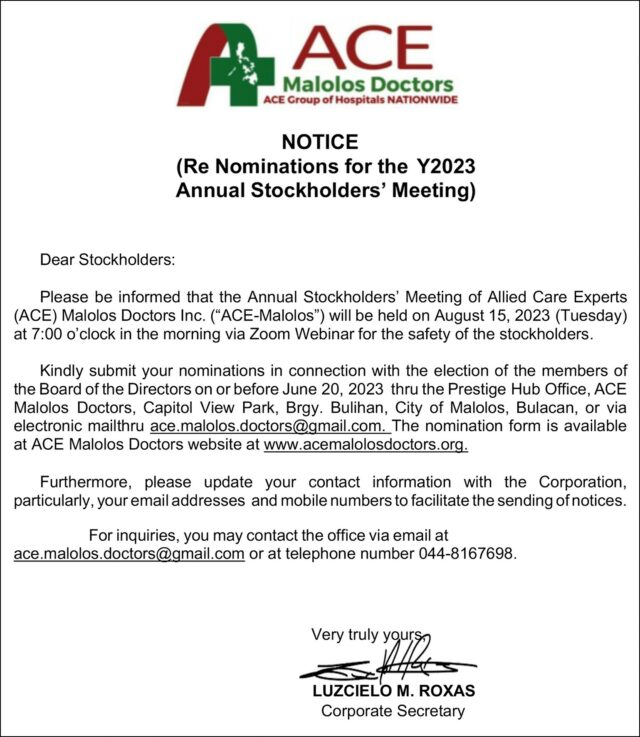
Allied Care Experts (ACE) Malolos Doctors, Inc. to hold Annual Stockholders’ Meeting on Aug. 15


Spotlight is BusinessWorld’s sponsored section that allows advertisers to amplify their brand and connect with BusinessWorld’s audience by enabling them to publish their stories directly on the BusinessWorld website. For more information, send an email to online@bworldonline.com.

Join us on Viber at https://bit.ly/3hv6bLA to get more updates and subscribe to BusinessWorld’s titles and get exclusive content through www.bworld-x.com.

The meat of the matter

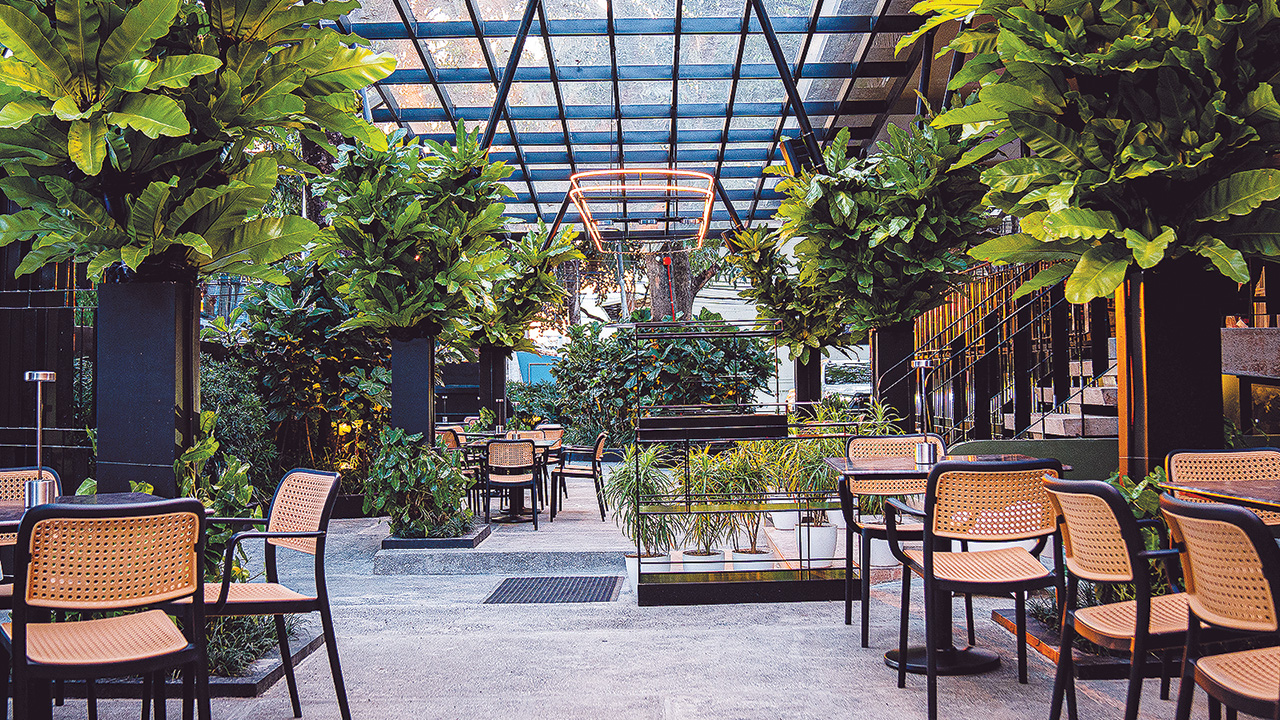
AL FRESCO dining at Azadore

Tatung Sarthou’s new neighborhood restaurant is for families with taste

A MID-CENTURY HOME in Quezon City is the site of a new restaurant, Azadore, by award-winning chef and author Myke “Tatung” Sarthou.

The restaurant had a soft opening in March, and is currently the chef’s biggest restaurant, with a seating capacity of about 110 indoors and another 200 outdoors. During a tasting on May 24, frankly, we kept our expectations quite low as the restaurant was billed as a place for family dining, spots not usually known for culinary excellence (but let’s be honest, are always the best places to satisfy baser cravings).

Well, perhaps some families really have better taste, because we encountered a Pork Tomahawk cooked sous-vide for four hours, resulting in pork with a texture as creamy as its mushroom sauce. This was accompanied by Paella Mixta with chicken, shrimp, clam, and chorizo (quite comforting), Smoked Pork Barbecue Ribs (which we will write home about; the salad, maybe not) and a Three-mushroom Truffle Penne. All these combined had the effect of transporting one to a Sunday lunch attended by all the members of a clan, with all its accompanying joy and noise.

The connection was easy to make. While the name comes from the Spanish for “grill,” the spirit comes from neighborhood barbecues. “We just chanced upon this property last year,” said Mr. Sarthou in an interview. “The houses here reminded me of my grandparents’ house,” he said about the Scouts-area street they occupy, dotted with these homes from the 1950s. “Communities where your entire neighborhood is your extended family.” One might notice then, that their menu is a hodge-podge of cuisines, calling to mind neighborhood potlucks where every home had a different specialty. “I wanted to relive that experience here,” said Mr. Sarthou.

He counts that he now has five restaurants — Lore, Pandan, Azadore, his private dining concept in Rizal, and NYC (New York Cubao, a Filipino-style diner in Robinsons Magnolia). In Gateway 2, a wing under construction at the Araneta family’s Gateway mall in Cubao, he plans to build a Filipino-style deli.

“I manage expectations by being very straightforward,” he said while explaining the challenges of expansion, noting: “[We] do the best we can, every time.

“There are always risks involved,” he notes in pursuing expansion, including financial and reputational risks, but, “it’s about taking calculated risks that allow you to grow…. If you cease growing, you begin to fall. You just have to keep moving forward.”

Azadore is located at 111 Scout Fernandez Street, Brgy. Sacred Heart, Quezon City. The restaurant is open from Monday to Sunday from 10 a.m. to midnight. For inquiries and reservations, contact 0917-101-0070. — Joseph L. Garcia

Franchise sector eyes expansion

THE PHILIPPINE Franchising Association (PFA) expects the industry to expand by 12-15% this year backed by new clients seeking to get into business after the pandemic.

“Last year was a bit difficult, of course. Everyone was recovering from the pandemic, but I think this year, we’re looking at about 12-15% growth in the industry because we see things opening,” PFA President Chris Lim told BusinessWorld on the sidelines of a franchising event.

He said after the pandemic, many franchisees realized that franchising is the best tool to get into business to earn extra income.

“So, we’re seeing a big boom this year,” he added.

Mr. Lim said the association is seeing “a new breed of franchisees” who are employees who want to have extra income, senior managers who do not want to go back to the corporate world, and entrepreneurs who want to restart.

He added that franchising “has always been a simpler way to get into business” because of the existing businesses that one just needs to learn how to operate.

“But at the end of the day, it is still getting into business. There’s ups and downs. You have to be innovative. You have to lead your team. You have to choose the right locations. But it’s just an easier way to get into business,” he said.

Among the business segments, food remains to be popular, he said, while franchises related to healthcare and pet care are seen to grow.

“Maybe in the next few years, the agricultural franchises — whether it’s in the logistics or retail side — we see that growing as well,” he added, noting that it may be the fastest to grow as some brands want to tap into it.

The PFA is set to host the World Franchise Council and Asia Pacific Franchise Confederation meetings this year.

“Our goal with the Philippine Franchise Association is to create 50 new market entries for our Filipino brands around the world, so we want more brands to go international,” he said.

Apart from the meetings, the PFA will also be hosting the International Expo in October, which is part of the Franchise Asia Philippines 2023. It is expected to draw about 60,000 local and international visitors.

“The Philippine hosting of these meetings is a testament of the market attractiveness of the Philippines as a tourism and investment destination of the world,” said Richard V. Sanz, founder, chief executive officer, and chairman of the Board of Philippine FoodAsia Corp. — Sheldeen Joy Talavera

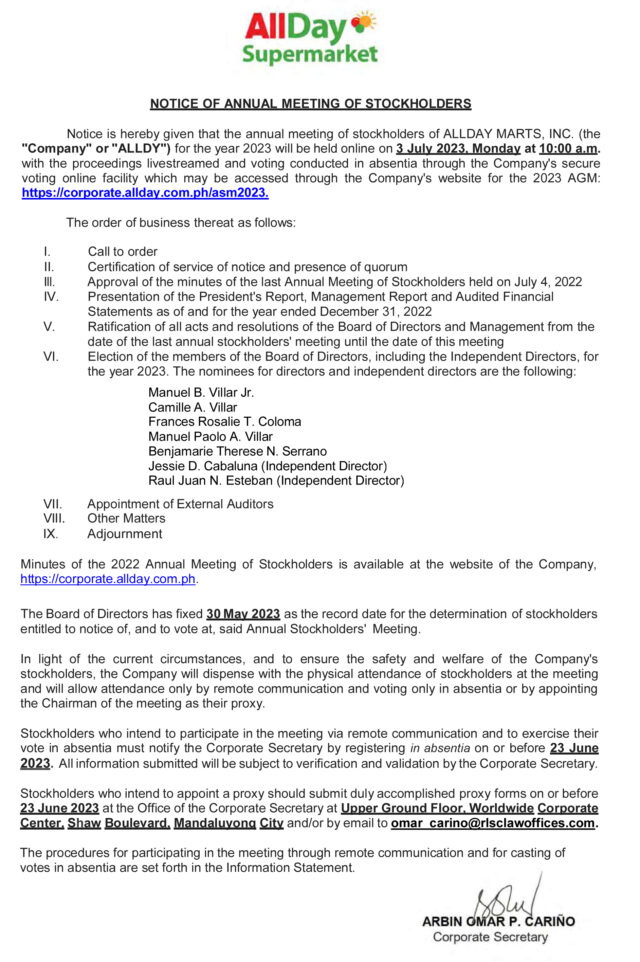
AllDay Marts, Inc. to hold 2023 annual meeting of stockholders on July 3


Spotlight is BusinessWorld’s sponsored section that allows advertisers to amplify their brand and connect with BusinessWorld’s audience by enabling them to publish their stories directly on the BusinessWorld website. For more information, send an email to online@bworldonline.com.

Join us on Viber at https://bit.ly/3hv6bLA to get more updates and subscribe to BusinessWorld’s titles and get exclusive content through www.bworld-x.com.

E-commerce boosts exports, shipping businesses — UPS

ONLINE retail transactions along with the growing digital shift present opportunities for export and shipping businesses, an official of a supply chain solutions provider said.

“One of the biggest opportunities available at the moment — especially for small and medium-sized businesses (SMBs) — is digitalization, and in particular e-commerce,” UPS Philippines Managing Director Russell Reed said in a recent interview.

“Online shopping has been growing quickly for many years already, and it’s likely the pandemic has accelerated that growth even more,” he added.

Mr. Reed said the e-commerce industry has leveled the playing field, allowing businesses to thrive with an internet connection, products, customers and the means of getting their products to customers.

However, limited time, expertise, and resources have made cross-border shipping a challenge for SMBs.

“There is literally a whole world of potential customers out there, so where is the best place to start? That’s what UPS is here to help with,” he said.

Mr. Reed said four segments can drive Philippine trade, namely: retail, industrial manufacturing and automotive (IM&A), high-tech, and healthcare.

“The high-tech segment, which alone accounts for 41% of the country’s intra-Asia trade, could double in value by 2030, while the IM&A segment could more than treble to overtake the high-tech segment as the largest in value by 2030,” Mr. Reed said.

UPS’s study on intra-Asia trade shows that Philippine trade was the second fastest in the region, largely driven by manufactured goods.

Trade value between the Philippines and 11 other top Asian markets is expected to triple to $393 billion in 2030, from $113 billion in 2020.

Meanwhile, the country’s entry into the Regional Comprehensive Economic Partnership is also seen to offer opportunities for trade and investment.

“This may mean an increase in the Philippines’ exports by 3.7% by 2030, an addition of $7 billion, according to the Asian Development Bank,” Mr. Reed said.

To reach the full potential of intra-Asia trade by 2030, businesses need to digitalize comprehensively to respond faster to cross-border demand, said Mr. Reed.

“Digitalization of more links in the supply chain process can contribute to business success, which is why we continue to develop tools and solutions that allow our customers to digitalize more of their processes at every step of the shipping journey,” he said.

“This includes using machine learning to simplify the process of creating a shipment to reduce the risk of documentation errors, providing a dashboard from which businesses can track and manage all in[bound] and outbound shipments in one place, paperless invoicing, and much more,” he added.

The UPS group’s smart logistics network is present in more than 220 countries and territories worldwide. It also has an airline that operates a fleet of nearly 600 aircraft. — Justine Irish D. Tabile

HONOR to launch Magic5 Pro smartphone in PHL

HONOR Philippines is set to launch on June 8 its flagship Magic5 Pro smartphone in the country, it said last week.

“We are extremely excited to Unleash the Power of Magic on June 8, 2023, so join us live to unveil the HONOR Magic5 Pro. Witness the real Magic as we share the breakthroughs in design, display, photography, and performance of this new HONOR flagship,” HONOR Philippines Vice-President Stephen Cheng was quoted as saying in a statement.

The HONOR Magic5 Pro will be launched live on HONOR Philippines’ Facebook page at 7pm.

The phone features enhanced hardware and advanced technologies, the brand said.

Its Super Triple Falcon Camera System has a 50-megapixel (MP) wide camera, a 50-MP ultrawide lens, a 50MP periscope telephoto camera with 3.5x optical zoom and 100x digital zoom, and a multi-spectrum color sensor.

“The camera also sports a breakthrough AI Motion Sensing Capture, enabling users to shoot their best moments, every time. The HONOR Magic5 Pro is equipped with IMAX Enhanced Movie Master to produce cinematic style videos, taking videography to a whole new level,” HONOR Philippines said.

The phone also comes with a 12-MP front camera with a 3D depth camera.

The Magic5 Pro has 6.81-inch LTPO Quad-Curved Floating Display featuring a Novel Display Luminance Enhancement Technology for an immersive experience.

It is powered by the Snapdragon 8 Gen 2 Mobile Platform and supported by HONOR’s GPU Turbo X. It runs on MagicOS 7.1 based on Android 13.

The HONOR Magic5 Pro also has IP68 water and dust resistance.

It is powered by 1 5,100 mAh battery that supports fast charging.

“The durable device can also withstand being submerged in water of depths up to 1.5m for 30 minutes, demonstrating HONOR’s exquisite craftsmanship and exceptional product quality,” the company said.

Based on HONOR’s global website, the phone comes in two color options, namely Meadow Green and Black. It has 12GB of storage and 512GB RAM.

‘Good soup is one of the prime ingredients of good living’: A (condensed) history of soup, from cave to can

FUSCO STUDIO —UNSPLASH

HOT SOUP on a cold day brings warmth and comfort so simple that we don’t think too much about its origins. But its long history runs from the Stone Age and antiquity through to modernity, encompassing the birth of the restaurant, advances in chemistry, and a famous pop art icon.

The basic nature of soup has a fundamental appeal that feels primordial — because it is.

Archaeologists speculate the first soup might have been made by Neanderthals, boiling animal bones to extract fat essential for their diet and drinking the broth. Without the fats, their high intake of lean animal meats could have led to protein poisoning, so stone age soup was an important complement to primeval nutrition.

The fundamental benefit of these bone broths is confirmed by archaeological discoveries around the world, ranging from a gelatin broth in Egypt’s Giza plateau, to Shaanxi Province in China.

The widespread distribution of archaeological finds is a reminder soup not only has a long history, but is also a global food.

Today, our idea of soup is more refined, but the classic combination of stock and bread is embedded in the Latin root of the verb suppāre, meaning “to soak.”

As a noun, suppa became soupe in Old French, meaning bread soaked in broth, and sowpes in Middle English. This pairing was also an economical way of reclaiming stale bread and thickening a thin broth.

Wealthier households might have toasted fresh bread for the dish, but less prosperous diners used up stale bread that was too hard to chew unless softened in the hot liquid.

New ideas about science and digestion in 17th century France promoted natural flavors and thick, rustic preparations gave way to the creamy and velvety smooth soups we know today.

New versions of the liquid food were developed by early modern European chefs, such as the seafood bisque, extracting flavor from the shells of crustaceans.

The first restaurant as we understand them today opened in Paris in 1765, and was immortalized for a simple broth, a clear soup made from bone broth and fresh herbs.

Mathurin Roze de Chantoiseau, the original French restaurateur, created a new type of public space where weary diners could regain their lost appetites and soothe their delicate nerves at all hours.

It may appear to be a contradiction that the first restaurant specifically catered to clients who had lost their appetites, yet it seems perfectly natural soup was the cure.

Soup was not destined to be limited to fancy restaurants or the long simmering stock pots of peasants. Modern science made it convenient and less expensive for home cooks.

In 1897, a chemist at the Campbell soup company, John Dorrance, developed a condensed canned soup that dramatically reduced the water content. The new method halved the cost of shipping and made canned soup an affordable meal anyone could prepare.

This revolutionary achievement was recognized at the 1900 Paris Exposition, winning an award for product excellence. Winning the prize was an achievement considering the competition at the world fair. The other technological advances exhibited at the turn of the century included the diesel engine, “talking” films, dry cell batteries, and the Paris Metro.   

The bronze medallion from 1900 still appears on the iconic red and white label, made famous by pop artist Andy Warhol’s 32 Campbell Soup Cans (1962).

In his work, Warhol appropriated images from consumer culture and the media ordinary people would instantly recognize, from Coca-Cola bottles to Marilyn Monroe. In his famous soup painting, 32 canvases — one for each flavor of soup — are lined up like cans on a supermarket shelf.

Some interpretations consider this a commentary on the link between art and consumerism, emphasizing the ordinary quality of the everyday object. The artist may also have been influenced by his personal eating habits — he claimed he had soup for lunch every day for 20 years.

A steady diet of soup is not guaranteed to inspire famous art, but its appeal is universal. Soup can be humble or fancy, cutting across cultures and classes.

Deceptively simple, the warmth and comfort of soup provide a temporary refuge from the winter chill, comforting the diner from the inside.

The French chef Auguste Escoffier, famous for enshrining the five basic “mother sauces” in French cuisine, raised soups to perfection in the early 20th century, developing refined preparations that remain classics today.

Escoffier, known as “the king of chefs and the chef of kings,” had very high standards for soup, claiming “of all the items on the menu, soup is that which exacts the most delicate perfection.”

An Austrian apprentice of Escoffier, Louis P. De Gouy, was chef at the Waldorf Astoria for 30 years and wrote 13 cookbooks.

He summed up the appeal of soup in a volume dedicated to the dish with over 700 recipes:

“Good soup is one of the prime ingredients of good living. For soup can do more to lift the spirits and stimulate the appetite than any other one dish.”

From Neanderthal broth to pop art icon, this humble pantry staple has a rich and vibrant history, giving us both nourishment and food for thought. — The Conversation via Reuters Connect

Garritt C Van Dyk is a Lecturer at the University of Newcastle.

Philippine Realty and Holdings Corp. sets 2023 Annual Stockholders’ Meeting on June 30


Spotlight is BusinessWorld’s sponsored section that allows advertisers to amplify their brand and connect with BusinessWorld’s audience by enabling them to publish their stories directly on the BusinessWorld website. For more information, send an email to online@bworldonline.com.

Join us on Viber at https://bit.ly/3hv6bLA to get more updates and subscribe to BusinessWorld’s titles and get exclusive content through www.bworld-x.com.

ADVERTISEMENT
ADVERTISEMENT