Home Blog Page 4753

ERC’s 22 years of empowering the electricity market through regulation

The blessing of ERC’s new office at Exquadra Tower in Ortigas Center at Pasig City last October — Photo from www.erc.gov.ph

Regulating electricity is necessary to fair competition in the power market and safeguard the interests of consumers. As the country’s independent regulator of the electric power sector, the Energy Regulatory Commission (ERC) has been taking on these tasks for the industry, consumers, and stakeholders for more than two decades.

Several developments were made regarding the regulation of the energy sector before the ERC was eventually established in 2001.

In November 1936, the Public Service Commission (PSC) was reorganized through the Commonwealth Act No. 146 or the Public Service Law. The PSC held the jurisdiction, supervision, and control over the entire public services, which included the electric power service as well.

With the preparation of the Integrated Reorganization Plan by the Commission on Reorganization, as ordered by Presidential Decree No. 1, the PSC was abolished in September 1972. The Board of Power and Waterworks (BoPW) assumed PSC’s regulatory and adjudicatory functions concerning the electric industry and water resources.

The government then established the Department of Energy (DoE) in October 1977 and abolished the Oil Industry Commission (OIC), which was built in 1971 through the Republic Act No. 6173. With Presidential Decree No. 1206, the OIC was replaced by the Board of Energy (BoE), which also took on BoPW’s powers and functions over the electric power sector.

The BoE was reconstituted as the Energy Regulatory Board (ERB) through Executive Order No. 172 in May 1987. This was undertaken to consolidate and entrust the entire regulatory and adjudicatory functions relevant to the energy industry into a single body. The ERB had the authority to regulate power rates and services of private electric utilities. The ERB’s focus of responsibility then became concentrated on the electric industry, with the full deregulation of the country’s oil industry in 1998.

June 8, 2001 marked the enactment of Republic Act (R.A.) No. 9136 or the Electric Power Industry Reform Act (EPIRA) of 2001, which abolished the ERB and created the ERC.

As per Section 43 of the EPIRA, it is the ERC’s duty to “promote competition, encourage market development, ensure customer choice and penalize abuse of market power in the restructured electricity industry.”

(Upper left photo) ERC Chairperson and CEO Atty. Monalisa C. Dimalanta (left) and ERC Commissioner Catherine P. Maceda (right) during the launch of the Competitive Retail Electricity Market (CREM) System Monitoring Platform. (Lower left photo) ERC officials Ms. Dimalanta, Ms. Maceda, and Commissioner Alexis M. Lumbatan with DoE and USAID officials witnessing the launch. (Right photo) DoE Undersecretary Rowena Cristina L. Guevara (leftmost) and USAID Philippines Mission Director Ryan Washburn (rightmost) express their support for the said project. — Photo from www.erc.gov.ph

For 22 years now, the ERC has been executing the combined quasi-judicial, quasi-legislative, and administrative functions in the electric industry. Apart from doing its functions on rate and service regulation, it also takes on the responsibilities of ensuring the education and protection of consumers as well as promoting competitive operations in the electricity sector.

The ERC is currently led by Atty. Monalisa C. Dimalanta, who has been the commission’s chairperson and chief executive officer since August 2022 and would serve until July 2029.

The ERC also began to operate in a new home last year, as it moved its office to the Exquadra Tower in Ortigas Center in Pasig City.

Atty. Dimalanta hoped that respect, accountability, and excellence are the values that would guide and be observed by the ERC. She added that respect should be the baseline in every dealing of the ERC, as the commission takes on “a transformational journey” toward becoming the most trusted government agency in the country.

Her vision for ERC is to become a center of excellence in the Philippines and the ASEAN (Association of Southeast Asian Nations) region. This would entail opening up to “new, better, and other ways of crafting and enforcing regulations,” according to a statement released by the commission.

“We can do exchange programs with other regulators in the region so that they can learn from us, and we can learn from them. ERC will carry a badge of professionalism and unmatched understanding of the energy industry,” Ms. Dimalanta said.

The ERC also presented a new vision, mission, and strategy map in its annual report for 2022.

“To meet the needs of an evolving power industry, the ERC adopted its new vision, mission, and strategy roadmap,” Atty. Dimalanta said in the report. “The various Services and Divisions at the ERC courageously confronted the agency’s limitations and challenges, and then diligently prepared strategies that will ensure the realization of our aspirations.”

In its strategy map for 2023 to 2026, the ERC envisions to work year on year as an electric power industry regulator that is esteemed for its “independence, credibility and fairness,” and complies with the best practices in public service. The ERC looks to being acknowledged as “an enabler of inclusive and sustainable economic development.”

“Towards this end, transparency and accountability shall be our primary principles which we shall live by at the ERC for years to come,” Ms. Dimalanta said.

The ERC is also on a mission to attend to the needs of all energy stakeholders with timeliness and in a value-creating way. This will be done through the development of free and fair competition as well as making certain that rates are reasonable through practicing “prudent and equitable” judgment. The commission will also work on championing consumers’ welfare and interests, as well as upholding a transparent and judicious regulatory environment that builds inclusive and sustainable growth and development.

Part of the ERC’s three-year strategy map is digital transformation, an initiative accelerated by various organizations since the pandemic in 2020. The ERC already stated its preparedness to undertake a digital shift for the new normal back in 2021.

One of its recent efforts involving digitalization is for the processes of the Competitive Retail Electricity Market (CREM) to be digitalized through the launch of the CREM Monitoring and Report System as well as the Retail Electricity Supplier (RES) Scorecard Survey in April.

“The CREM Monitoring System and the RES Scorecard Survey are important tools that will ensure robust competition in the market,” Ms. Dimalanta said.

The CREM Monitoring System is a website platform that brings different processes together, including the RES licenses registration and renewal; receipt of monthly and quarterly compliance reports from RES and Distribution Utilities; and creation of reports, analytics, and other relevant data concerning CREM. The RES Scorecard, meanwhile, provides the public access to RES scores and make comparisons.

“EPIRA was adopted 22 years ago to promote and enable competition. Among others, it created opportunity for consumers to exercise the power of choice. That power of choice need[s] to be supported with the right tools, like the CREM Monitoring System and RES Scorecard Survey, as this will enable our consumers to make informed decisions,” ERC Commissioner Catherine P. Maceda said. — Chelsey Keith P. Ignacio
For a more equipped, energy-secure power industry

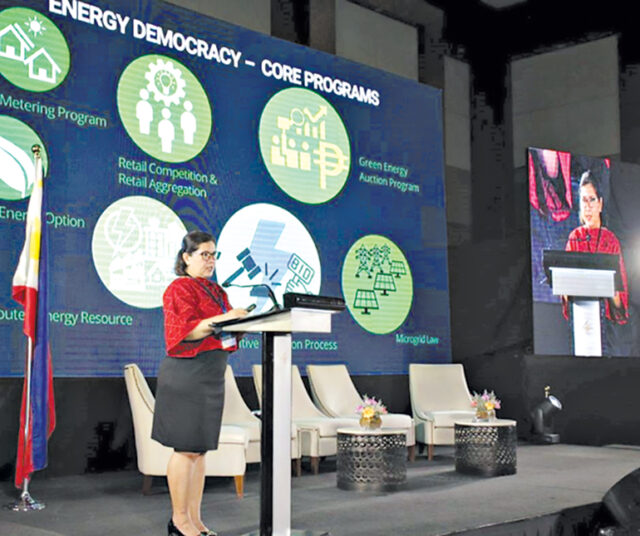
Atty. Monalisa C. Dimalanta during the Independent Electricity Market Operator of the Philippines’ 2023 Philippine Electric Power Industry Forum held last March — PHOTO FROM ERC.GOV.PH

It can be said that energy, if properly sourced, produced, and distributed to industries and households, is a vital enabler of economic growth and even social progress. This would not be possible, however, without a fairly competitive, developed, and sound electricity industry, which the Energy Regulatory Commission (ERC) is mandated to promote.

Overseeing 121 electric cooperatives, 20 private distribution utilities, 119 retail electricity suppliers, 590 power plants, and a wholesale electricity spot market, the ERC has a significant role of ensuring continuous electric service for the Philippine population and economy.

Speaking at the 2023 Philippine Electric Power Industry Forum (PEPIF) held by the Independent Electricity Market Operator of the Philippines, Atty. Monalisa C. Dimalanta, chief executive and chairperson of the ERC, recently discussed the ERC’s regulatory programs for the electric power industry and its “efforts in developing and enforcing regulations in the face of evolving power systems.”

According to Ms. Dimalanta, the ERC’s efforts and initiatives, which aims to foster the development of the emerging power system, as well as realize energy democracy, include Net-Metering Program, Retail Competition and Retail Aggregation, Green Energy Auction Program, Green Energy Option, Distributed Energy Resource (DER), Competitive Selection Process (CSP), and Microgrid.

The aforementioned programs were the ERC’s way in helping the power sector transition from being a “unidirectional and highly centralized system” to a “system that is increasingly becoming more multi-direction and more complex.”

“Last year was quite enlightening and full of valuable lessons that we should not put to waste. We have seen the vulnerabilities for our system in practical terms, especially for the islands that are not connected to the system. The dependence on fossil fuel-based facilities have translated to constant threats of brownout and lack of supply. This tells us that there remains a lot of opportunities in the off-grid areas for [renewable energy] proponents,” Ms. Dimalanta was quoted as saying in a statement.

The commission, as the country’s sole independent electric power industry regulator, also has an important role to take in ensuring energy security in the country. Ms. Dimalanta echoes this in a lecture she previously delivered about the country’s journey in energy security in the National Defense College of the Philippines back in February.

According to Ms. Dimalanta, the four major elements of energy security are availability, affordability, efficiency, and environmental stewardship; understanding these elements forges the path towards realizing energy democracy.

To best maintain the availability of energy supply is to use a variety of energy services, continuously supporting energy systems that have the ability to easily recover from any disruptions.

“Minimizing, if not altogether removing, reliance on foreign supply of fuel, determines the country’s self-sufficiency,” Ms. Dimalanta was quoted as saying in the ERC’s statement published last March on its website.

Affordability, meanwhile, remains a continuing challenge amid the government’s continuing efforts to provide energy access to millions of households that remain unserved.

Efficiency in the energy sector, Ms. Dimalanta continued, demands both improvement in the performance of energy equipment, as well as an alteration of consumer attitudes, which is said to be effected through an increase of confidence in clean, affordable, and sustainable energy.

Due to the increasing demand for sustainable energy, Ms. Dimalanta pointed out that environmental stewardship is the best way to protect the environment as well as future generations. — Angela Kiara S. Brillantes

Philippine May dollar reserves slide

US dollar banknotes are seen in this illustration taken July 17, 2022. — REUTERS

By Keisha B. Ta-asan, Reporter

PHILIPPINE DOLLAR reserves slipped at the end of May as the government paid its debt and the value of the central bank’s gold holdings declined.

Data released by the Bangko Sentral ng Pilipinas (BSP) on Wednesday showed the gross international reserves (GIR) slid by 0.5% to $101.3 billion (P5.675 trillion) from April. Year on year, the reserves declined by 2.3%.

This was the lowest dollar reserve level since $98.22 billion in February.

“The month-on-month decrease in the GIR level reflected mainly the National Government’s (NG) net foreign currency withdrawals from its deposits with the BSP to settle its foreign currency debt obligations and pay for its various expenditures,” the central bank said in a statement.

Ample foreign exchange buffers protect the economy from market volatility and ensure the country can pay its debts in case of an economic downturn.

Based on BSP data, foreign currency deposits fell by 7% from a month earlier to $1.06 billion at end-May and by 49.5% from a year ago.

The central bank also attributed the lower reserves to the declining value of its gold holdings due to falling gold prices in the world market.

Gold reserves were valued at $10.2 billion, down by 0.4% from end-April but 12.9% higher than a year earlier.

The reserves were enough to cover about 5.9 times the country’s short-term external debt based on original maturity and 4.2 times based on residual maturity.

It was also equivalent to 7.6 months’ worth of imports of goods and payments of services and primary income, the BSP said.

“The latest GIR figure may be attributed to increased foreign exchange outflows due to debt servicing, and exchange rate depreciation that led to a decline in the value of foreign exchange reserves in dollar terms,” Robert Dan J. Roces, chief economist at Security Bank Corp. said in a Viber message.

Latest Treasury bureau data showed the government’s debt payments more than doubled to P142.171 billion in March from a year earlier. Principal payments to foreign creditors reached P81.273 billion, while interest paid on external debt was P14.144 billion.

PESO SUPPORT
The BSP has “ample ammunition” to mitigate the volatility in the foreign exchange market, Domini S. Velasquez, chief economist at China Banking Corp. said in a Viber message.

“This is especially crucial given the possibility of another Fed rate hike which would narrow the BSP’s interest rate differential with the Fed to below 100 basis points (bps),” she added.

The US central bank has raised borrowing costs by 500 bps since March last year, bringing the Fed fund rate to 5-5.25%. It will meet on June 13-14 to discuss policy.

The Philippine central bank paused its aggressive policy tightening campaign last month. The Monetary Board has raised key rates by 425 bps to 6.25% and is set to meet on June 22.

“Holding this level of reserves should allay outsized concerns about currency stability and in turn help keep the peso stable,” Nicholas Antonio T. Mapa, senior economist at ING Bank N.V. Manila, said in a Viber message.

The peso weakened by 1.37% or 77 centavos to P56.15 on May 31 from its April 28 close. On Wednesday, the currency closed at P56.098 a dollar, up by 12.20 centavos from Tuesday’s close.

Net international reserves declined by 0.4% to $101.3 billion at the end of May from a month earlier, the BSP said.

Net international reserves are the difference between the central bank’s reserve assets and reserve liabilities such as short-term foreign debt, and credit and loans from the International Monetary Fund (IMF).

The central bank’s foreign investments reached $85.42 billion, 0.4% lower than April and 2.9% down from a year earlier.

The country’s reserve position in the IMF fell by 1.5% to $797.3 million from April but rose by 3.8% from a year ago.

Special drawing rights — the amount the country can tap from the IMF — stood at $3.81 billion, 0.3% higher than a month ago and 0.5% more year on year.

Dollar reserves remained at a comfortable level, Mr. Roces said. “The Philippines is expected to continue to attract foreign investment and remittances, which should help to boost foreign exchange inflows and support the gross international reserves.”

But sluggish global growth could weaken global trade and investment, and in turn hurt the Philippines’ dollar inflows, he added.

Ms. Velasquez said a comfortable dollar buffer could cover the country’s debt and help keep its sovereign credit rating.

The BSP expects dollar reserves to hit $100 billion by yearend.

World Bank raises Philippine growth outlook

PHILIPPINE STAR/MICHAEL VARCAS

By Luisa Maria Jacinta C. Jocson, Reporter

THE PHILIPPINE ECONOMY is likely to grow by 6% this year amid strong domestic demand and despite elevated inflation, the World Bank said, raising its forecast from 5.4% in January.

A recovery in jobs, improved consumer sentiment and strong remittances from Filipinos overseas would drive local consumption, the multilateral lender said in its Global Economic Prospects report on Wednesday.

“Despite external challenges, high domestic inflation and tight monetary conditions, domestic demand has once again remained resilient, fueling growth,” World Bank Country Director for the Philippines Ndiame Diop separately told a virtual news briefing.

World Bank GDP growth forecasts for select East Asia and Pacific economies

The latest growth forecast is the lower end of the government’s 6-7% growth target this year. The Philippine economy grew by 6.4% in the first quarter, slower than 8% a year ago and 7.1%  a quarter earlier.

“Despite weak global conditions, our upward revision reflects this continued strength in domestic demand,” World Bank Philippines Senior Economist Ralph van Doorn said.

But the potential global slowdown could still affect growth. “Although the global economy displayed remarkable resilience in early 2023, economic conditions will remain subdued for the rest of 2023,” Mr. Diop said.

He said global growth is expected to wane due to “persistent inflation, slowdown of global trade and the effect of recent monetary tightening.”

The World Bank expects global growth to slow to 2.1% this year, though this is higher than its earlier 1.7% projection. It also sees global growth reaching 2.4% next year and 3% in 2025.

“Risks remain tilted to the downside,” Mr. Diop said. “Recent episodes of market instability have raised concerns of a potential spillover. The possibility of further monetary tightening amid sticky core inflation could raise the cost of global financing and lead to a more pronounced and prolonged global slowdown.” Persistent inflation remained a cause for concern, the World Bank said.

“Although our baseline forecast (shows) inflation will decelerate, it is still the main challenge,” Mr. van Doorn said.

The World Bank expects Philippine inflation to average 5.7% this year, higher than its earlier 4.2% forecast.

The Bangko Sentral ng Pilipinas (BSP) expects inflation to average 5.5% this year, above its 2-4% target.

Risks to inflation include logistical challenges, the threat of El Niño, geopolitical tensions and tighter financial conditions.

“While both core and headline inflation are expected to ease through 2023, in the near term, headline inflation is likely to remain above central bank targets in some countries (Mongolia, the Philippines) due to the delayed passthrough of increases in global commodity prices and domestic supply shock,” according to the World Bank report.

“In some cases, local food production disruptions and supply bottlenecks have added to price pressures, notably in Mongolia, Myanmar and the Philippines,” it added.

To curb inflation, the BSP has raised key rates by 425 basis points (bps) since May last year to 6.25%.

The World Bank expects Philippine inflation to slow to 3.6% in 2024 and 3% in 2025.

Mr. van Doorn said the fading of pent-up demand and softer investment growth could also dampen growth.

The Philippines should address inflationary pressures by using both monetary and nonmonetary tools and use revenue-enhancing policies to support growth.

“Improving public spending efficiency through better targeting of social protection measures is essential to protect the poor and vulnerable from economic shocks amid limited fiscal space,” Mr. van Doorn said.

Mr. Diop said the Philippines should also raise investments to “strengthen economic recovery, reduce vulnerability and achieve its long-term development goals.”

LANDBANK health at risk from sovereign wealth fund — economists

By Kyle Aristophere T. Atienza, Reporter

ECONOMISTS are worried about the alleged failure of Philippine lawmakers to take into account the health of state-owned Land Bank of the Philippines (LANDBANK) when they approved a proposed sovereign wealth fund.

Congress should have considered Fitch Ratings’ warning that LANDBANK’s common equity Tier 1 ratio of 13.9% — a measure of its financial strength — could drop if it is forced to contribute to the Maharlika Investment Fund, said Enrico P. Villanueva, a senior lecturer at the University of the Philippines Los Baños Economics Department.

“Fitch already indicated that these ratios could turn their outlook from stable to negative,” he said in a Facebook Messenger chat.

Mr. Villanueva said LANDBANK has good ratings only because of implicit government guarantee, adding that credit rating companies look at data, not the spin. “Banking is a public trust. When the state tinkers with government financial institutions, it risks losing public trust,” he tweeted separately.

Pamela Louise Y. Nuyles of LANDBANK’s Public Communications Department declined when asked to comment via Viber.

Fitch Ratings in April revised its outlook for LANDBANK’s capitalization and leverage score of “BB” to negative from stable given the potential impact of its participation in the Maharlika fund on its loss-absorption buffers.

The newly passed bill requires the state lender and Development Bank of the Philippines (DBP) to contribute P50 billion and P25 billion, respectively, to the fund. The National Government must also contribute P50 billion.

Funds from the Philippine Amusement and Gaming Corp. and proceeds from privatization and transfer of government funds may also be used.

“LANDBANK’s ratings are a direct function of solvency and liquidity,” John Paolo R. Rivera, an economist at the Asian Institute of Management, said in a Viber message. “Its high ratings have been driven by its healthy solvency and liquidity metrics. It also benefits from the expectation, and fact, that it is government-supported, given that it is fully owned by the government and fulfills government policy objectives.”

If the Maharlika Investment Fund affects its solvency and liquidity, then it would certainly affect its ratings, he added.

“It is unlikely that the framers of the Maharlika Investment Fund bill took this into account,” Leonardo A. Lanzona, who teaches economics at the Ateneo de Manila University, said in a Messenger chat. “Even if they did, they probably ignored the warning.”

Finance Secretary Benjamin E. Diokno in March said President Ferdinand R. Marcos, Jr. had agreed to merge DBP and LANDBANK, with the latter becoming the surviving entity.

He said the merger, which is expected to take effect before the year ends, would save the government about P5.3 billion a year or at least P20 billion in the next four years.

‘DEGRADED’ INSTITUTIONS
Under the measure, the Bangko Sentral ng Pilipinas (BSP) must contribute 100% of its dividends to the Maharlika Investment Fund in the first two years. Its contribution drops to 50% after that; the remaining half will be deposited in a special account for its capital buildup funds.

Mr. Lanzona said Fitch’s warning should also apply to the central bank, which told lawmakers earlier that using its dividends as seed capital for the sovereign wealth fund would delay its capital buildup.

“Despite all this, the Maharlika Investment Fund bill was passed anyway,” he said. “This shows how much our democratic institutions have degraded during the Marcos administration.”

The government is the sole stockholder of the central bank, whose capitalization was increased to P200 billion from P50 million under a 2018 law.

Last week, former central bank Governor Diwa C. Guinigundo said it would now take about 17 years — instead of eight years — to recapitalize the central bank.

He noted that to replenish public money that will be used for the Maharlika fund, the government must either increase taxes or borrow money.

On the other hand, central bank Governor Felipe M. Medalla last week said he had no issues with the bill, adding that Maharlika is more of a development rather than a sovereign wealth fund.

But public budget analyst Zyza Nadine M. Suzara flagged a provision in the bill mandating the Bureau of the Treasury to release remittances of certain government financial institutions and government-owned and -controlled corporations to the fund.

“That means there will be less for the general fund that finances the budget,” she said in a Facebook Messenger chat.

Mr. Villanueva, meanwhile, said Finance Secretary Benjamin E. Diokno has contradicted “both the bill and people’s will” after saying that the Government Service Insurance System (GSIS) and Social Security System (SSS) could still invest in the Maharlika fund on a project level.

Public opposition to the bill was largely caused by lawmakers’ initial proposal to require GSIS and SSS to contribute to the fund.

The newly passed bill now bars SSS, GSIS and other agencies that provide pension funds such as the Philippine Health Insurance Corp., Overseas Workers Welfare Administration, Philippine Veterans Affairs Office and Home Development Mutual Fund (Pag-IBIG Fund) from investing in the sovereign fund.

Mr. Diokno last week said President Ferdinand R. Marcos, Jr. would likely sign the bill before his second State of the Nation Address in July.

The Finance chief said the fund is expected to be fully operational by yearend.

Ms. Suzara earlier urged the public to “closely monitor” how funds for the Maharlika fund would be incorporated in next year’s national budget.

“When legislation for the 2024 national budget begins, we need to watch out how much the appropriations for the Maharlika Investment Fund will be and how the limited fiscal space will be reallocated,” she told BusinessWorld.

“What programs and projects will be deprioritized and therefore lose appropriations in order to give way for Maharlika?”

Gov’t could boost infra spending to 12% of GDP

The construction of a railway is seen in Balagtas, Bulacan, June 14, 2021. — PHILIPPINE STAR/ MICHAEL VARCAS

By Aaron Michael C. Sy, Reporter

THE PHILIPPINES could boost infrastructure spending to as much as 12% of economic output as early as next year if its sovereign wealth fund goes as planned, according to its Finance chief.

“The 5-6% will come from the national budget,” Finance Secretary Benjamin E. Diokno told reporters on Wednesday. “If public-private partnerships (PPP) and the Maharlika Investment Fund are continued, we might reach 10-12% per year.”

The government plans to spend 5.3% of the gross domestic product (GDP) or about P1.29 trillion on infrastructure this year. Infrastructure spending is expected at 5-6% of GDP until 2028.

A number of priority projects are undergoing feasibility studies, while some are in the detailed engineering phase, Mr. Diokno said.

“Let’s not get the public’s hopes up that the Maharlika Investment Fund will suddenly ramp up infrastructure spending,” Terry L. Ridon, convener of Infrawatch PH, said in a Viber message. “Its initial funding is comparable only to a portion of the government’s infrastructure spending, so it should not translate into a massive percentage increase in total infrastructure spending.”

He also said not a single PPP has been started almost a year into the Marcos government. Its impact may only be felt midway into his term, he added.

As of May 9, there were 194 flagship infrastructure projects under the Marcos government’s “Build, Better, More” program. Sixty-eight projects have started, 25 were for implementation, nine for approval, 52 under project preparation and 40 under pre-project preparation.

The projects had a total investment of P8.2 trillion, including 14 projects in agriculture, five in digital connectivity, six in health, 119 in physical connectivity, one in energy, 44 in water and five in other infrastructure.

These will mainly be funded through official development assistance (ODA) worth P4.5 trillion, PPPs worth P2.5 trillion and P850 billion coming from the national budget.

Mr. Diokno said infrastructure spending was only 2% of GDP before ex-President Rodrigo R. Duterte came to office in 2016. The country needs more infrastructure to connect its islands, he added.

The government should determine which projects would be funded beyond the current spending plan because doubling it would not be easy,” said Alexander S. Escucha, president of the Institute for Development and Econometric Analysis.

“We need to see how much of these are already shovel-ready, and how much will need gestation or project development time,” he said in a Viber message.

Meanwhile, Mr. Diokno said the Senate version of the Maharlika Investment Found has enough safeguards.

He was reacting to the paper released by the University of the Philippines (UP) School of Economics, which said the Maharlika fund “violates fundamental principles of economics and finance and poses serious risks to the economy and the public sector — notwithstanding its proponents’ good intentions.”

“I think they have to read the Senate version first,” Mr. Diokno, who used to teach economics at UP, said. “It will be down to a matter of trust… This Maharlika fund is really going to be very useful for us. [It will be] another source of funding for our desire to boost infrastructure.”

He added that the discussion paper was too late since the bill was on its way to the presidential palace.

“It is both developmental and commercial,” the Finance chief said. “We will not invest in projects with no cash inflow… There should be a return to make sure the funds continue.”

LMG principal shareholders agree to sell 67% stake for P402 million

RAWPIXEL-FREEPIK

THE PRINCIPAL shareholders of LMG Corp. have agreed to sell their combined 67% stake in the listed holding firm to Maxwealth Infinity Holdings Corp. in a deal valued at P402 million.

In a regulatory filing on Wednesday, the company said the shareholders had entered into a share purchase agreement with Maxwealth, which will buy about 129.67 million common shares at around P3.1 each.

LMG identified Ann Marrieta L. Sytin, with 98.58 million shares, Robinson W. Siao, with 29 million shares, and Value Quest Securities Corp., with 2.09 million common shares, as the selling shareholders.

“The sellers decided to sell their shares in the corporation to pursue different business goals, which are not aligned with the objectives of a publicly listed company,” it said.

The company said Maxwealth would maintain the current business profile of LMG as a holding and investment company, It said the buyer has no immediate plans to change LMG’s business purpose.

According to the company, Maxwealth, headed by Alfonso Huang, is a holding firm with investments in various financial and information technology companies.

“Moving forward, the buyer intends to invest in the hospitality industry and the construction industry, consistent with its plan of diversifying its portfolio across various industries,” it said.

LMG said the buyer intends to expand the portfolio of the company to include Maxwealth’s operating subsidiaries. The move would provide LMG with the option to raise capital and investments.

Maxwealth will likewise conduct a tender offer to acquire minority shares in accordance with the Securities and Regulation Code, and its implementing rules and regulations.

Both parties intend to complete the tender offer and transaction within the next 60 days, while payment of the tender offer price will be done simultaneously with the payment of shares held by the principal stockholders.

“Should there be changes in the targeted timeline, the parties endeavor to revise this report and make the necessary disclosures,” LMG said.

LMG described Maxwealth’s primary purpose to include the following: “acquire, hold, sell, exchange, deal and invest in the stocks, bonds, or securities of any government, and in real or property of all kinds.”

Separately, the Philippine Stock Exchange (PSE) said that after an evaluation, it had deemed the transaction as covered by its Revised Rules on Backdoor Listing.

“Said determination is anchored on the transaction resulting in or will result in a change of control of LMG and/or a substantial change in LMG’s business,” the exchange said.

According to the PSE, a transaction is deemed a backdoor listing when a listed company is acquired by, merged, or combined with an unlisted company, and which acquisition, merger, or combination results in a substantial change in the business, membership of the board of directors, or voting structure of the listed company.

Also on Wednesday, the PSE said that it had implemented a trading halt on LMG shares due to its disclosure and pending regulatory evaluation of the transaction.

“The exchange will inform the trading participants and the investing public of further developments on the matter,” it added. 

In the first quarter, LMG reported a net income of about P7.2 million attributable to the parent equity holder, or more than double the P2.95 million recorded in the same period last year. — Adrian H. Halili

Globe backs creation of Connectivity Index Rating in PH, expresses readiness to work with government

Leading digital solutions platform Globe supports calls for the establishment of a national Connectivity Index Rating, which sets a standard for internet quality, as it stands ready to collaborate with the government to make this proposal a reality.

The proposed connectivity index aims to establish a standard for the quality of internet connectivity in public and private buildings, contributing to the wider national effort towards comprehensive digitization.

In an era where digital connectivity is life-enabling and crucial to socio-economic development, Globe is stepping up to facilitate this transformative project.

“We are ready and eager to work with the government to establish a Connectivity Index Rating in the country. This will allow our consumers to choose which establishment or public place they would want to patronize because internet services are within standards. With this in place, we will cement the perception that the Philippines has internet services at par with other countries, just as external party surveys have been showing.  This initiative resonates profoundly with the President’s blueprint for a digitally resilient and vibrant Philippines,” said Globe Group President and CEO Ernest Cu.

The Connectivity Index Rating was proposed by Globe together with various industry players to the sector leaders of the Private Sector Advisory Council (PSAC). The creation of a Connectivity Index Rating, supported by other industry stakeholders like consumer group CitizenWatch Philippines, is envisioned to serve as a consumer-friendly, easy to understand rating system for the quality of internet experience in a particular indoor area.

The quality of internet experience includes speed, accessibility, availability and security.  This rating will provide a meaningful benchmark for property owners and government institutions on the right level of connectivity vis-a-vis the volume of user traffic in a given building or area.

Atty. Tim Abejo, co-convenor of CitizenWatch Philippines, underlined the potential impact of this index, as having a connectivity rating publicly displayed or available online “will affect the image of an institution and will force building owners to take steps to ensure high-quality digital connectivity for their users.”

Currently, consumers have no way of assessing the quality of internet connectivity in public spaces such as airports, malls, hotels, libraries, and coffee shops. Abejo said the index should be as straightforward as the familiar 5-star system used to rate hotels.

Globe has been working relentlessly to provide fast and reliable internet connectivity to Filipinos.  After several years of strengthening its network backbone, the company is shifting towards capital efficiency and optimization. This strategy involves maximizing the use of fiber assets and leveraging partnerships with tower companies to boost tower construction.

To learn more about Globe and its initiatives, visit www.globe.com.ph.


Spotlight is BusinessWorld’s sponsored section that allows advertisers to amplify their brand and connect with BusinessWorld’s audience by enabling them to publish their stories directly on the BusinessWorld website. For more information, send an email to online@bworldonline.com.

Join us on Viber at https://bit.ly/3hv6bLA to get more updates and subscribe to BusinessWorld’s titles and get exclusive content through www.bworld-x.com.

DMCI Mining aims to ship 1.5M WMT nickel ore

DMCI Mining Corp. on Wednesday said that it is targeting to ship 1.5 million wet metric tons (WMT) of nickel ore this year after its unit secured an environmental compliance certificate.

In a disclosure to the stock exchange, its parent company DMCI Holdings, Inc. said the unit Zambales Diversified Metal Corp. (ZDMC) had been permitted in January to produce two million WMT of nickel ore from the previously allowed one million WMT.

“We have the necessary facilities and mitigating measures to minimize the impact of operations on the environment. With these in place, we’re targeting to produce anywhere between 1.7 million to 2 million tons of nickel ore this year,” said DMCI Mining President Tulsi Das C. Reyes.

In the three months to March, ZDMC nickel ore output reached 599,000 WMT, up 88% from 318,000 WMT previously.

According to the company, the growth led to a 16% increase in its total inventory to 178,000 WMT from 154,000 WMT.

“However, total shipment declined by 21% from 620,000 WMT to 487,000 WMT owing to the depletion of the BNC mine and stockpile, cushioned by the double-digit growth of ZDMC shipment,” the disclosure read.

Meanwhile, total shipment dropped by 21% to 487,000 WMT from 620,000 WMT, dragged by the depletion of the mine and stockpile of its subsidiary Berong Nickel Corp.

The decline was offset by the double-digit growth of ZDMC’s shipments. The average selling price increased by 11% to $49 from $44 backed by higher shipments of higher-grade nickel ore from the ZDMC mine.

“Despite the mine and stockpile depletion of Berong, DMCI Mining standalone revenues narrowly declined 8% from P1.4 billion to P1.3 billion due to better selling prices while reported income contracted by 15% from P543 million to P463 million,” DMCI Holdings said.

In the first quarter, DMCI Mining saw its core net income decrease by 5% to P473 million from P499 million, which was attributed to the “combined effect of lower shipments and better selling prices.”

Revenues during the quarter reached P1.31 billion, 8% lower than the P1.42 billion reported previously.

In its information statement, DMCI Holdings said its mining subsidiary last year shipped 1.449 million WMT, down 26% from 1.945 million in 2021. It also said total production declined by 42% to 1.031 million WMT from 1.788 million WMT after the depletion of its Palawan mine in the fourth quarter of 2021.

Meanwhile, ZDMC’s production last year grew to around 1 million WMT from 934,000 WMT previously. Its output last year was the maximum allowable production volume under its environmental compliance certificate. In turn, shipments from Zambales increased 22% to 1.088 WMT from 894,000 WMT. 

Last year, DMCI Mining recorded a 7% increase in its core net income to P1.29 billion, which it attributed to improved selling prices and favorable foreign exchange rates.

In 2022, the average selling price rose by 14% to $48 per WMT from $42 per WMT. Foreign exchange rates were also favorable last year at an average of P54 per US dollar from P49 a dollar previously amid currency market volatility.

DMCI Mining is a wholly owned subsidiary of Consunji-led DMCI Holdings, which has business interests in general construction, coal and nickel mining, power generation, real estate development, water concession, and manufacturing.

On Wednesday, DMCI Holdings’ shares were up by P0.13 or 1.35% to close at P9.75 apiece. — Sheldeen Joy Talavera

Hotel101 sets Quezon City launch

DOUBLEDRAGON Corp. said its hospitality unit Hotel of Asia, Inc. is set to launch its third Hotel101 project in Metro Manila, which will be its first in Quezon City.

“[We] are excited to very soon announce the start of our third Hotel101 project in Metro Manila and first in Quezon City, the 745-room Hotel101-Libis Bridgetowne in E.Rodriguez Avenue, Libis Quezon City,” said DoubleDragon Chief Investment Officer Hannah Yulo-Luccini in a statement on Wednesday.

Ms. Yulo-Luccini added that the first two Metro Manila branches are fully sold out. These are the 606-room Hotel101–Fort and the 518-room Hotel101–Manila.

Additionally, the company said it had sold all 548 rooms in the Hotel101-Cebu Mactan Airport project during its preselling phase.

The company added that the recently launched Cebu hotel is still under construction and slated to be completed after a year.

“Hotel101-Cebu Mactan Airport is poised to be the biggest airport hotel in the Visayas and Mindanao Region and currently ongoing construction on a 5,493-square meter (sq.m.) prime commercial lot along the Cebu Mactan Airport Terminal Road near Mactan Marina Mall,” the company said.

It added that its Cebu hotel will be the first branch to adopt the company’s new global version of the 21-sq.m. “Happy Room” unit.

The company said the rooms have been designed for construction and operational efficiency which optimized the use of modular furniture and fixtures as well as the use of prefabricated bathrooms, as it aims to be a “technologically advanced hotel chain.”

“The next version of the Hotel101 app is set to integrate the fully automated self-check-in system with IOT (Internet of Things) capability,” it said.

The company utilized artificial intelligence to design its modern banig, which has been chosen to be the hotel’s signature look.

“We have meticulously gone over each and every detail of the new signature Hotel101 HappyRoom to ensure that it can become the most efficient hotel room to build and maintain, while fulfilling every essential need to delight the growing number of Hotel101 customers from various parts of the world,” DoubleDragon and Hotel101 Global Chairman Edgar J. Sia II said.

The company said earlier that it expects to generate about P18.14 billion in revenues from its projects in Cebu, Libis, Boracay, Palawan, and Bohol.

“The asset-light Hotel 101 concept allows DoubleDragon to generate revenue and income twice, first from the pre-selling of the Happy Rooms, then second after the project is constructed it generates long-term recurring revenue from hotel operations,” it said.

DoubleDragon shares were unchanged at P7.20 apiece on Wednesday. — Adrian H. Halili

Allied Care Experts (ACE) Malolos Doctors, Inc. to hold Annual Stockholders’ Meeting on Aug. 15


Spotlight is BusinessWorld’s sponsored section that allows advertisers to amplify their brand and connect with BusinessWorld’s audience by enabling them to publish their stories directly on the BusinessWorld website. For more information, send an email to online@bworldonline.com.

Join us on Viber at https://bit.ly/3hv6bLA to get more updates and subscribe to BusinessWorld’s titles and get exclusive content through www.bworld-x.com.

The meat of the matter

AL FRESCO dining at Azadore

Tatung Sarthou’s new neighborhood restaurant is for families with taste

A MID-CENTURY HOME in Quezon City is the site of a new restaurant, Azadore, by award-winning chef and author Myke “Tatung” Sarthou.

The restaurant had a soft opening in March, and is currently the chef’s biggest restaurant, with a seating capacity of about 110 indoors and another 200 outdoors. During a tasting on May 24, frankly, we kept our expectations quite low as the restaurant was billed as a place for family dining, spots not usually known for culinary excellence (but let’s be honest, are always the best places to satisfy baser cravings).

Well, perhaps some families really have better taste, because we encountered a Pork Tomahawk cooked sous-vide for four hours, resulting in pork with a texture as creamy as its mushroom sauce. This was accompanied by Paella Mixta with chicken, shrimp, clam, and chorizo (quite comforting), Smoked Pork Barbecue Ribs (which we will write home about; the salad, maybe not) and a Three-mushroom Truffle Penne. All these combined had the effect of transporting one to a Sunday lunch attended by all the members of a clan, with all its accompanying joy and noise.

The connection was easy to make. While the name comes from the Spanish for “grill,” the spirit comes from neighborhood barbecues. “We just chanced upon this property last year,” said Mr. Sarthou in an interview. “The houses here reminded me of my grandparents’ house,” he said about the Scouts-area street they occupy, dotted with these homes from the 1950s. “Communities where your entire neighborhood is your extended family.” One might notice then, that their menu is a hodge-podge of cuisines, calling to mind neighborhood potlucks where every home had a different specialty. “I wanted to relive that experience here,” said Mr. Sarthou.

He counts that he now has five restaurants — Lore, Pandan, Azadore, his private dining concept in Rizal, and NYC (New York Cubao, a Filipino-style diner in Robinsons Magnolia). In Gateway 2, a wing under construction at the Araneta family’s Gateway mall in Cubao, he plans to build a Filipino-style deli.

“I manage expectations by being very straightforward,” he said while explaining the challenges of expansion, noting: “[We] do the best we can, every time.

“There are always risks involved,” he notes in pursuing expansion, including financial and reputational risks, but, “it’s about taking calculated risks that allow you to grow…. If you cease growing, you begin to fall. You just have to keep moving forward.”

Azadore is located at 111 Scout Fernandez Street, Brgy. Sacred Heart, Quezon City. The restaurant is open from Monday to Sunday from 10 a.m. to midnight. For inquiries and reservations, contact 0917-101-0070. — Joseph L. Garcia

ADVERTISEMENT
ADVERTISEMENT