Home Blog Page 4733

CIAC names Paglinawan as officer-in-charge

STATE-LED Clark International Airport Corp. (CIAC) has named Nancy C. Paglinawan as its new officer-in-charge amid changes in the leadership of the agency.

CIAC said in a statement on Wednesday that Ms. Paglinawan will act as its interim president after the previous president, Joshua M. Bingcang, was appointed by President Ferdinand R. Marcos, Jr. as the new president and chief executive officer of the Bases Conversion and Development Authority (BCDA) on June 8.

The Department of Transportation exercises policy supervision and operational control over CIAC, which is a BCDA subsidiary.

Ms. Paglinawan, the current vice-president for finance since 2020, was designed by CIAC’s board of directors. She is a certified public accountant and has a Master’s Degree in Management from the University of the Philippines.

Before joining CIAC’s financial team in 2012, Ms. Paglinawan served as a state auditor in various government agencies.   

“In spite of the decline in the agency’s revenues because of the privatized airport operations, Paglinawan enabled the CIAC to pay all of its outstanding bank loans and remit a record number of dividends to the national treasury,” CIAC said.

CIAC manages the 2,367-hectare Clark Civil Aviation Complex, which houses the Clark International Airport and hosts the mixed-use commercial hub Clark Global City and other locators engaged in manufacturing, information and technology, renewable energy, and other non-aviation-related industries. — Revin Mikhael D. Ochave

Philippines further slips in 2023 Global Startup Ecosystem Index

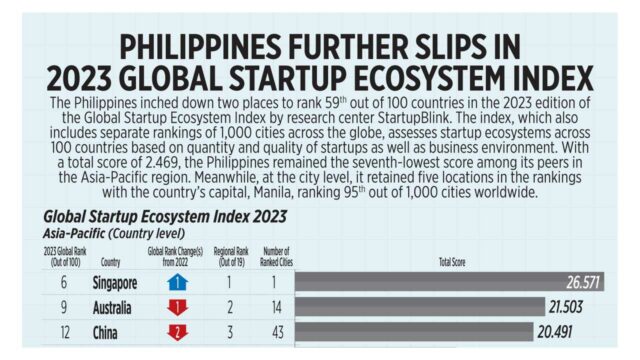
The Philippines inched down two places to rank 59th out of 100 countries in the 2023 edition of the Global Startup Ecosystem Index by research center StartupBlink. The index, which also includes separate rankings of 1,000 cities across the globe, assesses startup ecosystems across 100 countries based on quantity and quality of startups as well as business environment. With a total score of 2.469, the Philippines remained the seventh-lowest score among its peers in the Asia-Pacific region. Meanwhile, at the city level, it retained five locations in the rankings with the country’s capital, Manila, ranking 95th out of 1,000 cities worldwide.

Philippines further slips in 2023 Global Startup Ecosystem Index

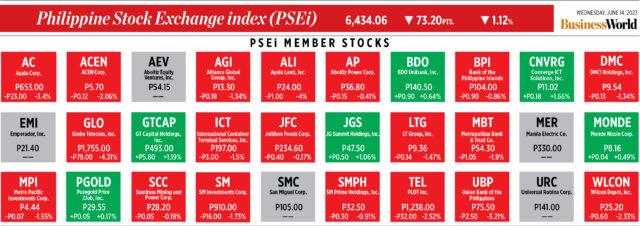
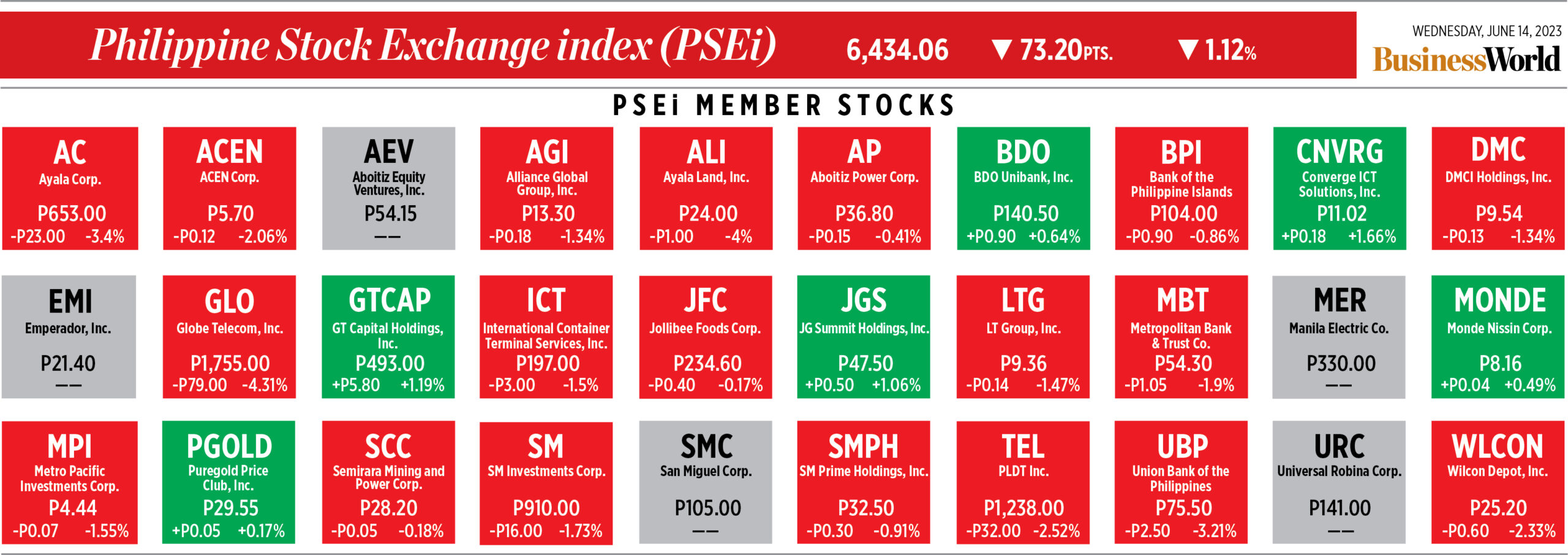
How PSEi member stocks performed — June 14, 2023

Here’s a quick glance at how PSEi stocks fared on Wednesday, June 14, 2023.


Peso strengthens versus dollar as US prices ease

BW FILE PHOTO

THE PHILIPPINE PESO strengthened against the dollar on Wednesday after inflation in the US continued to cool, and as investors waited for the results of the US Federal Reserve’s policy meeting.

It closed at P55.94, inching up by a centavo from Tuesday’s P55.95 finish, data from the Bankers Association of the Philippines website showed.

The peso opened at P55.88 a dollar, which was also its intraday best. It weakened to as much as P56.015. Dollars traded rose to $881.9 million from $834.75 million a day earlier.

The peso was supported by the release of the US Bureau of Labor Statistics’ inflation report, as well as expectations that the Fed would pause its tightening cycle, Michael L. Ricafort, chief economist at Rizal Commercial Banking Corp., said in a Viber message.

“The peso appreciated slightly following the weaker-than-expected US consumer inflation report for May 2023,” another trader said in a Viber message.

US consumer prices barely rose in May and the annual increase in inflation was the smallest in more than two years, though underlying price pressures remained strong, supporting the view that the US Federal Reserve would keep interest rates unchanged on Wednesday while adopting a hawkish posture, Reuters reported.

Consumer prices in the US rose by 4% in May, the slowest in more than two years, easing from April’s 4.9%.

The US central bank raised borrowing costs by 25 basis points (bps) last month, bringing the Fed fund rate to 5-5.25%. It has increased borrowing costs by 500 bps since March 2022.

Mr. Ricafort said a weaker dollar recently had also boosted the peso.

The dollar hovered near a three-week low against the euro and a one-month low versus the sterling on Wednesday.

The dollar index, which measures the currency against six major peers including the euro and sterling, was flat at 103.30 in Asian trading, after dipping to the lowest since May 22 overnight at 103.04.

The trader expects the peso to weaken on Thursday due to caution ahead of the Federal Reserve policy decision.

The trader expected the peso to trade from P55.85 to P56.05 a dollar, while Mr. Ricafort expected it to move between P55.85 and P55.95. — AMCS

Philippine shares fall, weighed by FDI, Fed meet

BW FILE PHOTO

By Adrian H. Halili

PHILIPPINE equities declined on Wednesday as reports of plunging foreign direct investment (FDI) in March and the US Federal Reserve’s policy meeting weighed on sentiment.

The benchmark Philippine Stock Exchange index (PSEi) fell by 1.12% or 73.20 points to close at 6,434.06. The broader all-share index went down by 0.87% or 30.21 points to 3,437.04.

“The local bourse slipped by 73.2 points to 6,434.06 as the lower net inflow of foreign direct investments to the Philippines weighed on sentiment,” Claire T. Alviar, Philstocks Financial, Inc. research analyst, said in a Viber message.

“Lower FDI net inflow dampened investors’ sentiment because this may have negative spillover effects on the economy, such as slower economic growth and reduced consumer spending if this continues to decline,” she added.

US inflation continued to cool in May, “fueling optimism that the Fed may skip a rate hike at its upcoming policy-setting meeting,” Luis A. Limlingan, head of sales at Regina Capital Development Corp., said in a Viber message.

“US May inflation increased by 4% year on year, marking the slowest annual rate since March 2021,” he said. “Following the report, traders increased their bets that the Fed will keep rates unchanged on Wednesday after hiking at 10 consecutive meetings.”

He said net FDI inflows in the Philippines slipped in March over concerns about worldwide economic growth slowdown, further affecting investor sentiment.

FDI net inflows declined by 30.7% to $548 million in March from a year earlier, data from the central bank showed.  These were 47.6% lower than $1.05 billion in February.

The US central bank raised borrowing costs by 25 basis points (bps) last month, bringing the Fed fund rate to 5-5.25%. It has increased borrowing costs by 500 bps since March 2022.

The Federal Open Market Committee is expected to review its policy on June 13-14.

Back home, all sectoral indices fell on Wednesday except industrials, which inched up by 0.003% or 0.29 point to 9,209.33.

Services declined by 2.04% or 31.49 points to 1,512.38, while property fell by 1.58% or 41.75 points to 2,585.09. Holding firms declined by 1.27% or 82.53 points to 6,400.64, while mining and oil slid by 1.13% or 113.71 points to 9,950.88. The financial index fell by 0.55% or 10.18 points to 1,831.41.

Value turnover surged to P11.45 billion, with 1.16 billion shares changing hands. Decliners outnumbered advancers, 118 to 72, while 41 stocks were unchanged.

Net foreign selling jumped to P533.22 million from P217.41 million on Tuesday.

Agri trade deficit widens to $2.81 billion in Q1

REUTERS

THE trade deficit in agricultural goods expanded 10.2% year on year to $2.81 billion in the first quarter, with plunging exports significantly outweighing a decline in imports, according to the Philippine Statistics Authority (PSA).

In a report, the PSA said overall trade in agriculture — or the sum of exports and imports — fell 8.6% to $5.90 billion during the quarter, a reversal from the 30.7% gain posted a year earlier.

Agricultural imports, which accounted for 13.9% of imports overall, dropped 3.3% to $4.50 billion in the first quarter. The decline in agricultural exports was even greater — 20.8% to $1.55 billion. Agricultural exports accounted for 9.2% of all exports.

The top agricultural export commodity group was edible fruits and nuts; peel of citrus fruit melons, which were valued at $439.51 million or 28.4% of the farm export total.

Agricultural products shipped to ASEAN hit $165.42 million, with tobacco and manufactured tobacco substitutes the top exports.

Malaysia was the country’s top export market within ASEAN, accounting for $52.58 million or 31.8% of overall farm exports to the region.

“Exports of agricultural goods to EU member countries in the first quarter of 2023 reached $380.74 million, which contributed 18.7% to the country’s total value of exports to EU member countries,” the PSA said.

The Netherlands was the top buyer of Philippine agricultural goods from within the European Union (EU), purchasing $180.77 million and accounting for 47.5% of exports to the region.

Among the commodity groups, animal or vegetable fats and oils and their cleavage products; prepared edible fats; animal or vegetable waxes were the top agricultural exports to the EU.

Cereals accounted for the largest share of agricultural imports at 21%, valued at $916.94 million.

In the three months to March, agricultural imports from the Association of Southeast Asian Nations (ASEAN) were valued at $1.47 billion, accounting for 15.5% of total imports.

Indonesia remained the top source of imports from within ASEAN, accounting for $412.51 million.

“The country’s agricultural imports from EU member countries amounted to $411.51 million or a share of 19.8% to the total value of imports in the first quarter of 2023,” the PSA said.

Within the EU, Spain was the top supplier of agricultural goods with imports worth $93.93 million, accounting for 22.8% of overall farm imports.

Meat and edible meat offal topped the list of imports from the EU.

“Lower global commodity prices in recent months amid risk of recession in the US, which is the world’s largest economy, after aggressive Fed rate hikes since 2022 to bring down/better manage inflation, partly led to the year-on-year decline in both agricultural exports and agricultural imports,” Rizal Commercial Banking Corp. Chief Economist Michael L. Ricafort said in a Viber message.

However, he noted that both agricultural imports and exports may still improve due to improved weather. “The onset of the rainy season with no large storm damage so far should help boost agricultural exports.” — Sheldeen Joy Talavera

National Tax Allotment for LGUs to exceed P871 billion in 2024

BW FILE PHOTO

THE National Tax Allotment (NTA) to be set aside for local government units (LGUs) in 2024 was pegged at P871.38 billion, the Department of Budget and Management (DBM) said.

“The fiscal year (FY) 2024 NTA level is P51.12 billion or 6.23% higher than the FY 2023 NTA share of LGUs,” the DBM said in a budget memorandum.

NTAs are the share given by the National Government (NG) to LGUs out of the take from all national taxes.

The size of the NTA varies each year because it represents a 40% share of the NG revenue total from three years prior. The 2024 NTA was thus based on NG revenue from 2021, the second year of the pandemic.

The 6.23% gain on the 2023 NTA, which was taken from 2020 NG revenue, reflects the economy’s recovery between the first and second years of the pandemic.

The LGU total is 43,670, consisting of 83 provinces, 148 cities, 1,486 municipalities and 41,953 barangays.

Municipalities are entitled to an NTA of P295.47 billion, followed by cities (P201.22 billion), provinces (P200.42 billion), and barangays (P174.28 billion).

Calabarzon (Cavite, Laguna, Batangas, Rizal, and Quezon) has been allotted P103.1 billion, followed by Central Luzon (P84.83 billion), the Western Visayas (P68.58 billion), the Central Visayas (P61.58 billion) and the National Capital Region (P52.55 billion).

Apart from the NTA, some LGUs are also entitled to special shares from the proceeds of taxes such as excise taxes on Virginia tobacco cigarettes, excise taxes on burley and native tobacco products, gross income taxes paid by all businesses and enterprises within the economic zones, among others.

“The NTA… shall first cover the cost of providing basic services and facilities, particularly those devolved by the NG, before applying the same for other purposes,” the DBM said.

LGUs are also required to appropriate at least 20% of their NTA on development projects and at least 5% of their estimated revenue from regular sources to their Local Disaster Risk Reduction and Management Fund.

The 2024 budgets of LGUs must also include programs and projects that prioritize gender and development, senior citizens and persons with disabilities, combating AIDS, and protecting children. — Luisa Maria Jacinta C. Jocson

Maharlika bill clear on excluded investments — Drilon

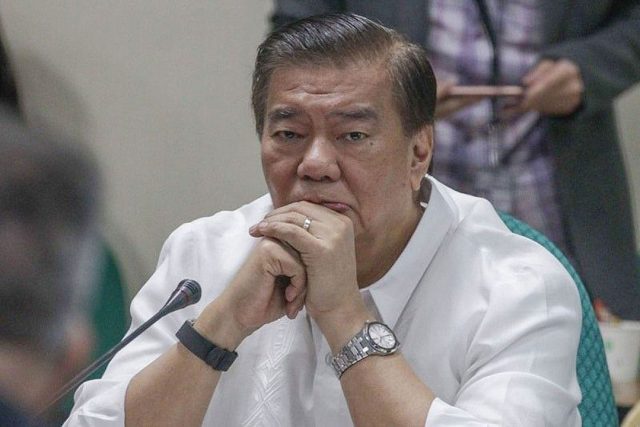
THE bill setting up the Maharlika Investment Fund (MIF) expressly bars government pension funds and the health insurance system from investing in the sovereign wealth fund’s projects, former Senate President Franklin M. Drilon said.

Mr. Drilon, who is also a former Justice Secretary, said in a statement that the bill specifically bars investments by the Social Security System (SSS), the Government Service Insurance System (GSIS), the Philippine Health Insurance Corp. (PhilHealth), the Home Development Mutual Fund (Pag-IBIG), the Overseas Workers Welfare Administration (OWWA), and the Philippine Veteran Affairs Office (PVAO) Pension Fund.

“The intention is crystal clear. Funds held in trust by the government, through these GOCCs (government-owned and -controlled corporations), cannot be invested in the MIF,” he said. “The prohibition is absolute and leaves no room for ambiguity.”

Legislators had initially proposed in early versions of the Maharlika bill to mobilize capital from the GSIS and SSS as seed money for the MIF.

The Congress-approved version — completed in late May — bars government pension funds and health insurers from providing funding to the MIF.

Recently, Finance Secretary Benjamin E. Diokno and National Treasurer Rosalia de Leon clarified that while SSS and GSIS are prohibited from investing in the Maharlika Investment Corp., the entity controlling the MIF, they can still invest in its projects.

Mr. Drilon said that “what the Congress directly prohibits cannot be done indirectly… Let’s avoid making pronouncements that undermine this prohibition and sidestep the intent of Congress.”

Mr. Drilon said the government should respect the boundaries and legislative intent established by Congress regarding the prohibition, warning that the Boards of these GOCCs could be held liable if they invest in the MIF or in any of its activities.

According to the Congress-approved bill, agencies “providing for the social security and public health insurance of government employees, private sector workers and employees, and other sectors and subsectors, such as but not limited to the SSS, GSIS, PhilHealth, Pag-IBIG Fund, OWWA, and PVAO Pension Fund shall be absolutely prohibited, whether mandatory or voluntary, to contribute to the capitalization of the Maharlika fund.”

Mr. Drilon said that the funds held in trust by the government through the GOCCs that handle pension funds are different in nature from dividends generated by the state-owned banks, which eventually served as major sources of capitalization for the wealth fund.

 “It is important to note that the funds held in trust by the government, through these GOCCs, are not of the same nature as the funds of the Bangko Sentral ng Pilipinas and other state-run banks,” he said. “These funds held in trust are not dividends. They are funds from private contributions.”

The MIF bill was approved by senators on May 31 and immediately adopted by the House of Representatives.

It requires the Land Bank of the Philippines and the Development Bank of the Philippines to contribute P50 billion and P25 billion, respectively, to the fund. The National Government must also contribute P50 billion.

Funds from the Philippine Amusement and Gaming Corp. and proceeds from privatization and transfer of government funds may also be used.

The bill also requires the central bank to surrender 100% of its dividends to the fund in its first two years. Its contribution drops to 50% after that period, with the remainder to be deposited in a special account for the bank’s capital buildup.

Lawyer and public investment analyst Terry L. Ridon urged GOCCs that handle pension funds to “enact policy guidelines and standards relating to project participation in the MIF,” citing the still undetermined risk of investing in future MIF endeavors. 

“In project-based participation, the pension funds can make their own determination on how to manage risk when undertaking a project,” he said via Facebook Messenger. “In fact, the funds can choose to not participate in MIF projects at all.”

Senator Mark A. Villar, one of the bill’s proponents, last week said that the implementing rules and regulations for the bill will provide clarity on which entities can participate in the Maharlika fund’s projects.

“There is a possibility that the SSS, GSIS, and the others will be part of an investor syndicate together with the Maharlika investment entity,” policy analyst and lawyer Michael Henry Ll. Yusingco said via Messenger.

“This means of course that the project involved is one permitted by all their charters,” he said. “What kind of project this would be will have to be determined and evaluated on its own merits and whether allowed by the charters of the investing financial institution.” — Kyle Aristophere T. Atienza


DoE may impose up to P100M in fines for RPS violations

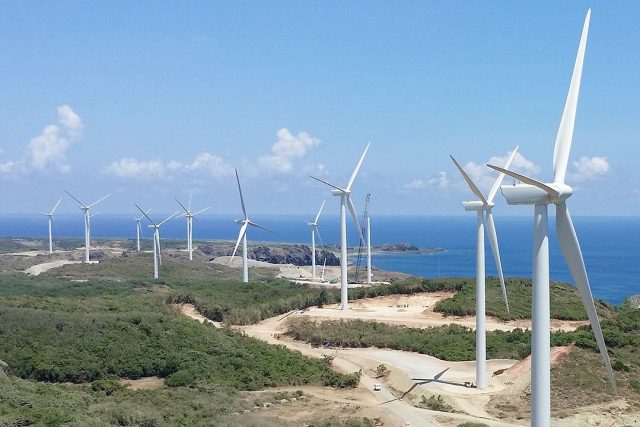
THE Department of Energy (DoE) said it will impose penalties of up to P100 million for violating the rules governing its Renewable Portfolio Standards (RPS) scheme.

“This guidelines shall be liberally construed to carry out the objectives of the RE (Renewable Energy) Act and other renewable energy laws, rules and regulations, and to obtaining a just and expeditious settlement or disposition of administrative cases,” the DoE said in a draft circular issued on June 13. 

Energy Assistant Secretary Mylene C. Capongcol said the DoE hopes to finalize the circular in about two months.

“The draft policy is still (subject to) public consultation until July 12. We just had the first leg (on Wednesday); usually it takes two months to promulgate due to discussions and deliberations on the comments received, but if there is not much comment, the promulgation will be earlier,” Ms. Capongcol said in a Viber message.

The draft bars participants from not complying with or violating the RPS rules or the guidelines set by the DoE.

“A fine ranging from a minimum of P100,000 to P100 million or twice the amount of damages caused or costs avoided for non-compliance, whichever is higher, or both, (will be imposed) upon the discretion of the court,” it said. 

The draft circular tasks the DoE with designating a composite team to handle and review complaints and violations. 

It said that all administrative action resulting from any violation of the RPS rules will be filed with the RPS composite team within four years from the date of the violation or upon the initiative of the RPS composite team within one year from the date of the discovery of the violation.

In separate department circulars signed on May 23, the DoE issued amendments to the RPS for both on-grid and off-grid areas.

The DoE said on-grid power suppliers must expand the share of RE in their output to 2.5% starting in 2023, from the current 1%.

It also requires off-grid participants to accelerate their green energy transitions by reducing their dependence on fossil fuel by hybridization or use of alternative technology.

Separately, the DoE also created a performance assessment and audit team to oversee the operations of the transmission network provider and system operator.

Signed by Energy Secretary Raphael P.M. Lotilla on June 8, the department said the circular aims to establish a comprehensive and sustainable mechanism.

Calls have emerged for a performance audit of the National Grid Corp. of the Philippines  following the tripping of transmission lines on May 8, raising red and yellow alerts over the Luzon power grid.

“The PAA (performance assessment audit) shall serve as basis for the DoE or the ERC (Energy Regulatory Commission) to recommend to Congress any actions to be taken in respect of the franchise of the TNP (transmission and network provider) and SO (system operator), and as basis for Congress to act upon such recommendations,” it said.

The DoE also said the PAA will serve as the basis for the DoE, ERC and other agencies in developing policies to ensure reliable and affordable electricity.

“The PAA shall provide the basis for the ERC’s enforcement of an incentive and penalty system that ensures accountability of the TNP and SO in performing its mandate in ensuring the security and reliability of the grid while allowing non-discriminatory access to all grid users,” it added. — Ashley Erika O. Jose

PHL being positioned for major role in game dev’t industry 

PIXABAY

THE Department of Trade and Industry (DTI) said the Philippines could occupy a strong position in the game development industry, after game companies obtained export orders at a recent conference.

“We are confident that with sustained initiatives to develop and promote Philippine capabilities in game development, the Philippines can position itself as a major player in the game development sector globally,” Trade Assistant Secretary Glenn G. Peñaranda said in a statement.

Five Philippine game developers signed export orders worth up to $1.67 million and generated 71 trade leads after 26 business-to-business meetings at the Nordic Game 2023 conference in Malmö, Sweden on May 23-26.

These companies were GameOps, Inc., Neun Farben Corp., Mata Technologies, Inc., Seaversity, Inc., and Taktyl Studios. Their participation in Nordic Game 2023 was organized by the DTI’s Export Marketing Bureau, the International Trade Center (ITC), and the Game Developers Association of the Philippines.

Mr. Peñaranda said the developers participating in Nordic Game 2023 were also supported by the ARISE Plus Philippines project funded by the European Union.

He added that preparations are now ongoing to join Gamescom 2023 in Cologne, Germany in August.

The ARISE Plus Philippines project seeks to improve the country’s trade performance, competitiveness, and economic integration. The ITC supports Philippine firms via training on export marketing and establishing market linkages with Europe and other markets. — Revin Mikhael D. Ochave 

Task force organized to contain animal diseases

REUTERS

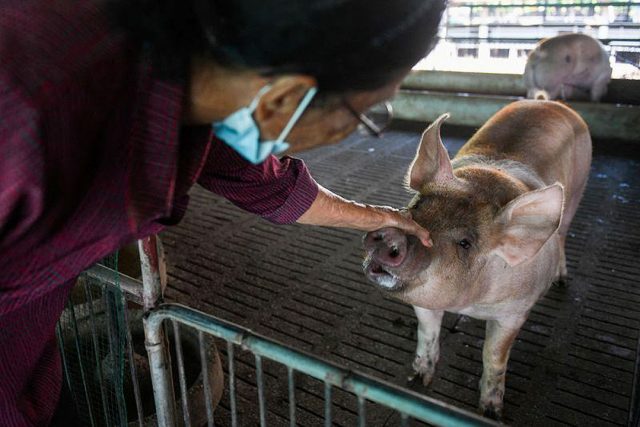
THE Department of Agriculture (DA) said it organized a special task force to detect and contain emerging transboundary animal diseases.

In a special order dated June 13, the DA said the task force will be a vehicle for strengthening collaboration between government and the private sector in managing animal diseases.

The special task force will be chaired by DA Assistant Secretary for Regulations Paz J. Benavidez II and co-chaired by United Broiler Raisers’ Association (UBRA) President Elias Jose M. Inciong.

Members include assistant secretaries Noel A. Padre, Arnel V. De Mesa, Kristine Y. Evangelista, as well as Bureau of Animal Industry Director Paul C. Limson.

The task force also includes representatives from the agriculture industry like UBRA Chairman Gregorio A. San Diego, National Federation of Hog Farmers, Inc. President Chester Warren Y. Tan, and Pork Producers Federation of the Philippines President Rolando E. Tambago.

Jesus G. Edullantes, president of the Provincial, City and Municipal Veterinarians’ League of the Philippines, was also designated a task force member.

The special task force has been tasked to work with the Department of Interior and Local Government (DILG) in drafting resolutions that will “harmonize guidelines of the national and local governments” in managing animal diseases.

An inter-agency task force will also be formed in cooperation with the departments of Health (DoH), Environment and Natural Resources (DENR), Trade and Industry, the DILG and the Philippine National Police for monitoring and managing of the animal transboundary diseases.

The task force also has a mandate to work with the DoH and DENR in rolling out the proposed Pandemic Fund and Livestock Infrastructure Modernization and Enhancement Program, as well as to monitor price and production levels of livestock and poultry. — Sheldeen Joy Talavera

MIAA sets three-year timeline for NAIA facility upgrades

PHILSTAR FILE PHOTO

THE Manila International Airport Authority (MIAA) said it expects to complete upgrades to the facilities of the Ninoy Aquino International Airport (NAIA) within three years.

“We are taking steps and exploring all ways possible to achieve our deliverables based on our established priorities,” MIAA Officer-in-Charge Bryan Andersen Y. Co said in a statement.

The MIAA said that it is currently expediting major rehabilitation projects and improvements to the passenger processing systems at the airport.

Among the upgrades are the replacement of passenger boarding bridges and chillers, work on taxiways, the expansion of surveillance coverage, and the digitization of operations and passenger systems.

“The MIAA sees the completion of these major projects in 24 to 36 months’ time,” it added.

The NAIA operator is currently working on additional toilets at Terminals 1, 2 and 3, and is planning to construct six more immigration counters, increasing the total to 36.

By December, the MIAA is planning to complete the construction of an immigration annex featuring six four-man counters.

The annex is expected to serve as the processing area for overseas Filipino workers, persons with disabilities, senior citizens, and diplomats.

The MIAA is also studying ways to minimize congestion points at the airport.

“The removal of the initial security checkpoints in the terminals has proven to be a welcome relief to travelers,” the MIAA said. — Justine Irish D. Tabile