Home Blog Page 4707

Government fully awards bonds at lower rate ahead of BSP meet

BW FILE PHOTO

THE GOVERNMENT made a full award of the reissued seven-year Treasury bonds (T-bonds) it auctioned off on Tuesday at a lower average rate ahead of the Bangko Sentral ng Pilipinas’ (BSP) policy meeting this week.

The Bureau of the Treasury (BTr) raised P25 billion as planned from the reissued seven-year bonds it offered on Tuesday, with total bids reaching P36.639 billion.

The bonds, which have a remaining life of five years and 11 months, were awarded at an average rate of 6.097%, with accepted yields ranging from 5.975% to 6.15%.

The average rate of the reissued bonds was 7.5 basis points (bps) below the 6.172% quoted for the papers when they were last offered on Feb. 28. It was also 40.3 bps lower than the 6.5% coupon for the series.

However, this was 16 bps higher than the 5.937% quoted for the six-year bond and 27.6 bps above the 5.821% seen for the same bond series at the secondary market before Tuesday’s auction, based on PHP Bloomberg Valuation Service (BVAL) Reference Rates data provided by the Treasury.

“The Auction Committee fully awarded the reissued 7-year Treasury bonds at today’s auction. With five years and 11 months to maturity, the T-bonds (FXTN 07-67) fetched an average rate of 6.097%, lower than the original coupon rate of 6.5% when it was first issued in May 2022. The auction attracted P36.6 billion in total tenders, 1.5 times the P25-billion offer,” the BTr said in a statement.

“With its decision, the committee raised the full program of P25 billion, bringing the total outstanding volume for the series to P129.7 billion,” it added.

The BTr made a full award of its offer as the T-bonds fetched a lower average rate amid lower inflation expectations, a trader said in an e-mail.

“However, this (the average rate) was relatively higher than secondary market rates amid views of potentially hawkish remarks from the BSP this week,” the trader added.

The BSP is expected to keep benchmark interest rates steady for a second straight meeting on Thursday after inflation eased further last month and the US Federal Reserve likewise paused its tightening cycle last week.

Fifteen economists in a BusinessWorld poll last week all expect the Monetary Board to maintain the overnight repurchase rate at 6.25% during its June 22 meeting.

If realized, this would be the second straight meeting the BSP will leave interest rates untouched. The central bank had raised borrowing costs by 425 bps from May 2022 to March 2023 to help bring elevated inflation down.

The BSP expects inflation to return within its 2-4% target later this year.

Headline inflation slowed to 6.1% in May from 6.6% in April. Still, this marked the 14th straight month that inflation breached the central bank’s 2-4% target.

For the first five months, inflation averaged 7.5%, well above the central bank’s 5.5% forecast for the year.

The BTr wants to raise P185 billion from the domestic market in June, or P60 billion via Treasury bills and P125 billion via T-bonds.

The government borrows from local and foreign sources to help fund its budget deficit, which is capped at 6.1% of gross domestic product this year. — A.M.C. Sy

Aboitiz to complete first phase of co-living space at LIMA Estate by yearend

ABOITIZ InfraCapital, Inc., the infrastructure arm of the Aboitiz Group, said on Tuesday that the construction of the first phase of its co-living space project at the LIMA Estate in Batangas will be finished by the end of the year.

The first phase of the co-living space project, or The Pods at LIMA, includes a 600-bed facility along with common areas, open spaces, a transport hub, and roof-mounted solar panels, the company said in a statement.

“Construction is currently underway and is projected to be completed by the end of 2023,” it added.

The co-living space project meets the housing needs of individuals employed by companies located in the commercial and industrial areas of LIMA Estate, according to the company. Currently, the workforce at LIMA Estate consists of 66,000 individuals.

“With The Pods at LIMA, we are pushing the boundaries of what could be done to help our locators within the Estate to ensure uninterrupted business operations and save transportation costs, as well as provide their employees with secure, comfortable, and sustainable housing,” said LIMA Estate Vice-President for Operations Clifford Academia.

 “We have always put a premium on creating thriving and self-sustaining communities that cater to the needs of various industries and businesses,” he added.

At the same time, the company announced that the next phase of The Pods at LIMA project will commence construction next year, and operations are projected to start in 2025. This phase will include a facility with an additional 2,700 beds.

“As we continue to grow and welcome new locators and businesses to LIMA Estate, we are committed to providing exceptional service to our current and prospective users, while raising the standard of development in the countryside,” said Rafael Fernandez de Mesa, LIMA Land president and Aboitiz InfraCapital Economic Estates head.

 “We will continue to prioritize sustainable and intelligent growth in all our operations in our effort to promote economic, social, and environmental progress in the Philippines,” he added.  

The LIMA Estate, which spans 800 hectares, is an economic zone encompassing Lipa City and Malvar town in Batangas province.

Currently, it accommodates 150 locators, 167 retail stores and restaurants, a four-star hotel, a transportation hub, over 4,000 households, and a range of developments including business process outsourcing firms, dormitories, schools, hospitals, churches, and other institutions. — Revin Mikhael D. Ochave

Rome to open ancient square where Julius Caesar was killed

THE DEATH of Caesar by Vincenzo Camuccini, between 1804 and 1805. —WIKIPEDIA.ORG

ROME — History buffs will be able to stroll close to the spot where legend says Julius Caesar met his bloody end, when Rome authorities open a new walkway on the ancient site on Tuesday.

Accounts, embellished by William Shakespeare, tell how the Roman dictator was stabbed to death by a group of aggrieved senators on the Ides of March — March 15 — in 44 BC.

According to tradition, he died in the capital’s central Largo Argentina square — home to the remains of four temples.

They are all currently below street level and up until recently could only be viewed from behind barriers close to a busy road junction.

From Tuesday, visitors will be able to move through the site at ground level on the walkway and see the structures up close.

Italian fashion house Bulgari funded the work at a site that was first discovered and excavated during building work in Rome in the 1920s.

The area — close to where Caesar is supposed to have exclaimed “Et tu, Brute?” as he saw his friend Brutus among his murderers — is these days also home to a sanctuary for stray cats.

Non-residents will pay 5 euros ($5.50) to visit it. — Reuters

Growing pains

PRESIDENT Ferdinand Marcos, Jr. at the Goldenberg Mansion. — NOEL B. PABALATE

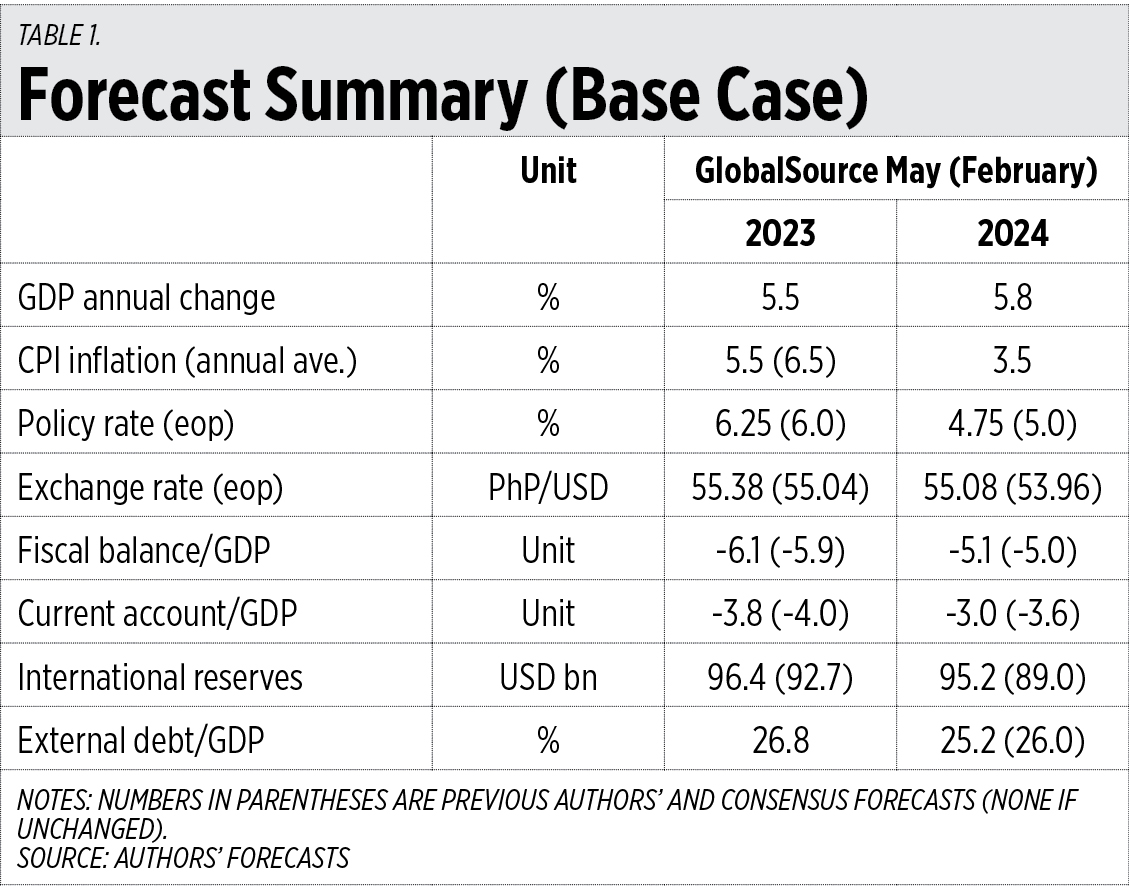
(I am pleased to share with readers, excerpts from our June 7 Quarterly Economic Outlook Report, “Growing pains.” Christine Tang, Shanee Sia, and I wrote this for GlobalSource Partners (globalsourcepartners.com), a New York based network of independent analysts in emerging markets.)

ALMOST a year in office, President Ferdinand Marcos, Jr. has managed to solidify his hold on power not least by putting the business sector at ease and keeping a 78% approval rating. He is overseeing a growing economy thanks largely to post-pandemic revenge spending, facing a quieter opposition thanks in part to his foreign policy pivot back to the US, and is himself exuding more confidence after winning the support of local businessmen with his relatively more consultative style compared with his predecessor.

Going into Year 2 with consumer and business sentiments seemingly steady, the President will nevertheless have a tougher challenge growing the economy. Not only are slackening global demand and tighter financial conditions weighing down output, but pent-up domestic demand looks close to running its course while inflation is turning out stickier than anticipated. Monetary authorities have paused policy tightening but the set of nine interest rate hikes, totaling 425 bp, is still working its way through the economy and likely lowering firms’ risk-taking appetites. Fiscal authorities, although aided temporarily by the unexpected inflation tax, remain committed to bringing down the budget deficit and the debt, with little room to support economic growth.

Coming from Q1’s 4.6% annualized growth clip, we still expect GDP to expand by 5.5% for the full year as inflation decelerates, interest rates stabilize, and the rebound in tourism strengthens, gaining from China’s reopening. Overall, GDP growth will still be consumption driven with rising remittances and local job opportunities, particularly in the BPO sector, supporting household spending. The recovery in investments is expected to be tentative given external uncertainties and higher hurdler rates, and uneven across sectors reflecting changing demand trends (e.g., travel up, telecommunications plateauing) and clarity of regulatory frameworks (e.g., renewable energy). Meanwhile, despite increased earnings from services exports and industry forecasts of semiconductor sales catching up following the sharp Q1 contraction, generally weaker external demand for goods exports alongside higher consumer goods imports will contribute to a still wide trade deficit. A higher 5.8% growth is still possible for 2024 based on more supportive monetary policy as inflation falls to target.

Upsides and downsides to our baseline scenario depend largely on the external environment and how an assortment of risks — economic, financial, and geopolitical — with varying transmission channels and impacts that either offset or reinforce each other, pan out. For example, higher odds of a recession in the US coupled with banking sector stress could lead to earlier interest rate cuts although spillover effects from credit contraction in the US would temper any fall in borrowing costs for emerging markets like the Philippines. Interest rate cuts may also be constrained by another bout of high inflation should there be an escalation of the war in Ukraine that pushes up energy and food prices anew. A weaker economic recovery in China due in part to an overextended property sector could delay tourism recovery and add to heightened tensions with the US particularly on trade and technology where a chip war is underway.

Ostensibly in response to the above, the Marcos administration rushed through congress a bill creating a P500-billion ($9 billion) Maharlika Investment Fund (MIF). Initially capitalized at P125 billion ($2.3 billion), it is still unclear at this point what direction the MIF will take and considering lead time to get the initiative off the ground, we are not expecting any significant contribution to economic growth over our forecast horizon.


Romeo L. Bernardo is principal Philippine adviser to GlobalSource Partners (globalsourcepartners.com). He serves as a board director in leading companies in banking and financial services, telecommunication, energy, food and beverage, education, real estate, and others. He had a 20-year run in the public sector including stints in the Department of Finance (Undersecretary), the IMF, World Bank, and the ADB.

romeo.lopez.bernardo@gmail.com

BSP rolls out coin deposit machines in malls

Bangko Sentral ng Plipinas Governor Felipe M. Medalla (left) and Robinsons Retail Holdings, Inc. President and Chief Executive Officer Robina Gokongwei-Pe (right) inspect the coin deposit machine located in Robinsons Place Ermita in Manila. — KEISHA B. TA-ASAN

THE BANGKO SENTRAL ng Pilipinas (BSP) has launched coin deposit machines (CoDMs) in retail establishments across the greater Manila area to help improve the circulation of the currency.   

The central bank deployed four CoDM units on Tuesday in partnership with Filinvest Lifemalls Corp., Robinsons Supermarket Corp., and SM Retail, Inc. Two units are located at the SM Mall of Asia in Pasay City, one in Robinsons Place Ermita in Manila, and one in Festival Mall in Muntinlupa City.   

“Through the CoDM project, the BSP aims to address the artificial coin shortage in certain areas of the country and help ensure that only fit and legal tender currency is readily available for public use,” the central bank said in a statement.   

“With the option to credit the value of deposited coins to e-wallets, the CoDM project also promotes the use of digital payments and strengthens financial inclusion,” it added.   

The value of coins deposited in CoDMs may either be credited to the depositor’s e-wallet account or converted into a shopping voucher for over-the-counter transactions.   

For now, customers depositing coins and can only credit the equivalent amount to their GCash e-wallets. The BSP is looking to include other electronic money issuers in the project’s next implementation phases.   

BSP Governor Felipe M. Medalla said at the project’s launch on Tuesday that there are 39 billion pieces of coins in circulation, but most are being stored in households or piggy banks.

“This partnership between the BSP and the big malls is in the interest of getting the coins recirculated,” Mr. Medalla said.

A total of 25 machines will be deployed across the greater Manila area from June to August. The rollout of 25 CoDMs in select retail establishments of the SM Store, Robinsons Supermarket, and Festival Mall will be under the first phase of the project’s implementation.   

All denominations of the BSP Coin Series and New Generation Currency (NGC) Coins Series are accepted by the CoDM. Mutilated and unfit coins will be rejected. Demonetized coins, foreign currency, and foreign objects like tokens will also be rejected by the machine and returned to the depositor.   

SM Retail Chief Finance Officer Jonathan Ng said the handling of coins presents challenges for both consumers and firms, even as these have always played a key role in daily transactions.   

“The advent of coin deposit machines aims to address these challenges and revolutionize the way we handle our lose change,” Mr. Ng said. “We are honored to stand alongside of BSP in the launch of this project as it not only impacts our consumers but also drives innovation and helps boost our economy.”

Robinsons Retail Holdings, Inc. President and Chief Executive Officer Robina Gokongwei-Pe said coins are an essential part of the country’s monetary system along with paper and digital currencies.   

“But when coins are forgotten, the balance of our monetary system is disrupted. These artificial shortages have a very real impact on us retailers,” she said.   

“For example, since we do not have enough coins for sukli (change), we have to source points and strangle Robinsons Bank to give us coins, or we have to get them from gas stations or from churches,” she said.   

A year after its launch, the BSP will determine if the project will be expanded to other regions and if the number of machines will be increased. Keisha B. Ta-asan

Alsons to start construction of three RE projects in 2024

ALCANTARA-LED Alsons Consolidated Resources, Inc. is set to begin construction of 79.8 megawatts (MW) of combined renewable energy (RE) projects next year, the company announced on Tuesday.

In a disclosure to the stock exchange, Alsons said that the projects will include a 37.8-MW solar and run-of-river hydropower plant in Zamboanga del Sur, as well as another 42-MW run-of-river hydropower project in Negros Occidental.

The company’s renewable energy expansion is now in full swing, with a target of adding three renewable projects next year, according to Nicasio I. Alcantara, chairman of Alsons.

Alsons also said that its planned expansion in renewables will encompass a solar power project in General Santos City, which is scheduled for construction in 2024.

The company is actively exploring opportunities to expand its operations beyond Mindanao, said Antonio Miguel B. Alcantara, Alsons’ chief investment and strategy officer.

Currently, the company’s power generation facilities are primarily concentrated in Mindanao. In total, Alsons’ portfolio comprises four power facilities with a combined capacity of 468 MW.

The company is currently in the process of constructing an 83-MW inland backup power plant in Bohol, Mr. Alcantara said.

“As we expand out of Mindanao, we are in the process of constructing 83-MW inland backup power plant in Bohol to support an upcoming PSA to commence this 2024 to allow us to establish an immediate foothold in Visayas as another avenue for growth,” he added.

For this year, Alsons is optimistic about commencing the commercial operations of its 14.5-MW Siguil hydropower plant. Additionally, the Siayan hydro project in Zamboanga del Norte and the Bago hydro project in Negros Occidental are scheduled for development within this year.

At the local bourse on Tuesday, shares in the company closed 1.39% higher to end at 73 centavos apiece. — Ashley Erika O. Jose

Training, cross-industry learning crucial for service quality — Antonio’s restaurant

ANTONIO “TONY BOY” M. ESCALANTE

By Patricia B. Mirasol, Reporter

BY PRIORITIZING continuous staff training and seeking insights and inspiration from diverse industries, restaurants can ensure that their service remains at the highest level, consistently meeting or surpassing customer expectations, according to an industry expert.

Continuous training ensures that staff members stay updated and equipped with the necessary skills to provide exceptional service, Antonio “Tony Boy” M. Escalante, founder of Antonio’s restaurant in Tagaytay, said in an interview with BusinessWorld.

Meanwhile, the practice of seeking inspiration from other industries fosters innovation and fresh perspectives, he noted.

“The most important thing is keeping the quality of the service,” Mr. Escalante said. “Training the staff is continuous; learning from other industries is continuous.”

His staff, including the pastry chef, undergo training in countries such as Switzerland.

Mr. Escalante himself is set to fly to Turkey in July to learn more about the said country’s grilling techniques.

“I’m not going to cook Turkish food; I want to learn how they grill,” he said. “Their techniques there are fantastic.”

A 2022 study by catering technology firm Zupa revealed that a lack of staff training is attributed to various operational issues, including staff happiness, low morale, lack of innovation, and even food wastage.

“By ignoring the need for critical training and engagement programs that allow staff to grow in confidence and innovate, hospitality businesses are creating a vicious, self-perpetuating cycle which directly impacts their revenue, customer relationships and future profitability,” Neil Shayle, ex-chef and commercial director at Zupa, said in a news release.

“It is vital that operators recognize training as a cornerstone of their people strategy,” he added.

At the same time, the Zupa report highlighted that restaurants are also concerned about the quality of customer service.

“In fact, 96% of respondents reported this as a key issue and of those, 47% said they believed it was linked to lack of staff training,” Zupa said.

For Mr. Escalante,  it is important to “treat your people right.”

“My dream is to give profit-sharing to my people, and I think it will be soon,” he said.

He also advised restaurants to develop core values and establish a strong foundation.

It is important to clearly define the brand’s unique identity, what it stands for, and the values that drive its operations, he said. This serves as the bedrock for making decisions, engaging with customers, and cultivating an overarching culture within the establishment, he also said.

Handling a company with 554 employees requires striking a balance between delegation and micromanagement, as noted by Mr. Escalante.

According to him, delegation plays a vital role in fostering teamwork and empowering employees to take ownership of their responsibilities. On the other hand, micromanagement aids in maintaining quality standards, ensuring consistency, and effectively addressing potential issues, he added.

Antonio’s has developed standardized processes for procurement, as well as training and procurement, for cost management and knowledge sharing within the group.

HOW IT STARTED
Nestled among the picturesque rolling hills of Tagaytay, Antonio’s has earned a reputation as a culinary destination that celebrates the tradition of fine dining.

“I wanted the restaurant to feel like home,” Mr. Escalante said.

“It’s really a passion for me to entertain and cook. I want to open a restaurant where, if it doesn’t work, it becomes my home,” the flight steward-turned-chef added.

Within two months of its opening in November 2002, Mr. Escalante found himself undertaking multiple roles as the receptionist, purchaser, and chef, as the seating capacity of his mom-and-pop establishment swiftly escalated from the initial 40 to 80 and eventually 120.

It was the customers who helped shape who he became, he said.

“Most of the guests who came here first were people who had vacation homes here, or out in Nasugbu, [Batangas]. They had discerning palates… These are clients who know what they want,” he said. This, he added, compelled him to be attentive and excel in his craft.

“I consider the availability of ingredients in the market and draw inspiration from my travels,” he said.

Antonio’s sources local as much as possible, with exceptions such as lettuce. Although he supports local farmers, local lettuce wilts after three days, said Mr. Escalante.

 “When I order from Australia, my lettuce comes in a box and stays 10 days. Mauubos ‘yun lahat (Those will all be utilized),” he said. “Wastage ko (My wastage) is only 2 to 5%.”

 Antonio’s also differentiates itself through its unique surroundings. The restaurant exudes the ambiance of a colonial house’s dining room.

SPOTTING OPPORTUNITIES
One recent obstacle the company had to overcome was the abrupt halt in operations due to the COVID-19 lockdowns.

“It was five months of agony,” Mr. Escalante said.

However, even amidst the lockdown restrictions, there was a silver lining.

The company was fortunate as it was able to rehire most of its staff after two months, according to Mr. Escalante.

“When they said that a 30% capacity was allowed… can you imagine, 30%? That’s a lot of numbers,” he said. “We’re not a restaurant boxed in the malls or with just one entrance, so walang bintana (and therefore didn’t have any windows), so we survived.”

It also helped that a lot of people wanted to go out of town.

“We were full packed of the 30% every day,” he added.

Another opportunity was the decision to expand and open restaurant branches in Metro Manila after 21 years in the business. 

 “In the past, I had been approached about opening branches, but I didn’t feel adequately prepared at that time,” Mr. Escalante said. “As the business grew, I realized that it was necessary to seek outside investors or partners.” 

Having the support and resources of investors, he said, becomes “crucial” when pursuing expansion or reaching new markets.

“When banks talk to you, [they ask], ‘What’s your succession?’” Mr. Escalante said. “You really have to think about succession.”

“I knew from the start I didn’t want to be forever in the kitchen cooking,” he added. “If I did, I would not have been able to branch out.”

Expansion is not a decision made in the early stages of one’s business, according to Mr. Escalante.

“You have to prepare yourself. You need to have a good product and a strong team, and then you wait for people to come to you,” he said.

“Do not undervalue yourself,” he added. “Otherwise, you will be perceived as cheap — and by cheap, I mean they will dictate the terms and undervalue you.”

Mr. Escalante acknowledged that it was a risky move when he and his business partner, fellow chef Ricky Sison, left the Mandarin Hotel over two decades ago to establish Antonio’s.

“While there may be challenges and competition, it is crucial to remain focused and determined,” he said.

“Believe in yourself, your vision, and the quality of your offerings. Your dedication and resilience will play a significant role in overcoming obstacles and attaining long-term success,” he added.

FEEDBACK
Building a customer base requires consistent effort, according to Mr. Escalante.

It necessitates prioritizing quality and consistency in both food and service, he said.

“I actively listen to customer feedback and consider it seriously, using it as a guide for continuous development and improvement,” he added.

“I understand the importance of avoiding stagnation and constantly striving to enhance the dining experience.”

Among the recognitions received by Antonio’s is the distinction of being the only Filipino restaurant included in The Miele Guide to Asia’s Finest Restaurants for five consecutive years.

“I never tell my team, ‘Hey, we better excel because we need to keep winning,’” Mr. Escalante said. “I always tell them, ‘Let’s do good, and the financial success will follow.’”

If you start fixating on numbers from the very beginning, “that will hinder your ability to excel because you are already limiting yourself,” he added.


Golden MV Holdings, Inc. to hold 2023 Annual Meeting of Stockholders on July 17


Spotlight is BusinessWorld’s sponsored section that allows advertisers to amplify their brand and connect with BusinessWorld’s audience by enabling them to publish their stories directly on the BusinessWorld website. For more information, send an email to online@bworldonline.com.

Join us on Viber at https://bit.ly/3hv6bLA to get more updates and subscribe to BusinessWorld’s titles and get exclusive content through www.bworld-x.com.

Visit a museum, go home inked — pop-up tattoo parlor at Dutch Rembrandt House

THE POOR Man’s Rembrandt Project —REMBRANDTHUIS

AMSTERDAM — Renowned body artist Henk Schiffmacher and his team are offering tattoos of Dutch master Rembrandt van Rijn’s most iconic works in a pop-up studio installed at the painter’s former house and now museum in Amsterdam.

The event has been dubbed “A Poor Man’s Rembrandt,” referring to the low cost of a tattoo — depending on the size between 100 and 250 euros ($273) — compared to a Rembrandt painting, though no less carefully produced.

“To own a Rembrandt, you have to have a lot of money, even if you want a small little etching. But we give you an affordable Rembrandt that lasts you to the end of your days,” Mr. Schiffmacher said.

“You can even take this Rembrandt to the beach,” he gleefully added.

People interested had to be quick — the week-long event was sold out in 15 minutes, head of the Rembrandt House Museum Milou Halbesma said, although daily walk-ins are also available.

Ms. Halbesma hopes it will encourage people from all walks of life to visit the museum.

“We are always looking for ways to make sure Rembrandt stays alive,” she said, adding that Rembrandt used to teach pupils in his house and Mr. Schiffmacher has students as well.

Rembrandt House employee Lillian Ramcharan was the first to get a tattoo this week. She chose an image of Hansken, a female Asian elephant that toured around in 17th century Europe.

The museum dedicated an exhibition to Hansken two years ago, including the elephant’s skull.

“So it feels a bit like I have seen her in real life,” Ms. Ramcharan said.

Mr. Schiffmacher is relishing the experience of working in Rembrandt’s house and plans to get a tattoo of the master’s work himself.

“His spirit and soul are still in the building,” he said. — Reuters

The dawn of a new era in Philippine Immigration Law

PHILSTAR

Since its passage on Aug. 26, 1940, Commonwealth Act No. 613, or the “Philippine Immigration Act of 1940,” has been the definitive guide on the issuance of Philippine visas, exclusion and deportation proceedings, the powers and structure of the Bureau of Immigration (BI), and other reportorial requirements that a foreign national must comply with to legally stay in the Philippines.

Over the past 80 years, the BI passed various issuances to complement the Philippine Immigration Act. However, it cannot be doubted that these amendments, notably made on a piecemeal basis, must necessarily be woven together to form a comprehensive and updated national immigration policy.

Thus, the 19th Congress of the Philippines, through the House of Representatives, proposed and approved on final reading House Bill (HB) No. 8203, also known as the “Immigration Modernization Act,” which aims to update the seemingly outdated law, and revamp and modernize the existing legal framework for immigration policies in the country. As the bill has now been passed at the House of Representatives, a counterpart bill shall also be proposed and approved by the Senate. Once approved, these bills shall be consolidated and endorsed to the Office of the President for final approval.

Under HB No. 8203, the BI Commissioner and his Deputy Commissioners must now be holders of a college degree, with proven capacity for administration; that at least one of them must be a member of the Philippine Bar in good standing for at least five years prior to the appointment; and that at least one member must come from the ranks of the BI. Under the current law, the Commissioner and Deputy Commissioners must only be natural-born citizens and be at least 30 years of age.

HB No. 8203 also defined the functions of the various divisions of the BI which include the Administrative Division, the Alien Registration Division, the Finance and Logistics Division, the Human Resource Management and Development Division, the Immigration Regulation Division, the Information and Communications Technology Division, the Immigration Intelligence Division, the Immigration Law Enforcement Division, the Legal Affairs Division, and the Planning and Research Division.

The proposed legislation also provided more clarity on the various visas which are available to foreign nationals. Under HB No. 8203, the current 9(a)/Temporary Visitor Visas are now classified as “A Visas,” which are further subdivided into three categories, namely: the “A-1 Visa,” which is available to aliens who come to the Philippines for temporary business activities, the “A-2 Visa,” which is granted to aliens coming for leisure, and the “A-3 Visa” which is for foreign nationals seeking entry for medical and health purposes.

HB No. 8203 also reintroduced the current 9(g) visas as “G Visas” which are available to foreign nationals coming to the Philippines on pre-arranged employment, intra-corporate assignments, and to professionals, performing artists, athletes, and cultural exchange workers. The bill also creates a separate visa category for missionaries, religious ministers, and their dependents, who may now be issued with an “H Visa.” There are also new types of visas such as the “J Visa” which is available to foreign media workers, the “K Visa” which is available to foreign exchange visitors, and the “L-1” and “L-2 Visas” which are available to refugees and stateless persons, respectively.

On immigrant visas, HB No. 8203 notably increased the allotment for quota immigrants per nationality from 50 to 200.

The proposed legislation also introduced a process called “Adjustment of Status,” whereby a non-immigrant foreign national may be granted permanent resident status if: a.) the foreign national makes an application for such an adjustment; b.) the foreign national is eligible to receive a quota or non-quota immigrant visa and is admissible to the Philippines as a permanent resident; and, c.) a quota immigrant visa is immediately available to the foreign national at the time of application, without need of departing from the Philippines.

HB No. 8203 also updated the grounds for a foreign national’s deportation from the Philippines. Aliens may now be deported from the country if they engage, abet, aid, or finance any terrorist activity; if they are charged with a crime involving acts or omissions punishable under Philippine penal laws cognizable by the Regional Trial Courts and the Sandiganbayan; if they violated Philippine labor and taxation laws, rules, and regulations; if they are found to be undesirable such that their further stay in the Philippines is inimical to public welfare or the dignity of Filipinos or the Republic of the Philippines as a sovereign nation; and, if their presence or activities in the country may result in adverse consequences to Philippine foreign policies as determined by the Secretary of Foreign Affairs.

In summary, the prospect of passing HB No. 8203 into law is indeed a welcome development. Initiatives to update the Philippine Immigration Act are necessary to reform and streamline our local immigration policies. We must nonetheless ensure that the implementation of the new law, once passed, will strike a balance between strict regulations on entry and a welcoming framework for foreign nationals to stay in the Philippines. Ultimately, the eventual passage of the proposed law must also translate to a more efficient and transparent immigration bureau.

This article is for general information and educational purposes only and not offered as legal advice or opinion.


Christianna Manami Y. Salud is an associate of the Immigration department of Angara Abello Concepcion Regala & Cruz Law Offices (ACCRALAW).

(632) 8830-8000

cysalud@accralaw.com

Sun Life Philippines targets Gen Z customers to boost growth

SUN LIFE of Canada (Philippines), Inc. is targeting to attract more Generation Z customers to boost its growth, its top official said.

“It’s really a growing market. Just start with their number of advisors. Majority of our advisors used to be the baby boomers, but it has gone down to the millennials. Now we’re having Gen Zs as financial advisors,” Sun Life Philippines Chief Executive Officer and Country Head Benedict C. Sison told reporters on the sidelines of an event on Monday.

Mr. Sison said Sun Life Philippines is looking to craft products that address the needs of Gen Zs.

“This is a good way to connect with Gen Zs. We want to be relevant,” he said.

He added that members of the younger generation are more digitally savvy and financially literate, making them more aware of the benefits of getting insurance policies. Getting more Gen Z customers could also help in increasing awareness about their products among the older generation, he said.

“They’re more educated compared to their parents. I know of some parents that would really rely on their millennial [or] Gen Z children for education,” he said.

Mr. Sison expects Gen Z to make up for a significant portion of insurance purchases, especially as the coronavirus pandemic increased awareness about the need for insurance protection.

This will continue even after the pandemic due to the low insurance penetration rate in the country, he said.

The insurance penetration rate was at 1.72% of gross domestic product in 2022, Insurance Commission data showed.

Sun Life Philippines was the top life insurer in terms of premium income in 2022 with P52.61 billion. It posted a net income of P11.73 billion last year. — AMCS

German cosmetics, wellness firms keen on PHL opportunities

GERMAN cosmetics and wellness firms are eyeing business opportunities in the Philippines, the German-Philippine Chamber of Commerce and Industry (GPCCI) said.

Five German companies are in the Philippines as part of a business mission from June 19 to 23, organized in cooperation with the German Association of Personal Care and Detergents, under the market development program for German small and medium enterprises of the German government, the GPCCI said in a statement on Tuesday.

These companies are Nobis, Estatira Organic, MedSkin Solutions, Medical Beauty Research, and Skin Care Manufaktur.

“The participation of these German companies highlights a charming potential in the cosmetics and wellness sectors in the Philippines,” GPCCI Executive Director Christopher Zimmer said.

Nobis specializes in the production of natural dietary supplements and cosmetics.

Estatira Organic manufactures essential cosmetic and healthcare products made from natural ingredients, while MedSkin Solutions focuses on biotech solutions for tissue regeneration and skin health.

Moreover, Medical Beauty Research specializes in luxury and premium skin and hair care products, while Skin Care Manufaktur produces skin care products.

As part of the business mission, the GPCCI conducted a conference on Tuesday, featuring talks on the retail and beauty sectors by various retail industry leaders.

During his presentation, SM Supermalls President Steven T. Tan said that the country’s health and beauty industry is continuously evolving and holds immense potential.

“We recommend that the players explore the Philippine market by exploring its local shopping mall culture,” Mr. Tan said.

Etaily Fast Moving Consumer Goods and Beauty Director Alexandra Garcia said that German investors should look into developing microtrends.

“For the e-commerce sector, we propose that investors capitalize on developing microtrends. Filipinos also are heavily concentrated on community/familial ties — recommendations help consumers decide purchase,” Ms. Garcia said.

The GPCCI said the business delegation will also look at potential partnerships with Philippine counterparts via business-to-business meetings and other networking activities. — Revin Mikhael D. Ochave 

ADVERTISEMENT
ADVERTISEMENT