Home Blog Page 4678

Accolades from Aletheia Capital

RONALD CARREÑO-PIXABAY
JIM WALKER OF ALETHEIA CAPITAL

Here’s another accolade given to the Philippine economy from an independent foreign analyst. For the past two years, I have made it a point to always cite outside think tanks, international organizations, foreign banks and other independent sources whenever I present bullish forecasts about the Philippine economy. The reason is that I have acquired a reputation for being a “prophet of boom,” that I am overly optimistic about the Philippine economic future. People who listen to me usually take what I say with a “grain of salt,” assuming that the reality is less rosy than what I prognosticate. Fortunately, over the last two years, there have been numerous outside observers who have been more bullish than I when forecasting the economic future of the Philippines.

For those who have been listening to me in the many economic briefings I have been giving, they will remember independent outside sources like Oxford Economics, The Economist, Hongkong Shanghai Bank, Goldman Sachs, the Japan Credit Rating Agency, the World Bank, and the Asian Development Bank ranking the Philippines as one of the most promising emerging markets in the Indo-Pacific region in the coming years.

I am glad that I can add Jim Walker of Aletheia Capital, ranked as No. 1 in Asia among independent research firms, to this list. After his recent visit to the Philippines, he came out with a very positive assessment of the Philippine economy in an article entitled “Philippines in Fine Form.” I have gotten his permission to quote profusely from this article which is a result of a series of consultations he had with leading economic analysts in the Philippines.

He started his article with his average growth projections of GDP growth for the whole of 2023 of select countries in Southeast Asia after considering the growth rates reported for the first quarter of the current year. In his forecast, the Philippines will grow the fastest at 7.1% in contrast with Indonesia (5.2%), Malaysia (3.5%), Thailand (2.9%), Vietnam (2.9%), and Singapore (0.8%). Especially notable is the low forecast for Vietnam which many critics of what President Ferdinand “Bongbong” Marcos, Jr. is doing always cite as stealing the thunder from us.

He then cites the latest consensus growth forecasts from the Emerging Markets Economic Data Ltd. (EMED) Survey. The Philippines also tops the list at 5.5%, followed by Indonesia (4.9%), Malaysia (4%), Thailand (3.6%) and Singapore (1.9%). There is no forecast for Vietnam on the EMED survey.

Jim was pleasantly surprised with these figures. I remember that he was one of those who often referred to the Philippines as the “sick man of Asia” in the 1990s and early 2000s. As he wrote in his current report, “for a country that was [at the] bottom of the Asian Tiger league in the 1990s, the turnaround in the Philippines in the last decade has been impressive. Credit Ratings Agencies agree, with Standard and Poor’s rating only Singapore and Malaysia higher than the Philippines.” He has a positive assessment of what the present Administration is doing to address the debt situation, which was a result of the extreme budgetary measures taken during the pandemic period. In his words, “it is heartening to note that the authorities in Manila are aiming to take gross government debt to GDP back to 40% by 2028. Given the double-digit nominal GDP growth being recorded at present, this is doable.”

I have been saying in my briefings since the beginning of the Marcos Jr. Administration that, even if the current President does very little to add to the sound economic institutions and improved economic policies that have been the results of at least 30 years of slow and painful reforms, the Philippine GDP can continue to grow at 6-7% yearly until 2028. I am glad that Jim gives very specific examples of these improved institutions and policies:

“The fiscal deficit is already headed lower. From a high of 8.6% of GDP in 2021, it is projected to hit 6.1% this year and be at 3% before the end of the President Marcos’ term. With just 14% of GDP raised in tax revenues this will require increased tax efficiency and new revenue raising measures, some of which are to be enacted 2023/24, with expenditure held constant at 20% of GDP. The goals are ambitious but, in fairness, the Philippines has been more creative than its peers in overhauling the tax system in recent years. The Tax Reform for Acceleration and Inclusion (TRAIN, 2018) Act and Corporate Recovery and Tax Incentives for Enterprises Act (CREATE, 2021) have been successfully implemented although they are not yet fully effective. The Rice Tariffication Act (2019) simplified importation of one of the country’s staple foods and, from the proceeds, allows farmers to tap a fund to improve competitiveness.”

I know for a fact that Jim interviewed some economists who were strong supporters of Leni Robredo. I find it significant, therefore, that whether grudgingly or willingly, these analysts acknowledged that President Marcos Jr. was on the right track. Indeed, in Jim’s words, some of his contacts have been “pleasantly surprised” by the efforts of the President.

Among the decisions and efforts of the President that received widespread approval were his “retaining solid, technocratic macroeconomic managers at Finance and Bangko Sentral (BSP).” His embarking on trade missions and diplomatic visits to countries such as the US, the UK, and Indonesia. His continuing Duterte’s policy of being friendly to foreign investment and his touting the idea of “friendly shoring” to US, European, and Japanese direct investors. He also cites the relatively predictable political environment now prevailing in the Philippines compared to the uncertainties brought about by the presidential elections in Indonesia and the political transition in Thailand.

His moves in international relations also received kudos from Jim: “His courting of the US, re-establishing a relationship his father valued but ultimately broke, has gone down well in business circles. So too has his continuation of Duterte’s intention to join the China-led Regional Comprehensive Economic Partnership (RCEP) framework, his willingness to make pragmatic choices and improve relations across geopolitical spectrum is restoring confidence at home.”

The assessment of at least this one foreign analyst is that the Philippines political prospect look stable and, potentially positive for the next five years. May I add that this view continues to be valid despite the political drama that we have witnessed in the last few weeks concerning former President Gloria Macapagal-Arroyo and Vice-President Sara Duterte. President Marcos Jr. and Speaker Martin Romualdez are in complete control of the situation.


Bernardo M. Villegas has a Ph.D. in Economics from Harvard, is professor emeritus at the University of Asia and the Pacific, and a visiting professor at the IESE Business School in Barcelona, Spain. He was a member of the 1986 Constitutional Commission.

bernardo.villegas@uap.asia

Globe deploys HPE technology with rapid connections, enhanced audio

GLOBE Telecom, Inc. with Singapore-based Hewlett Packard Enterprise (HPE) deployed voice over new radio (VoNR) technology to lower latency in calls and allow concurrent voice calls.

In a press release, the telecommunications company said the collaboration with HPE’s 5G in a Box solution allows “enhanced voice quality, rapid call setup, and seamless handovers.”

“It elevates the standard of voice communication, providing crystal-clear audio with minimal distortion, optimized bandwidth usage, and seamless simultaneous voice and data transmission,” Globe said.

Globe, which is said to be the first to deploy VoNR, expects the incorporation of the technology to result in shorter call setup times and quicker call connections, which in turn will enable more concurrent voice calls within a given network.

“Globe’s successful deployment of VoNR technology is a testament to our commitment to innovation and to providing our customers with the best telecom experience possible,” said Gerhard Tan, director and head of technology strategy and innovation at Globe.

“VoNR is not just about improved voice quality and faster connections — it’s about the future of integrated communication. By harnessing the power of 5G, we’re opening up a world of possibilities for both our enterprise and individual customers and redefining what’s possible with voice services,” he added.

Globe said the pilot run of the VoNR technology is one of the ways that the company keeps up with the changing landscape in the industry and as 5G networks continue to expand globally.

“It paves the way for significant new business opportunities, potentially creating a host of services that cater to evolving customer needs,” the company said.

“Globe’s successful VoNR deployment is only the beginning. The company is dedicated to pushing the boundaries of technology and continuing to revolutionize communications in the Philippines,” it added. — Justine Irish D. Tabile

Gov’t makes full award of bonds

BW FILE PHOTO

THE GOVERNMENT made a full award of the reissued 10-year Treasury bonds (T-bonds) it auctioned off on Tuesday at a higher average rate due to hawkish signals from both the Bangko Sentral ng Pilipinas (BSP) and the US Federal Reserve.

The Bureau of the Treasury (BTr) raised P25 billion as planned from the reissued 10-year bonds it offered on Tuesday, with total bids reaching P48.73 billion.

The bonds, which have a remaining life of nine years and two months, were awarded at an average rate of 6.243%, with accepted yields ranging from 6.18% to 6.275%.

The average rate of the reissued bonds was 28.5 basis points (bps) above the 5.958% quoted for the papers when they were last offered on May 30, but 50.7 bps lower than the 6.75% coupon for the series.

This was also 5.7 bps higher than the 6.186% quoted for the nine-year paper and 11.2 bps above the 6.131% seen for the same bond series at the secondary market before Tuesday’s auction, based on PHP Bloomberg Valuation Service (BVAL) Reference Rates data provided by the Treasury.

“The Auction Committee fully awarded the reissued 10-year Treasury Bonds (FXTN 10-69) at today’s auction. With 9 years and 2 months to maturity, the security fetched an average rate of 6.243%, lower than the coupon rate of 6.750% set on its first issuance in September 2022. The auction was 1.9 times oversubscribed with total tenders reaching P48.7 billion,” the BTr said in a statement on Tuesday.

“With its decision, the Committee raised the full program of P25 billion, bringing the total outstanding volume for the series to P240 billion,” it added.

The bonds fetched a higher average rate as Fed Chair Jerome H. Powell last week said they could hike rates two more times this year, Rizal Commercial Banking Corp. Chief Economist Michael L. Ricafort said in a Viber message.

“The higher yields in today’s auction were due to growing market sentiment of elevated interest rates for the year following hawkish policy comments from Fed Chair Powell during his semi-annual testimony to the US Congress last week,” a trader likewise said in an e-mail on Tuesday.

A majority of Fed policy makers see two more quarter-point rate increases as likely by the end of the year, Mr. Powell said last week.

The Fed paused its aggressive tightening cycle for the first time in its June 13-14 review after hiking for 10 straight meetings by a cumulative 500 bps since March 2022 to a range between 5% and 5.25%.

Its next meeting is on July 25-26.

Mr. Ricafort added that expectations that the BSP would keep its key rate unchanged at a near 16-year high of 6.25% for the rest of the year also pushed yields higher.

The BSP may keep its benchmark interest rates steady for the rest of the year before it starts easing by early 2024, Finance Secretary and Monetary Board member Benjamin E. Diokno said last week.

The Monetary Board kept benchmark interest rates unchanged for a second straight meeting on June 22 after raising borrowing costs by 425 bps from May 2022 to March 2023.

The BSP’s next policy review is on Aug. 17.

Tuesday’s auction was the Treasury’s last offering of T-bonds for July. It raised the programmed P125 billion for the long-tenored papers as it made full awards at all five auctions for the month.

With the BTr raising P47.989 billion via Treasury bills versus the P60-billion plan, the government was able to borrow P172.989 billion out of its P185-billion domestic program for July.

The government borrows from local and foreign sources to help fund its budget deficit, which is capped at 6.1% of gross domestic product this year. — A.M.C. Sy

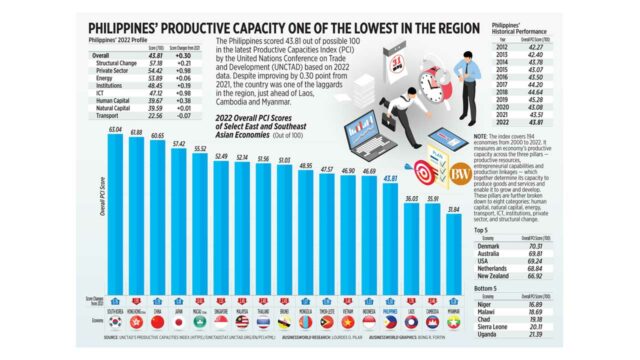
Philippines’ productive capacity one of the lowest in the region

The Philippines scored 43.81 out of possible 100 in the latest Productive Capacities Index (PCI) by the United Nations Conference on Trade and Development (UNCTAD) based on 2022 data. Despite improving by 0.30 point from 2021, the country was one of the laggards in the region, just ahead of Laos, Cambodia and Myanmar.

Philippines' productive capacity one of the lowest in the region

Fairy-tale return for London ballet company’s Cinderella

INSTAGRAM/ENGLISHNATIONALBALLET

LONDON — The stage at London’s Royal Albert Hall has been transformed into an enchanted forest, populated by gnomes, woodland creatures — and over 90 ballet dancers.

After a forced four-year break due to the COVID pandemic, the ballerinas of the English National Ballet are back at the venue for a spectacular run of Cinderella, one of the company’s biggest shows.

Ticket sales for this year’s Cinderella are up 20% on 2019, according to a spokesperson.

While performances restarted elsewhere in 2021, this is its biggest show since COVID with double the number of dancers.

The audience of about 4,000 surrounds the large circular performance space, giving the production an immersive feel.

“I think people really need art in their life,” says 28-year-old US-born Precious Adams, who is making her debut in the classic rags-to-riches title role.

There is a buzz of excitement backstage as the dancers limber up ahead of the show at the Royal Albert Hall, a distinctive red-brick circular building with a domed roof in London’s Kensington district.

Dancing there is a magical experience for Ms. Adams, given the venue’s 152-year history of hosting momentous cultural events, she said.

Like most of those who earn a living from theater, Ms. Adams was put on furlough during COVID and feared she may never dance in front of an audience again.

“It just feels really special to be on the other side of it and to finally be living this out,” Ms. Adams said. — Reuters

The President’s first year in office: Laying down strong foundations through developmental partnerships

PHILIPPINE STAR/KRIZ JOHN ROSALES

PPP is not a new acronym for many Filipinos. Public-private partnerships have been around for many years and have been an essential part of governance, in fact even before the term had been coined to depict it.

Use of the term, however, recently picked up during the first year of office of President Ferdinand “Bongbong” Marcos, Jr.

This is a stark departure from the previous administration’s alienating posture against the private sector characterized by the unfortunate, unfounded, and unproductive demonization of Philippine businesses who had always been willing and ready to engage with the government.

Still, as we saw in the early days of the pandemic, it was the private sector that stepped up to the challenge and provided immediate relief and assistance to millions of employees and the most challenged communities that were suddenly stranded by the lockdowns.

Filipinos themselves are cognizant of the significant role played by the private sector in national development. In a Stratbase-commissioned survey by Pulse Asia conducted in September 2022, almost nine in 10 respondents agreed — with 46% strongly agreeing and 41% somewhat agreeing — that the private sector plays a crucial role in accelerating economic growth, and that public-private partnerships will fuel such growth.

The survey was done just a few days before the 100th day mark of the Marcos administration.

And now that President Marcos Jr. has spent nearly a full year in office, it is apparent that he has responded to the people’s sentiment as he pursues a collaborative partnership with the private sector and with civil society in crucial aspects of government.

In energy, for instance, in pursuit of the objectives of the Philippine Development Plan 2023-2028, it is acknowledged that we need investments in energy infrastructure to ensure a reliable and stable energy supply to support our economic activity and growth. Here, PPPs are important in terms of opening up investments to achieve an optimal energy mix with the view in mind of transitioning to cleaner sources of energy in the long run. Increased reliance on renewable energy will, in turn, reduce our vulnerability to price shocks and other headwinds from the world market.

For trade and investments, the administration, judging by its actions during its first year, seems intent on establishing an environment conducive for doing business. It created green lanes for strategic investments and released the Implementing Rules and Regulations for the amendments to the Public Service Act. The improved guidelines for joint ventures between public and private entities will, in turn, breed healthy competition and encourage better performance among actors in the private sector.

The Regional Comprehensive Economic Partnership (RCEP) has been ratified, and the economic zones in Batangas and Bacolod City have been established. These developments will no doubt result in a more vibrant business environment, extending the benefits further to outside the capital and into the provinces.

There is likewise greater focus on encouraging investments in manufacturing, specifically for its multiplier effect on job creation, income generation, and enhanced quality of life for Filipinos. A more dynamic manufacturing sector remains possible and attainable and will correct recurring trade deficits by lessening the Philippines’ dependence on imports. Indeed, investment-led growth is a good formula for economic growth and resilience.

Protecting the environment and fostering climate action is another avenue for greater public-private collaboration. Achieving economic targets requires cooperation with the private sector for the entry of sustainable investments as well as a shift to a circular economy. Companies have also moved beyond corporate social responsibility activities and embraced sustainability components in their actual operations. Resilience in the face of natural disasters can also be achieved by harnessing technologies that can also be introduced and implemented by private companies.

Finally, on the issue of the West Philippine Sea, a whole-of-society approach is needed to address foreign and security policy. The private sector is also an indispensable partner to the government in pushing for initiatives that defend the rules-based international order. The President famously said, just a few weeks after assuming office, that he would not give up a square inch of our territory, and that his foreign policy would only be driven primordially by the national interest. Along with indispensable help from like-minded states, the government needs the expertise and technological assistance from the private sector in carrying out this truly Filipino-driven, truly independent foreign policy.

One year done, five more to go. The challenges that we face as a nation are real, daunting, and cannot be overcome by the government acting alone. At this crucial juncture, we find it heartening that the Marcos administration appears to be cognizant of the need to reach out to other actors — like-minded states, civil society, and, especially, the private sector — in carrying out its goals and programs.

If we proceed on this road and at this rate, in the next five years, we have no doubt that the Philippines would be a much better place for Filipinos.


Victor Andres “Dindo” C. Manhit is the president of the Stratbase ADR Institute.

Toyota partners with Lalamove for easier vehicle ownership

PHILSTAR FILE PHOTO

TOYOTA MOTOR Philippines Corp. (TMP) has partnered with the automotive unit of logistics firm Lalamove to allow easier vehicle ownership for aspiring and existing operators.

In a statement, TMP said it tied up with Lalamove Automotive to let Lalamove operators buy the Lite Ace Panel Van variant under Lalamove Automotive’s vehicle ownership program.

TMP said one of its dealerships, Toyota Taytay, together with Toyota Financial Services Philippines (TFS), has created an affordable pricing scheme for the Lite Ace.

“Toyota Taytay and TFS then collaborated with Lalamove to provide this lite-on-the-pocket pricing as an option for partner operators, giving them the convenience to grow their transport and delivery services,” the company said.

“The Panel Van variant, in particular, lets Lalamove partner operators transport more goods as it is within the required payload capacity for Lalamove vehicles with its redesigned compact body and efficient engine,” it added.

Meanwhile, Toyota Taytay and Lalamove Automotive will reach out to more potential operations as it plans to conduct a series of caravans under the program.

“Under the program and with every Lite Ace purchase, a partner operator will enjoy a comprehensive accident and repair coverage by Toyota Insure and free Periodic Maintenance Service from 1,000 kilometers until the 40,000-kilometer checkup,” TMP said.

“Further strengthening the collaboration, plans for the program include the possibility of using vehicles from T-SURE, Toyota’s Quality Pre-Owned Cars program, for Lalamove operations,” it added. — Revin Mikhael D. Ochave

Klimt portrait Lady with a Fan headed to auction with $80-million price tag

DAME MIT FÄCHER (Lady with a Fan) —SOTHEBYS.COM

LONDON — The last-ever portrait Austrian artist Gustav Klimt painted before he died is headed for auction this week, with a price estimate of $80 million.

DAME MIT FÄCHER (Lady with a Fan) —SOTHEBYS.COM

Dame mit Fächer (Lady with a Fan) — a portrait of an unnamed woman — was still on an easel in Mr. Klimt’s studio when the painter died in February 1918.

It leads Sotheby’s Modern & Contemporary Evening Auction on June 27 in London, with a price estimate of around 65 million pounds ($80 million). That price tag makes it “the most valuable ever to have been offered at auction in Europe,” according to Sotheby’s.

“It shows Klimt at the very height of his creative prowess, drawing on imagery from Asia of which he was obsessed,” Helena Newman, chairman of Sotheby’s Europe and worldwide head of impressionist and modern art, told Reuters, referring to depictions of a phoenix, lotus flower and other elements in the painting.

“It’s very rare for a Klimt painting of this quality and caliber of a portrait of a woman to come to auction.”

Last offered for sale in 1994, the painting is one of a small number of Mr. Klimt’s portraits in private collections, according to the auction house.

Other artworks being offered in the sale include Lucian Freud’s painting Night Interior (8 million-12 million pounds), a portrayal of his friend Penelope Cuthbertson, a rare self-portrait by Leonor Fini (400,000-600,000 pounds) and a painted bronze bust by Alberto Giacometti, Buste de Diego au col roulé (4 million-6 million pounds), among others. — Reuters

First Standard on track to meet growth target

BACOLOD CITY — Financing company First Standard Finance Corp. is on track to meet its growth target of 20-30% this year, its top official said.

“For 2023, we started quite strong rather than what was expected. So far, for the first six months, we are on track. I’m hoping that the remaining months will be the same or even better,” First Standard President Jacqueline Tan-Sainz told reporters here late on Monday.

“(With) businesses coming back in the Philippines, there are lots of entrepreneurs that are starting, so that’s where our target market is. With that, we were able to offset the inflation on expenses. I can say that 2023 is stronger (and) better than last year,” she added.

Data from the company showed its revenues rose to P503.56 million in 2021 from P418.06 million in 2018. Its compounded annual growth rate (CAGR) also stood at 6.4%.

Ms. Tan-Sainz said the company’s lending performance has also been improving amid the reopening of the economy.

“With the loosening of borders, there are a lot of entrepreneurs who are willing to take risks again. During the pandemic, people were afraid of risk. They want to be safe; they want to survive. This year, people are really starting to go out and start new businesses again. That’s where we come in to cater to them,” she added.

“Last year, a lot of things happened to financial institutions, like the rise of interest rates and inflation expenses, but we were able to still do good. It’s really more of an additional volume of our loans, because with the opening of our borders and loosening of restrictions, the business is really coming back to the Philippines,” she added.

First Standard is also working on expanding its locations outside of the Visayas, the official said.

“We are concentrating on our expansion. In Visayas, we are very strong. We have kind of saturated Iloilo, Bacolod, and Cebu. So currently we are concentrating on adding more offices in Luzon and west of Mindanao,” Ms. Tan-Sainz added.

The firm is currently present in over 80 locations nationwide. It is targeting to reach 100 locations, which Ms. Tan-Sainz said is a “moving target.”

“We are hoping to reach (100 locations). We had a timeline during the pandemic — now we need to set a target date again,” she said.

“During the pandemic, we had to stop (our expansion plans) because we wanted to survive. Now, we are continuing. Not only that, we added multiple products to adjust and cater to the needs of clients. That’s one of our biggest factors in the increase of volume,” she added.

However, Ms. Tan-Sainz said elevated inflation and high interest rates pose risks to their operations.

“As you know, interest is part of our capital, our cost, so it affects everything. It’s one thing we are trying to monitor. Hopefully, it will stabilize and lower by the end of the year. With that, we will be able to improve,” she said.

The Bangko Sentral ng Pilipinas (BSP) raised borrowing costs by 425 basis points (bps) from May 2022 to March 2023, bringing the benchmark rate to a near 16-year high of 6.25% before pausing for two straight meetings.

The reopening of the economy has also resulted in increased competition, Ms. Tan-Sainz said.

“One thing also, (with) the reopening, that means more competitors for us. Before, during the pandemic, there were only a few game players, a lot of financing institutions. Yes, we are not very aggressive, but we were semi-aggressive, that’s how we got our clients. Now that everyone is back on track, of course, more competition so we have to be on top of our game,” she said.

“At First Standard, we try our best to cater to the needs of our clients. We customize business solutions for them, since our goal is to uplift Filipino lives. We are only able to do that if we adjust based on their needs. I think that’s where our main competitive advantage is,” she added. — Luisa Maria Jacinta C. Jocson

The emerging industry of finance technology in the Philippines

AUSTIN DISTEL-UNSPLASH

The world has developed and advanced — the ways of the past do not necessarily apply to the present anymore. Resources now are not limited to natural resources since over time, people have discovered, created, and innovated new materials to be utilized by mankind. One of the undeniable fundamental resources of the present is technology.

Technology, in a layman’s perspective, denotes machines, gadgets, automated products, etc. To be technical, technology is the “application of scientific knowledge to the practical aims of human life or as it is sometimes phrased, to the change and manipulation of the human environment” (according to the editors of The Encyclopaedia Britannica). The Cambridge Dictionary defines technology as “(the study and knowledge of) the practical, especially industrial, use of scientific discoveries.”

Among the known products of technology are computers, laptops, and mobile phones. With these technologies, digitization and digitalization became inevitable. “Digitization is the process of changing from analog to digital form, also known as digital enablement. Said another way, digitization takes an analog process and changes it to a digital form without any different-in-kind changes to the process itself,” according to the Gartner Glossary. On the other hand, digitalization is “the use of digital technologies to change a business model and provide new revenue and value-producing opportunities.” To visualize, digitization is the scanning of a document and storing of the same scanned copy in a computer. Learning through online learning platforms and courses instead of actual face-to-face classes is an example of digitalization.

In this digital age, a lot of transactions and processes are made online. Text, audio, and video messages are easily exchanged. Photos are no longer printed from film; they are now posted on social media. Since information is easily available and accessible, businesses utilize data and technology to create more efficient business models that would produce greater profits and less costs. One of these innovations is finance technology (Fintech).

The CFA Institute refers to financial technology as the technological innovation in the design and delivery of financial services and products. In a Forbes Advisor article, financial technology is used as a catch-all term for technology used to augment, streamline, digitize, or disrupt traditional financial services. (“What is Fintech?”, Walden, S., May 30, 2023, Forbes, https://www.forbes.com/advisor/banking/what-is-fintech/) In essence, it is the use of technology such as software and applications to enhance financial transactions not only for businesses but also for consumers.

Fintech is not technically new in the sense that it has been present since the 1950s in the form of credit cards, and, in the 1960s through automated teller machines (ATMs). (Truong, O., 2016, How fintech industry is changing the world (thesis), CORE) Although it is not necessarily novel, it is certainly emerging and is becoming more accessible to the general public. In the present, it has advanced even more especially when the need arose during the pandemic when movement was limited; businesses had to find ways to make their products and services available online so as not to impede their profits. Current Fintech are in the forms of mobile banking, mobile payments, peer-to-peer lending, cryptocurrency, etc.

In 2021, the Philippines ranked 53rd out of 83 countries in the Global Fintech Index Ecosystem Rankings of Countries in which countries are ranked according to the strength of their Fintech startup ecosystem. In the country’s setting, Fintech startups include GCash, PDAX, and Maya. As more and more individuals avail themselves of these innovations — going cashless, preferring to pay bills online than over the counter — businesses are encouraged to incorporate these improvements in their business models or systems. Restaurants and stores now accept payment through cards, GCash, and the like. For online services that require delivery, payment is no longer limited to “cash on delivery.” The country’s independent monetary authority, the Bangko Sentral ng Pilipinas (BSP), acknowledges the inevitable growth of digital payments. As early as 2015, it launched the National Retail Payment System Framework, which created PESONet and InstaPay.

With these advancements, it is natural for one to ask, “is there security in using these services? Are businesses and consumers protected?” Although there is a dearth of Philippine law that specifically addresses regulatory compliance by the Fintech industry, the Department of Finance tasked the Securities and Exchange Commission (SEC) and the Bureau of Internal Revenue (BIR) with monitoring and ensuring that Fintech companies are regulated and taxed accordingly. In 2021, the SEC launched the PhiliFintech Innovation Office (PIO) which focuses on the regulation of the use of Fintech in the Philippines. The PIO facilitates the processing of the registration of new Fintech companies in the country or of existing companies that have been operating or are introducing new fintech products.

The BSP controls the growth of Fintech by crafting cybersecurity policies mandating banks and other financial institutions under its supervision to adopt better measures in technology risk management systems. It also set Anti-Money Laundering regulations to ensure that Fintech companies follow the best practices in preventing illegal activities. Fintech companies are thus not exempt from meeting Know-Your-Customer (KYC) requirements as part of their compliance process.

It is clear that there is no stopping the Philippine Fintech industry from moving forward. At present, an interplay of laws and regulations from different bodies and authorities is needed to determine compliance and violations by companies in the industry. Since the growth of Fintech is imminent, existing laws may not be sufficient to address issues targeted and specific to this technology. Improved legislation on this matter will be advantageous not just for the companies and investors, but more so the consumers. If the Philippine Fintech legal landscape is left as is, the country might not be able to keep up with the pace in which this industry is going. If so, instead of having a technology that is beneficial to the public, it could be a tool to commit thievery and other illegal acts.

(The views and opinions expressed in this article are those of the author. This article is for general informational and educational purposes only and not offered as and does not constitute legal advice or legal opinion.)


Christine L. Paulma is an associate of the Angara Abello Concepcion Regala & Cruz Law Offices (ACCRALAW), Davao Branch.

(6382) 224-0996

clpaulma@accralaw.com

Infrastructure consideration key to fintech startup growth — experts

By Brontë H. Lacsamana, Reporter

THE growth of financial technology (fintech) startups in the Philippines hinges on careful consideration of the available infrastructure and its impact on the integration of technology into the lives of Filipinos, according to industry experts.

“When you launch new technology, there’s a learning curve for users to adopt it,” said Aaron M. Villegas, co-founder and chief executive officer of the financial management application Lista, during an interview with BusinessWorld.

“It’s not sufficient to simply copy-paste an idea from a developed market,” he also said. “We need to incorporate localized elements.”

Lista is a free application that provides real-time tracking of income flow, profits, and savings for both individual users and micro, small, and medium enterprise (MSME) users.

In September 2021, when the app was launched, the global digital competitiveness index ranked the Philippines 58th out of 64 economies, based on future readiness, technology, and knowledge indicators.

Since then, its placement has improved slightly to 56th in 2022, but it still holds the lowest rank among Southeast Asian countries.

The digital divide, characterized by low mobile broadband penetration, affordability, and service quality, continues to pose a risk to the Philippines’ growth despite its citizens’ high internet usage, according to the International Finance Corp.

Lista said that its aim is to address these challenges by implementing an on-ground approach with its users. Through this approach, the startup introduces features that assist in achieving a balance in finances while maintaining a small app size for both online and offline usage.

The startup originated out of necessity in 2021 when Mr. Villegas’ parents encountered difficulties in comprehending the financial aspects of their family-owned stores. He observed a lack of available tools in the market that could aid Filipinos in gaining financial clarity, the entrepreneur said.

“The tools that were out there, if there were any, were either complex or expensive,” he said. His family was relying on pen and paper.

“For all Filipinos, money is an issue, mainly because we weren’t taught to handle finances. Personally, after graduating, I only learned to manage my finances maybe three to four years after I gained work experience,” said Khriztina T. Lim, co-founder and chief operating officer of Lista.

“I used Excel before, and it’s frustrating because you have to know formulas. It’s very manual,” she added.

FINDING THE PURPOSE
To start a business, it is not enough to have a good idea and just run with the risk. There has to be a clear purpose to do it, Ms. Lim said.

“I came from a very stable job and so moving to running or building a startup was really risky, but I was lucky enough to be surrounded by people who are very supportive.”

“When you find something that you like, something that you’re passionate about, something that you’re good at — when you find a specific thing that has all three, it’s worth every risk,” she added.

For Mr. Villegas, the fact that developed markets have had financial tracking tools for quite some time already fueled his ambition.

“That’s why we thought of creating Lista, with the goal of providing Filipinos financial clarity and being their financial companion,” he said.

While the app primarily targeted smaller businesses that wanted to digitize their financials, it eventually became a tool geared towards helping individual Filipinos track their money, debts, and payments.

YOUNG, CURIOUS, MOTIVATED
Mr. Villegas, now 25 years old, was one of seven Filipinos recognized in this year’s Forbes 30 Under 30 Asia list, which features young entrepreneurs and trailblazers in Asia and Australia under the age of 30.

“When you’re young, you have a beginner’s mind. You have a fresh perspective. You have no preconceived notions of how things should work. You tend to be more curious and try to question them,” he noted.

Founding Lista at just 23 also meant he was hungry to prove himself. “Because you have more time and less obligations, it allows you to have freedom in terms of experimenting and building new ideas,” he said.

However, one disadvantage was that he lacked a proven track record. In the eyes of the adults in the room, he had not accomplished anything noteworthy, especially considering he was only a high school graduate, he noted.

“When you’re in that position, I think people tend to look down on you, tend to not take you seriously.”

To surmount this obstacle, he exerted even greater effort and deliberately sought the company of individuals slightly ahead in their own journeys, with the intention of absorbing a wealth of knowledge from their experiences.

A MOTHER’S DUTY
As a co-founder, it is common to view one’s startup as his or her “baby,” but this was particularly challenging for Ms. Lim as she was pregnant during the early stages of Lista.

“It’s a male dominated industry, but I’m very lucky to be around people who are very welcoming. To them, gender was never an issue. It was more of, what can you bring to the table?” she said.

While talking to investors from East Ventures, Saison Capital, and 1982 Ventures to raise funds for Lista, the baby would kick, she said. She had to balance growing a baby inside her throughout the whole journey of growing a startup by fundraising and hiring.

“There are very few women in the startup world, so it can be challenging to find someone who can truly relate to your frustrations, your journey, or even just someone you can have a meaningful conversation with,” said Ms. Lim.

She also said that being a mother and a founder presents the most significant challenge a woman can encounter, but she appreciates and embraces challenges.

“When my baby resisted going to sleep early, I seized that opportunity to work and catch up on e-mails. Surprisingly, it fueled me with even more energy,” she added.

TARGETING ALL FILIPINOS
Like parents growing along with their child, a founder also has to grow along with their business. In Lista’s case, financial literacy is that process.

“We started by introducing the concept of financial management to Filipinos, then moving several stages until we reach a point that we’re confident that Filipinos are financially literate,” Ms. Lim said.

This also includes reducing the taboo nature of money talk in the culture of Filipinos by making it less intimidating.

There must be effort to understand what users need, before launching products and features, she added. Lista, the first financial management app in the country made by Filipinos for Filipinos, has to stand by this.

“We knew that we wanted to target all Filipinos, from the north to the south, even in the remote areas. For us to do that, we needed to make sure that without data you’re able to use Lista,” Mr. Villegas said.

While the country is in the process of reining in investments for better connectivity, innovators must for now be smart with the Philippines’ existing tech infrastructure.

Starting with building something that Filipinos want will result in everything else falling into place, rather than monetization or pleasing shareholders, he added.

The app now has over three million downloads across the country, double the number of downloads from half a year ago.

“In terms of usage, we’re seeing that both MSMEs and individuals are engaged on a day-to-day basis,” said Mr. Villegas, “And the main thing that they want to know is, am I financially healthy?”

Ms. Lim added that they hope to double the number of their users.

EMBRACING UNCERTAINTY
In a post-pandemic world, uncertainty and failure have become integral parts of business growth. “That’s the only time you’ll actually grow,” said Mr. Villegas.

He said that all founders and entrepreneurs have to overcome struggles and challenges on a day-to-day basis to become great.

Startups in the Philippines, in particular, face numerous hurdles, as evidenced by the country’s ranking of 59th out of 100 economies in the 2023 Global Startup Ecosystem Index, based on assessments of the local business environment.

This places the Filipino startup ecosystem as the seventh lowest in the Asia-Pacific region.

“If you’re afraid of the risk and the opportunity, it’s usually a positive sign,” said Ms. Lim. “It signifies that you genuinely care about it.”

The key is to utilize fear and curiosity as motivation to at least make an attempt, with the help of collaborators and a robust support system.

“Success is not achieved by a lone individual. It is always propelled by a group of people. Whenever possible, you want to ensure that you work with the very best,” said Mr. Villegas.

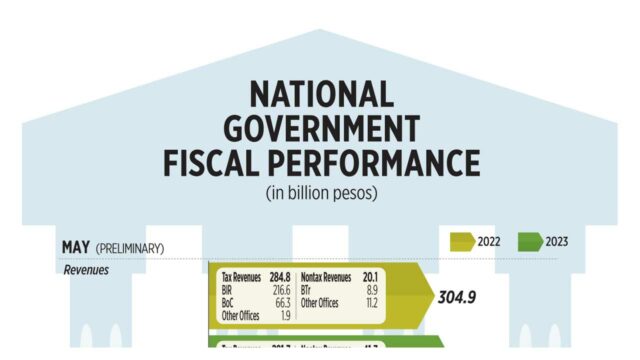
National Government fiscal performance

THE NATIONAL GOVERNMENT (NG) plans to borrow P180 billion from the domestic market in July, the Bureau of the Treasury (BTr) said on Tuesday. Read the full story.

National Government fiscal performance

ADVERTISEMENT
ADVERTISEMENT