Home Blog Page 4655

Industry veteran is new Geely PHL VP

Sojitz G Auto Philippines Vice-President Reggie See — PHOTO FROM GEELY PHILIPPINES

GEELY COUNTRY DISTRIBUTOR Sojitz G Auto Philippines (SGAP) recently announced the appointment of Reggie See as vice-president for its vehicle sales and flagship dealerships, effective June 1. Mr. See is expected to play “a key role in revving up SGAP’s growth strategy, further strengthening the company’s position in the automotive market,” said the company in a release.

The executive brings with him “a wealth of experience and expertise in automotive distributorship and dealership management, having held prominent positions in one of the largest Philippine conglomerates handling multiple automotive brands.” Mr. See’s track record includes vehicle business start-up and development, marketing, network expansion and dealer operations that have delivered “exceptional” results.

At SGAP, he will be focusing on expanding market share, cultivating strategic partnerships, and capturing new business opportunities. With his deep understanding of the automotive landscape and customer needs, Mr. See will leverage his expertise to develop customer-centric sales strategies that align with SGAP’s vision and enhance the overall brand experience.

“We are delighted to welcome Reggie as our vice-president at Sojitz G Auto Philippines,” said SGAP President and CEO Yugo Kiyofuji. “His leadership skills, extensive industry knowledge, and proven ability to drive business growth make him the perfect fit for our organization. We are confident that his contributions will further strengthen our position as the distributor of the Geely brand in the Philippines.”

Fisheries output seen rising in Q3 as El Niño boosts plankton growth

PHILSTAR

By Sheldeen Joy Talavera

FISHERIES production could continue to improve in the third quarter, with the weather favoring the growth of plankton that fish depend on for food, a former fisheries official said.

“That is the trend that I am seeing with El Niño, (assuming no other) extreme weather disturbance,” according to Asis G. Perez, former director of the Bureau of Fisheries and Aquatic Resources and co-convenor of advocacy group Tugon Kabuhayan.

Mr. Perez said fish eat more in warm weather, allowing them to grow bigger. Warm weather also encourages plankton growth, on which the fish feed.

“Since primary production happens with sunlight, the production of the food for fish will be higher this time as El Niño is entering,” he told BusinessWorld by phone.

The government weather service, known as PAGASA (Philippine Atmospheric, Geophysical and Astronomical Services Administration), has forecast the possibility of an El Niño episode beginning in June, running until the first quarter of 2024.

Fisheries production in the first quarter rose 2% to 991.14 thousand metric tons, led by the marine municipal fisheries and aquaculture subsectors.

From the three months to June, Mr. Perez said fishermen reported a good harvest as favorable weather allowed them to fish, while supply-chain disruptions are clearing up for processed animal protein (PAP), a material used in fish feed.

The Philippine Statistics Authority is set to release agricultural output data for the second quarter on Aug. 9.

During the third quarter of 2022, Mr. Perez said fisheries production, particularly aquaculture, declined due to the lower supply of PAP, which was caught up in the import bans on pork products imposed due to African Swine Fever.

“Now, we’re hoping that with the better climate and at least with less rain and moderate sunlight, assuming no weather disturbances, then maybe fisheries performance will improve,” he said.

Mr. Perez noted that increased volume of production does not translate to higher incomes, considering the market’s demand and supply situation.

Kapag sobrang madami naman, ‘yong farmer naapektuhan kasi good production does not necessarily mean more income… kapag nagkasabay-sabay ang harvest medyo ang presyo apektado (If the harvest if too bountiful, the farmer could be affected. Good production does not necessarily mean more income. If all the good harvests come in at once, the price could be affected),” he said.

According to the Department of Agriculture’s price monitors, as of June 30 the retail price of bangus or milkfish in Metro Manila was between P145 and P240 as of June 30.

Tilapia fetched between P105 and P160 while galunggong or local round scad sold for between P180 and P200.

Mr. Perez also noted that pork imports have affected demand for fish and other commodities.

“Our call is hopefully for the reduced tariff on pork not to be extended, because all producers are affected — chicken, egg, or fish — because we (all) compete with imported pork with lower tariff,” he said.

At present, the tariff rate on pork is 15% for imports within the minimum access volume quota and 25% for shipments exceeding the quota. The rates were set by executive orders issued by presidents Rodrigo R. Duterte and Ferdinand R. Marcos, Jr.

The lowered tariffs expire at the end of 2023, restoring pork tariffs to the original 30% within the quota and 40% for those exceeding the quota.

Rates of Treasury bills, bonds may go up

WIKIPEDIA/JUDGE FLORO

RATES of the Treasury bills and bonds on offer this week could rise to track secondary market levels due to hawkish signals from the US Federal Reserve.

The Bureau of the Treasury (BTr) will auction off P15 billion in Treasury bills (T-bills) on Monday, or P5 billion each in 91-, 182- and 364-day papers.

On Tuesday, it will offer P30 billion in reissued 10-year Treasury bonds (T-bonds) with a remaining life of nine years and two months.

T-bill and T-bond rates may track the rise in secondary market yields last week following hawkish comments from the Fed chief, Rizal Commercial Banking Corp. Chief Economist Michael L. Ricafort said in a Viber message.

At the secondary market on Friday, the 91-, 182-, and 364-day T-bills went up by 2.27 basis points (bps), 8.57 bps, and 8.74 bps week on week to end at 6.1113%, 6.1815%, and 6.2175%, respectively, based on the PHP Bloomberg Valuation Service Reference Rates data published on the Philippine Dealing System’s website.

Meanwhile, the yield on the 10-year papers rose by 11.6 bps week on week to end at 6.3036% on Friday.

US central bankers are likely to resume their rate hike campaign after a break last month, Fed Chair Jerome H. Powell signaled on Thursday, as a fresh slew of stronger-than-expected US economic data underscored why more monetary tightening is likely needed, Reuters reported.

“We did take one meeting where we didn’t move,” Mr. Powell said during an event held by the Spanish central bank in Madrid. “We expect the moderate pace of interest rate decisions to continue.”

The US central bank last month paused its tightening cycle after hiking rates for 10 straight meetings by a total of 500 bps to a range between 5% and 5.25%.

The US central bank’s next policy meeting is on July 25-26.

“[This] week’s 9-year auction has a tendency to be rejected as players will likely stay out or bid at ridiculous levels of 6.6% to 6.75%. Expect quiet trading [this] week with some relief on June disinflation due on Wednesday where the BSP (Bangko Sentral ng Pilipinas) projected it to slow down between 5.3% and 6.1%,” a trader said in an e-mail.

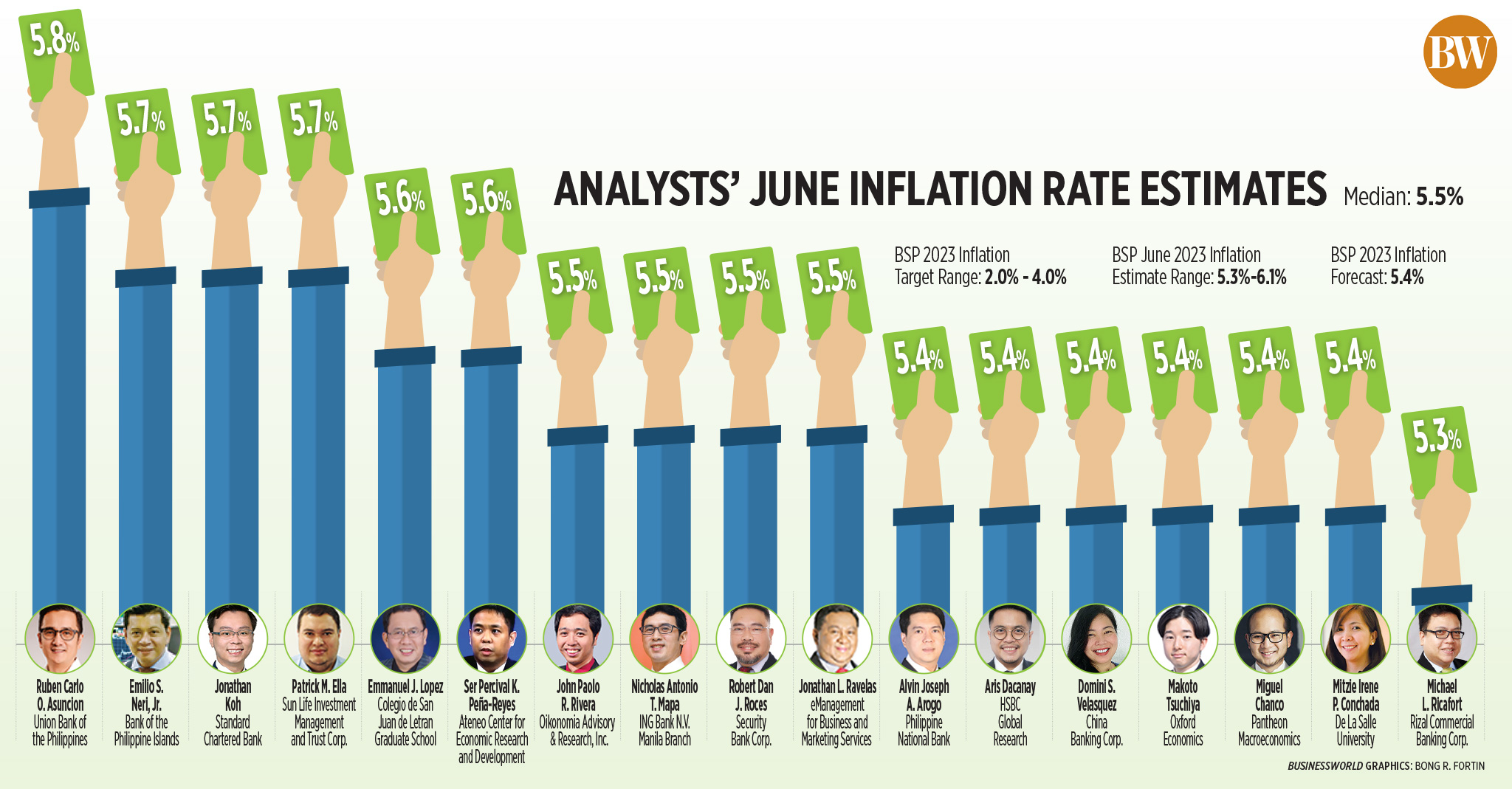
A BusinessWorld poll of 17 analysts yielded a median estimate of 5.5% for June headline inflation, near the lower end of the central bank’s forecast.

If realized, this would be below the 6.1% in May and would mark the fifth straight month of slower inflation.

However, June would be the 15th straight month that inflation surpassed the BSP’s 2-4% target range.

The Philippine Statistics Authority will release June inflation data on Wednesday.

Last week, the BTr raised just P10.581 billion via the T-bills it auctioned off versus the P15-billion program, even as total bids reached P17.648 billion.

Broken down, the Treasury raised P5 billion as planned via the 92-day T-bills as tenders for the tenor reached P6.677 billion. The average rate of the three-month papers went up by 5.7 bps to 6.086%, with accepted rates ranging from 5.98% to 6.199%.

Meanwhile, the government made a partial P2.97-billion award of the 183-day securities versus the P5-billion program as bids for the tenor reached just P4.98 billion. The six-month T-bill was quoted at an average rate of 6.144%, up by 6.3 bps, with accepted rates from 6.02% to 6.2%.

Lastly, the BTr raised just P2.611 billion from the 365-day debt papers out of the P5 billion on the auction block, even as demand reached P5.911 billion. The average rate of the one-year T-bills rose by 5.3 bps to 6.219% Accepted yields were from 6.11% to 6.25%.

The T-bill tenors offered last week were adjusted from the usual 91-, 182- and 364-day papers due to a holiday.

Meanwhile, the reissued 10-year T-bonds to be auctioned off on Tuesday were last offered on June 27, where the government raised P25 billion as planned. The papers were awarded at an average rate of 6.243%.

The BTr wants to raise P180 billion from the domestic market this month, or P60 billion via T-bills and P120 billion via T-bonds.

The government borrows from local and foreign sources to help fund its budget deficit, which is capped at 6.1% of gross domestic product this year. — A.M.C. Sy with Reuters

Versatile Oscar-winning American actor Alan Arkin, 89

ALAN ARKIN — IMDB

ALAN ARKIN, a versatile and prolific American actor who thrived in both comic and dramatic roles and won an Oscar for playing a heroin-using grandfather in the 2006 film Little Miss Sunshine, has died at 89, his family said.

“Our father was a uniquely talented force of nature, both as an artist and a man. A loving husband, father, grand and great grandfather, he was adored and will be deeply missed,” Mr. Arkin’s sons Adam, Matthew, and Anthony wrote in a joint statement.

Mr. Arkin died at his home in Carlsbad, California, on Thursday, Variety reported.

Mr. Arkin appeared in scores of films, was nominated for an Academy Award four times and won a Tony Award, Broadway’s top honors, in 1963 for his first major stage role in Carl Reiner’s Enter Laughing.

His first major movie role also earned him an Oscar nomination — best actor for playing a Soviet sailor in the 1966 Cold War comedy The Russians Are Coming! The Russians Are Coming!

Mr. Arkin was initially turned down for the Little Miss Sunshine role that ultimately won him a best-supporting-actor Oscar because the directors thought he was too healthy. The character was a foul-mouthed 80-year-old grandfather who was frail and shaky from years of drug abuse and bad behavior.

“It’s the best rejection I ever got in my life — they thought I was too virile,” Mr. Arkin said, flexing his biceps and striking a muscleman pose during a 2007 interview with The New York Times.

Mr. Arkin delivered a memorable dramatic turn as a psychopathic killer in the 1967 film Wait Until Dark, opposite Audrey Hepburn. He later said he hated the scenes in which his character terrorizes Ms. Hepburn, saying, “I didn’t like being cruel to her. It made me very uncomfortable.”

He appeared as a deaf-mute in the adaptation of Carson McCullers’ novel The Heart Is a Lonely Hunter in 1968, drawing his second Academy Award nomination for best actor.

In 1970, he starred in the film version of Joseph Heller’s novel Catch-22, putting in a strong performance in a movie that was considered a disappointment.

He also won plaudits for his performance in the 2012 thriller Argo, which told the true-life story of a CIA mission to free six Americans from Iran by disguising them as crew members of an elaborately concocted but fictitious film about aliens. Director Ben Affleck’s film won the Academy Award for best picture.

Mr. Arkin remained active in film and television well into his 80s. He won praise and Emmy nominations for the TV series The Kominsky Method, also starring Michael Douglas, that debuted in 2018.

“Did ANYONE have the range Alan Arkin had? Hilarious, sinister, insane, tragic. No mood he couldn’t live in,” tweeted actor and comedian Patton Oswalt.

Some of Mr. Arkin’s other films included The Seven-Per-Cent Solution in 1976, The In-Laws in 1979, Edward Scissorhands in 1990, Glengarry Glen Ross in 1992, Grosse Pointe Blank in 1997, The Slums of Beverly Hills in 1998, Get Smart in 2008, Sunshine Cleaning in 2008, Stand Up Guys in 2012, and Going in Style in 2017.

Not all his movies fared well. For example, he said he did Freebie and the Bean in 1974 because “I needed the bread.”

Alan Wolf Arkin was born on March 26, 1934, in the New York City borough of Brooklyn, but his family moved to Los Angeles when he was 11. His father, a painter and writer, lost his job as a teacher after he was accused of being a communist during the “Red Scare” of the 1950s.

Mr. Arkin was an original member of Chicago’s influential improvisational comedy troupe Second City and sang in a folk group that had a hit version of the 1950s single “The Banana Boat Song,” popularized by Harry Belafonte. Mr. Arkin also worked as a movie and stage director, made many TV appearances and wrote several books.

Mr. Arkin is survived by his wife Suzanne, his three sons, four grandchildren and a great-grandson. — Reuters


KitKats are no longer carbon neutral. That’s good.

ABI SCHREIDER-UNSPLASH

CARBON EMISSIONS aren’t like parking tickets. You can’t just pay a little money to clear your record and avoid the dreaded boot, thus freeing yourself to blithely park someplace else.

Yet too many companies use the market for carbon offsets this way. They buy credits that don’t come close to making up for their contributions to global warming, giving themselves a pass to emit more carbon. Fortunately, some are waking up to the reality that they must do more.

Consumer food behemoth Nestlé SA is getting out of the offset market and putting the money it would have spent on those credits toward cutting emissions in its supply chain and operations. It’s also dropping “carbon neutral” pledges for KitKat, Perrier, and other Nestlé brands, Bloomberg News reported.

The ranks of former offsetters are growing as the practice faces rising criticism that it too often amounts to greenwashing. Many offsetting projects don’t meaningfully contribute to reductions in carbon emissions in the world, instead giving companies credit for reductions that would have happened anyway. Or they rely on methods that don’t remove as much carbon from the atmosphere, or for nearly as long, as the carbon the companies pumped in the first place.

For example, planting trees is a common offsetting technique. But trees seem to be catching fire more often as the planet warms, releasing all the carbon they contain. Just this month, about 247 acres of the BigCoast Forest Climate Initiative offsetting project in British Columbia have burned in Canada’s record wildfire season. This was a tiny fraction of the overall project but a reminder of how fleeting tree-based offsets can be. 

But these companies still need to replace offsetting with real plans to fight emissions. It remains to be seen how much better Nestlé’s approach will fare. It still includes such squishy measures as habitat protection, wetlands restoration, and … planting trees. On the other hand, those aren’t the only tools Nestlé means to deploy; it makes a relatively robust accounting of its carbon emissions and has a multifaceted, detailed plan for reaching net-zero emissions by 2050.

Aggressive approaches to cutting emissions aren’t as easy or cheap as simply buying forgiveness. But as activists and investors agitate and sue companies over what they call greenwashing, making those reductions becomes more attractive.

It may also turn out to be good for business, or at least tolerable to shareholders. EasyJet Plc announced last September that it was ditching offsets and investing instead in expensive new technology to go carbon neutral. Its stock has experienced some air pockets since then but has managed to gain 59% over that time.

The jury is still out on how eager consumers will be to buy more legitimately sustainable goods, especially if they are more expensive. Consumers claim to care about sustainability, but their motivation when the shopping cart hits the aisles is murkier. A recent McKinsey study found consumer goods labeled ESG-friendly averaged 28% cumulative growth over a five-year period, compared with 20% for goods lacking such labels. But the consulting firm couldn’t establish any causality.

Doubtless, “green” products must appeal to that helpless, guilty part of us that feels (probably incorrectly) as if we are destroying the planet in every other aspect of our daily lives. Many of us lack the means to do much more than buy supposedly sustainable KitKats. Huge companies like Nestlé do have those means, and their actions have a real impact.

Through changes to its supply chain, manufacturing and packaging, Nestlé claims it was responsible for 93.3 million tons of carbon last year, roughly the output of Morocco. But that was down 6.4 million tons from what Nestlé calls its “business as usual” path. It would take a million individuals driving electric cars, going vegan, and flying less to effect a similar reduction.

That makes it all the more important that consumers and investors push for corporate decarbonization efforts that are credible and meaningful. It might help if we choose to give our business to those who do make such efforts. Fortunately, the momentum is moving in the right direction.

BLOOMBERG OPINION

Robinsons Land raises P15B from bond offer

LISTED property developer Robinsons Land Corp. (RLC) said that it had raised P15 billion after the strong demand for its fixed-rate bond issuance.

In a media release, the company said it had fully exercised its P5-billion oversubscription option amid “robust investor demand.”

“We are grateful to the investor community for their continued trust and confidence in RLC’s brand, reputation, and overall growth prospects,” RLC President and Chief Executive Officer Frederick D. Go said in a statement.

Mr. Go added that proceeds from the offering will be used to strengthen the company’s strategic investments aimed at increasing shareholder value.

Proceeds will be used to fully repay maturing debt obligations, partially fund the capital expenditure for project development, and support overall business operations.

“With the capital raised, RLC will continue to build a solid portfolio of well-designed, sustainable real estate developments that define the local landscape and uplift communities across the Philippines,” Mr. Go said.

The offering, which was listed on the Philippine Dealing & Exchange Corp., constitutes the second and final tranche of RLC’s P30-billion shelf-registered debt securities program, which was approved on Aug. 12, 2022.

The interest rate for the three-year series was 6.0972% per annum while that of the five-year tenor was 6.1663% per annum.

“The issuance also received the highest credit rating of PRS Aaa, with a Stable Outlook, from the Philippine Rating Services Corp.,” RLC said, “indicating the company’s stability, healthy balance sheet and strong capacity to meet its financial commitments.”

During the first quarter, its net income surged by 90% to P2.66 billion due to the strong performance of its business units. Consolidated revenues increased by 39% to P9.28 billion.

RLC shares fell by 0.83% or 12 centavos to P14.28 apiece on Friday. — Adrian H. Halili

Honda extends BR-V test-drive campaign

PHOTO BY KAP MACEDA AGUILA

HONDA CARS Philippines, Inc. (HCPI) announced the extension of its special test-drive campaign for the all-new Honda BR-V. To run until July 24, the campaign will afford all-new BR-V testers in any HCPI dealership a chance to win eight 10th-generation Apple iPads, and 100 gift certificates worth P2,000 each.

Those who purchase the model will get an additional P10,000 discount on top of existing offers. Winners for the initial campaign period will be proclaimed on July 12, and Aug. 7 for the extended campaign. The list of winners will be published on HCPI’s website www.hondaphil.com and official Facebook page.

With its seven-seater capacity, sleek SUV appeal, higher ground clearance, and comfortable and versatile interior, the BR-V is positioned as “the perfect road trip companion for families and friends.” The Honda BR-V 1.5 VX CVT variant gets the intelligent safety features of Honda Sensing. With its powerful and fuel-efficient engine that achieves up to 24.71kpl, advanced safety and technology, low maintenance, and “Honda quality and reliability,” the BR-V is now HCPI’s best-selling model.

HCPI says that test driving allows car browsers to make a well-informed choice, “avoid that dreadful buyer’s remorse, and be truly satisfied with (their) investment for years to come.”

Cotabato farmers trained in organic fertilizer preparation

COTABATO PROVINCIAL AGRICULTURIST

FARMERS in Cotabato province received training in the preparation of alternative fertilizers from the Office of the Provincial Agriculturist (OPAg) at the Municipal Nursery of Midsayap.

Seventy organic farmers from Midsayap learned to make fertilizer using fermented fruit juice, fermented plant juice, fish amino acids, and calcium phosphate made from jackfruit, bananas, fish, eggshells, muscovado, vinegar, carbonized rice hulls, and liquid smoke’ as well as organic composting.

The program is a farm-income improvement initiative of Governor Emmylou J. Taliño-Mendoza.

The OPAg lead official for organics, Dina A. Lumogdang, said the methods used will save farmers money and keep their farms chemical-free.

Meanwhile, the Department of Agriculture (DA) Region 12  and the provincial government of Cotabato also discussed the distribution of rice fertilizer support.

“Sa ngayon ay pinaghahandaan na ng probinsya ang isasagawang pamamahagi kung saan magkakaroon ng ikalawang pagpupulong kasama ang mga representante ng iba’t-ibang munisipyo upang maibahagi ang nasabing fertilizers sa mga karapat dapat na mga benepisyaryo (The province is preparing for the distribution, for which we will convene a second meeting with representatives from each municipality, in order to distribute fertilizer to eligible beneficiaries),” the governor said. 

In 2022, the DA ranked Cotabato province no. 1 in Region 12, no. 3 in Mindanao and no. 10 in the country in rice production, with output of 510,973 metric tons. — Maya M. Padillo

Analysts’ June inflation rate estimates

HEADLINE INFLATION likely further slowed for a fifth straight month in June, due to stable food prices and high base effects, analysts said. Read the full story.


Digital payments increase in 2022

STOCK PHOTO | Image by Katemangostar from Freepik

ONLINE PAYMENTS rose further in 2022 as more consumers and businesses used digital channels for transactions for speed and convenience, the Bangko Sentral ng Pilipinas (BSP) said on Friday.

The BSP’s 2022 Status of Digital Payments report showed the share of online payments in the total volume of retail transactions in the country rose to 42.1% in 2022 from 30.3% a year earlier.

The total payment volume stood at 4.85 billion in 2022, with those done via digital platforms totaling 2.04 billion transactions, BSP data showed.

The BSP said the top contributors for the increase in volume were merchant payments, person-to-person (P2P) transfers, and salaries and wage payments.

“Merchant payments and P2P transfers were further digitalized by 35.6% and 91.2%, respectively. Meanwhile, it is also noteworthy that salaries and wage payments grew by 41.1%, from just 32 million transactions in 2021,” the central bank said.

“These results are aligned with the latest BSP Financial Inclusion Survey Report, which found a significant increase in ownership of transaction accounts, majority of which are e-money accounts, and that more of these accounts are now being used for payments,” it added.

Meanwhile, the value of payments done online stood at $78.14 billion and represented 40.1% of $195.05 billion worth of total retail transactions last year, lower than the 44.1% share in 2021.

Outgoing BSP Governor Felipe M. Medalla said the numbers show the country is on track towards meeting the central bank’s goal to digitize 50% of the volume and value of retail transactions by yearend.

“The numbers tell us that the deliberate reforms and initiatives we have been undertaking are responsive to the shifting needs of the public towards more efficient payments services. Since the pandemic, which broadened digital payments adoption and acceptance, the upward trajectory of digital payment usage has been sustained. We need to carry on to maintain this trend, focusing on the overall value-adding experience of using digital payments,” Mr. Medalla said. — KBT

Hollywood actors extend contract talks, temporarily averting strike

NATHAN DEFIESTA-UNSPLASH

LOS ANGELES — Hollywood’s actors union and major Hollywood studios agreed on Friday to keep negotiating through mid-July, staving off the immediate threat of a second labor strike in the entertainment business this summer.

The SAG-AFTRA union and the Alliance of Motion Picture and Television Producers (AMPTP) said they would extend their current contract, which had been set to expire at midnight, through July 12.

The agreement gives the two sides more time to work out a deal and prevent a work stoppage that would have added to ongoing labor strife in Hollywood. Members of the Writers Guild of America (WGA) walked off the job on May 2, forcing many film and TV productions to shut down.

A-list stars including Jennifer Lawrence and Meryl Streep, in a letter to union leadership this week, said they were ready to walk off the job if negotiators failed to reach a “transformative deal” on higher base pay and safeguards around use of artificial intelligence (AI).

The letter came days after union negotiators issued a video saying their talks had been “extremely productive,” a possible sign that a deal was within reach.

In a message to members on Friday, SAG-AFTRA’s negotiators they had unanimously agreed to the contract extension “in order to exhaust every opportunity to achieve the righteous contract we all demand and deserve.”

“No one should mistake this extension for weakness,” they said.

SAG-AFTRA voted in early June to give its leaders the authority to call a work stoppage if talks were to break down.

Negotiations were taking place during a difficult time for Hollywood studios. Conglomerates are under pressure from Wall Street to make their streaming services profitable after pumping billions of dollars into programming to attract subscribers.

The rise of streaming has eroded television ad revenue as traditional TV audiences shrink.

The walkout by 11,500 writers has shut down a wide swath of TV production and delayed the filming of movies including Marvel’s Thunderbolts and Blade. Any ongoing filming would have to halt if actors also strike.

Leaders of SAG-AFTRA, which represents 160,000 actors, and the WGA say the entertainment industry has changed dramatically with the rise of streaming television and the emergence of technology such as generative AI, which they fear could be used to write scripts or create digital actors.

The AMPTP, which negotiates on behalf of the studios, has declined to comment about its talks with SAG-AFTRA. The two sides have agreed to keep negotiating without discussing the talks with the media, according to a joint statement on Friday.

With the writers, the AMPTP said it had offered “generous” pay increases but could not agree to all of the writers’ demands. The studios and the WGA have not held talks since the writers’ strike began on May 2.

The WGA walkout is hitting caterers, prop suppliers and other small businesses that generate a large portion of their income from Hollywood productions. The last writers’ strike in 2007 and 2008 cost the California economy an estimated $2.1 billion. — Reuters

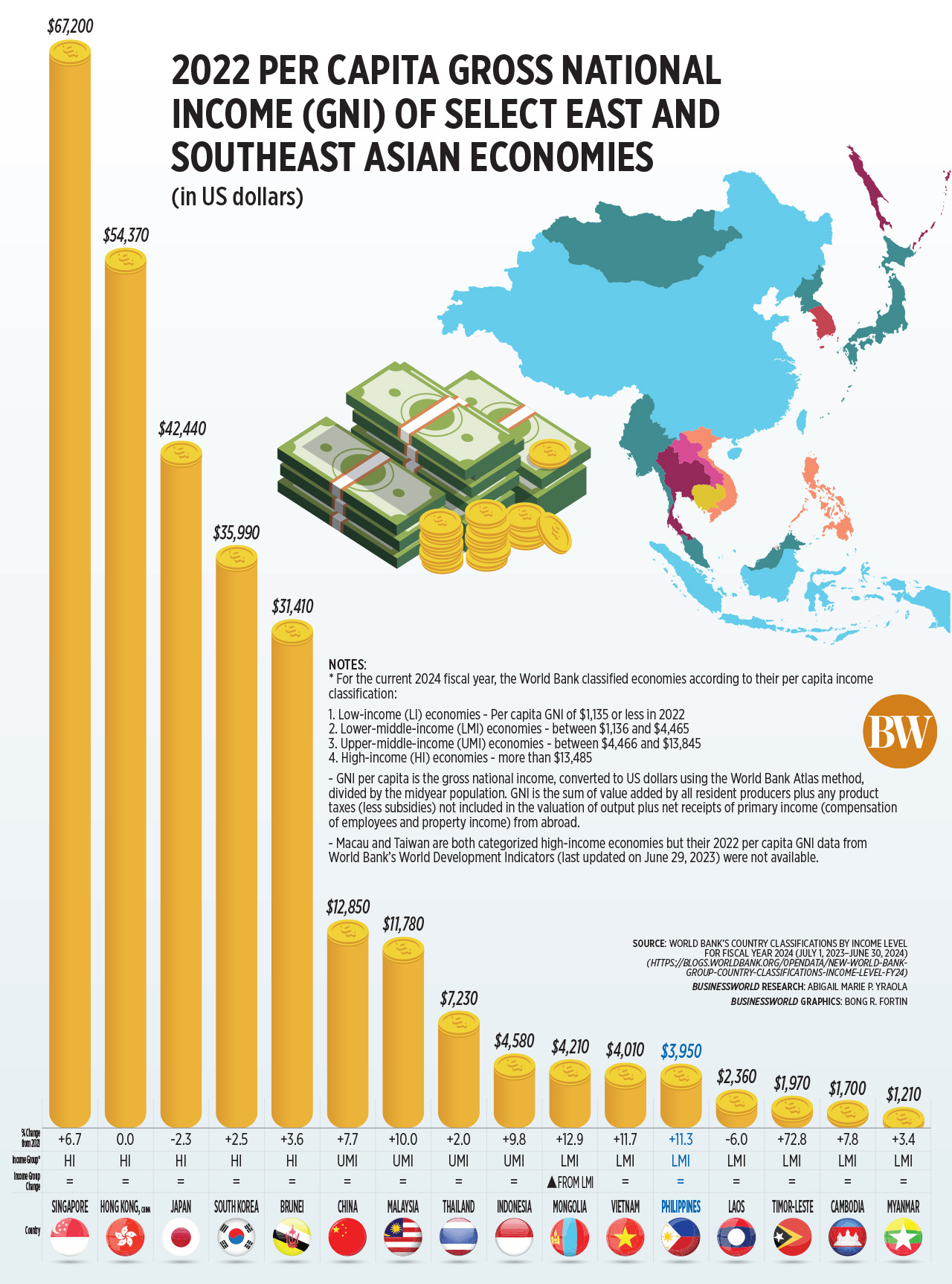
2022 per capita Gross National Income (GNI) of select East and Southeast Asia economies

THE PHILIPPINES remained a lower middle-income economy in 2022, according to the World Bank, as its gross national income (GNI) per capita lagged behind most of its Southeast Asian neighbors. Read the full story.

ADVERTISEMENT
ADVERTISEMENT