Home Blog Page 4568

USAID, DTI, fintech providers engage youth in GenSan MSMEs digitalization

The United States Agency for International Development (USAID) is supporting the Department of Trade and Industry (DTI) in General Santos City (GenSan) and financial technology (fintech) providers to ensure that marginalized youth are included in local business growth through the digitalization of micro, small, and medium enterprises (MSMEs).

Leading mobile wallet apps GCash and Maya, as well as the Bank of the Philippine Islands (BPI) and Union Bank of the Philippines, are joining the effort to ease marginalized youth and local businesses into the digital economy.

Organized through the USAID Opportunity 2.0 program, the forum titled, “DigiBiz: Redefining MSMES’ Future by Leveraging Workforce and Digital Technologies,” gathered around 50 business owners, government officials, and youth to discuss strategies that would enable MSMEs to accommodate consumers more effectively through fintech tools and other virtual platforms, with the help of a young and dynamic workforce to help them thrive in the digital world.

“Gen Z are the so-called ‘digital natives,’ and the world they know is about the internet and social media,” said DTI Chief Trade Industry Development Specialist Eddie de Asis. “[They] will most likely take the lead among GenSan MSMEs in embracing digitalization and innovation.”

Opportunity 2.0 introduced to GenSan businesses the idea of closely working and investing in upskilled Gen Z youth, as they are equipped with universal life skills to help boost their operations. Mr. de Asis also added that the youth, who are attuned to vast technological advancements, also contribute to growing businesses.

GCash and Maya shared how MSMEs, including youth-led businesses, can manage transactions more seamlessly through their apps via instant transfers, virtual cash-ins, and other services.

Meanwhile, BPI and UnionBank shared tips and tricks businesses can apply to easily track their money and facilitate virtual transactions. The forum also set up a workshop to aid youth entrepreneurs with quick digitalization strategies that they can incorporate into their day-to-day transactions, from generating QR codes to ease payments, to sharing the best practices that will help them start and upscale their businesses.

USAID’s Opportunity 2.0 program works in 15 cities nationwide to encourage local businesses to open their doors to upskilled out-of-school youth as part of the future workforce. US-based Education Development Center, Philippine Business for Education, Accenture, Catholic Relief Services, Voluntary Services Overseas, and SEAMEO INNOTECH implement this program.

Keeping children healthy with pediatric surgery

Health has always been a priority for all, especially in the early ages. For better growth and physical wellness among children, tracking your child’s growth and development is a must in preparation for reaching succeeding developmental stages in his/her life. This can be done properly with pediatric care, which is now more consequential, especially during a critical period in his/her life.

For children, any underlying health condition that is not treated at an early stage may eventually have an impact on their growth and well-being. Nonetheless, these can be addressed through interventions tailored to kids, like pediatric surgery. According to senior consultant pediatric surgeon Dr. Chui Chan Hon, pediatric surgery refers to the treatment of children’s conditions with surgical techniques and methods. Pediatric surgery covers people from birth until the age of 18.

Among the most common conditions among infants and children that can be addressed through surgery are congenital conditions and acute conditions such as infections, growths, or tumors.

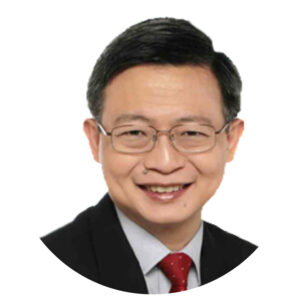
Dr. Chui Chan Hon

Dr. Chui refers to congenital conditions as growth defects that children are born with. These conditions include defects in the gastrointestinal tract like atresias and Hirschsprung’s disease.

Acute conditions, on the other hand, are the swellings, growths, tumors, or even cancers that children may encounter later on. There are also acute conditions leading to infections in kids, such as infections of the intestines or appendices, that would also require surgical treatment.

With new developments in pediatric surgery, including sub-specialization, minimally invasive surgery, and pediatric anesthesia, health conditions are now better identified, treated, and prevented among infants and children.

Pediatric surgeons are further updated and trained through sub-specialization in order for them to properly identify and perform the treatment a child needs.

There has also been a great development in minimally invasive surgery, which allows pediatric surgeons to perform surgical operations on children with smaller cuts and wounds, which helps speed up their recovery.

Additionally, pediatric anesthesia has made great improvements, allowing children to receive anesthesia more safely. As a result, many pediatric operations can be performed as outpatient or ambulatory surgery, which doesn’t require hospitalization.

Surgeons’ ability to determine the best method for the patient is an important factor in successful surgeries. Dr. Chui listed three key factors that pediatric surgeons consider, namely the patient’s condition; the child’s age and needs, since some are more anxious and need extra care and attention before, during, and after the surgery; and close coordination with the parents and adjusting to their needs.

Renowned globally, Mount Elizabeth Hospital in Singapore has earned a reputation for its top pediatric expertise coupled with unwavering commitment to curing and attending to patients’ health needs. Mount Elizabeth has set a standard for performing complex pediatric surgical conditions and treatments, thanks to its cutting-edge technology and skillful medical personnel who are committed to taking care of patients across ages, beginning with children.

“We have doctors in all subspecialties in pediatrics, and these are important personnel who can support the treatment of pediatric surgical conditions. Besides that, we have nurses, as well as the staff who are very familiar with and well-trained in managing pediatric patients,” Dr. Chui further explained.

“In addition, we have very good new scanning machines that we acquired that have lower dosages of radiation in CT scans and many other types of imaging techniques as well,” he added.

For inquiries, please contact Mount Elizabeth Hospital’s patient assistance center located at G/F-B, Marco Polo Hotel, Meralco Avenue and Sapphire Street, Ortigas Center, Pasig City 1600; e-mail manila.ph@ihhhealthcare.com or call 0917-526-7576. Follow them at facebook.com/MountElizabethHospitalsSGPhilippinesOffice.


Spotlight is BusinessWorld’s sponsored section that allows advertisers to amplify their brand and connect with BusinessWorld’s audience by enabling them to publish their stories directly on the BusinessWorld website. For more information, send an email to online@bworldonline.com.

Join us on Viber at https://bit.ly/3hv6bLA to get more updates and subscribe to BusinessWorld’s titles and get exclusive content through www.bworld-x.com.

Debt servicing balloons to P819B

BW FILE PHOTO

THE NATIONAL Government’s (NG) debt service bill ballooned to P819.526 billion as of end-May, data from the Bureau of the Treasury (BTr) showed.

The debt service bill nearly doubled to P819.526 billion in the January-to-May period from P414.069 billion in the same period a year ago.

In the first five months of the year, almost three-fourths or 71.99% of the debt service bill went to amortization.

Principal payments during the period tripled to P589.952 billion as of end-May from P193.606 billion in the previous year.

Of this, payments for domestic debt surged by 248.6% to P533.44 billion from P153.015 billion.

Amortization for foreign debt rose by 39% to P56.512 billion from P40.591 billion in the same period a year ago.

Meanwhile, total interest payments during the January-to-May period inched up by 4.1% to P229.574 billion from P220.463 billion a year ago.

Interest on local debt declined by 11.5% to P152.604 billion as of end-May from P172.358 billion a year ago.

Broken down, this consisted of P96.954 billion in fixed-rate Treasury bonds, P49.111 billion in retail Treasury bonds, and P5.159 billion in Treasury bills.

Interest paid on foreign debt soared by 60% to P76.97 billion during the five-month period from P48.105 billion a year ago.

In May alone, the debt service bill stood at P49.047 billion, lower by 14.6% than P57.444 billion in the same month in 2022.

Month on month, debt payments fell by 76% from P204.763 billion in April.

Of the total debt service bill in May, the bulk (84.3%) were for interest payments.

Interest payments increased by 22.2% to P41.344 billion.

Of the total, P29.529 billion went to domestic creditors, down by 2.3% from P28.871 billion a year earlier.

This consisted of P19.88 billion in fixed-rate Treasury bonds, P8.883 billion in retail Treasury bonds, and P756 million in Treasury bills.

Interest paid to external creditors more than doubled to P11.815 billion from P4.96 billion a year ago.

Meanwhile, amortization payments declined by 67.4% in May to P7.703 billion from P23.613 billion in the same month in 2022.

Domestic debt payments stood at P2.656 billion in May. No payments were made for domestic debt a year ago.

Amortization on foreign obligations dropped by 78.6% to P5.047 billion in May from P23.613 billion last year.

Analysts said the spike in the debt service bill in the five-month period was likely due to higher interest rates.

“Higher debt service payments in 2023 vs 2022 year-to-date likely due to the stark increase in interest rates throughout the period. We’ve seen several Bangko Sentral ng Pilipinas (BSP) policy rate hikes on top of bond yields reacting to global bond trends as well,” ING Bank N.V. Manila Senior Economist Nicholas Antonio T. Mapa said in an e-mail.

The Monetary Board has raised borrowing costs by 425 basis points (bps) from May 2022 to March 2023, bringing its key interest rate to a near 16-year high of 6.25%.

Rizal Commercial Banking Corp. Chief Economist Michael L. Ricafort said higher prices added to the government’s spending and budget deficit, as well as debt servicing.

“The higher debt servicing bill since the start of 2023 may have to do with higher debt maturities earlier this year, as well as higher interest rates, financing costs and weaker peso exchange rate since last year,” Mr. Ricafort said in a Viber message.

Headline inflation eased to 6.1% in May from 6.6% in April. However, it was the 14th straight month that inflation breached the central bank’s 2-4% target.

Inflation averaged 7.5% in the first five months. The BSP expects inflation to settle at 5.4% this year.

“For the coming months, an easing trend in inflation and eventually interest rates, thereby could lead to lower debt servicing, going forward,” Mr. Ricafort added.

The government’s debt service program this year is set at P1.6 trillion, 23.3% higher than the P1.298-trillion program in 2022.

As of end-May, the NG’s total outstanding debt hit a record P14.1 trillion, 1.3% up from the previous month due to the net issuance of domestic and foreign debt and the peso depreciation against the US dollar. — Luisa Maria Jacinta C. Jocson

PHL to address remaining FATF deficiencies in 2-3 months 

THE LOGO of the Financial Action Task Force (FATF) is seen at the OECD headquarters in Paris, France, Oct. 18, 2019. — REUTERS

THE BANGKO SENTRAL ng Pilipinas (BSP) is confident the Philippine government will be able to address the remaining strategic deficiencies identified by the Financial Action Task Force (FATF) within the next two to three months, an official said.

BSP Deputy Governor Chuchi G. Fonacier said the Philippines has already addressed four of the eight remaining action plans of the FATF, which are needed to exit the “gray list.”

“Hopefully maybe over the next two to three months, the remaining (action plans) would be addressed,” she said during an economic forum hosted by the German-Philippine Chamber of Commerce and Industry on July 20.

Ms. Fonacier told BusinessWorld on the sidelines of the event that the BSP is confident the Philippines will be able to exit the FATF’s gray list by January 2024.

“We’re also collaborating with the Anti-Money Laundering Council (AMLC) for them to be able to address the remaining deficiencies. As I said, four out of eight has been addressed already,” she said.

Since June 2021, the Philippines has been included in the global “dirty money” watchdog’s gray list of countries subjected to increased monitoring to prove its progress against money laundering (ML) and terrorist financing (TF).

To be removed from the list, the Philippines has committed to comply with 18 action plan items. Progress reports are submitted to the FATF in three reporting cycles in a year — January, May and September.

In its latest assessment in June, the FATF said the Philippines should continue to work on implementing action plans to address strategic deficiencies in its fight against money laundering.

This includes demonstration of effective risk-based supervision of Designated Non-Financial Business and Professions and ensuring that supervisors use anti-money laundering/counter-terrorism financing (AML/CTF) tools to mitigate risks. 

The country should also streamline the access of law enforcement agencies to information related to beneficial ownership as well as demonstrate an increase in ML and TF investigations.   

Meanwhile, the passage of the Anti-Financial Account Scamming Act and amendments to the Bank Secrecy Law would help the Philippines exit the gray list as well, Ms. Fonacier said.   

In May, the House of Representatives approved House Bill No. 7446, which seeks to ease bank deposit secrecy rules to give the BSP the power to investigate deposit accounts of bank officials and employees for fraud.

Lawmakers also passed on third reading House Bill No. 7393 or the Anti-Financial Account Scamming Act which prohibits the use of bank accounts and e-wallets for suspicious activities.

According to Ms. Fonacier, the BSP is also conducting thematic reviews with banks to aid the country in addressing the remaining deficiencies.

She also said that the central bank, including then-BSP Governor Felipe M. Medalla, had earlier met with Executive Secretary Lucas P. Bersamin to discuss the FATF’s action plans.   

“The executive secretary himself knows the urgency of addressing the deficiencies identified by the FATF. We’re optimistic we can address these,” she said.   

Last month, the AMLC earlier said it expects more lawyers to report any suspicious transactions or unlawful activities under relevant laws on anti-money laundering as the Supreme Court approved the Code of Professional Responsibility and Accountability in April.      

In May, the AMLC also told financial institutions to strengthen sanction screening systems amid underperformance in testing metrics over the last 12 months.

Sanction screening is used to identify individuals or entities that are subject to economic sanctions. It is a requirement for financial players and other regulated industries.      

All covered entities must screen all relevant parties against the Anti-Terrorism Council lists and United Nations Security Council resolutions. — Keisha B. Ta-asan

Marcos needs to detail plan to boost revenues in his second SONA

President Ferdinand R. Marcos, Jr. is set to deliver his second State of the Nation Address before Congress on Monday. — PPA POOL/RENE H. DILAN

By Kyle Aristophere T. Atienza, Reporter

PRESIDENT Ferdinand R. Marcos, Jr. should detail how he plans to boost state revenues to fund education, health and social welfare programs in his second address to Congress today (July 24), economists and political analysts said.

They also cited the need for Mr. Marcos to provide a clear plan for economic development amid a global slowdown, spiraling prices, weather disruptions and geopolitical tensions.

“In the short term, the President, in his State of the Nation Address (SONA), should be able to address the need to further expand government revenues in order to provide resources for expansion of important education, health and social welfare programs,” Ateneo School of Government Dean Philip Arnold “Randy” P. Tuaño said in a Facebook Messenger chat.
“In the long term, programs to address the malnutrition problem and the learning crisis, addressing sustainability efforts in the country and modernizing the bureaucracy — which was the theme of his previous speeches — should be featured in the SONA,” he added.

Sherwin E. Ona, a political science and development studies professor at De La Salle University, said via Viber that Mr. Marcos should give a “clearer economic development agenda to ensure growth and development” during his SONA.

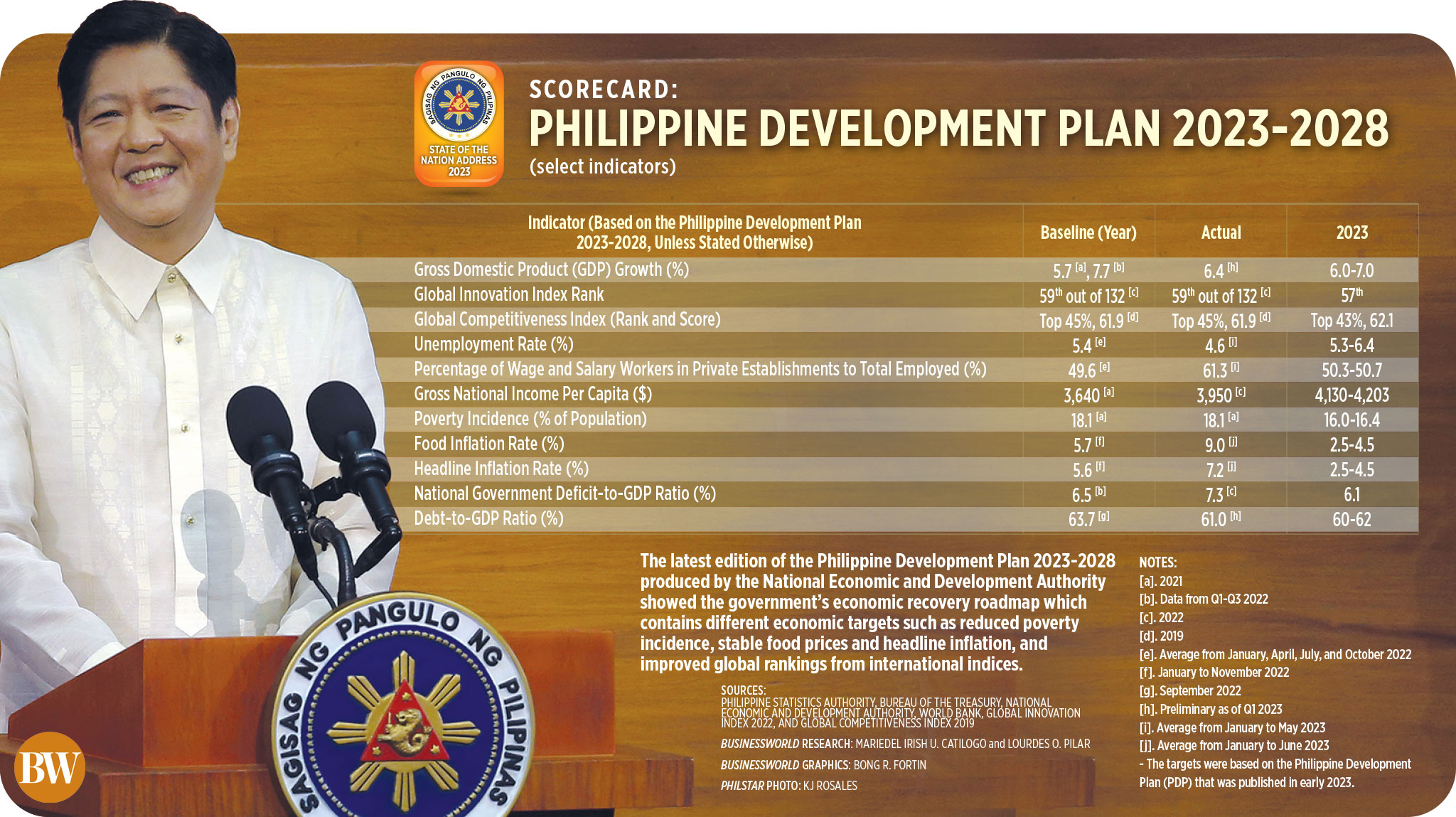
The Philippine economy grew by 6.4% in the first quarter, the slowest in two years. The government is targeting 6-7% gross domestic product (GDP) growth for this year, which would be slower than the 7.6% expansion in 2022.

“The President needs to expound on his administration’s development priorities especially because of the limited fiscal space and the higher budget deficit,” public finance expert Zyza Nadine M. Suzara said via Messenger chat.

The National Government’s budget deficit shrank by an annual 28.86% to P326.3 billion in the January-to-May period, as revenues rose by 10.83% to P1.59 trillion.

For this year, the government set the deficit ceiling at P1.499 trillion, equivalent to 6.1% of GDP. The Marcos administration is targeting to bring this down to 3% of GDP by 2028.

George N. Manzano, an economist from the University of Asia and the Pacific, said Mr. Marcos should detail how the country plans to achieve food security, modernize agriculture, and reduce urban blight and congestion.

“He should also discuss inflation; how to boost investments, particularly foreign direct investments; how to strengthen the manufacturing sector; how to foster the digital economy, and address poverty,” he said in an e-mail.

While inflation has been on a downtrend since January’s 8.7%, inflation remains elevated averaging 7.2% in the first half — still above the central bank’s 2-4% target range.

George T. Barcelon, chairman of the Philippine Chamber of Commerce and Industry (PCCI), hopes the Philippine leader will discuss how he plans to make domestic industries, especially the manufacturing and the agriculture sectors, competitive.

“When I reflect back to the first SONA, many issues that were mentioned by the President are still of concern. We still need to improve the productivity of the agriculture sector; our area of production must be competitive,” he said by telephone.

He also cited the high costs of logistics and power in the country, which he said prevent domestic sectors from improving their productivity.

“If you compare the amount of foreign investments we are getting, we are still lagging behind Singapore, Malaysia and Vietnam. That means we may not be that competitive, that is why foreign investors are not coming here,” Mr. Barcelon said.

NEW TAXES?
Traditionally, SONA speeches are reviews of policy accomplishments of the administration in the previous year, Mr. Tuaño said.

Despite Mr. Marcos’ huge mandate, only one of the legislative priorities mentioned in his first SONA was passed into law. The President signed New Agrarian Emancipation Act, which condones farmers’ debts, into law earlier this month.

“Therefore, we would expect that we would hear from the President how his priorities discussed in the last SONA would be put into action,” Mr. Tuaño said.

Filomeno S. Sta. Ana III, coordinator of Action for Economic Reforms, said addressing malnutrition and hunger and boosting the implementation of the Universal Health care Law — which are among the administration’s priorities — would require new sources of revenues.

“Taxes on sweetened beverages and junk food are being proposed. While justifiable, several quarters have opposed these taxes for their regressiveness,” he said. “The administration must form a narrative why new taxes are necessary.”

Finance Secretary Benjamin E. Diokno last month said the government is pushing for taxes on junk food and sweetened beverage to address “diabetes, obesity, and non-communicable diseases related to poor diet,” as well as raise P76 billion in additional revenues in the first year of implementation.

Instead of junk food, Mr. Sta. Ana proposed further increasing taxes on alcohol, tobacco and motor vehicles.

He said an innovative tax policy can help facilitate the transition to renewable energy, which Mr. Marcos has vowed to prioritize.

The Marcos administration is also pushing for a measure that would reforms the pension system for retired military and uniformed personnel, which if left unchanged may lead to what the Finance department described as a “fiscal collapse.”

“For instance, how will his government fund education, health and poverty alleviation while the military pension system which poses a fiscal crisis remains unreformed?” Ms. Suzara said.

While not mentioned in his first SONA, Mr. Marcos last week signed into law another priority measure that created the country’s first sovereign wealth fund or the Maharlika Investment Fund.

Ms. Suzara said Mr. Marcos should discuss how the government plans to generate additional resources with the Maharlika Investment Fund (MIF) in the picture, noting that it “competes with all of the development needs of the country in terms of the government’s sources of financing for the national budget.”

“Thus, it is not enough to present the numbers in the Medium-Term Fiscal Program as he did in his first SONA,” she said. “He needs to lay down the vision for the Philippines and tell us citizens exactly how we will get there.”

INFRASTRUCTURE
With the approval of the MIF and the approval of the P170-billion public-private partnership for the rehabilitation of the country’s major airport, “the President is expected to tout his plans for infrastructure in Monday’s SONA,” said Terry L. Ridon, convenor of infrastructure think tank InfraWatch PH.

“The President will surely provide updates on the Metro Manila subway and the North South Commuter Railway projects, both of which are currently proceeding well into their construction stages,” he said via Messenger chat.

He said the President should provide clarity on the primary objective of the MIF — “on whether it will be used to fund flagship infrastructure projects or whether it will be used to invest in various endeavors to yield higher than average market returns.”

“Pursuing both objectives may be incompatible as infrastructure projects do not typically yield high margins,” he said.

Meanwhile, Mr. Ridon said the bidding for the rehabilitation of the Ninoy Aquino International Airport will be the “first key test” to the public-private partnership program under the Marcos administration.

“It will test the Marcos administration on how it will deal with various private sector interests that will compete for the project,” he said, asking the president to urge the Transportation department to “ensure full transparency and efficiency in the proceedings.”

Meanwhile, the Philippine Business for Education urged Mr. Marcos to use his huge mandate to prioritize education reforms.

“We must make education and nutrition our national concern and national priority. If we focus on developing our people first, many of our problems — from corruption to poverty, to low productivity to joblessness—will be easier to solve,” it said in a statement. — with inputs from Beatriz Marie D. Cruz


All eyes on composition of Maharlika fund’s board

A Philippines peso note is seen in this picture illustration on June 2, 2017. — REUTERS

By Luisa Maria Jacinta C. Jocson, Reporter

THE APPOINTMENT of the board members to the company overseeing the Maharlika Investment Fund (MIF) will be crucial to ensure there is proper oversight of the fund, analysts said.

“What (we are waiting to see) is the governing body setup. Who will be on the board? We hope there will be more private sector representation and oversight. I take it that there must be oversight and the usual reporting,” Philippine Chamber of Commerce and Industry (PCCI) President George T. Barcelon said in a phone interview.

Last week, President Ferdinand R. Marcos, Jr. signed Republic Act (RA) No. 11954, which creates the country’s first sovereign wealth fund.

“We are waiting to see who will be on the (MIC) board. That’s very important, the members of (the MIC),” British Chamber of Commerce Philippines (BCCP) Executive Director Chris Nelson said in a Viber call interview.

The Maharlika Investment Corp. (MIC), which will manage the wealth fund, will have a board of directors composed of nine members.

In a press chat on Friday, Finance Secretary Benjamin E. Diokno said that the government is currently looking for candidates to the MIC board, which is expected to be completed by September.

The fund itself is expected to be “up and running” before the end of the year, he added.

Mr. Diokno said that the appointment of the board of directors will undergo a “strict screening process, just like any government appointment.”

“Let me make it crystal clear, the Finance secretary will not manage the fund. That role is entrusted to the president and chief executive officer of the MIC and its directors,” he said.

Under RA No. 11954, the Finance secretary will serve as the board chairperson in ex-officio capacity.

The board will consist of the president and chief executive officer of the MIC, the president and chief executive officer of the Landbank of the Philippines (LANDBANK) and the Development Bank of the Philippines (DBP), as well as the two regular directors and three independent directors from the private sector.

“Right now, we are looking for good men and women to apply. We need two regular directors with a term of three years. And then there will be three independent directors. The independent directors, like other government corporations, will serve for one year but (it is) renewable. Usually when it’s independent, there is a term limit of nine years,” Mr. Diokno said.

Meanwhile, Mr. Nelson said that the MIF’s focus on infrastructure projects will help boost economic growth.

“First of all, the concept of the Maharlika fund as outlined is to invest in infrastructure, if it occurs, it’s a welcome move. Any investment, if it can accelerate infrastructure in the Philippines is welcome,” he said.

“There’s a lot of renewed interest. We continue to highlight the opportunities in the Philippines. If the Maharlika fund can do this by investing in infrastructure, clearly that’s going to assist the economy,” he added.

Mr. Nelson noted it was important to “keep the momentum” in further opening up the economy and developing infrastructure.

For Mr. Barcelon, the government will also need to keep an eye out for the risks that may come with the investment strategy of the fund.

“The objective of the fund is to make more money than putting it in Treasury bonds. Any such investment you have to have a higher appetite for risk, that’s the thing that the government will give due focus,” he added.

On Friday, Mr. Diokno said the LANDBANK board approved its P50-billion contribution to the MIC, while the Bangko Sentral ng Pilipinas (BSP) Monetary Board declared a dividend of P31.859 billion “in favor of the NG.”

“This is based on 50% of BSP’s net income, after income tax, in 2022 of P63.731 billion,” he added.

However, he noted that it is still not clear if the BSP’s latest declared dividend will be given to the MIC.

“The law (states) two years after the enactment of the bill, so it’s still unclear if the P31.859 billion is part of that. If the Treasury is willing to give it to us, we are willing to accept. One thing, they might want to use it for the budget or give it back to BSP for their capitalization. But it can go to the NG, that is our recommendation,” Mr. Diokno said.

By the end of the year, the fund should also have at least P100 billion in capital, Mr. Diokno said.

Under the law, the MIC will have an authorized capital stock of P500 billion. The MIC will have an initial funding of P125 billion, which will come from the LANDBANK (P50 billion), the DBP (P25 billion), and the National Government (P50 billion).

The NG’s contribution will come from the Bangko Sentral ng Pilipinas, which is required to remit 100% of their total declared dividends to the fund in its first two years upon the effectivity of the act.

“It’s safe to say the fund is well capitalized at the very start. You can start before the end of the year,” he added.

National Treasurer Rosalia V. de Leon also said that the Finance department has reached out to the DBP to begin processing their contribution of P25 billion.

Here Wigo again

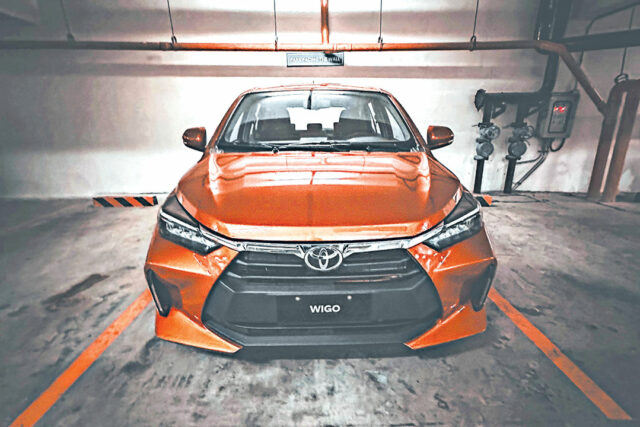
The all-new Wigo presents a more angular, aggressive exterior. — PHOTO BY KAP MACEDA AGUILA

The second-gen Wigo is a Toyota temblor in the entry-level segment

THE COUNTRY’s leading automotive brand just reissued its missive in the entry-level segment — service notice that it’s ready for more action.

Toyota Motor Philippines (TMP) recently unveiled the all-new version of its best-selling hatchback, the Toyota Wigo, in a very festive fashion at the TriNoma Mall in Quezon City. On the display at activity center of the shopping complex were six Wigo units, unveiled simultaneously after a dance number. There’s obvious importance ascribed to this new-generation Wigo.

Last year, TMP sold a total of 174,106 vehicles (including 861 Lexus units). The Vios unsurprisingly paced sales with 34,465 cars, followed by the Hilux pickup with 24,537 units, Innova MPV with 17,810, Fortuner SUV with 16,925, and Rush MPV/SUV with 14,871.

After these five nameplates comes the Wigo, effectively the company’s entry point into its stable of offerings in terms of pricing. A total of 14,306 of them were sold last year, and if you do the math, that’s an average of 1,192 units moved in a month — surely nothing to sneeze at. And the company is ready to up the ante (see our interview with a TMP executive below).

The full-model-change Wigo, per dealer materials made available in advance to “Velocity,” is meant to “focus on customer-appreciated specs while keeping its affordability.”

And according to TMP President Atsuhiro Okamoto in a release, “This is a very exciting launch for us at Toyota Motor Philippines because we know that the Wigo is one of the favorite Toyota models of Filipinos. The Wigo has given many new car buyers their memorable first car experience. In fact, we have given thrill and joy to more than 149,000 Wigo owners since the model was introduced in the country in 2014.”

As we previously reported in “Velocity,” the new-generation Wigo is longer by 70 millimeters (mm), stretching 3,760mm. The wheelbase is also longer (plus 70mm), now measuring 2,525mm. It is wider (plus 65mm) and stands lower (minus 15mm). These numbers also result in more interior space — surely a plus for anyone looking for peso-stretching value.

Powering all variants is a three-cylinder, 12-valve, DOHC 1.0-liter engine putting out 67ps and 89Nm. It runs on 175/65 R14 tires, receives split-type LED headlamps, a clearance lamp, and front fog lamps. The G grade’s exclusive fitments include an LED high mount stop lamp, power adjusting and folding sideview mirrors, side turn signal lamp, a rear spoiler, digital manual climate control system, four speakers (instead of two), and more.

The Wigo is also said to promise better handling and performance. “NVH levels have improved,” declared Mr. Okamoto to “Velocity” shortly after the unveiling. It shares a DNGA (Daihatsu New Global Architecture) platform with the Raize, Vios, Avanza, and Veloz.

Manufactured in Indonesia, the all-new Wigo comes in three trims, with pricing as follows: Wigo G (P729,000), Wigo E (P684,000), and Wigo J (P609,000). The top two grades are equipped with CVT; the J comes with a manual transmission.

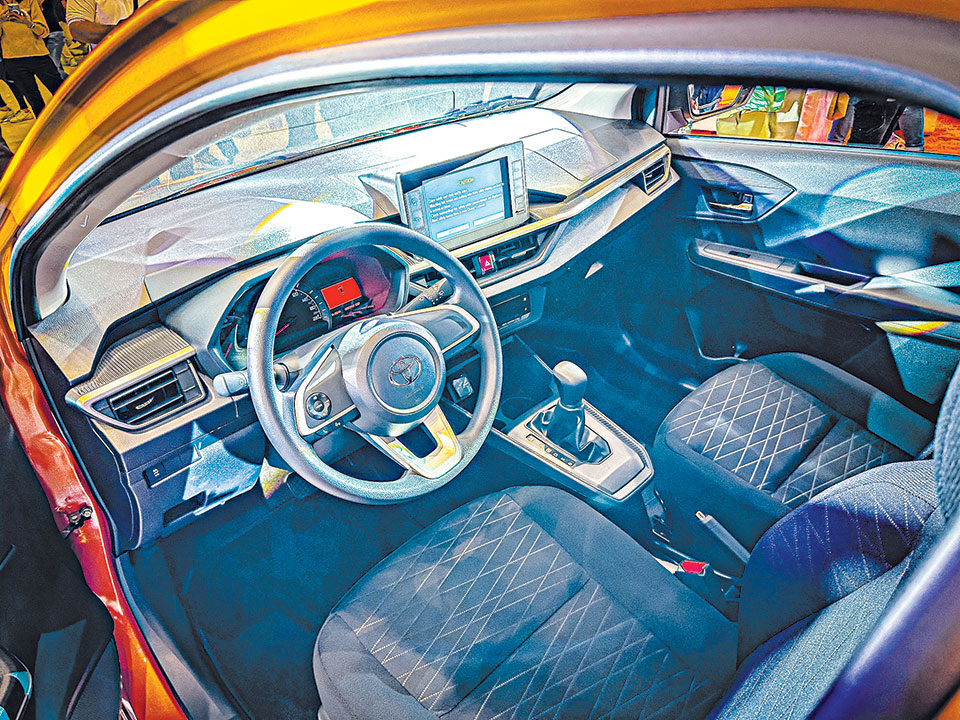
The all-new Wigo is given electronic power steering, smart keyless entry, and a push-start ignition system for the G. The G and E variants’ onboard eight-inch display audio system is said to be ready for Apple CarPlay and Android Auto.

SRS air bags, two Isofix tether anchors, vehicle stability control and hill start assist are among the car’s safety features. The all-new Wigo comes in the following exterior colors: Red Mica Metallic, Orange Metallic, Yellow SE, Silver Metallic, Gray Metallic, and White.

For more information, open your browser and visit toyota.com.ph/wigo. If you haven’t yet, follow Toyota Motor Philippines on Facebook and Instagram, ToyotaMotorPH on Twitter, and join the Viber community at Toyota PH.

PSE warns of taxes on sale of suspended Holcim shares

HOLCIM PHILIPPINES FACEBOOK PAGE

TENDERED SHARES of Holcim Philippines, Inc. are subject to capital gains tax (CGT) and documentary stamp tax (DST) and not the standard stock transaction tax, the local bourse said, pointing to the continuing trading suspension of the cement maker’s shares.

“Aside from the applicable tax rate, the shareholders have to facilitate all the documentary requirements, including the relevant tax clearance from the [Bureau of Internal Revenue (BIR)], needed to transfer shares sold outside of the exchange,” the Philippine Stock Exchange (PSE) said in a statement over the weekend.

BIR regulation requires every sale, barter, exchange or other disposition of shares of stock of a publicly listed company that is noncompliant with the minimum public ownership to be subject to CGT and DST, the exchange said.

Under Revenue Regulation No. 16-2012, a final tax of either 5% or 10% on the net capital gains would be imposed on every sale, barter, exchange or other disposition of shares for noncompliant companies.

The PSE said shareholders have to facilitate all the documentary requirements, including the relevant tax clearance from the BIR, needed to transfer shares sold outside of the stock exchange.

The clarification comes after the PSE suspended the trading of Holcim shares when Dutch firm Holderfin B.V. last month purchased 594.95 million common shares or 9.22% of the company’s outstanding capital stock from Sumitomo Osaka Cement Co., Ltd.

The deal resulted in Holcim’s public float falling to 5.05% or below the 20% minimum requirement of the PSE.

Holderfin conducted a tender offer for 325.58 million of Holcim’s issued and outstanding common shares at P5.33 apiece.

“[Holcim] now wishes to assign the responsibility of addressing this tax predicament to the exchange by informing shareholders that the matter can only be resolved if the suspension on its shares will be lifted by PSE,” the exchange said.

“The PSE takes strong exception to this ‘finger-pointing’ attempt of the company. The lifting of the suspension is not a discretion or prerogative that can be exercised by PSE,” it added.

Holcim said on Friday that the PSE had denied the company’s request to lift the trading suspension due to it being noncompliant with the minimum public ownership requirement.

It said the purchase by Holderfin and the tender offer settlement will have to be effected outside the facilities of the PSE.

Holcim “strongly urged“ shareholders who wish to participate in the tender offer to not tender their shares at the last minute “to allow sufficient time to correct any deficiency in their application.” 

Additionally, the local bourse operator said problems and concerns would not have been encountered if the companies “took into consideration the interest of its public shareholders before implementing the share transaction.”

“They should have thoroughly considered the repercussions of the Holderfin share purchase on its public float before implementing the same,” the PSE said.

Holcim has yet to comment on the matter after it was sought over the weekend to give its side. — Adrian H. Halili

Hyundai-branded EV charging station at SM Mall of Asia

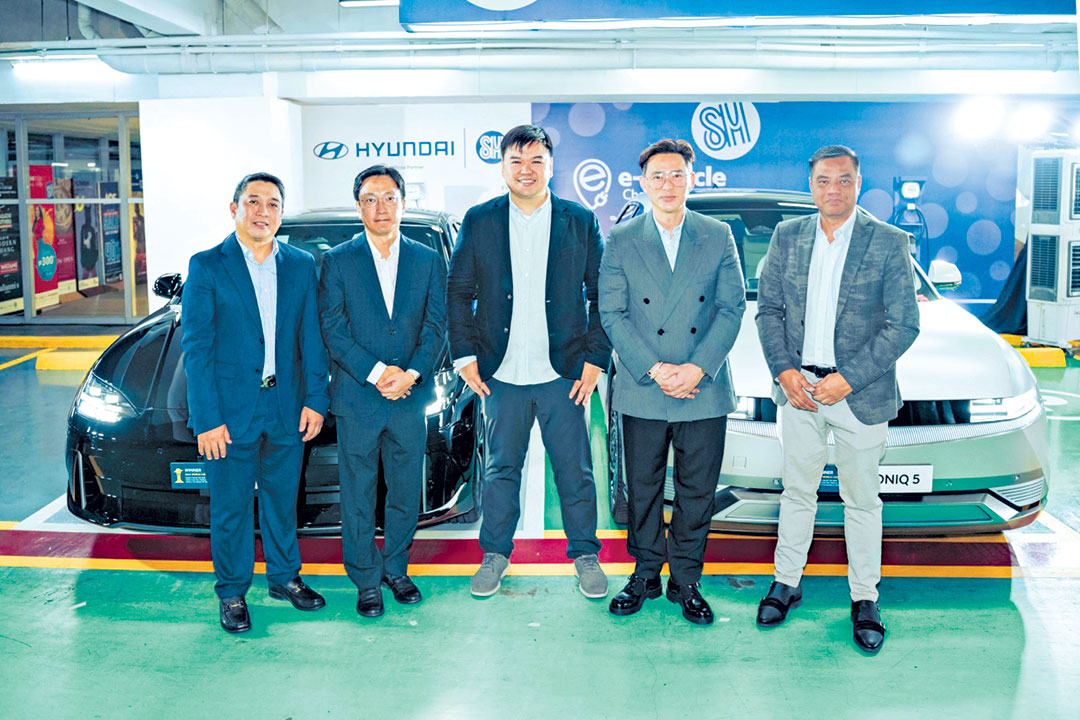
The all-electric Hyundai Ioniq 6 (left) and Ioniq 5 at the charging bays. — PHOTO BY KAP MACEDA AGUILA

HYUNDAI MOTOR Philippines (HMPH) and SM Supermalls last week inaugurated their first of six branded electric vehicle charging stations. Located on the third level of the North Parking Building of SM Mall of Asia, a maximum of three electric vehicles can be accommodated simultaneously. Charging through the Wallbox Pulsar Plus 7.4 kW (Type 2) AC devices is for free, and customers only need to pay for the regular parking fee. The service is also brand agnostic; any electric or PHEV can plug in.

Five other similar facilities are set to go online in the coming days: The Podium (July 21), SM City Fairview (July 25), SM City Clark (July 28), SM City Cebu (Aug. 8), and SM Lanang Premier (Sept. 2).

In a speech, HMPH Managing Director Cecil Capacete said that this alliance is aligned with the company’s efforts toward a worry-free ownership experience for EV users. Teaming up with SM Supermalls, he continued, makes sense because the two firms also share a sustainability vision.

Meanwhile, HMPH President Dongwook Lee explained that “Progress for Humanity,” Hyundai’s global vision, is based on the belief that (Hyundai), as an automaker, has to be more proactive when responding to climate change compared to companies in other industries.” He stressed, “We look after and uplift both people and the planet.”

HMPH has been “laying the foundation to this journey through the establishment of certified EV dealers. Out of the 10 in the pipeline, we currently have five that are fully operational: Alabang, Commonwealth, Makati, Pampanga and Pasig,” Mr. Lee explained.

Next month, the company will roll out Phase 1 of its customer program, specifically its 24/7 call center and roadside assistance service. Phase 2, the executive revealed, “is in the works focusing on EV owners and the V2V or vehicle-to-vehicle charging service.”

As for the partnership with SM, Mr. Lee maintained, “Although locally we have barely touched the surface, we are grateful that we have the opportunity to work with like-minded corporations such as SM. This valuable relationship strengthens and helps realize our mission as a mobility solutions provider.”

For his part, SM Supermalls President Steven Tan declared, “Our chief advocate for sustainability, Mr. Hans T. Sy, has instilled in us the importance of ensuring the safety of the communities, employees, and customers across all SM Prime developments. As he puts it, this is the only way we can sleep well at night. This is why we make a commitment to help the government make sustainable mobility and transportation more accessible to the Filipino people.”

He asserted that SM is the first mall chain to offer free charging facilities for electric vehicles — having starting a year ago. The service is now available in 28 SM malls nationwide, with the number soon to reach 50. Mr. Tan described Hyundai as a partner brand that shares the same goals. “By partnering with Hyundai, we will build on our long-term strategy toward zero emissions for a more sustainable future.”

Federal Land to expand retail portfolio in its townships

GT CAPITAL Holdings, Inc.’s property arm Federal Land, Inc. is planning on expanding its retail portfolio, which will be placed in its township developments, its top official said last Friday.

Federal Land President Thomas F. Mirasol said the property developer is looking at several retail formats.

“As part of the whole communities development, [we are looking at] expanding our retail with a Japanese element to it,” he told reporters last week.

Mr. Mirasol added that two of its projects — The Observatory in Mandaluyong City and Met Park in Pasay City — are set to house retail components.

“We are launching this year, [in] September or October,” he said. “So the construction might start early next year.”

GT Capital President Carmelo Maria Luza Bautista told reporters that retail would be part of the offering of Federal Land NRE Global, Inc., the joint venture company of Federal Land and Nomura Real Estate Development Co. Ltd.

“The estate that’s coming up in Cavite will be a mixed-use offering, so we would have residential, commercial, and some retail,” Mr. Bautista said.

The company recently announced its plans to venture into townships. It is set to develop 10 master-planned, multi-use properties as part of its Federal Land Communities product line.

The initial properties are set to lay the groundwork for further developments, all of which are planned to be unveiled within the next few years, it said.

It also announced a 600-hectare development, Riverpark, located in General Trias, Cavite.

Meanwhile, the company alongside its partners Isetan Mitsukoshi Holdings Ltd. and Nomura, formally launched a Japanese-themed mall in Bonifacio Global City.

The Mitsukoshi BGC is located within the company’s Grand Central Park property and is the podium level of its four-tower condominium property The Seasons Residences.

Federal Land Chairman Alfred Vy Ty told reporters that expansion for the Mitsukoshi mall in the country is “in the works” with its Japanese partners.

“We just had to get this [mall] off the ground,” he said.

GT Capital shares went up 0.28% or P1.50 to P537 apiece on Friday. — Adrian H. Halili

Rates of T-bills, bonds may drop further

BW FILE PHOTO

RATES of Treasury bills and bonds on offer this week could continue to decline to track secondary market levels ahead of the policy meetings of central banks in advanced economies.

The Bureau of the Treasury (BTr) will auction off P15 billion in Treasury bills (T-bills) on Tuesday, or P5 billion each in 91-, 182- and 364-day papers.

On Wednesday, it will offer P30 billion in fresh seven-year Treasury bonds (T-bonds).

T-bill and T-bond rates may track secondary market yields ahead of an expected rate hike by the US Federal Reserve this week, Rizal Commercial Banking Corp. Chief Economist Michael L. Ricafort said in a Viber message.

Mr. Ricafort added that the market will monitor Fed Chair Jerome H. Powell’s press conference after the policy meeting for possible signals about the central bank’s next move.

At the secondary market on Friday, the 91-, 182-, and 364-day T-bills went down by 17.13 basis points (bps), 13.46 bps, and 3.38 bps week on week to end at 5.808%, 5.9565%, and 6.1451%, respectively, based on the PHP Bloomberg Valuation (BVAL) Service Reference Rates data published on the Philippine Dealing System’s website.

Meanwhile, the seven-year T-bonds inched down by 2.52 bps week on week to yield 6.2462%.

“[This] week will be all about central bank meetings with the Fed on Wednesday, ECB (European Central Bank) on Thursday and BoJ (Bank of Japan) on Friday,” a trader said in an e-mail, adding that the T-bonds on offer could fetch a yield of 6.375%.

The Fed will raise its benchmark overnight interest rate by 25 bps to the 5.25%-5.5% range on July 26, according to all 106 economists polled by Reuters, with a majority still saying that will be the last increase of the current tightening cycle.

The US central bank paused its tightening cycle in June after hiking its benchmark rate by a cumulative 500 bps to a range between 5% and 5.25%.

Last week, the BTr raised P15 billion as planned via the T-bills it auctioned off as total bids reached P44.748 billion, or nearly thrice the amount on the auction block.

Broken down, the Treasury made a full P5-billion award of the 91-day T-bills as tenders for the tenor reached P17.716 billion. The average rate for the three-month papers went down by 8.9 bps to 5.884% with accepted rates ranging from 5.86% to 5.9%.

The government also raised P5 billion as planned from the 182-day securities as bids stood at P14.31 billion. The average rate for the six-month T-bill was at 6.095, lower by 17.1 bps from the previous week, with accepted rates from 6.09% to 6.11%.

The BTr likewise borrowed P5 billion as programmed via the 364-day debt papers as demand reached P12.732 billion. The average rate of the one-year T-bill went down by 11.3 bps to 6.226%. Accepted yields were from 6.098% to 6.3%.

The Treasury wants to raise P180 billion from the domestic market this month, or P60 billion via T-bills and P120 billion via T-bonds.

The government borrows from local and foreign sources to help fund its budget deficit, which is capped at 6.1% of gross domestic product this year. — A.M.C. Sy with Reuters

‘We expect to sell 1,600 units a month’

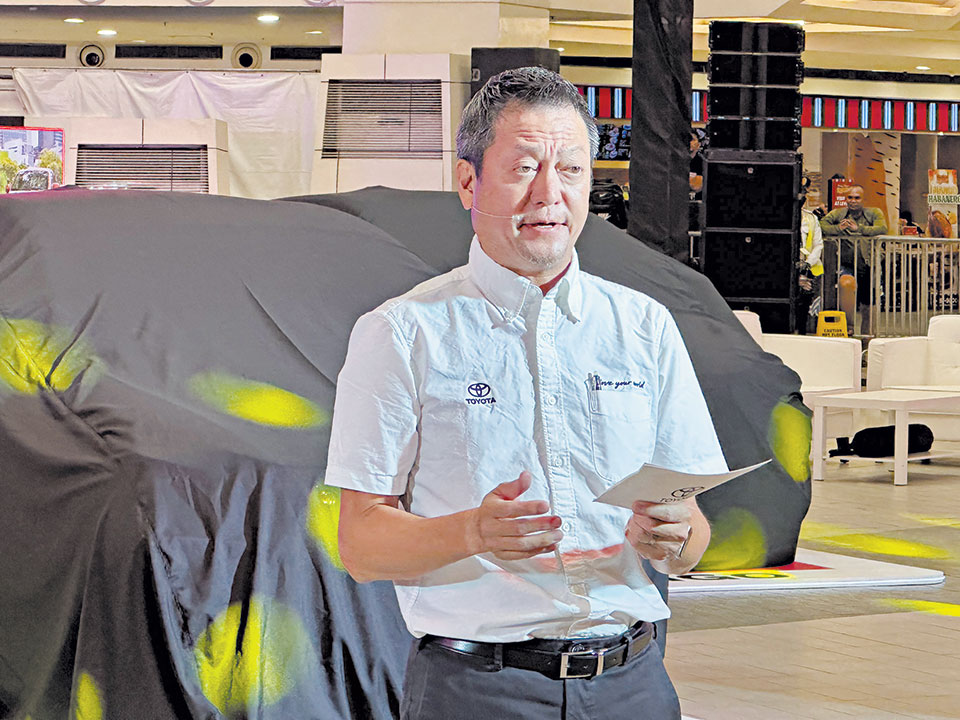
Mr. Cruz — PHOTO FROM TOYOTA MOTOR PHILIPPINES

Wigo talk with TMP First Vice-President for Vehicle Sales Operations Danny Cruz

Interview by Kap Maceda Aguila

Mr. Cruz — PHOTO FROM TOYOTA MOTOR PHILIPPINES

VELOCITY: How many Wigos do you intend to sell this year?

DANNY CRUZ: We don’t have a projection for the year, but what we expect on a monthly basis for this new model is to move around 1,600 units. A big portion of it will come from the upper-grade G, maybe 1,100 units, the middle grade around 350, and then 150 for the J.

SUVs and MPVs are obviously very popular among Filipinos, but what are you seeing in the passenger car segment, particularly at this price point? Are you still seeing healthy interest?

We see still a substantial number of Filipinos who are just about to buy their first car. We’re positioning the Wigo as a reliable, practical, low-cost vehicle that can serve them every day. We think that market is still there. Of course, this can also be an additional vehicle for families who already have a car.

But this will continue to target first-time buyers?

Primarily — and first-time buyers in the formal market. These are people who probably bought a second-hand vehicle and now have enough to get their first brand-new car.

Given the sales numbers you mentioned, are you confident that this will be supported by the production facility in Indonesia?

Yes, we are confident that they can supply those numbers. This year, we’ve already seen a lot of improvement in our supply in general. For this particular model, we don’t see any problem.

You have Wigo inventory already?

Yes, and many more are coming in.

In other markets, there is a Wigo TRD version. Will we see that here, or maybe even a GR-S version?

As of now, we have no comment yet on future products. We’ll explain once finalized.

Will you have after-market accessories for the Wigo?

Yes, we have the GR package, which comes with side skirts, a spoiler, and other items like sunshade and visor — available at any Toyota dealer.

ADVERTISEMENT
ADVERTISEMENT