Home Blog Page 4560

TDF yields decline on dovish Fed bets amid easing inflation
BW FILE PHOTO

YIELDS on the Bangko Sentral ng Pilipinas’ (BSP) term deposits went down on Wednesday, with investors betting on an extended tightening pause from the US Federal Reserve amid easing inflation.

The central bank’s term deposit facility (TDF) attracted bids amounting to P267.009 billion on Wednesday, below the P280 billion on the auction block as well as the P337.806 billion seen a week ago for a P350-billion offer.

Broken down, tenders for the seven-day papers reached P147.124 billion, lower than the P150 billion auctioned off by the central bank and the P176.015 billion in bids for a P190-billion offer seen the previous week.

Banks asked for yields ranging from 6.525% to 6.61%, wider than the 6.55% to 6.605% band seen a week ago. This caused the average rate of the one-week deposits to decline by 0.26 basis point (bp) to 6.5763% from 6.5789% previously.

Meanwhile, bids for the 14-day term deposits amounted to P119.885 billion, lower than the P130-billion offering and the P161.791 billion in tenders for a P160-billion offer seen on July 12.

Accepted rates were from 6.5250% to 6.63%, slightly higher than the 6.5% to 6.6288% margin recorded a week ago. With this, the average rate for the two-week deposits inched down by 0.43 bp to 6.5843% from the 6.5886% logged in the prior auction.

The BSP has not auctioned off 28-day term deposits for more than two years to give way to its weekly offerings of securities with the same tenor.

The term deposits and the 28-day bills are used by the central bank to mop up excess liquidity in the financial system and to better guide market rates.

TDF yields were lower following the continued easing in inflation in the US, Rizal Commercial Banking Corp. Chief Economist Michael L. Ricafort said in a Viber message.

“The Fed is widely expected to raise rates by 25 bps on July 26 but the odds of another Fed rate hike have been reduced significantly, thereby possibly nearing the end of the Fed’s tightening cycle,” Mr. Ricafort said.

“Thus, the local policy rates could follow/match future Fed rate moves (hike, pause, or eventually a possible cut in 2024) to maintain healthy interest rate differentials to help stabilize the peso and overall inflation,” he added.

The US consumer price index (CPI) rose by 0.2% last month after climbing by 0.1% in May.

In the 12 months through June, the CPI climbed by 3% after the 4% increase seen in May.

The Fed’s next policy meeting is on July 25-26. It raised its target interest rate by a total of 500 bps to a range between 5% and 5.25% before pausing its tightening cycle last month.

Meanwhile, Philippine headline inflation eased to 5.4% in June from 6.1% in May. It was the slowest in 14 months or since the 4.9% clip in April last year.

For the first six months, inflation averaged 7.2%, still well above the BSP’s  2-4% target for the year.

Easing inflation has prompted the Monetary Board to extend its policy pause for a second straight meeting last month, keeping the key interest rate at a near 16-year high of 6.25%.

The BSP will meet to discuss policy anew on Aug. 17. — Keisha B. Ta-asan
Year 1 of Marcos Jr.: GDP growth and agriculture

(Last of 4 parts)

This column attempts to make an independent assessment of year 1 economic performance of the Marcos Jr. administration. Part 1 discussed the budget deficit and unemployment, part 2 assessed inflation and interest rates, part 3 tackled trade and investments, and this part 4 will review the overall GDP performance and the agriculture sector.

Regular readers of this column will have some basic economic data when President Ferdinand Marcos, Jr. delivers his second State of the Nation Address (SONA) on Monday.

I wrote a nine-page paper for Stratbase-Albert Del Rosario Institute (ADRi) that was released yesterday, “An Assessment of the Economic Performance of the Marcos Jr. Administration During its First Year,” Stratbase-ADRi Occasional Paper, July 2023 Issue 16.07. I covered nine assessment areas there: GDP growth, agriculture, inflation rate, government borrowing rates and central bank rates, ratings upgrade, exports performance, foreign direct investment, employment, and people mobility.

I started the paper by showing that in 2022, the Philippines was the world’s 39th largest economy by GDP nominal values, or 30th largest by GDP purchasing power parity (PPP) values. And since the Philippines is the 12th largest population size in the world, then its per capita GDP is low compared with many countries, and that is the big challenge facing the administration — how to expand fast the overall size of the economy and the per capita income.

Here, I will show two of the nine areas discussed in the paper.

GDP GROWTH
As of July 14, 2023, I counted 113 countries and territories that reported their GDP growth in the first quarter (Q1) of 2023. The Philippines’ growth was 6.4% and many analysts and observers heckled it as low and slowing down. But compared with those 113 economies, our 6.4% growth was the 10th fastest, and among the major economies, the top 50 largest GDP size, ours was #1. It was a big achievement by the administration and its economic team that many sectors did not realize or recognize, for the sake of criticizing or mema.

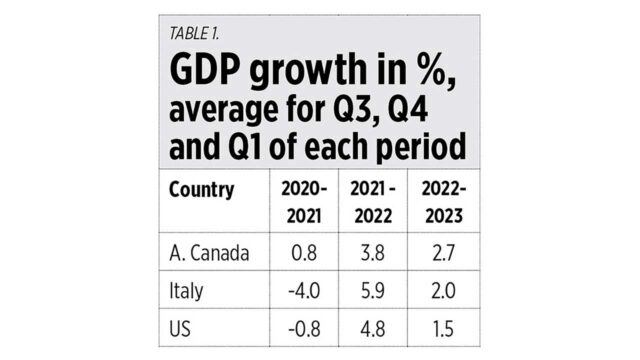
GDP performance in Q2 2023 is not yet available, so the assessment will use only the last three quarters, Q3 and Q4 of 2022 and Q1 of 2023, and compare it with the same quarters of preceding years, and with the performance of the other countries over the same period.

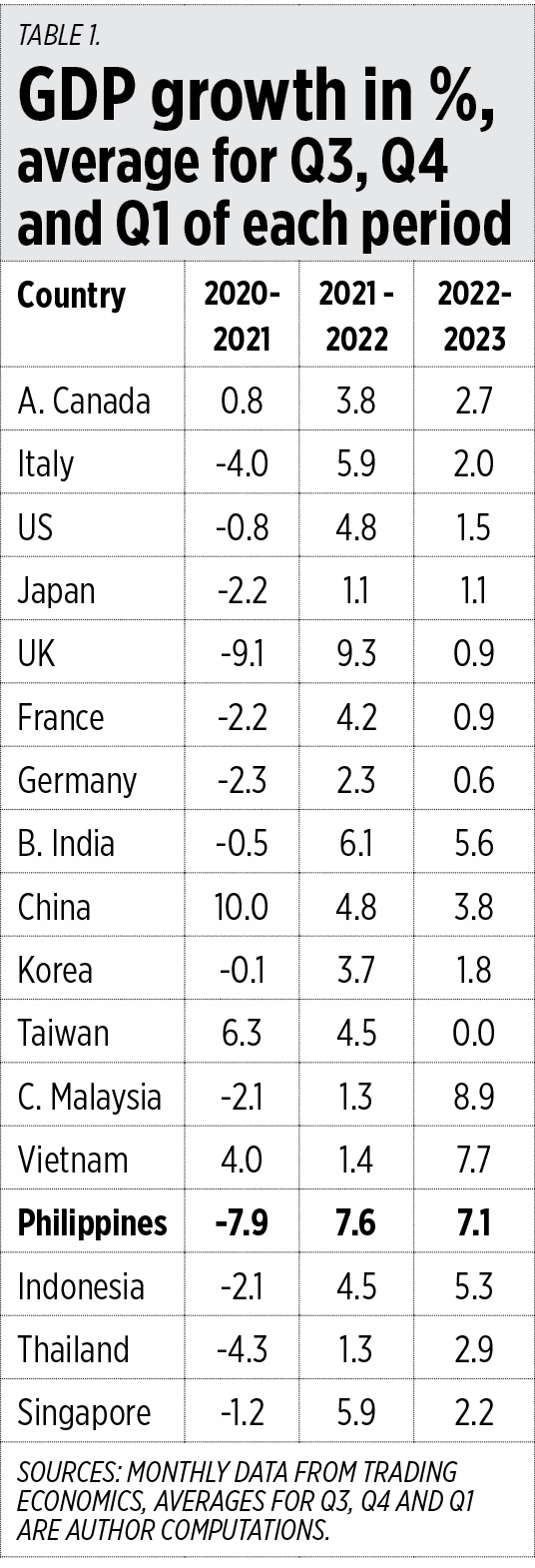
I grouped the countries into three: Group A for the G7 industrialized countries, Group B for the big economies of North and South Asia, and Group C for the ASEAN-6, for a total of 17 economies.

The Philippines under the Marcos Jr. administration has the third-fastest growth of 7.1% next to Malaysia’s 8.9% and Vietnam’s 7.7%. But what makes the Philippines’ growth impressive is that it was a high growth over a high base the previous year, whereas Malaysia and Vietnam have high growth over a low base the previous year.

AGRICULTURE, FISHERY AND FORESTRY (AFF)
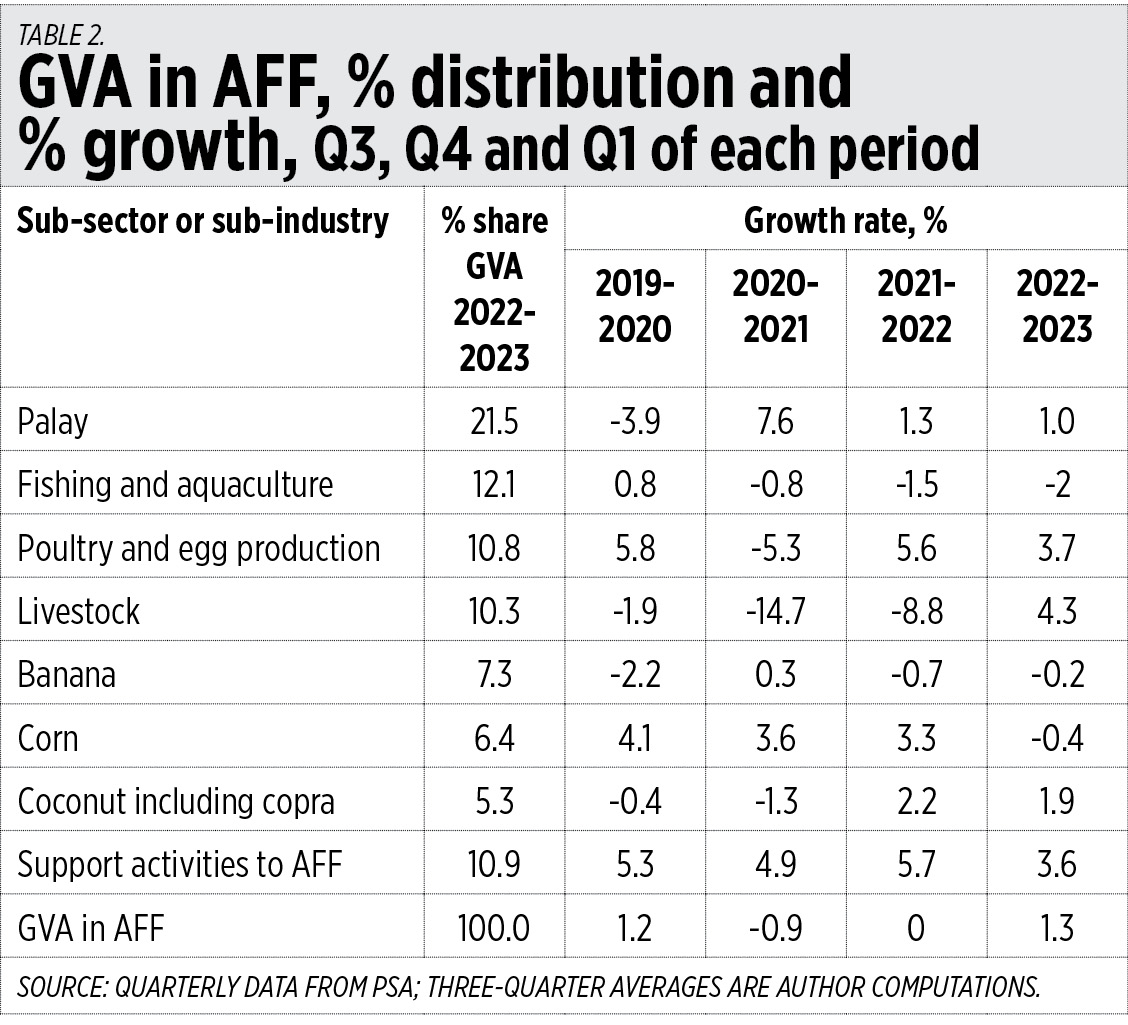
The President remains the Agriculture secretary so this sector needs special assessment. I reviewed the gross value added (GVA) in AFF in the past three quarters, and the overall growth is 1.3% — modest enough. The quarterly growth was 2.1% in Q3 2022, -0.3% in Q4 2022, and 2.2% in Q1 2023. The last time that AFF has a growth above 2% was in Q3 2019 at 3%.

For many years, AFF growth remains muted and low, why? One explanation is the high degree of underreporting of output as these are raw products from the farms, the forest, the lakes and the sea. One proxy for real growth of the AFF sector would be the accommodation and food service activities in GDP. Raw fish from the sea, fishponds and lakes become cooked food in restaurants and hotels and their valuation is more realistic than raw food.

Accommodation and food services have an average growth of 9.5% in 2015-2019. In contrast, AFF average growth over the same period was only 1.1%. So, even assuming that half of the growth of the former is AFF, then the actual annual growth of AFF is around 4.7%, not 1.1%.

AGRICULTURE IN SONA 2022
The President mentioned in his SONA 2022 the need to adopt more modern technology and farming practices to improve output and raise productivity in the sector. Among the government measures he mentioned is to provide more financial and technical assistance to farmers and fisherfolks. Agricultural credit and farm inputs that the government will bulk purchase are fertilizers, pesticides, seeds, feeds, and fuel subsidies.

A long-term measure is value chain coordination. Research in modern farming, animal husbandry and fishery will use modern technology, plus improvements in post-production and processing. The national network of farm-to-market roads will be expanded to hasten the delivery of products to consumers.

The President did not mention or consider land consolidation, and more large-scale corporate farming in more sub-sectors. I hope he will consider this in his SONA 2023 this Monday.

SUMMARY AND CONCLUSION
From the nine areas of assessment that I covered in the Stratbase-ADRi paper, the administration performance in year 1 is as follows:

1. Good in four areas: GDP growth, ratings upgrade, low unemployment, and people mobility.

2. Modest or mild performance in four areas: interest rate, merchandise exports, FDI, and agriculture.

3. Poor performance in controlling high inflation. But as discussed there, areas where commodity inflation is high actually point to high consumer demand for “less necessities” like alcohol, beverage and tobacco, and accommodation/hotel services. In this case, high consumer confidence will just prod other sectors to expand production and hence, high overall GDP growth in the coming quarters and years.

The first year of the Marcos Jr. administration, therefore, is off to a good start, with more jobs and businesses for Filipinos and foreigners doing business here.


Bienvenido S. Oplas, Jr. is the president of Bienvenido S. Oplas, Jr. Research Consultancy Services, and Minimal Government Thinkers

minimalgovernment@gmail.com

Allied Care Experts (ACE) Malolos Doctors, Inc. to hold 2023 Annual Stockholders’ Meeting on Aug. 15


Spotlight is BusinessWorld’s sponsored section that allows advertisers to amplify their brand and connect with BusinessWorld’s audience by enabling them to publish their stories directly on the BusinessWorld website. For more information, send an email to online@bworldonline.com.

Join us on Viber at https://bit.ly/3hv6bLA to get more updates and subscribe to BusinessWorld’s titles and get exclusive content through www.bworld-x.com.

Globe: Rise in digital payments to sustain economic recovery

THE increasing popularity of digital payments over the past five months could sustain the Philippines’ economic recovery, according to Globe Telecom, Inc.

“The surge in the adoption of digital payments coincides with the steady easing of inflation rates, which contributes to an increase in consumer purchasing power. This, combined with a drop in unemployment numbers, creates an environment conducive to economic growth,” Globe said in a press release on Wednesday.

Headline inflation slowed to 5.4% in June from 6.1% in May and in the same month last year. This is the slowest price movement in 14 months.

Meanwhile, the Philippines’ unemployment rate in May eased to 4.3%, slower than the 4.5% in the previous month and the 6% in the same period last year.

Globe said the Bangko Sentral ng Pilipinas’ (BSP) plan of shifting 50% of total retail transactions to electronic channels under the Digital Payments Transformation Roadmap will bode well for the country’s recovery.

“The shift to digital payments means faster and more convenient transactions, real-time cashflow for merchants, and quicker movement of goods and services, which all redound to a more vibrant economy. We, at the Globe Group, are ready to support this growing shift with our suite of digital solutions,” said Ernest L. Cu, Globe’s president and chief executive officer.

The BSP also plans to increase the number of Filipino adults who use digital payment services to 70% before the end of the year.

In the BSP’s 2022 Status of Digital Payments report, the share of digital payments in total retail transactions in terms of volume rose to 42.1% or 2.04 billion from 30.3% or 1.43 billion in 2021.

“At Globe, we’re deeply committed to empowering our country through technology. We’re poised not just to help the government meet its goal in terms of digital payments, but also to lead the way in shaping an inclusive, progressive retail payment landscape that thrives on innovation and accessibility,” said Mr. Cu. — Justine Irish D. Tabile

Taco Bell wins ‘Taco Tuesday’ trademark dispute with rival chain

YUM BRANDS’ Taco Bell prevailed on Tuesday in its self-described bid to “liberate” the phrase “Taco Tuesday,” as competing fast-food chain Taco John’s told the US Patent and Trademark Office (USPTO) it would abandon its federal “Taco Tuesday” trademark.

Taco Bell had asked the USPTO in May to cancel the trademark, calling it a common phrase that Taco John’s had monopolized unfairly in the restaurant industry.

In a statement, Taco John CEO Jim Creel said: “We’ve always prided ourselves on being the home of Taco Tuesday, but paying millions of dollars to lawyers to defend our mark just doesn’t feel like the right thing to do.”

He said the Cheyenne, Wyoming-based chain would instead donate $100 for each of its nearly 400 locations to a nonprofit for restaurant workers in crisis and challenged Taco Bell to do the same.

Taco Bell has more than 7,200 locations in the US, according to Yum Brands’ website.

Representatives for Taco Bell did not immediately respond to a request for comment on the Tuesday filing.

Taco John’s owned the right to use the “Taco Tuesday” name in commerce in every state except New Jersey, where it is still owned by Gregory’s Restaurant & Bar in Somers Point.

A separate Taco Bell challenge to that trademark is still pending. The restaurant’s co-owner Gregory Gregory told Reuters he did not have plans to give up its trademark and he was “shocked” that Taco John’s had abandoned its mark so soon.

Taco Bell publicized its petitions to cancel the “Taco Tuesday” marks as part of a marketing campaign, claiming it wanted to “liberate the phrase for restaurants nationwide.”

Taco John’s told the USPTO last month that Taco Bell was only seeking to sell more tacos, and that its mark did not prohibit anyone “from advertising and selling tacos on Tuesday.” — Reuters

EU’s AI lobbying blitz gets lukewarm response in Asian countries

TRUSTPAIR.COM

SINGAPORE/TOKYO/STOCKHOLM — The European Union (EU) is lobbying Asian countries to follow its lead on artificial intelligence (AI) in adopting new rules for tech firms that include disclosure of copyrighted and AI-generated content, according to senior officials from the EU and Asia.

The EU and its member states have dispatched officials for talks on governing the use of AI with at least 10 Asian countries including India, Japan, South Korea, Singapore, and the Philippines, they said.

The bloc aims for its proposed AI Act to become a global benchmark on the booming technology the way its data protection laws have helped shape global privacy standards.

However, the effort to convince Asian governments of the need for stringent new rules is being met with a lukewarm reception, seven people close to the discussions told Reuters.

Many countries favor a “wait and see” approach or are leaning towards a more flexible regulatory regime.

The officials asked not be named as the discussions, whose extent has not been previously reported, remained confidential.

Singapore, one of Asia’s leading tech centers, prefers to see how the technology evolves before adapting local regulations, an official for the city-state told Reuters. Officials from Singapore and the Philippines expressed concern that moving overly hasty regulation might stifle AI innovation.

As Reuters reported last month, Southeast Asian countries are drawing up voluntary guidelines. Japan, for its part, is leaning towards softer rules than the stringent approach championed by the EU, as it looks to the technology to boost economic growth and make it a leader in advanced chips.

Efforts in Asia are part of a global push by European nations that include talks with countries such as Canada, Turkey, and Israel, Dutch digital minister Alexandra van Huffelen told Reuters in an interview.

“We’re trying to figure out on how we can make the regulation from the EU copied, applicable and mirrored… as it is with the GDPR,” Ms. van Huffelen said late last month, referring to General Data Protection Regulation (GDPR), the EU’s data privacy regime.

The emergence of AI has been hailed as a breakthrough that will usher in an era of rapid advances in science and technology, revolutionizing all aspects of human activity, but also painted as an existential threat.

EU lawmakers in June agreed to a trailblazing set of draft rules, which would make companies such as ChatGPT operator OpenAI disclose AI-generated content, help distinguish so-called deep fake images from real ones and ensure safeguards against illegal content.

The proposed legislation, which also envisages financial fines for rule violations, faces resistance from companies, with 160 executives last month signing a letter warning it could jeopardize Europe’s competitiveness, investment, and innovation.

Still, officials from the EU, which has signed “digital partnerships” with Japan, South Korea, and Singapore, voice optimism they can find common ground with international partners to advance cooperation on technologies including AI.

“Our mission is again to make sure that what’s happening in the EU, which is our large constituency if I may say so, is protected,” EU industry chief Thierry Breton told Reuters during a trip to South Korea and Japan to discuss AI and semiconductors.

“I believe that it will be probably not too far from each other because we share the same values,” Mr. Breton said of regulation of AI in the EU and countries such as Japan. 

Leaders of the Group of Seven (G7) economies made of Canada, France, Germany, Italy, Japan, Britain, the United States, and the European Union, in May called for adoption of standards to create “trustworthy” AI and to set up a ministerial forum dubbed the “Hiroshima AI process.”

Seoul will continue discussing AI regulation with the EU but is more interested in what the G7 is doing, a South Korean official said following a meeting with Mr. Breton.

The EU is planning to use the upcoming G20 meetings to further push for global collaboration on AI, notably with 2023 president India, Ms. van Huffelen told Reuters. — Reuters

UnionBank rolls out ATMs to service US dollar withdrawals

BW FILE PHOTO

UNION BANK of the Philippines, Inc. (UnionBank) has deployed three dollar-dispensing automated teller machines (ATMs), it said on Wednesday.

The first machine was set up in the bank’s headquarters in Pasig City on July 6, the bank said in a statement.

“Within days, a couple more ATMs with the same capabilities were found in their Greenhills and Cebu Wealth branches,” it added.

UnionBank said it is the first local bank with ATMs that dispense the greenback.

The machines dispense dollars in denominations of $100 and with no withdrawal fees.

The bank is looking to upgrade ATMs in “strategic” locations to have this capability, it added.

It will also “deploy more dollar-dispensing ATMs in branches of areas that are frequented by UnionBank US Dollar account holders with intensive US dollar transaction requirements.”

UnionBank’s net income rose 30% year on year to P3.4 billion in the first quarter, driven by gains from its acquisition of Citigroup, Inc.’s consumer business in the country.

The bank’s shares closed unchanged at P72.50 apiece on Wednesday. — AMCS

Why credit is misunderstood and what can be done to fix it

TRUSTPAIR.COM

By Pia Arellano

THERE’S a lot to look forward to in the Philippines. The country is emerging as one of the fastest growing economies in the Southeast Asian region. Going from 5.6% economic growth in 2021 to 7.6% in 2022, with continued recovery and reform efforts, the World Bank also forecasted that the Philippines is set to become an upper middle-income country in two years’ time.

While these reports are promising, it also sheds greater light on the need for economic growth to be more inclusive. It is widely believed that financial inclusion aids economic growth and development. Specifically, financial inclusion efforts expand access to financial services for more people, increasing their economic opportunities and improving their lives.

Financial inclusion in the country must continue to be accelerated to enable more Filipinos to benefit from wider financial services. Yet for so many Filipinos, access to financial education and information remains limited. In a financial literacy survey conducted by the Bangko Sentral ng Pilipinas in 2021 showed that only 2% of Filipinos correctly answered all questions pertaining to basic financial literacy. 

Understanding financial access to credit is a basic pillar of financial literacy. With its ability to enable consumers to access goods or services on the premise that payments will be made in the future, credit has the potential to change lives for the better. That’s why it is a must for vast sectors of the population should be able access credit on both reasonable terms and in a responsible manner.

MANY FILIPINOS STILL SEE CREDIT AS ‘BAD DEBT’
Local efforts to facilitate greater access to credit cannot come without changing prevailing, deep-rooted stigma surrounding it. The notion of credit may unnerve many Filipinos. Understood as “utang” in Tagalog, the word itself carries notions of a debt to shoulder and the product of financial irresponsibility — something Filipinos would prefer to shy away from.

This deep-rooted negative stigma surrounding utang in the country may also influence how Filipinos perceive credit. According to a TransUnion study on credit perceptions in the country, 57% of Filipinos believe people who acquire credit products tend to overspend, while 50% believe that those who do are already in debt. Despite these perceptions, there is still a high reliance on informal credit systems, with 72% of Filipinos turning to family and friends when it comes to borrowing money. Given the data, financial institutions need to reframe the conversation surrounding credit from “utang” to an enabling force for more financial services and opportunities.

These largely unfounded misconceptions can be attributed to ways in which Filipinos acquire their financial knowledge. Many among both the general and unbanked population rely on family and friends as well as social media for financial education.

This presents a great opportunity for both the public and private sectors to work together to establish more formal and reliable channels for Filipinos to acquire financial knowledge. By doing so, the formal financial system can help change existing narratives surrounding credit from bad debt to a gateway to improved economic opportunities.

USING INFORMATION FOR GOOD
Greater financial inclusion can indeed unlock opportunities for more Filipinos to improve their economic standing, especially among those belonging to lower-income segments of the population. However, this cannot be achieved without addressing long-standing issues of trust surrounding credit and other financial services.

By understanding local credit perceptions as well as the factors that influence them, banks and other financial institutions can work towards the idea of credit to be both appealing and empowering. Through a more direct approach that highlights the benefits of credit, Filipinos will be more willing to see credit as better opportunities for financial access rather than a hindrance.

This can be achieved with the life-changing power of information. As a global information and insights company, TransUnion Philippines is dedicated to finding innovative ways to utilize information for consumers to manage credit, and for businesses to manage risk more efficiently. Through the power of information, more Filipinos can be “seen” by the formal financial system and access its services to change their lives and the nation for the better.

Pia Arellano is the president and CEO of TransUnion Philippines. She has over 25 years of industry experience across banking, payment solutions, telecommunications, and remittance services. She has been instrumental in establishing TransUnion as a leading private consumer credit reference agency and an information and insights partner of banks, fintech companies, and other institutions in the Philippine financial system. Questions can be e-mailed to tuphcomms@transunion.com.

Maintenance department

GUILHERME CUNHA-UNSPLASH

AFTER the pandemic (presuming it’s over) maintenance routines, given a low priority during the lockdown period, have become important again now that physical customers are out again.

The state of publicly accessible premises provides an indicator of effective management of companies, membership clubs, malls, restaurants, and condos. A well-lit lobby with clean walls and polished floors, toilets with working flushes and ample toilet paper (even when not charging for usage) and working elevators all demonstrate an effective maintenance culture.

A condominium building with a high occupancy rate, with most if not all unit owners or renters dutifully paying monthly dues, tends to have a well-lit reception area, with no dark corners where trash collects. Receptionists and security personnel are neatly attired and courteous. They answer questions on gym hours and policy on guests who want to use the Olympic pool — Sir, you need to remove your shoes.

Is a disregard for maintenance procedures sheer carelessness? Can its absence be excused as a case of cost-cutting? Do we often dispense with following the users’ manual for keeping equipment working as designed? Do we ignore maintenance schedules and run down equipment until it is no longer usable?

Do we as a country have a maintenance culture?

The maintenance department for offices and malls, especially when applied to non-revenue service areas like lobbies, elevators, and toilets, seems to rate low in a property owners’ list of priorities, right below building access for the disabled.

One reason we consign the maintenance and repair function to an unglamorous position (and low pay) in the corporate culture is the rise of a disposable culture. Shavers, face masks, and even gadgets are not intended to be used over and over to economize and reduce waste to save the earth.

Even with scrupulous maintenance habits, products have their “best-before” dates. Thus, it is no virtue to keep maintaining and repairing a car that is simply breaking down too often. This is usually sold cheaply without any guarantees — “as is, where is.”

The maintenance habit needs to also recognize when a piece of equipment just needs to be replaced. A mobile phone that is planned for obsolescence and no longer accepting new apps is merely handed down to others lower on the technological food chain. Or it is just mothballed when needing repair or parts replacement. There is, after all, a newer gadget with more features and a bigger memory one must have, even if not used to its full capability.

Of course, the antique collectors of watches and cars continue to rehabilitate their classic models and even join other collectors in auctions and trade events. This maintenance approach seeks to enhance the value of a product that is no longer being manufactured. Thus have vinyl records been elevated to collector status — it’s the mellowness of the sound. There is even pride and joy in machining no longer available parts to make obsolete equipment work again.

Thrift shops for second-hand clothes seem to be enjoying a chic resurgence. It’s becoming fashionable especially among millennials to sift through discarded (maybe even donated) coats and jackets looking for a fit. This bargain hunting has nothing to do with lack of purchasing power. It is more connected to advocacy of recycling and saving the earth.

“De-clutter” sales in posh neighborhoods and condominiums have just raised the charm of disposal and re-use. Isn’t this part too of maintaining habits for “previously owned” merchandise. The adventure of stumbling into some underpriced or unappreciated treasure can be a new thrill.

Social relationships too have maintenance issues. A partner requiring “high maintenance” refers to her expensive tastes or his needy and suffocating embrace. Both in time and money, such high maintenance partnerships can be exhausting. Maintenance rules need to be understood from the start.

What about personal maintenance habits like good physical and mental health? In this matter, a person, especially as he ages, needs to follow a healthy lifestyle that requires regular exercise, a good diet, an optimistic outlook in life, and lasting relationships.

This corporal equipment may also need occasional repair and rehabilitation, even when following a good maintenance regime. Replacement of defective parts in this case may not always be possible. Neither is a trade-in for a newer model.


Tony Samson is chairman and CEO of TOUCH xda

ar.samson@yahoo.com

Two airlines join list of year’s strongest brands

Airplanes are seen on the runway at the Ninoy Aquino International Airport. — PHILIPPINE STAR/ MICHAEL VARCAS

TWO of the country’s airlines — Cebu Pacific and Philippine Airlines — joined London-based brand consultancy firm Brand Finance’s list of top strongest brands for 2023.

Cebu Pacific came out third among the strongest brands after receiving a brand strength index score of 81, which corresponds to a rating of AAA-, the company said in a press release on Tuesday.

“We are humbled and honored to be named among the strongest and most valuable brands in the Philippines. This affirms our commitment to making air travel more affordable and accessible for every kind of Juan,” said Candice Jennifer A. Iyog, Cebu Pacific’s chief marketing and customer experience officer.

For its survey, Brand Finance analyzed companies’ investments in marketing and research and development, and ratings by review sites, social media engagement, customer churn, and market share, among others.

The Philippines’ strongest brands were determined based on a scorecard that evaluates the marketing investment, shareholder equity, and business performance of each company.

“We are also grateful for the trust and confidence of our passengers. In this dynamic and challenging industry, this distinction will further motivate Cebu Pacific to constantly improve our services and ensure the best travel experience for our passengers, along with our commitment to provide safe, reliable, and affordable air transport for every Juan,” Ms. Iyog said.

Meanwhile, flag carrier Philippine Airlines bagged 10th place with a strength index score of 73.2 or a rating of AA.

The two airlines are marked as new entries in the strongest Filipino brands and in the top 20 most valuable Filipino brands.

In Brand Finance’s brand value ranking, Philippine Airlines placed 17th with $275 million, while Cebu Pacific placed 20th with $194 million.

BusinessWorld tried to get Philippine Airlines’ comments on the matter but has yet to receive a reply as of article filing. — Justine Irish D. Tabile

Shanghai restaurant caters to pampered pets with gourmet dog’s dinners

SHANGHAI — Hengheng’s friends could tell she was enjoying her birthday party in the pricey, health-conscious restaurant in downtown Shanghai by the way she licked her food off the plate.

A one-year-old Border Collie sitting in a buggy and wearing a cupcake hat, Hengheng was the only one at the table enjoying the carefully prepared, elaborately plated food which at the Cat and Dog Club is for pets only.

“If my dog is happy then I am happy. My dog is just like my child,” said Tiffany Wang, Hengheng’s owner, one of six people celebrating the birthday by clapping and taking pictures of the dog and her paw-shaped cake.

“I can see from her reaction and the way she was eating everything so fast that she was actually really happy.”

China’s pet economy was worth 493.6 billion yuan ($69 billion) last year, a 25% increase on the previous year, according to data from research firm iiMedia Research. It is expected to reach 811.4 billion yuan by 2025.

Part of this growth is attributed to smaller family sizes in China — the country recorded its lowest birth rate on record last year.

A growing number of people are also living alone, with state media publishing data last year showing China has 125 million one-person households, increasing the importance of animal companions.

The Cat and Dog Club, which opened in 2021 to cater to a growing army of pet lovers, serves an extensive menu to its animal customers with an average meal costing around 90 yuan ($12.52).

“We don’t put any sugar, oil, additives and it’s very fresh to meet our standards,” said manager Ma Tao. “It’s also fine for people to eat, but it doesn’t have a lot of flavor.” — Reuters

Goldman CEO’s growth strategy gets traction with board — sources

NEW YORK — Goldman Sachs’ board supports Chief Executive Officer (CEO) David Solomon’s focus on its core Wall Street businesses and asset management, according to two sources close to Solomon.

The executive is tasked with reviving the bank’s stock, even as skepticism from some investors and employees grows.

The 12-member board of directors is intensely focused on Solomon’s refreshed strategy, one of the two sources told Reuters, after the firm’s foray into the consumer banking business saddled Goldman with losses and left if lagging rival Morgan Stanley.

The expected arrival of Tom Montag, who was approached by Mr. Solomon, also signals to insiders that the chief executive and his turnaround plans have internal support at the top, separate sources said.

The assessment, which follows Goldman’s recent board meeting in India, has not been previously reported. It shows that the circle around Solomon believe in his ability to revive the bank’s fortunes.

The bank’s shares have fallen about 2% in 2023, lagging competitors Morgan Stanley and JPMorgan Chase where shares have risen 8% and 15%, respectively. Even so, Goldman’s stock is still outperforming the S&P banks index, which is down more than 3% this year.

Goldman is trading at a forward price-to-book multiple of 0.99 times compared with JPMorgan, which trades at 1.43 times and Morgan Stanley’s 1.53 times, according to Refinitiv’s Eikon data.

The bank declined to comment on its share price performance.

LOST FAITH?
David Wagner, a portfolio manager at Aptus Capital Advisors, exited his small position in Goldman Sachs months ago because he was unimpressed with managers’ handling of the consumer business.

“The inability to execute on this front has led us to believe that there is a lot of internal strife at the company, which could create employee retention problems in the future as faith in David Solomon could be lost,” Mr. Wagner said.

Analysts have questioned the banks’ reorganization, which the bank argued strengthened its core business.

The firm has been belt-tightening in an ongoing push to cut $1 billion in costs, targeting smaller and smaller line items and contemplating more job cuts, sources previously said.

More bad news is expected on Wednesday when the bank is likely to report an almost 59% drop in earnings per share in its second-quarter results along with a writedown on fintech business GreenSky. Marcus, the consumer business, lost $3 billion in three years, and is being wound down.

BOARD BOOST
Mr. Solomon approached former Bank of America Chief Operating Officer Tom Montag after his retirement to discuss a Goldman board seat, according to two sources with knowledge of the situation. Mr. Montag was recommended by the board’s nominating committee to join as an independent director, according to a regulatory filing last month.

Mr. Montag previously worked at Goldman for 22 years and served as the co-head of its global securities business. Known as an intense and hands-on boss, he is expected to fortify Mr. Solomon’s position, according to five senior sources who worked with the executives.

The board’s secretary did not respond to direct requests for comment. Several board members did not respond to requests for comment, while others could not be reached for comment.

A Goldman Sachs spokeswoman said in a statement: “David and the leadership team are focused on executing on the strategic goals we laid out at investor day to grow and strengthen our existing businesses, diversify our products and services and operate more efficiently.”

Mr. Solomon did not respond to a Reuters request for comment.

The Wall Street giant laid off hundreds of staff in the second quarter, adding to a round of cuts in January of about 3,200 employees, the biggest reduction since the 2008 financial crisis.

In response to question about departures of senior executives including partners, the spokeswoman added that Goldman partners are staying longer, with their average tenure rising to 8.3 years in 2022 from 6.2 years in 2010.

STILL NO. 1
Mr. Solomon took the top job in 2018, leaning into Goldman’s consumer business to broaden earnings beyond volatile revenue from trading and dealmaking. The retail operations struggled to gain traction against well-established consumer banks, prompting the bank to set aside billions to cover potential loan losses.

Even after its ill-fated foray in consumer banking, the investment bank still ranked as the top adviser for global mergers and acquisitions in the first half of this year, according to Dealogic.

Goldman’s enduring influence was on show at a recent board meeting convened in India last month, which included a meeting with Prime Minister Narendra Modi.

Board member and billionaire steel magnate Lakshmi Mittal hosted a reception for Goldman clients and government officials at his luxurious residence in New Delhi, according to a source who attended the event. Mr. Mittal’s company ArcelorMittal did not respond to a request for comment about the meeting.

“Just got back from an incredible trip to India where our leadership team and I met with our board of directors,” Mr. Solomon wrote in a LinkedIn post with photos of the group. — Reuters