Home Blog Page 456

Clinical trials are the cornerstone of medical progress

STOCK PHOTO | Image by Vectorjuice from Freepik

In 1747, Scottish physician Dr. James Lind conducted an experiment aboard a British naval vessel to find a cure for scurvy, then a devastating cause of illness and death among sailors. He divided 12 afflicted sailors into six groups and administered different remedies such as cider, vinegar, seawater, spice paste, and citrus fruits. Within a week, the group receiving oranges and lemons recovered and returned to duty, while the others showed little improvement.

Lind’s experiment, now recognized as the first controlled clinical trial in history, generated crucial evidence that citrus fruits prevented and cured scurvy. More importantly, his methodology marked a breakthrough in medical research and laid the groundwork for modern clinical trials.

A clinical trial is a research study involving human participants to evaluate the safety, efficacy, and broader effects of an intervention, whether a medicine, vaccine, medical device, behavioral change, or new standard of care. Clinical trials are indispensable to the research-based pharmaceutical industry’s drug development process. They ensure that innovation is rooted in rigor, safety, and efficacy before new therapies reach the market. They also provide healthcare professionals with the scientific evidence needed to care for patients and improve quality of life.

The global response to COVID-19 powerfully demonstrated the value of clinical trials. When the pandemic hit, the biopharmaceutical industry worked with governments, regulators, and scientific institutions at unprecedented speed and scale. New and repurposed treatments were tested, and vaccines were developed on groundbreaking technological platforms, deployed, and continuously monitored that were all enabled by clinical trials that were rapidly launched in the face of uncertainty.

National Regulatory Authorities (NRAs) played a pivotal role.

To overcome the exceptional challenges of the pandemic, regulators adopted a range of flexibilities and innovations in clinical trial processes. Some approaches were new, while others were accelerated from pre-existing tools, including the digitalization of trial conduct, remote monitoring, and decentralized trial models. These adaptations not only advanced the global COVID-19 response, but also offered lasting insights into how clinical trials could evolve to better integrate science, regulatory agility, and patient needs.

Data sharing has likewise emerged as a key enabler of scientific progress. Responsible clinical trial data sharing expands scientific understanding, improves patient outcomes, reduces duplicative research, and fosters public trust. The biopharmaceutical industry seeks to enhance public health through data sharing that is grounded in three principles: safeguarding patient privacy; upholding the integrity of NRAs; and sustaining investment in biomedical research and innovation.

The momentum for reform continues. In September 2025, 11 major global medical research funding bodies signed a joint statement supporting World Health Organization (WHO) standards to strengthen clinical trial systems. The signatories are committed to improving trial design, ensuring representative trial populations, integrating clinical trials into sustainable national infrastructure, and embedding best practices in transparency, data management, and public engagement.

Building clinical trial capacity also relies on regulatory convergence and harmonization. Encouraging reliance and work-sharing among NRAs can accelerate patient access to new therapies, reduce fragmentation, and promote evidence-based decision-making. Patient engagement and responsible data sharing are equally vital in building trust, supporting transparency, and ensuring that innovation translates into public health impact.

Another critical dimension is diversity and inclusion in clinical trials. Patient populations should reflect the epidemiology and demographics of those who stand to benefit from new treatments. Diverse participation is both a matter of equity and scientific rigor. It helps determine the right treatment for the right patient. The biopharmaceutical industry is committed to advancing diversity in clinical research and ensuring equal opportunity to participate in relevant trials.

Transparency also remains a cornerstone of accountability and public trust. Biopharmaceutical companies routinely collaborate with academic researchers, publish clinical research, and share trial information at recruitment, completion, and, depending on applicable rules, post-approval or program discontinuation. Increasingly, efforts are underway to provide lay summaries of clinical trial results so that research participants can better understand the studies in which they took part.

Clinical trials are thus more than a procedural step in drug development. They are the engine of medical progress. They generate the evidence needed to develop innovative medicines and vaccines that save and improve lives. As the world continues to invest in science, data, and regulatory modernization, we reiterate our commitment to transparency, ethical and regulatory compliance, and enhancing diversity in clinical trials. Ultimately, strengthening clinical trial systems is an investment in public health, innovation, and patients worldwide.


Teodoro B. Padilla is the executive director of Pharmaceutical and Healthcare Association of the Philippines, which represents the biopharmaceutical medicines and vaccines industry in the country. Its members are at the forefront of developing, investing and delivering innovative medicines, vaccines, and diagnostics for Filipinos to live healthier and more productive lives.

Washington National Opera latest to leave Kennedy Center after Trump takeover

WASHINGTON — The Washington National Opera (WNO) will leave the Kennedy Center, the two organizations said on Friday, marking the latest departure from the storied Washington arts institution since President Donald J. Trump and his allies took it over.

“Today, the Washington National Opera announced its decision to seek an amicable early termination of its affiliation agreement with the Kennedy Center and resume operations as a fully independent nonprofit entity,” the opera said in a statement, saying the step followed changes at the center.

The opera’s artistic director, Francesca Zambello, told the Guardian in November that it might leave its home of more than 50 years after a collapse in box office revenue and “shattered” donor confidence in the wake of Mr. Trump’s takeover.

A spokesperson for the center said it had “made the difficult decision to part ways with the WNO due to a financially challenging relationship,” adding that the departure “enables us to make responsible choices that support the financial stability and long-term future of the Trump Kennedy Center.”

The opera said the Kennedy Center’s “new business model requires productions to be fully funded in advance — a requirement incompatible with opera operations” and that “centralized support services previously provided by the Center have been reduced or eliminated.”

Mr. Trump named himself chairman of the Kennedy Center and filled its board with his allies last year. In December the institution’s board voted to rename it as the Donald J. Trump and the John F. Kennedy Memorial Center for the Performing Arts, or Trump Kennedy Center for short.

Since then many groups and artists have withdrawn from the center, citing the Republican leader’s takeover. Democrats, noting that the center’s name was established by Congress, have said Mr. Trump’s rebranding has no force of law. John F. Kennedy’s family denounced the renaming move as undermining the slain president’s legacy. — Reuters

Debt yields decline on below-target inflation

YIELDS on government securities (GS) traded at the secondary market fell last week on data showing that Philippine inflation was below target last year and as market players continue to adjust their positions.

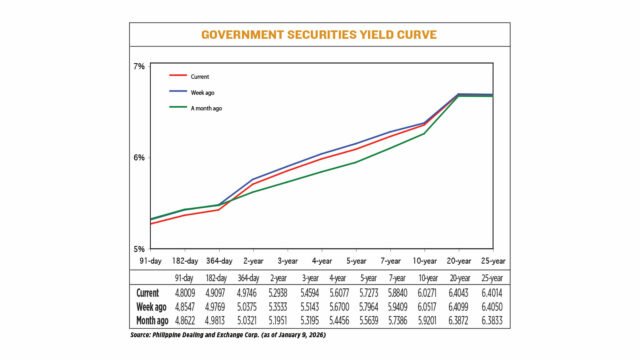
GS yields, which move opposite to prices, declined by an average of 4.73 basis points (bps) week on week, based on the PHP Bloomberg Valuation Service Reference Rates as of Jan. 9 published on the Philippine Dealing System’s website.

Rates went down across all tenors. At the short end of the curve, yields on the 91-, 182-, and 364-day Treasury bills (T-bills) dropped by 5.38 bps (to 4.8009%), 6.72 bps (4.9097%), and 6.29 bps (4.9746%), respectively.

At the belly, the rates of the two-, three-, four-, five-, and seven-year Treasury bonds (T-bonds) declined by 5.95 bps (to 5.2938%), 5.49 bps (5.4594%), 6.23 bps (5.6077%), 6.91 bps (5.7273%), and 5.69 bps (5.8840%), respectively.

At the long end of the curve, the 10-, 20-, and 25-year notes went down by 2.46 bps, 0.56 bp, and 0.36 bp to yield 6.0271%, 6.4043%, and 6.4014%, respectively.

GS volume traded increased to P55.42 billion on Friday from P12.18 billion a week prior.

“The uptick inflation rates seem to have influenced the curve to flatten and yields to move lower overall throughout the week. This is likely due to the tempering expectations for further near-term monetary easing by the BSP (Bangko Sentral ng Pilipinas),” the first bond trader said.

“Beyond inflation data, domestic monetary policy signals played a key role. BSP Governor Eli M. Remolona, Jr.’s statements suggesting a cautious approach to further easing reinforced the idea of a policy pause, supporting yields, particularly at shorter maturities. Additionally, the behavior of market players, including positioning ahead of auctions and portfolio rebalancing, at the start of the year, also influenced yield movements.”

The second bond trader said the market remains “awash with cash,” which helped bring yields down.

“The weaker peso, however, capped yields from moving lower after the local pair breached the 59.30 handles.”

Philippine headline inflation picked up to 1.8% in December from 1.5% in November, the government reported last week.

For 2025, the consumer price index (CPI) averaged 1.7% in 2025, easing from 3.2% in 2024. This was the slowest rate in nine years or since the 1.3% clip in 2016.

This was also below the BSP’s 2%-4% target but a tad higher than its full-year forecast of 1.6%.

Mr. Remolona said last week that they could consider a sixth straight cut at the Monetary Board’s Feb. 19 review, but noted that the current policy rate of 4.5% is already “very close” to where they want it to be, signaling an imminent end to their easing cycle.

The Monetary Board has lowered benchmark borrowing costs by a total of 200 bps since its rate-cut cycle began in August 2024.

Meanwhile, the peso closed at a new all-time low of P59.355 against the dollar on Jan. 7, eclipsing the previous record set in December.

The first trader added that US yield movements also affected the local market last week.

“The typical movements in US Treasury yields continued to guide the direction of the yields. Likewise, relevant US data (jobless claims, employment change, consumer confidence, etc.) had an impact on US Treasury yields and local GS yields as well.”

For this week, both traders said the market could react to key US jobs data released over the weekend.

“For the coming week, I expect GS yields to trade within a narrow range in a sideways manner, with a slight upward bias overall. Absent major domestic data surprises, yield movements are likely to be driven by external developments, particularly US economic releases and global bond market trends. Any risk-off sentiment could support demand for longer-dated GS and cap yields, while stronger global data may push yields modestly higher,” the first trader said.

“The market will likely take its cue from the release of the US nonfarm payrolls data and unemployment rate surveys… Local rates will likely move in sympathy with US rate moves after the data prints out of the US,” the second trader said.

The result of the Bureau of the Treasury’s bond auction on Tuesday could also drive yield movements, with the trader added, with the reissued seven-year papers on offer likely to fetch rates of 5.65%-5.75%. — Heather Caitlin P. Mañago

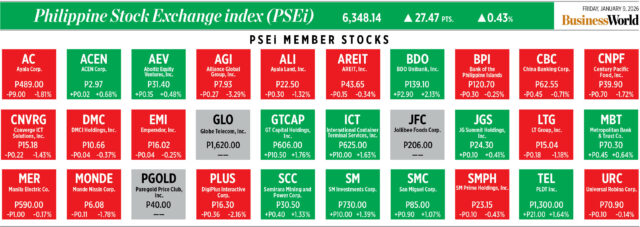
How PSEi member stocks performed — January 9, 2026

Here’s a quick glance at how PSEi stocks fared on Friday, January 9, 2026.


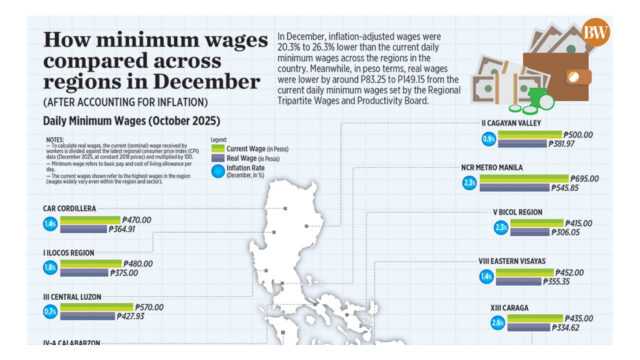
How minimum wages compared across regions in December

(After accounting for inflation)

In December, inflation-adjusted wages were 20.3% to 26.3% lower than the current daily minimum wages across the regions in the country. Meanwhile, in peso terms, real wages were lower by around P83.25 to P149.15 from the current daily minimum wages set by the Regional Tripartite Wages and Productivity Board.

Philippine shares may drop on selling pressure

PHILIPPINE STAR/KRIZ JOHN ROSALES

PHILIPPINE SHARES may decline in the coming days as the market may succumb to selling pressure following last week’s rally and as cautiousness could prevail as investors await fresh leads.

On Friday, the Philippine Stock Exchange index (PSEi) rose by 0.43% or 27.47 points to end at 6,348.14. This was a new five-month high for the main index as this was its best close since Aug. 7’s 6,364.69.

Meanwhile, the all shares index edged down by 0.01% or 0.65 point to close at 3,607.

Week on week, the PSEi climbed by 213.08 points from its Jan. 2 finish of 6,135.06.

“The local market has been exhibiting a bullish bias recently, rallying for three straight weeks and breaking above crucial lines including the 200-day exponential moving average which it last traded above in July 15. Foreign investors have also been supportive recently, with the past week registering a net inflow of P2.16 billion,” Philstocks Financial, Inc. Research Manager Japhet Louis O. Tantiangco said in a Viber message.

2TradeAsia.com said in a market note that the PSE index soared above the 6,300 mark last week on benign inflation and strong manufacturing activity data that bolstered the case for another rate cut by the Bangko Sentral ng Pilipinas (BSP) in February.

These overshadowed the peso’s plunge to a new record low of P59.355 on Wednesday, it added.

Philippine headline inflation picked up to 1.8% in December from 1.5% in November. For 2025, the consumer price index averaged 1.7%, below the BSP’s 2%-4% target but a tad higher than its full-year forecast of 1.6%.

Meanwhile, S&P Global said the Philippines Manufacturing Purchasing Managers’ Index rebounded to 50.2 in December from a 47.4 reading in November.

For this week, Mr. Tantiangco said profit taking could pull the PSEi down again.

“With a three-week run, we may see strong selling pressures this week driven by profit taking. Investors may also move with more cautiousness while waiting for new catalysts. These include: updates on the situation between the US and Venezuela; clues on the BSP’s policy path this 2026; movement of the peso; and clues on the local economy’s growth trajectory,” he said. “Investors may also take cues from our upcoming foreign direct investments and overseas Filipino workers cash remittances data.”

“The bourse is nearing its resistance at 6,400. If it is able to take this level, then it may target its next resistance at 6,600.”

2TradeAsia.com placed the PSEi’s immediate support at 6,000-6,100 and resistance at 6,500.

“The index now faces a psychological hurdle at the 6,500 zone, where historical selling pressure remains dense… While tame December inflation figures have supported the initial rally, a sustained move beyond 6,500 will depend on the reversal of the 2025 investment slowdown and a clearer signal that the private sector is re-engaging in large-scale capital expenditure,” the online brokerage said. — A.G.C. Magno

‘Most countries would dream of’ PHL debt-to-GDP levels, WB says

REUTERS

By Aubrey Rose A. Inosante, Reporter

THE sustainability of Philippine debt is not currently a matter of serious concern, the World Bank (WB) said, noting however that the government still needs to rebuild fiscal buffers to prepare for future shocks.

“There is no cause for serious concern (over debt sustainability… Most countries would dream of having the kind of debt-to-GDP (gross domestic product) ratios we have here,” World Bank Senior Economist Jaffar Al-Rikabi told reporters last week on the sidelines of an event.

Philippine debt-to-GDP was 63.1% at the end of the third quarter, rising from 60.1% a year earlier.

The rule of thumb for healthy levels of debt for developing countries is 60%, which the government has informally abandoned in favor of a new 70% benchmark.

Asked if the record P17.65-trillion debt stock at the end of November poses concerns for debt servicing, Mr. Al-Rikabi said it is “normal” for such levels to increase with inflation and fiscal deficits.

The Bureau of the Treasury will release the fourth-quarter debt-to-GDP ratio when the Philippine Statistics Authority (PSA) reports full-year and fourth-quarter GDP.

“We still don’t have Q4 data, but in our projection, if you looked at the outlook slides, we are generally reassured that the fiscal situation is very sustainable,” he said.

In its Philippine Economic Update, the World Bank said it expects sovereign debt to start declining after 2026.

National Government debt is projected to peak at 62.5% of GDP in 2026 before declining to 61.4% by 2028.

Mr. Al-Rikabi also noted that public debt remains “sustainable,” noting that the majority of the debt is long-term and peso-denominated.

“Because if debt held (is) non-peso-denominated or short-term, that usually is much more volatile and is exposed to external shocks instead of just domestic shocks,” he said.

He also noted that the debt ratio was low at 40% leading up to the COVID-19 pandemic, when the government had to take on much more debt to fund the pandemic containment effort and stimulate the economy.

“What we want to see on public debt, on servicing costs, is fiscal consolidation program being implemented,” he said.

“We want to rebuild fiscal space so that the country can act for future crisis. You had a lot of fiscal space back then. You’ll have fiscal space in the future,” he added.

Mr. Al-Rikabi said the government should take control of rising interest payments to avoid squeezing out productive spending.

“You want to spend more of your budget on education, on health, on effectively implementing infrastructure projects. You don’t want it to go increasingly on interest expenditure, which has grown over the last few years,” he said.

For 2026, the government has budgeted P2.01 trillion for debt service, with P1.06 trillion going to amortize principal and P950 billion to interest payments.

Mr. Al-Rikabi said the bank expects the economy to expand 5.3% in 2026 and 5.4% in 2027.

“We do see deceleration for this year. We’re projecting around 5.1% (in 2025). Maybe with fourth-quarter data, it ends up being weaker. I don’t know. Or maybe around the same,” he said.

The revised government target is 5-6% for 2026 and 5.5-6.5% for 2027.

Jonathan L. Ravelas, senior adviser at Reyes Tacandong & Co., projected a faster economic growth for the Philippines at 5.3% in 2025.

“Mainly because we’re a consumption-driven economy. We have one of the longest Christmases. People tend to forget when the calendar starts the ber-months it’s Christmas,” Mr. Ravelas said in a John Clements Consultants, Inc. event on Jan. 8.

“People talk about spending. This has been a major driver over the last two weeks of December. I think that could probably prop up the fourth quarter,” he said.

Mr. Ravelas sees the economy growing by 5.6% in 2026 and 5.8% in 2027.

Economy Secretary Arsenio M. Balisacan has said that GDP growth likely slowed to 4.8-5% in 2025 due to the flood control corruption scandal, prompting economic managers to temper their goals through 2027.

“We may have seen peak negative sentiment, unless somebody gets jailed (over the corruption scandal),” he said.

Mr. Ravelas said the peso may settle between P61 and P65 over the next three years, after the currency fell to a record low of P59.35 on Jan. 7.

“A weaker peso should be good for the Philippines even though we’re a net importing country, because we need to sell the Philippines as an investment destination,” he added.

Supermarket ‘mainstreaming’ to drive cold chain growth

PHILIPPINE STAR/ MICHAEL VARCAS

By Justine Irish D. Tabile, Reporter

THE cold chain industry is expected to grow by at least 8% each year over the next five years with frozen or chilled food becoming more mainstream and shedding its luxury image, the Cold Chain Association of the Philippines (CCAP) said.

CCAP estimated a growth range of 8-10% annually, making it among the fastest-growing segments within the logistics and food supply ecosystem.

“As consumers become more aware of food safety and quality, chilled and frozen products are no longer viewed as premium or niche — they are becoming mainstream,” President Anthony S. Dizon said in a statement over the weekend.

“This shift is pushing demand for cold chain capacity across storage, processing, and especially transportation,” he added.

In particular, the shift from traditional wet markets to supermarkets and retail outlets offering chilled and frozen products is expected to reshape demand for cold storage facilities and refrigerated transport.

CCAP said post-harvest food losses remain significant in the Philippines, especially in regions with limited access to cold chain infrastructure.

“Improving refrigerated transport is widely seen as one of the most effective ways to preserve product quality, stabilize prices, and extend market reach for farmers and food producers,” CCAP said.

However, the association sees last-mile and regional refrigerated delivery as a key bottleneck as food distribution expands into provincial and inter-island routes.

“This challenge is compounded by the Philippines’ tropical climate and relatively high electricity costs, which place a premium on energy-efficient cooling solutions,” it said.

For this reason, Mr. Dizon said that the next phase of cold chain growth will demand higher operating efficiency and reliability.

“The industry has embraced state-of-the-art technologies because sustainability of investment is critical,” he said. “Operators are looking for solutions that reduce spoilage, manage energy costs, and perform consistently across longer and more complex delivery routes.”

Farm job volatility seen as structural, not just result of seasonality

BW FILE PHOTO

By Vonn Andrei E. Villamiel

PERSISTENT month-to-month employment swings in agriculture point to structural weaknesses beyond seasonal factors, analysts said, after the industry lost more than half a million jobs in November even as overall employment expanded.

Employment in agriculture fell 5.7% month on month in November, equivalent to 594,000 jobs lost, according to results of the Labor Force Survey issued by the Philippine Statistics Authority (PSA). Total employment rose 1.34% from October to 49.27 million.

On a year-on-year basis, agricultural employment declined 0.71% to 9.85 million in November, shedding 69,000 jobs.

Former Agriculture Undersecretary Fermin D. Adriano said agriculture jobs typically taper off in November due to the close of the rice harvest, a time when vegetable and orchard farmers also cannot harvest because this is still peak typhoon season,” he told BusinessWorld via Viber.

According to the PSA, agriculture employment typically peaks in the May to June and September to October periods, coinciding with the main planting and harvest cycles, before falling sharply because of typhoons.

During the offseasons, agricultural workers are absorbed by other industries, like services.

In December, the Philippine Institute for Development Studies reported that such off-season employment tends to be informal and low value.

“The continuing decline of agricultural employment, without a commensurate rise in high-productivity industry jobs, suggests a risk of premature de-industrialization, where labor shifts to low-value services rather than high-value manufacturing,” the study found.

Mr. Adriano said another key issue is whether other industries are generating enough jobs to absorb workers displaced from agriculture.

“The main concern should be employment in manufacturing…” he said. “If you don’t see increases in employment in those sectors as we near the peak Christmas season, then we really do have a serious employment problem.”

Mr. Adriano added that manufacturing and services are generally preferred by workers because of higher and more stable wages, but weak investment inflows have limited their capacity to generate jobs.

Meanwhile, some analysts said the scale and recurrence of employment losses in agriculture suggest structural problems.

Jose Enrique A. Africa, executive director of think tank IBON Foundation, said the decline in agricultural employment on both a monthly and year-on-year basis indicates more than routine seasonal adjustments.

“The structural weakness is even clearer if we look at how agricultural employment has fallen steeply in recent years, dropping by 627,000 from an annual average of 10.7 million in 2021 to just 10 million in the first eleven months of 2025,” he told BusinessWorld via Viber.

Mr. Africa also pointed to extreme volatility in agricultural employment over the past five years, with year-on-year changes ranging from losses of as much as 2.3 million jobs in August 2024 to gains of up to 1.9 million in July 2022.

Month-on-month swings are even more severe due to seasonal factors, with employment falling by as much as 3 million in January 2024 and increasing by as much as 2.2 million in August 2023.

Mr. Africa said the huge swings in agricultural employment reflect structural joblessness, rather than a voluntary shift to better jobs in other industries, including the services sector, which is also plagued by pervasive informality.

To arrest this trend, Mr. Africa said interventions must focus on stabilizing farm incomes and protecting farmers from market distortions.

“Farm incomes have to be stabilized with price support and procurement mechanisms, curbing monopolies in input and trading markets, and cheap public credit and insurance,” he said.

Jayson H. Cainglet, executive director of the Samahang Industriya ng Agrikultura, said government commitment is critical to rebuilding confidence in farming.

“Reversing this trend requires the farming community to clearly see that government is on their side: increasing public investment in agriculture and protecting the market against unfair competition,” he told BusinessWorld via Viber.

Mr. Cainglet added that ensuring farmgate prices are consistently 20% to 30% above production costs is essential to attract and retain farmers. He said inadequate subsidies, unimpeded imports, and reduced tariffs are hurting agricultural workers.

“Farmers are ultimately discouraged when, after months of hard work and investment, they are wiped out by cheaper imports and collapsing farmgate prices,” he said.

Former Agriculture Secretary William D. Dar said the industry’s vulnerability to extreme weather events must also be addressed to increase employment stability.

“The agriculture sector is badly impacted by extreme weather events like strong typhoons and flooding. We need to enhance resilience of the agriculture sector, including upskilling our agriculture labor,” he said.

Mr. Africa said substantial public investment must be poured into climate-resilient irrigation, post-harvest facilities, and marketing infrastructure. He said industrialization must also be realized to increase overall productivity and generate viable employment outside farms.

“Industrialization is critical for productive rural non-farm employment in agro-processing, food systems, and rural manufacturing, as well as for a more modern high-technology, high-productivity, and job-creating economy overall,” he said.

Contestable power customers saved P19 billion in first 9 months — PEMC

ROBERT LINDER-UNSPLASH

POWER CONSUMERS who chose their preferred electricity suppliers saved about P19.25 billion in the first nine months of 2025, according to the Philippine Electricity Market Corp. (PEMC).

The savings estimate exceeded the P16.76 billion in estimated savings over the full year of 2024, the PEMC said in a retail market assessment report.

The PEMC, the governance arm of the Wholesale Electricity Spot Market (WESM), said in third quarter, estimated savings for contestable end-users at about P9.93 billion — the highest level to date, with retail weighted-average generation rates ranging from P5.68 per kilowatt-hour (kWh) to P5.75 per kWh.

The corresponding average generation rates charged by distribution utilities ranged from P6.12-P6.66 per kWh.

Through the competitive retail electricity market (CREM), contestable customers are those qualified to choose their supplier of electricity, while captive customers are required to stay within their respective distribution utilities.

“Market participation continued to expand in the third quarter of 2025, with total registered contestable end-users increasing to 2,412, up from 2,290 in the previous quarter,” PEMC said.

The savings estimate covers over 64% of all eligible end-users, it said.

Luzon accounted for 86% of all contestable end-users, while the Visayas and Mindanao represented 12% and 3%, respectively. — Sheldeen Joy Talavera

Business chamber cites urgent need to reform laggard tourism industry

PHILSTAR FILE PHOTO

THE Federation of Filipino Chinese Chambers of Commerce and Industry, Inc. (FFCCCII) said the government needs to reform the tourism industry, which it said continues to lag its regional peers.

Victor R. Lim, FFCCCII president, said immediate, decisive, and comprehensive reforms are needed for the Philippines if it is to reap the benefits of the robust tourism recovery seen elsewhere in the Association of Southeast Asian Nations (ASEAN).

“Our nation is blessed with unparalleled natural beauty and resources. Yet, as our ASEAN neighbors celebrate a robust tourism recovery, the Philippines is charting a dissimilar and concerning course,” he said in a statement on Sunday.

“We are at a pivotal time where decisive, comprehensive reform is not just an option — it is an urgent economic imperative,” he added.

Citing the Department of Tourism, FFCCCII said international arrivals totaled 5.24 million in the first 11 months, down 2.2% from a year earlier and 37% below pre-pandemic levels.

“This Philippine tourism decline is a direct blow to our national economic well-being,” Mr. Lim said.

“Tourism is our economy’s low-hanging fruit. It is the most accessible engine for inclusive economic growth — a sector that directly creates jobs and sustains the micro, small and medium enterprises (MSMEs),” he added.

He said some of the challenges faced by the industry are congested gateways, logistical hurdles, and unreliable connectivity.

“(These) create a barrier deterring the mainstream traveler, limiting our appeal to only the most adventurous,” he said.

He said the Philippines should continue modernizing primary airports and improving inter-island travel infrastructure.

“This is non-negotiable. The first and last impression must be one of efficiency and ease,” he added.

He also cited the need to streamline the visa issuance process and better promote the country’s culture, history, and cuisine.

Mr. Lim proposed a visa regime competitive with the rest of ASEAN.

“We must immediately benchmark and match the most visitor-friendly visa policies in our ASEAN region, making the choice to visit the Philippines an easy one,” he added.

Meanwhile, he said that tourism promotion should move beyond scenery.

“We must train our industry and tell stories that connect our landscapes to our living heritage, our flavors, and our famed hospitality,” he added. — Justine Irish D. Tabile

With PFRS, sustainability disclosures can become a competitive edge

IN BRIEF:

• The SEC’s new guidelines require companies to report sustainability and climate-related financial information starting FY 2026, specifically disclosures on governance, strategy, risk management and metrics and targets.

• Effective reporting and sustainability practices can enhance corporate governance, attract investors, and improve long-term business resilience by integrating sustainability into core business strategies.

In today’s fast-changing business environment, the demand for consistent, comparable, and transparent sustainability reporting is crucial for investment decisions. The International Sustainability Standards Board (ISSB) has introduced IFRS S1 General Requirements for Sustainability-related Financial Information and S2 Climate-related Disclosures, which provide crucial sustainability-related information alongside financial statements, catering to investor demands for transparency.

These standards offer businesses a chance to enhance corporate governance and investor protection through globally aligned regulations.

Following the adoption of IFRS S1 and S2, on Dec. 22, the Securities and Exchange Commission (SEC) issued Memorandum Circular No. 16, Series of 2025 requiring publicly-listed companies (PLCs) and large non-listed companies (LNLs) to adopt Philippine Financial Reporting Standards (PFRS) on Sustainability Disclosures starting in FY2026 with limited extensions of transition reliefs under a tiered approach.

Mandatory external limited assurance of Scope 1 and Scope 2 Greenhouse Gas (GHG) emissions by an independent assurance practitioner will also be required two years after the initial implementation of these standards for each tier.

The standards focus on four core areas:

Governance: governance processes, controls and procedures a reporting entity uses to monitor, manage and oversee sustainability- and climate-related risks and opportunities

Strategy: approach the entity uses to manage sustainability- and climate-related risks and opportunities

Risk Management: processes the entity uses to identify, assess, prioritize and monitor sustainability- and climate-related risks and opportunities

Metrics and Targets: information used to manage and monitor the entity’s performance in relation to sustainability- and climate-related risks and opportunities over time

Adopting the standards allows companies to shift sustainability from a mere compliance requirement to a fundamental part of their corporate strategy, driving long-term value and resilience. These reporting obligations can serve as a catalyst for organizational improvement and bolster investor trust.

Organizations often struggle to integrate sustainability across all levels. According to EY’s 2023 Sustainable Value Study, only half of Chief Sustainability Officers (CSOs) feel empowered to hold C-suite peers accountable for sustainability initiatives. Furthermore, 41% of organizations aim to strengthen collaboration between the C-suite and the board to effectively implement climate strategies.

With the new reporting obligations, effective sustainability disclosures can influence corporate governance structures and strategic decision-making processes. In their disclosures following the PFRS on Sustainability Disclosures, companies need to set out their governance processes, controls and procedures that they use to monitor, manage and oversee sustainability-related and climate-related risks and opportunities. This includes considering trade-offs associated with sustainability risks and linking remuneration policies to performance metrics. In addition, companies need to identify responsible governance bodies and ensure they have the necessary competencies.

In addition, the standards ask the board to disclose how sustainability-related and climate-related risks and opportunities are considered when overseeing overall strategy, the company’s decisions on major transactions and its risk management processes and related policies. With these obligations, organizations that have not yet integrated environmental, social, and governance (ESG) factors into their strategies will need to reassess their approaches to meet these new expectations. By doing so, they can enhance governance, meet stakeholder expectations, and leverage sustainability for revenue growth.

Local adoption of the IFRS Sustainability Disclosure Standards paves the way for a consistent sustainability reporting framework applicable across companies, making it easier for companies to communicate their sustainability efforts. Standardized disclosures on climate-related risks can also enable investors to assess how well companies are managing these risks. Between companies who disclose their exposure to extreme weather events in a similar manner, investors can better evaluate which company has a more robust risk management strategy.

Mandatory and standardized disclosures help ensure comparability of company data, improving understanding of performance and potentially financial information that translates towards better capital access. When companies disclose the financial implications of their sustainability initiatives, stakeholders can better understand how these initiatives contribute to overall financial performance, improving investor confidence and potentially lowering capital costs.

Transparent sustainability practices have the potential to attract a broader range of investors, including those focused on ESG criteria. Companies that can outline sustainability goals, progress, and metrics consistently can foster trust and attract investors who prioritize ESG criteria. Reporting under the standards, in compliance with the SEC Memorandum Circular, provides covered entities the opportunity to inform senior-level decision-making while enabling them to hold themselves accountable over their sustainability targets — and be held accountable by others.

To truly realize the value of sustainability, boards must adopt a long-term perspective. Sustainability should not be treated as an isolated initiative; it needs to be seen as an essential pathway for successful businesses. By effectively integrating sustainability strategies into their operations, companies and boards can enhance performance. Sustainability and business must work hand in hand and should not treated as a separate endeavor.

Adopting PFRS on Sustainability Disclosures allows companies to shift sustainability from a mere compliance requirement to a fundamental part of their corporate strategy, ultimately driving long-term value and resilience in an increasingly unpredictable environment.

To prepare for the adoption of the new sustainability standards and related reporting developments, companies can consider the following actions:

Integrate sustainability into governance frameworks. Ensure a shared vision at the leadership level for integrating sustainability into business practices. Governance roles should oversee strategy, major transactions, and risk management, setting the tone for the organization.

Build capacity. Develop capabilities across different functions to meet the new standards. Every department should understand the importance of sustainability and its business benefits.

Adopt a mindset of continuous improvement. Embrace a culture of continuous improvement in sustainability practices and reporting. The company’s initial report does not need to be perfect; however, as capabilities, skills, and resources improve over time, so too should the quality of the report.

Regularly monitor and assess the evolving risk landscape through tailored board insights and discussion sessions. In addition, be prepared to revisit sustainability targets based on the latest scientific data, and leverage insights from peers to drive innovation. This proactive approach enables leadership teams to make informed decisions and implement strategies effectively.

This article is for general information only and is not a substitute for professional advice where the facts and circumstances warrant. The views and opinions expressed above are those of the authors and do not necessarily represent the views of SGV & Co.


Crystal Aleli Cornell, Joyce Anne Soriano And Zoe Aurora Romero are managers from the Sustainability Team of SGV & Co.

ADVERTISEMENT
ADVERTISEMENT