Home Blog Page 453

Iranians tap Musk’s Starlink to skirt internet blackout, sources say

STARLINK.COM

SOME IRANIANS are still using Elon Musk’s Starlink satellite internet service despite a nationwide communications blackout, three people inside the country said, the latest example of Starlink being used to counter internet shutdowns in geopolitical flashpoints.

Iranian authorities have in recent days launched a deadly crackdown on nationwide protests, including the near-complete shutdown of internet service, which is provided through fiber-optic cables and cellphone towers.

But Starlink, which beams its service directly from thousands of low-earth orbit satellites, is still working in some places in Iran, despite being banned by authorities there, three people using Starlink in the country told Reuters. One of them, in Western Iran, said he knew dozens of people using Starlink and that users in border towns and cities were largely unaffected.

Alp Toker, founder of internet monitoring group NetBlocks, said he has heard from people in the region that there is still some Starlink access in Iran, though service appears reduced.

“It is patchy, but still there,” he said.

Mr. Toker added a broader internet blackout that began in Iran on January 8th continued on Monday, with non-satellite connectivity at around 1% of usual levels in the country, based on the fixed-line and mobile internet data NetBlocks tracks.

While it is not clear how Starlink’s service was being disrupted in Iran, some specialists said it could be the result of jamming of Starlink terminals that would overpower their ability to receive signals from the satellites.

Starlink, which is part of privately held US company SpaceX, did not respond to requests for comment. Authorities in Iran could not be reached on Monday, amid phone and internet outages. Iranian authorities have blamed the unrest on terrorists and vowed to safeguard the governing system.

CRITICAL TOOL AMID GLOBAL CONFLICTS
The communication lifeline Starlink has provided for some protesters in Iran is the latest sign of the influence Mr. Musk and his satellite internet service have in global conflicts and unrest around the world.

Starlink has been a critical tool for Ukrainian forces since Russia’s full-scale invasion in 2022. In Myanmar, where the military junta has imposed repeated internet shutdowns, rebel groups, aid organizations, and medics have used Starlink for communications. In Sudan, Starlink has also been used by both sides in a years-long civil war due to prolonged blackouts.

US President Donald Trump said on Sunday he plans to speak with Mr. Musk about restoring internet in Iran, without mentioning Starlink.

Mr. Musk previously shipped free Starlink terminals, which are slightly larger than a laptop, to Ukraine and offered free internet service there. Standard Starlink terminals cost around $599, plus a monthly service fee, making it unaffordable for many Iranians.

Mr. Musk’s ability to tip the balance in global conflicts was demonstrated when he shut down Starlink as Ukraine retook territory from Russia in 2022, Reuters previously reported.

Starlink is not licensed to operate in Iran, but Mr. Musk has previously said the service is active there. In December 2022, he posted on his social media platform X that the company was “approaching 100 Starlinks active in Iran,” a modest figure given Iran’s population of 92 million.

In June last year, in response to a post on X calling for him to provide Starlink access to Iran, Mr. Musk posted “beams are on.”

Following the 12-day war between Iran and Israel in June, Iran’s parliament passed a law formally banning the use of Starlink, introducing severe penalties for those who use or distribute the unlicensed technology, according to Iranian state media.— Reuters

DepEd expands anti-bullying, mental health programs

Source: DepEd

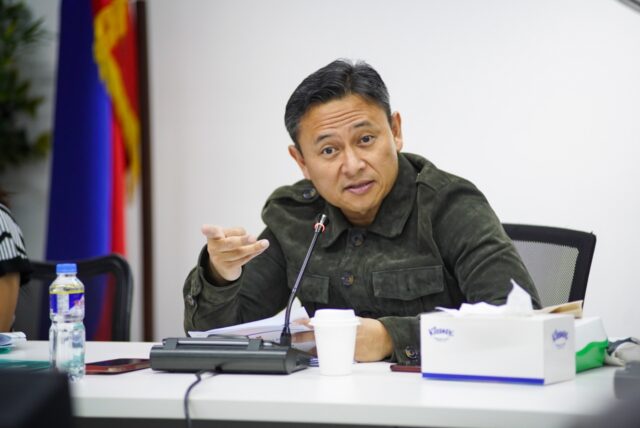
The Department of Education (DepEd) said on Monday that it aims to expand its school-based mental health and anti-bullying program by involving parents in strengthening learners’ well-being and protection.

“As a parent myself, I know how heavy the responsibility of caring for and guiding a child can be,” Education Secretary Juan Edgardo “Sonny” M. Angara said in Filipino in a statement.

“When families and schools work together in shaping values and creating a better understanding of what children are going through, learners are better supported, and the work of teachers becomes lighter,” he added.

The Kaagapay program, which aims to align the values taught in schools with parental upbringing, will be implemented through parent engagement sessions and advocacy campaigns.

“The sessions are structured to help parents situate their role within DepEd’s curriculum and learner development priorities before moving into learning discussions on socio-emotional and values support, positive discipline, bullying awareness, and home–school–community partnership,” the DepEd said.

Although participation is voluntary, the agency underscored that all parents and caregivers of public school students are encouraged to participate in the sessions to prevent stigma and ensure proper representation of different family structures and socioeconomic backgrounds.

Sessions may be conducted face-to-face, modular, and asynchronous to cater to parents’ different schedules and circumstances.

The DepEd added that the rollout of the Kaagapay program, which has a P100 million budget allocation, complements the P2.9-billion allocation for the School-Based Mental Health Program, which includes suicide prevention in schools.

In 2025, several school-based violence were reported, prompting the government to strengthen mechanisms for reporting and addressing incidents involving child abuse, bullying, violence, exploitation, discrimination plus gang-related activities on campus.

A lawmaker has also pushed for the designation of mental health counselors in all public schools, including state universities and colleges, to reverse the “disturbingly increasing rates” of depression, anxiety, and even self-harm or suicidal ideation among young Filipinos.

Under House Bill 163, or “Mental Health and Digital Wellbeing for Youth Act of 2025” by Camarines Sur 2nd district Rep. Vincenzo Renato Luigi R. Villafuerte, it mandates annual mental health screenings, the establishment of safe spaces for emotional processing, and training programs for teachers in trauma-informed and empathy-based approaches.— Almira Louise S. Martinez

German Foreign Minister Wadephul says NATO allies must work together

A German national flag flies atop the illuminated Reichstag building in Berlin, Germany. — REUTERS

WASHINGTON — German Foreign Minister Johann Wadephul said on Monday that NATO allies had to work together for security, and said Greenland and Denmark should decide the future of the island, which US President Donald Trump says should belong to the United States.

Mr. Wadephul’s comments, following a meeting with US Secretary of State Marco Rubio, came amid increasing tensions over Washington’s aims toward Greenland, an autonomous region of Denmark which Mr. Trump says is vital for US security.

Mr. Wadephul said his talks with Mr. Rubio had been friendly and intensive and had underlined the importance of the alliance between European countries and the United States.

But he echoed other European politicians in rejecting Mr. Trump’s avowed intention to take control of Greenland, in defiance of his NATO allies.

“We will only strengthen security in the North Atlantic when we work together, in solidarity and united,” he told reporters. “So with regard to the issues that concern Greenland and Denmark, it is up to Greenland and Denmark to decide and it is up to people in Greenland to decide.”

The standoff over Greenland has fueled deepening fears in Europe over the future of the NATO alliance, which Danish Prime Minister Mette Frederiksen said would be finished if the United States seized the island.

Mr. Wadephul said he and Mr. Rubio had agreed on the importance of the alliance in efforts to secure a lasting peace in Ukraine and said both were committed to so-called Article 5 provisions in the NATO treaty that commit member states to come to the defense of a member state under attack.

“And in this period of uncertainty and crises, this is of decisive importance. It is a clear signal to Russia that it should not try to threaten the NATO alliance,” he said.— Reuters

Venezuela says 116 prisoners released, rights groups cite much lower figures

A person holds a Venezuelan flag as government supporters gather after US President Donald Trump said the US has struck Venezuela and captured its President Nicolas Maduro, in Caracas, Venezuela, January 3, 2026. — REUTERS/GABY ORAA

VENEZUELA’S government said on Monday that 116 prisoners have so far been released as part of process announced last week, though rights groups reported a lower figure as family members of the detained awaited liberations, with some sleeping outside prisons.

By late afternoon on Monday, Unidad Venezuela, a group of opposition parties, said just 65 people had been freed so far, urging the Venezuelan government in a post on X to “speed up the release process so that the suffering of political prisoners and their families can finally come to an end.”

Legal advocacy group Foro Penal had a count of just 49.

The government figure, published by the Penitentiary Services Ministry, followed three days of reports from rights organizations about delays in releases. The ministry said those being freed had been involved in “acts associated with disrupting the constitutional order and undermining the stability of the nation.”

Supporters and family members have spent the weekend gathering at detention centers throughout the capital Caracas, where they also held candlelit vigils and some stayed overnight on mattresses outside, hoping to see their loved ones set free.

“I have visited several detention centers and the answer is always the same: he is not here. A long time has passed, and I have no proof of life. I demand proof of life because I need to know how my husband is. It’s been more than a year without hearing my husband’s voice,” said Mariana Gonzalez de Tudares, the daughter of the opposition’s former presidential candidate Edmundo Gonzalez. Her husband Rafael Tudares was detained in January 2025 while driving his two young children to school.

The dripfeed of releases comes after a week of political turmoil in Caracas following the capture of President Nicolas Maduro by the United States, and his appearance in a New York court on drug trafficking charges.

The release of hundreds of political prisoners in the South American country is a long-running demand of human rights groups, international bodies and opposition figures.

Opposition leader and Nobel Peace Prize winner Maria Corina Machado, who is due to meet with US President Donald Trump this Thursday and several of whose close allies are detained, has been one of the main voices calling for releases.

Ms. Machado visited the Vatican on Monday, where she met Pope Leo and asked him to intercede for all Venezuelans who “remain kidnapped and disappeared.”

The head of Venezuela’s National Assembly, Jorge Rodriguez, had said on Thursday that a significant number of prisoners, both foreign and Venezuelan, would be released, though the government has not given a total.

According to Foro Penal, at least 800 people were being held as political prisoners at the beginning of the year in Venezuela. The government denies that there are detainees held for political reasons.— Reuters

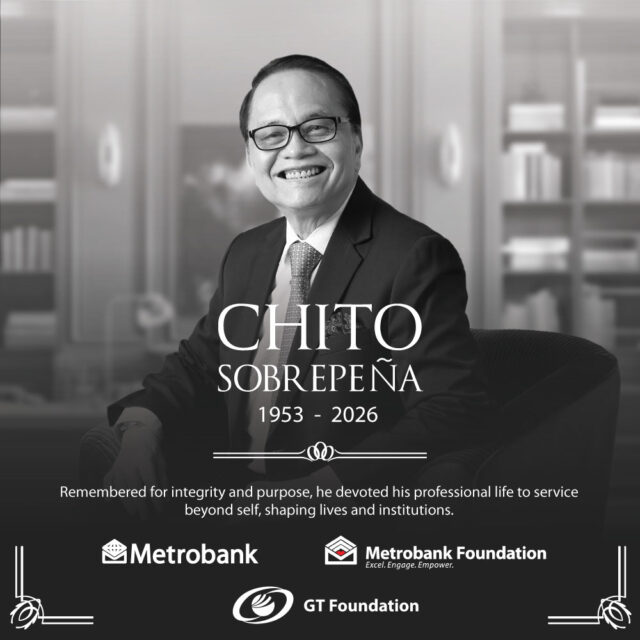
Chito Sobrepeña, public servant and former Metrobank Foundation head, dies at 72

Photo credit | Metropolitan Bank & Trust Co. and Metrobank Foundation, Inc.

ANICETO “Chito” M. Sobrepeña, a former Cabinet Secretary who was also a long-time president of Metrobank Foundation, Inc. (MBFI), the corporate social responsibility arm of Metropolitan Bank & Trust Co., has died at the age of 72.

Mr. Sobrepeña was a civic leader and public servant who held various government posts before he moved to the private sector, serving as a Cabinet Secretary during the term of former President Corazon C. Aquino and as Deputy Director-General of the National Economic and Development Authority (now the Department of Economy, Planning, and Development) under former President Fidel V. Ramos.

Following his over 20-year stint in government, he transitioned to the private sector in the mid-1990s to lead MBFI for 30 years before he retired in 2025.

“A titan in corporate social responsibility, Mr. Sobrepeña dedicated his life to the pursuit of the common good. From his years in public service, including key leadership roles in the government, to his long and distinguished tenure as President of Metrobank Foundation, he exemplified integrity, compassion, and principled leadership,” Metrobank and MBFI said in a joint statement on Tuesday.

“In his three decades leading the Metrobank Foundation, he set new standards for corporate social responsibility. MBFI’s programs expanded meaningfully across excellence recognition, education, health, the arts, and livelihood, creating enduring hope and opportunity for Filipinos from all walks of life.”

They said Mr. Sobrepeña’s career was defined by his commitment to service, community development, and excellence with purpose, in line with the cornerstone Jesuit philosophy of being men and women for others.

“Metrobank and the Metrobank Foundation extend our deepest sympathies to his family, loved ones, colleagues, and the many individuals whose lives he touched. We honor his legacy by continuing the work he so passionately advanced, service that uplifts, empowers, and creates enduring positive change,” they said.

“Mr. Sobrepeña will be remembered not only for what he led, but for how he led — with wisdom, empathy, and unwavering commitment to the greater good.”

Trump administration probe of Fed’s Powell sparks pushback

Fed Chairman Jerome Powell — FEDERAL RESERVE

The Trump administration’s decision to open a criminal investigation into Fed Chair Jerome Powell drew condemnation from former Fed chiefs and a chorus of criticism from key members of Trump’s Republican Party on Monday, following an unusually sharp public rebuke from Powell calling the move a “pretext” to win presidential influence over interest rates.

The investigation, revealed late on Sunday when Powell said the Fed had received subpoenas from the US Justice Department, was approved and started by Jeanine Pirro, the US Attorney in Washington and an ally of President Donald Trump, according to two sources with knowledge of the investigation.

Neither Attorney General Pam Bondi nor Deputy Attorney General Todd Blanche was briefed about the decision to subpoena the Fed last week, one of the sources added.

The threat of indictment, ostensibly focused on comments Powell made to Congress about a building renovation project, sent rates on longer-term US Treasury bonds up, as investors parsed what a less independent Fed could mean for inflation and monetary policy.

If amplified, such a market reaction could constrain Trump’s efforts to reshape the Fed, considered the most influential central bank in the world and a cornerstone of the world financial system. A rise in long-term borrowing costs could also backfire against Trump’s efforts to address broad concerns about “affordability.”

The independence of central banks, at least in setting rates in order to control inflation, is considered a central tenet of robust economic policy, insulating monetary policymakers from short-term political considerations and allowing them to focus on longer-term efforts to keep prices relatively stable.

On Monday, former Fed chairs Janet Yellen, Ben Bernanke and Alan Greenspan joined with former government economic policy leaders from both political parties in raising the alarm.

“This is how monetary policy is made in emerging markets with weak institutions, with highly negative consequences for inflation and the functioning of their economies more broadly,” they wrote. Global central bankers including the chiefs of the French and Canadian central banks publicly offered solidarity.

US Republican Senator Thom Tillis, a member of the Senate Banking Committee that vets presidential nominees for the Fed, called the move a “huge mistake” on Sunday and said he would oppose any Trump nominees to the Fed, including whoever is named to succeed Powell as central bank chief, “until this legal matter is fully resolved.”

He was joined on Monday in condemning the development by fellow Banking Committee member Kevin Cramer and Senator Lisa Murkowski, who wrote on X that “the stakes are too high to look the other way: if the Federal Reserve loses its independence, the stability of our markets and the broader economy will suffer.”

Senator Cynthia Lummis, one of Powell’s more strident critics usually, on Monday said the Justice Department’s use of a criminal statute looked like a “heavy lift” and that she did not see any criminal intent.

“We need this like we need a hole in the head,” quipped Senator John Kennedy, also on the banking committee.

Treasury Secretary Scott Bessent told Trump on Sunday that the investigation “made a mess” and could be bad for financial markets, Axios reported on Monday, citing two sources.

The rise in longer-term rates notwithstanding, market reaction was relatively muted. Gold hit a record high and the dollar fell. Major US stock indexes notched record closing highs after gains from artificial intelligence stocks and Walmart.

“The market looks to be taking substantial reassurance from the fact that Powell’s decision to call out the attack on Fed independence has triggered a backlash in the Senate that will be reinforced by public support from former Fed chairs and Treasury Secretaries,” wrote Evercore ISI’s Krishna Guha.

Powell – who was nominated by Trump to lead the Fed in late 2017 and confirmed by the Senate to the position in early 2018 – will complete his term as Fed chief in May, but he is not obligated to leave its Washington-based Board of Governors until 2028. A number of analysts saw the latest move by the administration as adding to the chances that he will defiantly remain at the central bank.

The criminal indictment threat emerged about two weeks before Trump’s effort to fire another Fed official, Governor Lisa Cook, will be argued before the Supreme Court.

Until now Powell had avoided public disagreement with the Trump administration, Republican lawmakers had been largely silent and investors had been warily watching as the sparring match between the White House and the Fed played out during Trump’s second term.

Powell’s pointed response and signs of congressional pushback appear to open a new and more highly charged chapter in that row, even as House Speaker Mike Johnson told reporters he’d let the process “play out.”

‘THREATS AND ONGOING PRESSURE’

The subpoenas from the US Justice Department last week pertained to remarks Powell made to Congress last summer over cost overruns for a $2.5 billion building renovation project at the Fed’s headquarters complex in Washington, and threatened a criminal indictment.

“I have deep respect for the rule of law and for accountability in our democracy. No one – certainly not the chair of the Federal Reserve – is above the law,” Powell said.

“But this unprecedented action should be seen in the broader context of the administration’s threats and ongoing pressure” for lower interest rates and more broadly for greater say over the Fed, he said.

“This new threat is not about my testimony last June or about the renovation of the Federal Reserve buildings. It is not about Congress’ oversight role … Those are pretexts. The threat of criminal charges is a consequence of the Federal Reserve setting interest rates based on our best assessment of what will serve the public, rather than following the preferences of the President.”

Trump told NBC News Sunday that he had no knowledge of the Justice Department’s actions. “I don’t know anything about it, but he’s certainly not very good at the Fed, and he’s not very good at building buildings,” Trump said.

A Justice Department spokesperson declined to comment on the case but added: “The Attorney General has instructed her US Attorneys to prioritize investigating any abuse of taxpayer dollars.” — Reuters

Wage hike for domestic workers eyed

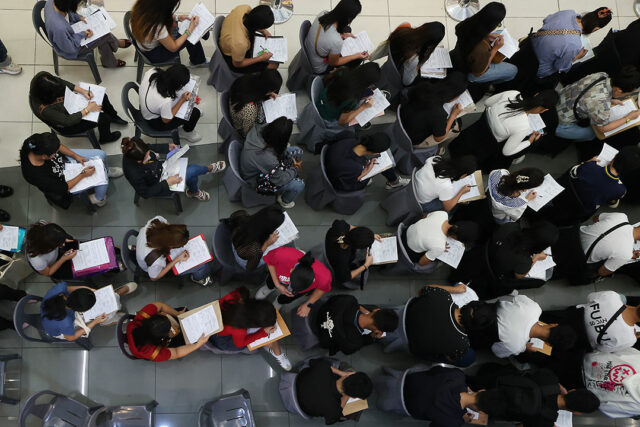
Jobseekers are lined up at a job fair in Antipolo, Rizal, June 12, 2025. — PHILIPPINE STAR/MIGUEL DE GUZMAN

By Erika Mae P. Sinaking

PHILIPPINE WAGE regulators opened talks on a possible increase in the minimum pay for domestic workers in Metro Manila, a move that could raise household costs for millions of families even as authorities grapple with weak compliance and uneven ability to pay.

The Regional Tripartite Wages and Productivity Board-National Capital Region on Monday held a public hearing on adjusting the minimum wage for a kasambahay (domestic worker), marking the start of deliberations that could result in a decision after Jan. 15, according to the board chairperson Sarah Buena S. Mirasol.

“We are hopeful that there will also be an increase for domestic workers, following last year’s adjustment for formal sector workers,” she told BusinessWorld.

Ms. Mirasol said the hearing in Pasay City gathered views from local governments, labor groups, employer representatives, and domestic workers themselves.

Ms. Mirasol said the board is weighing several factors, including cost of living, inflation, prevailing wages, and employers’ capacity to pay. Unlike the formal sector, household employers are largely workers themselves rather than businesses, she added.

Data presented during the hearing indicated that the average wage of domestic workers in Metro Manila is around P9,000 a month, above the current minimum of P7,000. This was set by the last minimum wage order effective Jan. 4, 2025.

“That already reflects the prevailing wage in NCR,” she said.

The board is also seeing a shift toward part-time and live-out arrangements for domestic workers, Ms. Mirasol added.

The board is currently relying on the Philippine Statistics Authority’s Labor Force Survey, while awaiting the release of a more detailed results from the rider questions on kasambahays. The results are expected later this year.

Employer representative Federico R. Marquez, Jr. said any wage hike for domestic helpers would be felt most by middle- and low-income households.

“Those earning below P50,000 a month are the ones who will really feel the increase,” he said, noting that “elite-income” households already pay above the minimum.

“For those in the top group, such as families living in gated subdivisions, the increases are negligible. In fact, the current P7,000 minimum wage is almost nothing for them. Most already pay P10,000 to P11,000 for their kasambahays. They can easily afford this,” Mr. Marquez said.

“But for employees… earning less than P50,000 — the increase is substantial. These are the households that will truly feel the impact of a wage hike for a kasambahay,” he added.

Mr. Marquez stressed the need to balance affordability with worker welfare, warning that steep increases could lead some households to forgo hiring domestic help or to circumvent the law.

He also expressed concern about weak compliance, particularly the lack of written employment contracts, which are mandatory under the Kasambahay Law (Republic Act No. 10361), also known as the Domestic Workers Act.

The law establishes comprehensive labor rights and protections for domestic workers, including a written contract, minimum wage, humane working conditions, and social security benefits.

Labor groups, meanwhile, pushed for a meaningful adjustment and stronger enforcement.

Helena Simplina, project officer of the Federation of Free Workers, said the hearing highlighted persistent noncompliance, citing cases of domestic workers earning as low as P2,000 a month.

“There are still employers who do not comply with the minimum wage and registration requirements,” she said, adding that many households remain unregistered with barangays, contributing to data gaps.

Labor sector representative Angelita D. Señorin said workers are expecting a “good increase,” noting that most domestic workers in Metro Manila already refuse jobs paying only the minimum wage.

“No one is really accepting P7,000 anymore,” she said.

Rizal Commercial Banking Corp. Chief Economist Michael L. Ricafort told BusinessWorld that cost of living and inflation, which vary by region, “are key inputs in wage decisions.”

According to the PSA, full-year NCR inflation averaged 2.4% in 2025, down from 2.6% in 2024, driven by slower food price growth, though higher housing and utility costs exerted upward pressure.

“(The wage) may look low but many of them are stay in. Free or subsidized rent, food, utilities, among others, but mostly free,” Mr. Ricafort added.

Benjamin B. Velasco, an assistant professor at the University of the Philippines Diliman School of Labor and Industrial Relations, said domestic workers deserve higher wages.

“Definitely kasambahays deserve a raise. It’s been a year since they had a wage hike,” he told BusinessWorld in a Facebook Messenger chat.

While the law mandates 10-point criteria for wage adjustments, in practice it boils down to the cost of living and the capacity of employers to pay, Mr. Velasco said.

“In the case of kasambahays, their employers are the rich, the middle class and the small number of higher paid workers in which both parents are most probably working so they need a househelp for domestic and care work,” Mr. Velasco said. “Given the sustained economic growth, I believe they have the capacity to pay kasambahays a higher salary.”

Mr. Velasco said given the option to work abroad and the high cost of living, the reservation wage — the rate at which a kasambahays is willing to work — has gone up.

Meralco rates go down in January

Manila Electric Co. (Meralco) announced that electricity rates will fall by P0.16 per kilowatt-hour in January. — PHILIPPINE STAR/RYAN BALDEMOR

OVER EIGHT MILLION customers of Manila Electric Co. (Meralco) will see lower electricity bills this month as the power distributor announced a rate cut on Monday.

The overall electricity rate declined by P0.1637 per kilowatt-hour (kWh) to P12.9508 per kWh in January from P13.1145 per kWh in December, the company said in a statement.

Residential households consuming 200 kWh will see their monthly electricity bills go down by P33. Customers using 300 kWh, 400 kWh, and 500 kWh will see reductions of P49, P65, and P82, respectively.

Meralco Vice-President and Head of Corporate Communications Joe R. Zaldarriaga said the decline in power rates was driven by the lower transmission charge.

“While there were upward pressures on certain cost components this January, the overall electricity bill still went down for the second consecutive month. We hope this will help our customers, especially at the start of the new year,” Mr. Zaldarriaga said in Filipino during a briefing.

The residential transmission rate dropped by P0.10 per kWh to P1.0368 per kWh mainly due to lower ancillary service charges incurred by the National Grid Corp. of the Philippines from its bilateral contracts and the reserve market.

Contributing to the downward adjustment was the lower generation charge, which declined by P0.0171 per kWh to P7.7471 per kWh due to lower costs from the Wholesale Electricity Spot Market (WESM) and power supply agreements (PSAs).

Charges from WESM fell by P1.1898 per kWh as the supply situation in the Luzon grid improved. PSA charges likewise declined by P0.0516 per kWh as a coal plant in Quezon province returned to operations.

Meanwhile, the cost of electricity charged by independent power producers (IPPs) increased due to higher fixed fees from a major gas plant, as well as the peso depreciation, affecting their costs that are mostly dollar denominated.

The peso closed at P58.79 per dollar on Dec. 29, weakening by P0.145 from its P58.645 finish on Nov. 28.

WESM, PSAs, and IPPs accounted for 7%, 71%, and 22%, respectively, of Meralco’s total energy requirement for the period.

Taxes and other charges slipped by P0.0837 per kWh, further pulling down the overall rate.

The lower charges cushioned the increase arising from the implementation of the green energy auction allowance equivalent to P0.0371 per kWh, in accordance with the directive of the Energy Regulatory Commission.

The amount is charged to all on-grid electricity end-users to fund the incentives of new renewable energy projects under the government’s green energy auctions.

“Pass-through charges for generation and transmission are paid to the power suppliers and the grid operator, respectively, while taxes, universal charges, and renewable energy subsidies are all remitted to the government,” Meralco said.

Meralco’s distribution charge has not been adjusted since the P0.0360 per kWh reduction in August 2022.

SUMMER FORECAST
With the anticipation of higher demand during the summer months, Mr. Zaldarriaga assured consumers that there will be adequate power supply.

“We have always ensured that we have adequate capacity in coming into our system to make sure that we will be able to supply efficient, reliable, and adequate electricity to all our customers,” he said.

On the distribution side, Meralco First Vice-President and Head of Networks Froilan J. Savet said the company is implementing proactive and preventive maintenance of its facilities.

“We continue to implement our capex (capital expenditure) projects, including the installation of additional lines and the construction of substations, to ensure we provide reliable and quality service to our customers,” Mr. Savet said in Filipino.

Meralco also warned against theft of electrical facilities, including power cables, following a recent attempt in Quezon City that resulted in a temporary disruption of electricity service to nearly 8,000 customers.

In 2025 alone, the power distributor reported 285 theft incidents of electrical facilities, including power cables. Most of these resulted in service interruptions while four resulted in physical injuries.

“Beyond the inconvenience caused by service interruptions, these acts pose life-threatening risks due to the high voltage of Meralco facilities. Any contact with energized facilities can lead to electric shock, severe injuries, or even death,” Mr. Savet said.

Meralco’s controlling stakeholder, Beacon Electric Asset Holdings, Inc., is partly owned by PLDT Inc. Hastings Holdings, Inc., a unit of PLDT Beneficial Trust Fund subsidiary MediaQuest Holdings, Inc., has an interest in BusinessWorld through the Philippine Star Group, which it controls. — Sheldeen Joy Talavera

Tiis ganda no more?’ Filipinos’ digital patience may wane over time

A laptop screen shows an interaction with an AI chatbot. — REUTERS

By Beatriz Marie D. Cruz, Reporter

FILIPINOS have the second-highest level of digital patience among seven Asia-Pacific countries, but this could shorten over time as more brands compete in the digital space, according to US-based customer engagement platform Twilio.

About 76% of Filipinos consider themselves patient when dealing with online or automated customer service, Twilio said in its “Decoding Digital Patience: The Philippines spotlight” report.

Filipinos’ level of digital patience is the second highest among seven countries in the Asia-Pacific and Japan (APJ), only behind Indonesia (85%). It is also well above the APJ average of 68%.

Customers in Japan (65%), India (65%), Australia (64%), Hong Kong (60%), and Singapore (59%) are more impatient online, Twilio said.

“The digital world has really redrawn the boundaries when it comes to something like waiting, and I think that’s going to increasingly put pressure on brands to compete for users’ attention,” Nicholas Kontopoulos, vice-president of marketing, Asia-Pacific & Japan at Twilio, told BusinessWorld in a video interview last week.

“We’ll likely continue to see improvements being delivered by brands as a consequence of Filipinos’ patience level maybe decreasing.”

Digital patience, which refers to a user’s willingness to deal with brands online, is expected to be the “new currency” of customer experience, Twilio said.

It attributed the high level of digital patience to the Filipino phrase “tiis ganda,” or a user’s willingness to “endure discomfort for a worthwhile outcome.”

According to the report, Filipinos were more willing to accept delays for better security (68%) and customer support (62%) than their regional counterparts.

“What sets Filipino consumers apart is their exceptional patience across every channel. This goodwill even extends to the automated services that typically frustrate consumers elsewhere,” Twilio said.

It noted that 72% of Filipinos are tolerant of artificial intelligence (AI)-powered chatbots and 70% remain patient with automated phone menus.

However, Mr. Kontopoulos also noted that the Philippines’ digital-savvy consumer base could become more impatient with online customer support over time.

“We are living in an on-demand world, and every second of delay can ultimately impact consumer loyalty and revenue,” he said.

When dealing with digital or automated channels, Filipino users seek warmth, friendliness, and a sense of progress, Twilio said.

About 50% of Filipinos also value easy-to-follow instructions, as well as data security (41%), response time (41%), friendliness (37%) — all more than their regional peers, it added.

Filipino users are also self-reliant problem seekers, Twilio said, with 43% seeking their own answers when digital customer services fall short. Meanwhile, 35% said they would switch to a different channel, while 26% would complain or leave a negative review.

Twilio also noted that Filipino users are willing to wait for an average of 27 minutes for a resolution, given that brands ensure transparency and security in the process.

“They will wait if the friction feels necessary for the outcome that they are striving to achieve,” Mr. Kontopoulos said at a briefing on Friday.

Philippine Airlines (PAL) Vice-President for Customer Experience Mark Anthony C. Munsayac said Filipinos’ longer digital patience could be due to the relatively lack of exposure to more advanced technologies online.

“It’s also possible that [Filipinos’] lack of exposure on other global processes can influence lower expectations, and we want to elevate those standards,” he told the briefing.

PAL, which also uses Twilio, is looking to deploy a customer engagement tool by the latter half of the year to help manage customer data and personalize user engagement, Mr. Munsayac said.

‘CONDITIONAL’ PATIENCE
In a “high-stakes interaction,” Filipino users are most patient when using a health platform (81%), followed by travel (76%), retail and electronic commerce (73%), technology and telecommunications (72%), and finance and insurance (68%).

While 61% of Filipinos are comfortable in using agentic AI in customer service, users want AI to respond in human-like, tailored, and genuinely helpful ways, it said.

Filipino users also want to know if they are talking to an AI agent (68%), while 37% expect human-like interactions, Twilio added.

“If you are fast but cold, you are still failing in their eyes. Customers aren’t just demanding speed, they want proactive updates,” Mr. Kontopoulos said.

It also noted that users expect AI to provide 24/7 availability and faster responses, but 34% want an option to speak to a human agent if AI cannot solve the issue.

They are more frustrated when AI-powered systems provide scripted or robotic answers (46%), limited or generic responses (44%), or immediate solutions to issues (41%).

The report also said Filipinos are among the most cautious in the region when letting AI agents handle sensitive tasks in banking (55%), healthcare (46%), and legal or government services (45%).

To transform Filipinos’ trust to consumer loyalty, brands must offer clarity, continuity, choice, and care when providing digital customer services online, Twilio said.

“The Filipino consumer extends goodwill and patience, but this is not a free pass. Filipinos welcome automation only when it genuinely reduces effort and maintains the safety net of human support,” it said.

Twilio commissioned marketing research firm YouGov to conduct the study. It surveyed around 7,331 users in the APJ region including 1,007 Filipinos from Aug. 28 to Sept. 4, 2025.

Telco landscape to see major shifts, investment growth — analysts

PHILIPPINE STAR/MICHAEL VARCAS

By Ashley Erika O. Jose, Reporter

PHILIPPINE telecommunications companies (telcos) are preparing for major shifts in the telco landscape, including margin pressure and evolving business strategies, as the Konektadong Pinoy Act reshapes competition, according to analysts.

“The entry of new participants and a more intense competitive market dynamic could temper the margins and growth prospects of the current major players,” China Bank Capital Corp. Managing Director Juan Paolo E. Colet said in a Viber message.

However, he noted that incumbent operators retain advantages that could help cushion the impact of heightened competition.

“Industry leaders can leverage their position as incumbent operators to drive expansion and profitability, including brand equity, deep local market knowledge, and financial resources,” he said, adding that some players also have room to improve operational efficiency.

The Konektadong Pinoy Act, also known as the Open Access in Data Transmission Act, lapsed into law on Aug. 24, while its implementing rules and regulations (IRR) were signed on Nov. 5. The law removed the requirement for a legislative franchise for data transmission players, easing market entry, and promoting infrastructure sharing.

John Paolo R. Rivera, a senior research fellow at the Philippine Institute for Development Studies, said the law is poised to significantly alter the competitive landscape.

“As a ‘gamechanger’ law, I expect it to spur fresh investment in the country’s digital and connectivity sector by removing the need for a legislative franchise and easing entry barriers for data-transmission players, thus opening the market to more competition,” he said.

He added that mandated infrastructure sharing could lower costs and encourage network expansion.

“By mandating infrastructure sharing and focusing on unserved and underserved areas, it reduces costs and encourages both domestic and foreign investors to expand broadband, fiber, and satellite networks,” he said.

Information and Communications Technology Secretary Henry Rhoel R. Aguda said several foreign players have already expressed interest in entering the Philippine market.

“So far, seven foreign data transmission industry participants have already signified their interests in entering the telecom industry,” Mr. Aguda said, noting that each is expected to invest about $1.5 billion.

Under the IRR, data transmission industry participants (DTIPs) will be allowed to construct, install, establish, maintain, lease, or own networks and facilities without a legislative franchise, while also promoting asset sharing between incumbents and new entrants.

The Department of Information and Communications Technology (DICT) will serve as the primary policy and coordinating body for the law’s implementation, Mr. Aguda said, adding that the agency will also issue guidelines on cybersecurity standards aligned with each DTIP’s risk profile.

“The State shall promote data transmission infrastructure sharing and co-location to eliminate the uneconomic duplication of these facilities in the data transmission industry,” according to the IRR.

INCUMBENT CONCERNS
PLDT Inc. Chairman Manuel V. Pangilinan said the law’s implementing rules unfairly disadvantage existing operators.

“I think [Konektadong Pinoy] has added to our concerns. Eventually, what does the bill and the IRR hope to accomplish?” he said.

He criticized provisions requiring incumbents to share infrastructure with new entrants. “They are going to use our infrastructure, and their claim is that the existing infrastructure is inadequate. Yet they are going to use inadequate infrastructure. How does that improve the service?” he said.

PLDT Chief Legal Counsel Joan de Venecia-Fabul said the company is studying its options. “We are not yet in a position to say what legal remedies, but we are actively studying all [options] because ultimately we want to support the goal of the President, especially for greater connectivity,” she said.

Meanwhile, Converge Information and Communications Technology Solutions, Inc. views the law as a catalyst for expanding its wholesale business.

“The Konektadong Pinoy Law is helping competition deepen, which opens opportunities for faster rollout to communities,” Converge Chief Executive Officer Dennis Anthony H. Uy said.

He said infrastructure sharing could reduce capital expenditures (capex) for new operators while supporting Converge’s expansion.

“Infrastructure doesn’t come overnight, which is why we are ready for Konektadong Pinoy’s infrastructure sharing provisions for both backbone and distribution networks,” Mr. Uy said.

“In other countries, infrastructure sharing has proven to be beneficial because it reduces capex for new operators. It’s a win-win situation for us, and we are ready for Konektadong Pinoy implementation,” he added.

Globe Telecom, Inc. said it is continuing to innovate as competition intensifies.

“I think the DNA of Globe is about innovation and innovation actually addresses the pain points of the customers,” Globe Chief Commercial Officer Darius R. Delgado said.

“In the prepaid or fiber space, we would just continue the formula that works. We will continue developing things for them, then the demand will come,” he added.

DITO Telecommunity Corp. expressed support for the law’s objectives, particularly expanding access in far-flung areas.

“When you look at the noble objectives of the [Konektadong Pinoy], we are fully supportive of that,” said DITO Telecommunity President and Chief Executive Officer Ernesto R. Alberto.

“Who does not want to democratize access to the internet, broadband to a wider base?” he added.

DITO Chief Revenue Officer Adel A. Tamano said regulations should remain flexible for new entrants.

“New players should not be subjected to the same level of requirements currently imposed on incumbent operators,” he said.

REGULATORY AND MARKET IMPACT
For Samuel V. Jacoba, founding president of the National Association of Data Protection Officers of the Philippines, the IRR strikes a balance by imposing cybersecurity requirements.

“Within two years from registration or authorization, DTIPs shall secure a cybersecurity certification or cybersecurity compliance from the DICT Cybersecurity Bureau,” the IRR said.

Mr. Jacoba said the timeline is reasonable.

“Two years will be enough time for new operators to establish baseline cybersecurity compliance anchored on global standards,” he said, adding that incumbents should already meet such requirements.

Digital Pinoys national campaigner Ronald B. Gustilo said the law could broaden the market base.

“When more Filipinos gain reliable access to the internet, the demand for digital services, e-commerce, and financial technology naturally rises,” he said.

“This creates a multiplier effect across industries,” he added.

Mr. Aguda said the DICT expects internet prices to decline and service quality to improve as competition increases.

“We do anticipate increased investment in the connectivity sector as a result of the Konektadong Pinoy law. It provides predictability and policy direction — two major factors that investors look into before committing capital,” he said.

The law offers tax incentives, including income tax holidays and value-added tax exemptions. Tower companies’ operating licenses have been extended to 15 years from five years at no additional cost.

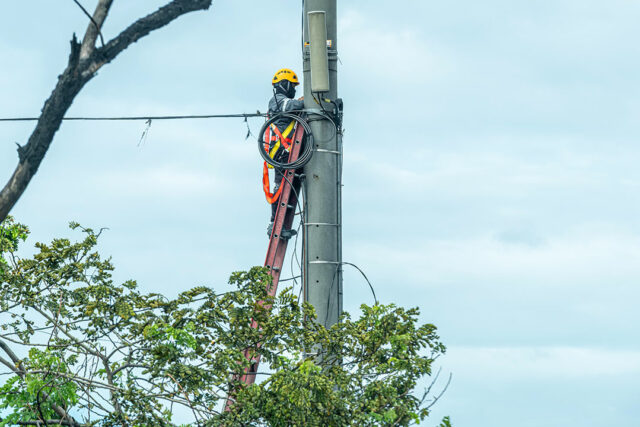
DICT, in partnership with the Australian government, has completed a real-time mapping of all fiber optic lines nationwide, which will guide efforts to expand connectivity to 100% of households.

Lower internet prices and improved service quality are expected as new players enter the market, especially in underserved and far-flung areas.

Despite being a national priority since 2022, the Philippines’ digital transformation has lagged due to weak broadband infrastructure and restrictive policies, according to a July World Bank report. Only 28% of households had fixed broadband access in 2023, while the country had more than half of Southeast Asia’s unconnected mobile broadband users.


Megaworld earmarks P8B for Negros township

Megaworld President and Chief Executive Officer Lourdes Gutierrez-Alfonso — MREIT.COM.PH

LISTED property developer Megaworld Corp. has allocated P8 billion to develop a 97-hectare (ha) township in Negros Occidental, banking on continued growth in the Visayas.

The project, called The Sugartown, is the company’s 37th township in the Philippines and its seventh estate in the Visayas, Megaworld said in a stock exchange disclosure on Monday.

The township will be located in Talisay City, Negros Occidental, with development expected to be completed over seven to 10 years.

The property is Megaworld’s third mixed-use development in the Negros Island Region, following the 53-ha Northill Gateway and the 34-ha township The Upper East.

The Sugartown will feature premium residential developments under Megaworld and its wholly owned subsidiary Suntrust Properties, Inc., as well as a town center, commercial district, and tourism-related facilities.

Megaworld President and Chief Executive Officer Lourdes Gutierrez-Alfonso said the township aims to attract tourists, visitors, and local residents, citing its proximity to the Bacolod-Silay Airport Road.

“Our vision for this new township in Negros Occidental is to provide new opportunities to help boost tourism in the province,” she said.

The site will be less than five minutes from Talisay City Hall and about 15 minutes from the Bacolod City Government Center.

Megaworld’s expansion in Negros Occidental reflects its confidence in the region’s growth, Alliance Global Group, Inc. President and Chief Executive Officer Kevin L. Tan said.

“With the Negros Island Region already in place, the future of this province is bright and we have seen the rise of mixed-use developments not just in the capital but also in other towns and cities,” he said.

The Negros Island Region’s economy grew by 5.9% in 2024, faster than the national average of 5.7%, according to data from the Philippine Statistics Authority.

Megaworld reported a 1.16% increase in third-quarter attributable net income to P5.23 billion, driven by the strong performance of its hotel and residential segments.

On Monday, Megaworld Corp. shares rose by 1.85% or four centavos to close at P2.20 apiece. — Beatriz Marie D. Cruz

GCash rolls out in-app OTPs to curb fraud

PHILSTAR FILE PHOTO

ELECTRONIC wallet platform GCash has launched in-app one-time passwords (OTPs) to strengthen account security against phishing, scams, and fraud.

“Our upgrade to In-App OTPs is a strategic move to put an end to phishable SMS OTPs. We will shift users to instant, GCash app-verified authentication, to increase the security of their daily transactions,” GCash Chief Information Security Officer Miguel Geronilla said in a media release on Monday.

By the first quarter, users will receive OTPs directly through secure push notifications within the GCash application, instead of via text messages, the company said.

GCash said SMS-based OTPs have been a frequent target of scammers seeking unauthorized access to user accounts, adding that in-app OTPs are designed to address these vulnerabilities.

“By sending OTP requests directly to the user’s authenticated GCash app, GCash ensures that only the intended users can receive and use the unique OTPs, protecting them from unauthorized access,” the company said.

GCash also said the new system allows one-tap authentication, eliminating the need for users to switch applications or wait for OTPs delivered through text messages.

“In-App OTPs reflect commitment of GCash to providing secure, seamless financial services for its millions of users and set a new benchmark for digital finance security in the Philippines,” it said.

In December, Globe Telecom, Inc. and GCash announced the completion of initial tests for the implementation of a silent authentication system.

A silent authentication system verifies users through a secured network, replacing the need for one-time passwords.

Globe Fintech Innovations, Inc. (Mynt), the operator of GCash, is a partnership among Globe, Ayala Corp., and Ant International, a digital payments, digitization, and financial technology provider.

Last year, Globe and Bank of the Philippine Islands also announced that they are developing a proof of concept for silent network authentication to combat fraud.

The technology verifies a user’s identity by checking whether the mobile number provided matches the SIM card active in the current data session, Globe said, describing it as a powerful layer of defense against phishing and other SIM-based fraud.

At the local bourse on Monday, shares in Globe closed unchanged at P1,620 each. — Ashley Erika O. Jose

ADVERTISEMENT
ADVERTISEMENT