Home Blog Page 4527

‘Barbenheimer’ box office sales keep rolling in second weekend

WARNER BROS.’ Barbie showed no signs of slowing down in its second weekend at the box office, and was set to haul in $93 million in ticket sales Friday through Sunday, according to estimates from media analytics firm Comscore.

Director Greta Gerwig’s take on Barbie – the year’s No. 1 movie by first weekend sales, and the highest-grossing opening weekend for a film directed by a woman – has made more than $351 million in the US and Canada since opening on July 21, and nearly $775 million globally, Comscore reported.

The film, which stars Margot Robbie in the titular role, and Ryan Gosling as Barbie’s iconic beau, Ken, sends Mattel, Inc.’s iconic doll on an adventure into the real world. The toy maker last week posted a surprise second-quarter profit in the wake of the movie’s release, with Chief Executive Officer (CEO) Ynon Kreiz telling analysts the company would expand its Barbie-related toys and products in the second half of 2023.

On Barbie’s heels this weekend was Oppenheimer, director Christopher Nolan’s historical tale of the physicist J. Robert Oppenheimer and the making of the atomic bomb, which made an estimated $46.2 million Friday through Sunday in what Comscore analyst Paul Dergarabedian called a “phenomenal second weekend.”

The two films together have been dubbed “Barbenheimer,” a nod to the relative rarity of two blockbusters opening the same weekend. Their combined sales are “absolutely mind blowing,” Dergarabedian said, with second-weekend numbers that “would have been hailed as opening weekend wins.”

Universal’s Oppenheimer has made $174 million in the US and Canada so far, and $400 million worldwide.

The films have seized American moviegoers’ attention at an uncertain time for Hollywood. The Writers’ Guild of America, a labor union representing writers, has been on strike over pay since May, while SAG-AFTRA — the union for artists and actors, including A-list stars like Robbie — went on strike earlier this month. — Reuters

RCBC completes share sale to Sumitomo Mitsui

PHILSTAR FILE PHOTO

RIZAL COMMERCIAL Banking Corp. (RCBC) has completed its sale of shares to Sumitomo Mitsui Banking Corp. (SMBC) that will raise the latter’s stake in the lender.

RCBC said in a disclosure to the local bourse on Monday that it completed the sale of an additional 15.01% stake to SMBC.

SMBC’s stake in RCBC is now at 20% after it acquired a 4.999% stake in 2021.

The P27-billion capital infusion from the commercial banking arm of Sumitomo Mitsui Financial Group as a result of the transaction will boost its corporate, small and medium enterprises (SME), and retail segments, RCBC said.

“Through this partnership, RCBC will once again set the bar higher, adopting global best practices and customer-centric strategies, promoting disruptive banking solutions, and expediting our digital transformation,” RCBC President and Chief Executive Officer Eugene S. Acevedo said in a statement on Monday.

“Closer collaboration will open more business matching opportunities for RCBC’s local customer base and SMBC’s global network. Through this, RCBC and SMBC shall jointly establish a bridge for Philippine businesses and consumers to connect to international markets and vice-versa,” the bank added.

SMBC is the commercial banking arm of Sumitomo Mitsui Financial Group and is one of the largest banks in the world with a presence in about 40 countries.

Meanwhile, RCBC is the fifth-largest private bank in the country with an asset base of P1.17 trillion as of end-June.

RCBC’s attributable net income surged by 69.92% to P3.638 billion in the first quarter amid an increase in its non-interest earnings.

Its shares climbed by P1.80 or 7.76% to close at P25 each on Monday. — AMCS

Lifting moratorium on NCR ecozones seen to boost IT-BPM job creation

BW FILE PHOTO

LIFTING the moratorium on new economic zones (ecozones) in the National Capital Region (NCR) is expected to attract new Information Technology and Business Process Management (IT-BPM) companies to the Philippines, according Leechiu Property Consultants (LPC).

This as the Philippine Economic Zone Authority (PEZA) earlier said it expects Malacañang to lift the moratorium within the year.

“Opening up applications for new Metro Manila PEZA locations will encourage new tenants and hasten new employment,” LPC said in a statement.

LPC said the move would help the IT and Business Process Association of the Philippines achieve its target of creating 1.1 million jobs by 2028, as well as another 3.3 million in indirect employment.

Issued by then-President Rodrigo R. Duterte in June 2019, Administrative Order (AO) No. 18 declared a moratorium on the approvals of new ecozones in the NCR in order to boost countryside development.

LPC noted the AO No. 18 “created a barrier to entry for new IT-BPM tenants preferring to locate in Metro Manila.”

“IT-BPM companies have been the primary growth driver of Philippine real estate for more than 20 years. New IT-BPM entrants typically open their headquarters in the National Capital Region, which has about 70% to 75% of the industry headcount as of 2021, and only after will be willing to expand to the provinces,” it said.

The Philippines is one of the few countries experiencing net positive absorption in the office sector, LPC said.

“The Philippines will be further boosting this growth by making available another 2.8 million square meters (sq.m.) of office space in the next 10 years; of which, 1.8 million sq.m. will be in Metro Manila. IT-BPM tenants will likely remain as the primary takers of this office space,” it said.

Year to date, office demand has reached 554,000 sq.m., with LPC projecting another 500,000 sq.m. demand for the second half.

“While office absorption is moving towards pre-pandemic levels, the lifting of the moratorium will bolster further growth benefiting projects in Metro Manila, as well as in the provinces,” LPC said.

Debt service, sustained growth, and the PDE alumni homecoming

During the post-State of the Nation Address (post-SONA) Philippine Economic Briefing (PEB) last week, July 25, at the Philippine International Convention Center, Finance Secretary Benjamin Diokno expressed continued optimism saying that “Higher economic activity and increased investments will bring us to even greater heights. The policy environment for foreign direct investments is the most open and liberal it has ever been.”

On the Maharlika Investment Fund (MIF), Secretary Diokno said “the MIF is expected to widen the fiscal space and reduce reliance on official development assistance (ODA) in funding big-ticket infrastructure projects.” Right on, Sir.

Budget Secretary Amenah Pangandaman was not there as she was presenting the National Expenditure Program (NEP) to President Marcos Jr. that will be submitted to Congress. Then the President flew to Kuala Lumpur for a state visit.

Budget Undersecretary Joselito Basilio took her place at the event and discussed the priority sectors under the FY 2024 proposed budget through the NEP that is anchored on the Philippine Development Plan (PDP) 2023-2028. Economic Planning Secretary Arsenio Balisacan highlighted social services spending in the PDP 2023-2029.

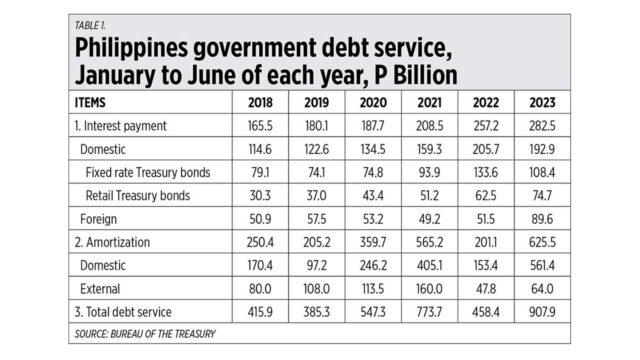
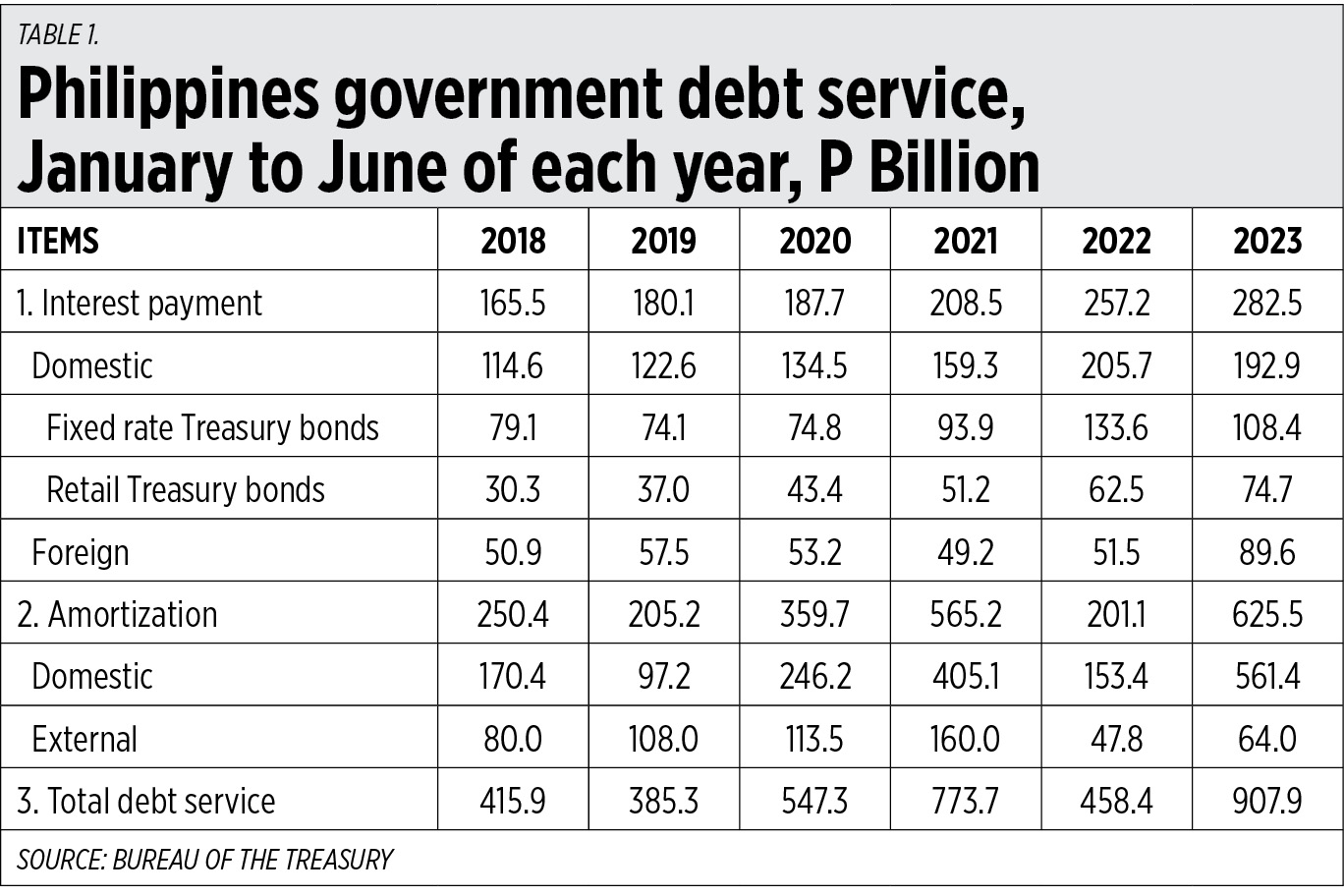
Also last week, the Bureau of the Treasury released the cash operations report including debt service for June 2023. Since the results of the first half (H1) of 2023 are already reported, I have compared the H1 numbers of previous years, 2018-2022. The numbers this year on debt servicing — payment in interest plus amortization for public debt contracted and accumulated for many years under previous administrations — are not good.

One — interest payment this year is already P283 billion, amortization is P626 billion, total debt service is P908 billion or approaching P1 trillion in H1 alone. This is not good.

Two — domestic debt constitutes a rising share of total debt service, especially in fixed rate and retail treasury bonds (see Table 1).

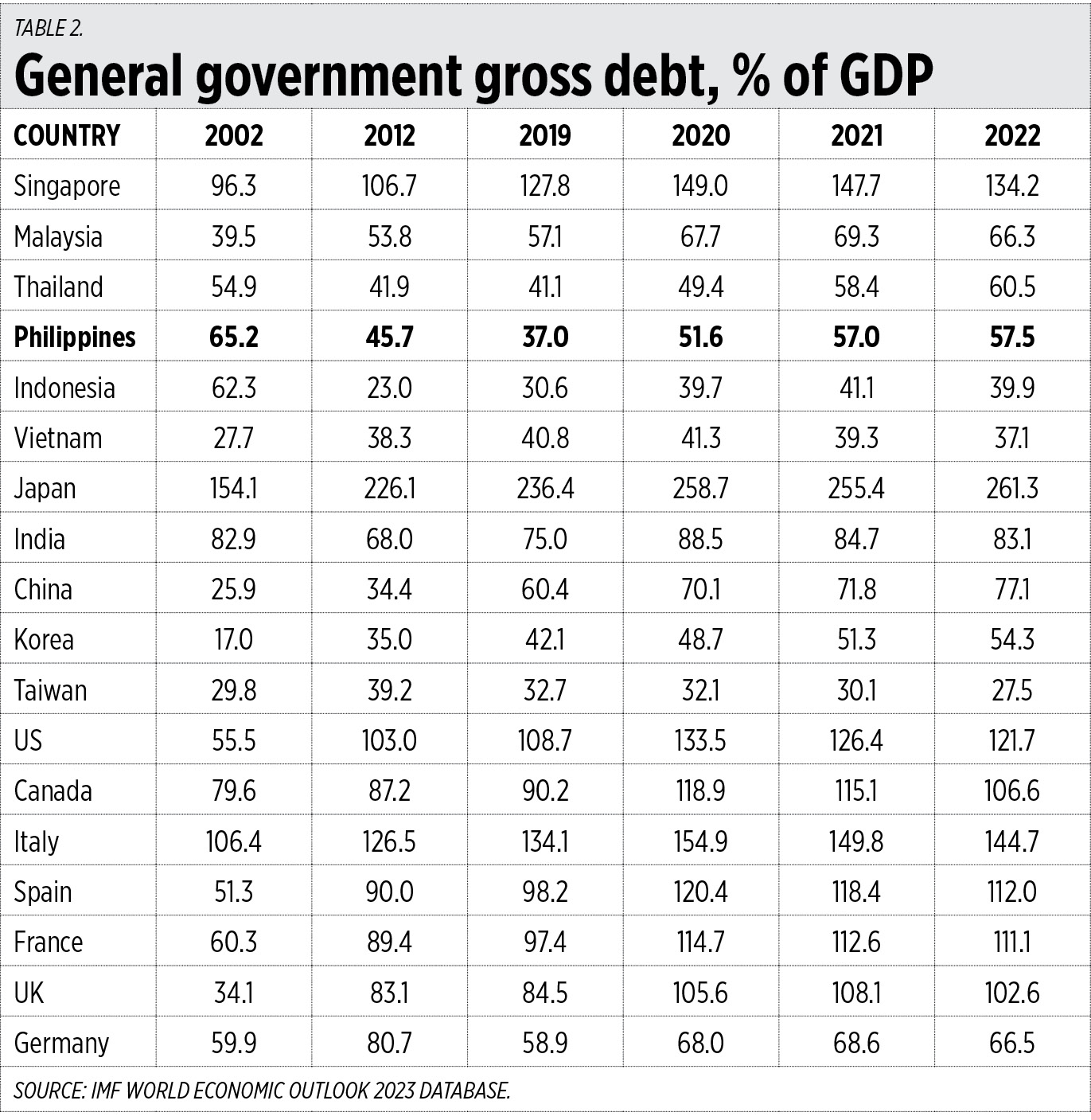
I checked the level of indebtedness of other countries. The gross debt/GDP ratio really jumped in the 2020-2021 lockdown dictatorship period, and began to flatline, or increase/decrease mildly in 2022. For the Philippines though, the jump was steep, from 37% in 2019 to 52% in 2020 then 57% in 2021. The lockdown dictatorship of the previous Duterte administration was really harsh compared to many countries, in Asia and around the world. Recall that Philippines GDP’ contracted 9.5% in 2020 — the worst in Asia, and the worst in Philippine economic history since after World War II.

Vietnam and Taiwan practically did not raise their indebtedness in 2020, they also managed to have GDP growth, not contraction, that year. For big countries in North America and Europe, all of them except Germany experienced debt/GDP ratios of 100% and above (see Table 2).

The above numbers show that lockdowns — shutting down of tax-paying businesses while expenditures remained high, then relying heavily on debt financing — is not good. It will never be good. Economic freedom — allowing people and companies to continue working and leaving healthcare to personal and civil society responsibility, not government lockdown irresponsibility — is the key to balancing economics and healthcare.

And the Maharlika Investment Fund? It is demonized by many individuals and groups concerned with public finance but who have little to zero (sound-of-silence) positions on military and uniformed personnel pension reform, a big public finance issue.

The Maharlika Fund should help finance big infrastructure and projects that were killed by politics (or subject to future political harassment) and hence, reduce fiscal pressure and need for borrowing. Since that new body has government presence and footprint, it can help thwart political harassment from local and National Government bureaucracies, as well as invite sovereign wealth funds from other countries to put their investments here as those projects have vetting and confidence by the MIF.

PDE ALUMNI HOMECOMING
Meanwhile, the Program in Development Economics (PDE) Alumni Association of the UP School of Economics (UPSE) will hold the PDE alumni homecoming on Aug. 19, 4 p.m., at the UPSE auditorium. Before the homecoming program, there will be “A Conversation with Finance and Budget Secretaries on Financing Sustained Growth.” The guest speakers will be Finance Secretary Diokno (PDE batch 7) and Budget Secretary Pangandaman (PDE batch 33).

These two officials are responsible for revenue generation and deficit borrowing and proposing the budget for the entire government to Congress, then manage its disbursement once enacted as appropriations act by Congress. They are key leaders in financing the very important goals of high sustained growth and sustained job creation while reducing the huge public debt accumulated by previous administrations.

PDE graduates from different batches, from the late 1960s to 2023, are encouraged to attend this very important lecture and meeting with their fellow alumni Cabinet Secretaries. This is a by-invitation event only, with some media and friends who are non-PDE alumni also invited to the “Conversation” before the homecoming program starts. Dinner will be served by the Philippine Center for Economic Development (PCED).

For the homecoming program, the PDE Alumni Association officers — including this writer — have solicited donations in kind from some corporations for raffles and give aways to participants. The following firms have expressed their willingness to give: San Miguel Corp., Robinsons Retail, Meralco, Astoria Hotels and Resorts, Nestlé Philippines, Gallerie Joaquin, Japan Tobacco, Inc., iOptions Ventures Corp., Philip Morris Fortune Tobacco Corp., and Alas Oplas & Co. CPAs. Thank you.

Thank you, Ferdie, Robina, Joe, Jeffrey, Arlene, Jack, Robert, Pidro, Noel, and my sister Marycris and their respective companies above. They are mostly my friends and fellow alumni of UPSE plus other friends and my sister.

Last month, this column produced a four-part series on Financing Sustained Growth: MUP pension reform (part 1, June 6), Fiscal discipline and Maharlika fund (part 2, June 13), Tax reforms (part 3, June 15), and NAIA privatization (part 4, June 27).

After the talks and “Conversation” with the two Secretaries, this column will resume another series on Financing Sustained Growth. Tune in, dear readers.


Bienvenido S. Oplas, Jr. is the president of Bienvenido S. Oplas, Jr. Research Consultancy Services, and Minimal Government Thinkers.

minimalgovernment@gmail.com

Upson to open new concept store in August

OCTAGON outlet at SM Megamall — UPSON.COM.PH

LISTED information technology retailer Upson International Corp. said on Monday that it is set to open a new store in SM North Edsa in line with its store network expansion goals.

In a regulatory filing, the company said that it is set to open a new TP-Link concept store by August this year.

“TP-Link has long been known for offering a portfolio of affordable and reliable consumer and business networking products, such as hubs, routers, switches, cables, and more,” President and Chief Executive Officer Arlene Louisa T. Sy said.

“There are still a lot of product models aside from the ones that are popularly sold, and we would like to showcase those in a shopping space that is focused on their discovery,” Ms. Sy added.

As of June 30, the company owns and operates a total of 11 concept stores for Acer, HP, Brother, and Silvertec brands.

“Upson has earned a reputation for integrity and fair dealing. We are eager to collaborate with them. With our shared ambition of enabling digital transformation and deeper customer connectivity, this store will bring an expanded range of TP-Link merchandise including indoor and outdoor wireless and wired systems for small to large enterprise networks,” TP-Link Philippines Country Manager Ben Chen said.

Mr. Chen added that the new location will also feature occasional exclusive models and offers.

Upson said earlier that proceeds from its P1.65-billion maiden offering would be used for its store network expansion.

It planned to open 250 stores from 2023 to 2027, or an additional retail space of 25,000 square meters.

The company offered about 625 million common shares apart from 62.5 million common shares as an over-allotment option. The offer shares are priced at P2.40 apiece.

Meanwhile, the company announced last week that it plans to open six new Acer concept stores beginning July 2023. The company said that it would only display Acer products in the concept stores, which carry the brand’s full collection of PCs, monitors, and other devices.

On Monday, Upson shares fell by 4.23% or P0.09 to close at P2.04 each. — Adrian H. Halili

Hollywood studios considering terminating some deals with writers — Variety

PEDRO MARROQUIN-UNSPLASH

MAJOR Hollywood studios and streaming platforms are considering terminating some of their first-look, overall deals with writers as soon as Aug. 1, Variety reported on Friday, citing sources with knowledge of various term agreements and talks inside the companies.

The deals would be torn up under contractual force majeure clauses, as SAG-AFTRA and the Writers Guild of America continue to strike, the report said. — Reuters

Other financial firms’ domestic claims rise in Q1   

BW FILE PHOTO

Domestic claims of nonbank financial firms grew by 12.2% in the first quarter of the year, the Bangko Sentral ng Pilipinas (BSP) said on Monday.   

Data from the BSP’s Other Financial Corporations Survey (OFCS) showed domestic claims of firms climbed to P8.22 trillion in the January-to-March period from the P7.33 trillion seen in the same period a year ago.   

“The growth in the OFCs’ domestic claims in Q1 2023 was due to higher claims on the depository corporations (DCs), the central government and the other sectors,” the central bank said in a statement on Monday.   

The OFCS is an analytical survey of the assets and liabilities of the OFC sector. It uses standardized report forms as required by the International Monetary Fund.

These include individual financial statements from insurance firms, holding companies, government financial institutions, investment companies, and other financial intermediaries, as well as consolidated financial statements from trust institutions.

“In particular, the OFCs’ claims on DCs expanded significantly, owing mainly to the growth in the sector’s deposits in banks and holdings of bank-issued equity shares. Similarly, claims on the central government rose, following OFCs’ increased holdings of government securities,” the BSP said.   

Claims on depository corporations surged by 30.8% year on year to P2.05 trillion and increased by 8.4% from the level seen in the fourth quarter of 2022.

OFCs’ net claims on the central government grew by 19.4% year on year to P1.98 trillion in the first quarter and rose by 5.4% from the prior three-month period.

“Likewise, the OFCs’ claims on other sectors, particularly the private sector, grew slightly, primarily on account of increased loans extended to the households and the nonfinancial corporations,” the BSP said.

By component, the bulk of the OFCs’ domestic claims during the quarter was mainly composed of claims on other sectors — particularly the private sector. This was followed by claims on DCs and the central government.

The private sector includes other nonfinancial corporations, households and nonprofit institutions serving households.   

The other nonfinancial corporations refer to private corporations and quasi-corporations whose principal activity is the production of market goods or nonfinancial services.

Meanwhile, net foreign assets of OFCs rose by 20.8% to P304.3 billion in the first quarter from P251.98 billion in the same period a year earlier. It also grew by 16.5% versus the prior quarter.

“The claims on nonresidents expanded mainly due to the OFCs’ increased investments in debt securities issued by nonresidents. The sector’s liabilities to nonresidents grew slightly due to higher reinsurance payables to nonresidents,” the BSP said.   

Reinsurance liabilities consist of premiums due to reinsurers, which represent premiums payable by the insurance companies to all their reinsurers.

“The expansion in the OFCs’ gross assets was funded mainly by its issuances of shares and other equity to other sectors,” it added.   

Claims of OFCs on nonresidents rose by 12.9% year on year to P477.33 billion. Liabilities to nonresidents inched up by 1.2% year on year to P173.03 billion. — Keisha B. Ta-asan

Commercial real estate investors, banks buckle up for perfect property storm

THE shadow of the Central Park Tower stretches over the west side of Manhattan as seen from the window of the building in New York, US, Sept. 17, 2019. — REUTERS/LUCAS JACKSON

LONDON/SYDNEY — Commercial real estate investors and lenders are slowly confronting an ugly question — if people never again shop in malls or work in offices the way they did before the pandemic, how safe are the fortunes they piled into bricks and mortar?

Rising interest rates, stubborn inflation and squally economic conditions are familiar foes to seasoned commercial property buyers, who typically ride out storms waiting for rental demand to rally and the cost of borrowing to fall.

Cyclical downturns rarely prompt fire sales, so long as lenders are confident the investor can repay their loan and the value of the asset remains above the debt lent against it.

This time though, analysts, academics and investors interviewed by Reuters warn things could be different.

With remote working now routine for many office-based firms and consumers habitually shopping online, cities like London, Los Angeles and New York are bloated with buildings local populations no longer want or need.

That means values of city-center skyscrapers and sprawling malls may take much longer to rebound. And if tenants can’t be found, landlords and lenders risk losses more painful than in previous cycles.

“Employers are beginning to appreciate that building giant facilities to warehouse their people is no longer necessary,” Richard Murphy, political economist and professor of accounting practice at the UK’s Sheffield University, told Reuters.

“Commercial landlords should be worried. Investors in them would be wise to quit now,” he added.

WALL OF DEBT
Global banks hold about half of the $6-trillion outstanding commercial real estate debt, Moody’s Investors Service said in June, with the largest share maturing in 2023-2026.

US banks revealed spiraling losses from property in their first half figures and warned of more to come.

Global lenders to US industrial and office real estate investment trusts (REITs), who supplied credit risk assessments to data provider Credit Benchmark in July, said firms in the sector were now 17.9% more likely to default on debt than they estimated six months ago. Borrowers in the UK real estate holding & development category were 4% more likely to default.

Jeffrey Sherman, deputy chief investment officer at $92 billion US investment house DoubleLine, said some US banks were wary of tying up precious liquidity in commercial property refinancings due in the next two years.

“Deposit flight can happen any day,” he said, pointing to the migration of customer deposits from banks to higher-yielding ‘risk-free’ money market funds and Treasury bonds.

“As long as the Fed keeps rates high, it’s a ticking time bomb,” he said.

Some global policymakers, however, remain confident that the post-pandemic shift in the notion of what it means ‘to go to work’ will not herald a 2008-9 style credit crisis.

Demand for loans from euro zone companies tumbled to the lowest on record last quarter, while annual US Federal Reserve ‘stress tests’ found banks on average would suffer a lower projected loan loss rate in 2023 than 2022 under an ‘extreme’ scenario of a 40% drop in commercial real estate values.

Average UK commercial property values have already fallen by around 20% from their peak without triggering major loan impairments, with one senior regulatory source noting that UK banks have far smaller property exposure as a proportion of overall lending than 15 years ago.

But Charles-Henry Monchau, Chief Investment Officer at Bank Syz likened the impact of aggressive rate tightening to dynamite fishing.

“Usually the small fishes come to the surface first, then the big ones — the whales — come last,” he said.

“Was Credit Suisse the whale? Was SVB the whale? We’ll only know afterwards. But the whale could be commercial real estate in the US.”

CUTTING SPACE
Global property services firm Jones Lang LaSalle (JLL) — which in May pointed to a 18% annual drop in first quarter global leasing volumes — published data this month showing prime office rental growth in New York, Beijing, San Francisco, Tokyo and Washington DC turned negative over the same period.

In Shanghai, China’s leading financial hub, office vacancy rates rose 1.2 percentage points year on year in Q2 to 16%, rival Savills said, suggesting a recovery would depend on nationwide stimulus policies succeeding.

Businesses are also under pressure to slash their carbon footprint, with HSBC  among those cutting the amount of space they rent and terminating leases at offices no longer considered ‘green’ enough.

More than 1 billion square meters of office space globally will need to be retrofitted by 2050, with a tripling of current rates to at least 3%-3.5% of stock annually to meet net-zero targets, JLL said.

Australia’s largest pension fund, the A$300 billion AustralianSuper, is among those on the sidelines, saying in May it would suspend new investment in unlisted office and retail assets due to poor returns.

Meanwhile, short-sellers continue to circle listed property landlords the world over, betting that their stock prices will sink.

The volume of real estate stocks lent by institutional investors to support shorting activity has grown by 30% in EMEA and 93% in North America over the 15 months to July, according to data provider Hazeltree.

According to Capital Economics, global property returns of around 4% a year are forecast this decade, compared with a pre-pandemic average of 8%, with only a slight improvement expected in the 2030s.

“Investors must be willing to accept a lower property risk premium,” Capital Economics said. “Property will look overvalued by the standards of the past.” — Reuters

The state of tourism in the nation

EL NIDO, PALAWAN — EIBNER SALIBA-UNSPLASH

In his second State of the Nation Address on July 24, President Ferdinand Marcos, Jr. touched on several issues that I have mused about many times in this column. Due to space limitation, I will comment only on his report on tourism in today’s column.

On tourism, the President said:

“Tourism is not only an important economic development tool but the abundance of opportunities that the sector creates in terms of regular employment and even job creation at the grassroots level is undeniable.

“To boost our tourism industry, we will first and foremost make basic developments such as road improvements for easier access to tourism spots. We will also upgrade our airports and create more international airports to help decongest the bottleneck in the Manila airport.

“We will also make it more convenient for travelers to go around the country, even to remote areas to help promote undiscovered tourist spots. This program will be led by the Department of Tourism, together with the Department of Public Works and Highways.”

I join the members of both chambers of Congress in applauding the President in boosting the tourism industry. Tourism is a powerful force in the socio-economic development of many countries, both mature industrial economies and developing economies. Tourism is either the first or the second largest business for more than half of the 178 nations represented in the United Nations.

As he said, tourism is an important element of the Philippine economy. It brings in the much-needed US dollars into the country, receipts reaching $3.68 billion in 2022. It generates hundreds of thousands of jobs. Tourism-related industries spawn other industries. The hotels, restaurants, and shops give impetus to the construction industry, the restaurants create demand for farm products, and the souvenir shops and retail establishments in the area promote the handicraft industry.

But the President has to do much more than what he promised to do in his State of the Nation Address. In 2004, I was commissioned to conduct, under a grant from the United States Agency for International Development, a study of the tourism industry with a view to identifying areas of adjustments and upgrading.

I was able to identify the facets of the country that had drawn the most negative comments from visitors. They were the poor security and safety measures for tourists; inadequate infrastructure like airports, seaports, and bus terminals in Metro Manila and in the tourist destinations outside the National Capital Region; low-class domestic land and sea transportation systems; polluted air and poor sanitary conditions of the environs; the horrendous traffic in Metro Manila; and arrogant Immigration and Customs personnel at points entry into the country.

A reading of today’s newspapers and viewing of the evening TV newscast indicate that not only have those areas of concern remained in their sorry state, but they have also deteriorated further. The Ninoy Aquino International Airport, particularly Terminal 1, now ranks among the “Worst Airports in the World.” Seaports are only slightly better than wharves in fishing villages. They are not suitable even for traveling local businessmen. Foreign tourists are turned away by the shabby appearance of these ferry terminals.

Roads to tourist destinations are too narrow to carry a large volume of tourists and too bumpy for their comfort. Those that lead to the beach or mountain resorts are unsafe and are bumpier. The physical conditions of the bus terminals are pathetic. They are cramped, toilets are dirty, and appointments uncomfortable.

But more than improving roads and upgrading airports and seaports, the quality of tourism service needs to be raised several levels. Our tourism service is of low quality.

One of the findings of my study is that many personnel manning immigration windows and customs counters at the airports are arrogant. Not only that, but they are also sleazy. That is what has been my own personal experience. I traveled a lot when I was country manager for a multi-national company.

In 2009, I and my family went on a cruise of the Baltic Sea. Of the 2,000 plus employees of the Emerald Princess, 62% were Filipinos, most of them waiters, kitchen staff, and room boys. I asked some of them why the Princess Cruises had not sailed to Manila. This was their shocking story: “It did once but management of the cruise line decided to delist Manila and any Philippine port from the itinerary of any of its ships after its horrible experience with Customs officials. When one of its ships docked in Manila, the Customs agents confiscated all the liquor bottles in the ship’s bars saying that the ship had no license to sell or serve liquor or alcoholic beverages in Philippine territory. The Customs men justified the confiscation by saying the goods were untaxed items.”

But the No. 1 negative comment of visitors to the Philippines was the lack of safety measures outside airports and seaports. Many visitors to the Philippines warn their relatives and friends of unsavory characters waiting outside airports and seaports ready to pounce on tourists.

The huge traffic jams that occur in the main thoroughfares of Metro Manila every day have caused Cruise Lines International Association, Inc. to issue this warning to its passengers: “Cruise ships dock at the Port of Manila. From there, you can take a bus or cab to downtown Manila. Manila is known for its congested thoroughfares, so it’s wise to choose your transportation options carefully. Taxis are everywhere in Manila, and the meter runs in absurdly low increments of $0.03! However, don’t let a driver convince you that the meter is broken, as they will often try to do, in order to charge you triple the fare.”

A major deterrent to the growth of the tourism industry was the lack of world-class facilities in distant tourist destinations, diminishing their attractiveness. Thanks to the private sector there is now a boom of deluxe hotels in those distant tourist destinations. But transportation to them is still limited or inconvenient. Flights to island resorts and adventure sites are limited in number, if there are any. Unsafe makeshift boats and plain outriggers carry tourists to destinations that are not accessible by air. Not only that, they are not comfortable conveyances, even for a short ride.

The supply of hotel and resort manpower with the skills required to service tourists is way below the current demand for such personnel. Many universities and colleges, including those in the provinces, offer tourism-related courses. But what is badly needed, according to former Tourism Secretary Narzalina Lim, are training programs for waiters, cooks, room boys/girls/gays, and souvenir shop salespersons similar to the training programs of cruise ship companies.

The main function of the secretary of Tourism is to develop tourist destinations and attractions and the support infrastructure and services (product development) and to promote them (advertising and sales promotions). That is why I originally recommended back in 2004, after I completed my study of the tourism industry, that a marketing professional, which many people mistakenly think is the same as an advertising practitioner, be appointed as secretary of Tourism. A marketing person is much more than an advertising or sales person. The marketing professional creates value-satisfying goods and services that consumers — tourists in the case of the tourism industry — will want to buy.

After realizing that the authority of the secretary of Tourism does not extend to many components of the tourism industry like the destinations and the supporting infrastructure, I now suggest that the secretary of Tourism be both a marketing person and a politician, the persuasive kind respected by both political allies and foes.

He/she also has to badger Cabinet members, governors, and mayors to upgrade the infrastructure and domestic transportation system, clean the environment, improve the peace and order situation, and discipline Immigration and Customs personnel at points of entry to the country. This is where the politician’s savvy and network would serve him/her in good stead.

The current secretary of tourism does not have a marketing or advertising background. She is a politician but not the persuasive kind. She is the authoritarian kind, as manifested by her decision to stick to her “Love the Philippines” slogan in total disregard of the advice of experts in the field of promotional campaigns.


Oscar P. Lagman, Jr. is a retired corporate executive, management professor, and business consultant.


Axelum launches coconut milk powder

AXELUM Resources Corp. launched its latest coconut milk powder in flexible retail pouches to boost its branded segment for the consumer market.

In a media release on Monday, the coconut product manufacturer said its Fiesta Coconut Milk Powder may be used as an ingredient in different dishes or as a dairy substitute.

“This forms parts of our strategy of leveraging on our manufacturing expertise, combined with efficient brand-building campaigns, to further strengthen our domestic presence,” said Axelum President and Chief Operating Officer Henry J. Raperoga.

The company is conducting product research and development focused on local and overseas retail sectors to take advantage of the emerging health and active lifestyle trend in plant-based consumption.

“We are excited for customers to partake in a world-class product, with a host of innovative applications at affordable price points to offer a better-for-you guilt-free indulgence,” Mr. Raperoga said.

Axelum said that its new product is available in major supermarket chains nationwide, as well its official stores in Shopee and Lazada.

In the three months ending in March, Axelum reported an attributable net loss of P69.26 million, reversing its P181.93-million net income in the same period last year.

Axelum has business interests in manufacturing coconut water and other coconut products for the domestic and international markets.

It sends its products to the United States, Canada, Australia, New Zealand, Europe, the Middle East, Japan, and other major countries in Asia.

On Monday, Axelum shares went down by six centavos or 2.64% to close at P2.21 apiece. — Sheldeen Joy Talavera

Ghostbusters, Spider-Man are latest films impacted by strike

SONY Pictures is the latest movie studio shaking up its release schedule amid the ongoing work stoppage by Hollywood writers and actors.

Gran Turismo, a car-racing film originally scheduled for a wide release on Aug. 11, will instead get sneak previews for two weekends before coming to more theaters on Aug. 25, a strategy designed to cope with strike-related prohibitions on actors engaging in their usual publicity tours. “The stars can’t promote the movie, but the audience can,” Sony said in an e-mail announcing the changes on Friday.

An untitled Ghostbusters sequel previously scheduled for December has been pushed back to March of next year. Kraven the Hunter, based on the Marvel Comics character of the same name and previously scheduled for October, is now moving to Aug. 30, 2024.

The release date for Spider-Man: Beyond the Spider-Verse, was pulled. The latest in Sony’s series of animated films based on the character had been scheduled for March. “The studio is considering several dates depending on how long the strike lasts,” the company said of the picture.

Strike rules prevent actors represented by the SAG-AFTRA union from participating in red carpet premieres, press interviews, and film festivals to promote their projects. That’s upending marketing strategies and stands to dent the box office performance of films released during the strike.

Delays are especially unwelcome news for theater chains including AMC Entertainment Holdings, Inc. and Cineworld Group Plc that are desperate for more films to accelerate their recovery from pandemic-induced lockdowns.

Walt Disney Co. said earlier this week that it was delaying Poor Things, a film starring Emma Stone, until December. Bloomberg News earlier reported that the company was reviewing its release strategy for several pictures.

Writers and actors are seeking better compensation and benefits from studios as well as protections from artificial intelligence taking over their jobs. They have been on strike since May and July respectively, which has brought many Hollywood productions to a standstill. — Bloomberg

How PSEi member stocks performed — July 31, 2023

Here’s a quick glance at how PSEi stocks fared on Monday, July 31, 2023.


ADVERTISEMENT
ADVERTISEMENT