Home Blog Page 4492

APEC sees trade barriers rising within bloc  

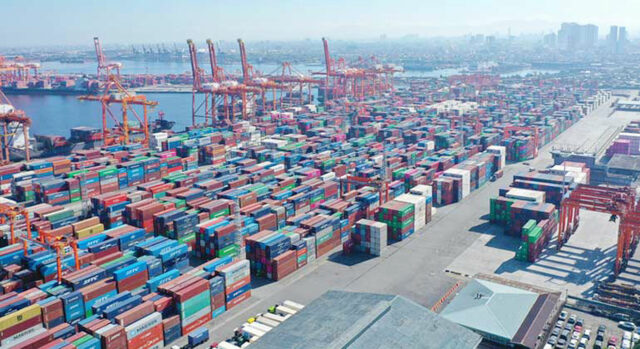
PHOTO COURTESY OF ICTSI

TRADE barriers are being erected by members of the Asia-Pacific Economic Cooperation (APEC) bloc, the APEC Policy Support Unit (PSU) said in a report.

It said commercial trade among APEC members recovered to $4.9 trillion in 2022, lower than the estimated $5.4 trillion for 2022 “had there been no pandemic.”

The finding was contained in its Monitoring Pandemic Recovery Under the APEC Services Competitiveness Roadmap (ASCR) report.

According to the PSU, recently introduced trade restrictions are affecting foreign entry, movement of people, competition, and create momentum for other discriminatory measures. 

“There are many factors that affect services trade. But one critical factor is government policies, which affect various services sectors differently,” PSU analyst Andre Wirjo said.

“Three years since the pandemic, while we’re seeing that member economies have started to roll back the temporary measures put in place during COVID-19, we’re also seeing more unrelated trade restrictions being introduced,” Mr. Wirjo added.

The unit said that the top restrictions vary by industry and could involve barriers to competition and regulatory transparency.

“While some restrictions may have been enacted for legitimate policy objectives, economies may wish to explore how these objectives could be achieved without having an unintended impact on trade, considering the interlinkages among policy measures,” Mr. Wirjo said.

The report indicated that travel-related trade, despite reaching $700 billion in 2022, only accounted for about 50% of both the value in 2019 and the projected value in 2022.

“After falling 81% between 2019 and 2020, the number of international tourist arrivals to APEC economies registered a further decline of 16.4% between 2020 and 2021 due to COVID-19 related border measures as many economies took longer to reopen,” the PSU said. — Revin Mikhael D. Ochave

Energy industry bats for Senate bill streamlining LNG import process

REUTERS

THE energy industry asked the Senate to pass a bill easing the process for importing liquefied natural gas (LNG), citing the uncertainty surrounding the gas remaining in the Malampaya field.

Malampaya operator Prime Energy Resources Development B.V. said the energy industry requires a stable framework regulating gas imports to foster growth in power generation.

At a Senate energy committee hearing on Thursday, Prime Energy general manager Donnabel Kuizon-Cruz said: “We can’t really pinpoint an exact date of the Malampaya cutoff. It depends on how we plan our production… We need a bill that would allow companies and government agencies concerned to import gas in an organized way.”

The Malampaya gas field is the country’s only indigenous commercial source of natural gas. It is expected to run out of easily recoverable gas using current techniques by 2027.

In May, President Ferdinand R. Marcos, Jr. renewed Malampaya Service Contract 38 to Feb. 22, 2039, giving operators a 15-year extension beyond the initial Feb. 22, 2024 expiration date.

Malampaya gas accounts for about 20% of Luzon’s electricity requirements.

Senate Bill No. 152, written by Senator Sherwin T. Gatchalian, seeks to develop the midstream natural gas industry, including natural gas transportation and storage.

Senators Rafael T. Tulfo, Emmanuel Joel J. Villanueva, and Maria Imelda Josefa Remedios R. Marcos had filed similar measures seeking to develop the midstream and downstream gas industries, citing the need to maintain a balanced energy mix.

Mr. Gatchalian said LNG is positioned as an aid to the country’s transition to renewable forms of energy.

While a Department of Energy (DoE) circular covers the midstream gas sector, there is no law governing the liquefaction, transportation, and transmission of natural gas, he said.

The bills are part of the common legislative agenda of the Legislative-Executive Development Advisory Council (LEDAC).

Last week, the House of Representatives passed on third and final reading a counterpart bill which includes a provision allowing eligible companies zero-rating on value-added tax (VAT) on natural gas.

Karlo Fermin S. Adriano, Finance Assistant Secretary, said the measure should ensure safeguards are in place to prevent costs from being passed on to consumers.

He noted that proposals for additional tax exemptions for the natural gas industry must also be subject to the Fiscal Incentives Review Board’s oversight.

Mr. Gatchalian at the end of the hearing requested the DoE, First Gen Corp., and Prime Energy to submit position papers to the committee, for discussion by technical working groups.

He also asked the Philippine Competition Commission to provide its views on ensuring healthy competition in the industry.

“Regulating the natural gas industry is a matter of national interest,” Mr. Tulfo said.

“It’s about ensuring that as we transition from indigenous sources like Malampaya to importing of LNG, we have a robust, transparent and efficient system in place.” — John Victor D. Ordoñez

Retail industry supports tax to level playing field with online merchants 

PHILIPPINE STAR/ MICHAEL VARCAS

THE Philippine Retailers Association (PRA) said it supports a tax on online merchants to ensure that the bricks-and-mortar segment of the industry enjoys fair competition.

PRA President Roberto S. Claudio said in a speech at the opening of the National Retail Conference & Expo (NRCE) in Pasay City on Thursday that the organization is pushing for a “more equitable landscape” and supports a bill seeking to collect value-added tax (VAT) from digital service providers.

“The PRA stands firmly behind the proposed internet taxation law through Senate Bill (SB) 250… We firmly believe that this bill will pave the way for a more equitable business landscape in the Philippine retail industry, benefiting both local and international online players,” Mr. Claudio said.

“One significant challenge we face is the unlevel playing field created by online foreign merchants. Ensuring that online retailers adhere to the same laws and ordinances that traditional stores abide by is crucial,” he added.

SB 250 seeks to clarify the rules on VAT collection from digital service providers, which are being required to help the government collect VAT from their users.

“Matters such as taxation, duties, product standards, intellectual property, price tags, official receipts, and truth in advertising among others, must be upheld consistently across all online marketplaces. Addressing this concern is of paramount importance to our retail community,” Mr. Claudio said.

Mr. Claudio noted that the retail industry has seen a “significant resurgence” throughout the year from so-called revenge shopping.

“Our businesses are not only recovering but experiencing substantial growth as we reopen more stores. Customers are eagerly returning to stores and malls, reigniting vibrant shopping experiences,” Mr. Claudio said.

“Notably, revenge shopping and travel have played significant roles in driving growth since last year, and our aim is to sustain this momentum and reach even higher levels of growth,” he added.

Mr. Claudio said the PRA supports the bill making foreign tourists eligible for VAT refunds. Such visitors currently pay the 12% VAT on goods and services.

On March 6, the House of Representatives approved House Bill No. 7292 on third and final reading. If signed into law, the measure would authorize VAT refunds for foreign tourists with purchases worth at least P3,000.

“This crucial legislation seeks to establish a mechanism for refunding VAT to non-resident tourists, thereby enhancing our country›s overall shopping and tourism experience,” Mr. Claudio said.

“We recognize the immense potential this bill holds in attracting more tourists, stimulating retail businesses, and fostering overall economic growth. The bill is set to undergo floor deliberation in the Senate within the coming weeks, with plans for industry-wide implementation slated for the first quarter of 2024,” he added.

Meanwhile, Mr. Claudio said the retail industry will lead the transition to the GS1 bar code system.

“The whole world will transition from the one-dimension black and white vertical lines to quick response (QR) code matrix 2-dimensional bar codes,” Mr. Claudio said.

“The Philippine retail industry will spearhead the transition by requiring manufacturers and distributors to migrate to the QR matrix barcode for worldwide simultaneous implementation by 2025,” he added. — Revin Mikhael D. Ochave 

Philippines suspends all Manila Bay reclamation projects pending review

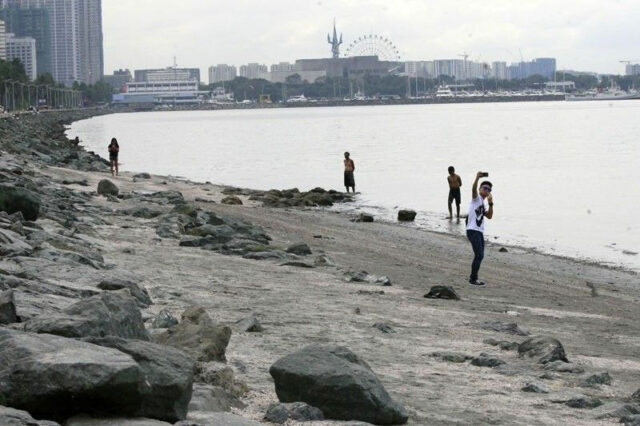
PHILIPPINE STAR/EDD GUMBAN

THE GOVERNMENT of President Ferdinand R. Marcos, Jr. has suspended all reclamation projects in Manila Bay pending a review of their environmental and social effects.

“All of these projects are suspended at this point,” Environment Secretary Ma. Antonia “Toni” Yulo-Loyzaga told a news briefing on Thursday.

“All [projects] are under review,” she said. “We have to take our time, really beginning with those that are ongoing because they’re in fact already impacting the areas. And then we will graduate to all those that have not yet begun.”

Ms. Yulo-Loyzaga issued the clarification after Mr. Marcos said all Manila Bay projects — except one — had been suspended.

There are 22 reclamation projects in the bay, which is surrounded by Metro Manila and the provinces of Bataan, Pampanga, Bulacan and Cavite.

Ms. Yulo-Loyzaga said her agency would write to the 22 project operators about the compliance review. The Environment department is looking at the conditions that allowed the issuance of environmental compliance certificates and clearances to the companies, she added.

Permits for the reclamation projects were completed from 2019 to 2021 under the administration of ex-President Rodrigo R. Duterte, who led a foreign policy pivot to China in exchange of investment pledges, few of which had materialized.

The US Embassy in Manila earlier this month expressed concern about a Manila Bay reclamation project that has links to China Communications Construction Co. (CCCC), a Chinese construction company that Washington blacklisted in 2020 along with other companies for helping the Chinese military build and militarize artificial islands in the South China Sea.

The World Bank and Asian Development Bank had also flagged the state-owned company for engaging in fraudulent business practices, the embassy said.

Scientist group Agham welcomed the suspension of reclamation projects in Manila Bay and the resolution filed in the House of Representatives to probe the projects’ status.

“This victory was achieved through the collective action of various civil society organizations who have tirelessly campaigned against reclamation for years,” it said in a statement.

Agham was among the stakeholders that her agency has been consulting on reclamation issues, Ms. Yulo-Loyzaga told the briefing.

“We challenge the Marcos administration to release this policy of suspension and immediately implement it on the ground,” Agham said.

It also urged the government to release a report on the status of coastal ecosystems affected by the projects.

“For example, the Department of Environment and Natural Resources (DENR) must report how much of the coastline was altered, and how many hectares of mangroves were destroyed,” it said.

“DENR must also report the status of the seabed in Cavite where sand used as filling material for reclamation projects was excavated,” it added.

Meanwhile, Ms. Yulo-Loyzaga said social scientists would be included in the group of experts who will assess the effects of the reclamation projects.

“There will be climate scientists on board. There will be social scientists on board,” she said, adding that the projects’ effects on communities should always be considered.

Opposition Senator Ana Theresia “Risa” Hontiveros-Baraquel on Wednesday urged Mr. Marcos to bar China from funding reclamation projects in the Philippines

The Philippine Reclamation Authority (PRA) said two of the six approved reclamation projects in Manila Bay belong to China Harbour Engineering Co. Ltd., a unit of China Communications Construction.

“CCCC, like its home country China, has committed many violations against the Philippines,” Ms. Hontiveros-Baraquel said. “From building artificial islands in the West Philippine Sea to now reclaiming land in Metro Manila, China is destroying Philippine territory left, right and center. How can we negotiate with Beijing when she acts in bad faith?”

The opposition senator said the Philippines should ban CCCC after China’s Coast Guard blocked and fired a water cannon at Philippine vessels on a resupply mission at Second Thomas Shoal in the South China Sea. Kyle Aristophere T. Atienza

Congressman seeks transfer of intel funds to education

A CONGRESSMAN on Thursday asked his colleagues to strip the Education department of confidential funds, saying these are better spent on students’ needs.

“That’s better spent on more teachers and more classrooms,” House Senior Minority Leader and Northern Samar Rep. Paul R. Daza told reporters on the sidelines of a House of Representatives committee hearing on the proposed P5.768-trillion national budget for 2024.

“We need repairs [because] there is too much damage on school buildings,” he said. “We also need more IT (information technology) support and teaching aids both for teachers and students.”

Mr. Daza urged Vice-President Sara Duterte-Carpio, who is the Education secretary, to realign her agency’s funds because she would have double funds from her offices.

“I support a little bit of confidential funds for the Office of the Vice President,” Mr. Daza said. “And because she already has a dual role, it would be good if the VP, on her own, requests an institutional realignment.”

Last week, Ms. Carpio defended the Department of Education’s (DepEd) P150-million confidential and intelligence funds in the national budget.

“Education is intertwined with national security,” she told reporters. “It’s important that we mold children who are patriotic, who will love and defend our country.”

Mr. Daza said youth programs should have a separate allocation in the national budget. 

“On her own, she can propose an institutional amendment consistent with what she said, that she will use it with youth programs… taking it out from the confidential [funds] and placing it in a specific program,” he said. 

The budget for confidential and intelligence funds next year increased by P120 million to P10.14 billion — P5.28 billion in intelligence and P4.86 billion in confidential funds.

Under the 2024 National Expenditure Program, the Office of the President was given P4.5 billion in intelligence funds, while the Department of Information and Communications Technology got confidential funds worth P300 million.

The Bureau of Customs will get P30.5 million, while the Department of Foreign Affairs was allotted P5 million in confidential funds. 

The Department of Agriculture was allotted P50 million in confidential funds, the Defense department was given intelligence funds worth P60 million, and the Presidential Security Group was allocated P60 million.

The budget for state colleges and universities fell by 5.7% to P105.58 billion.

Budget Secretary Amenah F. Pangandaman said the budget for education infrastructure has a capital outlay of P25 million for the lowest tier to P50 million for highest tier per state university.  

“While the 2024 budget has increases for defense and big-ticket infrastructure projects, increases for education are measly. It does not address learning loss and is riddled with forms of pork,” Party-list Rep. Raoul Danniel A. Manuel told the House appropriations committee. — Beatriz Marie D. Cruz

Marcos looking forward to maritime deal with Vietnam, Malacañang says

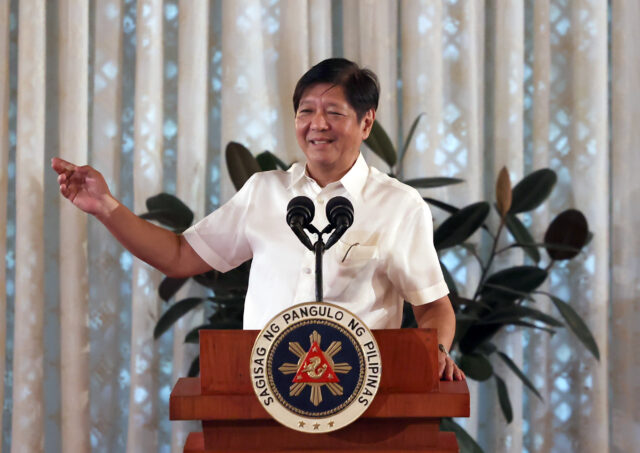
PRESIDENT FERDINAND R. MARCOS, JR. — PNA PHOTO BY ALFRED FRIAS

PRESIDENT Ferdinand R. Marcos, Jr. Looks forward to signing a deal with Vietnam to boost maritime cooperation in the South China Sea, the Philippine presidential palace said in a statement on Thursday.

Speaking with outgoing Vietnam Ambassador to the Philippines Hoang Huy Chung, Mr. Marcos underscored the importance of maritime cooperation.

“Now that we are going to start discussions on the agreement that we have between the Philippines and Vietnam… it will be a very, very important part of our relationship and it will bring an element of stability to the problems that we are seeing now in the South China Sea,” the President said.

President Marcos said the agreement “is going to be a very big step” between the Philippines and Vietnam.

Mr. Chung paid a farewell call to the President on Thursday. He was appointed ambassador to the Philippines in 2020.

Meanwhile, Armed Forces spokesman Medel Aguilar said 12 Chinese militia vessels had helped the Chinese Coast Guard attack using a water cannon Philippine vessels on a resupply mission at Second Thomas Shoal on Aug. 5.

“Our soldiers and crewmen saw 12 maritime militia that supported the six ships of the China Coast Guard,” he told a news briefing. “There was also the presence of the People’s Liberation Army Navy in the vicinity of Ayungin Shoal,” he added, referring to Second Thomas Shoal.

But not all of them participated or were involved in the blocking, Mr. Aguilar said.

The National Security Council earlier said the Chinese Coast Guard had used one of the world’s strongest water cannons.

Also on Thursday, Philippine Coast Guard spokesman Jay Tristan Tarriela criticized Filipinos whom he accused of sympathizing with China in its sea dispute with the Philippines.

“If you are a Filipino, whether in government or private sector, regardless of your politics, defending and making excuses for China’s aggressive behavior should deem you unpatriotic, and a traitor to the Philippines and to our people,” he tweeted.

“Given current developments in the West Philippine Sea, it is important to show loyalty to the country,” he said, referring to areas of the sea within the country’s exclusive economic zone.  Freedom of speech should not be misused by Filipinos who act as China’s mouthpiece, he added.

Ex-President Rodrigo R. Duterte met with Chinese President Xi Jinping last month, during which he reportedly asked the Chinese leader to look kindly on the Philippines.

The sea dispute between the two nations was never brought up during the meeting, Senate President Juan Miguel F. Zubiri said last week, citing President Ferdinand R. Marcos, Jr.

Mr. Marcos met with Senate leaders on Wednesday night after meeting with Mr. Duterte at the presidential palace, the senator said.

There are now proposals from his Senate allies to make him a special envoy to China, citing his “good standing” with Beijing. — KATA

Manila’s new curriculum to focus on reading, math, values and patriotism

Parents and students are seen crowding the entrance of the Pura V. Kalaw Elementary School in Project 4, Quezon City, Aug. 22. — PHILIPPINE STAR/ MIGUEL DE GUZMAN

THE PHILIPPINES’ new curriculum for kindergarten and Grade 10 students would prioritize “foundational skills,” the Department of Education said on Thursday.

Under the new K-10 curriculum, students from kindergarten to Grade 2 will study five subjects — language, reading and literacy, mathematics, values education and patriotism, Education Director Jocelyn Andaya said at the curriculum’s launch.

Students will study science starting in Grade 3, just like in the old curriculum, she said.

Mother tongue was removed from the curriculum, but it will remain as a medium of instruction, Education Undersecretary Michael T. Poa told a news briefing.

Ms. Andaya said the new curriculum balances cognitive demands and seeks to develop 21st-century skills.

It also seeks to strengthen values and peace education. “It is now on par with international standards.”

In her speech during the event, Vice-President and Education Secretary Sara Duterte-Carpio highlighted “peace competencies for nonviolent action and conflict resolution skills” in the new curriculum.

“After all, there is security if there is peace,” she said.

Human rights groups have criticized Ms. Duterte-Carpio for accusing government critics of having links to the Maoist movement.

Her agency is proposing another P150 million in confidential funds under next year’s national budget.

Ms. Duterte earlier said DepEp’s confidential and intelligence funds are needed because “education is intertwined with national security.”

“It’s very important that we mold children who are patriotic, children who will love our country and who will defend our country,” she said.

ACT Teachers Party-list Rep. France C. Castro is worried that the confidential funds would be used to “put under surveillance students and teachers” suspected of recruiting people to the Maoist movement.

“Is the DepEd now a police or military agency that is conducting surveillance operations on students and teachers?” she said in a statement.

Despite opposition from civil society and some lawmakers, Congress last year approved the agency’s P150-million confidential and intelligence funds for 2023. — Kyle Aristophere T. Atienza

Irrigation deputy named 

BAGUIO CITY — President Ferdinand R. Marcos, Jr. has appointed former National Tobacco Administrator (NTA) Robert Victor Seares, Jr. as deputy administrator of the National Irrigation Administration (NIA).   

Mr. Seares Jr. took his oath before Executive Secretary Lucas P. Bersamin at the presidential palace in Manila on Aug. 9. 

He was ex-President Rodrigo R. Duterte’s administrator at the NTA at the age of 40, the youngest ever appointed to the position, after his father, former NTA Administrator Robert Lizardo Seares Sr. died. — Artemio A. Dumlao

Jail escapee caught in Kalinga 

TIM HUFNER —UNSPLASH

BAGUIO CITY — Cordillera police caught an alleged car thief who escaped from the Cabarogguis district jail in Quirino province in Cagayan Valley nine years ago. 

He was caught in Rizal, Kalinga province on Monday, Cordillera police chief Brigadier General David Peredo said. 

The suspect was among four prisoners who escaped from the Cabarogguis jail on Sept. 13, 2014.  They were detained for carnapping. 

Police received a tip from an informant, leading them to his hideout, Mr. Peredo said. He was turned over to the Bureau of Jail Management and Penology Regional Office 2. — Artemio A. Dumlao

Tornado hits Zamboanga 

COTABATO CITY — A tornado from the sea ripped and blew away the roof of about 30 houses in the coastal village of Sinunuc in Zamboanga City on Wednesday.   

In separate reports on Thursday, the office of Mayor John M. Dalipe and Zamboanga City Police Office said emergency responders had been dispatched to help to 32 affected families.    

Mr. Dalipe, who heads the Zamboanga City Disaster Risk Reduction and Management Council, said their local government unit’s engineering and social welfare offices would provide makeshift shelters to victims. 

The tornado, which was first spotted in the sea about a kilometer away, moved inland and hit the houses on its path. — John Felix M. Unson 

P13-M crystal meth seized in Sulu 

PHILSTAR

COTABATO CITY — Anti-narcotics agents seized P13 million worth of crystal meth from two suspected dealers, one of them a former member of the Moro National Liberation Front in Maimbung, Sulu in southern Philippines on Wednesday. 

Christian O. Frivaldo, director of the Philippine Drug Enforcement Agency (PDEA) 12, told reporters on Thursday the duo fell in a sting operation. 

The suspects did not resist arrest when PDEA agents and local police frisked and cuffed them after they traded two kilos of crystal meth to operatives disguised as drug users. 

Mr. Frivaldo said the operation was launched after local officials, among them members of the Sulu Provincial Peace and Order Council, reported the suspects’ drug trafficking activities. — John Felix M. Unson 

DTI, Bangsamoro to push halal 

THE DEPARTMENT of Trade and Industry (DTI) has partnered with the Bangsamoro Autonomous Region in Muslim Mindanao Ministry of Trade, Investments and Tourism to promote the halal industry in the region. 

The two have signed a memo that seeks to promote business development in certain Bangsamoro areas, DTI said in a statement on Thursday. 

Trade Secretary Alfredo E. Pascual cited opportunities in the $2.3-trillion (P129 trillion) global halal food industry, which is expected to grow by about 50% to $3.4 trillion next year.    

He said the law mandates the promotion and development of the local halal industry.   

“Acquiring even a tiny bit of this cake — let’s say 0.1 percent or $2.3 billion to $3.4 billion — would still greatly contribute to the country’s economic recovery and growth,” the Trade chief said. — Revin Mikhael D. Ochave