
Performance of Philippine Agriculture
THE PHILIPPINES’ agricultural output contracted in the second quarter due to a double-digit drop in fisheries production, government data showed on Wednesday. Read the full story.
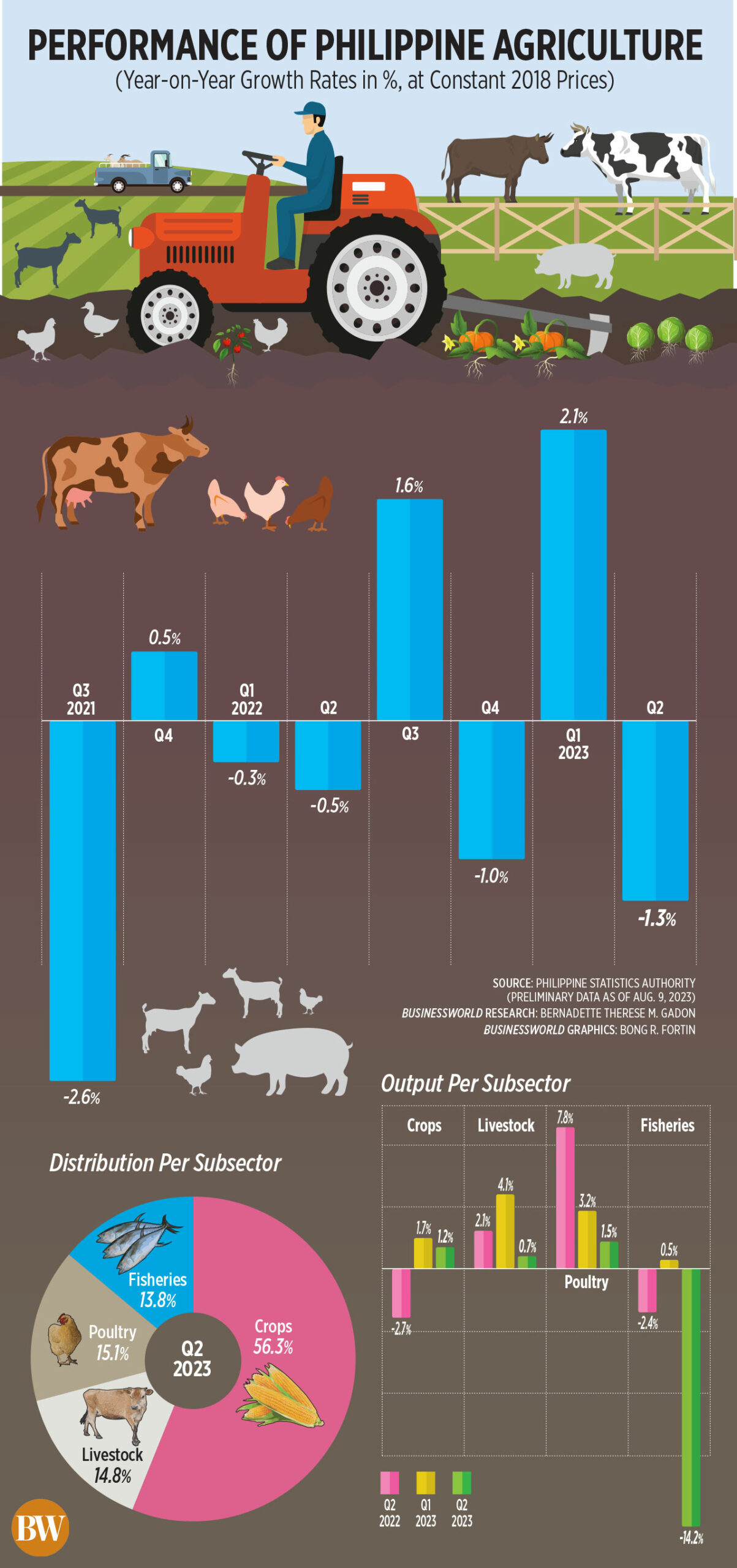
THE PHILIPPINES’ agricultural output contracted in the second quarter due to a double-digit drop in fisheries production, government data showed on Wednesday. Read the full story.

ABC Tech Ventures, Inc. is looking to launch shockproof laptops in the third quarter of 2024, targeting students as they will be priced at just P10,000 to P20,000.
“Our design is dust-proof and shockproof so that even if you drop it, it will still work,” Arvin Arik Carranceja, chief executive officer of ABC Tech, said in a chance interview last week.
“We lowered the price so that its affordability will be able to reach the capacity of the buyers, which will be the students,”he said.
ABC Tech said the laptops will be for its retail market and will be different from what it has previously launched in partnership with the government.
“The laptops will have i3, i5 and i7 [processors]. Since it is designed for education, it will have little to none graphics cards, because graphics are for gaming,”Mr. Carranceja said.
He said the laptops are currently at the testing stage, which will span around six to eight months.
“I think this will be launched in July, because school starts in August. That is our target,”he said.
Banking on the government’s goal of digitalizing education, Mr. Carranceja said market demand laptops could be as big as 33 million, or the number of students in the Philippines.
The laptops will be produced in the company’s factory in China and will have Filipino engineers and software developers.
Meanwhile, the company is also in the process of developing software that it aims to present to the Department of Education and the Department of Information and Communications Technology.
“We call it Teacher in a Box,” said Mr. Carranceja. “The Teacher in a Box is an access point which has a server where, even if you don’t have WiFi, you can still watch videos and access the learning modules.”
He said this will help students in areas with poor or no Internet connectivity. — Justine Irish D. Tabile

ITS ORANGE, sparkling, and bitter hues remind some of an Italian sunset in a glass. Aperol spritz, the cocktail that dots terraces with the passing of the summer, hails from the Veneto region of northern Italy, where it has been drunk since the first half of the 19th century. Born under the influence of the Austrian Empire — hence the sound of its name — it has been back in fashion since 2010, thanks to a marketing coup. If the spritz appeals to so many palates, it’s because it at once manages to combine the chic and the simple, the fun and the sophisticated, the retro and the modern, along with the bitter and the sweet.
A WHOLE WORLD IN A GLASS
Any emblematic aperitif comes with its host of images and accessories. For many a European, the hour of the apero conjures up a set of carefully crafted rituals. Time, within this enchanted interlude, bends and softens. How could a French person possibly think of anisette, for example, without visualizing a certain type of glass and a zinc table under a glaring sun, the whole set to the song of the cicadas? You find yourself immediately transported to the sleepy Provincial villages of the novels of Marcel Pagnol.
The taste of Champagne, by contrast, evokes a world of elegance, celebration and exception. The oblong flutes in which it is traditionally poured sublimate its light sand color with chic undertones. To each drink its atmosphere: the Beaujolais wine brings up the full glass, the checkered tablecloth and sausages, and the music of French singer-writer Charles Trenet. The spritz, on the other hand, inevitably evokes a sunset in Italy, a sweet pop song, and the start of the holidays. One thinks of Dean Martin or Domenico Modugno crooning “Volare” (“Volare, oh, oh; Cantare, oh, oh, oh, oh”), or the flourish of mandolin in Elvis Presley’s “It’s Now or Never,” originally inspired by the bel canto of “O Sole Mio.”
You would be forgiven for viewing the above as nothing more than product placement. However, these representations are a central part of our consumer rituals. We take them up without even thinking about it, re-enacting them more or less consciously.
EXOTICISM AT EVERY LEVEL
The spritz that propels us on holiday promises kitsch-tainted exoticism. It stems from the drink’s transalpine ancestry, of course, but also from the name’s strangeness — several pronunciations are possible depending on the degree of alcohol in the blood, perhaps. The cocktail invites us to take a trip back in time, to the land of nostalgia. Its flashy orange color recalls the distinctive design of the 1960s and 1970s, conjuring up a reassuringly retro world — picnic coolers, yogurt makers, ‘70s Formica tables and even grandma’s wallpaper.
The bitter taste is also exotic, so typically Italian — think coffee, chicory, green olive oil — and at the same time conveys a form of social distinction: liking bitter is more original than liking sweet! Sweet is unctuous and emollient, whereas bitter surprises and stimulates the senses.
A MOMENT OF CONVIVIALITY
Above all, a spritz invites us to savor the moment, by appealing to all our senses. There’s the color, the transparency. But there’s also the sense of touch, through the oversized glass cradled within the palm of the hand, the straw that you play with, sip through, even chew on as you chat lightly. The tinkling ice cubes even give the cocktail a sound identity. Finally, the word itself seems to sparkle, anticipating the pleasure associated with tasting it as you say it.
While the drink is best enjoyed with friends, preferably at leisure — the glass tends to be big and full — it’s not uncommon for it to do the rounds on social networks: known for its inclination toward colorful, cheerful shots, Instagram now counts almost 2 million images tagged #spritz — a figure that should continue to rise with the summer temperatures.
Another great thing about a spritz is its capacity for igniting small talk. Everyone has their bit to say about the cocktail: too much water, too sweet, too much prosecco, not enough bitterness. Lightness, the spirit of the terraces, the sun playing with the leaves and the parasol, the breeze stroking your cheek? Holidays are well and truly underway. — The Conversation via Reuters Connect
Pascal Lardellier is a Professor at the University of Bourgogne Franche-Comté, and a Researcher at the CIMEOS laboratory, University of Burgundy — UBFC. Sonia Zannad is the head of the Culture section, The Conversation France.

THE PHRASE “terminal leave” refers to a phase where someone who has already been terminated is technically still on the payroll and may be finishing his unused vacation leave and getting a partial advance on his variable pay. A more acceptable phrase for this limbo period has been coined.
The British term “garden leave,” previously applied to the civil service, requires the subject to stay away from the office and spend his time “in the garden” at home, though not necessarily minding the hibiscus and moldy orchids. Those on garden leave are allowed to travel out of town, but not abroad, to be available in case called for some office matter — Did you leave behind the confidential files?
The executive on garden leave is paid during this absence, maybe for three months or so, as the company strives to hold on to his clients and keep them from getting poached by the gardener. The forced leave ensures too that the employee is denied access to current information which will be helpful to him if he joins a competitor. The leave then can also be a kind of suspension, allowing an audit team to check the books without undue interference.
The Japanese have a similar practice of removing designated executives out of line operations and assigning them a desk by the window to look out at lovely autumn days during office hours. Window gazing may be less traumatic as a form of internal exile as it allows one to go to the office, wear business attire, even carry files in an attaché case.
Not as dramatic but equally clear is the local version of the garden leave.
Acceptable reasons are given for the disappearance of a particular executive from the circle of life. The current favorite is “family leave” — She wants to spend more time with the family. Doing what? It’s not specified. It’s just a reason to withdraw a person from public view and the temptation to give reaction statements every time her name comes up in the news.
Another reason given for a disappearing executive is “health.” This one is truly accompanied by an ailment, although not always specified. Even ennui may qualify as a disability. Being bored with the state of things can be stressful.
The company spokesman, when queried about somebody’s disappearance from the office premises, can even plead a WFH (working from home) status. The executive in question is consulted when needed, especially to explain the items involved in the present challenges facing the company.
A garden leave, or whatever it is called, fools no one. The whole office knows that a person given such an excused and paid absence is probably on his way out. Even if this condition is hardly contagious, there is an attempt to avoid the vacationers if by chance one sees them in the mall during lunch, maybe on their way to a movie. Such avoidance stems from a sense of discomfort — what do you talk about with them? Even an innocuous question like asking how they are doing comes across as intrusive and seems to delve into their obvious misery. Getting out of such a person’s way is an instinct that arises from an irrational fear that his bad luck may cling to the person standing next to him, like some malevolent spirit in a horror movie looking for a new host.
Is it possible that a leave is just what it says it is, and that the leave-taker is really with her family and off on a vacation to Antarctica? Maybe she is expected to return and resume her position and interviews, this time about polar bears and how they fish for their meals.
Still, an extended leave of more than 14 working days is apt to raise eyebrows, especially when it continues to be renewed indefinitely — yes, he is still pruning his bonsai trees in the garden.
Anyway, even the actively curious and inquisitive will tire of hanging around asking silly questions. The matter is put to rest when a replacement is announced. The new hire is not likely to unravel the mystery of the predecessor still on leave. He will be too busy announcing the new strategic direction to be taken by his office — Any questions?
Tony Samson is chairman and CEO of TOUCH xda

MONDE NISSIN Corp. reported on Wednesday a 23.9% lower attributable net income for the second quarter, amounting to P1.55 billion compared to the previous year’s P1.92 billion.
In a regulatory filing, the company’s top line increased by 1.43% to P19.14 billion from the prior year’s P18.87 billion.
Its Asia-Pacific Branded Food and Beverage (APAC BFB) business grew by 2.6% to P15.57 billion from P15.17 billion.
“The APAC BFB business experienced moderated topline growth in the second quarter as volume expansion slowed down across all categories, particularly in noodles,” noted Chief Executive Officer and Executive Vice-President Henry Soesanto.
“This trend aligns with observations over the past few months and a broader macro trend of more modest consumption within many food and beverage sectors,” Mr. Soesanto added.
Its meat alternative business, Quorn Foods, saw a 3.5% revenue decrease for the three-month period, falling to P3.57 billion from P3.7 billion.
“The previously announced restructuring of our meat alternative business has been substantially completed, and we are on track to achieve the previously guided savings,” he said.
Meanwhile, for the first half, its attributable net income also declined to P3.49 billion, marking a 17.9% drop from the prior year’s P4.25 billion.
This drop was attributed to decreased gross profits, particularly in its meat alternative business, increased marketing expenses in the APAC BFB business, and foreign exchange losses.
First-half net sales for the six-month period grew by 5.4% to P39.19 billion from the prior year’s P37.17 billion.
Revenues for the company’s APC BFB segment increased by 8% for the first semester, reaching P32.1 billion from P29.71 billion.
Its domestic business expanded by 9.3% to P30 billion, reflecting continuous growth in biscuits and other categories, balanced by softening demand for noodles.
International revenue likewise grew by 20.8% to P2.1 billion due to robust growth in biscuits.
Its meat alternative unit observed a 5.2% sales decline for the period, decreasing to P7.09 billion from P7.46 billion, as the UK experienced a 5.5% decline on a constant currency basis in the first half due to a challenging retail market.
Shares of Monde Nissin fell by 2.47% to 7.9 apiece on Wednesday. — Adrian H. Halili
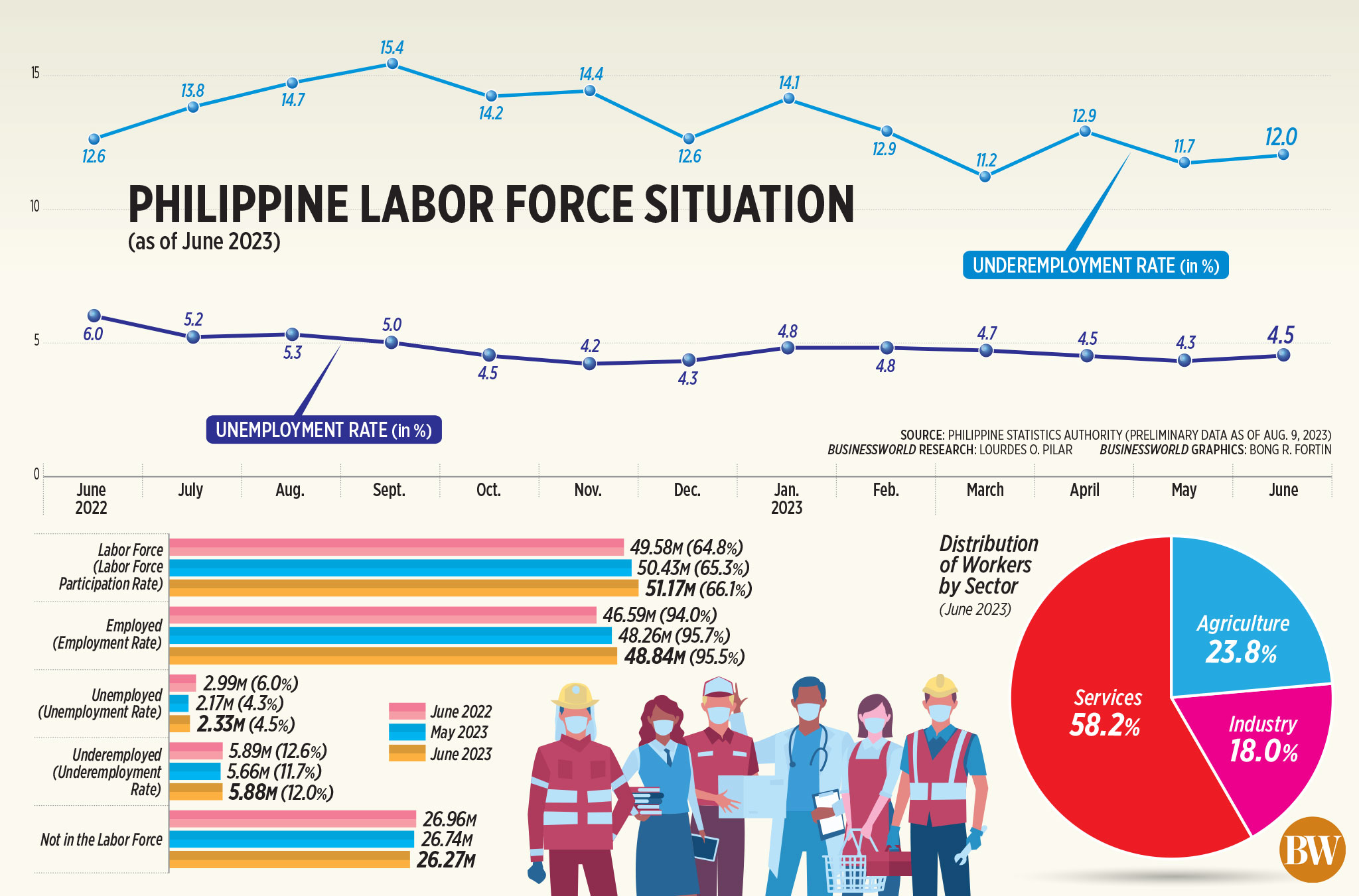
THE UNEMPLOYMENT RATE rose to a three-month high in June as the quality of jobs deteriorated, the Philippine Statistics Authority (PSA) reported on Wednesday. Read the full story.

LONDON — Britain’s data regulator is gathering information on Snapchat to establish whether the US instant messaging app is doing enough to remove underage users from its platform, two people familiar with the matter said.
Reuters reported exclusively in March that Snapchat owner Snap, Inc. had only removed a few dozen children aged under 13 from its platform in Britain last year, while UK media regulator Ofcom estimates it has thousands of underage users.
Under UK data protection law, social media companies need parental consent before processing data of children under 13. Social media firms generally require users to be 13 or over, but have had mixed success in keeping children off their platforms.
Snapchat declined to give details of any measures it might have taken to reduce the number of underage users.
“We share the goals of the ICO (Information Commissioner’s Office) to ensure digital platforms are age appropriate and support the duties set out in the Children’s Code,” a Snap spokesperson said.
“We continue to have constructive conversations with them on the work we’re doing to achieve this,” they added.
Before launching any official investigation, the ICO generally gathers information related to an alleged breach. It may issue an information notice, a formal request for internal data that may aid the investigation, before deciding whether to fine the individual or organization being investigated.
Last year, Ofcom found 60% of children aged between eight and 11 had at least one social media account, often created by supplying a false date of birth. It also found Snapchat was the most popular app for underage social media users.
The ICO received a number of complaints from the public concerning Snap’s handling of children’s data after the Reuters report, a source familiar with the matter said.
Some of the complaints related to Snapchat not doing enough to keep young children off its platform, the source said.
The ICO has spoken to users and other regulators to assess whether there has been any breach by Snap, the sources said.
An ICO spokesperson told Reuters it continued to monitor and assess the approaches Snap and other social media platforms were taking to prevent underage children accessing their platforms.
A decision on whether to launch a formal investigation into Snapchat will be made in the coming months, the sources said.
PLATFORM PRESSURE
If the ICO found Snap to be in breach of its rules, the firm could face a fine equivalent to up to 4% of its annual global turnover, which according to a Reuters calculation would equate to $184 million based on its most recent financial results.
Snapchat and other social media firms are under pressure globally to better police content on their platforms.
The NSPCC (National Society for the Prevention of Cruelty to Young Children), has said that figures it obtained showed that Snapchat accounted for 43% of cases in which social media was used to distribute indecent images of children.
Richard Collard, associate head of child safety online for the NSPCC, said in response to the Reuters report on Tuesday that the charity was hugely concerned about the use of Snapchat by children under 13.
“Snapchat users as young as 11 and 12 are talking to Childline about how they are sending nude images and communicating with adults on the platform,” he said.
“It is vital we see stronger action to ensure young children are not using the platform and older children are being kept safe from harm.”
Earlier this year, the ICO fined TikTok 12.7 million pounds ($16.2 million) for misusing children’s data, saying the Snap competitor did not “take sufficient action” to remove them.
A TikTok spokesperson said at the time that it “invested heavily” to keep under-13s off the platform and that its 40,000-strong safety team worked “around the clock” to keep it safe.
Snapchat does block users from signing up with a date of birth that puts them under the age of 13. However, other apps take more proactive measures to prevent underage children accessing their platforms.
For example, if an under-13-year-old has failed to sign up to TikTok using their real date of birth, the app continues blocking them from creating an account. — Reuters

PARIS — French wine production in 2023 is expected to be near the average of the last five years, with a favorable outlook in Champagne and Burgundy contrasting that in disease-hit Bordeaux, the French farm ministry said.
Overall wine output is projected to be between 44 million and 47 million hectoliters, a range that encompasses both the five-year average of 44.5 million hectoliters and 2022 output of 46.1 million hectoliters, the ministry said in a report on Tuesday.
A hectoliter is the equivalent of 100 liters, or 133 standard wine bottles.
Frequent storm showers and hot weather during May and June created the conditions for mildew disease in the Bordeaux and Southwest growing regions, meaning production forecasts are tentative for those areas, the ministry said.
“We’ve never been in a situation with such uncertainty and contrasts,” Jerome Despey, a producer in southern France and chair of farm office FranceAgriMer’s wine committee, told Reuters by telephone.
With the grape harvest expected to revert to a more typical schedule after a very early start last year, harvest prospects would not become clearer until picking gets into full swing from late August, he said.
Disease losses could add to difficulties for Bordeaux producers.
Falling demand for red wines, out of fashion with younger drinkers, prompted the government to offer producers aid this year.
The wine sector wants the government to expand funding for a distillation scheme so 3 million hectoliters of wine stocks can be cleared, mainly in Bordeaux and Languedoc-Roussillon in the far south, Despey said.
A separate scheme to pull up vines in Bordeaux, as a longer-term response to the decline in consumption, exacerbated by inflation pressures on households, had attracted applications totaling around 9,200 hectares, or some 8% of the total wine growing area in Bordeaux, he added.
In the south, drought was expected to lower output in Languedoc-Roussillon region, the ministry said.
But the situation was favorable elsewhere, with the growth of grapes boosted by ideal weather during the flowering period and by rain at the start of summer, it said.
Output was seen surpassing the five-year average in Champagne, where frost and hail caused limited damage this year, and also in Burgundy, despite some mildew cases, the ministry added. — Reuters

BANK of Commerce (BankCom) saw its net profit rise by 79% in the first half, driven by sustained growth of its core businesses.
The bank’s net income stood at P1.59 billion in the first semester, up from P886.01 million in the same period last year, it said in a statement on Wednesday.
Its financial statement was not available as of press time.
Its second-quarter net income stood at P874.35 million, with gross revenues at P2.58 billion.
The lender’s first-semester performance translated to a return on equity of 11% and a return on assets of 1.49%.
Net interest income grew by 28% year on year to P3.95 billion in the first half.
This resulted in a net interest margin of 4.35%, up from 3.73% at end-2022.
Meanwhile, non-interest income grew by 54% to P901.2 million.
The bank said this was mainly due to a 24% rise in fee-based revenues to P448.02 million.
“Foreign exchange gains also rose by 18% to P80.81 million on account of increased volume of transactions,” BankCom said.
“The bank recorded a reversal of provisions amounting to P11.83 million reflecting improving credit quality and some recoveries,” it added.
This resulted in a 32% growth in revenues to P4.85 billion.
Meanwhile, total operating expenses excluding provisions rose by 7.51% to P2.74 billion in the first quarter.
Its cost-to-income ratio stood at 56.36% at end-June.
Loans and receivables went up by 3.22% to P108.47 billion driven by corporate lending.
Its net nonperforming loan (NPL) ratio decreased to 0.56% from 0.6% at end-2022. Meanwhile, its gross NPL ratio stood at 2.13%.
The bank’s assets stood at P207.52 billion at end-June.
Meanwhile, total capital rose by 6% to P29.67 billion from P28.03 billion at end-2022. Its capital adequacy ratio climbed to 19.42% as of June from 17.97%.
BankCom’s shares closed at P6.05 apiece on Wednesday, up by two centavos or 0.33%. — AMCS
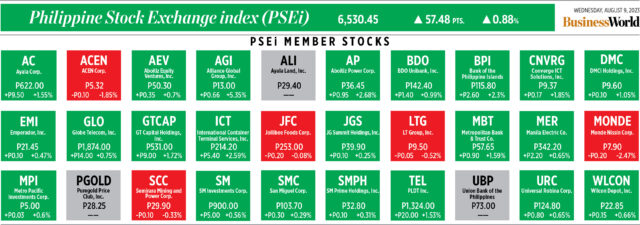
Here’s a quick glance at how PSEi stocks fared on Wednesday, August 9, 2023.
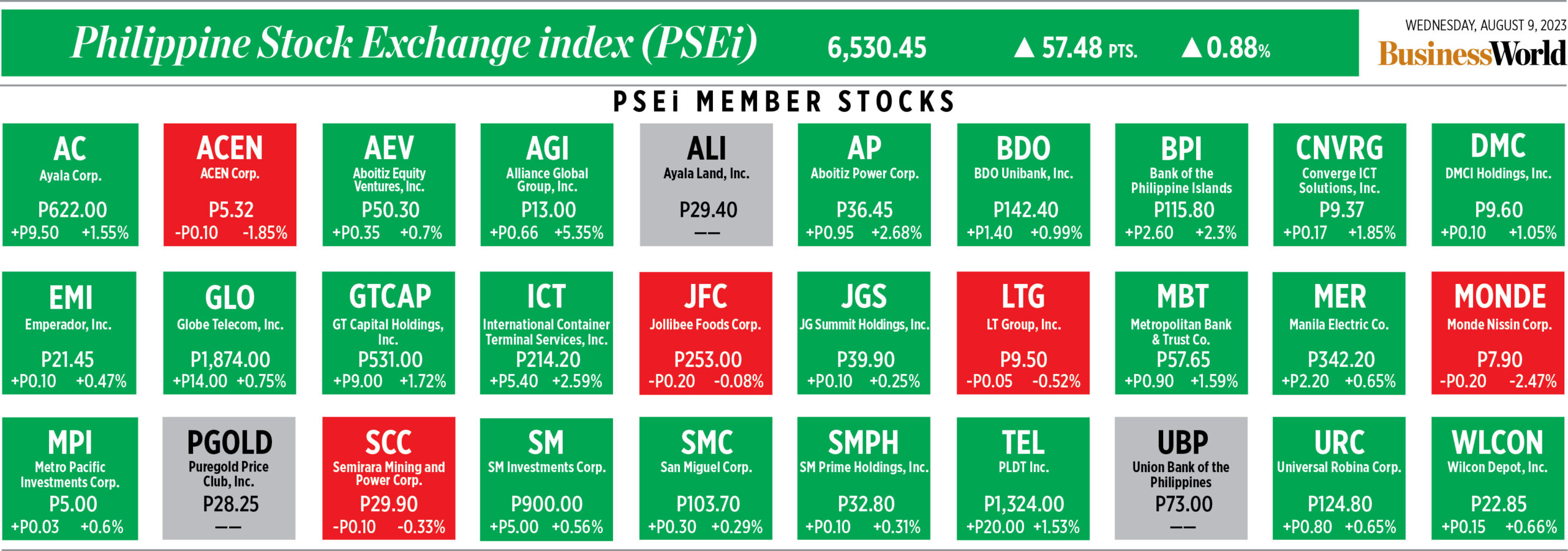


PHILIPPINE SHARES rebounded on Wednesday as positive economic data and corporate results helped improve sentiment.
The Philippine Stock Exchange index (PSEi) rose by 57.48 points or 0.88% to close at 6,530.45 on Wednesday, while the broader all shares index went up by 19.05 points or 0.55% to end at 3,480.16.
“The local bourse gained by 57.48 points to 6,530.45 as the Philippines’ employment rate remained strong in June, despite inching down month-on-month,” Philstocks Financial, Inc. Research Analyst Claire T. Alviar said.
“Employment rate in June was at 95.5%, inching down a bit from May’s 95.7% but still higher compared to June last year’s 94.00%. Moreover, narrower balance of trade in goods in June, especially with the 0.8% year-on-year growth of exports, helped lift sentiment,” Ms. Alviar said.
The labor force size in June increased by 741,000 from the previous month, reaching 51.17 million, Philippine Statistics Authority data released on Wednesday showed.
Meanwhile, the Philippines’ trade-in-goods deficit narrowed for a third consecutive month in June as imports contracted to a near three-year low while exports were flat as global demand for goods weakened.
Merchandise imports contracted by 15.2% year on year to $10.62 billion, while exports inched up by 0.8% to $6.7 billion.
The local bourse rose as stocks were bought following the release of corporate results and ahead of Philippine second quarter gross domestic product (GDP) data due out on Thursday, Regina Capital Development Corp. Head of Sales Luis A. Limlingan said in a Viber message.
Economic growth likely slowed to 6% in the second quarter amid elevated inflation and higher borrowing costs, a BusinessWorld poll of 21 analysts held last week showed.
If realized, this would be slower than the 6.4% growth in the first quarter and the 7.5% expansion in the same period in 2022.
This would bring the average GDP growth to 6.2% in the first half, within the government’s 6-7% full-year target.
Sectoral indices increased on Wednesday except for mining and oil, which dropped by 60.78 points or 0.59% to 10,106.29.
Meanwhile, services rose by 21.37 points or 1.36% to 1,590.70; financials climbed by 22.41 points or 1.18% to 1,915.64; holding firms went up by 51.02 points or 0.83% to 6,196.09; property added 7.54 points or 0.27% to end at 2,742.49; and industrials inched up by 2.69 points or 0.02% to 9,136.48.
Value turnover dropped to P3.39 billion on Wednesday with 428.38 million shares changing hands from the P4.58 billion with 622.67 million issues seen on Tuesday.
Decliners outnumbered advancers, 92 versus 89, while 52 names closed unchanged.
Net foreign buying stood at P214.67 million on Wednesday versus the P165.06 million in net selling recorded on Tuesday. — AHH

THE PESO recovered against the dollar on Wednesday ahead of the release of Philippine gross domestic product (GDP) data for the second quarter.
The local currency closed at P56.20 versus the dollar on Wednesday, strengthening by four centavos from Tuesday’s P56.24 finish, data from the Bankers Association of the Philippines’ website showed.
The local unit opened Wednesday’s session at P56.40 per dollar. Its intraday best was at P56.20, while its weakest showing was at P56.44 against the greenback.
Dollars traded went down to $996.2 million on Wednesday from $1.15 billion on Tuesday.
“The peso recovered today amid local optimism ahead of the Philippine GDP report tomorrow,” a trader said in a Viber message on Wednesday.
A BusinessWorld poll of 21 economists conducted last week yielded a median estimate of 6% for second-quarter GDP growth.
If realized, this would be slower than the 6.4% growth in the first quarter and the 7.5% expansion in the same period in 2022.
This would bring the first-half average to 6.2%, within the government’s 6-7% full-year target.
The Philippine Statistics Authority will release second-quarter GDP data on Thursday, Aug. 10.
The peso was supported by dovish signals from a US Federal Reserve official, Rizal Commercial Banking Corp. Chief Economist Michael L. Ricafort added in a Viber message.
Barring any abrupt change in the direction of recent economic data, the US Federal Reserve may be at the stage where it can leave interest rates where they are, Philadelphia Fed President Patrick Harker said on Tuesday, Reuters reported.
The Fed raised borrowing costs by 25 basis points (bps) last week, bringing its target rate to a range between 5.25% and 5.5%.
The US central bank has hiked rates by a cumulative 525 bps since it began its tightening cycle in March last year.
The Federal Open Market Committee will hold its next policy review on Sept. 19-20.
For Thursday, the trader said the peso would likely appreciate further ahead of the GDP report.
The trader expects the peso to move between P56.05 and P56.30 per dollar on Thursday, while Mr. Ricafort expects it to range from P56.10 to P56.30. — A.M.C. Sy with Reuters
