Home Blog Page 4483

Yields on term deposits rise amid growing inflation risks

BW FILE PHOTO

YIELDS on the term deposits auctioned off by the Bangko Sentral ng Pilipinas (BSP) edged higher on Wednesday as global crude oil prices rose and the peso depreciated to a two-month low against the dollar, which could affect inflation.

Demand for papers under the BSP’s term deposit facility (TDF) totaled P297.282 billion on Wednesday, lower than the P300 billion on the auction block. However, this is higher than the P280.088 billion in bids logged last week for the P280-billion offer.

Broken down, the seven-day deposits attracted tenders amounting to P167.147 billion, above the P160-billion offering and the P151.358 billion in bids recorded the prior week for a P150-billion offer.

Rates for the one-week papers ranged from 6.57% to 6.61%, slightly narrower than the 6.559% to 6.61% range logged in the previous week. This brought the average rate for the tenor to 6.5932%, inching up by 0.44 basis point (bp) from the 6.5888% seen on Aug. 2.

For the 14-day deposits, tenders hit P130.135 billion, below the P140-billion offering but slightly above the P128.730 billion in bids seen last week for the P130 billion on the auction block.

Accepted yields were from 6.5% to 6.62%, unchanged from the previous week. Still, the average rate of the two-week deposits went up by 0.71 bp to 6.5974% from the 6.5903% logged a week ago.

The central bank has not auctioned off 28-day term deposits for more than two years to give way to its weekly offering of securities with the same tenor.

The term deposits and the 28-day bills are used by the BSP to mop up excess liquidity in the financial system and to better guide market rates.

TDF yields were higher week on week after global crude oil prices went up, which could affect inflation, Rizal Commercial Banking Corp. Chief Economist Michael L. Ricafort said in a Viber message.

Brent crude futures and US West Texas Intermediate (WTI) gained nearly $1 on Tuesday. Brent crude futures gained 83 cents to $86.17 a barrel while US WTI crude rose 98 cents to $82.92, Reuters reported.

Yields went up amid the peso’s depreciation against the greenback, which could also lead to higher import prices and inflation, Mr. Ricafort added.

The peso weakened to a two-month low against the dollar on Tuesday due to hawkish remarks from a US Federal Reserve official.

The local currency closed at P56.24 versus the dollar on Tuesday, weakening by 22 centavos from Monday’s P56.02 finish, data from the Bankers Association of the Philippines’ website showed.

This was the peso’s weakest close in over two months or since its P56.26-per-dollar close on June 1.

Additional interest rate hikes will likely be needed in order to lower inflation to the Fed’s 2% target, Fed Governor Michelle Bowman said on Monday.

The Fed raised borrowing costs by 25 bps last month, bringing its target interest rate to a range between 5.25% and 5.5%.

The US central bank has hiked rates by a cumulative 525 bps since it began its tightening cycle in March last year.

The Federal Open Market Committee will hold its next policy meeting on Sept. 19-20.

Meanwhile, the BSP expects inflation to return to its 2-4% annual target before the year ends.

Headline inflation slowed to 4.7% in July from the 5.4% in June, its sixth straight month of decline.

From January to July, inflation averaged 6.8%, still higher than the 5.4% forecast of the central bank. — K.B. Ta-asan with Reuters

A new gourmet treasure trove

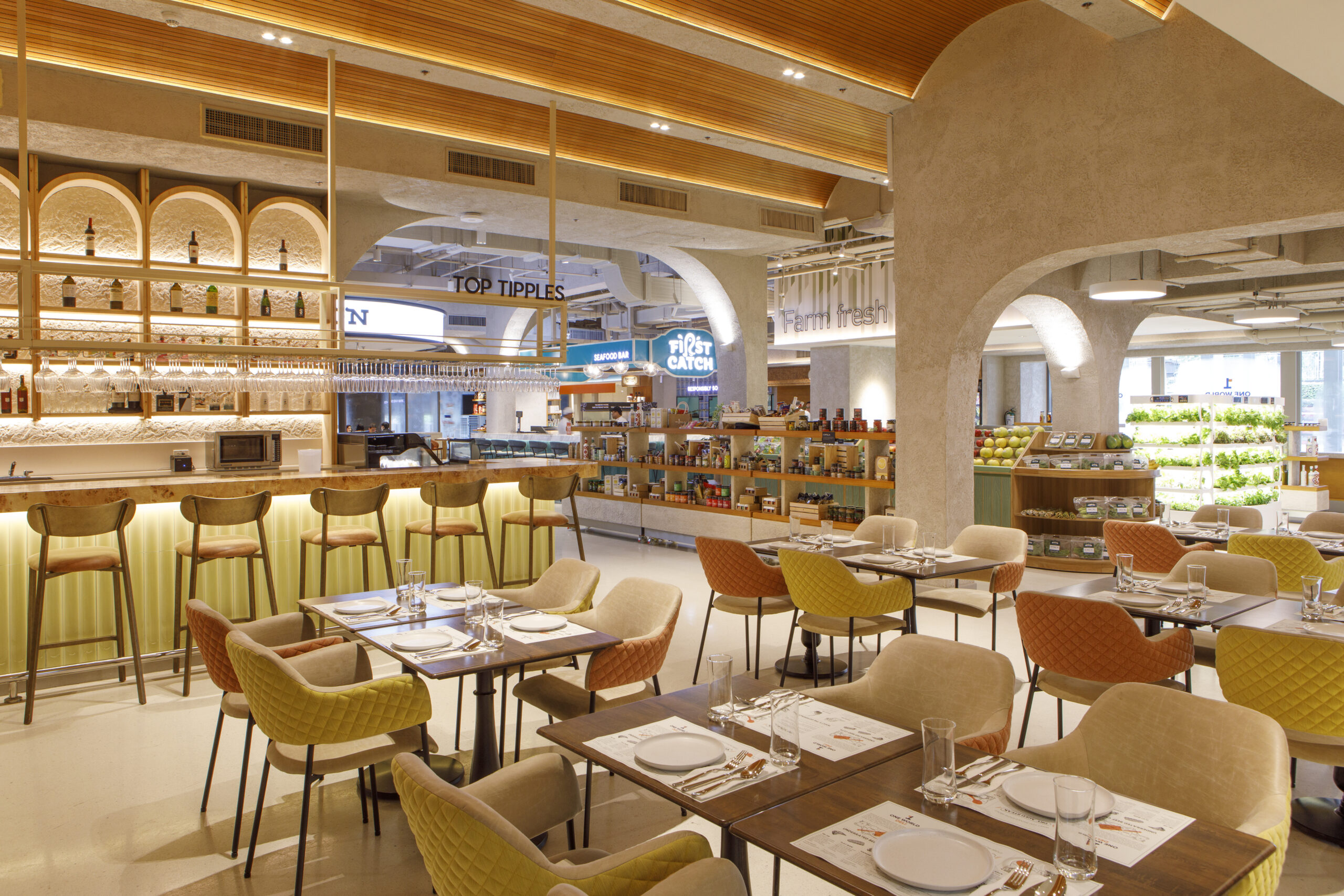
THE WORLD is getting bigger for One World Deli, which opened its latest branch in San Juan City on Aug. 7. Guests surveyed and celebrated the shelves and counters lined with fresh local produce, meats, seafood, and pantry staples brought in by the deli’s suppliers, chef collaborators, and in-house experts.

One World Deli presents goods from all around the world — the Meat Anton counter alone offering such specialties as John Stone Beef dry-aged meats from Ireland, black angus beef by Braveheart in the US, Red Duroc pork from Dingley Dell in the UK, and Satsuma Fukunaga wagyu from Japan.

The deli may look like a clean, spacious supermarket from the outside, but within lie high-grade items that can either be brought home or cooked and consumed on the spot.

For PYC Foods Corp. president and founder Julio “Jun” Sy, who owns One World Deli, it was a no-brainer to open the second branch in San Juan to follow up the success of the first one that opened in Makati last year.

He mentioned that others are slated to open this year, including a branch in Mall of Asia in Pasay City.

Many foodies joined the warm and lively opening in San Juan, commenting on the sheer cavernous space within the deli. It turns out, it was inspired by one of the city’s major attractions, the El Deposito, which is the Philippines’s oldest underground reservoir.

The various pods also reflect One World Deli’s various points of interest.

The Farm Fresh area, for instance, has a mix of local and imported organic fruits and vegetables, as well as towers of hydroponically grown greens. Whether it’s vibrant greens or flavorful mushrooms, this spot will have it all, according to Nicolo Durian of produce supplier Pedro Farms, based in Cavite.

Meanwhile, the Cellar houses a mix of old and new world wines, while the Top Tipples bar pours out choice wines and spirits. Tagaytay-based Monkey Eagle Beers provides bottles of premium craft beer.

“Everyone involved here loves food, loves exploring, loves experimenting, and loves sharing all of that with everyone else,” said chef John Lees of The Tattooed Baker, which stocks the deli’s bakery with bread baked daily.

He told BusinessWorld that there’s a delicious story behind every food item you pick out. His own macaroons, with flavors spanning carrot cake to Bailey’s to Vegemite with white chocolate, reflect that motto.

With that mentality, even condiments are a must-try and must-buy here — take for example a sweet honey elixir resulting from sustainable harvesting methods by A Buzz From The Bees.

“Eating is way more fun if you’re curious about everything,” he said.

One World Deli San Juan is located at The Corner House, C.M. Recto St., cor. P. Guevarra St., San Juan city. — Brontë H. Lacsamana

Villar group acquires Muntinlupa Cavite Expressway

PRIME ASSET Ventures, Inc. (PAVI) has signed the  implementing agreements for its acquisition of the four-kilometer Muntinlupa Cavite Expressway (MCX) from Ayala Corp., the Villar-led company said on Wednesday.

“This momentous event shows our resolve to provide our countrymen better services in the area of roads and toll ways,” Manuel B. Villar, Jr., Vista Land chairman, said in a statement.

The company said that this aligns with the Villar group’s ongoing investment portfolio expansion, extending from its core businesses in housing, retail, food, water, power, and utilities to integrated resorts and entertainment.

“Ayala developed MCX over a decade ago to connect Metro Manila to Imus, Dasmariñas and Bacoor in Cavite, which were experiencing rapid growth. MCX succeeded in relieving traffic congestion and reducing the travel time between Metro Manila and Cavite,” Ayala President and Chief Executive Officer Cezar P. Consing said.

Mr. Consing added that the sale of MCX represents the company’s aim to recycle capital to “benefit from opportunities in our core and emerging businesses.”

Ayala said last year that it would sell its entire stake in MCX to the Villar-led firm for P3.8 billion as part of its strategy to divest noncore assets.

The company said that it had signed an investment agreement with Prime Asset Ventures for the sale of its 100% ownership in MCX Project Company, Inc.

PAVI said that the Department of Public Works and Highways had given its consent for the transfer of ownership from Ayala to the Villar group on July 19, 2023.

The Villar-led PAVI is an investment and holdings company with a diverse portfolio of infrastructure and public utility assets. — Adrian H. Halili

IFC to invest $250M as sole subscriber of BPI green bond

THE INTERNATIONAL Finance Corp. (IFC) will invest $250 million in a green bond to be issued by the Bank of the Philippine Islands (BPI) to help boost climate finance in the country.

IFC will be the sole subscriber of the bond, the global developmental institution said in a joint statement with BPI on Wednesday. The bond will be aligned with the International Capital Market Association’s Green Bond Principles.

This is the biggest deal the IFC has done with a Philippine financial institution, they said.

“Proceeds will be used to finance eligible green assets in the Philippines, including renewable energy, energy efficiency, green buildings, electric vehicles, and climate-smart agriculture projects, among others,” they said.

“While most of the proceeds will be used for local projects, part could also be used to invest in bonds with underlying green assets overseas. IFC has also agreed to help BPI build its capacity to assess the eligibility and impact of its climate projects,” they added.

The issuance is also aligned with IFC’s 30 by 30 Zero Program, under which it targets to help financial institutions bring their climate-related lending to 30% of their portfolios and have minimal coal exposure by 2030.

“As a bank known for its commitment to sustainable finance and climate change mitigation, we are delighted that IFC has entrusted us with this significant investment. This is our third green bond issuance, and we will draw on our successful track record to fund projects that will make a lasting difference in the communities in which we operate,” BPI President and Chief Executive Officer Jose Teodoro K. Limcaoco was quoted as saying.

“IFC is pleased to continue its impactful partnership with BPI, a longtime client and partner in promoting climate finance in the Philippines. Thematic bonds are a key pillar of our longstanding commitment to not only tackle climate change, but also to help deepen sustainable capital markets in the country,” IFC Country Manager for the Philippines Jean-Marc Arbogast said.

BPI saw its net income rise by 4.5% year on year to P13 billion in the second quarter amid higher revenues.

Its shares rose by P2.60 or 2.3% to close at P115.80 apiece on Wednesday. — AMCS

The incredible shrinking global sea powers

DANIIL ZAMESHAEV-UNSPLASH

THE OBVIOUS place to look if you want to understand the future is cyberspace — the birthplace of virtual worlds, artificial intelligence and other digital wonders. But we shouldn’t forget the case for keeping a watchful eye on something more elemental — the relative fortunes of land powers versus sea powers. Sages from Homer onwards have argued that land and sea powers generate different societies and we forget their wisdom at our peril.

Everywhere you look, land powers are on the march. Russia is trying to reassemble its old imperium by gobbling up first Crimea and now Ukraine. China has ingested the great seaport of Hong Kong and may be planning to do the same to the island of Taiwan. Brexit means that the European Union is more than ever a land-power: dominated by Germany and France and looking eastward towards land-locked Mitteleuropa. The United States, which has long flipped between being a land power and a sea power, is turning inwards once again.

This is bad news for the future of both free trade and liberty. Sea powers, most notably Great Britain, created both the institutional and intellectual infrastructure of a distinctively liberal form of capitalism: limited government at home and free trade abroad supported by innovative stock markets and powerful navies. Land powers, by contrast, pursued a more authoritarian road to modernity: overbearing governments, standing armies necessitating efficient tax systems, dirigiste economies, and, above all, a hunger for yet more land (at its most monstrous manifestation, Adolf Hitler’s lebensraum).

The founders of modern economic liberalism saw numerous links between open seas and open societies. Adam Smith argued that “water carriage” opens a more extensive market than “land carriage.” David Hume noted that merchants who “possess the secret of importation and exportation” check the power of the ancient nobility and “tempt other adventurers to become their rivals in commerce.” In the 16th century, England and another smallish seafaring nation, the Dutch Republic, became the world’s first capitalist powers. They both created powerful navies, ambitious merchant classes, sprawling empires, far-flung alliances and vital political philosophies — Hugo Grotius, John Locke — of global import.

The relationship between sea power and land power, and between both and liberty, was more nuanced than these great thinkers supposed. Spain had a powerful enough navy to challenge the British to a fight (the Armada of 1588 was repulsed as much by the weather as Francis Drake) and founded a giant empire in the Americas. Japan was a hermit kingdom until the late 19th century when it launched on imperial expansion in Asia and the Pacific.

The Atlantic world’s commitment to freedom was also nuanced. The Netherlands and Britain created vast overseas empires. British trading companies, particularly the Royal Africa Company, dealt in slaves. The navy’s detractors described ships as floating prisons that relied on press gangs to provide them with men — and rum and the lash to keep those men in order.

Yet qualifications don’t discredit the thesis. Spain was a highly centralized state that treated its South American territories as a source of gold to finance its military exploits on the European mainland rather than as a trading partner. Slavery and colonialism have been ubiquitous in human history. In 1807, Britain was the first country to abolish the slave trade within its territories and to use the might of its navy to enforce the abolition. And, for all their abuses, sea powers developed principles of limited government and secure property rights whereas prominent land powers, notably Russia and China, remain despotisms.

Britain’s history and culture are saturated in sea salt: many of the country’s greatest heroes were admirals (Horatio Nelson who still looks over central London from his column) and many of its greatest artists, notably J.M.W. Turner, focused on maritime themes. The British navy was known as “the Senior Service” to the army’s junior. The unofficial national anthem, “Rule Britannia,” was fully conscious that the country’s source of power came from ruling the waves.

The US was never as committed to the sea as Britain. It began life as a maritime power with its population concentrated on the north-east seaboard and its political elite soaked in the writings of Smith and Locke. In the 19th century it turned inwards, colonizing the vast interior, protecting its infant industries and steering clear of foreign entanglements. But in the late 19th century it turned outwards once again as it built its own navy, extended its commerce around the world, and renewed its links with Britain.

The US and Britain together twice prevented Europe from becoming a German province. During World War II, Winston Churchill and Franklin Roosevelt bonded in part over their shared naval experience — the US president was Assistant Secretary of State for the Navy in 1897-98 and the British prime minister was First Lord of the Admiralty in 1911-15. Seadog to seadog. The Atlantic Charter, which provided a joint declaration of Britain and America’s war aims on Aug. 14, 1941, was celebrated in an extraordinary religious service on the HMS Prince of Wales. Thereafter, Britain and America co-operated in re-founding the world on the basis of the liberal principles of free trade and rule-bound global institutions.

Victory, however, had its costs. While defeating the Axis, Britain lost about 280 major warships and 1,000 smaller ones like minesweepers. It was an astonishing demonstration of its continued naval prowess amid the decline of its empire but also a loss from which an exhausted power could never recover. Today, the UK scarcely has a fishing fleet, a shipbuilding industry, a merchant marine, or sailors. The Senior Service has suffered from merciless cuts. It is hard to see Britain sending a fleet to the South Seas to thwart an Argentinian invasion of the Falklands Islands as it did in 1982. The coastguard is locked in the endless job of rescuing refugees from the sea.

The US still has by far the world’s biggest navy. But it is nevertheless reverting to its old land-based habits. Joseph Biden has entrenched Donald Trump’s America First policies by reinforcing barriers to the export of strategic industries to China, focusing on promoting domestic manufacturing and national industrial strategies rather than global trade. Having played a leading part in creating the World Trade Organization, America is now sidelining or even undermining it. US culture is increasingly inward looking, focused on addressing domestic decay, which is understandable, or fighting toxic culture wars, which is less so. (Europe is now mimicking the US in subsidizing and protecting domestic manufacturers and turning its attention away from global trade.)

The critical shift in the balance of power is gathering pace elsewhere. China has the capacity to define the 21st century in the way that the US did the 20th. History and geography have conspired to make the Middle Kingdom a quintessential land power. The Emperor disbanded the country’s formidable navy in the 15th century and banned trading with the outside world. The government is based in the inland city of Beijing and has long been preoccupied by threats from marauders from the vast northern steppe, hence the Great Wall. The West once hoped that coastal provinces and cities — most notably Hong Kong — would pull the country towards freedom. Instead, the former British colony’s liberty has been crushed and the metropolis has gone from entrepot to garrison. The next great global clash may well be ignited should China try to conquer Taiwan.

China is allied to another great land power that stretches from Asia to Europe. In the 17th century, Peter the Great tried to reorient Russia to the West — and modernity — by building a navy and creating the port city of St. Petersburg. But, over the ensuing centuries, the enterprise failed spectacularly. Today Russia displays all the defects that have long been associated with land powers at their worst: an omnipotent state, a lack of private property rights, and an addiction to seeking power and prestige by acquiring land. Russia’s basic instinct is to extend its influence by marching into neighbors’ territories, but it is also extending its tentacles around the world, dispatching Wagner group mercenaries to Africa and using the proceeds of its mineral wealth to twist, subvert, or otherwise corrupt foreign institutions.

There have been dire consequences in the past when sea powers have been supplanted by land powers. Athens, the birthplace of democracy, declined rapidly after Sparta destroyed its navy at Aegospotami in 405 BCE. Venice pioneered limited government at home — the Doge was elected for life but required to take advice from a rotating council — while trading with all the known world. But it eventually sank into beautiful irrelevance. Its fate holds poignance for Britain. J.R. Seeley, one of the most influential 19th century historians, once dubbed Britain “a world Venice, with the sea for streets.”

One of the great 18th century politicians, Thomas Pelham-Holles, the first Duke of Newcastle, noted that Britain had no choice but to “consider the whole globe” because “every part of the world affects us.” Now, Britain can barely manage to look across the channel. It skitters from one geopolitical strategy to another — first joining Europe, then leaving it, and now feverishly searching for a place in a regionalizing world. The country’s departure from the EU has handed power to a Franco-German alliance — something that centuries of British foreign policy had tried to avoid — and reduced the size and sophistication of the free trade caucus in Brussels.

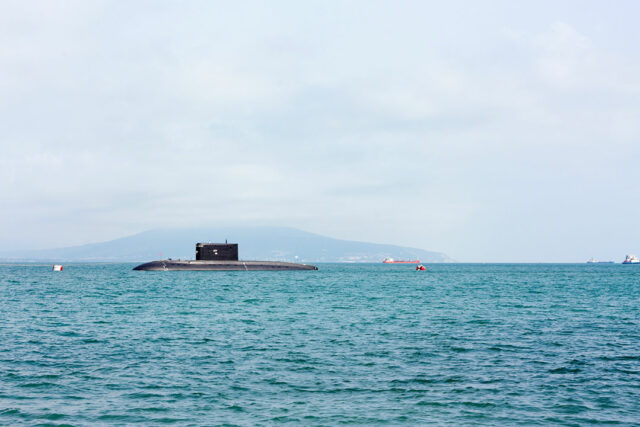
Many Brexiteers hoped to use the departure to construct an Anglosphere of culturally similar powers linked by similar maritime traditions — the United States, Canada, Australia, New Zealand — to function as a counterbalance to a land power future. But this has not happened. The AUKUS agreement, whereby Britain and the United States are helping to provide Australia with nuclear submarines, hardly compensates for the failure to create an Anglo-American trading deal.

A striking number of Britain’s seaside towns are moldering places like Clacton-on-Sea. They provided the Brexit-mongering UK Independence Party with its first footholds in British politics. British naval heroes have been moved from the center of school curriculums to the margins, mentioned, if they are mentioned at all, with a lecture on colonialism. University history departments have almost abandoned naval history.

The spirit that defined the buccaneering world of England’s Francis Drake is now finding new homes in cyberspace and outer space. Today’s pirates spend their time surfing the web rather than skimming the waves. Our contemporary adventurers finance flights to the moon and Mars rather than the East Indies. But will these they create a liberal culture in the way that the English and Dutch once did? China has broken the link between the web and liberty by building a Great Fire Wall and using the internet to spy on its people. Russia exerts its cyber prowess interfering in foreign elections and stirring up discord across the West.

The decline of sea power is clearly a tragedy for Britain. Over the coming decades, it is likely to prove just as tragic for the rest of the world.

BLOOMBERG OPINION

Dining In/Out (08/10/23)


Johnnie Walker Blue, Wolfgang’s Steakhouse team up on pairing menu

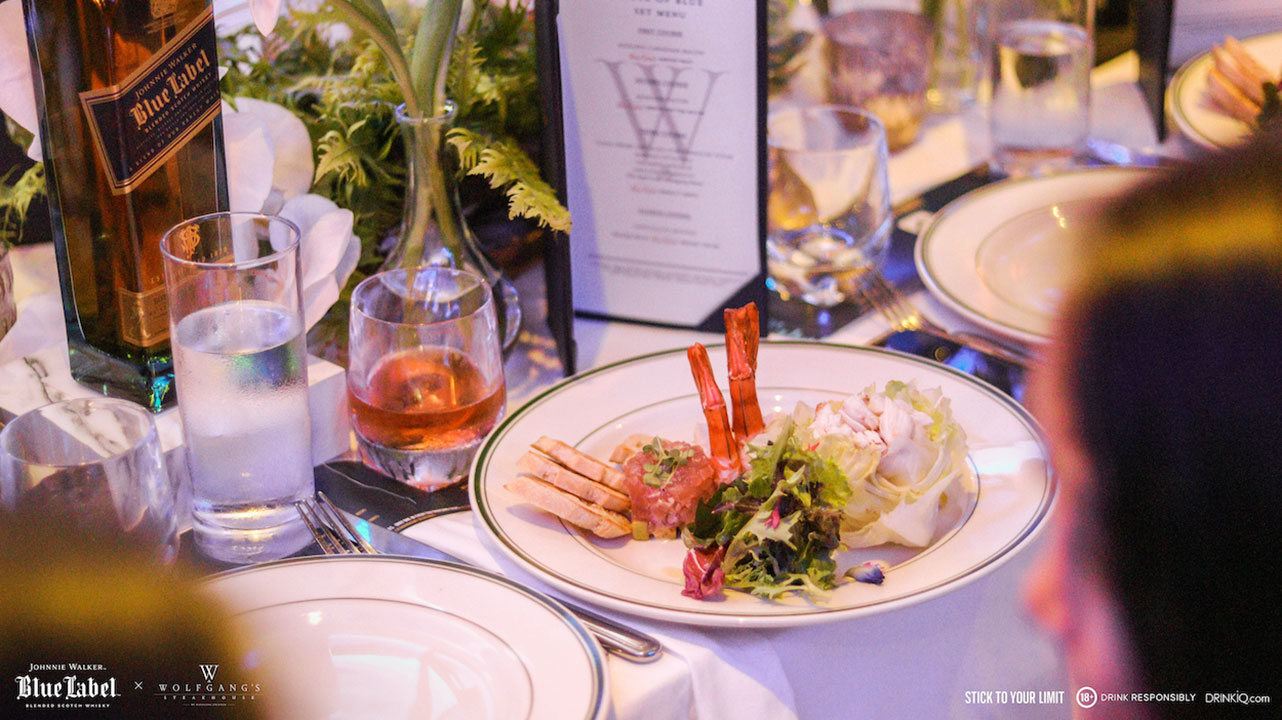
JOHNNIE WALKER has partnered with Wolfgang’s Steakhouse to launch The Taste of Blue, an exclusive steak and whisky pairing menu. Developed in collaboration with Chris Oronce, Executive Chef of Wolfgang’s Steakhouse, the pairing menu showcases the harmony between the restaurant’s cuisine and the blend of Johnnie Walker Blue Label. Customers at Wolfgang’s Steakhouse at Newport World Resorts can now enjoy a four-course menu accompanied by a selection of Blue Label. The pairing menu begins with an appetizer of Canadian Bacon, to be enjoyed with Johnnie Walker Blue Label neat. This is followed by a Seafood Platter, partnered with Blue Label whisky on the rocks. For the main course, diners are served Wolfgang’s famous Porterhouse Steak with mashed potatoes, spinach, and grilled asparagus, accompanied by signature Johnnie Walker Blue Label served neat with iced water on the side. To fully unlock the blend’s complexity this is to be enjoyed by taking alternate sips between the whisky and water to bring out the fruity and subtle smoke of Johnnie Walker Blue Label. To finish the meal, a special whisky-infused dessert is served. The Taste of Blue pairing menu by Johnnie Walker Blue Label is available until Oct. 15 at Wolfgang’s Steakhouse’s Newport World Resorts, City of Dreams Manila — Integrated Resort, Hotel & Casino, and Bonifacio Global City branches. The set menu for two is priced at P9,488 per person.


Pizza Hut’s newest creation is for solo diners

PIZZA Hut’s newest dish targets the solo diner — Pizza Hut Melts. This is a thin, crispy crust pizza covered with cheese and other toppings, which comes with a marinara dip. The new Pizza Hut Melts is priced at P229 a la carte and is available in four flavors: Meat Lovers, with pepperoni slices, Italian sausage bits, beef and pork toppings, bacon, and mozzarella cheese; Hawaiian Supreme, made with diced ham, pineapple tidbits, and mozzarella cheese; Double Bacon, made with toasted bacon bits, and mozzarella cheese; and, Four Cheese & Mushroom, with mozzarella cheese, parmesan, orange cheddar cheese, Hokkaido cheese, and mushrooms. There’s also the My Melts Meal, priced at P249, which comes with one’s choice of Melts and a serving of Pepsi. The My Melts Combo, priced P299, comes with Crispy Fries to go with the Melt and drink. Pizza Hut Melts are available for dine-in and take-out in all Pizza Hut stores nationwide, and for delivery via the (02) 8911-1111 hotline, www.pizzahut.com.ph, or the Pizza Hut mobile app, as well as Pizza Hut’s official delivery partners GrabFood, foodpanda, and Pick.a.roo (prices may vary).


Popeyes opens 50th branch in Quezon City

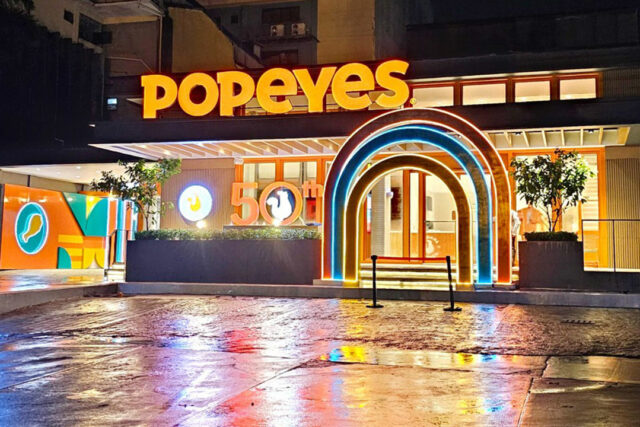
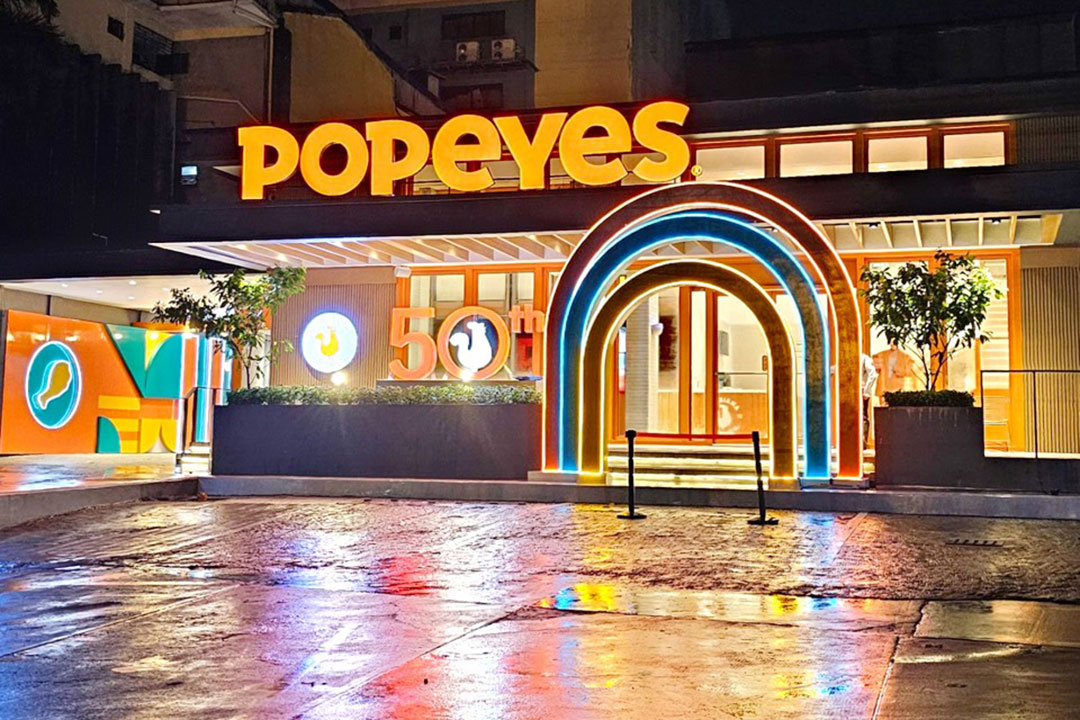
POPEYES PHILIPPINES opened its 50th restaurant at Quezon Ave. Corner Timog Ave., Quezon City on July 19. The new restaurant is the biggest one in the country yet — boasting a two-floor design, eye-catching interiors, and a drive-through. The chain’s menu includes Louisiana Popeyes Fried Chicken, Chicken Tenders, Cajun Fries, Chicken French Quarter, US Spicy Chicken Sandwich, and their signature Biscuits. “While Popeyes is a US brand, we’ve made it our priority to appeal to Filipinos through our delicious food, passionate service, and extraordinary ambience. We’re thrilled to announce that we’re extending the Popeyes experience to more chicken fans here in Quezon City,” said Dustin Ngo, Marketing Director of Popeyes, in a statement. The New Orleans-founded restaurant, which has been in the Philippines since 2019, also has a new brand ambassador, actor Kyle Echarri, who recently appeared in Popeyes new music video for the song, “That’s Poppin.” Follow @popeyesph on Facebook and Instagram to stay updated on the latest meals and deals or visit www.popeyes.ph for more information.


Conrad Manila’s Legendary Chefs Series goes Italian

FROM Aug. 7 to 15, Conrad Manila’s Brasserie on 3 features the Legendary Chefs Series — La Dolce Vita, showcasing the culinary style of chef Valerio Pierantonelli from the world-class Italian restaurant, Basilico of Conrad Singapore Orchard. The menu will feature a selection of dishes, including Mediterranean Octopus Salad with Yellow Potato and Fresh Basil Pesto, Carnaroli Risotto with Saffron and Asparagus Sauce, and Traditional Italian Tiramisu with Marsala and Mascarpone Sabayon. In addition to these, a live station will offer pasta enthusiasts an opportunity to indulge in Tortelli Pasta stuffed with Pork, tossed in a Brown Butter and Sage Sauce with Grana Padano and Toasted Hazelnuts. The festival will run during lunch and dinner, with prices as follows: Monday to Thursday lunch, P1,799 net; Monday to Thursday dinner, P2,299 net; Friday to Sunday lunch, P3,000 net; and Friday to Sunday dinner, P3,500 net. For reservations and inquiries, contact Conrad Manila’s dining reservations at 8833-9999 (landline), 0917-650-3591 (mobile) or e-mail MNLMB.FB@conradhotels.com.


Burger King introduces BK CAFÉ line

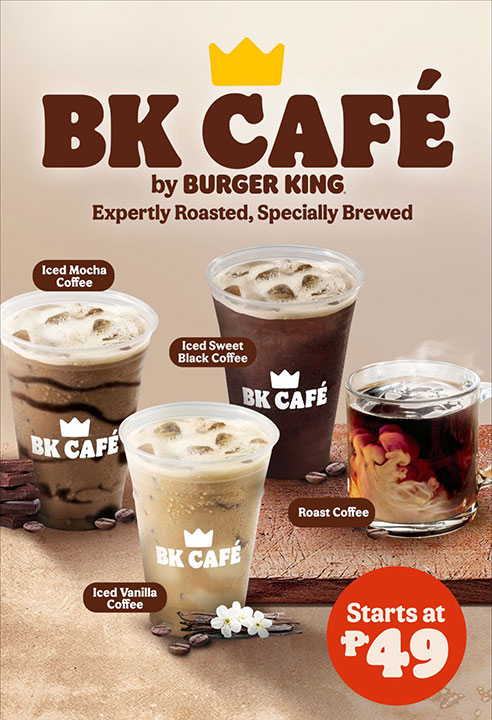
GLOBAL fast-food chain Burger King is upping its game with its new coffee product line, BK CAFÉ. This is a wide range of expertly roasted and specially brewed coffee drinks made with 100% Arabica beans, directly sourced from Holland. The drinks are made using Cafitesse coffee machine technology. Starting at P49, BK CAFÉ offers a range of hot and iced coffee options. Choose from three iced coffee flavors: Iced Sweet Black, Iced Vanilla, and Iced Mocha. With the launch of BK CAFÉ, Burger King has also rebranded its Joe Coffee as Roast Coffee, assuring customers that the drink remains unchanged. BK CAFÉ will be a mainstay feature on Burger King’s menu nationwide, whether dining in, going through the drive-through, choosing take-out, or opting for delivery. It is also available through delivery platforms such as the Burger King App, Grab, and FoodPanda. Meanwhile, promotions are now exclusively available through the BK App. Order a combination of an Iced Coffee drink and a rice meal or burger, all at a discounted price. Check out the BK App to explore a variety of featured Combos. Diners who miss the Mocha Joe Frost can upgrade their Iced Mocha drink to a coffee float (tap on the “Add Sundae” option) and experience that familiar taste.


Nespresso offers deals this August

AUGUST is here, and with it comes Nespresso’s biggest sales promotion of the year. Nespresso’s Ultimate August offers consist of discounts, gifts, and convenient payment options. For the whole month, Nespresso is offering a 20% discount on a wide range of coffee machines including the Essenza Mini, the Creatista Plus, and the revolutionary Vertuo Next. One can also enjoy gifts in the form of Nespresso accessories for one’s coffee purchase. Nespresso understands that investing in a coffee machine is a considered decision, and to make it even easier, the brand is offering 0% installment options up to six months for payments made via credit cards (BPI, BDO, and Metrobank). Avail of Nespresso’s Ultimate August offers online at www.nespresso.ph or in Nespresso boutiques located in Power Plant Mall, Podium Mall, Robinsons Magnolia, One Bonifacio High Street Mall, Mitsukoshi BGC, and Ayala Center Cebu, and pop-up stores in Greenbelt 5, Shangri-La Plaza, TriNoma, Alabang Town Center, and SM Mall of Asia. Follow @nespresso.ph on Instagram or @nespresso.phl on Facebook for more information.


Robina Farms offers cage-free specialty eggs

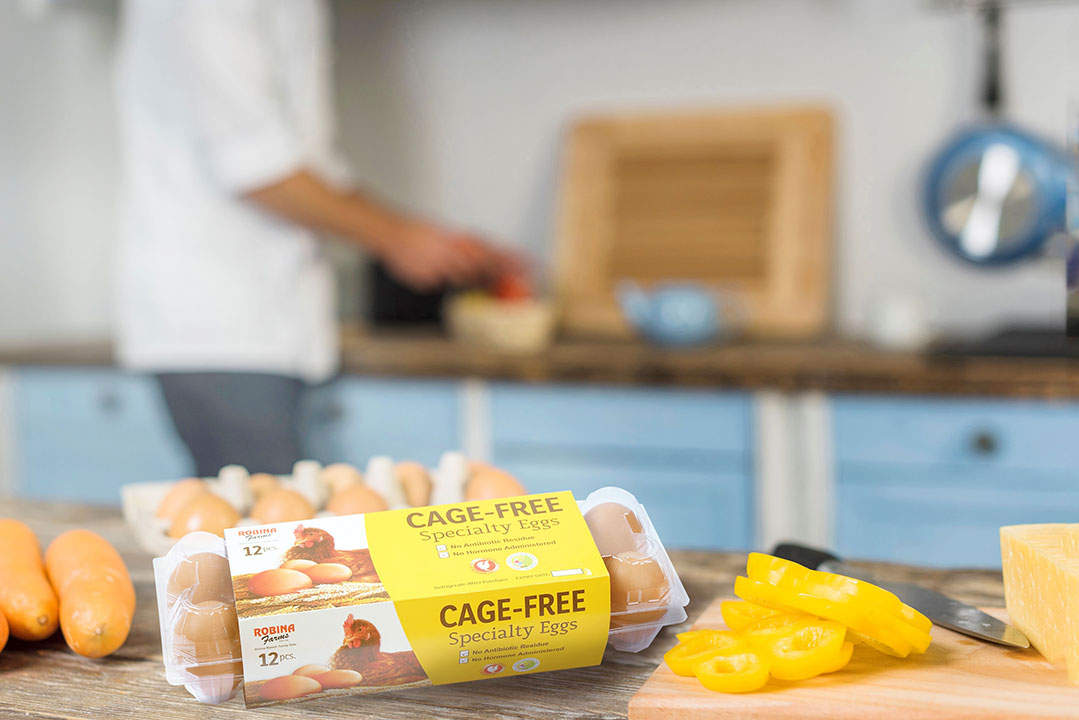
Cage-free hens produce quality eggs, which is why Universal Robina Corp. (URC) ensures that Filipino households can have only the best for their everyday meals with Robina Farms Cage-Free Specialty Eggs. URC’s agro-industrial arm, Robina Farms, focuses on providing clean and safe quality meat and produce. Its Cage-Free Specialty Eggs are harvested from the Robina Poultry Farm, which received the Good Animal Husbandry Practices (GAHP) certification from the Bureau of Animal Industry (BAI). The product is also certified No Antibiotic Residue, No Hormone Administered. Now becoming a global trend, cage-free eggs are laid by free-roaming hens. According to a study, these are said to have dramatically lowered risks of salmonella and other dangerous bacteria compared to eggs from caged hens. By allowing hens to carry out natural behaviors before nesting, there are far greater chances to achieve food safety, nutritional value, and overall quality, while also keeping hens healthy. As of 2022, more than 2,000 companies worldwide had pledged to source 100% cage-free eggs, according to the Lever Foundation. Robina Farms’s Cage-Free Specialty Eggs are available in boxes of a half-dozen and a dozen eggs at Robinsons Supermarket and Puregold branches, as well as in Fisher Mall. These can also be ordered online through GoCart. For more information,visit Robina Farms’ Facebook and Instagram pages https://www.facebook.com/RobinaFarmsPH/ and https://www.instagram.com/robinafarms.ph/ or join its Facebook Community, https://www.facebook.com/groups/eatsrobinafarms


Red Ribbon adds Classic White Bread to lineup

RED RIBBON has added Classic White Bread to its line-up. The soft bread is available at select Red Ribbon stores in Luzon, with prices starting at P55 for a half loaf and P89 for a full loaf. It can also be delivered straight to one’s home by ordering through the Red Ribbon website, http://redribbondelivery.com.ph or through the Red Ribbon App (http://bit.ly/RedRibbonApp). Order now or in advance, for Delivery or Pick Up and enjoy exclusive promos. There is no minimum spend requirement with fixed ₱49 delivery fee. Also available on GrabFood and Foodpanda.

Jollibee says Q2 net income falls 16.6% to P2.33 billion

JOLLIBEE FOODS Corp. announced on Wednesday a 16.6% decline in its second-quarter net income, falling to P2.33 billion from the previous year’s P2.79 billion.

In a regulatory filing, the company attributed this decline to one-time gains from land conveyance and sale of land properties last year, amounting to P1.1 billion and P2.9 billion, respectively.

The company recorded a 16.9% increase in system-wide sales (SWS), which measures all sales to consumers from both company-owned and franchised stores, rising to P85.49 billion from P73.15 billion the previous year.

“System-wide sales of the Philippine business grew by 14.5% while international business grew by 20.9%,” said Jollibee President and Chief Executive Officer Ernesto Tanmantiong.

“Our China business posted the highest year-on-year incremental international sales driven by consumption recovery from pandemic disruption last year,” Mr. Tanmantiong added.

In line with the sales results, its top line rose by 16.8% to P60.79 billion from P52.05 billion in the same period last year.

The company’s same-store sales growth (SSS) for the three-month period went up by 9% globally, primarily driven by an increase in transaction volumes.

The Philippines saw an 11.3% higher SSS, while international markets grew by 5%. However, the company’s coffee and tea business declined by 1.8%.

Meanwhile, the company reported a 13.9% decline in first-half attributable net income to P4.39 billion from P5.1 billion the previous year.

The company’s SWS for the first semester likewise increased by 23.3% to P164.13 billion from P133.13 billion last year.

Its top line rose to P115.88 billion, 22.1% higher than P94.91 billion in the same period last year.

“We remain focused on improving our margins through strong revenue generation and operational efficiencies and will continue to execute on our strategic priorities including accelerating the growth and improving the profitability of our international business,” Jollibee Chief Financial Officer Richard Chong Woo Shin said.

The company opened 270 stores during the first half, 230 of which are in the international markets.

As of June, the company’s store network has increased by 5.1%. The group operates 6,617 stores worldwide, with 3,287 stores in the Philippines and 3,330 international stores across various brands. — Adrian H. Halili

Lives covered by microinsurance go up by 15.39% in Q1

BW FILE PHOTO

MICROINSURANCE coverage went up by 15.39% year on year in the first quarter, driven mainly by the mutual benefit association (MBA) sector, the Insurance Commission (IC) said in a statement on Tuesday.

A total of 51.71 million lives were covered by microinsurance policies issued by insurance companies and MBAs as of end-March, up from 44.81 million lives in the same period last year, the IC said.

Of the 51.71 million insured lives, 28.82 million or 55.74% are insured by MBAs. This was a 11.95% increase from the 25.74 million in the same period last year.

Meanwhile, lives covered by life insurers through microinsurance policies rose by 12.01% to 16.75 million from 14.95 million.

Lives insured by nonlife insurance companies through microinsurance products jumped by 49.13% to 6.14 million from 4.12 million.

Total microinsurance premiums collected by insurance companies and MBAs also increased by 22.48% year on year, amounting to P3.25 billion at end-March from P2.65 billion, the IC said.

Broken down, microinsurance premiums collected by MBAs rose by 13.43% to P1.78 billion from P1.57 billion.

Premiums collected by life insurance companies likewise grew by 12.02% to P840.1 million from P749.96 million.

Microinsurance premiums collected by nonlife insurance companies jumped by 88.83% to P627.64 million from P332.38 million.

The IC said there were 48 regulated entities actively selling microinsurance products, made up of 23 MBAs, 12 life insurers, and 13 nonlife insurance companies.

“The Insurance Commission actively promotes microinsurance as a means for financial inclusion by allowing low-income earners to hedge against various risks such as death, injury and damage to livelihood or property,” it added.

Microinsurance products are those that can be purchased for premiums below 7.5% of the minimum wage in Metro Manila, computed daily.

These include micro-life and health insurance, and micro-agricultural insurance products.

“There are also micro pre-need products available, such as micro-memorial, educational, and pension plans,” the IC said. — AMCS

The Private Equity Challenge: Investing smart in turbulent times

OURTEAM-FREEPIK

ASIA-PACIFIC private equity investors turned cautious in 2022 amid a difficult and uncertain economy. Deal value for the region fell 44% in 2022, ending two years of record investments. In Southeast Asia, PE deal value declined more than 50% for the full year, and it tumbled further in the first half of 2023, down 68% compared with the same period the previous year.

These results have left Asia-Pacific PE managers less optimistic about future returns than they were a year ago, according to Bain’s 2023 Asia-Pacific Private Equity survey. Asia-Pacific exits and fund-raising also fell sharply in 2022, with exit value down 33% year on year. In Southeast Asia, exits fell by 46%.

Many conditions contributed to investor gloom, including slower economic growth, declining consumer confidence, falling manufacturing output, high inflation, and heightened geopolitical tensions. Macroeconomic weakness is now the No. 1 concern keeping the region’s investors awake at night, according to our survey.

Internet and technology, still the region’s largest investment sector, made up only 33% of Asia-Pacific deal value in 2022, the lowest level since 2017. Investors turned instead to defensive sectors that offer steady cash flow and lower risk, including advanced manufacturing and energy and natural resources. In Southeast Asia, the internet and technology sector lost share in 2022 to healthcare and financial services.

But turbulent times also create an opportunity to outperform. In our experience, the best-performing PE funds follow a few key strategies during periods of economic uncertainty. The first is identifying recession-proof sectors and the top-performing companies within those sectors. They also use scenario planning as a vital tool to understand the range of potential outcomes for targets and portfolio companies. Finally, fund managers roll up their sleeves and help improve portfolio performance.

In the current economy, attractive sectors in the Asia-Pacific region include healthcare, business services, infrastructure, and technology (in markets outside of China). Medical services and pharmaceuticals have been resistant to recessions historically. In Southeast Asia, rising levels of income and broader consumer health awareness are stimulating the expansion of private healthcare businesses.

As companies confront labor shortages, many are turning to outsourcing. That’s creating investment opportunities in business services such as business process outsourcing, facilities management, and industrial and technology services. At the same time, the Ukraine crisis has increased transportation costs and disrupted supply chains, boosting demand for distribution and logistics, such as marine services.

Winning PE firms identify the companies poised to outperform in attractive sectors. That approach ensures high-quality investments that should outperform through the economic cycle.

At the same time, assessing a target’s business fundamentals is even more important in a turbulent economy. PE funds in the Asia-Pacific region are no longer relying on multiple expansion to fuel returns. Two-thirds (66%) of Asia-Pacific GPs say solid business fundamentals and good cash flow are their top criteria in selecting deals now.

A set of winning factors can help investors spot companies with the potential for superior outcomes. Bain analysis shows PE deals that outperform have at least one winning factor to counterbalance possible negative macroeconomic developments. These include rapid market growth; organic sales growth in existing stores and rising market share; and expansion into new geographies, products, channels, or adjacent markets. Other winning factors are acquisitions that make a target more competitive, identifiable acquirers that ensure a viable exit strategy, and margin improvement of more than 20% during a five-year holding period.

In turbulent times, leading fund managers also revisit their portfolio plans. A poor macroeconomic climate may make it prudent to delay exits, for example. Companies suffering from declining multiples or deteriorating business performance are likely to generate lower-than-expected returns. At the same time, value creation becomes paramount. Leading funds focus on cost reduction, improving capabilities, and bold strategic moves.

Macroeconomic developments will continue to pose a greater-than-usual risk to company performance for the next 12 months and maybe longer. For investors, the challenge is to identify and focus on the few things that matter most for portfolio performance. Scenario planning is vital in uncertain times since the range of potential outcomes is much wider than most businesses anticipate.

Leaders are taking a fresh look at their portfolio companies to see if the current macroeconomic climate warrants a shift in strategy. Almost certainly, some assumptions that originally underpinned a value creation plan no longer hold true. When the economic outlook darkens, the best funds redouble their efforts to improve portfolio company performance. They monitor and manage cash on the balance sheet, grow the top line through commercial excellence, and increase margins by managing costs and implementing smart pricing strategies. That helps these winners prosper in challenging times.


Kiki Yang is a partner and co-head of Bain & Company’s APAC Private Equity practice based in Hong Kong, and Thomas Kidd is a partner at Bain & Company based in Singapore.

On ratings upgrades and the budget of state universities

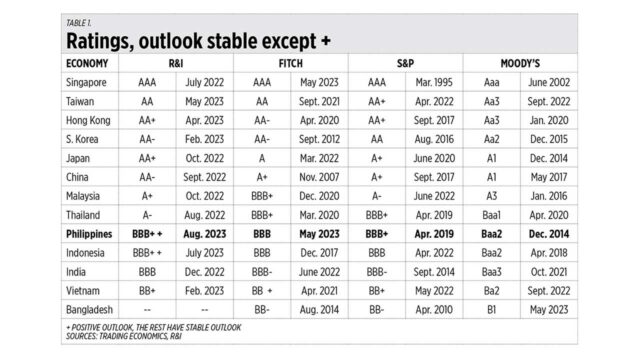
Last Monday, Rating and Investment Information, Inc. (R&I), a Japan-based debt watcher, affirmed the Philippines’ investor-grade credit rating at “BBB+” and revised its outlook from stable to positive. The Finance department attributed this good news “to the country’s robust macroeconomic fundamentals, improving fiscal position, sound banking system, comfortable external payments position, and stable political environment,” explaining that “A ‘BBB+’ rating is two ranks higher than the minimum investment grade and just one notch below the ‘A-’ rating.”

On May 22, the Philippines also earned a ratings upgrade from Fitch, with the outlook moved from “negative” to “stable.” The Philippines’ rating remains at “BBB,” considered “investment grade” and above the “speculative grade” of D to BB. A “BBB stable” means the risk of loan default is low and that the country’s ability to pay its financial obligations is high.

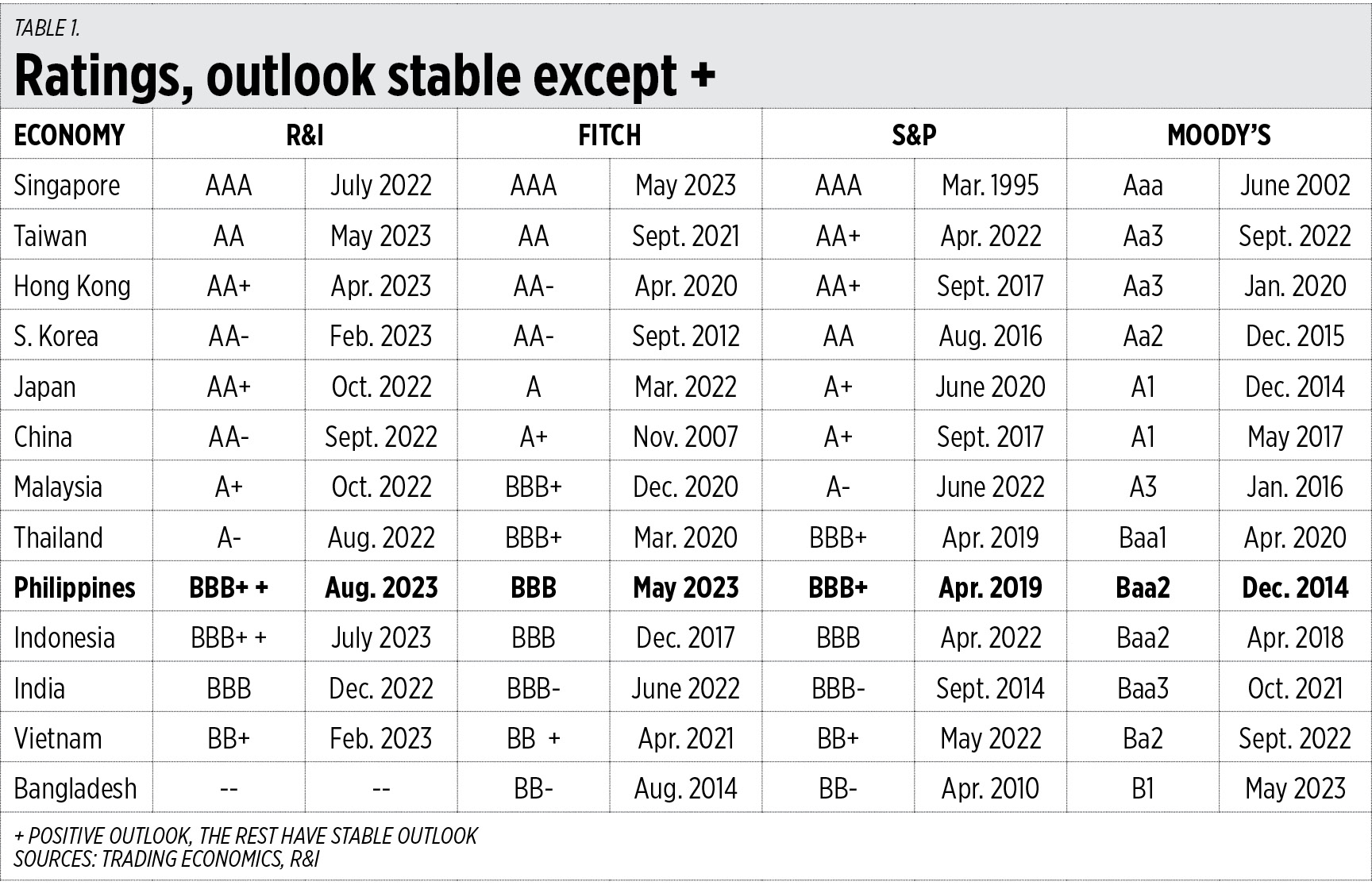
I created a table comparing the ratings of major East and South Asian economies from four ratings agencies. The Philippines is within striking distance of an “A” under R&I and “BBB+” under Fitch and, hence, will be in a comparable ratings position as Thailand, and might even be at the position of Malaysia (see Table 1).

Today, Thursday, the Philippine Statistics Authority will release the GDP figures for the 2nd quarter (Q2) of 2023. This column was written yesterday, Wednesday, and, not having seen the date yet, this columnist initially predicted that it would show around 6.4% growth in Q2 — but considering that the electricity demand data for Q2, among other factors, is not that high, I project growth of 6% instead.

The average GDP growth in Q1 and Q2 of 2023 in East Asia were as follows: South Korea 0.9%, Singapore 0.6%, Taiwan -0.7%, Hong Kong 2.2% (but in 2022 it was -3.5%), China 5.4%, Indonesia 5.1%, and Vietnam 3.7%.

After the Philippines’s Q1 growth of 6.4%, if Q2 growth is 6%, then the Q1 and Q2 average growth will be 6.2%. If Q2 growth is only 5.6%, then the average will be 6%. Either way, the Philippines will remain the fastest growing economy in East Asia, if not among the top 50 biggest economies in the world.

This might prompt the other ratings agencies — S&P, Fitch, and Moody’s — to consider another upgrade for the Philippines.

RISING BUDGETS FOR UNIVERSITIES
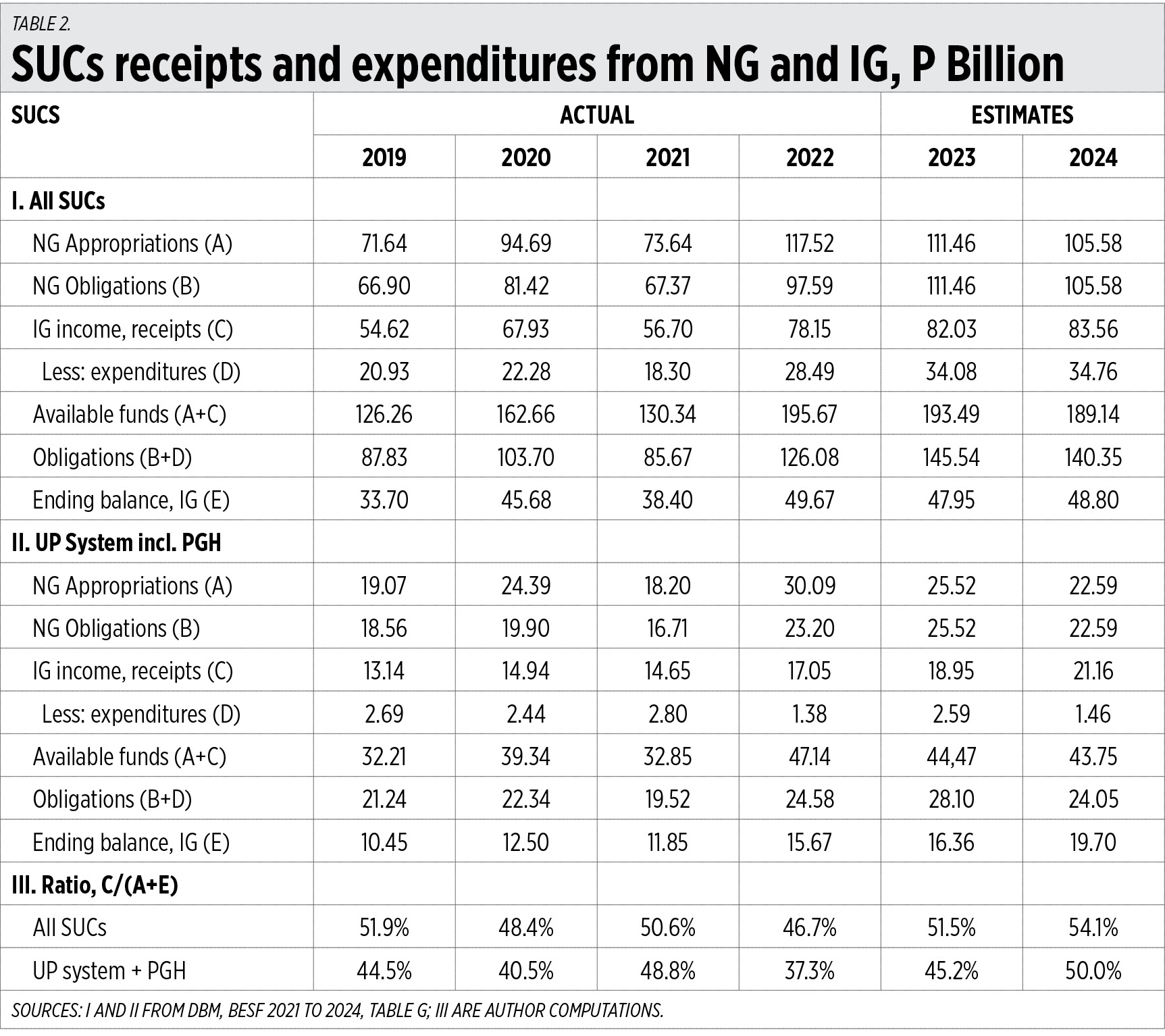
Meanwhile, many state universities and colleges (SUCs) will receive bigger budgets from the National Government (NG). The budget for public elementary and secondary education also keeps rising, and university personnel and students are supposed to be mature enough to generate revenues other than asking for more money from taxpayers. So I build this table on SUCs receipts or income and expenditures.

The good thing is that SUCs’ internally generated (IG) income is rising — from P55 billion in 2019 to P78 billion in 2022, and projected to reach P84 billion next year.

But the National Government’s appropriation for the University of the Philippines (UP) and all its campuses nationwide, plus the Philippine General Hospital (PGH) in UP Manila, is not rising fast, going from P19 billion in 2019 to P30 billion in 2022, but going down to P23 billion next year.

To make sense of these numbers, I computed the ratio of IG receipts (IG + beginning balance or carry over from last year) over NG appropriation plus the ending balance. The result shows an average from 2019-2024 of 50.5% for all SUCs and 44.4% for UP system (see Table 2).

I believe that the law on Universal tertiary education — or simply the free-tuition law (RA 10931, August 2017) — is wrong. People are not getting poorer (for instance, the Philippines’ GDP growth 2012-2017 average was 6.7%), so lawmakers are only raising peoples’ expectations of more freebies from the state.

Government — Congress, the SUCs themselves, the Commission on Higher Education, and local governments — should begin to wean SUCs away from high funding. One scheme is to raise the IG/(appropriations+ending balance) ratio from the current 50% to, say, 55% by 2030, 60% by 2040, and so on. The same trend should apply to UP.

People should assume more personal and parental responsibility for their own lives and households, and not expect more government responsibility which actually means more government taxes to fund such expanded freebies. Besides, there is a double standard in the treatment of Filipino students — those in private universities are not subsidized even if they and their parents are also taxpayers.

REUNION NEWs
The UP School of Economics’ Program in Development Economics (PDE) alumni reunion on Aug. 19, Saturday, at the school auditorium will have two PDE alumni, Finance Secretary Benjamin Diokno (7th batch) and Budget Secretary Amenah Pangandaman (33rd batch) as guest speakers.

The lecture at 4 p.m. will be open to the public plus media. The alumni reunion in the latter part will be exclusive to PDE graduates. While there is no registration fee, there are plenty of raffle prizes and giveaways, courtesy of our corporate sponsors and donors.


Bienvenido S. Oplas, Jr. is the president of Bienvenido S. Oplas, Jr. Research Consultancy Services, and Minimal Government Thinkers

minimalgovernment@gmail.com

First Gen says RE boosts Q2 net income to $77.21M

LOPEZ-LED First Gen Corp. reported on Wednesday an attributable net income of $77.21 million for the second quarter, marking a 29.6% increase from $59.56 million a year ago, driven by its renewable energy  (RE) business.

However, for the April-to-June period, First Gen’s gross revenues declined by 9.7% to $634.78 million from $703.19 million in the same period last year, the company’s second-quarter report showed.

The decline in the company’s gross revenue for the second quarter was offset by the decrease in its gross expenses for the period, which went down by 17.2% to $481.12 million from $580.82 million a year ago.

For the January-to-June period, First Gen reported an expanded attributable net income of $166.44 million, reflecting a 36.1% increase from $122.31 million a year prior.

Its recurring net income, adjusted for non-recurring items for the first half, reached $166.67 million, showing a 30.1% rise from $128.07 million a year ago.

Revenues for the first half of the year increased by $13.3 million, or 1.6%, to $1.29 billion from $1.27 billion, primarily due to the higher contribution of its renewable energy segments.

First Gen said that revenues from the geothermal, wind, and solar (GWS) platform of its renewable energy arm, Energy Development Corp. (EDC), surged by $48.4 million, or 12.5%, to $434.1 million from $385.7 million in the corresponding period a year ago.

Elevated natural gas prices and Wholesale Electricity Spot Market rates all contributed to the company’s revenues for the period.

The company’s natural gas portfolio constituted 63% of its total consolidated revenues, while its renewable energy arm contributed 34%, and the remaining 2% came from its hydropower plants.

“It was EDC that mainly delivered higher earnings as a result of better operating income from higher electricity prices,” First Gen said.

EDC’s attributable net income contribution for the first half went up to $74.3 million or double the $37 million a year ago. 

The profit rise was mainly due to higher electricity selling prices, lower plant operating and maintenance cost, the company said. 

“We hope to carry over the good performance of the first half in the next six months. We are looking forward to a number of significant milestones that are expected to happen for the remainder of the year, including the commercial operations of our LNG terminal at the First Gen Clean Energy Complex,” Francis Giles B. Puno, president and chief operating officer of First Gen said in a statement.

At the stock exchange on Wednesday, shares in the company gained 65 centavos or 3.30% to end at P20.35 apiece. — Ashley Erika O. Jose

BSP sees increase in Islamic banking interest

BW FILE PHOTO

FIVE BANKS and government institutions from abroad have expressed interest in venturing into Islamic banking in the Philippines, an official from the Bangko Sentral ng Pilipinas (BSP) said.

BSP Deputy Governor Francisco G. Dakila, Jr. said during an economic briefing in Davao City that the promotion of Islamic finance in the country has sparked a “notable surge” in market interest from local and foreign investors.

“We’ve had numerous briefings and informative sessions and this has resulted in engagements with potential new players,” Mr. Dakila said.

“Notable of which, aside from conventional banks, we have seen interest from five foreign banks, foreign government institutions, and foreign embassies who volunteered support in tapping new Islamic banking players,” he added.

The central bank has been encouraging lenders and new players to venture into Islamic banking in the country.

Changes in rules covering Islamic banking licensing, Shari’ah governance, and taxation have been instrumental in attracting more players to enter the sector. The government has also issued policies to implement the Islamic Banking Law.

With these initiatives, the BSP is looking to attract investors from Muslim regions, including the Cooperation Council for the Arab States of the Gulf, as well as investors from non-Muslim countries who are looking for diversified investments, Mr. Dakila said.

The BSP is also looking forward to the issuance of the first sovereign sukuk, which will generate more prospects and engagements with the global Islamic financial market, he said.

Sukuk refers to certificates that represent a proportional undivided ownership right in tangible assets, or pool of tangible assets and other types of assets. These assets could be in specific project or specific investment activity that is Shari’ah-compliant.

Residents and nonresidents, regardless of their religious affiliation, are allowed to invest in sukuk.

Meanwhile, the Shari’ah law refers to a system of values, norms, and rules regulating all aspects of life based on the principles of justice, fair dealings, and harmony through equitable distribution of wealth.

“The market interest on Islamic banking is primarily attributed to its business models that emphasizes risk sharing, ethical, and sustainable finance,” Mr. Dakila said.

He noted that the regulatory approach in ensuring a level playing field across all players is also a key factor behind the market interest.

“The promotion of Islamic banking and finance in the country will expand our financial inclusion agenda particularly in the BARMM (Bangsamoro Autonomous Region in Muslim Mindanao) which is the most unbanked region in the country,” he said.

He also said that the Monetary Board has approved the first Islamic banking unit license issued to a traditional bank.

“This has brought the Islamic banking players in the country to two. We anticipate more applicants as we continue our initiatives to promote Islamic banking and finance,” he said.

The Al-Amanah Islamic Investment Bank of the Philippines is the first Islamic bank in the Philippines and was established in 1973. — Keisha B. Ta-asan

ADVERTISEMENT
ADVERTISEMENT