Home Blog Page 4462

High inflation fails to dampen vehicle sales in July

TRAFFIC builds up along EDSA during morning rush hour, Feb. 2, 2023. — PHILIPPINE STAR/ MIGUEL DE GUZMAN

THE PHILIPPINE auto industry recorded a 33% increase in vehicle sales in July, even as elevated inflation dampens overall consumer spending.

A joint report by the Chamber of Automotive Manufacturers of the Philippines, Inc. (CAMPI) and the Truck Manufacturers Association (TMA) showed new vehicle sales rose to 37,086 units in July from 27,813 units in the same month a year ago.

“The auto industry is sustaining its positive growth trend as sales of new motor vehicles recorded a continued year-on-year growth for the past 17 consecutive months — since March 2022. The industry hopes to maintain this trend for the year,” CAMPI President Rommel R. Gutierrez said in a statement.
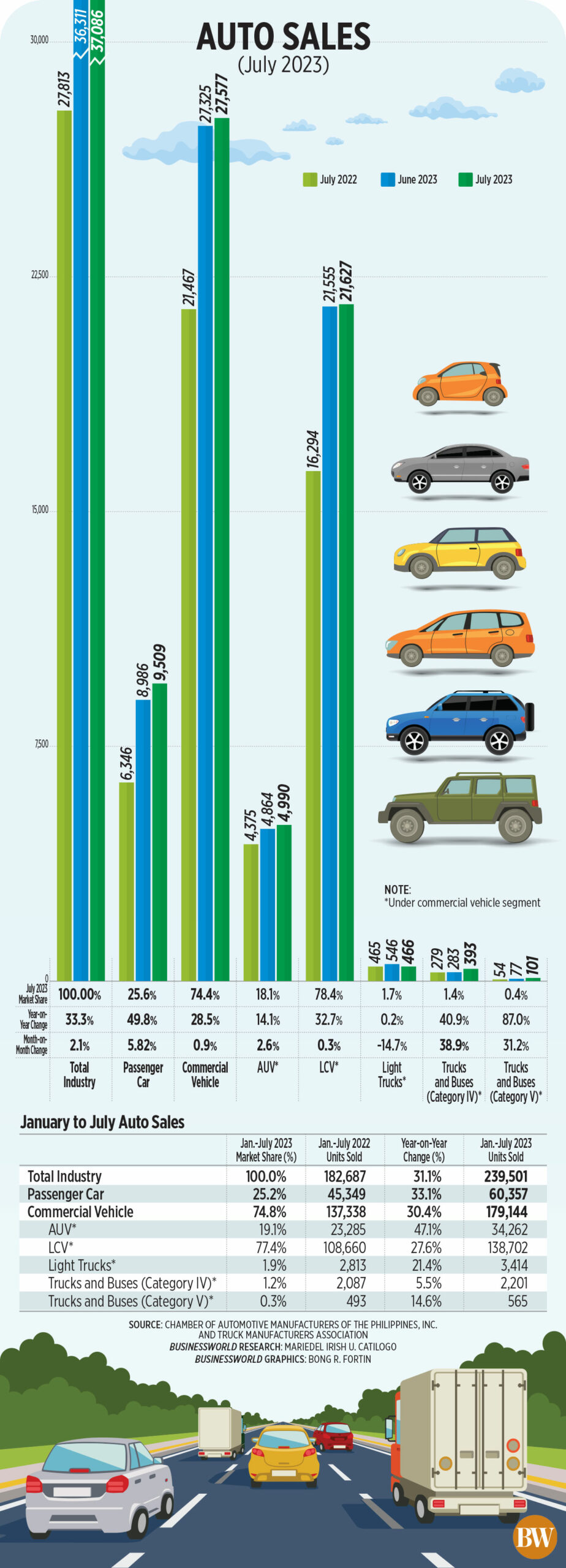
Month on month, auto sales went up by 2.1% from 36,311 units in June.

In July, passenger car sales accelerated by an annual 49.8% to 9,509 units from 6,346 units a year ago. Month on month, sales of passenger cars rose by 5.82% from 8,986 units in June. 

Meanwhile, sales of commercial vehicles jumped by 28.5% to 27,577 units in July from 21,467 in the same month last year. Month on month, commercial vehicle sales inched up by 0.9%.

Asian utility vehicle sales in July grew by an annual 14.1% to 4,990, while sales of light commercial vehicles climbed by 32.7% to 21,627. Sales of light trucks inched up by 0.2% to 466.

For the first seven months of the year, CAMPI-TMA members sold 239,501 units, up by 31.1% from 182,687 a year ago.

The bulk of sales came from commercial vehicles, which rose by 30.4% to 179,144 units. Passenger car sales jumped by 33% to 60,357 in the January-July period.

“The auto industry is notably going strong despite the consumer spending slowdown attributed to the risks of inflation,” Mr. Gutierrez said.

The Philippine economy grew by a slower-than-expected 4.3% in the second quarter, as consumer demand was dented by rising prices. Household spending growth slowed to 5.5% in the April-June period, from 8.5% a year earlier.

Headline inflation cooled to a 16-month low of 4.7% in July from 5.4% in June, and 6.4% in the same month in 2022. For the seven-month period, inflation averaged 6.8%, still higher than the 5.4% forecast by the central bank.

Toyota Motor Philippines Corp. (TMP) remained the market leader with a 45.99% market share as seven-month sales jumped by 17.2% to 110,158.

Mitsubishi Motors Philippines Corp. is in second spot with a 70% surge in sales to 43,831 in the January-to-July period.

In third place is Ford Motor Company Phils. Inc., whose sales rose by 54.5% to 16,611 units in the period ending July.

Nissan Philippines, Inc.’s sales increased by 21.6% to 15,674 units, while Suzuki Phils., Inc. posted a 10.9% drop in sales to 10,174 units.

“The auto industry is truly inspired to expand its product and service offerings to the consumers and businesses alike as seeing this continued growing demand for new motor vehicles is indeed a welcome and significant part of growth development,” Mr. Gutierrez said.

Previously, Mr. Gutierrez said the auto industry set a sales target of 395,000 units for 2023.

In 2022, CAMPI-TMA members sold a total of 352,596 units. — Justine Irish D. Tabile

Megawide swings to net profit as revenues double

MEGAWIDE CONSTRUCTION Corp. booked a second-quarter attributable net income of P370.28 million, a reversal of the P64.93-million loss incurred a year ago, as revenues for the period doubled.

From April to June, the company’s top line reached P6.76 billion, which is nearly twice last year’s P3.47 billion.

“Construction is on its way to recovery and we are starting to see it. We have yet to capitalize on the big-ticket infrastructure projects in our portfolio, such as the Metro Manila Subway Project, which has yet to commence,” Megawide President and Chief Executive Officer Edgar B. Saavedra said in a statement.

“Our landport is also recovering in terms of foot traffic, office occupancy, and commercial sales. All in all, we are confident of sustaining the momentum for the remainder of the year,” he said.

Megawide’s construction operations were still the biggest revenue contributor, accounting for P6.7 billion as it doubled last year’s P3.28 billion.

The construction segment cushioned the 15.7% decline in revenues from landport operations, which amounted to P100.89 million for the April-to-June period from P119.63 million last year.

However, the company said the average daily foot traffic at the Parañaque Integrated Terminal Exchange breached the 100,000 level in June.

It added that it was able to post its highest average passenger spend at P35.4 from the P28.5 seen at the beginning of the year.

The company’s direct costs also doubled in the three months ending in June, totaling P5.83 billion from P2.88 billion in the year prior.

In the first half, the company’s attributable net income reached P363.16 million, a turnaround from the P125.68-million loss seen in the previous year.

Total revenues hit P11.16 billion in the January-to-June period, reflecting a 52.4% increase from the P7.32 billion seen a year ago.

Year-to-date revenues from construction operations reached P10.97 billion, up by 55.1% from the P7.07 billion booked last year.

Landport operations accounted for P191.05 million of the company’s first-half topline, reflecting a 23.7% decline from the P250.4-million revenues registered in 2022.

Direct costs in the first semester amounted to P9.78 billion, an increase of 58.7% from the P6.16 billion seen last year.

As of the end of the second quarter, the company said that its order book of P50 billion remained “very healthy and diverse.”

“More than half of the projects are still in the 0-20% completion stage, providing a significant balance for bookable revenues in the coming periods,” it added.

Mr. Saavedra expects Megawide to gradually reap the benefits from its acquisition of affiliate PH1 World Developers, Inc.

“Aside from generating synergies and providing long-term project visibility, PH1 World’s healthy pipeline will also strengthen our order book quality by de-risking it from contractual and collection issues,” he said.

On Tuesday, shares in the company climbed nine centavos or 2.85% to P3.25 each. — Justine Irish D. Tabile

Sia-led MerryMart, DDMP REIT post higher income

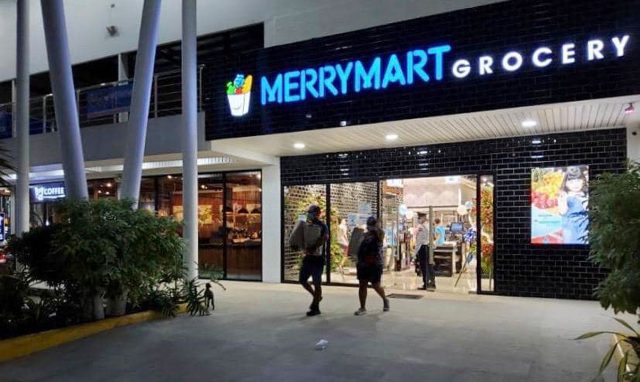
MERRYMART FB PAGE

LISTED COMPANIES led by Edgar J. Sia II reported mixed second-quarter earnings results on Tuesday, with retailer MerryMart Consumer Corp. recording the biggest profit growth amid higher revenues.

MerryMart’s attributable net income for the second quarter of the year climbed by 94.4% to P14.11 million from P7.26 million after a 16.4% rise in revenues to P1.92 billion from P1.65 billion a year ago.

Mr. Sia’s real estate investment trust DDMP REIT, Inc. increased its net income by 8.2% to P539.36 million from P495.06 million in the same period last year. Its revenues for the quarter went up by 11.4% to P663.6 million from P595.47 million a year ago.

In a separate disclosure on Tuesday, DoubleDragon Corp. posted an 8.4% drop in attributable net income to P637.76 million from P696 million previously as costs increased.

The firm’s top line for the period rose by 31.2% to P2.23 billion from about P1.7 billion the prior year, mainly from a 57.4% increase in rentals to P1.13 billion.

Its costs and expenses likewise went up by 15.9% to P1.08 billion from P897.19 million a year ago.

Meanwhile, DoubleDragon’s attributable net income for the first half fell by 18.4% to P805.37 million from P986.77 million the previous year.

Its top line rose by 15.6% to P3.94 billion from P3.41 billion a year earlier. The growth mainly came from rental income, which went up by 20.4% to P1.95 billion from P1.62 billion, as occupancy and rates were higher.

To date, DoubleDragon has 1.29 million square meters of recurring-revenues gross floor area (GFA) portfolio.

The company said the next phase of its vision is to further grow its portfolio, targeting 3 million square meters of recurring-revenue generating GFA portfolio by 2030.

During the six-month period, MerryMart posted a 6.9% drop in attributable net income to P16.95 million from P18.19 million in the same period last year.

The company’s consolidated revenues climbed by 29% to P3.71 billion from P2.87 billion last year, driven by an increase in the sale of goods by new and existing stores. Sales contributed 98.2% of its total revenues.

In a separate filing, MerryMart said that its super app saw “exponential growth” in month-on-month sales since its launch last year. It now has 70,000 registered users.

“MerryMart has set its Vision 2030 with the goal to generate P120 Billion in systemwide recurring consumer sales revenue,” the company said.

Meanwhile, DDMP REIT recorded a 5.7% decline in net income for the first semester to P1 billion from P1.06 billion as costs and expenses hit P216.22 million, 21.7% higher than P177.65 million last year.

The company’s revenues for the period slipped by 0.8% to P1.22 billion from P1.23 billion, as rental income decreased by 15.2% to P966.74 million from P1.14 billion a year prior.

On Tuesday, DoubleDragon rose 0.77% to P7.89 per share. MerryMart shares fell by 1.83% to P1.07 apiece, while DDMP REIT declined by 1.55% to P1.27 a share. — Adrian H. Halili

Globe to defend mobile market lead

GLOBE TELECOM, Inc. aims to defend its mobile market leadership after the results of the subscriber identity module (SIM) registration showed that it still has the highest number of subscribers, its top official said.

“I think it has been some time since we have been leading. We captured leadership in 2016, it is now seven years, and we expect to defend that as well in the coming years,” said Globe President and Chief Executive Officer Ernest L. Cu in an online media briefing on Tuesday.

Data from the National Telecommunications Commission showed a total of 113.97 million SIM registrants or 67.83% of 168.02 million total subscribers.

Globe was able to register a total of 53.73 million subscribers or 61.9% of its 86.75 million total subscribers by the end of the grace period or by July 30.

Meanwhile, Smart Communications, Inc. closed the registration period with 52.5 million or 79.18% of its total users, while DITO Telecommunity Corp. registered a total of 7.74 million users representing 51.72% of its total users.

“We always stated that we want to register close to 100% of our active subscribers or loading subscribers, and we managed to do that because at the 54 million mark our revenues were not affected,” Mr. Cu said.

“Globe has said this many times that we have never really been focused on the number of subscribers we have, it is just a by-product of overall leadership in the industry,” he added.

Darius Delgado, head of Globe’s consumer mobile business, reiterated that the SIM card registration will have no material impact on the network operator’s top line.

“We have seen our top-ups, pickups and acquisitions in the last five weeks and they are still at least 50% higher than how it was pre-SIM registration deadline. And this is because we have already registered 99% of our revenue base,” he said.

Meanwhile, Martha M. Sazon, president and chief executive officer of GCash said that the platform expects a decline in user base after the registration period.

“We are not reporting the registered users now because we are waiting for the cleanup from the SIM registration. Just to let you know, we are expecting a significant decline similar to the telcos in terms of our user base as we are dependent on SIMs registered,” Ms. Sazon said.

However, she also said that the decline will not impact GCash’s revenues significantly as it will be shifting focus on the quality of its users.

OUTLOOK
For the second half of the year, Globe is expecting lower spending due to the slowdown of the economy which could affect the business, according to Mr. Cu.

“I have to say that in the coming quarter, there could be some headwinds primarily [due] to the slowdown of the economy,” he said.

In the second quarter, the country’s gross domestic product expanded by 4.3%, or slower than the 6.4% economic growth in the first quarter and the 7.5% last year.

“But there is also talk that inflation may be tapering off already. We are hoping that the (central bank) will hold on to the interest rates and not increase rates once again,” he said.

Nonetheless, Mr. Cu said that he was very pleased with Globe’s first-half results and that the team is “optimistic that it can continue for the balance of the year.”

Globe Chief Commercial Officer Maria Louisa Guevarra-Cabreira said that the optimism also comes from the improvement of average revenue per unit as mobility increases.

“This is despite the headwinds that we are actually anticipating in the second half, perhaps driven also by the back to school and the economic activity that has returned to the country,” she said.

Globe’s net income for the first semester declined 27.1% to P14.33 billion from P19.65 billion a year ago, despite a 2.5% increase in its top line to P89.52 billion from P87.32 billion last year.

At the stock exchange on Tuesday, shares in Globe closed higher by P65 or 3.51% to P1,915 each. — Justine Irish D. Tabile

Business units drive FDC’s nearly 33% income growth

FILINVEST Development Corp. (FDC) on Tuesday reported 32.6% higher attributable net income for the second quarter to P1.79 billion from P1.35 billion, due to gains from its business segments.

In its financial statement, the company booked a top line of P19.73 billion, 21.5% higher than P16.24 billion in the same period last year.

“We are very encouraged by the continued recovery of our businesses. We look forward to sustaining our growth momentum for the balance of the year. We are working to make the businesses and the entire organization even stronger under the leadership of newly appointed executives,” said FDC President and Chief Executive Officer Chiqui A. Huang.

FDC’s banking and financial services unit East West Banking Corp. contributed the bulk of revenues for the quarter, increasing by 32.2% to P8.33 billion from P6.3 billion the previous year.

The company’s real estate segments Filinvest Land, Inc. and Filinvest Alabang, Inc. saw a combined top line contribution of P3.46 billion, a 6.1% rise from a year ago’s P3.25 billion.

FDC’s power and utility operation, FDC Utilities, Inc., accounted for P3.93 billion, an increase of 23.6% from P3.18 billion. Hospitality operations led by Filinvest Hospitality Corp. saw a 19.2% increase to P645.22 million.

Sugar operations contributed P1.55 billion to FDC’s top line for the period, 15.7% higher than P1.34 billion the prior year.

In the first semester, the company’s attributable net income reached P3.9 billion, higher by 77% than P2.2 billion a year earlier and driven by a 29% increase in revenues to P42.5 billion from P33.1 billion.

FDC said that its banking and financial service business more than doubled its net income to P3.18 billion primarily through sustained lending momentum.

Filinvest Land saw a 15% increase in attributable net income to P1.39 billion after its revenues rose by 8% to P9.92 billion as its residential and rental business segments posted growth.

Its residential revenues grew 4% to P6.06 billion on the back of faster construction progress and the strong performance of its housing projects.

Reservation sales likewise rose by 21% to P11 billion. It launched P4.56 billion worth of residential projects in Rizal, Laguna, Davao, Pangasinan, South Cotabato, and Zamboanga.

Its mall business saw a 64% growth to P1.15 billion, while office revenues went up by 1% to P2.29 billion.

The company’s power unit went up by 3.9% for the first semester to P1.11 billion from 1.07 billion the prior year. Its revenues rose by 24.5% P7.32 billion from P1.44 billion due to power rate hikes.

Profit for FDC’s hospitality segment surged by 84%, while its revenues increased by 61.4% to P1.37 billion due to improvements in occupancy, room rates, and average food and beverage revenues. — Adrian H. Halili

AboitizPower unit to build 2 solar power plants: in Zambales, Negros Occidental

ABOITIZ POWER Corp. (AboitizPower) through its renewable energy arm is set to build two new solar power projects in Negros Occidental and Zambales, further expanding its renewable energy capacity, the listed energy company said on Tuesday.

AboitizPower through Aboitiz Renewables, Inc. (ARI) will build a 173-megawatt (MW) solar power project in Calatrava, Negros Occidental, which is expected to start exporting power by 2024.

“We are looking to begin the construction of our Calatrava Solar and Olongapo Solar projects this year on the way to achieving our growth strategy of providing an additional 3,700 megawatts of renewable energy by the next decade,” Emmanuel V. Rubio, president and chief executive officer (CEO) of AboitizPower, said in a media release.

SUMEC Complete Equipment and Engineering Co., Ltd. will begin the construction of the solar power project by September. It is the same company completing AboitizPower’s 159-megawatt-peak solar power project in Pangasinan.

Further, ARI is also set to build a 211-MW solar power project in Olongapo, Zambales — its largest solar power project to date.

“We are aligned with the ambitious goal to help the country usher in a just and balanced energy transition. Our customers want clean, affordable and dependable energy, and we want to deliver that,” James Arnold D. Villaroman, ARI president and CEO, said.

The project’s construction will also begin in September and will be undertaken by the joint venture between Guangdong Electric Power Design Institute Co., Ltd. and parent company China Energy International Group Co., Ltd.

The 211-MW solar power project in Olongapo is targeted for commercial operations by 2025, AboitizPower said, adding that this will bring its solar project to five, including San Carlos Sun Power Inc.’s solar projects in Negros Occidental, Laoag in Ilocos Norte, and Cayanga in Pangasinan.

AboitizPower is aiming to expand its renewable energy portfolio in the next 10 years. It has set an ambition of building an additional 3,700 MW of renewable energy, growing its capacities to 4,600 MW by 2030.

To date, the company has a pipeline of projects with a combined capacity of more than 1,000 MW through the development of wind, solar, and geothermal plants.

At the local bourse on Tuesday, shares in the company closed 0.56% higher to end at P36 apiece. — Ashley Erika O. Jose

AREIT registers 26% profit rise to P1.3B

AYALA-LED real estate investment trust company AREIT, Inc. reported a 26.4% jump in net income for the second quarter to P1.3 billion from P815.19 million in the same period last year.

In a regulatory filing, the company reported that its revenues grew by 26.3% to P1.49 billion from P1.18 billion mainly due to rental income and dues.

AREIT’s rental income for the quarter rose by 31.3% to P1.14 billion from P868.68 million in the same period last year.

The company’s net dues reached P298.49 million, 16.7% higher than P255.75 million the previous year.

For the first half, the company saw a 25.2% jump in net income to P2.04 billion from P1.63 billion, driven by stable operations.

Its revenues during the six-month period went up by 26% to P2.97 billion from P2.36 billion in the same period last year, the bulk of which came from rentals.

Its rental income rose by 31% to P2.28 billion from P1.74 billion due to the addition of the Cebu properties, namely: Ebloc Towers 1 to 4, ACC Tower, and Tech Tower, in October last year.

Dues increased by 14% to P583.85 million from P511.49 million the prior year on the back of the operations of new assets acquired in October 2022.

The company said that it had signed the deed of exchange with Ayala Land, Inc. (ALI) for the infusion of the P22.48-billion flagship offices and malls to AREIT’s portfolio last June.

“AREIT is looking forward to securing regulatory approvals for this third property-for-share swap with its sponsor, ALI, within the year,” it said.

The transaction will increase AREIT’s gross leasable area by five times to 863,000 square meters or its assets under management to P87 billion.

AREIT shares went up by 0.29% or 10 centavos to P34 apiece on Tuesday. — Adrian H. Halili

PetroEnergy earnings decline 41% 

PetroEnergy Resources Corp. registered a second-quarter attributable net income of P104.96 million, down by 41.1% from P178.23 million a year ago due to lower revenues from its Gabon oil operations.

In a stock exchange disclosure, the company reported gross revenues of P771.31 million, up by 7% from P720.96 million in the same period last year.

The Yuchengco-led energy company registered higher gross expenses for the April-to-June period at P503.74 million, up by 7.2% from the P469.78 reported a year ago.

For the first semester, its attributable net income declined to P277.57 million, 21.9% lower from P355.19 million last year.

The company’s gross revenues for the January-to-June period, however, expanded to P1.48 billion, marking an 8% increase from P1.37 billion in the corresponding period last year.

Higher electricity sales from short-term investments were identified as key contributors to the company’s growth, PetroEnergy said.

It added that short-term investments also offset the decline in the company’s revenues from its Gabon oil operations due to lower average crude oil prices.

Majority of the company’s revenues came from its investments in renewable energy projects, PetroEnergy said.

PetroEnergy, through its renewable energy arm, PetroGreen Energy Corp., invested in the 32-megawatt Maibarara geothermal power project of the Maibarara Geothermal Inc. and the 70-megawatt-direct current Tarlac solar power project of PetroSolar Corp.

PetroEnergy said the improved generation of the Maibarara contributed to a 14% growth in electricity sales compared with the same period last year when its major plant underwent maintenance. — Ashley Erika O. Jose

Fruitas Holdings income jumps 27% to P24 million

Fruitas Holdings, Inc. on Tuesday reported a 27% increase in net income for the second quarter to P24.37 million from P22.95 million the prior year on the back of higher revenues.

In a regulatory filing, the company said that its top line rose by 21% to P624.11 million from P457.02 million in the same period last year.

Meanwhile, the company saw a 48% higher net income for the first half to P43.5 million from P29.3 million, driven by an increase in revenues.

“Our first half 2023 performance is proof of the group’s capacity to enhance and innovate its product portfolio. We saw improved profits and controlled margins despite the uncertain economic climate,” Fruitas President and Chief Executive Officer Lester C. Yu said in a disclosure.

The company’s top line for the first semester grew by 44.9% to P1.14 billion from P787 million, driven by same-store sales growth, business expansion, and the addition of the Ling Nam store and Fly Kitchen operations.

The company said that it anticipates opening about 10 additional Ling Nam outlets for the rest of the year.

Fruitas announced earlier its acquisition of Fly Kitchen, Inc. whose brands include Hatid Pinoy, Jade Express, and Kanin at Sabaw. It expects to further accelerate sales through the acquisition.

“[We] are eager to seize the upcoming quarters’ growth opportunities through store network diversification and relevant product offerings that will provide value to our customers and stakeholders,” Mr. Yu said.

Fruitas reported a 54.11% increase in cost of sales to P467.6 million from P303.4 million a year prior.

“Despite inflationary pressures, gross profit margin in the first half of 2023 marginally declined versus the same period in 2022,” the company said.

As of June 2023, the company’s network had a total of 822 stores ahead of an anticipated opening of at least 50 additional locations in the last two quarters of the year.

“[Fruitas] intends to keep up its rapid network development while retaining a smart and systematic approach to its growth,” the company said. — Adrian H. Halili

Japan’s Taiheiyo plans Luzon cement distribution terminal

Japan’s Taiheiyo Cement Corp., through its local unit, is looking at developing a new cement distribution terminal in Calaca, Batangas worth Y10 billion.

In a press release, the Department of Trade and Industry (DTI) said that it had received the commitment of Taiheiyo to expand its operations in the Philippines.

The cement distribution terminal, which will be built through Taiheiyo Cement Philippines, Inc. (TCPI), is expected to supply 700,000 tons of cement annually to areas in Luzon.

The DTI said TCPI also conveyed its plan to upgrade its facility in San Fernando, Cebu to increase its capacity to 3 million tons a year and the reinforcement of the port area of the plant.

“Taiheiyo’s investments under the letter of intent are expected to generate 2,000 new jobs,” the DTI said.

Dita Angara-Mathay, commercial counselor of the Philippine Trade and Investment Center in Tokyo, expressed her confidence in Taiheiyo as she said the company has a good track in keeping its commitments.

“The company’s latest announcement materializes their plans to expand to Luzon from their long-time base in the Visayas region,” Ms. Angara-Mathay said.

The Philippine Construction Industry Roadmap envisions P130 trillion worth of business to be generated between 2020 and 2030.

This would be made possible through the revitalization of the DTI Construction Industry Authority of the Philippines and the implementation of its action plans, according to the DTI.

“The DTI will continue to work towards a vibrant and globally competitive construction industry that is committed to building with integrity,” Trade Secretary Alfredo E. Pascual said in a statement. — Justine Irish D. Tabile

Art as a sensorial showcase

THE AUDIENCE interacts as the paintings on the wall change. —BRONTË H. LACSAMANA

IN the lively One Bonifacio High Street mall, an otherwise empty exhibition space at the third level has become a large-scale canvas, where data paintings are brought to life by vivid audio and visual projections.

Award-winning Istanbul-based new media studio Ouchhh is responsible for this out-of-this-world experience coming to Bonifacio High Street. Using artificial intelligence (AI), they weaved together Leonardo Da Vinci’s technical drawings and works by over 300 artists into cohesive immersive experiences.

“Wisdom of Da Vinci: An Immersive AI Experience” comes together by taking inspiration from the legendary Italian artist’s own ideas about the marriage of art and science.

“Da Vinci was also a scientist. He tried to integrate art and science and technology,” Ouchhh director and new media artist Ferdi Alici said at the exhibition’s launch in August.

The Curator Lounge is where the experience begins, with a collection of innovative digital displays. One is the Poetic AI Gallery where an algorithm transforms 20 million lines derived from the notes of Albert Einstein and Galileo Galilei into art.

Another is the Manila Real-time Data Artwork, which utilizes Philippine economic data from budgets, agriculture, and statistics, to show a data piece fluctuating in real-time as it reflects the nation’s pulse.

Mr. Alici said that viewers can journey inside the artistry of these data sources thanks to machine learning, which sheds light on “how machines see us and how machines can create art from the data archive.”

The first immersive hall, called Digital Garden of Dreams, takes that philosophy to the next level. Its energetic whirlwind of visuals and sound is divided into chapters:

Atlas, inspired by Leonardo Da Vinci’s Vitruvian Man and his study of the human body;

DataGate, a collaboration with NASA using data gathered by the Kepler space telescope covering 500,000 stars, 2,500 planets, and 60 supernovae;

Superstrings, featuring real-time brain waves of musicians; and,

Filipino Master, featuring the works of Juan Luna created throughout his lifetime translated as data paintings.

The second immersive hall, the titular Wisdom of Da Vinci, explores through abstract aesthetics the works of the artist-scientist and other acclaimed creative masters, combining visual data from the likes of the Mona Lisa down to detailed manuscripts, sketches, invention plans, and paintings.

A dynamic musical score by movie composer Ludovico Einaudi (Nomadland, Alexandreia, The Father) completes the final part of this experience.

Mr. Alici noted that, beyond getting a glimpse of Da Vinci’s unique mindset, viewers “will experience multidimensional universes made by AI.”

For Filipinos, this will prove fascinating, especially now that the pandemic has eased and allowed communal experiences in public art spaces once more, according to Bonifacio Global City (BGC) Estate Association executive director Jun Galvez.

He told BusinessWorld after the launch that the “Van Gogh Alive” interactive art exhibit in 2019 showed that AI-made multi-sensory experiences can be a hit in the Philippines.

“Now that we’re back to normal, we want to continue providing immersive experiences because we don’t have a lot of these kinds of shows here. The result was overwhelming before and it proved that Filipinos are into art, especially digital art,” Mr. Galvez said.

“Wisdom of Da Vinci: An Immersive AI Experience” runs until October, at the third level of One Bonifacio High Street mall in BGC, Taguig City. Tickets are priced at P975 for adults and P780 for students. Visit https://bgcimmersive.com for ticket reservations. —  Brontë H. Lacsamana

ADVERTISEMENT
ADVERTISEMENT