Home Blog Page 4444

BSP extends ‘hawkish’ rate pause

PHILIPPINE STAR/MIGUEL DE GUZMAN

By Keisha B. Ta-asan, Reporter

THE BANGKO SENTRAL ng Pilipinas (BSP) kept benchmark interest rates steady for a third straight meeting on Thursday, but signaled it is prepared to resume tightening if needed amid risks to inflation.

At the same time, the BSP raised its inflation forecast for this year and next, reflecting the spike in global oil prices.

The Monetary Board left its overnight reverse repurchase rate unchanged at a near 16-year high of 6.25%, as expected by 13 economists in a BusinessWorld poll last week. Interest rates on the overnight deposit and lending facilities were maintained at 5.75% and 6.75%, respectively.

The BSP has raised borrowing costs by 425 basis points (bps) from May 2022 to March 2023 to tame inflation.

“The Monetary Board deemed it appropriate to maintain monetary policy settings to allow a moderation of inflation even as authorities continue to assess the emerging risks to the inflation outlook,” BSP Governor Eli M. Remolona, Jr. said after chairing his first policy meeting as governor.

The balance of risks to the inflation outlook remains skewed to the upside, he added.

“Potential price pressures are linked to the impact of possible higher transport charges, higher minimum wage adjustments, persistent supply constraints on key food items, and the effects of El Niño weather conditions on food prices and power rates,” he said.

Mr. Remolona said the Monetary Board also recognized the “challenging outlook” for the economy, as the slower second-quarter gross domestic product (GDP) expansion reflected a “broad-based slowdown in domestic demand.”

“Authorities noted that the strength of economic activity going forward is likely to moderate as pent-up demand wanes and the full impact of prior monetary policy tightening continues to manifest,” he said.

The Philippine economy expanded by 4.3% in the second quarter, the slowest in two years. For the first half, GDP growth averaged 5.3%, below the government’s 6-7% target.

INFLATION OUTLOOK
The BSP slightly raised its average inflation forecast for 2023 to 5.6% (from 5.4% previously) and 3.3% (from 2.9%) for 2024, respectively, citing wage hikes and the recent rally in global oil prices. It also hiked its 2025 inflation forecast to 3.4% from 3.2% previously.

Despite the higher forecast for this year, the BSP still expects inflation to return to the 2-4% target band by the fourth quarter of 2023.

In July, headline inflation eased for the sixth consecutive month to 4.7%, bringing the seven-month average to 6.8%.

“The upward revision in these (inflation) forecasts is due to the sharp increase in Dubai crude oil prices in recent weeks. We’ve also incorporated the effect of the higher-than-expected minimum wage adjustment and the recent movements in the peso,” BSP Monetary Policy Sub-Sector Officer-in-Charge Dennis D. Lapid said during the same briefing.

BSP Deputy Governor Francisco G. Dakila, Jr. said the BSP expects the price of Dubai crude to average about $82.3 per barrel in 2024 and to around $77-$78 per barrel in 2025. 

“If oil prices went up again following the onset of the war in Russia-Ukraine to $100 per barrel, that would be a scenario where inflation could breach the (2-4%) target. But those scenarios are unlikely. We are much more comfortable that we will be on the target path,” Mr. Dakila said.

Mr. Lapid said the BSP is looking at the potential inflationary impact of an increase in fares, more wage hikes, and higher power rates.

A P40 minimum wage hike in the National Capital Region took effect on July 16. Several regional wage boards are expected to decide on wage hike petitions by September.

READY TO TIGHTEN
Mr. Remolona said the BSP is “ready to tighten” if necessary, as it keeps a close eye on developments that may impact inflation.

“For now, we don’t see any easing, at least not in the next meeting. The [policy] rates are not that elevated, it is still low enough to not be a factor in growth,” Mr. Remolona said.

He added that monetary tightening was not a major contributor to the slower GDP growth in the second quarter.

Mr. Dakila said the Philippine economy may still achieve its 6-7% growth target, particularly if government agencies ramp up their spending. He noted the 7.1% contraction in government spending was a significant factor in the weaker-than-expected growth in the April-to-June period.

“If government spending had just been flat, it would have already added more than a percentage point to economic growth. If government spending had just been moderately positive, then the outturn would have actually been significantly higher for the second-quarter growth,” he said. “That illustrates the cruciality of government spending in achieving government target.”

Mr. Dakila said a further deceleration in inflation in the second half will help support household spending.

Private consumption increased by 5.5% in the second quarter, but this was the slowest pace since the 4.8% contraction in the first quarter of 2021.

“Sustained non-monetary measures remain crucial in addressing lingering supply-side pressures on prices. The BSP remains prepared to respond as necessary to safeguard the inflation target, in keeping with its primary mandate to ensure price stability,” Mr. Remolona said.

Nicholas Antonio T. Mapa, senior economist at ING Bank N.V. Manila, noted Mr. Remolona made sure to retain his “hawkish bias, vowing to quickly resort to potential rate hikes in order to help anchor inflation expectations.”

Shivaan Tandon, emerging Asia economist at Capital Economics, said it is unlikely for the BSP to embark on rate cuts soon since core inflation remains “uncomfortably high.”

“Policy makers would also want to see signs of sustained falls in core inflation in the coming months. Given this backdrop, we are sticking with our view that interest rates will remain unchanged for the next few months and rate cuts are unlikely before the first quarter of 2024,” he said.

Core inflation, which discounts volatile prices of food and fuel items, slowed to 6.7% in July from 7.4% in June. This brought the year-to-date average to 7.6%.

Mr. Tandon also said the BSP likely considers it “premature” to cut rates before the impact of El Niño to food prices becomes more evident, as the Philippines is among “the most exposed” to risks from the weather event.

The state weather agency expects the El Niño weather pattern to persist in the Philippines until the first quarter of 2024.

Makoto Tsuchiya, assistant economist at Oxford Economics, said that while the pause was in line with consensus expectations, the outlook for monetary policy is becoming “increasingly uncertain.”

“Although soft second-quarter GDP calls for a more dovish stance, recent rapid rise in daily food prices and the peso depreciation provide a reason for the central bank to stay cautious,” he said in a note.

Mr. Mapa said the BSP may continue to keep policy rates for the rest of the year to balance the risks to growth and inflation.

“However, we could see BSP considering a rate hike down the line should the US Federal Reserve opt to increase policy rates before the end of the year, in order to maintain interest rate differentials,” he said.

The US central bank raised its target interest rate by 25 bps last month to a range between 5.25% and 5.5%, the highest level in 22 years.

The BSP is next scheduled to discuss policy on Sept. 21, Nov. 16, and Dec. 14.
Power rates expected to drop in coming months

PHILIPPINE STAR/MICHAEL VARCAS

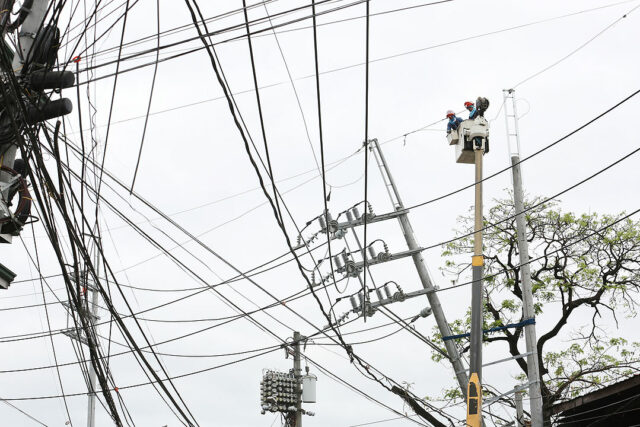
THE PHILIPPINES can expect power prices to go down in the coming months amid softening global coal prices and declining rates at the Wholesale Electricity Spot Market (WESM), according to the Energy Regulatory Commission (ERC).

ERC Chairperson and Chief Executive Officer Monalisa C. Dimalanta said the agency expects power rates to continue falling in the next few months.

“Over the summer months there is always a trend towards higher rates because of the increased demand. And now what we see over the last few months, also because the global prices for coal have really been softening, the prices in WESM are also declining, that’s what we see,” she said before the Joint Congressional Energy Commission hearing on Thursday.

Ms. Dimalanta made the statement in response to Bataan Rep. Albert S. Garcia’s question if the ERC expects power rates to continue their downtrend.

“Although what we see in the generation rates being passed on, they are not decreasing at the pace commensurate to the pace at which coal prices are decreasing. That’s part of the analysis we are conducting in the commission.”

Power rates in areas covered by Manila Electric Co. (Meralco) fell this month as the generation charge declined for a third straight month.

Meanwhile, the Department of Energy (DoE) does not expect to have a shortfall in power reserves in the Luzon grid for the rest of the year.

“Our available capacity, including the current resumption of operation in Ilijan, will provide ample supply and reserve to the Luzon grid,” Energy Assistant Secretary Mario C. Marasigan said during the same hearing.

He said there may be potential yellow and red alerts in the Visayas during peak hours in the afternoon, but “this will be easily resolved” by the transfer of electricity coming from the Luzon-Visayas interconnection, as well as the ongoing testing and commission of the Mindanao-Visayas interconnection project.

“We have excess capacity in Mindanao, so we don’t see any alerts in Mindanao,” Mr. Marasigan said.

DELAYS
At the same time, the DoE vowed to keep a close eye on renewable energy (RE) service contractors who fail to implement their projects on time, saying these projects may be canceled if delays continue.

“A service contractor has certain deliverables so we are strictly monitoring this so that if they fail to deliver according to their schedule, we would be able to cancel them,” Mr. Marasigan said.

This came after Marinduque Rep. Lord Allan Jay Q. Velasco and Senate Energy Committee head Senator Rafael “Raffy” T. Tulfo questioned why the DoE has not addressed red tape and right-of-way issues that have delayed the implementation of RE projects.

“Since we’re already starting with renewables and we’re targeting 35% in our energy mix, I hope the DoE can come up with a plan as early as now to resolve these right-of-way problems,” Mr. Velasco said. “This is the crux of the problem [delay of projects].”

Mr. Tulfo said the DoE should regularly monitor these RE projects.

“We can’t just keep giving permits to these developers that fail to implement their projects,” Mr. Tulfo said in Filipino.

Mr. Marasigan assured the lawmakers that the DoE conducts a yearly review on the execution of RE projects.

RE accounts for 22% of the Philippine energy mix. The government is aiming to increase its share to 35% by 2030 and 50% by 2040. — S.J.Talavera and J.V.D.Ordoñez

Fish supply deficit seen in 4th quarter

The Department of Agriculture (DA) approved the importation of 35,000 metric tons (MT) of frozen fish for wet markets in the fourth quarter. — PHILIPPINESTAR/ WALTER BOLLOZOS

THE BUREAU of Fisheries and Aquatic Resources (BFAR) expects the fish supply deficit to reach 57,830 metric tons (MT) in the fourth quarter.

Based on its supply and demand outlook, the BFAR said there will be an estimated fish supply of 769,446 MT in the fourth quarter, which will not be enough to cover the demand of 827,285 MT. The deficit is equivalent to six days’ supply of fish.

BFAR spokesperson Nazario C. Briguera on Thursday defended the government’s approval of a plan to import fish in the fourth quarter, saying imports are needed to augment the supply during the closed fishing season in parts of the country.

The Agriculture department earlier this week approved the plan to import 35,000 MT of fish for wet markets for the fourth quarter. This includes frozen round scad or galunggong, bigeye scad, mackerel, bonito, and moonfish.

“Of course, if we have enough supply, we expect prices to go down. We are also closely monitoring to ensure there will be no gap or deficit in the supply of fish in wet markets, especially in Metro Manila,” Mr. Briguera told reporters in mixed Filipino and English.

Closed fishing season is implemented in northern Palawan province, Ilocos, Negros Occidental, Capiz, and Cebu during the fourth quarter. This would allow fish to spawn and repopulate over the period.

Sardine fishing is not allowed in northern Palawan from Nov. 1 to Jan. 31, while the closed fishing season for herring and mackerel in the Visayan Sea runs from Nov. 15 to Feb. 15.

Asis G. Perez, former BFAR director and co-convenor of advocacy group Tugon Kabuhayan, said in a Viber message that the industry is aware of the drop in production during closed fishing season.

“Generally, we are in agreement that the fourth quarter is the time when production is the lowest, particularly in fisheries as this is the time when our three major closed seasons happened and also the time for strong amihan (northeast monsoon),” he said.

Mr. Perez said that the government should focus on measures that will increase production in aquaculture to boost the overall fisheries production and build more cold storage facilities.

“As this is an annual event, the fisheries sector has responded by increasing aquaculture output. Many of our aquaculture producers time their production schedule to meet these demands,” he added.

The import plan comes on the heels of an 11% decline in fish production during the second quarter. — SJT

Ayalas’ IMI revises down capex to $25 million

GLOBAL-IMI.COM

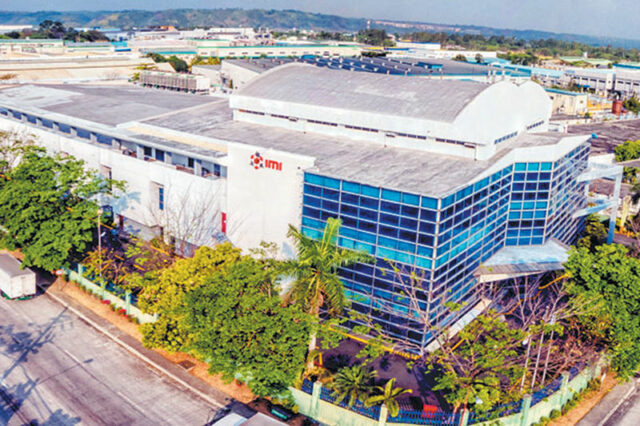
AYALA-LED Integrated Micro-Electronics, Inc. (IMI) said on Thursday that it is poised to end the year with lower-than-expected capital investments of around $25 million.

“Initially our target for the year should be close to $30 million but given that we are trying to defer some of the capital expenditures (capex) and just focusing on the critical ones maybe it could be at a similar level as last year $22 million to an average of $25 million,” said Laurice S. Dela Cruz, chief financial officer of IMI on the second day of the PSE STAR event.

So far this year, the company has spent $11.1 million in capital investments mainly on machinery and construction, which comprised 40% and 36% of the total, respectively.

For 2022, IMI spent $21.2 million on capex related to new programs. In its annual report, the company said that it expects to spend $30 million to $40 million in 2023.

However, IMI President Jerome S. Tan said he expects capital investments to grow in 2024 due to planned expansions.

“A lot of the focus is shifting more toward how we can source outside of China so there is strong demand in North America to onshore. And North America includes Mexico so there are some discussions that we are having to see whether that would be an opportunity for an area for us to expand,” said Mr. Tan.

He added that Europe is also an area where the company sees a need to expand despite its current operations in the region.

“I think the overall capex next year will definitely be higher than this year and as things start to normalize, then we can be more aggressive in expanding the business,” he said.

The company incurred a net loss of $82.91 million in the second quarter, significantly wider than last year’s loss of $3.55 million.

The decline can be attributed to the $83.68 million miscellaneous losses booked for the three months ended June due to the sale of the company’s 80% stake in STI Enterprises Ltd.

From April to June, IMI’s revenues totaled $345.07 million, a decline of 3.3% from the $356.91 million booked last year. Cost of sales was 5.2% lower at $312.03 million from $329.95 million a year ago.

In the first half, the company’s net loss attributable to equity holders amounted to $83.66 million, widening last year’s loss of $5.51 million. This is despite a slight increase in the company’s top line to $691.89 million from $690.86 million.

IMI is a listed electronics manufacturing services company serving markets such as the automotive, industrial, consumer, telecommunications, and medical industries.

On Thursday, stocks of IMI dropped by 28 centavos or 6.22% to P4.22. — Justine Irish D. Tabile

Research as key to the production of knowledge

FOR filmmaker, film historian, and author Nick Deocampo, historical scholarship is essential. His books demonstrate this, whether they tackle Philippine cinema and its history or try to make sense of its culture and chart its future — and his latest series manages to do all of the above.

The three-volume opus Sine Tala gives a rounded view of how cinema evolved in the country to form historical records, operates as material culture, and provides a pedagogical tool for learning. More than a compilation of Mr. Deocampo’s essays and lectures over the years, it is an “encyclopedic work of love,” as described by National Artist for Film Kidlat Tahimik.

At the Aug. 8 launch of the book series, the Cinema Palma at the Philippine International Convention Center (PICC) was filled with students, teachers, and lovers of film, and it was to them that Mr. Deocampo dedicated his work.

“I think we need to equip ourselves with words like these because I felt very impoverished when I was a young student like you. I knew more about Hollywood cinema and its history and aesthetics more than I knew about Philippine cinema, so I took it as a challenge,” he said in his speech.

The key to the production of knowledge is research, said Mr. Deocampo, and it will result in the films that you make and the books that you write.

“This intellectual rigor and discipline is something that we truly need in this age of disinformation, misinformation, and globalization, wherein we can all just get lost in terms of identity and who we are as a people,” he concluded.

FILM AS AN AGENT OF HISTORY
Sine Tala is divided into themes — history, culture, and literacy — drawing from over 250 essays written over the past 40 years.

The first volume traces Philippine cinema’s trajectory from the oft-forgotten, erased tradition of shadowplay in pre-colonial times, to early silent cinema, all the way to the digital era, passing through the major influences of the Spanish, Americans, and Japanese.

The second volume covers almost all other aspects of cultural life — the influence of theater, music, and even religious practices, all finding their way into the cinematic form and Filipino material culture.

The third volume, according to Mr. Deocampo, may be the closest to his heart. “I am at the phase of my life wherein my advocacy for education, for pedagogy, is just very strong. I believe that it is through education that cinema can really be meaningful in our society,” he said.

It takes on the semiotics, or science of signs, that can be deciphered and decoded from the likes of Lino Brocka’s filmography, which communicated through film language the realities of the Marcos military regime and post-martial law era. It also charts the futures of the educational film market, the role of film screening in a digital age, and the development of multimedia.

In a foreword by University of the Philippines Film Institute associate professor Patrick F. Campos, the relevance of studying all this is made clear.

“Film is essential as an instrument or agent of history in the reorientation of historical consciousness. The book urges us to pay attention to film in particular, and cultural production in general, in the way that it affects the balance of power,” he said.

Neither static nor timeless, Mr. Deocampo shows history as grounded in place and time yet also dynamic and always part of ongoing dialogue. Moreover, it is committed to a vision of a future, said Mr. Campos.

The resulting book series was co-published by the Film Development Council of the Philippines and the Ateneo University Press.

Sine Tala is priced at P1,500. To order the box set, go to
https://unipress.ateneo.edu/product/philippine-cinema-and-history-sine-tala-box-set-volumes-1-3. — Brontë H. Lacsamana

Now Corp. to partner with US-based company; shares rise nearly 5%

NOW CORP. said on Thursday that it has signed a memorandum of understanding (MoU) with US-based enterprise networking company Celona, Inc. for 5G local area network (LAN) solutions.

In a disclosure to the Philippine Stock Exchange, the company said the signing took place on Thursday together with Now Telecom Co., Inc.

“Under the MoU, the parties agree to pursue, collaborate, and focus on the expansion of Now’s current broadband telecom network by rolling out turnkey stand-alone private wireless networks specifically engineered for the enterprise market,” the company said.

It also said that it would leverage the complete end-to-end portfolio of products and technology of Celona to hasten the rollout of private wireless network applications.

Celona, a company based in Silicon Valley, California, has been providing 5G LAN solutions to customers such as BMW, Schneider Electric, Verizon, and St. Luke’s Hospital, among others.

Now Corp. said that the partnership will target vertical markets such as manufacturing, oil and natural gas, logistics and transportation ports.

The solutions are expected to help businesses streamline costs, mitigate operational challenges, improve customer experience and enable scaling up as they automate business processes.

Now Corp. has three wholly owned subsidiaries which are J-Span IT Services, Inc., Porteon SEA, Inc., and I-Resource Consulting International, Inc. It also has equity interest in I-Professional Search Network, Inc. and Softrigger Interactive, Inc.

At the stock exchange on Thursday, shares in the company rose by 4.63% or five centavos to P1.13 apiece. — Justine Irish D. Tabile

Time for a royally dumb gay romcom

Movie Review
Red, White & Royal Blue
Directed by Matthew Lopez
Amazon Prime Video

By Brontë H. Lacsamana Reporter

RANKING high on the LGBTQ+ wish list (along with same-sex marriage and protection from discrimination) is the development of sillier, steamy, sexy romantic comedies in the mainstream that center on homosexual relationships.

Basically, the straights have had their fair share of romcoms, and now it’s time for the gays! (Sure, its exact order on the wish list is debatable, but it’s definitely up there.)

For proof, look no further than the Philippines’ own Cinemalaya Independent Film Festival this year, which saw Samantha Lee’s Rookie, about the budding romance between two lesbian students on a volleyball team, garner the Audience Choice award. See the boom of the boys love (BL) genre popularized in Thailand, usually taking the form of TV or web series. BL stories became hits during the pandemic and beyond, spanning Gameboys and Hello Stranger in 2020 to Gaya sa Pelikula and Quaranthings in 2022.

Now, Casey McQuiston’s best-selling book, Red, White & Royal Blue, adapted to the big screen by director Matthew Lopez and available in the Philippines via the Amazon Prime Video streaming platform, shows just how the time is ripe for a dumb gay romcom.

It follows Alex, the US president’s charismatic son (played by Taylor Zakhar Perez) and the UK’s Prince Henry (played by Nicholas Galitzine), who start off as rivals and clash at a royal event. With their long-running feud now threatening to derail US-UK relations, they are forced to become friends for the sake of public appearances.

Needless to say, the thawing of their initially icy relationship makes for an entertaining, exciting watch, especially for fans of the classic, cheesy enemies-turned-lovers trope. This is due in large part to the dreamy, hunky leads, with Perez and Galitzine displaying just the right friction and chemistry (both verbal and non-verbal) that closeted gay lovers Alex and Henry would have being such public figures. They each shine on their own as well, Perez exuding a politician’s charisma and confidence and Galitzine subtly conveying princely angst and inner turmoil.

The rest of the cast is decent, too. Sarah Shahi plays the president’s assistant Zahra with ample overreactions given the stress of her job, and Uma Thurman as the US president delivers both gravitas and motherly concern despite the distracting fake Texas accent. Personally, a cool highlight was Stephen Fry as the King of England, shifting into a role of traditional masculinity in contrast with Fry’s own homosexuality in real life.

Apparently, the movie fails to cover a lot of the nuance and detail in the book — an age-old complaint against any sort of adaptation — but it manages to make something beautiful and fun amid the hot mess. Friends who’ve read the book have said that Red, White & Royal Blue would have been paced better and fleshed the characters out properly over the course of a limited series.

As it is, Alex’s family’s working-class background pre-politics, supposedly crucial to the story, was only mentioned during a brief moment. We also barely see the consequences of Prince Henry’s eventual open relationship with Alex towards the end (though perhaps it may be akin to the real-life Prince Harry’s exit from the royal family).

Most glaringly, having one of the leads operate squarely in the world of politics makes it hard to suspend disbelief when major sweeping political decisions and situations occur in service of the story. The US elections, for one, might be flagged for multiple inaccuracies.

Perhaps the snappy wit and filthy humor are much more evident in the book, but the movie only has sprinkles of that amid what is mainly an inconsistent, abruptly paced romance with heavy exposition.

It does work best when it leans into typically corny romcom scenes but lingers on the details and vibes.

A notable scene is at a party when the two leads find each other’s eyes in the crowd when “Get Low” by Lil Jon plays and everyone drops low to the floor except for them. To be fair, every steamy scene is notable. For queer people, such cringey moments in mainstream romantic comedies are welcome additions to the pantheon of LGBTQ+ cinema.

Is it an objectively good film? Perhaps not, but often that’s not really the point. It’s heartwarming, horny, and a hell of a good time, and for romcoms, that can be enough.

DDMP REIT records P55-million in rental deposits

DDMPREIT.COM

DDMP REIT, Inc. on Thursday reported that it had booked P55.26 million in rental deposits for its DoubleDragon Plaza at DD Meridian Park in Pasay City.

In a regulatory filing on Thursday, the company said that about 15,100 square meters within the property were taken up valued at about P798.81 million.

“The new office space lease take up is expected to form part of the goal of DDMP REIT to achieve 95% occupancy by the end of 2023,” the company said.

It added that DoubleDragon Plaza expects an additional government agency, the property’s third state-led locator after the Philippine Economic Zone Authority and the Tourism Infrastructure Economic Zone Authority.

“[The property] is positioned as a mini central business district (CBD) in the Bay area given its prime landmark double corner location of EDSA, Roxas Boulevard and Macapagal Avenue in the Bay Area, Pasay City, Metro Manila,” the company said.

The complex currently houses eight commercial banks, several food chains, and a MerryMart supermarket on the ground floor.

“I am personally grateful to the whole DoubleDragon team with the support of all the DoubleDragon Group stakeholders that enabled the planting of the right quality of seeds at the right places over the years, which at this point starts to demonstrate its positive fundamental difference,” said DDMP REIT Chairman Edgar J. Sia II.

For the second quarter, the company reported an 8.2% rise in attributable net income to P539.36 million from P495.06 million in the same period last year.

Its revenues for the quarter went up by 11.4% to P663.6 million from P595.47 million a year ago.

DDMP REIT is the real estate investment trust of DoubleDragon Corp. Its property portfolio consists of three commercial properties in DD Meridian Park. These are DoubleDragon Plaza, DoubleDragon Center East, and DoubleDragon Center West.

On Thursday, DDMP REIT shares were unchanged at P1.29 apiece. — Adrian H. Halili

Entertainment News (08/18/23)


Jungo Pinoy marks Buwan ng Wika

FINDING classic and modern Filipino cinematic hits online has never been easier with Jungo Pinoy. A streaming app created by Los Angeles-based media company Jungo TV specifically for Filipino viewers around the world, it is presenting a lineup of Pinoy films that span eras and a wide range of genres to celebrate the Filipino language this Buwan ng Wika. The platform’s roster of love stories includes the 2017 production 100 Tula Para Kay Stella, featuring JC Santos and Bela Padilla in a heartwarming tale of a boy longing to win over a longtime crush. The combo of Pinoy drama and comedy can be found in AEIOU, which features veteran comedian Leo Martinez in a wholesome 1996 tale of five rough and tumble but witty kids who meet a funny but dedicated cop. For heart-pounding action, Yukari Oshima shares the screen with Ricky Davao in Kakambal Ko Sa Tapang. Jungo Pinoy also hosts the largest Tagalog-dubbed movie library in the world that includes international thrillers and horror flicks. This includes Blood Ransom, where Anne Curtis stars in her first international role as a young woman struggling against her vampiric nature. All these and more are available this month on Jungo Pinoy. Download the Jungo Pinoy app on Google Play Store and Apple App Store, and to unlock more content there are affordable monthly subscription packages.


Ely Buendia Live to headline Tanduay Bacolod Rum Fest

ELY BUENDIA Live takes the spotlight at the Tanduay Rum Festival concert on Aug. 19 at the Bacolod City Government Center (BCGC), marking the official start of the festival in the city. Ely Buendia is expected to sing classics from his legendary alternative rock band Eraserheads. The Rum Festival, which is ongoing until Aug. 20, celebrates the arts, food, and music. This year’s Rum Festival features barrel art, mixology and flairtending, and culinaria competitions. The barrel art competition, held at Ayala Malls Capitol Central, sees contestants painting an old Tanduay barrel, with their finished creations to be displayed at the mall. Apart from bartenders from Bacolod, the mixology and flairtending contest has been opened to contestants from different cities in the country. The culinaria competition is likewise held at the Food Park, with concessionaires highlighting rum-infused food. The Food Park is also a staple at the festival and features some of the best dishes that Bacolod has to offer. On its last day, the Rum Festival will feature the announcement and awarding of winners of the barrel art competition, the finals of the mixology and flairtending contest, and the music festival. For more information about the Tanduay Bacolod Rum Festival, follow the official Tanduay Rum Festival in social media accounts.


Pinoy rock queens release their first single as a group

AFTER staging a sold-out concert last year at the Solaire Theatre, Pinoy rock queens Barbie Almalbis, Kitchie Nadal, Aia de Leon, Acel, Lougee Basabas-Alejandro, and Hannah Romawac continue their collaborative streak with the release of “Talinghaga,” their first single together as a group. Released under Waterwalk Records, a music label focused on bringing fresh Christian music to a new generation, the praise anthem narrates their individual experiences walking in faith with God and finding him even in the most tumultuous of times. “Talinghaga” highlights the group’s individual and collective strengths as singer-songwriters. The track is produced by Jarlo Bâse, who worked with Ms. Almalbis recently on “Piraso.” Emil Dela Rosa is also credited as the song’s mixing and mastering engineer, while also providing additional bass. Part of the recordings were done at Ms. Almalbis’ “makeshift” home studio in Marikina, while Ms. De Leon and Ms. Nadal recorded their parts in their respective abodes due to physical and scheduling constraints. “Talinghaga” is out now on all digital music platforms.


Sonik Session holds boutique conference, artist showcase

ON AUG. 18, 22 Tango Music Group, the British Council in the Philippines, and Sonik Philippines are hosting Sonik Sessions: Music Export 101, a boutique conference and artist showcase bringing together international music experts, Filipino artists and creators to talk about music and how to bring Filipino talents to the forefront of the global market. The event will be held at Making Space in Cebu City, the first Sonik event outside Metro Manila. In this 2nd installment of Sonik Sessions, Filipino creators will learn how artists and the music industry can benefit from increased recognition, access to new markets, revenue streams, and cultural exchange. The conference will dive deep into “music export”: the process of promoting and distributing music to foreign markets, showcasing and marketing artists to audiences outside their home country. The theme was inspired by Filipino music mavens and the organizers’ experiences as British Council delegates to the recently concluded Great Escape Music Festival in Brighton, England. Sonik Sessions: Music Export 101 is led by the talented singer-songwriter and founder of 22 Tango Music Group, Cattski Espina, alongside musician-entrepreneur and founder of Homonym, Mike Constantino. Upon their return after the Great Escape delegation, the two organized the event in hopes of sharing their experiences and knowledge with Filipino artist communities. The event will feature four experts in their field, sharing industry trends and global practices: Fil-Brit publicist, consultant and international music marketeer from EMPIRE Cat Lazarra will elaborate on what music export is; Fil-Brit singer and producer RJ Belo of State is Flow London will share his experiences and dreams of bridging UK Asian artists with other cultures; founder of SRM Booking and Services and co-founder of AXEAN Music Showcase Festival Satria Ramadhan will share how to grow music and fanbase in foreign markets; FOCUS Wales’ co-founder and music programmer Andy Jones will talk about applying and participating in music festivals and conferences; and Primavera Pro’s head of partnerships and programming Camila Anino will discuss how government support fuels the exploration of Filipino music. The event will conclude with a singer-songwriter and artist showcase, featuring some of the best Cebu-based artists. Sonik Session: Music Export 101 is a free event and will be simultaneously streamed on the official Facebook pages of 22 Tango Music Group, Sonik Philippines, and Homonym.


West End’s ABBA tribute show coming to Manila

GET ready to dance and jive in the feel-good concert Mania: The ABBA Tribute at the Newport Performing Arts Theater on Aug. 25 and 26. ABBAMANIA is a long-running tribute group that relives the closest thing to a true ABBA experience in concert venues all over the world since 1999. They aim to bring music lovers and the younger generation back to the golden disco days. Tickets are available on TicketWorld.


Japan Foundation shows independent films

THE JAPAN Foundation is holding a special program called JFF+ Independent Cinema 2023, a specially curated showcase of 12 independent Japanese films. The films are available to stream for free online at the JFF+ website, https://jff.jpf.go.jp/watch/ic2023/. The lineup includes films recommended by independent mini theaters throughout Japan, as well as by international film critics and film festival directors. JFF+ Independent Cinema is organized by the Japan Foundation and will run until Oct. 31.


Davao Aurora Music Fest mixes OPM and hot air balloons

THE FIRST-EVER Davao Aurora Music Festival and Hot Air Balloon Display will be held on Oct. 28, a fusion of live music from the country’s original Pilipino music (OPM) top acts and a hot air balloon display. Organized by Epic Events in collaboration with Eggstop and Mr. Machiatto, the festival is headlined by Ben&Ben, Zack Tabudlo, and Adie. The festival is a family-friendly affair, open to music enthusiasts of all ages, with the condition that children under three years old are accompanied by an adult on a 1:1 ratio. The festival will also feature hot air balloon displays. The festival will be held at the Crocodile Park Concert Grounds, Davao Riverfront. Festival tickets are P1,000 for Gold and P3,000 for SVIP. Tickets are available at https://ticket.epiceventsph.com/ and www.smtickets.com and all SM Tickets outlets.

Villar plans two casinos

KAYSHA-UNSPLASH

THE VILLAR group is planning to develop two casino operations to be located in its 3,500-hectare Villar City development and 80-hectare Global South project, its top official said.

Manuel B. Villar, Jr., who chairs the group, told reporters earlier this week that the company plans a more than $1-billion casino operation within the Global South complex.

Itong sa (The one in) Global South will be 80 hectares, that will be bigger than Solaire [or] Okada, and the like,” he added.

Mr. Villar also said that the group has finalized discussions with a Korean partner for the Global South project.

Matagal na kami nag-uusap, final na, (We’ve been talking for a while, it is already final),” he said. “And we will probably start operations probably late this year or first quarter of next year.”

He plans to convert two floors of the mall within the site into a casino for high-rollers and VIPs. The location will also house a hotel.

He said another casino is planned to be developed within the 3,500-hectare Villar City, his flagship development project, which is set to be bigger than the other location.

He did not disclose further details about the project.

Meanwhile, Mr. Villar said that a theme park component is set to be developed within the flagship location, which will be integrated into a mall.

Villar City is the group’s next development, described to be 10 times the size of Bonifacio Global City. The group aims to have about 15 satellite cities.

The planned cities are set to include a central business district, a “tech valley,” a university town, and a lifestyle hub.

Villar City is said to span across Taguig, Las Piñas, Parañaque, Muntinlupa, Bacoor, Dasmariñas, Imus, San Pedro, General Mariano Alvarez, Silang, General Trias, Tanza, Trece Martires, Carmona, and Tagaytay.

Mr. Villar said that the majority of the development would be handled by the Villar group’s holding firm Prime Asset Venture, Inc., while a part of it would be developed by Vista Land & Lifescapes, Inc.

The group recently inaugurated Villar Ave., a 6.2-kilometer road that aims to connect the satellite cities to the development. — Adrian H. Halili

CCP announces Cinemalaya 2024 finalists

STILL on the high from the recently finished Cinemalaya 19, the Cultural Center of the Philippines and the Cinemalaya Foundation Inc. are already gearing up for the 20th edition of the country’s biggest independent film festival in 2024.

The Cinemalaya organizing committee has announced the 10 full-length finalists who will be competing to be named the Best Film in Cinemalaya 20 next year.

The finalists were selected from 20 semifinalists who had undergone the Cinemalaya Film Lab, a three-month-long film-laboratory mentorship program to train the finalists in the different aspects of filmmaking such as scriptwriting, directing, cinematography, performance, editing, production design, sound, music, production management, and promotion strategies, among others.

THE FINALISTS ARE:
Alipato by JL Burgos
— The brother of missing activist Jonas Burgos bares in this documentary the untold stories behind the confidential leads, damning evidence, and why the disappearance of his brother remains a relevant case today.

Ang Tumandok (The Inhabitants) by Kat Sumagaysay and Richard Salvadico — Based on real-life trials of the Atis of Central Panay, and starring the Atis themselves, the film follows the 16-year-old daughter of a chieftain as she fights tooth and nail with her people for their ancestral land.

Aripuen (The Servant) by Christopher Gozum — Stranded for 21 years in a remote mountain village in a Middle Eastern country, a 63-year-old Filipina shepherdess endures isolation, threats of imprisonment and deportation, homesickness, unpaid salaries, and insanity while clinging to her faith in God and love for her family. But when seven mysterious visitors arrive, they bring challenges and opportunities to finally help her return home to the Philippines.

Balota by Kip Oebanda — A land-grabbing tycoon and a former sexy male actor are locked in a tight race for mayor in a small town. When violence erupts, Emmy, a teacher, runs into the wilderness with a ballot box, the last copy of the election results. Then Emmy and the community try to outsmart and outmaneuver the goons who want the elections to fail.

Gulay Lang Manong by BC Amparado — Pilo is a struggling, old vegetable farmer in Benguet, and a policeman, Ariel, team up to catch Razer, a member of the Benguet Marijuana Cartel — who happens to be the best friend on Pilo’s stoner brother, Ricky. Together they learn shocking secrets while trying to catch Razer .

Kantil (Trench) by Joshua Caesar Medroso — While facing threats of demolition, a coastal community of informal settlers in Davao City discovers a strange, unearthly shell by the sea. This makes them more vulnerable to menacing powers set out to destroy their homes and their humanity.

Kono Basho (This Place) by Jaime Pacena II — The introspective journey of a Filipino son attending the funeral of his estranged OFW father in a city in Japan that is rebuilding from the aftermath of the March 2011 tsunami.

Love Child by Jonathan Jurilla — a young, unmarried couple must agree on how to properly raise their son, who is diagnosed with autism spectrum disorder, if they wish to keep their relationship afloat. Or would they rather heed the call of their unfulfilled dreams?

The Errand by Sarge Lacuesta — A driver is sent on a simple errand: to pick up a designer T-shirt and a tin of viagra for his boss, who is shacked up in a hotel with his lover. Simple as it sounds, the road trip crisscrosses the chasms of time, class, and character.

The Wedding Dance by Julius Lumiqued — In 1942, a Kalinga woman is personally invited by her husband, a warrior of their tribe, to his new wedding dance.

ACEN secures P10-billion via term loan facility

ACEN Corp. said it had secured funds from a term loan facility amounting to P10 billion, the Ayala-led energy company said on Thursday.

In a disclosure to the stock exchange, the company said that it had secured the loan on Wednesday.

The company did not provide additional details on where it intends to use the loan proceeds.

In May, the company said its board had approved the availing of credit facilities amounting to about P7.8 billion from two financial institutions.

ACEN also said it had approved the “execution and availment” of the credit facilities with China Banking Corp. for P5 billion.

The company also said its board had made the same move for $50 million or about P2.8 billion with Japanese bank Mitsubishi UFJ Financial Group, Inc.

ACEN has around 4,200 MW of attributable capacity spread across the Philippines, Vietnam, Indonesia, India, and Australia. The energy company is targeting to expand its renewable energy portfolio to 20 gigawatts by 2030.

The company has also set its ambition to transition its power generation portfolio to fully renewable energy by 2025. It is targeting to reach 20 gigawatts of renewable capacity by 2030.

At the local bourse on Thursday, shares in the company fell by two centavos or 0.38% to end at P5.26 apiece. — Ashley Erika O. Jose

ADVERTISEMENT
ADVERTISEMENT