Home Blog Page 4421

Eastern Communications trials free cloud service

LOCAL telecommunications company Eastern Communications launched a free trial that will allow business owners to use cloud services for their operations. 

In a statement on Wednesday, the company said enterprises can take advantage of the cloud service free trial until Oct. 31. The service features stringent security features so users can maximize the free trial without worrying about data privacy and safety.

“Satisfied users who would like to continue their Eastern Cloud subscription after the trial can explore the match subscription funds of up to $1,000. Additionally, customers will experience a smooth transition as Eastern offers a complimentary migration tool that provides uninterrupted continuity,” the company said.

“If users are looking to maximize the cloud through a flexible subscription, they can enjoy the latest features — Platform as a Service (PaaS), Eastern Cloud Virtual Router, and SGX Confidential Computing,” it added.

According to Eastern Communication, the PaaS feature allows businesses to employ higher-level programming with lower complexity as well as create customizable applications from scratch and reduces the costs involved in developing cloud-based products.

“Eastern Cloud Virtual Router, and SGX Confidential Computing on the other hand, ensure maximum safety of the cloud through added network security and redundancy features,” the company said.

Eastern Communications said some of the products offered for free under the cloud service trial include 10GB RAM, 500GB of hard disk drive (HDD) storage, 100GB of solid-state drive (SSD) storage, 2 IP addresses, 1 VLAN, and 1 terabyte of outbound data transfer.

Interested individuals and business could use the free cloud service for 30 days and experience a cloud network for their day-to-day operations.

“As we enter the latter part of the year, Eastern Communications is dedicated to serving more businesses across the nation. Cloud adoption is pivotal for all businesses, ushering in their growth and innovation,” Eastern Communications Vice-President and Head for Product and Innovation Edsel C. Paglinawan said.

“In today’s digital era, cloud adoption will provide businesses the capacity to cover a larger scope of work, a space for collaboration, and a multi-purpose hosting platform that offers flexibility,” he added. — Revin Mikhael D. Ochave

Japanese restaurant owners in Hong Kong brace for Fukushima seafood ban

HONG KONG — Japanese restaurant owners in Hong Kong are grappling with a looming ban on seafood imports from 10 Japanese prefectures because of Tokyo’s plan to release treated water from the crippled Fukushima plant into the sea from Aug. 24.

Japan gave the date on Tuesday for discharging the wastewater after first announcing the move in July. Approved by the UN nuclear watchdog, Japan’s plan has faced opposition at home and abroad over concerns of food safety. The country says releases will be safe and meet global standards.

Hong Kong is Japan’s second largest market, after mainland China, for agricultural and fisheries exports. Japanese restaurants are popular in the special administrative region and Japan is a favorite holiday destination for many residents.

Although the details of Hong Kong’s ban remains unclear, Halry Yu, 42, owner of Japanese restaurant Hassun, said more than 90% of seafood sent to Hong Kong is gathered in Tokyo.

“If they ban imports that come via Tokyo, I think all sushi restaurants in Hong Kong will be in trouble. There are some seafood supplies from Osaka, but variety is limited.”

Mr. Yu expects a loss of up to 40% for his restaurant from the ban and said he would try to salvage business by adding more meat to the menu.

“Meat will become the main theme of the menu. We will start putting barbecued skewers and fried food on our menu that we never had before, to keep the operation running,” Mr. Yu said.

Hong Kong said the ban would apply to imported aquatic products from Tokyo, Fukushima, Chiba, Tochigi, Ibaraki, Gunma, Miyagi, Niigata, Nagano, and Saitama.

It includes live, frozen, refrigerated, dried aquatic products, including sea salt and seaweed.

Many Hong Kong customers dining in Japanese restaurants did not know about the ban.

Advertising executive Hilda Lee, 30, said she enjoys eating Japanese seafood, and dines at Japanese restaurants two to three times each month.

“I am a bit worried. But I will choose to still eat it. The Hong Kong government should have very strict control over the imports of seafood,” Ms. Lee said. “They will conduct a lot of testing and ban those deemed problematic.”

Japan has asked Hong Kong officials not to tighten restrictions on food imports. In 2022, Japan exported 75.5 billion yen ($536 million) of fishery products to Hong Kong, according to government statistics.

Jim Smith, professor of environmental science at the University of Portsmouth, said controlled waste release from nuclear sites is common around the world and there had not been any significant impacts on people or the environment.

“The science has been misunderstood and there’s been a very effective lobbying campaign against this release by anti-nuclear groups and also in some countries … there’s been political backlash,” Mr. Smith said.

Some customers remained cautious. Dino Leung, 30, a lifeguard who was eating at a Japanese restaurant in Hong Kong’s Wan Chai district, said he would eat other cuisines instead.

“I’m afraid,” Mr. Leung said. “I will try to consume less, but Japanese food is really good.” — Reuters

‘The state of the nation is sound.’ But we could — and must — do better

PEXELS KRISIA

LIKE MOST of the nation, we listened intently to the State of the Nation address of President Ferdinand Marcos, Jr. delivered earlier this month. He ended his less than two-hour speech by declaring that “the state of the nation is sound and is improving.”

The President is right. And indeed, it is improving.

He addressed various sectors where we are improving: agriculture, education, tourism, digitalization of the bureaucracy, and more. He provided figures showing that these are indeed improving.

For instance, the President mentioned, “In 2022, the digital economy contributed P2 trillion, equivalent to 9.4% of our GDP.” Regarding tourism, he said, “From January to June this year [2023], we have received 3 million international visitors. This number is already 62% of our 4.8-million target for the entire year.” Of education, he stated that “more and more of our higher education institutions (HEIs) have reached world-class status. This year [2023], 52 Philippine HEIs have been included in the World Universities Rankings, compared to just 15 last year. Last year [2022], out of the 4.1 million enrolled college students, almost 50% were beneficiaries of the country’s free higher education under the Universal Access to Quality Tertiary Education program.” On digitalization and scientific development, Marcos Jr. said that “the Philippines has launched two additional satellites into space. Together with the first satellite, they will track weather, predict storms, evaluate soil and water supply, analyze population shifts, and be used for traffic management, geo-hazard mapping, and risk assessment, including security and defense.”1

We suggest in this article that while we are indeed fine in these aspects, we could do much better if one looks at where the state of the nation is within a broader global context, especially within the context of our being part of the Association of Southeast Asian Nations (ASEAN).

This is an opportunity to take a hard look at ourselves from a global comparative perspective. Unfortunately, while we are okay, we could do much better.

And therein lies the challenge for our lawmakers and policymakers.

For instance, he talked about tourism. Five million tourists came to the Philippines in 2023. But how many tourists visited our neighbors during the same period?

In 2022, Statista cited the Bank of Thailand in saying that country had 11.15 million tourists. Even during the pandemic in 2020, they had 6.7 million tourist arrivals and as many as 39.8 million tourists in 2019.2 In June, the Vietnam National Administration of Tourism said the first six months of 2023 had seen over 5.5 million foreign visitors.3 In 2022, Statista pointed out, Singapore had 6.31 million tourists.4 Also, regarding international airports, Vietnam has nine, while Indonesia has 34. The Philippines only has 8.5

Then he talked about connectivity and digitalization. He said we improved and that “because of system upgrades, our internet speed has improved. As of June this year [2023], our fixed broadband speed ranks 47th among 180 countries. This ranking is 11 places higher than it was in 2022. Our mobile internet speed is now [2023] rated at 83 out of 142 countries, which is eight places higher than it was last year [2022].”

How do we compare to our neighbors? According to the Speedtest Global Index 2023, the Philippines has a fixed broadband speed of 92.84 Mbps and ranks 47th among 180 countries. But Singapore is in 1st place among the 180 countries in fixed broadband internet with 247.29 Mbps, Vietnam is in 44th place with its 93.44 Mbps, Malaysia has the 39th spot at 95.69 Mbps, and Thailand is in the top six at 206.60 Mbps.

Additional data from the same index on mobile internet speed in 2023 indicate that while the Philippines has its 83rd place at 26.98 Mbps, Malaysia’s 48.10 Mbps earned 46th place. Singapore is in 25th place at 77.95 Mbps. Thailand has 40.15 Mbps, putting it in 60th place. Vietnam has 47.31 Mbps and secured its 50th place. Brunei is in 5th place at 129.04 Mbps. We definitely need to catch up with our neighbors.

For social welfare, the President said, “Last week, we introduced the pilot Food Stamp Program (FSP), which seeks to supply the nutrition needs of the million most food-poor Filipinos.” However, how do we fare compared with our neighbors? Our peers have a Human Development Index that far exceeds ours. In 2021, the latest from HDI, Singapore was at 0.939 (Very High). Vietnam at 0.703 HDI (High), Malaysia was at 0.803 (Very High), Thailand at 0.8 (Very High), and Indonesia was 0.705 (High). On the other hand, the Philippines was at 0.699 (Medium). We have made progress but have a long way to go.6

In agriculture, “Our aim is to boost local agricultural production — through consolidation, modernization, mechanization, and improvement of value chains — augmented by timely and calibrated importation, as needed. Nakita nating tumaas nang 2.2% ang sektor ng agrikultura sa unang tatlong buwan pa lang ng taong ito. (We have seen that the agriculture output increased by 2.2% in the first three months of this year).”

However, in 2021, Thailand’s agriculture earned 1.38 trillion baht ($39,976,833,600).7 Indonesia’s 2022 agricultural output saw it earning 2.43 quadrillion rupiah ($165.7 billion).8 The Philippines’ agricultural trade in the second quarter of 2022 amounted to just $6.95 billion.9

Then the President referred to education. Where are we as far as education metrics are vis-a-vis our neighbors? The Philippines ranks second to the worst in Grade 5 students’ reading and math skills among Southeast Asian countries, according to the Southeast Asia Primary Learning Metrics 2019 (SEA-PLM). The study reveals that only 10% of Filipino students meet the minimum reading standard, and only 17% meet the minimum math standard expected at the end of primary education. Grade 5 students in the Philippines scored 288, compared to students in Vietnam’s 316, Malaysia’s 319, Myanmar’s 292, and Cambodia’s 290 in reading assessment. Only Laos falls behind with a lower average score of 275.10

Regarding higher education, according to the Times Higher Education, the best universities in Asia are mostly in China — Tsinghua and Peking University, ranked Nos. 1 and 2 in Asia and Nos. 16 and 17 in the world in 2022-2023. The National University of Singapore is in 3rd place in Asia and 19th in the world. In 2023, the University of the Philippines Diliman (UPD) is 201-250th in Asia and 801-1,000th in the world; Ateneo De Manila University is the 84th in Asia and 351-400th worldwide, De La Salle University is 501-600th in Asia and 1,201–1,500th globally. The University of Santo Tomas (UST) is 601–800th regarding Impact rankings. UST is only a Reporter for the World and Asian Universities rankings.11 UP was 65th among all Asian universities in 2020. Unfortunately, it slid down to 84th in 2021, then 129th in 2022.12

In the 2023 Quacquarelli Symonds (QS) World University Rankings published on June 9, 2022, a British education specialist, the National University of Singapore ranked 11th, the Nanyang Technological University of Singapore ranked 19th, while the Tsinghua University of China ranked 14th. In Malaysia, Universiti Malaya ranked 70th, Universiti Kebangsaaan Malaysia ranked 129th. Thailand’s Chulalongkorn University got 224th place and Mahidol University 256th. Universitas Indonesia ranked 248th. Unfortunately, the University of the Philippines ranked 412th, Ateneo De Manila ranked 651-700th. Both De La Salle University and the University of Santo Tomas (UST) ranked 801-1,000th.13

In the 2024 QS World University Rankings, UPD ranks 404th. Ateneo is ranked 563rd. De La Salle is at 681-690th. UST is ranked 801-850th. Looking at our Southeast Asian neighbors, Universiti Malaya rose to 65th place. Universiti Kebangsaaan Malaysia went down to 159th. Chulalongkorn University went up to 211th place. Mahidol University went down to 382nd. Universitas Indonesia climbed to 237th.14 There is so much to be done.

Our point is certainly not meant to be a sweeping, negative wet blanket. But, given the enormous possibilities, the SONA could also be an opportunity to disturb our lawmakers, policymakers, and the general public by saying that while we are okay, still, we could do much, much better.

The picture has not always been that bleak. Dr. Michael Alba, an economist and the 11th President of the Far Eastern University, pointed out that the Philippines had Asia’s second-largest per capita GDP in the 1950s. Malaysia, Indonesia, Thailand, and Vietnam, once regarded as the Philippines’ Southeast Asian peers, are now classified as high-performing economies aiming for first-world status. However, the Philippines is on a low-growth track.15 This situation has to change, or the Philippines will risk getting left far behind. The country might need help to compete well in the world economy, diminishing its survival capacity in an inherently anarchic world order.

Without downplaying our achievements or criticizing anyone, our neighbors like Malaysia, Indonesia, Thailand, and Vietnam have left us behind. In 2020, the IMF forecast that Vietnam’s GDP per capita of $3,498 would overtake the Philippines’ GDP per capita of $3,373. This development is not because of the COVID-19 pandemic. The Vietnamese gradually made progress. It took 40 years because Vietnam’s income per capita was 83% of the Philippines’ in 1980.16

Also, the share of our fellow ASEAN states’ GDP vis-a-vis industry illustrates how much their governments have prioritized manufacturing and other high-productivity sectors. As of 2021, Vietnam’s GDP for manufacturing was at 36.6%, Thailand’s was at 34.3%, Indonesia’s 39.4%, and Malaysia’s at 36.8%. The Philippines’ is at 29.2%, while its services comprise 60.7% of its GDP.17

And, of course, there’s the elephant in the room — Corruption.

In the 2022 Corruption Perception Index, the Philippines scored 33 and ranked 113rd worldwide. Indonesia scored 34 and ranked 110th, Vietnam scored 42 and ranked 77th, Malaysia was rated 47 and got 61st place. Thailand ranked 101st and scored 36. Singapore scored 83 and ranked 5th.18 While the administration’s commitment to national development is impressive, a clean and competent political leadership across generations is imperative.

Robert Rotberg pointed out that corruption inevitably harms the effective implementation of public services, which adversely affects human lives on a global scale along with its great potential to trigger conflicts and erode national interests. A strong anti-corruption strategy is important to ensure that good governance will be sustained.19 Similarly, the Chandler Institute of Governance stated that good national governance can determine a nation’s development success or ruin. This ideal can only be attained by having good structures in place.20 In the words of Acemoglu and Robinson, politico-administrative institutions must become inclusive and pluralistic, not exploitative and extractive, to ensure that good governance and a prosperous society would materialize, regardless of whether a state has plenty of natural resources.21

Yes, we are getting our act together, and it is good to be optimistic, but it looks like neighbors are zooming past ahead of us. We could do more by supporting manufacturing, especially industrial development. The President mentioned the Balik Scientist Program and the renewed support for Research and Development. We must continue to push for agro-industrialization. One step that could be considered would be to bring back the Bureau of Industrial Development. This thrust can help focus policies and initiatives bolstering agricultural productivity, a known priority of the Marcos Jr. Administration.

Let us be more ambitious in our developmental goals and not be satisfied by our seeming mediocrity. We need to take a hard look at ourselves. We need to have a sense of urgency. We need to build upon the hard-earned gains of our predecessors, a long-term project where generations of Filipinos must work towards the Ambisyon Natin 2040 goals of the matatag, maginhawa, at panatag na buhay para sa lahat (a secure, comfortable, and decent life for all).

We must aim not just to survive but to thrive and excel. And we must act with a sense of urgency.

The State of the nation is sound. But we could — and must — do better.

1 Source of the verbatim quotes: The full text of the 2023 SONA of President Ferdinand Marcos, Jr. Philippine Star. https://www.philstar.com/headlines/2023/07/24/2283450/full-text-marcos-2023-state-nation-address

2 Source: Bank of Thailand. (Feb. 13, 2023). Number of international tourist arrivals in Thailand from 2015 to 2022 (in millions) [Graph]. In Statista. Retrieved July 25, 2023, from https://www.statista.com/statistics/994693/thailand-number-international-tourist-arrivals/

3 Source: DW. https://www.dw.com/en/vietnam-emerging-as-southeast-asias-new-tourist-hot-spot/a-66126221#:~:text=The%20Vietnam%20National%20Administration%20of,of%20international%20arrivals%20in%202022.

4 Source: STB. (May 23, 2023). Number of international visitor arrivals in Singapore from 2013 to 2022 (in millions) [Graph]. In Statista. Retrieved July 25, 2023, from https://www.statista.com/statistics/977993/total-international-visitor-arrivals-singapore/

5 Source: Statista. ASEAN. (May 30, 2022). Number of international airports in Southeast Asia in 2020 by country [Graph]. In Statista. Retrieved July 25, 2023, from https://www.statista.com/statistics/1009338/asean-number-international-airports-by-country/

6 Source for Human Development Index 2021 Data. https://worldpopulationreview.com/country-rankings/hdi-by-country

7 Source: National Statistical Office (Thailand). (April 1, 2022). Gross domestic product (GDP) from the agriculture, forestry, and fishing sector in Thailand from 2012 to 2021 (in trillion Thai baht) [Graph]. In Statista. Retrieved July 25, 2023, from https://www.statista.com/statistics/1023181/thailand-gdp-from-agriculture-forestry-and-fishing/

8 Source: Statistics Indonesia. (June 12, 2023). Gross domestic product (GDP) from agriculture, forestry, and fishing in Indonesia from 2014 to 2022 (in quadrillion Indonesian rupiah) [Graph]. In Statista. Retrieved July 25, 2023, from https://www.statista.com/statistics/1018464/indonesia-gdp-agriculture-forestry-fishing/

9 Source: PSA. Highlights of the Foreign Trade Statistics for Agricultural Commodities in the Philippines Second Quarter 2022, Preliminary. https://psa.gov.ph/content/highlights-foreign-trade-statistics-agricultural-commodities-philippines-second-quarter-2022

10 Source: Philippine Daily Inquirer. https://newsinfo.inquirer.net/1721616/southeast-asia-rank-ph-2nd-to-worst-in-grade-5-students-reading-math-skills 

11 Source: Times Higher Education. https://www.timeshighereducation.com/student/best-universities/best-universities-asia

12 Source: https://www.philstar.com/headlines/2023/06/23/2276023/3rd-year-row-slips-ranking-top-asian-universitie

13 Source: QS Top Universities 2023: Top Global Universities. Published on June 8, 2022. https://www.topuniversities.com/university-rankings/world-university-rankings/2023?&search=nanyang 

14 Source: QS Top Universities 2024: Top Global Universities. Published on June 27, 2023. https://www.topuniversities.com/university-rankings/world-university-rankings/2024

15 Source: Alba, M. (2007). Why has the Philippines Remained a Poor Country? Some Perspectives from Growth Economics, Discussion Paper No. 2007–01. University of the Philippines School of Economics. https://www.econstor.eu/obitstream/10419/46668/1/538098074.pdf

16 Source: IBON cited the IMF 2020 report. https://www.ibon.org/imf-sees-vietnam-overtaking-ph-its-not-because-of-covid/

17 Source: Statista. ASEAN. (December 28, 2021). Main economic sectors as a share of the GDP in Southeast Asia in 2020 by country [Graph]. In Statista. Retrieved July 25, 2023, from https://www.statista.com/statistics/1307202/asean-main-economic-sectors-gdp-share-by-country/

18 Source: Corruption Perception Index of Transparency International. https://www.transparency.org/en/cpi/2022?gclid=Cj0KCQjwldKmBhCCARIsAP-0rfzTL4IhNaOx6mRrV6AlerBKCAnx9LLSoal5W_LFI97KgcukBLyTOXYaArIKEALw_wcB

19 Source: Rotberg, R.I. (2017). The Corruption Cure. How Citizens and Leaders Can Combat Graft. Princeton University Press.

20 Source: Chandler Institute. https://www.chandlerinstitute.org/cggi

21 Source: Acemoglu, D., & Robinson, J.A. (2013). Why Nations Fail: The Origins of Power, Prosperity, and Poverty. Crown Publishers.

(The online version of this column contains the full list of sources used in this piece. — Ed.)

Dr. Alex B. Brillantes, Jr. (abbrillantes@up.edu.ph) is a professor emeritus and former dean of the National College of Public Administration and Governance of the University of the Philippines (UP NCPAG) and secretary-general of the Eastern Regional Organization for Public Administration. Karl Emmanuel V. Ruiz is a librarian at the UP NCPAG.


Microsoft, Activision Blizzard set to sell streaming rights to Ubisoft to secure biggest video gaming deal

TRUSTPAIR.COM

LONDON — “Call of Duty” maker Activision Blizzard will sell its streaming rights to Ubisoft Entertainment in a fresh attempt to win approval from Britain’s antitrust regulator for its $69 billion sale to Microsoft.

Shares of Activision were trading 1.1% higher, while Microsoft was up 0.7% before noon in New York. Ubisoft shares listed in Paris closed 8.8% higher, the biggest gainer on the pan-European STOXX 600 index.

Microsoft announced the biggest gaming deal in history in early 2022, but the acquisition was blocked by Britain’s competition regulator, which was concerned the US computing giant would gain too much control of the nascent cloud gaming market.

After months of back and forth, the Competition and Markets Authority (CMA) said on Tuesday it had stuck by its original decision to veto the deal, forcing Microsoft to come forward with new terms.

Under the restructured deal, Microsoft will not be able to release Activision games like “Overwatch” and “Diablo” exclusively on its own cloud streaming service — Xbox Cloud Gaming — or to exclusively control the licensing terms for rival services.

Instead, French gaming rival Ubisoft will acquire the cloud streaming rights for Activision’s existing PC and console games, and any new games released by Activision in the next 15 years.

That will apply globally but not in Europe, where Brussels had already accepted the original deal. In Europe, Ubisoft will get a nonexclusive licence for Activision’s rights to enable it to offer those games in that region too.

Microsoft would need to license the rights to Activision’s games from Ubisoft for its own Xbox cloud platform outside the European Economic Area, the CMA said.

EU antitrust regulators are examining whether Microsoft’s proposal to gain UK approval would affect its concessions to the European Commission, a spokesperson said.

Tom Smith, a partner at law firm Geradin Partners and previously legal director at the CMA, said it now looked like the deal would go through. “The process has been torturous, and there’s still possibly scope for the wheels to come off, but we shouldn’t expect Big Tech deals to sail through nowadays,” he told Reuters.

Microsoft said on Tuesday it believed its new proposal was “substantially different” and it expected it to be reviewed by the CMA by Oct. 18.

The CMA said it would examine the new deal under its usual system, with a Phase 1 process ending on Oct. 18. If it still has concerns about the impact on competition, the CMA could open a much longer Phase 2 examination.

The two American companies have already extended the deal deadline —pushing it back by three months to Oct. 18 — after the regulatory process took longer than expected.

Alex Haffner, competition partner at UK law firm Fladgate, said he did not believe Microsoft would have taken this new step if it did not believe it would be able to get the new deal past the British regulator by Oct. 18.

EFFECTIVE COMPETITION
CMA Chief Executive Sarah Cardell said the UK regulator would now look closely at the new deal, including seeking the thoughts of third parties.

“Our goal has not changed ‚Äì any future decision on this new deal will ensure that the growing cloud gaming market continues to benefit from open and effective competition driving innovation and choice,” she said in a statement.

The CMA will argue that the major concession by Microsoft shows the success of its tough approach to tech deals since it became a standalone regulator following Britain’s departure from the European Union.

Competition lawyers have argued, however, that the divergence with Brussels and the back-and-forth over the deal have introduced huge uncertainty to the regulatory landscape.

The Federal Trade Commission in the United States also opposed the deal, but it has failed in its bids to block it. The European Union, however, waved it through after accepting Microsoft’s commitments to license Activision’s games to other platforms.

The CMA first said it would block the deal in April and was preparing to go to court to defend its case.

However, it took the rare step of reopening its investigation in July after Microsoft said commitments accepted by the European Union and a new agreement with Sony constituted a material change.

The CMA said on Tuesday that, having reviewed those changes, it still did not accept them and would block the original deal, forcing the US giant to come back with its new terms.

Microsoft said Ubisoft would acquire the rights through a one-off payment and a market-based wholesale pricing mechanism, including an option that supports pricing based on usage.

Ubisoft’s shares listed in Paris were up by almost 10% at 1430 GMT. — Reuters

Gov’t rejects all bids for reissued bonds

BW FILE PHOTO

THE GOVERNMENT rejected all bids for the reissued 20-year Treasury bonds (T-bonds) it offered on Wednesday as investors asked for higher rates amid hawkish signals from the Philippine central bank chief.

The Bureau of the Treasury (BTr) did not accept any tenders for its offer of P30 billion in reissued 20-year securities, which have a remaining life of 15 years and five months.

This, even as total bids for the tenor reached P35.302 billion, above the auctioned volume.

Had the Treasury fully awarded the bonds on Wednesday, the issue’s average rate would have jumped by 158.6 basis points (bps) to 6.927% from the 5.341% average quoted for the bond when it was last offered on Nov. 28, 2019, with yields ranging from 6.723% to 7.240%.

This would also be 17.7 bps above the issue’s 6.75% coupon, 30 bps higher than the 6.627% quoted for the 15-year bond, and 29.9 bps above the 6.628% seen for the same bond series at the secondary market before Tuesday’s auction, based on PHP Bloomberg Valuation Service Reference Rates data provided by the Treasury.

“The Auction Committee decided to fully reject bids for the Treasury Bonds (FXTN 20-23) in today’s auction. With a remaining term of 15 years and 5 months the average rate for the reissued T-bonds reached 6.927% had it been awarded, with P35.3 billion in total tenders,” the BTr said in a statement on Wednesday.

“The total outstanding volume for the series still stands at P83.8 billion,” it added.

The Treasury did not accept any bids for the reissued papers as yields seen were higher than secondary market levels due to hawkish signals from the Bangko Sentral ng Pilipinas (BSP), Rizal Commercial Banking Corp. Chief Economist Michael L. Ricafort said in a Viber message.

BSP Governor Eli M. Remolona, Jr. on Tuesday said the central bank’s stance remains hawkish, with rate cuts not on its radar, as inflation is still elevated.

The Monetary Board kept benchmark interest rates steady for a third straight meeting last week, but said it is prepared to resume tightening if needed amid risks to inflation.

The BSP left its overnight reverse repurchase rate unchanged at a near 16-year high of 6.25%. Interest rates on the overnight deposit and lending facilities were maintained at 5.75% and 6.75%, respectively.

The central bank raised borrowing costs by 425 bps from May 2022 to March 2023 to tame inflation.

The Monetary Board will hold its next policy meeting on Sept. 21.

“The results of today’s auction somehow reflects the tepid market appetite on new bond placements this week. This is mainly due to participants remaining on the sidelines ahead of potential policy comments from Fed Chair Powell in the Jackson Hole Symposium on Friday,” a trader added in an e-mail.

US Federal Reserve Chair Jerome H. Powell is scheduled to deliver a speech on the economic outlook at the Kansas City Jackson Hole Economic Policy Symposium on Aug. 25, where markers expect his tone to be hawkish following the release of the minutes of their July meeting that hinted on more rate hikes.

The Fed raised interest rates by 25 bps last month, bringing its benchmark overnight rate to a range between 5.25% and 5.5%.

The US central bank has hiked rates by a cumulative 525 bps since it began its tightening cycle in March last year.

The Federal Open Market Committee will next meet on Sept. 19-20 to review policy.

The BTr wants to raise P225 billion from the domestic market this month, or P75 billion via T-bills and P150 billion via T-bonds.

The government borrows from local and foreign sources to help fund its budget deficit, which is capped at 6.1% of gross domestic product this year. — A.M.C. Sy

Australian wine industry faces hangover from China’s high tariffs

FREEPIK

SYDNEY — Australia’s wine industry faces severe oversupply problems that will need years to resolve, experts say, pointing to Chinese tariffs, high production and export bottlenecks during the COVID-19 pandemic.

Vineyards nationwide have enough wine in domestic storage to fill 859 Olympic swimming pools, Rabobank said this week in its third-quarter wine report.

“That’s over two billion liters of wine, or over 2.8 billion bottles,” said RaboResearch analyst Pia Piggott, adding that the inventory was depressing prices, particularly for commercial red wines.

Ties with biggest trading partner China deteriorated in 2020 after Australia called for an inquiry into the origins of COVID-19, triggering reprisals by Beijing, such as anti-dumping duties on Australian wine and barley.

The curbs battered the wine industry, with exports to China shrinking to just A$8.1 million ($5.2 million) in the year to June, from a peak of A$1.2 billion for the year to January 2020, when the pandemic began to take hold.

“No other market can quickly compensate for the China market,” said Lee McLean, chief executive of industry body Australian Grape & Wine, thanks to Chinese drinkers’ obsession with red wine.

Diversification into markets such as Britain, Europe, the United States, and elsewhere in Asia would take time to yield results, Lee McLean added.

China, traditionally an avid purchaser of Australian commodities, including iron ore, resumed buying coal and timber this year after tension between the two has eased since the center-left Labor party won power in Australia last year.

The recent removal of tariffs on Australian barley has fed hopes for an early easing of the five-year tariffs China imposed on Australian wine in 2021.

But even if the tariffs are lifted this year and Chinese wine consumption recovers, Australia’s wine industry will take at least two years to work through the surplus, Ms. Piggott said, as the curbs had coincided with an exceptional growing season.

“This coincided with COVID, logistics bottlenecks, and inflation, which were major hurdles in the way of plans to grow and diversify exports,” she added.

“Thus, two-plus years into the tariff, prices of Australian commercial red grapes have significantly declined, and oversupply issues remain.”

Australian wine exports declined a tenth in value to A$1.87 billion and 1% in volume to 621 million liters in the year ended June, Wine Australia’s Export Report said in July.

Last week, Australia’s Treasury Wine Estates, the world’s biggest standalone winemaker, reported a drop in its profits, hurt by lower sales.

Wine sales will not return to the same level for the company even if the high tariffs are dropped, its chief executive said in May.

The crisis has made quality red wines more affordable for Australian domestic consumers, however.

“All we can say is next time you go to buy a bottle of wine, make sure it’s Australian,” Lee McLean said. — Reuters

Some trends in de-dollarization and implications for developing countries

De-dollarization is the process of countries slowly moving away from using the US dollar. Two ways they do it, via central banks reducing their US dollar reserves in favor of gold and other major currencies, and using currencies other than the US dollar to settle some international payments in trade, tourism and so on.

Since around the middle of 2022, the term “de-dollarization” has been cropping up more often. For instance, here are some reports and opinion pieces that came out this month: “US dollar’s decline could benefit Asian economies” (Asia Times, Aug. 4), “De-dollarization: Why countries are seeking alternate currencies” (CGTN, Aug. 5), “De-Dollarization: What Is It, and Is It Happening?” (Investopedia, Aug. 16), “The Real Cost of De-Dollarization” (Project Syndicate, Aug. 16), “China urges BRICS to become geopolitical rival to G7” (Financial Times, Aug. 21), “Is the dollar finally on its way out?” (East Asia Forum, Aug. 21), “De-dollarization is irreversible — Putin” (RT, Aug. 22), “Trends, Reasons and Prospects of De-dollarization” (South Center, August 2023).

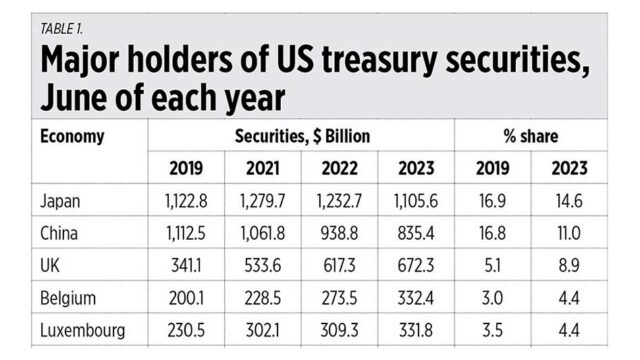
To see how valid this observation or process is, I checked the country origin of US treasury securities — the total has increased from $6.626 trillion in June 2019 to $7.563 trillion in June 2023. The biggest lenders to the US government are Japan and China, Japan alone provided 17% of the total in 2019 but this has declined to 14.6% in 2023.

The BRICS (Brazil, Russia, India, China, South Africa) are either reducing their lending to the US, or not lending, or there is no data from them about this (Russia, South Africa). The US has imposed economic sanction against Russia since 2014 when it annexed Crimea, then strengthened the sanctions in 2022. The share of China, India, Brazil, and Hong Kong has declined from 27.3% in 2019 to 19.7% in 2023. Saudi Arabia’s share has declined by half, from 2.7% to 1.4%.

The Philippines, Thailand, and Vietnam also have exposure to US debt but their combined share is small, 2.2% in 2019, down to 1.8% in 2023 (See Table 1).

On Aug. 2, Fitch downgraded its US credit rating from AAA to AA+ mainly due to “the expected fiscal deterioration over the next three years, a high and growing general government debt burden, and the erosion of governance relative to ‘AA’ and ‘AAA’ rated peers over the last two decades that has manifested in repeated debt limit standoffs and last-minute resolutions.”

The world’s big exporters of energy and mineral products include Russia, Qatar, Iran and Iraq. Note that they are non-lenders or minor lenders to the US.

One common narrative during the Russia-Ukraine war is that Russian exports of energy and minerals have declined because of the heavy economic sanctions imposed by the US and NATO allies. This is not true, it is fake news. Russian exports expanded from $249 billion in 2021 to $350 billion in 2022. The Russian market has changed, from its European neighbors to India, China, and Turkey, which refine Russia’s crude oil and export the refined oil products to Russia’s European neighbors. The Europeans now suffer from higher energy prices and higher overall inflation.

But the major winners and gainers from the sanctions against Russia are the US itself, which expanded its LNG exports to Europe, the United Arab Emirates (UAE), whose exports have expanded 5.3 times from 2017 to 2022, Saudi Arabia, Canada, and Norway (See Table 2).

The Philippines, Vietnam, and Thailand remain small players in energy and mining exports. The Philippines has failed to benefit from the higher prices of gold, copper, and silver over the last three years because of our anti-mining policies, especially the anti-open pit mining policies. And we endured high oil-gas prices when we could have a new domestic gas supply aside from Malampaya if the service contract there had been extended much earlier.

The main lesson for the Philippines and other developing countries is that we should reduce our dependence on the US dollar as forex reserves and as currency payment in our trade with other countries. We should have more gold reserves, more yen, yuan, won and other Asian currencies as reserves.

The US credit rating downgrade by Fitch is among the most recent proof of cracks in the US economic and financial power. It has too much public debt, has a high annual budget deficit, has been engaged in many costly and unproductive wars abroad, and is even preparing for a big war with China over Taiwan.

The Philippines needs more trade, more investments, more tourism, more peace based on commerce and not based on missiles. We need more cargo ships, not battle ships. More diplomats and traders, not more generals and admirals.


Bienvenido S. Oplas, Jr. is the president of Bienvenido S. Oplas, Jr. Research Consultancy Services, and Minimal Government Thinkers

minimalgovernment@gmail.com

Third-party subscribers take 13.55% of DITO CME’s shares

TWO unrelated third-party subscribers to shares in DITO CME Holdings Corp. have cornered as much as 13.55% of businessman Dennis A. Uy’s listed holding firm.

In a regulatory filing on Wednesday, DITO CME said one of the subscribers, Xterra Ventures Pte. Ltd., makes up 3.76% or 610 million of the firm’s 16.235 billion issued and outstanding common shares.

The subscribed shares via private placement were issued out of the company’s unissued authorized capital stock.

Before the share issuance to Xterra Ventures, DITO CME issued 1.59 billion new shares to Summit Telco Corp. Pte. Ltd., bringing the listed firm’s outstanding shares to 15.625 billion.

Summit Telco now accounts for around 9.79% of DITO CME’s outstanding shares, with Udenna Corp. remaining the biggest shareholder with a 68.98% stake, lower than its previous 71.68% before the entry of the new investors.

The identity of the third-party subscribers was disclosed by DITO CME on Tuesday.

On Wednesday, the company responded to a query from the Philippine Stock Exchange for more information on the transaction.

DITO CME said the issue price was set at P1.00 par value considering that the book value per share of the company was a negative P2.21 as of the latest quarterly financial report on June 30, 2023, and since it cannot issue new shares below par value of P1.00.

The company finished the second quarter with an attributable net loss of P1.1 billion, which was more than four times lower than the P6.63 billion recorded a year ago.

It described Xterra Ventures as a Singapore-based entity with an investment fund engaged in investment activities in the Asia-Pacific region. No additional information was given about Summit Telco.

DITO CME said the net proceeds of the transaction are to be fully invested in its operating subsidiary, DITO Telecommunity Corp.

It said the investment is “in compliance with the capital contribution commitments of DITO to be used to support its operations for the roll-out of its telecommunications business, further improving quality of access and user experience as well as accelerating the take up of its FWA (fixed wireless access) 5G and mobile postpaid product offerings.”

DITO Telecommunity is considered the third dominant telecommunications company in the Philippines.

DITO CME said the payment for the subscription of the shares had been fully paid.

The transaction also brought the company’s public float to 30.94% of its shares from 20.11%, while raising its foreign ownership level to 15.18% from 1.88% previously.

On Wednesday, shares in DITO CME jumped 2.7% or six centavos to close at P2.28 each. — VVS

BCDA sets initial phase of Marine Corps’ relocation

THE Bases Conversion and Development Authority (BCDA) has begun the preparatory works for the first construction package for the relocation of the Philippine Marine Corps headquarters to Bataan.

“We commend BCDA for facilitating the construction of roads, utilities, and preparatory works and the replication project as a whole for the Philippine Marine Corps. We would not be here without their dedication, hard work, and persistence in this endeavor,” said Philippine Marine Corps Commandant Major General Arturo M. Rojas in a statement on Wednesday.

The recent groundbreaking ceremony signaled the start of the first package of the relocation plan, which includes the construction of roads, utilities and other preparatory works of the Morong Discovery Park Phase 1 Project.

“The start of construction works for Package 1 today will help us get closer to our goal of providing a new, modern and state-of-the-art headquarters for the Marines that will support the operational efficiency of our troops in responding to national threats; in delivering aid during calamities; and in fostering peace and order across the country,” BCDA Chairman Delfin N. Lorenzana said.

On the day of the ceremony, BCDA also installed the steel columns for the Philippine Marine Corps grandstand, which is part of the ongoing construction of the parade grounds that is expected to be completed by November this year.

Construction packages 2 and 3 previously commenced in February last year, while the BCDA aims to complete the first phase of the project by 2024.

“We don’t want to lose sight of our focus on helping strengthen the Armed Forces. We will continue to share revenues and support the AFP (Armed Forces of the Philippines) Modernization Program,” said BCDA President and Chief Executive Officer Joshua M. Bingcang.

As part of the relocation program, BCDA has provided 100 hectares of its land in Morong Discovery Park for the Philippine Marines Headquarters, which only covers 12.65 hectares in its previous location in Fort Bonifacio, Taguig.

It is located at the eastern half of the park directly facing the West Philippine Sea and is accessible to major access roads including the Subic-Clark-Tarlac Expressway.

“The Bataan location was deemed strategic for the Marines as it would help expedite emergency response and ease deployment of troops,” BCDA said.

The transfer is also seen to open up income-generating opportunities as the area in Fort Bonifacio will be vacated.

From May 1993 to December 2022, BCDA’s contribution to the AFP reached P59.71 billion, P48.59 billion of which will be used for the latter’s rehabilitation program, while the remaining P11.12 billion is earmarked for the replication of military facilities.

Under Republic Act No. 7227, BCDA is mandated to generate funds for the AFP Modernization Program by transforming former US military bases and Metro Manila camps into economic growth areas. — Justine Irish D. Tabile

Changing the business model

SLIDEBEAN-UNSPLASH

PARADIGMS have been shifting even before Copernicus. When the Ptolemaic view of the sun revolving around the earth was replaced by the Copernican view (for which Galileo was persecuted in the 17th century) designating that central role to the sun, this was a major shift in the paradigm on the dominance of earthlings. Weren’t they the center of the universe? Maybe not.

“Shifting paradigms” are a staple of strategy sessions for besieged (or even healthy) companies in a changing environment. The process refers to a dramatic redefinition of an industry which usually repositions the skills needed and the restructuring that a company needs to undergo to continue being relevant and profitable. Sometimes it leads to closure.

The word paradigm comes from Latin, paradigma — to compare, to show alongside something else. A paradigm then is a metaphor. So, shifting a paradigm means changing the metaphor. The image of moving tectonic plates is implied when old assumptions, concepts, values, and practices are shaken up and overturned.

Paradigms keep shifting in many sectors. Think of the distribution of books through a handheld device like the Kindle or an iPad that can hold over a thousand books that are shelved in the cloud.

What about money transfers which used a traditional “padala” — asking OFW friends or relatives to bring physical cash home to hand over to their “near and dear” residing in the Philippines. This was superseded by corporate entities with semi-banking functions using a branch network for recipients of cash from abroad or even locally to withdraw remittances. This model too was overtaken by online banking which uses mobile phones and other devices to transfer cash instantly.

Lately, however, it seems consultants have not been too keen on paradigm shifts, maybe because the word itself seems pretentious with its silent “g.” Does anybody even use the word “paradigm” in ordinary conversation? (Have you had your paradigm checked?) Anyway, paradigms seem paired with no other modifier than “shifting” as they don’t tilt, slide, or shake hands.

Even executives trying to impress their boss shy away from a paradigm with its shifting ways. Is the customer base shifting its paradigm from owning to renting, as in homes or transport in the sharing economy? Are office paradigms moving to hoteling (use as needed) rather than one-to-one permanent occupancy (always available)? This type of speech will only evoke a sneer from corporate rivals — what did he have for lunch, fish head soup?

The recent pandemic has shifted all sorts of paradigms like dine-in in favor of food delivery.

Consultants now like the “business model” to capture how companies make or lose money. These two words (business, model) have an open-minded arrangement allowing marriage with other nouns with no compunctions. There is not the automatic union seen between a paradigm and its shift.

A business model is not pretentious. It merely describes a structure of how goods and services are offered for profits. The ditching of the paradigm has not automatically led to a business model that is comprehensible. Still, the new phrase seems friendlier and more flexible.

When old industries are wiped out by technology (like slide rules by calculators or the pager by the cell phone SMS) some guru is sure to analyze failure as the result of massive change. Before he shifts paradigms, the analyst is likely to look at new business models.

Will people stop traveling for business meetings abroad with the advent of teleconferencing? This prediction of a shift was made 25 years ago even before the advent of working from home. This is another shift that the pandemic has accelerated. Virtual meetings have not completely gone away even with the lifting of the alert level.

Still, the “new normal” — another shift in phraseology of change — seems to favor face-to-face (FTF) meetings again, without even the face mask.

Paradigms may shift. Business models may be revised. But it still takes imagination to understand what to do with change. The only thing that really shifts seems to be who is making more money now than before. Let’s not count the shady characters here.

Changing business models is more frequent than one presumes. Even the language has morphed. Those forced to exit a company now declare that their skills set do not fit the company’s ethos…which is just a new way of saying “I failed.”


Tony Samson is chairman and CEO of TOUCH xda

ar.samson@yahoo.com

Crypto startup aims to tokenize stocks by playing by the rules

TRUSTPAIR.COM

FOR YEARS, cryptocurrency startups have tried to replicate parts of the US stock market on the blockchain for use by digital-asset investors around the world, often without worrying too much about getting approval from regulators first.

The latest project, however, is an attempt to turn equities into crypto tokens in a way that won’t run afoul of securities laws, and it has scored the backing of one of Wall Street’s most well-known trading firms. Susquehanna International Group joined former Coinbase Global, Inc. executive Balaji Srinivasan and other investors in funding the company called Dinari, based in Los Altos, California.

The co-founders of Dinari have acquired a broker-dealer in the US, subject to final approval by the Financial Industry Regulatory Authority. They’ve also registered with the Securities and Exchange Commission (SEC) as a transfer agent, allowing the company to perform tasks such as distributing dividends and maintaining records of securities ownership.

“Oftentimes people, especially in the crypto space, are just afraid of regulation. And the thing is, in a lot of ways, they shouldn’t be,” Gabriel Otte, co-founder and chief executive officer of Dinari, said in an interview. “Look at the US stock exchanges. We are probably one of the highest-regulated ecosystems in the world. But it’s allowed us to flourish and grow since the 1920s into what really has become the most-robust market for securities in the world.”

The project is part of a growing list of efforts to turn real-world assets into digital tokens that trade on blockchains. Decentralized finance, the corner of the crypto world that proponents hope to make a more transparent and decentralized version of Wall Street, once offered triple-digit returns during an era of ultra-low interest rates. But the tables have turned following last year’s collapse of several lending projects and an environment of more-favorable returns in the relative safety of traditional assets. 

Founded in 2021, Dinari’s flagship product, Dinari Securities Backed Tokens, or dShares, allows investors outside the US a way to use cryptocurrencies to buy shares of some of the largest US companies and exchange-traded funds, including Tesla, Inc., Walt Disney Co., and Nvidia Corp. The platform, which went live earlier this month, is offered under Regulation S, a set of rules that allows for SEC-compliant sales of securities to overseas investors.

Unlike some previous projects, these tokenized stocks are backed one-to-one by real-world shares purchased by Dinari. The company uses Alpaca Securities LLC and Interactive Brokers Group, Inc. for custody of the actual equities.

The most well-known previous efforts to tokenize US stocks included the Mirror Protocol built on the Terra blockchain. Those unregistered tokens drew SEC scrutiny even before the collapse of Terra’s stablecoin caused some $40 billion in losses and triggered a global manhunt for the project’s co-founder, Do Kwon. Mr. Kwon is currently serving a four-month sentence in Montenegro for traveling on a fake passport, and both the US and South Korea are seeking his extradition to face charges for his alleged role in the stablecoin’s failure to maintain its intended $1 value.

Dinari has raised $7.5 million in seed investment from investors including SPEILLLP, which is a Susquehanna International Group company, venture-capital firm 500 Global, former Coinbase chief technology officer Mr. Srinivasan, and VC investor Sancus Ventures.

Once a user is verified by Dinari according to “know your client” rules, the investor can purchase tokenized shares by paying with stablecoins such as USDC. Token holders earn dividends, but cannot vote directly as shareholders. The platform collects a fee from every purchase.

Every trade on Dinari can be monitored by anyone, thanks to the underlying blockchain technology. Mr. Otte said they are looking for a third-party auditor.

Dinari has its work cut out for it when it comes to creating anything that remotely resembles the functionalities of the world’s largest stock market.

Holders of the stock tokens initially can only sell them back to Dinari. The platform’s goal is that the tokens will be widely used in the crypto market — either as collateral for borrowing or by swapping them for other security tokens. Purchases of the tokens are not available outside of US trading time. And according to Jake Timothy, co-founder and chief technology officer, Dinari is noncustodial, meaning that users need to hold the tokens in their own digital wallets.

Navigating securities laws around the world will also be a challenge. Dinari faces “complex regulatory landscapes across jurisdictions,” said Lake Dai, founder and managing partner at Sancus Ventures, one of the project’s investors.

“The end game of Dinari is to use our broker-dealer licenses to be able to have an operating exchange where these securities can be traded,” Chas Rampenthal, co-founder and chief legal officer of Dinari, said in an interview. “In order to run, you have to walk, and in order to walk, you have to crawl,” he said. “This is kind of our way of getting started.” — Bloomberg

Term deposit yields end mixed as central bank keeps hawkish stance

BW FILE PHOTO

YIELDS on the central bank’s term deposit facility were mixed on Wednesday after hawkish signals from the Bangko Sentral ng Pilipinas (BSP), even after it kept benchmark rates steady last week.    

Demand for the term deposit facility (TDF) of the BSP reached P318.596 billion on Wednesday, surpassing the P280-billion offer but a tad lower than the P319.002 billion in bids for a P300-billion offer at last week’s auction.

BSP Deputy Governor Francisco G. Dakila, Jr. said in a statement on Wednesday that the term deposit facility saw stronger demand this week.

“The BSP reduced the volume offering in the TDF to P280 billion, with the allocation between the 7-day and 14-day tenors recalibrated to P160 billion (from P170 billion) and P120 billion (from P130 billion), respectively,” he said.

“Both tenors were oversubscribed, with the respective bid-to-cover ratios for the 7-day and 14-day tenors at 1.121x and 1.160x,” he added.

Broken down, bids for the seven-day papers amounted to P179.347 billion, higher than the P160 billion auctioned off by the BSP as well as the P179.011 billion in tenders for a P170-billion offering logged in the previous auction.

Banks asked for yields ranging from 6.5780% to 6.6%, a wider band compared with the 6.57% to 6.61% seen a week ago. The average rate of the one-week term deposits inched down by 0.2 basis point (bp) to 6.5936% from 6.5956% previously.

Meanwhile, the 14-day term deposits attracted tenders amounting to P139.249 billion, higher than the P120-billion offer. However, it was below the P139.991 billion in tenders for a P130-billion offer seen on Aug. 16.

Accepted rates for the tenor ranged from 6.5780% to 6.61%, a slimmer margin versus the 6.55% to 6.62% last week. This caused the average rate of the two-week papers to inch up by 0.01 bp to 6.6% from 6.5998% in the prior auction.

“Looking ahead, the BSP’s monetary operations will continue to be guided by its assessment of prevailing liquidity conditions and market developments,” Mr. Dakila said.

The central bank has not auctioned off 28-day term deposits for more than two years to give way to its weekly offering of securities with the same tenor. 

The term deposits and the 28-day bills are used by the BSP to mop up excess liquidity in the financial system and to better guide market rates.

Rizal Commercial Banking Corp. Chief Economist Michael L. Ricafort said TDF yields were mixed on Wednesday as central bank officials said they remain ready to pause or hike rates if needed.

The BSP also signaled no rate cuts for now as inflation is still not within the 2-4% target range, Mr. Ricafort said.

BSP Governor Eli M. Remolona, Jr. on Tuesday said the central bank’s stance remains hawkish and rate cuts are far off as inflation is still elevated.

The Monetary Board kept benchmark interest rates steady for a third straight meeting last week, but said it is prepared to resume tightening if needed amid risks to inflation.

The BSP left its overnight reverse repurchase rate unchanged at a near 16-year high of 6.25%. Interest rates on the overnight deposit and lending facilities were maintained at 5.75% and 6.75%, respectively.

The central bank raised borrowing costs by 425 bps from May 2022 to March 2023 to tame inflation.

The BSP will hold its next policy meeting on Sept. 21. — Keisha B. Ta-asan

ADVERTISEMENT
ADVERTISEMENT