HANOI — Vietnam expects to sign an agreement to export 2.5 million metric tons of rice to the Philippines this year, state media reported on Wednesday.
The Philippines, which has for years been Vietnam’s largest market for rice, suspended rice imports during the last four months of 2025 to support domestic production.
But it plans to import 3.6 million tons of rice this year, with most of the grain to be sourced from Vietnam, Voice of Vietnam radio reported, citing an official with the Embassy of Vietnam in the Philippines.
The comments came after a meeting between Philippine Agriculture Secretary Francisco Tiu Laurel and Le Phu Cuong, Commercial Counselor at the embassy.
The Philippines will implement measures to control rice import volumes this year, including tariffs, the report added. — Reuters
Wreckage at the site where a train was derailed when a construction crane collapsed and fell onto its carriages, causing several casualties, in Sikhio district, Nakhon Ratchasima province, Thailand, January 14, 2026.
— REUTERS/CHALINEE THIRASUPA TPX IMAGES OF THE DAY
BANGKOK — A train derailed in northeastern Thailand on Wednesday after a construction crane fell on three of its carriages, killing at least 25 people and injuring about 80, police said.
The accident took place on Wednesday morning in the Sikhio district of Nakhon Ratchasima province, 230 kilometers (143 miles) northeast of Bangkok, on a train from the capital bound for Ubon Ratchathani province.
“The death toll has now reached 25. The search for more bodies is ongoing,” Police Colonel Thatchapon Chinnawong told Reuters by phone.
Transport Minister Phiphat Ratchakitprakarn said in a statement that there were 195 people on board, adding that he had ordered a thorough investigation to be carried out.
Those killed were in two of the three carriages hit by the crane, he said.
The crane was working on a high-speed rail project when it collapsed and hit the passing train, causing it to derail and briefly catch fire.
Images shared by the ministry showed carriages overturned next to shrubland and firefighters extinguishing a blaze as smoke billowed out.
Footage of the crash site verified by Reuters shows rescue workers trying to extract casualties from one of the buckled carriages, with some badly injured passengers already being loaded into ambulances.
The elevated high-speed rail project, one of several under construction in Thailand, was being built above the existing rail line. Part of the collapsed crane is still propped up by the stanchions built to support the new rail link.
Chinese Foreign Ministry spokesperson Mao Ning said at a press briefing that the Chinese government attached great importance to the safety of projects and personnel and was looking into the situation.
“At present, it seems that the relevant section was under construction by a Thai enterprise. The cause of the accident is still under investigation.”
The high-speed rail project will connect to China through Laos. The government said last year that more than a third of construction had been completed in the segment connecting Bangkok to Nakhon Ratchasima, and the whole line to Nong Khai at the border with Laos would be ready by 2030. — Reuters
MANILA/SINGAPORE — Jollibee Foods Corp’s JFC.PS international business is “ready to be a standalone”, its global chief financial officer said on Wednesday, as the Philippine fast food group prepares to spin off overseas operations to list on a US exchange in late 2027.
The plan unveiled on January 5 envisages retaining the Manila listing of its Philippine business. The company’s shares have climbed nearly 16% year-to-date, for a market capitalization of about $3.9 billion, LSEG data showed.
There were “so many reasons to believe that international is ready to be a standalone and the potential is there to continue because of the growth rate,” said Richard Shin, the global chief financial officer.
The international business accounted for 6,800 of Jollibee’s 10,300 stores by the end of last year’s third quarter, he told reporters.
Over the past 15 quarters its store network racked up compound annual growth of 26.7%, outpacing the group’s overall expansion of 15.1%, he added.
Mr. Shin said the spin-off would simplify the group’s structure and improve transparency, allowing investors to assess the domestic and international businesses on a standalone basis.
The United States offers capital markets with a large investor base experienced in valuing global consumer and restaurant growth companies, Mr. Shin said.
A listing there would provide greater liquidity, deeper capital markets and broader analyst coverage, he added.
Jollibee operates across 33 countries with brands such as Jollibee, Chowking, Smashburger, and Tim Ho Wan.
Known for the flagship brand of the same name, which offers menu items from sweet-style spaghetti to fried chicken, it has expanded its store base internationally alongside a broader multi-brand portfolio. — Reuters
SAKS Fifth Avenue flagship store in Toronto, Canada. — CAN PAK SWIRE/FLICKR
NEW YORK — High-end department store conglomerate Saks Global filed for bankruptcy protection late on Tuesday in one of the largest retail collapses since the pandemic, barely a year after a deal that brought Saks Fifth Avenue, Bergdorf Goodman and Neiman Marcus under the same roof.
The move cast uncertainty over the future of US luxury fashion, though the retailer said early on Wednesday its stores would remain open for now after it finalized a $1.75 billion financing package and appointed a new CEO.
Former Neiman Marcus CEO Geoffroy van Raemdonck will replace Richard Baker, who was the architect of the acquisition strategy that left Saks Global saddled with debt.
The company also appointed former Neiman Marcus executives Darcy Penick and Lana Todorovich as chief commercial officer and chief of global brand partnerships at Saks Global, respectively.
Saks Fifth Avenue, the retail arm of Saks Global, listed $1 billion to $10 billion in assets and liabilities, according to court documents filed in US Bankruptcy Court in Houston, Texas.
The court process is meant to give the luxury retailer room to negotiate a debt restructuring with creditors or sell itself to a new owner to stave off liquidation. Failing that, the company may be forced to shutter.
A retailer long loved by the rich and famous, from Gary Cooper to Grace Kelly, Saks fell on hard times after the COVID pandemic, as competition from online outlets rose, and brands started more frequently selling items through their own stores.
The original Saks Fifth Avenue store, known for displaying exclusive brands like Chanel, Cucinelli and Burberry, was opened by retail pioneer Andrew Saks in 1867.
FINANCING DEAL The new financing deal would provide an immediate cash infusion of $1 billion through a debtor-in-possession loan from an investor group, Saks Global said. Reuters earlier reported the loan was led by Pentwater Capital Management in Naples, Florida, and Boston-based Bracebridge Capital.
Financing worth $240 million would be available through an asset-backed loan provided by the company’s asset-based lenders, according to the company.
The luxury retailer will have access to $500 million of financing from the investor group once it successfully exits bankruptcy protection, expected later this year, the company added.
A host of luxury brands were among the unsecured creditors, led by Chanel and Gucci owner Kering at about $136 million and $60 million respectively, the court filing said. The world’s biggest luxury conglomerate, LVMH, was listed as an unsecured creditor at $26 million. In total, Saks Global estimated there were between 10,001 and 25,000 creditors.
In 2024, Mr. Baker had masterminded the takeover of Neiman Marcus by Canada’s Hudson’s Bay Co, which had owned Saks since 2013, and later spun off the US luxury assets to create Saks Global, bringing together three names that have defined American high fashion for over a century.
The $2.7 billion deal was built on about $2 billion in debt financing and equity contributions from investors including Amazon, Salesforce, and Authentic Brands, which were listed in the court filing as equity investors in Saks Global.
NEIMAN MARCUS DEAL ADDED DEBT The Neiman Marcus deal was designed to create a luxury powerhouse, but it saddled Saks Global with debt at a time when global luxury sales were slowing, complicating an already difficult turnaround for CEO and veteran executive Marc Metrick.
Saks Global struggled last year to pay vendors, who began withholding inventory, disrupting the company’s supply chain and leaving it with insufficient stock.
The thinly stocked shelves may have driven shoppers away to rivals like Bloomingdale’s, which posted strong sales in 2025, compounding pressure on Saks Global.
“Rich people are still buying,” Morningstar analyst David Swartz said last month, “just not so much at Saks.”
Running out of cash, Saks Global last month sold the real estate of the Neiman Marcus Beverly Hills flagship store for an undisclosed amount. It had also been looking to sell a minority stake in exclusive department store Bergdorf Goodman to help cut debt.
On December 30, it failed to make an interest payment of more than $100 million to bondholders. — Reuters
JAKARTA — Millions of Indonesian ride-hailing drivers would receive major increases to financial and social benefits under a draft decree being considered by President Prabowo Subianto, two sources said, threatening the profitability of ride-sharing platforms in their largest market in Southeast Asia.
Mr. Prabowo is under pressure to respond to drivers’ demands for better pay and conditions, particularly after their involvement in widespread student-led protests in August demonstrated the political clout of the sector’s workforce.
The debate also comes amid concerns about driver welfare as a result of a potential merger between the two largest ride-hailing platforms in the country, Indonesia’s GoTo and Singapore-based rival Grab. Critics of the deal say it will create a monopoly that will work against drivers.
The draft rules, seen by Reuters, details of the concessions, and potentially immediate enforcement via a presidential decree have not previously been reported. It was not clear if this was the final draft or when it would be enforced.
The decree under consideration would slash caps on commissions – the amount ride-hailing companies take from drivers for each trip – to 10% from the current 20%.
Indonesia is the only country in Southeast Asia that places caps on commissions for two-wheel ride-hailing services, and a cap would further limit the platforms’ margins.
Platforms would also have to pay for drivers’ accident and death insurance in full – which could cost companies about $1 a month for each of the roughly seven million delivery drivers in the ride-hailing industry.
It would also split health, old-age, and pension premiums for industry workers, potentially driving up hiring costs further.
“Most of the players in the industry cannot sustain these changes,” an industry source, who has seen the draft, told Reuters, expressing concern that the insurance fees would mean skyrocketing annual spending.
A second source, who also confirmed the proposals, warned that costs of premiums borne by platforms could lower margins and reduce the number of drivers they are able to allow on their platform.
Such benefits have for years been resisted by companies, which insist drivers are gig workers not eligible for the same insurance available to full-time employees.
The draft also authorizes the government to review agreements between the companies and online transportation workers, and protects the right to unionize.
The Indonesian government and the presidential office did not respond to Reuters requests for comment.
POLITICAL FORCE The administration of President Prabowo has been particularly sensitive to appeasing drivers. Presidential spokesperson Prasetyo Hadi has labeled them “heroes of the economy.”
“Motorcycle taxi drivers have become an increasingly visible political force, staging multiple protests over commission rates and rights and drawing significant public attention to their grievances,” Siwage Dharma Negara, a senior fellow at the ISEAS-Yusof Ishak Institute in Singapore, said.
He said the death of a motorcycle taxi rider during the August protests sharply intensified public scrutiny of gig workers’ vulnerability, and likely increased political urgency around worker protection.
In 2024, Indonesia led the ASEAN taxi market with a 37% share, based on its population and rapid uptake of digital payments, data from India-based research firm Mordor Intelligence showed.
The decree under consideration would also apply to on-demand logistics firms such as Lalamove, a Hong Kong-based company, and global logistics service firm J&T Express, which is listed on the Hong Kong stock exchange. — Reuters
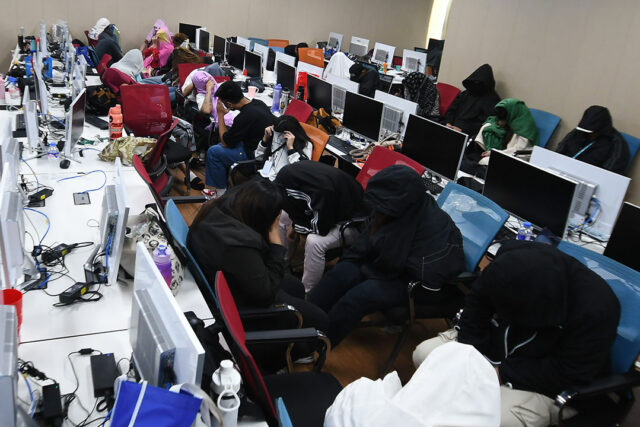
Police raided a suspected Philippine offshore gaming operator hub in a building in Parañaque City. — PHILIPPINE STAR/EDD GUMBAN
CAMBODIA’S arrest of alleged scam center kingpin Chen Zhi and his extradition to China was “not the end” of the Southeast Asian nation’s battle to stamp out trans-border crimes, its foreign minister said.
Last week’s surprise arrest of Chinese-born Mr. Chen is a key step in an until now fragmented international campaign targeting sophisticated scam networks in Southeast Asia run by criminal gangs, swindling victims worldwide out of billions of dollars.
The extradition of Mr. Chen, sanctioned by several countries and indicted by the United States for wire fraud and money laundering, followed a joint investigation by China and Cambodia, details of which have not been made public.
“It’s a continued combat, and we have set measures and steps in order to eradicate this crime,” Cambodian Foreign Minister Prak Sokhonn said in a rare interview from Phnom Penh, the capital.
Cambodia has always been determined to crack down on transnational crimes, especially crimes employing new technology, such as online scam organizations, he told Reuters.
“The fact that Chen Xi was arrested and extradited to China is just reflecting this firm commitment of Cambodia to combat the crime. And it’s not the end of the combat.”
He gave no details of the investigation into Mr. Chen but said full cooperation with Beijing had started months ago.
BILLIONAIRE CONGLOMERATE HEAD Mr. Chen, an enigmatic billionaire in his late 30s, heads the Prince Group conglomerate, based out of Cambodia with scores of ostensibly legitimate businesses worldwide.
But US authorities have said those were fronts for “one of the largest investment fraud operations in history”.
Last year, Prince Group rejected as baseless the accusations against Mr. Chen.
Hong Kong, Singapore, and Taiwan have frozen hundreds of millions of dollars in assets linked to Prince Group, while Britain and South Korea have imposed sanctions.
Last year, US prosecutors seized about $15 billion in bitcoin linked to Mr. Chen and Cambodia has liquidated the Prince Bank he founded.
It is not clear what Mr. Chen will be charged with in China, which set up a special task force in 2020 to investigate Prince Group, Chinese court documents dating to 2022 showed.
Last week, China’s state broadcaster showed video of Mr. Chen arriving in Beijing handcuffed and hooded.
It said Mr. Chen was wanted for fraud and running illegal casinos and described him as the “leader of a major transnational gambling and fraud crime syndicate”.
The scams, operated from vast compounds in countries such as Cambodia, Myanmar, and Laos, involve tens of thousands of workers.
Among them are human trafficking victims lured by promises of jobs in industries such as technology and hospitality, forced to cheat strangers online or face brutal punishment.
Cambodia has “very close cooperation” on transnational crime with countries such as the United States, China, South Korea, and neighbors Vietnam and Thailand, the Cambodian minister said.
“This is the result of a long investigation,” Prak Sokhonn added, referring to the events that led to Mr. Chen’s extradition.
“Chen Zhi had Cambodian nationality, but when we made those investigations and found that his nationality was not legally obtained and he is also a Chinese national … we have decided to extradite him to China.” — Reuters
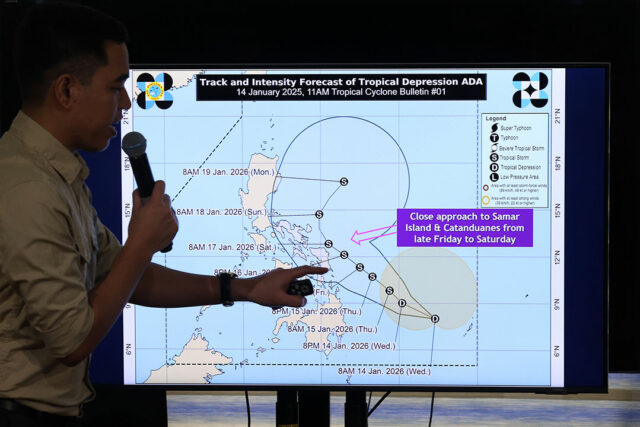
Tropical Depression Ada may bring strong winds with speeds of 39 to 61 kilometers/hour according to PAGASA at a press briefing on Jan. 14, 2026. — PHILIPPINE STAR/MIGUEL DE GUZMAN
The low-pressure area east of the country has developed into Tropical Depression Ada, according to the state weather bureau on Wednesday. Storm Signal No. 1 has been raised in several areas.
Ada entered the Philippine Area of Responsibility at 8:00 a.m. and was last located 635 kilometers east of Hinatuan, Surigao del Sur, the Philippine Atmospheric, Geophysical and Astronomical Services Administration (PAGASA) said in its 11:00 a.m. advisory.
The tropical depression has maximum sustained winds of 45 kilometers per hour (kph) and gusts of up to 55 kph.
Ada is forecast to intensify into a tropical storm within 24 to 36 hours.
PAGASA raised Storm Signal No. 1 over several areas in the Visayas and Mindanao, including Northern Samar, Eastern Samar, and Samar. The signal is also in effect over Dinagat Islands, Surigao del Norte, and Surigao del Sur.
Under this signal, PAGASA said minor to moderate impacts from strong winds may be experienced within 36 hours.
Storm Signal No. 2 may be the highest signal to be raised during the system’s passage, it said.
The weather bureau also issued a heavy rainfall outlook over the same areas, effective until Saturday.
A yellow rainfall warning was raised over Eastern Samar, Dinagat Islands, Surigao del Norte, and Surigao del Sur, where 50 to 100 millimeters of rain may experience on Thursday.
PAGASA warned of possible localized flooding and landslides, especially in disaster-prone areas amid heavy rainfall.
As of Ada’s trajectory within the next three days, it may pass near or make landfall over Eastern Visayas on Friday or Saturday morning.
The Tropical Depression may then move close to or make another landfall over Catanduanes from Saturday to Sunday before turning generally northeastward over the waters east of Luzon.
Tropical Depression Ada is the country’s first tropical cyclone for 2026.
The Philippines averages around 20 tropical cyclones each year, among the highest in the world, as it lies along the western North Pacific basin where storms frequently form. — Edg Adrian A. Eva
Armed Forces of the Philippines (AFP) personnel march during a parade in this file photo. — PHILIPPINE STAR/NOEL B. PABALATE
The Marcos administration is beefing up support for military and uniformed personnel (MUP) this year, rolling out higher base pay, increased subsistence allowances, and new positions, the Department of Budget and Management (DBM) said.
The higher take-home pay follows the issuance of Executive Order No. 107, which mandates salary increases in three tranches, the DBM said.
The DBM issued National Budget Circular No. 600 on Jan. 13.
The salary increases already started on Jan. 1, and will be followed with subsequent rounds on Jan. 1, 2027, and Jan. 1, 2028.
“A total of P21.7 billion has been clearly allocated for this (pay increase)— P15.4 billion for active service and P6.3 billion for pension obligations,” the DBM said in a statement on Wednesday.
Budget Secretary Rolando U. Toledo said the move recognizes the daily sacrifices of MUP, who protect the nation, often working through exhaustion, sleepless nights, and long periods away from their families.
“This is not written on water — this is certain, and funding has already been set aside,” he added.
Along with the take-home pay hike, the subsistence allowance has increased to P350 per day from P150 per day, effective on Jan. 1.
The DBM said it has allotted P71.5 billion to guarantee the continuous implementation of the higher allowance benefit.
“The increase in the subsistence allowance is not a luxury and not a favor—it is recognition that those who guard the nation must have sufficient food, strength, and daily nutrition,” Mr. Toledo said.
The covers all MUP of the Armed Forces of the Philippines (AFP), Philippine National Police (PNP), Philippine Public Safety College, Bureau of Fire Protection (BFP), Bureau of Jail Management and Penology (BJMP), Bureau of Corrections, Philippine Coast Guard and the National Mapping and Resource Information Authority and Resource Information Authority under the Department of Environment and Natural Resources.
In addition, the DBM said 10,077 new military and uniformed positions will be created across agencies under the 2026 national budget, backed by a P4.06 billion allocation.
The new posts are aimed at easing workload pressures and strengthening the government’s capacity to respond to threats, crises, and disasters, the DBM said.
Broken down, the PNP, BFP, and the BJMP will each add 2,000 new posts.
The Coast Guard will add 1,719 positions, the Armed Forces will add 1,358, and the Bureau of Corrections will add 1,000. — Aubrey Rose A. Inosante
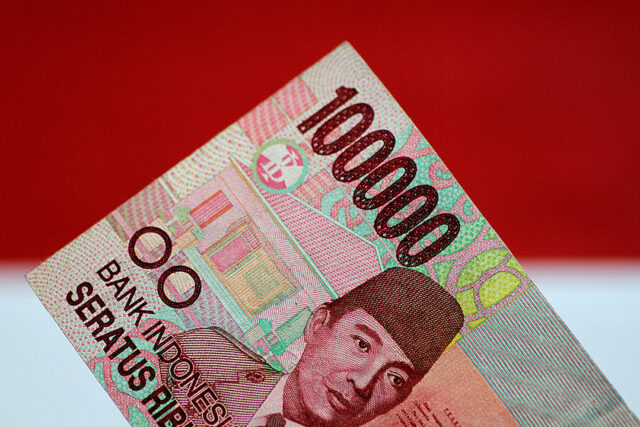
An Indonesia Rupiah note is seen in this picture illustration June 2, 2017. — REUTERS/THOMAS WHITE/ILLUSTRATION
JAKARTA — Indonesia’s central bank will continue intervening in the foreign exchange markets to ensure moves in the rupiah exchange rate reflects the currency’s fundamentals, it said on Wednesday, as the currency trades near a historic low.
The rupiah has been steadily depreciating so far this year, and hit its weakest point since April 2025 on Tuesday before recovering slightly. On Wednesday, it had slipped 0.03% by 0230 GMT to trade at 16,865 per dollar.
The rupiah hit its all-time low against the U.S. dollar in April 2025.
The rupiah’s fall was in line with regional peers, driven by rising geopolitical tensions as well as market worries about the independence of central banks in some developed countries, said Erwin Gunawan Hutapea, head of monetary management at Bank Indonesia (BI), in a statement.
“Bank Indonesia will remain active in the market to ensure the rupiah exchange rate moves in line with fundamental values ??and sound market mechanisms,” Hutapea said, using a phrase the central bank uses to describe its interventions in the market.
BI has conducted interventions in offshore non-deliverable forward markets in Asia, Europe and America, as well as in the domestic spot, non-deliverable forward and bond markets, Hutapea said.
Analysts said there have also been domestic concerns about Indonesia’s fiscal position, after the government reported a budget deficit of 2.92% of GDP in 2025, close to a statutory cap of 3% of GDP. — Reuters
BEIJINGUS — China on Wednesday reported a strong export run in 2025 with a record surplus of nearly $1.2 trillion, as producers braced for three more years of a Trump administration set on slowing the production powerhouse by shifting US orders to other markets.
Beijing’s resilience to renewed tariff tensions since President Donald Trump returned to the White House last January has emboldened Chinese firms to shift their focus to Southeast Asia, Africa and Latin America to offset US duties.
With Beijing looking to exports to counteract a prolonged property slump and sluggish domestic demand, the record-shattering surplus risks further unsettling economies concerned about China’s trade practices and overcapacity, as well as their overreliance on key Chinese products.
The manufacturing powerhouse’s full-year trade surplus came in at $1.189 trillion – a figure on par with the GDP of a top-20 economy globally like Saudi Arabia – customs data showed on Wednesday, having broken the trillion-dollar ceiling for the first time in November.
“The momentum for global trade growth looks to be insufficient, and the external environment for China’s foreign trade development remains severe and complex,” Wang Jun, a vice minister at China’s customs administration, said at a press briefing on Wednesday.
However, “with more diversified trading partners, (China’s) ability to withstand risks has been significantly enhanced,” Wang said, adding that “the fundamentals for China’s foreign trade remains solid.”
Outbound shipments from the world’s second-biggest economy grew 6.6% in value terms year-on-year in December, compared with a 5.9% increase in November. Economists polled by Reuters had expected a 3.0% increase.
Imports were up 5.7%, after a 1.9% bump the month earlier and also beat a forecast for a 0.9% uptick.
“Strong export growth helps to mitigate the weak domestic demand,” said Zhiwei Zhang, chief economist at Pinpoint Asset Management.
“Combined with the booming stock market and stable US-China relations, the government is likely to keep the macro policy stance unchanged at least in Q1.”
EXPORTS UP AS CHINA SET TO GAIN MORE GLOBAL SHARE China’s yuan held steady following the upbeat data even as equity investors welcomed the forecast-beating numbers. The benchmark Shanghai Composite index and blue-chip CSI300 index both rose more than 1% in morning deals.
The Asian economic juggernaut’s monthly trade surpluses exceeded $100 billion seven times last year, partially underpinned by a weakened yuan, up from just once in 2024, underscoring that Trump’s actions have barely dented China’s broader trade with the wider world even if he has curbed US-bound shipments.
Exports to the US slumped 20% in dollar terms in 2025, while imports from the world’s top economy were down 14.6%. Chinese factories managed to make inroads in other markets, with exports to Africa jumping 25.8% and those to the ASEAN bloc of Southeast Asian nations up 13.4%. EU-bound shipments grew 8.4%.
Trump on Tuesday said he thinks China can open its markets to American goods, after threatening a day earlier to slap a 25% tariff on countries that trade with Iran, risking reopening old wounds with Beijing, Tehran’s biggest trading partner.
Economists expect China to continue gaining global market share this year, helped by Chinese firms setting up overseas production hubs that provide lower-tariff access to the United States and the European Union, as well as by strong demand for lower-grade chips and other electronics.
A flagship of Beijing’s global industrial ambitions, China’s auto industry saw overall exports jump 19.4% to 5.79 million vehicles last year, with pure EV shipments up 48.8%. China would likely remain the world’s top auto exporter for a third year after first superseding Japan in 2023.
Beijing, however, has shown signs of recognising it must moderate its industrial exports if it is to sustain its success, and the leadership has been increasingly cognizant and vocal about imbalances in China’s economy and the image problem outsized exports are causing.
After November’s trillion-dollar surplus data, Chinese Premier Li Qiang was quoted last week on national television as calling for “proactively expanding imports and promoting the balanced development of imports and exports.”
The country also scrapped subsidy-like export tax rebates for its solar industry, a long-standing point of friction with EU states.
Lawmakers last month passed revisions to the Foreign Trade Law after two, rather than the usual three readings, in a signal to members of a major trans-Pacific trade pact that China is prepared to shift from industrial subsidies and towards freer, more open trade.
Despite the year-long truce on tariffs that Trump and Chinese President Xi Jinping struck in late October, US duties of 47.5% on Chinese goods are well above the roughly 35% level analysts say enables Chinese firms to export to the US at a profit. — Reuters
Tigkiliwi’s selection at Fantasporto 2026 marks another win for Puregold CinePanalo on the international festival circuit.
Tara Illenberger’s Tigkiliwi (Lopsided), a Puregold CinePanalo creation, scores another milestone for Filipino filmmaking with a prized spot in the Official Competitive Director’s Week of the 46th Porto International Film Festival, known worldwide as Fantasporto 2026.
A chilling yet poignant tale, Tigkiliwi follows young siblings Lala and Marlin, orphaned and left to navigate the world alone, as they find unexpected refuge with an elderly woman rumored to be an aswang, a shape-shifting creature in Philippine folklore. The film stars Ruby Ruiz, Gabby Padilla, Julian Paul Larroder, and Sunshine Teodoro who deliver performances that have captivated local audiences and are now set to seize the global stage.
Puregold CinePanalo’s Tigkiliwi takes Filipino storytelling to the global stage at Fantasporto 2026.
The film previously won the Jury Prize at the 2025 Puregold CinePanalo Film Festival, becoming the second CinePanalo-backed feature to reach Porto, following the success of Pushcart Tales.
Primed to take place from Feb. 27 to March 8, 2026, Fantasporto is an international film festival that is celebrated for its high-quality, imaginative cinema, particularly in the realms of fantasy, science fiction, and horror.
Offering a platform for films that push boundaries and explore new methods of storytelling, the festival attracts over 110,000 attendees annually and has been lauded by Variety as one of the top 25 film festivals in the world.
Director Tara Illenberger is excited to bring Tigkiliwi to the international film scene.
Tigkiliwi Director Tara Illenberger is elated by the achievement and looks forward to the movie being appreciated by a foreign audience. “I’m excited to find out if people will laugh or cry or respond to it the same way the Filipino audience did. Of course, I am thrilled by the prospect of visiting Portugal for the first time with my Puregold CinePanalo family,” she shares.
Puregold Senior Marketing Manager Ivy Hayagan-Piedad expressed enthusiasm over the selection, stating, “Tigkiliwi’s acceptance to Fantasporto has once again proven that Filipino narratives resonate on a global scale. We aim to pave the way for stories of our cultureto receive the recognition they deserve. We could not be prouder to see another CinePanalo film represent Filipino cinema with such distinction.”
The Official Competitive Director’s Week, where Tigkiliwi will compete, is dedicated to feature films, with Fantasporto’s Asian filmmakers-eligible sections also including the Official Fantastic Cinema Section for short films (under 15 minutes) and the Oriental Express Section for features produced by Asian filmmakers.
From local acclaim to international recognition, Puregold CinePanalo’s Tigkiliwi continues its winning journey abroad.
Eligibility for Fantasporto requires that films be produced in 2025, presented as a Portugal premiere, and have English subtitles for non-English dialogue.
Puregold CinePanalo, which launched in 2024 to highlight stories of hope and triumph, or mga kuwentong panalo of Filipinos, continues to nurture emerging filmmakers and provide a platform for films that celebrate Filipino creativity.
Following its Jury Prize at the 2025 Puregold CinePanalo Film Festival, Tigkiliwi now embarks on its international journey, joining the ranks of Philippine films making a mark on the world’s cinematic stage.
Tigkiliwi’s international recognition builds on the growing global footprint of Puregold CinePanalo titles, several of which have earned accolades at major film festivals worldwide. Aside from its Fantasporto recognition, Sigrid Bernardo’s Pushcart Tales (2024) was also the Philippines’ official entry for Thailand’s Pattaya Film Festival 2025. JP Habac’s Olsen’s Day (2025) was showcased at the 31st Minsk International Film Festival and the Asian Film Festival Barcelona, while TM Malones’ Salum (2025) garnered a Special Mention win for lead actress Christine Mary Demaisip at the Festival International du Film Transsaharien de Zagora, and selections at the 24th Dhaka International Film Festival and Asian Film Festival Barcelona.
Blending folklore and human emotion, Puregold CinePanalo’sTigkiliwi tells a haunting story of survival.
Other standout CinePanalo films have also found international audiences. These include Jill Singson Urdaneta’s Co-Love (2025), Mes de Guzman’s Sepak Takraw (2025), and Catsi Catalan’s Fleeting (2025), which were featured at the Asian Film Festival Barcelona under different competitive sections. Sepak Takraw was also featured at the 24th Dhaka International Film Festival.
Short films under the CinePanalo banner have also made their mark internationally, with Kent Michael Cadungog’s Text FIND DAD and Send to 2366 (2024) earning official selections at the Up-and-Coming International Film Festival Hannover in Germany; the Gandhara Independent Film Festival in Pakistan; and the Diwa Filipino Film Festival in Seattle.
Other Puregold CinePanalo shorts have likewise been recognized abroad, such as Mark Joseph Sanchez’s Our One and Only Bab(oy) (2025), which screened at the 30° Ningbo Short Film Festival in China, and the Jagran Film Festival in India — together with Sean Verdejo’s Dela Cruz, Juan P. (2025) and Clyde Gamale’s Champ Green (2025).
Jenievive Adame’s Smokey Journey (2024) was selected for the Student Film Competition of the Port Said Film Festival in Egypt, while Kenneth Flores’ 1… 2… Strike!!! (2025) and Jose Andy Sales’ G! (2025) were both official selections at the Asia Pacific Youth Micro-Movie Festival.
Together, these achievements highlight Puregold CinePanalo’s sustained commitment to nurturing Filipino filmmakers and amplifying beautifully made stories on the global stage.
Spotlight is BusinessWorld’s sponsored section that allows advertisers to amplify their brand and connect with BusinessWorld’s audience by publishing their stories on the BusinessWorld Web site. For more information, send an email to online@bworldonline.com.
Join us on Viber at https://bit.ly/3hv6bLA to get more updates and subscribe to BusinessWorld’s titles and get exclusive content through www.bworld-x.com.
HONG KONG — An app called “Are you dead” targeted at people living alone has gone viral in China, with surging downloads and widespread commentary on social media, prompting the company to introduce a subscription fee and change its name for a global audience.
The app called Sileme in Chinese, which translates to “Are you dead?” in English, is “a lightweight safety tool created for solo dwellers” from students, to solo officer workers or “anyone choosing a solitary lifestyle”, says its development team.
The app requires setting up one emergency contact and sends automatic notifications if the user has not checked in via the app for consecutive days.
China may have up to 200 million one-person households, with a solo living rate exceeding 30%, state newspaper the Global Times said.
Sileme said on its official Weibo on Tuesday that the company will launch the global brand name Demumu in its new version to be released soon.
It is already called Demumu on Apple’s paid app chart where it is currently sitting at number two, after surging to the top earlier in the week.
“Thanks to all netizens for their enthusiastic support. We were originally just an unknown small team, co-founded and operated independently by three born after 1995,” Sileme said.
It said on Sunday that it would launch an eight yuan ($1.15) payment scheme to help cover increasing costs.
Netizens on social media platforms, including Weibo, called on Sileme not to change its name, while others suggested options like “Are you alive”, “Are you online” or “Are you there.”
“Maybe some conservative people can’t accept it,” said one user, but it is helpful for safety purposes. “It will make us unmarried people feel more at ease to spend our lives.”— Reuters