Home Blog Page 4337

BoJ’s hawkish tilt suggests end to super-easy policy approaching

WIKIPEDIA.ORG

TOKYO — Bank of Japan (BoJ) policy makers are increasingly talking up the need to shift away from the massive monetary stimulus of the past decade, even as growing global risks heighten concerns about a fragile economic recovery.

A series of hawkish comments by BoJ speakers in recent weeks suggest the bank is preparing markets for an eventual policy change amid growing price pressures in deflation-prone Japan, analysts say.

Even dovish members of the BoJ board have expressed an openness to talk about a long-awaited exit from the extremely accommodative policy of former governor Haruhiko Kuroda, acknowledging changes in conditions may warrant a tweak in monetary settings.

Governor Kazuo Ueda told a newspaper interview on Saturday the BoJ could get enough data by yearend to judge whether conditions are in place to raise short-term interest rates.

Ueda’s remarks, which pushed up the yen and bond yields on Monday, followed those of BoJ board member Naoki Tamura last month that suggested the bank could safely hike short-term rates without hurting the economy.

“Even if the BoJ were to end negative rates, it won’t be scaling back monetary easing as long as it can keep interest rates low,” said Mr. Tamura, a former commercial bank executive.

The commentary contrasts in tone to the pro-growth posture adopted under Mr. Kuroda, an advocate of aggressive monetary easing to shock Japan out of its deflationary mindset.

It also suggests the BoJ under Mr. Ueda will be more inclined to prioritize unwinding the Kuroda-era policy framework, which has been blamed for distorting bond markets and crushing bank margin.

“The BoJ will proclaim that Japan has achieved 2% inflation and end negative rates in April,” said Mari Iwashita, chief market economist at Daiwa Securities and a veteran BoJ watcher.

To be sure, the BoJ is in no rush to phase out stimulus until there is enough data suggesting the economy can withstand the impact of weakening global demand and allow firms to keep hiking wages, say three sources familiar with its thinking.

But growing signs of change in Japan’s deflation-prone economy are making policy makers more open to discussing the hurdles for an exit, a sign they see decision-time approaching.

Inflation has exceeded the BoJ’s 2% target for more than a year as companies pass on higher costs to households. Firms also offered the largest pay hikes in three decades.

Even doves in the nine-member board have noted these changes.

“I believe Japan’s economy is finally seeing early signs of achieving the BoJ’s 2% inflation target,” said Hajime Takata, one such board member.

“We need to patiently maintain the current massive monetary stimulus. At the same time, we need to respond nimbly against uncertainties as we’re seeing early signs of a positive cycle emerge” between wages and inflation, he said.

Another board member, Junko Nakagawa, laid out the conditions for ending negative rates, notably a continued improvement in household confidence.

“When we see many people share prospects that wages will keep rising, we may be able to exit (negative rates).”

NO PRESET TIMING
Since taking the helm in April, Ueda has moved steadily toward phasing out stimulus. The BoJ tweaked policy in July to allow long-term rates to rise more reflecting higher inflation.

The next step would be to ditch or hike a 0% target set for the 10-year bond yield, and raise short-term rates from -0.1%.

Policy makers’ recent remarks suggest the BoJ could act sooner than markets expect. A majority of analysts polled by Reuters in August saw the BoJ scaling back stimulus only in a year’s time. Less than half expect negative rates to end in 2024.

There seems to be no consensus within the BoJ board, however, on when or how the bank would dismantle Mr. Kuroda’s complex policy framework.

Mr. Ueda said the BoJ could end negative rates if it believed that inflation would sustainably hold above the target.

His deputy Shinichi Uchida appeared to set a higher bar for ending negative rates, saying last month there was “still a long way to go” before conditions were met.

Next year’s wage outlook remains key.

Japanese firms traditionally kick off their spring “shunto” wage negotiations with unions in March. But the BoJ could get information before those talks through its regional branch offices and comments from corporate executives on the wage outlook, the sources said.

The global outlook would also be crucial with a downturn in the US and Chinese economies hurting manufacturers and discouraging pay hikes, the sources said.

“There’s so much uncertainty on the outlook for wages and Japan’s economy,” one of the sources said.

“The BoJ probably doesn’t have a pre-set timing in mind on when it can take the next step.” — Reuters


Roman-era swords, likely Jewish rebel booty, unearthed in Israel

YOUTUBE

JERUSALEM — Four 1,900-year-old swords, complete with wooden and leather scabbards, have been discovered in a remote cave in an Israeli desert, leading archaeologists to believe they were the booty of Jews who rose up against Roman rule.

The fashioning of three of the blades recalls Roman spatha swords, and the fourth has a ring-pommel handle consistent with the period, the Israel Antiquities Authority (IAA) said. The rare find included a shafted Roman pilum spear.

The desert location, overlooking the Dead Sea, was a hideout for Jewish rebels against the Romans, who controlled what was then Judea between the first century BC and second century AD.

A coin from the time of the Bar Kokhba revolt of 132-135 AD was found at the entrance to the cave.

“The hiding of the swords and the pilum in deep cracks in the isolated cave … hints that the weapons were taken as booty from Roman soldiers or from the battlefield,” IAA archaeologist Eitan Klein said in a statement.

“Obviously, the rebels did not want to be caught by the Roman authorities carrying these weapons.” — Reuters

No, climate scientists aren’t being forced to exaggerate

LAUNCHING an ozonesonde balloon. — NOAA-UNSPLASH

IT READS like a climate denier’s dream come true: A prestigious climate scientist publicly confesses he fudged research in order to get published.

That’s basically how excited headlines in right-wing media have portrayed scientist Patrick Brown’s claim this week that he oversold the influence of climate change on wildfire risks in order to get a paper published recently in the prestigious journal Nature.

But the real story isn’t quite that simple.

At the top of his would-be mea culpa, Brown links to a column I wrote about last month’s Maui wildfires, citing it as an example of how the media contributes to a narrative that such conflagrations are “mostly the result of climate change.” While I appreciate the link, I must point out that nowhere in my column do I argue climate change was the primary cause of the Maui fires. I do strongly suggest it was a contributing factor, with much of the leeward side of the Hawaiian islands trapped in a drought cycle that has and will continue to be exacerbated by global warming.

But of course a host of other factors contributed to the Maui disaster, from questionable land management to human error. Assigning a precise percentage of the blame to climate change is impossible, at least for me, and probably for any actual scientists.

That sort of thinking should feel familiar to Brown, because that’s pretty much exactly how his Nature paper about wildfires begins, except more science-y:

Some portion of the change in wildfire behavior is attributable to anthropogenic climate warming, but formally quantifying this contribution is difficult because of numerous confounding factors…”

In the rest of the paper, Brown and his seven co-authors use machine learning to try to figure out how climate change has affected, and will continue to affect, the risk of wildfires, mainly by drying out fuel such as undergrowth and grass (as happened in Maui, for example). They found, to a reasonable degree of certainty, that climate change has in fact increased wildfire risk in the recent past and will increase it even more in the near future. The paper is well-reasoned, not obviously overhyped, and peer-reviewed. It echoes many other recent studies with similar findings. Brown even stands by it.

But Brown also claims, in his column in The Free Press, a media company founded by former New York Times writer Bari Weiss, that he and his co-authors “didn’t bother to study” other factors contributing to wildfires, limiting their analysis to climate change. This decision was made, according to Brown, to ensure the paper fit a narrative that climate change is the world’s primary problem and that reducing greenhouse-gas emissions is the only solution. Veering from that path will cause prestigious journal editors and peer reviewers to reject your paper, Brown says, forcing you to resort to lesser publications, to the detriment of your career.

“[T]he editors of these journals have made it abundantly clear, both by what they publish and what they reject, that they want climate papers that support certain preapproved narratives — even when those narratives come at the expense of broader knowledge for society,” Brown writes.

And yet energy and climate consultant Richard Black did a quick survey of just the past month’s publications in Nature and found papers:

• suggesting Amazon deforestation is primarily the result of shoddy law enforcement;

• blaming a severe rainfall event in Japan on ocean waters mixing;

• suggesting underlying social vulnerabilities were more to blame than climate for extreme-weather disasters.

That third paper was co-authored by Friederike Otto, a pioneer in the burgeoning science of attributing extreme weather events to climate change. That work has practically won her household-name status as a climate Cassandra, a high-profile career she apparently doesn’t mind risking by countering Brown’s alleged narrative.

All of which suggests Nature has no problem publishing research that counters said narrative. Nature’s editor in chief, Magdalena Skipper, has denied that her publication pushes any agenda and criticized Brown for trying to manipulate it.

Skipper also pointed out that peer reviewers suggested Brown should include other wildfire factors in his research beyond climate, but he argued (pretty convincingly) that it wasn’t necessary for the purposes of his paper. This suggests not only that Brown’s work might have had an easier time getting published had those factors been included, but also that, if any censorship was happening in the climate-science community, it was Brown censoring himself.

It’s true that there is an allure, at least for those of us in the media, to lean into the lurid when it comes to climate. It’s difficult to get readers to pay much attention otherwise. If it bleeds it leads, and all that. But it’s also true that most climate scientists and writers still take great pains to avoid being too apocalyptic or definitive in their declarations, lest they be accused of doom-mongering that would incite climate deniers and trigger unproductive despair in normal people. Many of us think and argue constantly about such messaging. That’s a healthy thing.

Pretending otherwise, as Brown’s piece and its jubilant aggregators in right-wing media are doing, only gives comfort to climate deniers, confuses the science and makes real action far more difficult.

It so happens that Brown is the co-director of the climate and energy team at the Breakthrough Institute, a nonprofit known for courting controversy and pushing “ecomodernism,” or relying on technology to help humanity adapt to climate change. Implied is the idea that global warming isn’t as catastrophic as many scientists warn it could be, further implying that action to transition from fossil fuels isn’t so urgent. If any narrative is dangerous and needs debunking, it’s that one.

BLOOMBERG OPINION

PLDT group backs PHL e-governance drive

PRIVATE COMPANIES will be crucial in advancing the development of telecommunications and addressing the digital divide in the country, PLDT Inc. said.

“Governments around the world are now under pressure from rapid globalization, fiscal, social and technological changes to provide services that are citizen-centric, efficient, transparent, and effective,” Smart Vice-President and Head of Regulatory Affairs Roy D. Ibay said in a media release on Tuesday.

He made the statement amid the government’s digitalization thrust that aims to bring the benefits of the internet to more communities.

PLDT together with its wireless subsidiary Smart Communications, Inc. said it would continue to push for solutions to help narrow the digital divide while also advancing the government’s e-governance ambition.

“For e-governance to succeed, a country must narrow and bridge the existing digital divide,” he added.

The group has given its support to e-governance by continuously enhancing its integrated fixed and wireless networks.

Earlier, PLDT and Smart said they would explore the use of artificial intelligence (AI) for more efficient network operations and to boost customer experience.

PLDT has been considering AI and how to use the technology to grow its business.

Both PLDT and Smart have aimed to explore other emerging technologies to help elevate the customer experience in line with the government’s national digitalization ambition.

At the local bourse on Tuesday, shares in the company shed P23 or 1.92% to end at P1,172 apiece.

Hastings Holdings, Inc., a unit of PLDT Beneficial Trust Fund subsidiary MediaQuest Holdings, Inc., has a majority stake in BusinessWorld through the Philippine Star Group, which it controls. — Ashley Erika O. Jose

Goldman shrinks executive committee, memo shows

REUTERS

NEW YORK — Goldman Sachs appointed Chief Administrative Officer Ericka Leslie head of operations for global banking and markets, its largest division, according to a memo seen by Reuters.

The move reduces the bank’s number of executive officers to eight, for now, and leaves just two women in the group.

Ms. Leslie’s previous duties will be divided among other executives, people familiar with the matter said.

“Ericka is moving into one of the biggest and most important businesses,” a company spokesperson told Reuters.

The two women who remain among the executive officers are Chief Accounting officer Sheara Fredman and Chief Legal Officer and General Counsel Kathryn Ruemmler. The group is led by Chief Executive Officer (CEO) David Solomon and includes John Waldron, the bank’s president, and Denis Coleman, its finance chief.

Despite efforts to diversify the management of Wall Street firms, men vastly outnumber women in the top ranks. Citigroup’s Jane Fraser is the only woman CEO among the largest US banks, and the short list of candidates for Morgan Stanley’s next CEO does not include any women.

“Unfortunately, Wall Street boards and executives have not done enough to attract and retain women at banks,” said Mayra Rodriguez Valladares, a financial risk consultant at MRV Associates who trains bankers and regulators.

“Moreover, they have not been able to mentor them well enough to reach the C-suite.”

Ms. Leslie, who is also co-chair of the partnership committee, joined Goldman as an associate in 1996 and became a partner in 2012. The executive has held various leadership roles, including head of technology for currencies and commodities, and operations for the securities division, according to the Goldman memos.

Ms. Leslie is replacing Will Bousquette, who has been appointed chief operating officer of the asset and wealth management division, according to another memo by Marc Nachmann, who leads the unit.

“We’ve identified growth opportunities and built an organizational structure that will allow us to take advantage of them,” Mr. Nachmann wrote.

The memos did not indicate when the changes would take effect.

Mr. Bousquette, who joined the firm in 1998 and became a partner in 2014, succeeds Laurence Stein, a 27-year Goldman veteran who plans to retire at the end of the year, the memos said.

Goldman Sachs has made a raft of changes since it divided its business into three units last year and scaled back ambitions for its consumer business, which has lost $3 billion in the last three years.

It has also been refocusing its wealth business on the super rich, recently striking a deal to sell part of its wealth unit to an independent manager.

The Wall Street giant has seen a number of high-profile departures in recent months, including Julian Salisbury, chief investment officer of asset and wealth management, who is joining investment firm Sixth Street.

The partner departures are “absolutely typical” and allow the bank to make room for new leaders, Mr. Solomon told CNBC in an interview last week. More than 400 people comprise its elite partner ranks.

“If the partnership’s a certain size and we want to make a certain number of partners, we have to create that amount of movement over the course of every two-year period,” he said.

Goldman is also gearing up for another round of job cuts for employees who are seen to be underperformers, which could come in October, a person familiar with the matter told Reuters last week, confirming a report in the Financial Times.

The bank laid off about 3,200 people earlier this year in its biggest headcount reduction since the 2008 financial crisis. — Reuters

AI for business can help SME growth — experts

FREEPIK

ADOPTING a responsible learning mindset around the business uses of artificial intelligence (AI) can multiply the ways small- and medium-sized enterprises (SMEs) drive revenues and innovate for future value, according to experts.

“As a machine, it learns from us, but as humans, we learn from it,” Nikki L. Del Gallego, data and insights lead at Google Philippines, told BusinessWorld on the sidelines of the company’s AIMagine Marketing forum with the Internet and Mobile Marketing Association of the Philippines (IMMAP) last week.

“When you have more understanding of what it can do, then you are more open to what you can use it for and how it will benefit the business,” she added.

“The key for small business owners is to embrace learning opportunities,” said Mervin Teo V. Wenke, communications and public affairs head at Google Philippines. “Whether AI or not, any form of technology can bring value to the business.”

“Have that mindset. As a small business owner, you demonstrate that leadership by example, so your employees and staff will follow.”

The global AI market is expected to top $407 billion by 2027, with a compound annual growth rate of 36.2% within the 2022-2027 period, according to analytics firm MarketsandMarkets. The large total addressable AI market signals an opportunity for growth and profitability.

In the IBM report titled “Augmented Work for an Automated, AI-Driven World,” the availability of external skills (58%) and the development of new skills for existing talent (48%) were recognized as the most pressing concerns among Filipino executives.

“AI is about people and skills, not just technology,” the study said. “Competitive advantage comes from scaling employee expertise and transforming how work is done.”

“Organizations have to make human talent central to their AI strategy,” it added.

Adopting AI technology poses benefits for businesses of all scales in terms of streamlining processes and allocating efforts to more important matters than those that can be automated.

“[AI] can free a lot of time for staff, employees, and small business owners to allocate their resources to more strategic activities, rather than waste their time and energy in admin tasks,” Mr. Wenke said.

“That saved time means value and revenue, and it would really help the company focus on innovation, future value, expansion, customer experience, and many others.”

AI can also enable enterprises to explore the boundaries of creative development in marketing and branding through democratizing creative assets for campaigns, according to Raymund Sison, partner and chief creative officer at Propel Manila.

“Like AI, technology allows us to explore uncharted territories,” Mr. Sison said. “The more we democratize creative-making, [the more] it’s going to bring the bar up for creativity.”

Mr. Sison cited the “NotJustACadburyAd” campaign of global chocolate brand Cadbury, where small business owners in India were given the opportunity to create their own specialized advertisement featuring Bollywood actor Shah Rukh Khan through AI.

However, AI applications tread on ethical issues such as copyright and intellectual property, causing resistance to such a rapidly growing technology.

“It’s incumbent upon us to be transparent with our customers to lower their resistance with AI,” said Denise Haak, IMMAP president. “Tell them that we are using AI, what kind of AI tools, how we use it, and how their data and information are being processed by AI platforms.”

“Put together a multi-sector committee or task force to lead governance in AI,” said Cynthia Dayco, IMMAP trustee and head of content at Metrobank. “Figure out the best course of action and guidelines for the organization.”

“Talk to your employees and partners. Figure out how to monitor the use of AI… Constantly update guidelines for transparency,” she added.

Transparency is deemed the key to navigating the AI landscape among businesses, while regulation catches on and follows suit soon, according to Ms. Haak.

“Because there is no strict regulation, please exercise your best judgment,” Ms. Haak said on business owners adopting AI. “Ethical and moral responsibilities are imperatives.”

“Do what is right. Since you are also consumers: if this is something you would want from the brands that use AI, please do it for yours.” — Miguel Hanz L. Antivola

Lending process for SMEs seen faster with AI

FREEPIK

TECHNOLOGY that uses automated decisions on risks brings innovation to fintech and lending platforms, resulting in speedy services to small- and medium-sized enterprises (SMEs), an industry player said.

“Using alternative data sets which are not accessible to SMEs cuts down the time and requirements for the application process,” Bharath Kumar Vellore, Asia-Pacific general manager at risk decisioning platform provider Provenir, said in an interview with BusinessWorld.

Access to formal data remains a key challenge among business owners, Mr. Vellore said, but artificial intelligence (AI) can shorten the loan application process for SMEs to less than 24 hours from 10 or more weeks under traditional lending institutions.

Lenders are provided an automated decisioning platform and integrated data marketplace to build their credit policy as accurately and efficiently as possible today, according to Mr. Vellore.

Credit onboarding and integrations are purely data-driven, pooling from banks’ internal data, application data from the SME, third-party reference data, and alternative data.

Alternative data sources include web behavior on devices, participation in the e-commerce supply chain, and point of sale machines.

“In a traditional lending process, you would see that it is highly rules-driven,” Mr. Vellore said about small business owners having to secure inaccessible data themselves and lenders manually processing applications.

Mr. Vellore noted that financial inclusion amid the lack of access to working capital is a challenge faced by SMEs, adding to the informal parts of the lending process.

According to the World Bank, access to capital is the second most cited obstacle faced by SMEs in growing their businesses in emerging markets and developing countries.

“SMEs are less likely to be able to obtain bank loans than large firms,” the World Bank said. “Instead, they rely on internal funds, or cash from friends and family, to launch and initially run their enterprises.”

Mr. Vellore described the obstacle as a “vicious cycle” as SMEs “take lending from informal channels at very high interest rates.”

AI has powered predictive decisions based on a vast number of datasets to help SMEs where they do not need any prior credit data or fixed collateral, he said.

“We have now gotten very disruptive lenders like fintechs and digital banks, proactively addressing the credit needs of the SME market,” he said. “Over the next couple of years, we’re going to see much more prevalent use of technology with very, very fast loan approvals.”

“Lenders will be embracing digital technology, data, and advanced algorithms like machine learning to simplify and transform the application process,” he added.

Hallucinations and risks must still be noted as the technology grows, Mr. Vellore said. — Miguel Hanz L. Antivola

Archaeologists unearth 1,000-year-old mummy in Peru residential neighborhood

LIMA — Archaeologists in Peru have unearthed a 1,000-year-old mummy in the latest discovery at an archaeological site located in a residential neighborhood of the country’s capital, Lima.

The remains were found alongside ceramic vessels, textiles, and other objects in the Huaca Pucllana site in the middle of Lima’s affluent Miraflores district, the head of the team of archaeologists, Mirella Ganoza, told Reuters last week.

“This is an adult individual in a sitting position with bent legs,” the expert said, noting that the mummy had long hair and a jaw that was nearly completely intact.

The uncovered mummy lived possibly as long as a millennium ago, at the beginning of the Ychsma culture that developed on the central coast of modern Peru during a period of social reorganization prior to the arrival of the Incas to the area, Ms. Ganoza said.

Mummies and ancient offerings have already been found in the Huaca Pucllana site, and experts expect much more to be found.

While best known for the mountain-top Inca royal retreat of Machu Picchu, Peru was home to various pre-Hispanic cultures that thrived in the centuries before the Inca empire rose to power, mainly along the country’s central coast and in the Andes.

“I find it quite interesting that right in the heart of Miraflores, in the middle of the city, surrounded by modern buildings and constructions, an important site is still preserved, the Huaca Pucllana ceremonial center,” said Ms. Ganoza.

Lima, with 10 million inhabitants, has some 400 huacas, or sites with archaeological ruins, that can be seen in various neighborhoods, according to experts. — Reuters

Departure rules for Filipinos exiting the Philippines

PASSENGERS queue at the various gates of the NAIA Terminal 3 in Pasay City. — PHILIPPINE STAR/MIGUEL DE GUZMAN

Since travel restrictions have been lifted, our airports have been bustling with travelers heading to various destinations around the world for purposes of tourism, business, or employment, among others. Due to the surge of outbound passengers, lengthy queues at the airport, such as before the immigration counters, are a regular occurrence. Immigration checks for outbound travelers are indeed necessary to ensure that outbound passengers are traveling with appropriate documentation to protect them from potential illegal recruitment and human trafficking.

Despite the existing measures, some Filipinos, particularly first-time travelers, unfortunately remain vulnerable to exploitation, illegal recruitment, and human trafficking. In this context, the Inter-Agency Council Against Trafficking (IACAT), the government body tasked to coordinate and monitor the implementation of the Anti-Trafficking in Persons Act, issued the Revised Guidelines on Departure Formalities for International-Bound Filipino Passengers which was scheduled to take effect on Sept. 3. The enforcement of the Revised Guidelines was, however, suspended in view of the concerns raised by lawmakers and the public.

Under the Revised Guidelines, all international-bound Filipino passengers are required to present basic travel documents, which include their passport with validity of at least six months from the date of departure, appropriate valid visas where applicable, a boarding pass, and a confirmed return or roundtrip ticket for certain categories of travelers. The immigration officers (IO) of the Bureau of Immigration (BI) are tasked to inspect these basic travel documents and to inquire on the passenger’s purpose of travel. The IO may also ask relevant clarificatory questions and require the presentation of additional supporting documents which vary depending on the category of the passenger.

For instance, self-funded travelers may be required to present proof of hotel booking/accommodation, financial capacity or source of income, or proof of employment. Meanwhile, passengers whose travel is sponsored may be asked to provide substantial proof of their relationship with their sponsor, such as original birth or marriage certificates issued by the Philippine Statistics Authority (PSA). The traveler must also be able to present the relevant identification documents of the sponsor, such as copies of the passport and valid work visa/permit or residence permit, or registration documents in case the sponsor is a juridical entity.

Notably, an Affidavit of Support and Guarantee is required if the sponsor is either a relative up to fourth civil degree of consanguinity or affinity, a non-relative, or a juridical entity. The Affidavit must state, among others, the passenger’s relationship with the sponsor, the sponsor’s contact information, financial capacity to support the passenger’s travel, immigration status, and the reason for sponsorship. Additionally, the sponsor must undertake that the passenger’s travel is solely for tourism purposes, that he or she shall return to the Philippines upon the completion of the tour as reflected in the return ticket, and that the unreasonable failure to comply with the obligations of sponsorship may affect the assessment of the passenger’s future travels and the sponsor’s capacity to invite. If the sponsor is abroad, the Affidavit must be notarized by the Philippine Embassy or Consulate, or by a local notary public in the country of destination. In the latter case, the notarized affidavit must be apostilled by the relevant government authority in the country of destination or duly authenticated by the Philippine Embassy or Consulate.

With respect to departing Overseas Filipino Workers (OFWs), the Revised Guidelines reiterate the existing formalities which include the Overseas Employment Certificate duly issued by the Department of Migrant Workers, valid work visa/permit, and proof of employment.

The Revised Guidelines likewise seek to protect minors. Thus, parents who are traveling with their minor children may now be required to present their children’s original PSA-issued birth certificates, or the PSA-issued marriage certificate in case the mother is not accompanying her minor children. Meanwhile, a Travel Clearance Certificate or a Certificate of Exemption duly issued by the Department of Social Welfare and Development (DSWD) may be required of passengers traveling with minors in specific cases, such as when the parents are not married and the mother is not accompanying the minor. Relevant clearances issued by the National Authority for Child Care, DSWD, the appropriate court where the adoption proceedings are pending, and the Commission on Filipinos Overseas may also be required for passengers traveling with adopted minors. It must also be noted that minors below 13 years old are absolutely prohibited from traveling alone, pursuant to the existing rules of the DSWD.

The Revised Guidelines also provide additional documents that certain categories of passengers must be able to present to sufficiently establish the purpose of their trip. For example, intra-company transferees must be able to show proof of their local employment as certified by the Department of Labor and Employment (DoLE) and their secondment agreement as executed by their local employer and the foreign host company. Depending on the purpose of their travel, some passengers like volunteer workers, organ donors, Hajj pilgrims, and trainees, may be required to show proper endorsements from various government agencies and relevant institutions.

It remains to be seen whether the foregoing formalities on the part of the passengers will effectively curb the despicable crimes of human trafficking and illegal recruitment. While it may appear that Filipino travelers carry the physical and economic burden of proving the legitimacy of their travels, it is hoped that the Revised Guidelines, when enforced, will prevent the need for the presentation of irrelevant documents, thus minimizing delays in immigration checks and deferred departures.

Ultimately, our government agencies must strike a balance between one’s right to travel, as guaranteed under the Constitution, and national security and public safety, in crafting and implementing measures that streamline the departure requirements for Filipino travelers and promote smooth and efficient travel.

This article is only for general informational and educational purposes and is not offered as and does not constitute legal advice or opinion.


Kristine Bernadette F. Soriano is an associate of the Immigration department of the Angara Abello Concepcion Regala & Cruz Law Offices (ACCRALAW).

kfsoriano@accralaw.com

(632) 8830-8000

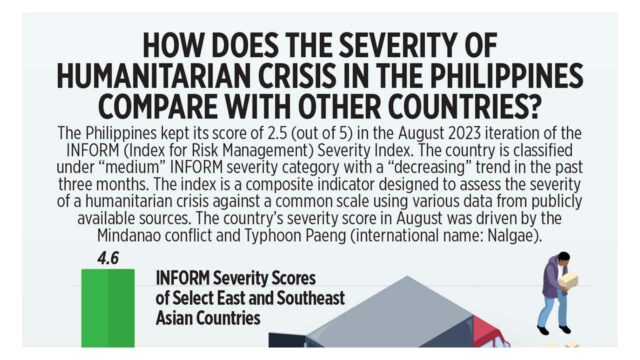
How does the severity of humanitarian crisis in the Philippines compare with other countries?

The Philippines kept its score of 2.5 (out of 5) in the August 2023 iteration of the INFORM (Index for Risk Management) Severity Index. The country is classified under “medium” INFORM severity category with a “decreasing” trend in the past three months. The index is a composite indicator designed to assess the severity of a humanitarian crisis against a common scale using various data from publicly available sources. The country’s severity score in August was driven by the Mindanao conflict and Typhoon Paeng (international name: Nalgae).

How does the severity of humanitarian crisis in the Philippines compare with other countries?

Probe sought on spam texts sent to motorcycle riders

A NETWORK of digital advocates is asking regulators to investigate the spam text messages sent to motorcycle taxi riders allegedly by Grab-owned company Move It.

Digital Pinoys has requested “swift action” from the National Telecommunications Commission (NTC) and the National Privacy Commission (NPC), according to a statement by its national campaigner Ronald B. Gustilo.

Move It and the NTC have been sought to comment on the matter but have yet to give their reply.

Mr. Gustilo asked the NTC and the NPC to ensure that the data used by Move It were not acquired illegally.

“They should explain as to how they were able to get hold of the data that they used,” he said about Move It’s accountability.

The spam text messages included an invitation to Move It’s Sept. 9 onboarding of new MC taxi drivers in its training facility in Marikina City.

“Based on the complaints of the riders, it is clear that the riders were unaware as to why they received text messages and that they did not want to,” Mr. Gustilo said, referring to posts by message recipients who claim that they have not transacted with Move It.

“We find it suspicious that Move It was able to send an invitation via text specifically to motorcycle taxi riders,” he said. 

“With the government’s campaign against the proliferation of spam and scam texts, companies using these practices should be held accountable,” he added.

Digital Pinoys sought a review of the SIM registration law and an audit of the SIM registration process, which promised to curb the proliferation of spam and scam cases. — Miguel Hanz L. Antivola

BSP woos UAE investors to enter PHL Islamic finance sector

BW FILE PHOTO

THE PHILIPPINES is an attractive investment destination for Islamic banking and finance, with an underserved market to tap into, an official from the Bangko Sentral ng Pilipinas (BSP) said on Tuesday.

BSP Assistant Governor Arifa A. Ala said in an economic briefing in Dubai that inquiries about the sector have surged after the Islamic banking law was passed before the coronavirus pandemic.

“We hope to see an investor from the UAE (United Arab Emirates),” Ms. Ala said. “The approach of the Philippine government in terms of Islamic banking and finance is very flexible… so come and please invest in the Philippines.”

The BSP has been encouraging lenders to get into Islamic banking after the sector was opened to new players following the passage of Republic Act No. 11439 or An Act Providing for the Regulation and Organization of Islamic Banks in 2019.

Changes to rules covering Islamic banking licensing, Shari’ah governance, and taxation have been instrumental in attracting more players to enter the sector, the central bank has said.

Interested market players can venture into Islamic banking in the Philippines by forming an Islamic banking unit (IBU) or a full-fledged Islamic bank, Ms. Ala said.

“The aim of the government is to provide an enabling environment wherein Islamic banks can operate alongside conventional banks. In fact, the National Government is also keen on issuing its first sovereign sukuk and this can expand our engagements with Islamic financial markets,” she said.

The Philippines is planning to launch its first-ever sukuk bond before the end of the year or early next year.

“On the opportunities, there are 115 million Filipinos, 10% of whom reside in the Bangsamoro Autonomous Region in Muslim Mindanao. Around 34% of cities and municipalities in the PHL are unbanked, so there is definitely a market to serve,” Ms. Ala said.

BSP Deputy Governor Francisco G. Dakila, Jr. earlier said there are five banks and government institutions from abroad which have expressed interest in venturing into Islamic banking in the country. — K.B. Ta-asan

ADVERTISEMENT
ADVERTISEMENT