Home Blog Page 4318

Regular-milled rice prices average P41.47/kg in late July

PHILIPPINE STAR/KRIZ JOHN ROSALES

THE national average retail price for regular-milled rice in late July was P41.47 per kilogram (kg), the Philippine Statistics Authority (PSA) said in a report.

Prices rose 0.6% in the July 15 to 17 period, which the PSA refers to as the second phase of July, compared with prices between July 1 to 5, or the first phase.

The PSA said that the highest retail price was recorded in Northern Mindanao at P43.32 per kg.

At the low end was Cagayan Valley with regular-milled rice prices at P37.01 per kg during the period.

The PSA said that the average price for a kilogram of well-milled rice was P45.68 per kg.

The highest average retail price of well-milled rice was in the Central Visayas at P48.38 per kg; while Ilocos Region reported the lowest average of P41.88 per kg.

The government imposed a temporary price cap on regular-milled rice of P41 per kg and well-milled rice of P45 per kg via Executive Order No. 39.

The PSA also said that a kilogram of pork belly (liempo) averaged P338.43 per kg during the second phase of July.

The highest average price was in Calabarzon (Cavite, Laguna, Batangas, Rizal, Quezon) at P377.4 per kg. Western Visayas was at the low end at P292.25 per kg.

It added that the average price for a kilo of galunggong (round scad) was P202.62 per kg.

The PSA said that the highest retail price was also recorded in Calabarzon at P267.20 per kg, with the lowest in Zamboanga Peninsula at P133 per kg.

The average price for carrots during the period was 156.87 per kg during the period.

Bicol region reported the highest retail price at P198.2 per kg, while Cordillera Administrative Region was the lowest at P103.14 per kg.

The average prices of red onion, carabao mango, and brown sugar were P204.15 per kg, P143.62 per kg, and P83.2 per kg, respectively. — Adrian H. Halili

Palay production forecast for Q3 downgraded 2.3%

PRODUCTION of palay, or unmilled rice, is expected to come in at 3.788 million metric tons (MT) during the third quarter, based on the standing crop as of Aug. 1, the Philippine Statistics Authority (PSA) said.

The estimate reflects a 2.3% downgrade of the initial 3.876 million MT forecast issued on July 1.

The third-quarter estimate, if borne out, would result in a 0.3% year-on-year decline from actual output recorded in the third quarter of 2022.

The PSA said the estimated harvest area for the quarter reflects a 0.5% year-on-year decline to 926.95 thousand hectares.

“Based on standing crop for the period of July to September 2023, the yield per hectare of palay may improve to 4.09 MT or by 0.5%,” the PSA said.

About 168.07 thousand hectares of the standing crop had been harvested as of Aug. 1. This was about 18.1% of the total 926.95 thousand hectares.

Output within the harvested area was about 693.51 thousand MT.

About 14.7% of the crop yet to be harvested was in the vegetative stage, 55.5% in the reproductive stage, and 29.8% in the maturing stage.

The Department of Agriculture has said that it expects palay output during the second half to hit 11 million MT, citing estimates from the Philippine Rice Information System.

During the harvest season palay production is expected to hit 5 million MT; by the end of September output is expected at 2 million MT, and in October at up to 3 million MT.

Meanwhile, the PSA said corn production is projected at 2.48 million MT in the quarter, up 5.4% year on year.

During the quarter, the area planted to corn is projected to rise 1.8% to 820.73 thousand hectares, while total yield is estimated to rise 3.8% to 3.02 MT per hectare.

The PSA said that about 25.3% or 207.59 thousand hectares of the standing crop have been harvested, producing 580.42 thousand MT of corn.

“Of the 613.14 thousand hectares of standing corn yet to be harvested as of (Aug. 1), about 7.2% were at the vegetative stage, 49.0% at the reproductive stage, and 43.8% at the maturing stage,” it added. — Adrian H. Halili

The peculiarities of taxing PEZA entities

In my little over a year of experience as a tax professional, I have noted the peculiarities of taxing Philippine Economic Zone Authority (PEZA) registered businesses. This peculiarity creates conflicting resolutions and interpretations of tax rules issued by Bureau of Internal Revenue (BIR) and PEZA. Unfortunately for PEZA entities and taxpayers transacting with PEZA entities, the conflict creates uncertainty in the tax treatment of some of their activities. 

Considering that BIR and PEZA are both government agencies with mandated powers and duties, a good way to resolve the confusion caused by these conflicting interpretations is to determine their respective powers and duties in relation to the taxation of PEZA entities.

In general, the power and duty to assess national internal revenue taxes are lodged with the Commissioner of Internal Revenue (CIR) or his authorized representatives. It follows then that the CIR or his authorized representative have the power to audit and assess PEZA entities. Specifically, Revenue Regulations (RR) No. 01-00, as amended, has emphasized the CIR’s or his authorized representative’s power to audit the 5% special gross income tax (GIT), as well as his power to abate, cancel, or compromise on the payment of the tax, including his power to implement special voluntary payment program/s for last priority in audit.

In the case of AGM Packaging System Ltd. Corp. vs. Commissioner of Internal Revenue (CTA Case No. 1743 dated March 29, 2019), the court disregarded AGM’s contention that PEZA has the sole authority to declare upon factual compliance that the company is a bona fide PEZA enterprise and its entitlement to tax incentives. The court recognized the CIR’s authority, in the exercise of his power to assess, to determine whether the company is qualified to avail of the preferential income tax rate granted to PEZA entities.

Considering the ruling in this case, what then is the role of PEZA as to the taxation of PEZA entities?

If we look at the listed powers and duties of PEZA under Section 13 of RA 7916, as amended, it does not really mention the specific authority of PEZA when it comes to the taxation of PEZA entities. However, item (h) of the same section provides that PEZA has the authority to recommend to the local government units or other appropriate authorities the location, incentives, basic services, utilities and infrastructure required or to be made available for such entities. Following this provision, we can infer that PEZA’s role in the taxation of PEZA entities is merely recommendatory.

Evidently, PEZA is authorized to issue certifications on an annual basis confirming that an entity is a bonafide PEZA establishment entitled to the 5% special tax on gross income pursuant to Section 5(c) of RR No. 01-00.   

Take note, however, that since the distinction of powers and duties between BIR and PEZA is general in nature, certain tax issues remain unresolved up to this date. This is where BIR and PEZA are somehow given flexibility to issue conflicting resolutions and interpretations. An example would be the issue of whether scrap sales are subject to 5% GIT or 30% regular corporate income tax (RCIT).

PEZA, through its Director General, issued PEZA Memorandum Circular No. 032-05 stating that sales of production rejects and seconds and recovered waste/scrap are considered covered by the registered activity of an export enterprise; hence, they are subject to 5% GIT.

On the other hand, in the CTA case of Subic Water Sewerage Co., Inc. vs. Commissioner of Internal Revenue (CTA Case No. 9074 dated Aug. 14, 2019) adopting the ruling in the case of Commissioner of Internal Revenue vs. Nidec Copal (CTA Case No. 250 dated Oct. 1, 2007), the court held that scrap sales although incidental to the registered activity of the PEZA entity are subject to 30% RCIT pursuant to Section 8 of the PEZA Rules and Regulations.

Notwithstanding these CTA cases, the BIR issued rulings, such as BIR Ruling [DA-(IL-038) 726-09] dated Dec. 9, 2009, adopting the PEZA circular and subjecting the scrap sales to 5% GIT. Furthermore, some PEZA entities have received confirmation from PEZA that their scrap sales are subject to GIT. Thus, PEZA entities are still confused as to the proper tax treatment of their scrap sales, resulting in deficiency tax assessments during BIR audit.

Nonetheless, there are certain tax issues resolved by BIR and PEZA resolutions and interpretations as they clearly define BIR and PEZA’s respective roles and duties in line with their general powers and duties, such as in case of the issuance of VAT zero-rating certification.

Prior to the CREATE Law and when the “cross border doctrine” was still applicable, securing VAT zero-rating certification was not mandatory. However, with the passage of the CREATE Law, which qualified the VAT zero-rating of local purchases of PEZA entities, securing a VAT zero-rating became mandatory.

Initially, local suppliers of PEZA entities had to secure VAT zero-rating certification from BIR in addition to the VAT zero-rating certification issued by PEZA. However, with the effectivity of RR No. 03-2023 on April 28, 2023, they are no longer required to seek approval from the BIR. This is without prejudice, however, to the BIR’s authority to conduct post-audit investigations or verification as to the validity of the zero-rating.

With the change of BIR rules, the effect of RR No. 03-2023 on pending VAT zero-rating applications with the BIR became unclear to taxpayers. To resolve this, BIR issued Revenue Memorandum Circular (RMC) No. 80-2023. Pursuant to the RMC, applications for VAT zero-rating which have been received by BIR prior to April 28, 2023 and with a VAT zero-rating certificate from an Investment Promotion Agency such as PEZA, will be accorded VAT zero-rating treatment from the date of filing, subject to post audit by BIR. On the other hand, transactions that were already consummated prior to April 28, 2023 but without an approved application for VAT zero-rating and disapproved applications prior to April 28, 2023, will be subject to 12% VAT.

With the issuance of RR No. 03-2023 and RMC No. 80-2023 which clearly defined the respective roles and duties of BIR and PEZA on VAT zero-rating of local purchases of PEZA entities, let us all hope that more regulations will be issued, and cases will be promulgated to resolve all the tax issues peculiar to PEZA entities.

Let’s Talk Tax is a weekly newspaper column of P&A Grant Thornton that aims to keep the public informed of various developments in taxation. This article is not intended to be a substitute for competent professional advice.


Tonee Rose M. Palomeno is an associate from the Tax Advisory & Compliance division of P&A Grant Thornton, the Philippine member firm of Grant Thornton International Ltd.

pagrantthornton@ph.gt.com

PCG reveals ‘severe damage’ to disputed shoals

SCREENGRAB FROM PHILIPPINE COAST GUARD FB PAGE

By John Victor D. Ordoñez, Reporter

THE PHILIPPINE Coast Guard (PCG) revealed on Monday that there is now “severe damage” to marine life in Rozul Reef (Iroquios Reef) and Escoda Shoal (Sabina Shoal) in the South China Sea, maritime areas where swarming by Chinese vessels had been reported.

“The surveys conducted in Escoda Shoal revealed visible discoloration of its seabed, strongly indicating that deliberate activities may have been undertaken to modify the natural topography of its underwater terrain,” the PCG said in a statement.

The PCG also posted an underwater video of the damage in the seabed of Escoda Shoal on its Facebook page.

Commodore Jay Tarriela, PCG spokesman, confirmed severe damage to the marine environment in an Armed Forces of the Philippines (AFP) report, stating: “The continued swarming for indiscriminate illegal and destructive fishing activities of the Chinese maritime militia in Rozul Reef and Escoda Shoal may have directly caused the degradation and destruction of the marine environment in the West Philippine Sea features.”

The Chinese Embassy in Manila did not immediately reply to an e-mail seeking comment.

Last week, the National Security Council of the Philippines reported that Chinese research vessels had been roaming the eastern side of the West Philippine Sea, just as the military flagged the resurgence of Beijing’s swarming tactics.

The so-called swarming activity was reported days after the Chinese Coast Guard’s repeated attempts to block Philippine resupply missions to the Second Thomas Shoal.

Second Thomas Shoal is about 200 kilometers from the Philippine island of Palawan and more than 1,000 kilometers from China’s nearest major landmass, Hainan Island.

“The PCG emphasizes the importance of protecting and preserving our marine environment, which plays a crucial role in sustaining marine life and supporting local communities,” the PCG said.

In a televised interview, Senator Francis N. Tolentino said the destruction of the coral reef could be linked to a possible reclamation project in the area.

“I think there is a deeper reason for what is being done in the area… not just in destroying the corals, but as a prelude for something,” Mr. Tolentino said in Filipino. “If you destroy these (corals), you can now reclaim the area.”

The senator pointed out that harvesting the corals violated the United Nations Convention on the Law of the Sea (UNCLOS), which the Philippines could challenge before the UN tribunal.

Last month, Energy Secretary Raphael P.M. Lotilla said that President Ferdinand R. Marcos, Jr. had given the go-signal for Manila to conduct drilling and exploration activities at Reed Bank and other areas of the South China Sea within the Philippines’ exclusive economic zone (EEZ).

Former Supreme Court Justice Antonio T. Carpio earlier urged the government to explore Reed Bank amid rising energy costs and the drying up of the Malampaya natural gas field.

Tensions between the Philippines and China have worsened after the Chinese Coast Guard fired water cannons to block Manila’s resupply mission at Second Thomas Shoal on Aug. 5.

Mr. Carpio said the move was China signaling to Manila not to send survey ships to Reed Bank.

House minority vows scrutiny of intel funds and more at plenary

PHILSTAR FILE PHOTO

By Beatriz Marie D. Cruz, Reporter

MINORITY congressmen vowed to raise questions on wage increases, budgets for bases and infrastructure to which United States troops are given access, intelligence funds, and the Executive’s controversial fund transfers as plenary debates on the proposed P5.768-trillion national budget begins today in the House of Representatives.

“In the DBCC (Development Budget Coordination Committee), we will raise the [proposed] salary increase for teachers and other government employees, [and the] general provision on confidential/ intelligence funds,” Deputy Minority Leader and Party-list Rep. France L. Castro said in a Viber chat.

All confidential funds in government agencies will be questioned and lump sums, special purpose funds, and unprogrammed appropriations will also be scrutinized, Ms. Castro added.

The proposed budget for next year has P10.14 billion worth of confidential and intelligence funds (CIFs), with P5.28 billion in intelligence and P4.86 billion in confidential funds.

The Office of the President (OP) was given P4.5 billion in intelligence funds, while the Office of the Vice President (OVP) and the Department Education (DepEd) sought confidential funds worth P500 million and P150 million, respectively.

The budgets of these offices breezed through the House Committee on Appropriations without scrutiny, especially on its proposed CIFs.

The Department of Information and Communications Technology (DICT) is earmarked confidential funds worth P300 million. The Bureau of Customs (BoC) will get P30.5 million, while the Department of Foreign Affairs (DFA) was allotted P5 million in confidential funds.

The Department of Agriculture (DA) was allotted P50 million in confidential funds, the DND, P60 million, and the Presidential Security Group, P60 million.

Assistant Minority Leader and Party-list Rep. Arlene D. Brosas said she will question the supposed fund transfers of the OP to the government’s anti-communist task force.

She will also question the proposed budget for the military bases accessed by the US under the Enhanced Defense Cooperation Agreement (EDCA), which Defense Secretary Gilberto “Gibo” C. Teodoro, Jr. said the Philippines still funds.

“Our focus will be more on the budget for infrastructure, foreign bases, social services, and food security,” she said via Viber.

Albay Rep. Edcel C. Lagman said he will scrutinize the budgets of the Finance, Education, Foreign Affairs, and Environment departments.

The lower chamber seeks to pass the 2024 budget on Sept. 27.

Additional P4B for tuition in SUCs sought

PHILSTAR FILE PHOTO

THE PHILIPPINE Association of State Universities and Colleges (PASUC) sought an additional P4.2 billion to fund the government’s free tuition program for tertiary education students to accommodate the increase in enrollees this school year.

“It is our earnest request that additional amount of P4.2 billion be appropriated for free higher education for FY 2024 to close the deficiency,” PASUC President Tirso A. Ronquillo told the House Appropriations Committee on Monday.

Mr. Ronquillo noted that P21.7 billion is allocated in the National Expenditure Program for 1.8 million tertiary education beneficiaries from state universities and colleges (SUCs).

Because of the projected program of receipt and expenditures of P25.86 billion, the budget of SUCs would mean a deficiency of P4.16 billion.

“It seems to us that this issue on deficiency will be recurring since 2022 so for 2024, we hope that the good Congress would find ways to allocate additional P4.2 billion to address the deficiency in 2024,” he said.

Under Republic Act No. 10931 or the Universal Access to Quality Tertiary Education Act institutionalizes providing free tuition and fee exemptions in SUC and local universities and colleges (LUCs).

Mr. Ronquillo also urged Congress to ensure budget allocations for educational equipment and infrastructure.

“We understand that there is a very limited fiscal space in 2024… But it is also our humble belief that in pursuit of delivering quality higher education, as we all believe and as we all espouse, equipment provision and infra development must also be prioritized,” Mr. Ronquillo said.

SUCs need approximately P17.66 billion to fund its priority projects for equipment and infrastructure.

Under the 2024 National Expenditure Program (NEP), the total budget for SUCs is at P105.58 billion.

There are a total of 114 SUCs nationwide, Mr. Ronquillo noted.

As mandated by the Constitution, the education sector receives the highest budget allocation of P924.7 billion for next year. Beatriz Marie D. Cruz

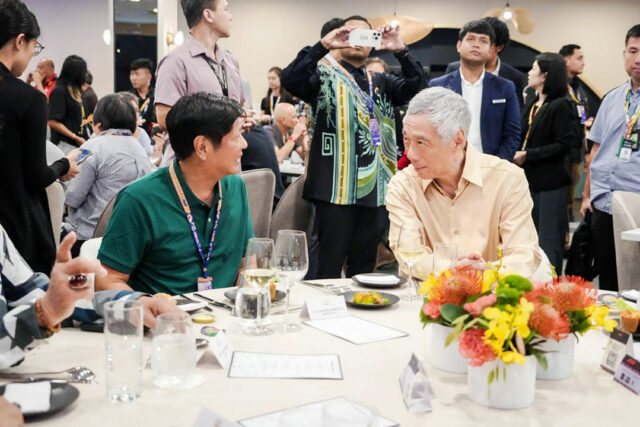
‘More collaboration’ with Singapore eyed

(L-R): PRESIDENT FERDINAND R. MARCOS JR. AND PRIME MINISTER LEE HSIEN LOONG — PCO.GOV.PH

PHILIPPINE President Ferdinand R. Marcos, Jr. expects more collaboration and stronger ties with the Singaporean government after he met with Prime Minister Lee Hsien Loong and Deputy Prime Minister Lawrence Wong at the weekend, the Presidential Communications Office (PCO) said on Monday.

“The discussions with Prime Minister Lee Hsien Loong and Deputy PM Lawrence Wong have been promising. Our countries can expect enhanced collaboration on multiple fronts to address common global challenges,” Mr. Marcos said, speaking of his dinner meeting hosted by Mr. Lee.

The PCO said Mr. Marcos and the Singaporean leaders watched the F1 Grand Prix, after an invitation by Mr. Lee.

Mr. Marcos was in Singapore last week to meet with economic managers and business leaders at the 10th Milken Asia Conference, where he invited foreign investors to the Philippines’ infrastructure program.

“We open our doors to international developers and construction companies who wish to take part in the infrastructure development of our country,” he said in his speech.

He also cited the government’s Build, Better, More infrastructure program, noting that its “commitment to connectivity is unwavering.”

The President also endorsed the Maharlika Investment Fund, which he said could drive “economic development through strategic investments both domestically and overseas.”

Singapore-based Dyson Ltd. committed to invest P11 billion ($193.5 million) for a new factory in the Philippines, Mr. Marcos said last week. — Beatriz Marie D. Cruz

Go slow on certifying bills as urgent, senator tells Marcos

SENATE PRIB

A PHILIPPINE senator urged President Ferdinand R. Marcos, Jr. on Monday not to overuse the power to certify bills as urgent and reserve the exercise for times of emergency or calamity.

“Even if I question it on the floor and they (other senators) defer it to the President, that’s the presidential power given by the Constitution, but there are requirements and (they) should not be abused,” said Senator Aquilino Martin “Koko” D. Pimentel III at the Senate Finance Committee hearing on the budget of the Presidential Communications Office (PCO) and its attached agencies.

The Senate panel approved the PCO’s P1.921-billion budget to fund its anti-fake news campaigns.

Mr. Pimentel’s remarks followed Presidential Legislative Liaison Office (PLLO) Secretary Mark Leandro L. Mendoza’s informing senators that there are still 14 priority bills pending approval in Congress, with four of them being certified as urgent, or awaiting certification.

Mr. Mendoza stated the Public-Private Partnership Act, Internet Transactions Act, and a bill reorganizing the Philippine National Police as priority measures with presidential certification.

He added that the Legislative-Executive Development Advisory Council (LEDAC) will meet on Sept. 20 to discuss the progress of these measures, or to make recommendations on more priority bills.

Mr. Pimentel said senators are being very careful to refine these priority measures before approval.

“We should not overuse or abuse this concept of presidential certification as its value may diminish over time,” Mr. Pimentel said.

The President had certified both bills creating the Maharlika Investment Fund, which opposition lawmakers had challenged before the Supreme Court.

The High Court in February denied a plea of the Makabayan block to void the measure’s certification, saying there was no urgent need for its passage.

Under the Constitution, a president can only certify a bill as urgent if there is a public emergency or calamity that requires the immediate passage of a law. — John Victor D. Ordoñez

Commuters against fare hike

A jeepney driver receives payment from a commuter in Metro Manila. — PHILIPPINE STAR/WALTER BOLLOZOS

THE MAJORITY of Filipino commuters in Greater Metro Manila do not have the budget for fare increases, a recent survey conducted by a network and mobility advocacy group showed.

The Passenger Forum (TPF) poll also showed that more than half of its respondents (71%) are against a jeepney fare hike.

“There is no doubt that regular commuters simply do not have the budget space to allow any fare hikes,” Primo V. Morillo, TPF convenor, said on Monday. “This confirms what we have been asserting that the government should look for other solutions such as continuous and effective fuel subsidy for PUJs (public utility jeepneys), rather than simply giving the go signal for a fare increase.”

He urged the Land Transportation Franchising and Regulatory Board (LTFRB) to publicly release the liquidation of the P3-billion fuel subsidies.

“As the main rationale for the fuel subsidies is to cushion the effects of oil price hikes on the transport sector, it should also eliminate, or at least minimize, the need for fare hikes,” said Mr. Morillo.

Earlier this month, the Department of Budget and Management said it has approved the release of the P3 billion fuel subsidy program for public utility drivers and transport operators amid the rising prices of oil.

“We just cannot understand how LTFRB Chief (Teofilo E.) Guadiz’s media statement after distributing 3 billion pesos is to announce that they will soon approve a fare hike,” Mr. Morillo said.

Meanwhile, the TPF poll was conducted on Sept. 16-17 with the biggest percentage of respondents from Quezon City at 20%, Manila at 14%, and Caloocan at 9%. It said 29% of the respondents ride PUJs about 14 to 10 times a week, while about 20% take the jeep over 14 times a week. — Ashley Erika O. Jose

Bill seeks VAT refund for tourists

Local and foreign tourists are seen in Puka Beach in Boracay, Aklan, April 6, 2023. — PHILIPPINE STAR/MIGUEL DE GUZMAN

SENATOR Sherwin “Win” T. Gatchalian has sponsored to the plenary a bill seeking to provide a value-added tax (VAT) refund for foreign tourists, which he said would encourage visitor spending in the Philippines.

“The VAT refund mechanism emerges as our gateway to achieving a competitive edge, harmonizing us with our neighboring nations in the pursuit of excellence,” Mr. Gatchalian, chairman of the ways and means committee, said during the Senate’s Monday plenary session.

Under Senate Bill No. 2415, non-resident tourists will be eligible for a VAT refund for goods purchased if they are purchased locally from stores accredited by the government, the goods are taken out of the country within 60 days from the date of purchase, and must amount to at least P3,000.

“By incentivizing tourists to spend within our borders, we will undoubtedly drive economic growth, create employment opportunities and enhance the overall well-being of our people,” said the senator. — John Victor D. Ordoñez

Barangay bet slain in ambush

STOCK PHOTO | Image by kjpargeter from Freepik

COTABATO CITY — A candidate for kagawad (village councilman) and his companion were killed after gunmen opened fire as their motorcycle passed by a secluded area in South Upi, Maguindanao del Sur on Sunday afternoon, police said.

Col. Roel Rullan Sermese, director of the Maguindanao del Sur provincial police, identified the fatalities as Zeraphi A. Omar, who was registered as a candidate in Barangay Biarong, South Upi, and his 32-year-old companion, Parato S. Mudzol. They were ambushed in Barangay Lamud and died on the spot.

Omar was the son of the incumbent barangay chairman in Biarong, Esmael D. Omar.

Mr. Sermese noted that the ambush happened a day after motorcycle-riding gunmen shot and killed Leonardo A. de Jesus, Jr., a third-termer kagawad in Barangay Poblacion, Datu Piang town in the same province. Both cases are now under investigation, he said. — John Felix M. Unson

HIV/AIDS figures alarming

BAGUIO CITY — The Baguio City Health Services Office (CHSO) is seeking an aggressive education and information dissemination drive as it sounded the alarm that cases of the Human Immuno-Virus/Acquired Immunodeficiency Syndrome (HIV/AIDS) are shooting up.

Newly diagnosed cases reported in the HIV/AIDS and retroviral treatment (ART) registry of the Philippines showed a leap in daily cases: from six new cases diagnosed daily in 2011 and 35 in 2019, now there are 50 a day.

In this city, there were only 21 cases in 2019 and 14 cases in 2020 before a leap to 31 in 2021 and 56 in 2022, the CHSO said. As of the first half of this year, there are already 19 new cases in the city included in the nationwide tally of 6,059.

During the recent AIDS Watch Council (AWAC) event, CHSO Officer-in-charge Celia Flor C. Brillantes highlighted the need to get aggressive in informing the public about HIV/AIDS.

She said an anti STI/HIV AIDS drive would increase knowledge on HIV transmission, prevention and services, provide combination prevention and access to services, and more importantly, prevent new HIV infections.

Ms. Brillantes also pushed for testing in an HIV-infected populace or vulnerable population so that victims can be properly diagnosed and enrolled to the ART — a medical regimen which reduces and keeps the amount of virus under control.

This process lowers and suppresses the viral load of people living with HIV (PLHIVs) and allows them to lead normal healthy lives; all at a ninety-five percent (95%) rate, she explained.

Ms. Brillantes cited latest reports showing that the vulnerable population consists of men having sex with men (MSM), transgender women, female sex workers, people who use/inject drugs, persons deprived of liberty (PDLs) and, women and children.

Another important factor to consider is zero discrimination for PLHIVs, because the stigma drives them away from seeking medical services, said Ms. Brillantes. It must be emphasized that all tests are treated with confidentiality.

As to HIV cases enrolled in the Reproductive Health and Wellness Center, 60.37% are from Baguio, 11.94% from the other provinces of CAR, and 27.67% from non-CAR area, she added. — Artemio A. Dumlao