Home Blog Page 4288

ADB cuts PHL growth outlook to 5.7%
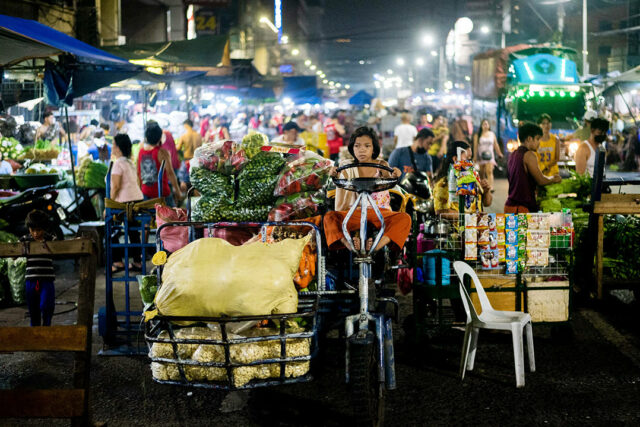
A child sits in a motorized vehicle loaded with vegetables at a public market in Manila, Philippines, Oct. 21, 2022. — REUTERS/LISA MARIE DAVID

THE ASIAN Development Bank (ADB) cut its gross domestic product (GDP) growth forecast for the Philippines this year, as elevated inflation dampens consumer spending.

In its latest Development Outlook report, the ADB trimmed its GDP growth outlook to 5.7% this year from the 6% projection it gave in April.

If realized, this would be below the government’s 6-7% target for this year, and slower than the 7.6% GDP expansion in 2022.

ADB trims 2023 Philippine GDP growth outlook to 5.7%; inflation steady at 6.2%

“We have downgraded our (Philippine growth) forecast for this year mainly due to the weakening in domestic demand,” ADB Senior Regional Cooperation Officer for Southeast Asia Dulce Zara said in a webinar discussing the report on Wednesday.

She noted last year’s economic performance reflected the reopening of the economy, strong pent-up demand and election-related spending.

“Spending, investments were also high (last year). This year, they have gone down. Another factor is the decline in exports. That’s the reason for the downgrade,” she said.

The Philippine economy expanded by 4.3% in April to June, the slowest growth in over two years, amid weak household consumption and a contraction in government spending.

The ADB’s 2023 growth forecast for the Philippines is still the second fastest among Southeast Asian economies, after Vietnam (5.8%) and ahead of Cambodia (5.3%), Indonesia (5%) and Malaysia (4.5%).

This is also higher than the 4.6% GDP growth projection for Southeast Asia, which was slightly lower than the previous forecast of 4.7%.

“The Philippines’ growth story remains strong despite an expected moderation in 2023. Public investment and private spending fueled by low unemployment rate, sustained increase in remittances from Filipinos overseas, and buoyant services including tourism will support growth,” ADB Philippines Country Director Pavit Ramachandran said in a statement.

For 2024, the ADB expects the Philippines to now be the fastest-growing economy in Southeast Asia with a 6.2% GDP growth projection. This after the ADB downgraded its growth forecast for Vietnam to 6% from 6.8% previously.

“Private consumption and investment will continue to underpin growth. A moderation in inflationary pressures next year bodes well for domestic demand,” the multilateral lender said.

Public expenditure and infrastructure spending are expected to pick up in 2024.

“Moving forward, prospects remain positive for the Philippines. We are looking at investments from the government given its pipeline of infrastructure projects and as well as continued consumer spending, which is the main driver of growth for the Philippines,” Ms. Zara said.

The ADB cited several risks to the Philippine growth outlook such as the expected slowdown in major economies, rising geopolitical tensions, and elevated global commodity prices.

“An intensified and prolonged El Niño, other severe weather disturbances, and a continuation of the Russian invasion of Ukraine could elevate inflationary pressures,” it added.

ELEVATED INFLATION
At the same time, ADB maintained its inflation outlook at 6.2% this year and 4% next year, which are both at the higher end of the Bangko Sentral ng Pilipinas’ (BSP) 2-4% annual target range.

Both forecasts are above the BSP’s average inflation projections of 5.6% for this year, and 3.3% for 2024.

At 6.2%, Philippine inflation is projected to be the third-fastest in Southeast Asia this year, following Laos (28%) and Myanmar (14%).

In 2024, the Philippines is still expected to see the third-fastest inflation, after Cambodia and Vietnam.

“Inflation is expected to soften, though the onset of El Niño and elevated global commodity prices may slow the pace of deceleration,” the ADB said.

The multilateral institution said the El Niño weather phenomenon will likely hurt the upcoming harvest, particularly in Southeast Asia.

“This could dent food security and raise inflation in net rice-importing countries, such as Bangladesh, Bhutan, Maldives, Nepal, and the Philippines,” it said.

Ms. Zara said that agriculture production in countries like the Philippines, Indonesia, Myanmar and Thailand will likely be the most impacted by El Niño-induced dry spells and droughts.

“Although inflation has moderated in the first seven months of the year, food inflation remains elevated, above 5% for Laos, the Philippines, Singapore and Malaysia. Reduced agri output both domestic and globally will be harmful for these economies,” she added.

Meanwhile, second-round effects stemming from higher transport fares and wage adjustments may also impact Philippine inflation this year.

“The government is considering extending the period for the reduced tariffs for some food items including rice which are due to expire by December 2023, to keep inflation contained,” the ADB said.

As core inflation eases, the ADB noted the BSP would likely keep policy rates steady before considering cutting them in 2024.

The BSP hiked the key policy rate by 425 basis points (bps) to 6.25% from May 2022 to March 2023.

The Monetary Board will likely hold interest rates steady for a fourth straight meeting on Thursday, as expected by 14 of 17 analysts in a BusinessWorld poll last week.

SLOWER GROWTH
Meanwhile, economic growth in developing Asia this year will be slightly lower than previously expected as the weakness in China’s property sector and El Niño-related risks cloud regional prospects, the ADB said.

Updating its regional economic outlook, the ADB trimmed its 2023 growth forecast for developing Asia to 4.7% from 4.8% projected in July.

But the growth forecast for next year for the grouping, which consists of 46 economies in the Asia-Pacific and excludes Japan, Australia and New Zealand, was revised slightly upwards to 4.8% from 4.7% previously.

“We see resilient growth in the region really based on pretty strong domestic consumption and investment, and despite reduced external demand, which is a dampener on export-driven growth,” Mr. Park said.

The ADB tempered its growth forecasts for East Asia, South Asia, and Southeast Asia this year, with China and India expected to grow 4.9% and 6.3%, respectively, slightly lower than the July growth projections of 5% and 6.4%.

China’s property crisis “poses a downside risk and could hold back regional growth,” the ADB said in its report.

The Manila-based lender maintained its 2024 growth forecasts for China and India at 4.5% and 6.7% respectively.

While growth has so far been robust and inflation pressures are receding in developing Asia, Mr. Park said governments need to be vigilant against the many challenges the region faces, including food security.

Inflation in developing Asia is forecast to ease to 3.6% this year from 4.4% last year, and continue to slow to 3.5% in 2024, giving central banks policy space, but the ADB said interest rate hiking and easing cycles will vary going forward. — Luisa Maria Jacinta C. Jocson with Reuters

BoP deficit narrows in Aug.

A person shows US dollars at a currency exchange store in Manila, Philippines, Oct. 21, 2022. — REUTERS

THE PHILIPPINES’ balance of payments (BoP) position remained in a deficit for a fifth straight month in August, albeit sharply narrower from a year ago, mainly due to the National Government’s foreign debt payments, the central bank said late on Monday.

Based on data released by the Bangko Sentral ng Pilipinas (BSP), the country’s BoP deficit stood at $57 million in August, 90% lower than the $572-million gap recorded in the same month a year ago.

Month on month, it rose by 7.5% from the $53-million deficit in July.

The August BoP gap was the highest deficit in two months or since the $606-million shortfall seen in June.

The BoP measures the country’s transactions with the rest of the world at a given time. A deficit means more funds fled the economy than what went in, while a surplus shows that more money entered the Philippines.

“The BoP deficit in August 2023 reflected net outflows arising mainly from the National Government’s (NG) payments of its foreign currency debt obligations,” the BSP said in a statement.

For the first eight months of the year, the BoP position swung to a $2.15-billion surplus from the $5.49-billion deficit a year ago.

“Based on preliminary data, this development reflected mainly the improvement in the balance of trade and the sustained net inflows from personal remittances, trade in services, and foreign borrowings by the NG,” the BSP said.

ING Bank N.V. Manila Senior Economist Nicholas Antonio T. Mapa said the overall BoP was better than last year mainly due to the improvement in the trade balance.

“Last year we saw the trade deficit balloon to all-time lows, but we have seen a bit of an improvement this year,” Mr. Mapa said in an e-mail.

The Philippines’ merchandise trade deficit shrank to a $4.2-billion deficit in July amid falling imports and exports. This brought the first-half trade balance to a $32.18-billion gap, lower than the $35.84-billion shortfall in the comparable year-ago period.

Rizal Commercial Banking Corp. Chief Economist Michael L. Ricafort in a note said the year-to-date BoP surplus was due to the proceeds of the NG’s foreign currency-denominated borrowings from commercial and multilateral sources this year.

These include global bond issuances and official development assistance (ODA), as well as the continued structural dollar inflows into the country via remittances, business process outsourcing revenues, and tourism receipts.

The central bank said the eight-month BoP position reflects the final gross international reserves (GIR) level of $99.6 billion at end-August, slipping by 0.4% from $100 billion as of July.

The GIR represents 7.4 months’ worth of imports of goods and payments of services and primary income.

It can also cover up to 5.7 times the country’s short-term external debt based on original maturity and 3.9 times based on residual maturity.

In the coming months, the country’s BoP position will be supported by continued structural dollar inflows and the likely narrower trade deficit, Mr. Ricafort said.

“The proposed $2-billion retail bonds to be offered by the National Government in September 2023… as well as the National Government’s planned debut of about $1-billion Islamic bonds later in 2023 or early 2024… would also be added to the country’s BoP and GIR in the latter part of the year,” he said.

The government is planning to offer retail dollar bonds this month, as well as Islamic bonds or Sukuk bonds by yearend or early 2024.

“For the rest of the year, we do see the BoP likely flat with any potential worsening of the current account deficit possibly offset by inflows related to the financial account (dollar issuance and return of portfolio investments),” Mr. Mapa added.

Last week, the central bank lowered its balance of payments projection for this year as exports and imports of goods may decline amid weaker global economic conditions.

For this year, the BoP is seen to yield a deficit of $127 million (0% of gross domestic product), which is significantly lower than the previous projection of a $1.2-billion gap (-0.3% of GDP).

For 2024, the country’s BoP position is projected to swing to a $1-billion surplus (equivalent to 0.2% of GDP) next year, better than the previous projection of a $0.5-billion deficit. 

The BSP also projects the current account deficit to reach $11.1 billion (-2.5% of GDP), lower than the previous forecast of $15.1 billion (-3.4% of GDP).

The central bank expects a narrower current account deficit of $10.3 billion (-2.1% of GDP) in 2024 as the country’s trade in goods gap is expected to shrink. — Keisha B. Ta-asan

Tech industry eyes more products under WTO’s zero-tariff framework

A logo is pictured outside the World Trade Organization (WTO) in Geneva, Switzerland, Sept. 28, 2021. — REUTERS/DENIS BALIBOUSE

By Norman P. Aquino, Special Reports Editor

GENEVA — The technology industries of dozens of countries including the Philippines are lobbying to bring more than 400 technology products under the World Trade Organization’s (WTO) tariff-eliminating framework, which is expected to add almost $766 billion to the global economy over 10 years.

The global semiconductor and supply chain would be helped by an Information Technology Agreement 3 (ITA-3), which will also play a critical role in driving global sustainability across industries, Philippine Representative to the WTO Manuel Antonio J. Teehankee told a public forum at the WTO headquarters last week.

“We know the benefits,” he told the forum attended by policy makers and representatives from various semiconductor companies worldwide, citing $49 billion worth of Philippine electronic exports in 2022, representing 36% growth over five years and accounting for almost 50% of the country’s exports.

The Philippine electronics sector, including semiconductors, generated three million direct and indirect jobs that year, Mr. Teehankee said. “I have instructions from the capital, and I am convinced [about ITA-3].”

ICT merchandise exports account for 39% of Vietnam’s, 32% of Malaysia’s, 29.2% of South Korea’s, 25.5% of China’s and 16.1% of Thailand’s total exports.

In contrast, ICT goods exports account for a much lower and incredibly meager share of goods exports for non-ITA countries, including for just 2.5% of Cambodia’s goods exports, 0.7% of South Africa’s and less than half a percent each for Brazil, Chile, Pakistan and Argentina.

Twenty-nine countries signed the ITA at the Singapore Ministerial Conference in December 1996. The participants committed to completely eliminate tariffs on eight broad categories of IT products such as semiconductors, computers and telecommunication equipment.

At the Nairobi Ministerial Conference in December 2015, more than 50 member nations concluded the expansion of the agreement, which now covers 201 more products valued at more than $1.3 trillion a year. Members have since grown to 82, representing about 97% of world trade in IT products, according to the WTO website.

Expanding the ITA for the second time could bring products such as 3D printers, industrial robots, commercial-use drones, patient-monitoring systems and other medical devices, lithium-ion batteries, solar cells and high-definition TVs into the agreement.

If the 82 signatories of the original ITA were to join an expanded ITA-3, the global economy could cumulatively rise by almost $766 billion over 10 years, the Information Technology and Innovation Foundation (ITIF), a global think tank, said in a study released last week.

Beyond merchandise trade, a similar story plays out in information and communications technology services, Mr. Teehankee told BusinessWorld on the sidelines of the forum.

“Expanding the agreement could expand our exports because it will increase products [with zero tariffs] and it will have a knockdown effect on our IT-enabled service exports and a multiple knockdown effect on the environment and agriculture,” he said.

The Philippines’ IT-enabled service exports reached $32.5 billion in 2022 and has grown by 10% year on year on the average, he pointed out.

“From an economic viewpoint, development viewpoint and environmental viewpoint, it is an impressive number for developing countries like the Philippines and our ASEAN (Association of Southeast Asian Nations) colleagues and our community of developing countries to take into account,” the Philippine ambassador said.

“The WTO agreement alongside complementary regional agreements have helped spur significant trade and job growth in the Philippines,” Mr. Teehankee said.

Aside from powering consumer goods, semiconductors also play a crucial role in addressing global climate change. Multiple industries including transportation, manufacturing, construction and agriculture rely on semiconductors to enable energy-efficient or clean energy production, which in turn reduces emissions.

‘TIME TO MOVE’
Global IT product exports increased from $550 million under the original ITA agreement in 1996 to $2.5 trillion in 2021 under the expanded ITA-2 signed in 2015, he added.

Almost three-quarters of these IT product exports were concentrated in Asia, where many countries were participants of ITA-1 and ITA-2 and signatories of various free trade agreements such as ASEAN+ and the Regional Comprehensive Economic Partnership, Mr. Teehankee said.

In absolute terms, the United States would be the biggest beneficiary of ITA-3, followed by China, according to the ITIF study. ITA-3 expansion would be poised to deliver a cumulative $208 billion in US GDP growth over 10 years, 0.82% greater US GDP growth than would otherwise be expected.

Moreover, ITA-3 expansion would increase US exports of ICT products by $2.8 billion, boost revenues of US ICT companies by $6.9 billion and support the creation of almost 60,000 US jobs.

China’s economy would cumulatively grow by 0.52% to be about $147 billion greater than would otherwise be the case as a result of ITA-3 expansion.

The economic growth generated by an ITA-3 expansion would produce tax income that, for at least 12 study countries and the European Union, would well exceed tariff revenues forgone, and for four more countries would fill more than 50% of the revenue gaps 10 years post ITA-3 accession, the ITIF said.

Mr. Teehankee said there are no estimates yet for the Philippines in terms of revenue from ITA-3, adding that stakeholders are in a “scoping exercise” for products that should be included in the deal.

“ITA-3 has not taken off yet,” he said. “It’s private sector-led and it’s demand-driven. It’s just the beginning of the conversation. The private sectors have to push their governments.”

“For countries contemplating participation in ITA-1, ITA-2, ITA-3, or all three, the time to move is now, as major economies are looking to diversify their sourcing and supply chains in order to promote greater supply chain resilience, security and sustainability,” the ITIF said in the study.

“As a result, large technology and industrial companies are taking a fresh look at potential suppliers and locations for production and assembly, creating an opportunity for new suppliers and economies to break into technology global value chains,” it added.

In contrast, countries declining to join ITA-1 and ITA-2 or neglecting to participate in an ITA-3 risk experiencing a technologically deficient economy, reduced productivity and exclusion from global technology supply chains, the think tank said.

Nonparticipation in the ITA also limits an economy’s ability to partake in the expanding universe of industrial products that incorporate semiconductors and other advanced technologies, it said.

“Ultimately, refraining from ITA participation reduces countries’ wage growth and opportunity because a technologically deficient workforce cannot be in a position to participate effectively in the advanced global technology supply chains that pay higher wages and demand greater technology training and skills,” it added.

Lawmaker calls for relaxation of biofuel requirement to ease oil prices   

PHILIPPINE STAR/WALTER BOLLOZOS

THE GOVERNMENT should provide P5.19 billion in fuel subsidies to the transport, farm and fisheries sectors in the next three months to avert runaway inflation that could hit 6.2% this year amid spiraling global crude prices, the chairman of the House of Representatives Ways and Means Committee said.

In a memo to House Speaker Ferdinand Martin G. Romualdez, Albay Rep. Jose Ma. Clemente S. Salceda also proposed the reduction of the biofuel requirement for gasoline to 5% to reduce prices by as much as P1.03 a liter.

To address the spike in pump prices, he said the government should implement fuel discounts for the transport, farm and fisheries sectors to prevent second-round effects.

“An increase in fuel prices, however, would have second-round effects on inflation. Historically, a P10 increase in fuel prices results in a one-percentage-point increase in overall consumer price index (CPI),” he added.

Inflation quickened for the first time in seven months to 5.3% in August, due to rising fuel and food costs.

If fuel and rice prices continue to increase, Mr. Salceda noted inflation could average 6.2% this year. This would be higher than the Bangko Sentral ng Pilipinas’ 5.6% full-year projection.

Mr. Salceda estimated that P907 million would be needed to provide fuel discounts for 180,000 jeepneys or P5,040 per driver until the end of the year. He also proposed giving a subsidy of P2,800 per hectare for farmers, which would require a P3.36-billion budget; and a subsidy of P420 for a fisherman, which would need a P924-million budget.

Mr. Salceda, who is also chair of the Ways and Means Committee, said the funds for the fuel subsidies could come from value-added tax (VAT) collection from diesel and gasoline, which are projected to be at least P9.3 billion higher than its target.

The Commission on Elections also said it would exempt the distribution of fuel subsidy from the spending ban currently in place for the village and youth council election, Chairman George Erwin M. Garcia told reporters.

At the same time, Mr. Salceda suggested that the National Biofuels Board lower domestic bioethanol additive requirement to 5% from the current 10% under the Biofuels Law.

“The additive makes pump price more expensive because current domestic bioethanol is P84.11 per liter, above the gasoline pump price. Relaxing the requirement could also increase mileage, as bioethanol contains 30% less energy than pure gasoline. The reduction will result in an outright reduction of per liter price by P1.03, and total savings (due to mileage) of P3.05 per liter,” he said.

The lawmaker also proposed a flexible excise tax regime for fuel products.

“Automatic reduction of excise tax by P3 when the 3-month average Means of Platts Singapore (MOPS) index of prices exceeds $80 and increases the excise tax by P2 when the same is lower than $45,” Mr. Salceda said.

House leaders have proposed the temporary suspension of fuel taxes to address rising pump prices.

However, Mr. Salceda said that suspending fuel excise taxes can only be done if Congress amends the Tax Reform for Acceleration and Inclusion law.

Finance Secretary Benjamin E. Diokno on Tuesday warned that the government may lose up to P37 billion in revenues in the fourth quarter if it suspended collection of VAT and excise tax on petroleum products.

“Removing — or even simply suspending — taxes invariably raises disposable income. Cutting taxes puts more money in everyone’s pocket, enabling them to buy more goods and services, ultimately stimulating the economy,” Terry L. Ridon, convenor of think tank InfraWatch PH, said in a statement. — Beatriz Marie D. Cruz

LEDAC adds 10 more priority measures

PHILSTAR FILE PHOTO

THE Legislative-Executive Development Advisory Council (LEDAC) identified 10 more bills as priority legislation, including the measures seeking to rationalize the fiscal regime for the mining industry and to amend the public procurement system.

In a statement after LEDAC’s third meeting presided by President Ferdinand R. Marcos, Jr., the Palace said the bill amending the Government Procurement Reform Act and the proposed rationalization of the mining fiscal regime were among the 10 bills added to the common legislative agenda.

The new priority bills also include a measure imposing excise tax on single-use plastics and the proposed amendments to the Cooperative Code and Fisheries Code, the Palace said.

The proposed New Government Auditing Code, Open Access in Data Transmission Act, Defense Industry Development Act, and Philippine Maritime Zones Act were also included in the priority agenda.

Proposed amendments to the Right-of-Way Act were also among the LEDAC’s new 10 priority bills.

Senate President Juan Miguel F. Zubiri said the bills were endorsed by Mr. Marcos’ economic team.

“We committed to support this as well,” he said after the LEDAC meeting, based on the Palace statement.

The Palace said Congress is on track to pass the LEDAC’s top 20 priority bills for this year, including measures amending the Bank Deposit Secrecy Law and Anti-Financial Account Scamming Act.

The two bills, which are still pending at the Senate committee level, had been endorsed by the Bangko Sentral ng Pilipinas (BSP), which aims to remove the Philippines from the Financial Action Task Force’s “gray list” by January 2024.

Another bill proposing changes to the military and uniformed personnel (MUP) pension system, which was approved on second reading by the House of Representatives earlier this week, was also on LEDAC’s list.

Bills targeted for Congress approval by December also include the proposed Property Valuation and Assessment Reform Act, E-Governance Act, Magna Carta for Seafarers, Anti-Agricultural Smuggling Act, and a bill seeking to ease the payment of taxes.

The list also includes bills seeking to rightsize the National Government, create a National Employment Action Plan, institutionalize the automatic income classification of local government units, and develop the salt industry.

The proposed Internet Transaction Act, National Scamming Act, National Citizens Service Training Program Act, New Philippine Passport Act, and proposed amendments to the Build-Operate-Transfer law were also included in the list.

House Speaker Ferdinand Martin G. Romualdez said 18 out of the 20 priority bills were already approved by the lower house.

He said the bill reforming the MUP pension system is slated for approval on third and final reading next week, while the proposed Anti-Agricultural Smuggling Act was already approved at the committee level earlier in the day.

“We are on track to approve the two remaining measures before the October recess,” the House leader said in a separate statement. “In sum, the House of Representatives will meet its commitment to approve all 20 priority measures by the end of September, or three months ahead of target.” — Kyle Aristophere T. Atienza

Pangilinan eyes listing of tollways unit, Maynilad

By Revin Mikhael D. Ochave, Reporter

METRO Pacific Investments Corp. (MPIC) is set to list at the stock market its tollways and water businesses once the listed holding firm completes its voluntary delisting plan, according to its top official. 

“After delisting, we will list our tollways. Maynilad has got to list by 2026. We will list our major subsidiaries,” MPIC Chairman, President, and Chief Executive Officer Manuel V. Pangilinan said on the sidelines of a mining conference on Wednesday.

“Most probably, the tollways unit will be the first to list,” Mr. Pangilinan said, adding that the listing at the local bourse will be by next year. 

MPIC’s tollways unit is Metro Pacific Tollways Corp. (MPTC) while Maynilad Water Services, Inc. is managed by a joint venture among MPIC, DMCI Holdings, Inc., and Marubeni Corp.

Maynilad is a water and wastewater service provider for Metro Manila’s west zone and nearby areas while MPTC operates tollways such as North Luzon Expressway, Subic-Clark-Tarlac Expressway, Manila-Cavite Toll Expressway, Cavite-Laguna Expressway, Cebu-Cordova Link Expressway, and the NLEX Connector Road. 

The water provider is mandated to list on the Philippine Stock Exchange under its franchise and the revised concession agreement signed with the government.      

Aside from toll operations and water, MPIC has business interests in sectors such as power via Manila Electric Co. (Meralco), rail through Light Rail Manila Corp., healthcare, logistics, and agribusiness. 

Sought for comment, China Bank Capital Corp. Managing Director Juan Paolo E. Colet said that MPTC and Maynilad would be “very attractive initial public offering (IPO) candidates.”

“They are strong cash-generating businesses that have good room for long-term growth. I expect many investors will look at them as healthy dividend stocks as well as demographic plays,” Mr. Colet said.

“The tollways assets can actually be structured into and listed as a real estate investment trust, which would make it the first of its kind in the Philippines,” he added. 

COL Financial Group, Inc. Financial Analyst George Ching said the attractiveness of the two possible IPOs will depend on the valuation. 

“If they will sell it at a cheap price, then it will be good,” Mr. Ching said via mobile phone.

“Between the two though, toll roads have more expansion opportunities. Maynilad is more straightforward, it’s just the concession agreement,” he added.

Rizal Commercial Banking Corp. Chief Economist Michael L. Ricafort said in a Viber message that the two planned listings would provide opportunities for local and foreign investors.

“These would provide local and foreign investors the opportunity to invest in infrastructure units that may also need large capital for capital expenditure for the coming years,” Mr. Ricafort said, adding that the units will also await “better market conditions alongside greater profitability to realize and maximize the highest possible selling price/valuations once they list at the stock market”

Meanwhile, MPIC said in a stock exchange disclosure on Wednesday that the company’s tender offer is closed.

“The total of tendered shares, excluded shares and other non-public shares is equivalent to 97.22% of MPIC’s total issued and outstanding listed shares and has exceeded the threshold required to complete the voluntary delisting,” MPIC said. 

“The bidders stated that the tender offer is now closed,” it added. 

According to MPIC, the cross date is on Sept. 26 while the settlement date is on Sept. 28.

“When the tendered shares are accepted and crossed, the bidders expect MPIC’s public float to fall to 2.78% whilst the total of tendered shares, excluded shares and other non-public shares will be above the voluntary delisting threshold of at least 95% and the bidders anticipate MPIC’s voluntary delisting around October 2023,” the disclosure said. 

Mr. Pangilinan said that state-led Government Service Insurance System (GSIS) will be entitled to a board seat “post-delisting.” 

GSIS recently acquired an additional stake in MPIC, which resulted in an aggregate holding of about 3.44 billion common shares, equivalent to 12% of the company’s total issued and outstanding listed shares.   

“This is welcome news to the tendering shareholders as they can now look forward to the payment of their shares next week,” China Bank Capital’s Mr. Colet said on the closing of the tender offer. 

“The seat will allow GSIS to take a more active role in the corporate governance and business direction of MPIC. This is very important to protect the pension fund’s interests and sizable investment in the company,” Mr. Colet added.

On Wednesday, shares of MPIC at the local bourse closed unchanged at P5.11 apiece.

Metro Pacific Investments Corp., which has a majority stake in Maynilad, is one of three Philippine units of Hong Kong-based First Pacific Co. Ltd., the others being Philex Mining Corp. and PLDT Inc.

Hastings Holdings, Inc., a unit of PLDT Beneficial Trust Fund subsidiary MediaQuest Holdings, Inc., has an interest in BusinessWorld through the Philippine Star Group, which it controls.

ACEN seeks P5.5-B loan from ADB to fund solar projects 

ACEN Corp. is eyeing a P5.5-billion loan from the Asian Development Bank (ADB) to develop solar photovoltaic projects in the country.

In addition to the loan, the firm is also seeking a partial credit guarantee of P1.1 billion, according to documents on the ADB website.

The loan and guarantee will be a “sustainability-linked facility with performance indicators on environmental and social matters. The loan proceeds will be used to finance solar photovoltaic projects in the Philippines,” it added.

“The sustainability-linked note aims to boost the renewable energy capacity of the Philippines, which has traditionally relied on coal to meet its growing electricity needs,” it added.

The ADB said that ACEN’s proposal is consistent with its strategy of promoting private sector participation in infrastructure through corporate financing and expanding support for renewable energy, among others.

“The project will contribute to poverty reduction through the provision of clean and sustainable electricity to support productivity while being able to improve the quality of life through the reduction of greenhouse gas emissions and improving local air quality,” it added.

The proposal will be up for approval on Oct. 20.

ACEN has about 4,200 megawatts of attributable capacity spread across the Philippines, Vietnam, Indonesia, India, and Australia.

It is targeting to expand its renewable energy portfolio to 20 gigawatts by 2030.

On Wednesday, ACEN shares declined by 0.21% or P0.01 to finish at P4.70 apiece. — Luisa Maria Jacinta C. Jocson

Making the old new again

MAYOR MARCY TEODORO, McDonald’s executives, and San Roque Elementary School officials ready the McDonald’s ReClassified chairs made entirely from decommissioned seats, tables, plastic, wood, and steel from renovated McDonald’s stores. For the launch, over 150 of these chairs were donated to public schools in Marikina.

McDo’s seats go to schools

WHAT happens to the old furniture when a restaurant gets refurbished, as all have to do to keep up with the times? Sometimes the old equipment is sold, sometimes it is tossed into the dump. And this time, it is transformed into classroom chairs.

By the count of Adi Hernandez, McDonald’s Philippines AVP for Corporate Relations, the fast-food giant has about 700 stores in the Philippines. “Every year, we open at least 50,” she said. McDonald’s branches are also constantly renovated and opened, and “We will always have equipment that will be unused, and therefore can be repurposed,” Ms. Hernandez added.

On Sept. 8, guests were invited to see these old chairs from McDonald’s restaurants made new as desks at Marikina’s San Roque Elementary School in a project called ReClassified.

McDonald’s partnered with social enterprise Junk Not to design and fabricate the desks. Junk Not, founded by

Dr. Willie Garcia who is also its principal designer, upcycles plastic materials into new furnishings. Junk Not used the old restaurant furniture to make chairs and tables, including an arm desk for schools. The transformation from worn out restaurant furniture to school desks included everything from prototyping to production of the final products, which they assure come up to global standards.

“I’m sure you’ve sat on these chairs,” said Ms. Hernandez during the project launch at the school’s basketball court, referring to their former lives. “It’s all about strengthening it and adding the table. Definitely it has all the safety requirements, as we prioritize also in the stores,” she said.

To date, the partnership has created 200 desks, with 100 already installed in San Roque Elementary School, and 100 in another Marikina location. Ms. Hernandez said that they have worked closely with the Marikina local government on other projects, such as the Ronald McDonald House Charities. And, “To be very honest, they raised their hand, and they were interested,” in this seats-for-schools project.

In a statement, Marikina mayor Marcelino “Marcy” Teodoro (a San Roque Elementary graduate, according to a release), said, “We, in government, are at the helm of ensuring quality education for all, but we cannot do it alone. Sabi nga (they say), education is everyone’s responsibility. Creative solutions through strategic partnerships with various sectors amplify positive outcomes. No matter the scale, collaborations such as this ReClassified project contribute to our shared goals for Filipino learners. Kaya’t salamat (and so thanks) McDonald’s for choosing Marikina and my alma mater, San Roque Elementary School, as your first beneficiary.”

Other corporate social responsibility (CSR) projects that the fast-food giant has had include McClassroom, where they used the party spaces (vacant during the pandemic) in restaurants as classrooms for needy schools. Now that parties are back in, the party spaces are still used as classrooms, but only in the evenings. They’ve also just concluded a partnership with Brigada Eskwela to help prepare public schools for the opening of the school year, giving cleaning materials and providing manpower through their employees. “It’s really about supporting education and the youth,” McDonald’s Ms. Hernandez said.

McDonald’s concentration on the educational sector for their corporate social responsibility projects is a choice of its employees. Ms. Hernandez said when asked, “We checked from within our crew.” By her count, they have 60,000 employees nationwide — “All of them directly hired; no contractual (employees) at McDonald’s” — a large chunk of whom are working students.

“We believe that there’s an opportunity for us to help these working students. They’re able to go to school while having work. We provide them with flexible working hours,” she said. According to her, their enrolled employees can show their class schedules to their managers, and shifts can be adjusted to their school schedules.

“I don’t even want to call it CSR. Corporate social responsibility has always been associated with charity or one-off donations. It should be part of every business model, and it should really have value to a business life cycle,” she said. — JLG

Philex targets nickel mining amid rising demand for electric vehicles

PHILEX MINING Corp. is planning to expand into nickel mining to meet the increasing demand for the mineral by electric vehicle makers, company officials said on Wednesday.

“We are prospecting for nickel resources to developing this country because the future for [electric] vehicles is bright… so we have to be in the correct position,” Philex Chairman Manuel V. Pangilinan told reporters on the sidelines of a forum led by the Chamber of Mines of the Philippines.

“I think we should be a major nickel supplier to the world. At the moment, we’re not. Our mining industry has absolutely no impact on mining prices globally because we’re so small,” Mr. Pangilinan added.

Philex President and Chief Executive Officer Eulalio B. Austin, Jr. likewise said that the company is now conducting studies into nickel mining “considering the transition into green energy is a global issue right now.”

“It’s our first time to enter into the nickel space, we have been into the copper and gold business for so long,” Mr. Austin added.

He added that the company is currently conducting exploratory studies with a site in Zambales.

“We have now started groundworks, trying to do sampling and after some evaluations, that’s the only time we could say when to mine,” he said.

The company is also eyeing a possible partner in the nickel mining endeavor, he said, without giving details.

“We will be asking [for] some guidance or having a partner to develop that property since we are not experts,” he said. “the direction is to get partners that will teach us to mine nickel.”

During the first half of the year, nickel production reached 16.87 million dry metric tons, a 40% increase from the same period last year.

Meanwhile, Mr. Austin said that the company is planning to start commercial operation of its Silangan copper-gold mine by 2025.

He added that the company is planning to produce the first ton of ore by the first quarter of 2025.

“We have raised the necessary funding and we have started the actual works underground,” he said.

The Silangan project is the company’s $224-million copper-gold mining project located in Surigao del Norte. It is said to have 571 tons worth of mineral resources.

Philex is one of three Philippine units of Hong Kong-based First Pacific Co. Ltd., the others being Metro Pacific Investments Corp. and PLDT Inc.

Hastings Holdings, Inc., a unit of PLDT Beneficial Trust Fund subsidiary MediaQuest Holdings, Inc., has interest in BusinessWorld through the Philippine Star Group, which it controls.

On Wednesday, shares in Philex went up by 0.73% or two centavos to close at P2.75 apiece. — Adrian H. Halili

Megaworld to build two-tower residential condo in Bacolod

LISTED property developer Megaworld Corp. is set to build a two-tower residential condominium development in Bacolod City as part of its portfolio expansion.

The company said the development, called Kensington Sky Garden, will be a 26-storey two-tower residential condo development within its Upper East township in Bacolod.

“Megaworld is expecting to generate around P5 billion in sales from this new property, which is scheduled for completion in 2029,” the company said in a stock exchange disclosure on Wednesday. 

Kensington Sky Garden, located at the corner of Upper East Ave. and Bentley St., will offer 643 “smart home” units. The company said the Kensington Sky Garden will be its tallest residential condo in the Visayas to date.

Megaworld said units at Kensington Sky Garden start from a studio and executive studio of up to 40 square meters (sq.m.), one bedroom of up to 56 sq.m., two bedrooms of up to 90 sq.m., and three bedrooms of up to 110 sq.m. All unit sizes will have either a balcony or a lanai.

Each unit will be equipped with a wireless smart home system and devices with Wi-Fi routers that can be accessed remotely via a dedicated phone app. The technology allows residents to control several unit features such as lighting fixtures and other smart appliances in the living, kitchen, and dining areas as well as the bedroom.

The amenities at Kensington Sky Garden include an adult pool and kiddie pool, pool bar, landscaped areas, outdoor fitness area and children’s play area, gazebo, reading nooks, fitness center, daycare center, and game and entertainment room.

The ground-level exterior will also feature several retail spaces, while two basement levels will be allocated for parking.

Kensington Sky Garden will also have features such as a private dining hall, a function room, skydecks at the 14th and 26th levels of each tower, a shared outdoor sitting lounge on the fifth floor, and an electric vehicle charging facility at the basement parking area. 

Meanwhile, the sustainability features of the development include low flow rate fixtures for water conservation, occupancy sensors in hallways and parking floors to conserve energy, LED lights for units and common areas, a rainwater harvesting system, and a materials recovery facility.

Aside from Kensington Sky Garden, Megaworld’s 34-hectare Upper East township also houses four other residential developments such as One Regis, Two Regis, One Manhattan, and Herald Parksuites, which have a combined total of 1,028 units.

The company is also expected to begin the construction of the 300-room Kingsford Hotel and the Upper East Mall by next year.

Megaworld recorded P7.9 billion in attributable net income in the first six months, a 34% improvement from P5.9 billion a year ago, due to surging demand in the property sector.  

On Wednesday, shares of Megaworld at the local bourse closed unchanged at P1.98 each. — Revin Mikhael D. Ochave

The not so new kid on the block

L to R: Elderton Barossan Shiraz, Domaine la Fonte Notre Dame Lirac, Jules Taylor Marlborough Chardonnay and Pebble Lane Marlborough Sauvignon Blanc

Being in the domestic imported liquor business is really a huge challenge for new players. It is a very oligopolistic market where there are just a handful of huge importers that dominate the importation of wines, beers, and spirits presently sold in the country. So, when a new company joins the competition, the new company needs to create its own niche to survive.

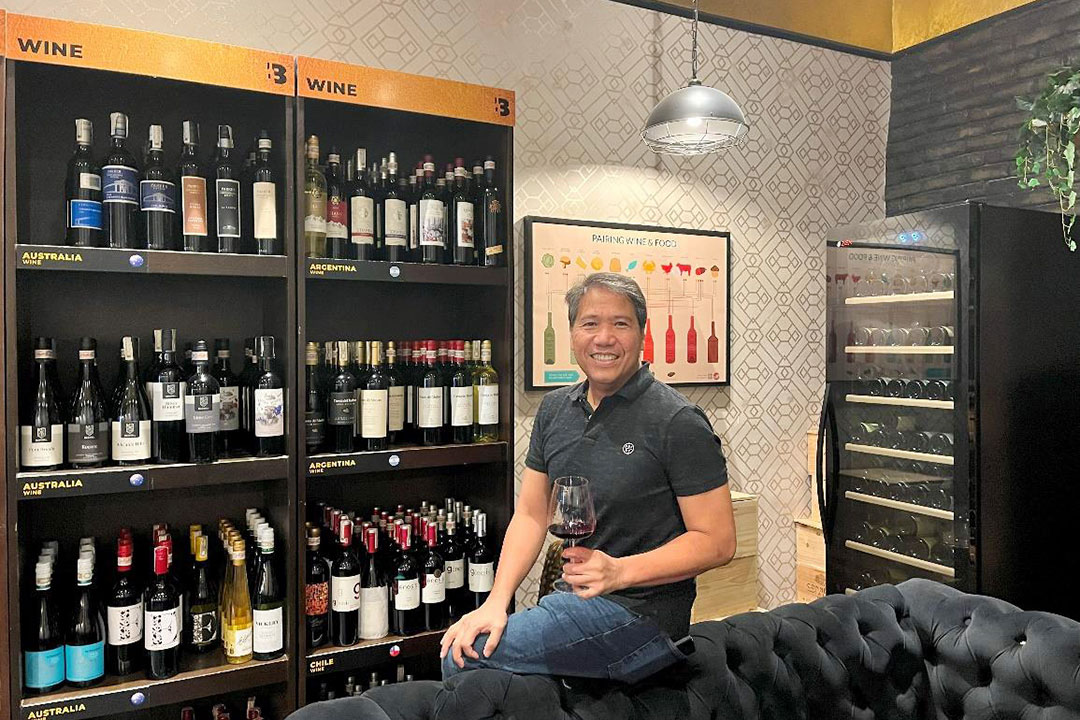
Like any good businessman this was what JoJo Vega and his partners at Don Revy did.

THE BACK STORY
Don Revy Philippines, Inc. is a collaboration between partners Jojo Vega, Piers Kinloch, the late Robbie Ferguson. The three partners met at a Singapore Telecom (Singtel)-sponsored Global System for Mobile Communications Conference, way back in 2003.

Jojo Vega is the only Filipino among the three, while both Piers and Robbie are Brisbane, Australia-based since the late 1990s but were both originally from Scotland. Jojo, who started his career in San Miguel Corp. (SMC) as a truck salesman fresh out of college, had just left SMC after 15 long years during which time he rose through the ranks to become its Assistant Vice-President of Sales at the time of his departure. Jojo then worked for Globe Telecom. Globe is partly owned by Singtel, while both Piers and Robbie had business interest with Optus, one of the biggest telecom companies in Australia, and also a wholly owned subsidiary of Singtel.

Robbie back then was married to a Filipina from Bacolod, so when he would come visit the Philippines, he would hang out with Jojo for a few days first in Manila. That was how the friendship was cemented, and by the late 2000s, the trio already spoke about doing business together in the Philippines, and since all of them enjoy drinking alcohol (we know the Scottish do), and with Jojo’s background in SMC, the decision to import and distribute liquor came to fruition. Thus, the birth of Don Revy.

As Jojo pointed out to me, the Don Revy logo has three bottles which symbolize each of the three partners.

THE WHITE WINE OPPORTUNITY
The company started with wines — as we know the spirits market is very brand-driven and had a more difficult level of entry. In Jojo’s research of the wine industry, he realized that white wines are not that big, and most importers compete in the red wine category. Based on import numbers, white wines are just around 25% of the total wine market, so Jojo saw this number as an opportunity to introduce better white wines into the market.

And where else to go for internationally renowned whites than to go bring in the Sauvignon Blancs from New Zealand’s Marlborough region?

While Marlborough and NZ whites have been around for ages, NZ wines were never priorities here in our market, because NZ is better known for white wines, for Sauvignon Blanc, than reds, and Philippines is a majority red-wine drinking country like most of our Asian counterparts.

So not only was it the whites that Don Revy was looking at, but wines from NZ as a country in general as their niche to enter this competitive industry.

Their first wine imports came in 2013, and all were from NZ. They covered three wine regions of New Zealand — Marlborough, Gisborne, and Hawkes Bay — under three different brands: Pebble Lane (a proprietary label), Jules Taylor, and Mills Reef.

BUSINESS INTEGRATION
Like every new importer, the first order of business was to get distribution, so Don Revy did that immediately. The targets primarily were on-premises establishments — restaurants, bars, cafes and hotels.

Retail has always been challenging because of the expensive listing fees that are involved. During the early stages of Don Revy, among the three partners, Robbie Ferguson, who had moved to Manila by then, was the most involved, as Piers was still Brisbane-based, and Jojo was employed as a high-ranking executive in MNCs Samsung, and then Huawei. But in 2017 Jojo left his corporate life to become a full-fledged partner at Don Revy and teamed-up with Robbie to further cement the foundation of the company.

Unfortunately, in 2018 tragedy struck Don Revy when one of the founding partners, Robbie, passed away untimely. Jojo then took over the entire day-to-day operations of the company, while Piers remained a loyal supporter remotely from Australia.

Soon, following the vision of the three partners, Don Revy embarked on their “brick and mortar” strategy. First, they wanted a place of their own to showcase their products. This was when Bevvy came to existence. Bevvy, which is a colloquial term for booze or alcoholic beverages in Australia, seemed like a perfect name. Don Revy had an office and depot in Pasong Tamo in Makati City, and the partners thought it would be cool to forward-integrate and have their own restaurant-bar. After all, they were growing, and more principals were visiting Manila than ever, so, a place of their own seemed ideal — even economical — to not only host their foreign visitors but also do events.

To their credit, Bevvy grew to be more than a Don Revy extension. With its good food and cozy ambience, Bevvy became a secret resto-bar for appreciative customers who needed a place to unwind and recharge.

Aside from Bevvy, Jojo saw an opportunity to go into retail, and joined the bidding process to be the liquor concessionaire of the Mitsukoshi department store in BGC. Don Revy won this bidding fair and square. With Mitsukoshi, Don Revy now has another outlet to showcase their products. Over the course of time, Don Revy added beers (Jojo Vega’s expertise from his SMC background) to their portfolio, with four brand imports from three countries, including the world’s first and original pilsner, Pilsner Urquell from the Czech Republic. They also tried their hands with spirits — scotch whiskies in particular, since both Piers and Robbie were originally from Scotland.

BEVVY
Bevvy is literally a hole in the wall as this resto-bar is as inconspicuous as they come. There is no sign, nor indication of where it is located. And even if you get the address from Google and use Waze, you still need a bit of help from the security guard in the compound to locate this place. But once you overcome that obstacle, believe me, this resto-bar is worth going to.

I recently visited Bevvy and met up with Jojo Vega and chef Bheng Velarde, Bevvy’s consultant. The menu is not only wine-friendly, but reasonably priced. And the liquor selection is priced at retail prices, which makes it like Terry’s Selection, Barcino, and other importer-cum-restaurateurs that deal directly with end-consumers.

A good dinner for two can be only P3,000++ and this already comes with a decent bottle of wine — this is hard to beat.

Bevvy top-sellers tasted:

Lemongrass Calamari — deep fried to a crisp perfection and served with ranch dressing. Menu price: P425

Fish & Chips — thankfully NOT made from brittle, structure-less dory but made with cod, it comes with homemade potato wedges, and is served with ranch dressing. Menu price: P550

Barbequed Glazed Beef Ribs — a five-hour oven-baked chuck ribs glazed with homemade BBQ sauce. Menu price: P1,180

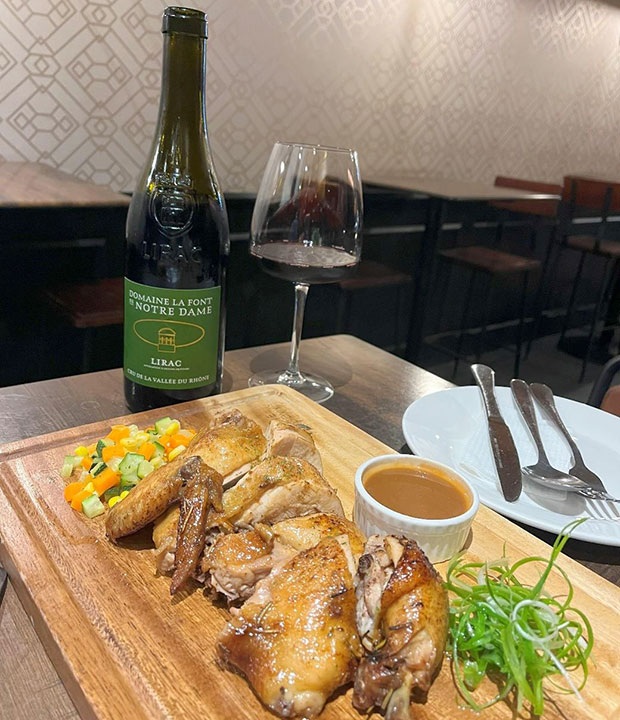
Herb Roasted Chicken — a five-hour oven-roasted half-size chicken seasoned with special herbs and spices. Menu price: P680

TASTING NOTES OF WINES TASTED AT BEVVY

Pebble Lane Sauvignon Blanc 2021, Marlborough, NZ: “I have tried several vintages of this wine and it has always been consistent, lovely notes of quince, lychee, though more subtle nose than most Marlborough Sauvies, this wine is clean, crisp, delectable and super quaffable even on its own.” Bevvy price: P910.

Jules Taylor Chardonnay 2022, Marlborough, NZ: “a more sophisticated Chardonnay with nice balance of cream, oak, and acidity, the wine has notes apricot and walnuts and has enough weight and acid backbone to go with a lot of dishes, nice long lime rind finish.” Bevvy price: P1,270.

Domaine la Font de Notre Dame Lirac 2019, Southern Rhone, France: “I rarely had a chance to taste Lirac as its not a normal Rhone Valley go-to wine, but this one made with usual Southern Rhone varietal-mix dominated by Grenache is very decent, with red cherry flavors, noticeable acids, friendly tannins, mineral and herbaceous notes, and juicy all the way.” Bevvy price: P1,090.

Elderton Shiraz 2019, Barossa, South Australia: “This wine captures the typicity of the Barossan Shiraz, fruit forward, alluring aromatics, flavors of ripe sweet berries, peppercorn and cassis, and ends with lingering bitter-sweet finish.” Bevvy price: P1,630.

Don Revy just reached their milestone 10th anniversary and already passed the prescription period of a newbie in this industry. They are no longer the new kids on the block and are here to stay and contribute to this industry.

Don Revy products can be purchased online, at on-premises establishments, and retailers which range from Rustans to 7-Eleven, and in Mitsukoshi, and, of course, in Bevvy.

For more information, including reservations at Bevvy, contact them at 8556-3312, or e-mail drink@donrevy.com.

The author is the first Filipino wine writer member of both the Bordeaux-based Federation Internationale des Journalists et Ecrivains du Vin et des Spiritueux (FIJEV) and the UK-based Circle of Wine Writers (CWW). For comments, inquiries, wine event coverage, wine consultancy and other wine related concerns, e-mail the author at wineprotege@gmail.com, or check his wine training website https://thewinetrainingcamp.wordpress.com/services

Dining In/Out (09/21/23)

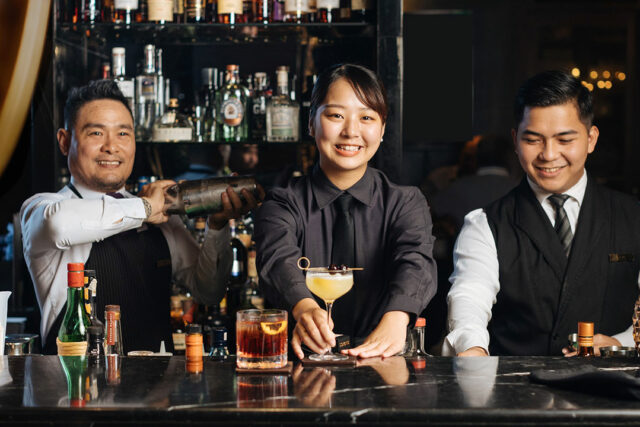
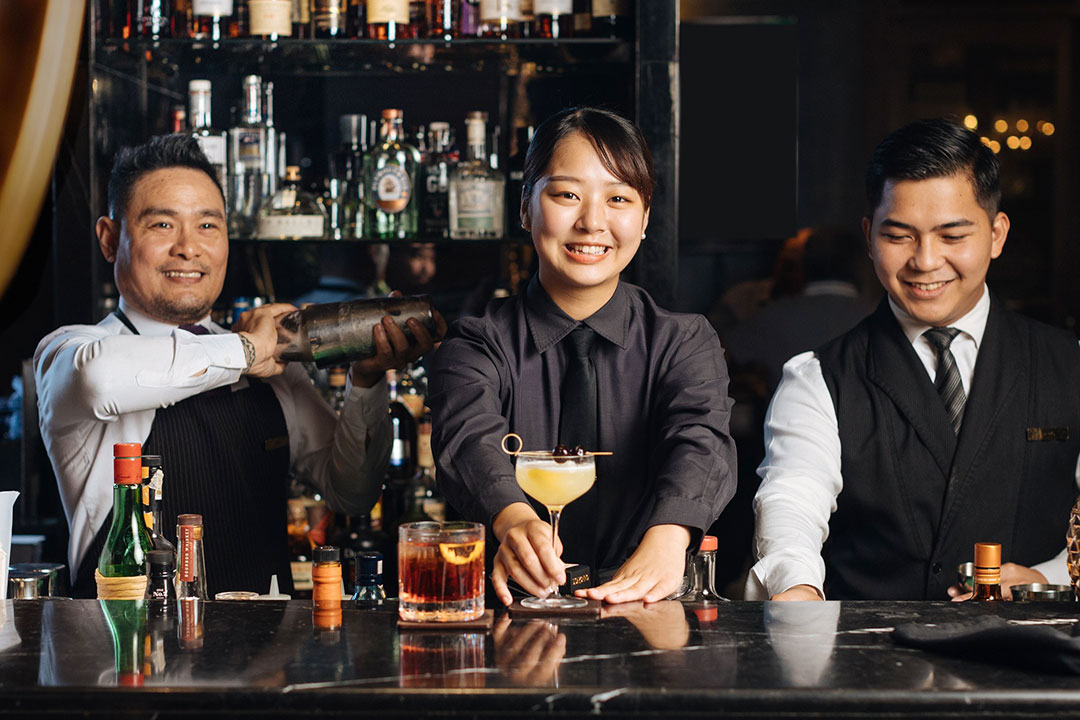
MAO MATSUMOTO (c) with The Peninsula Manila Team

Peter: The Bar takes over The Peninsula Manila

TOKYO isn’t just a culinary hub. It’s also one of the world’s classiest cocktail capitals, where mixologists can mix a classic Manhattan that will knock your socks off. That’s exactly what guest bartender Mao Matsumoto of The Peninsula Tokyo’s Peter: The Bar aims to accomplish this Saturday, Sept. 23, when she takes up her spot at The Bar of The Peninsula Manila during her takeover. For the one-night-only event, Ms. Matsumoto will take her passion for cocktails from her skybar home on the 24th floor of The Pen Tokyo to The Pen Manila where she will shake up gin-, vodka-, and whiskey-based cocktails from Peter: The Bar’s menu, as well as serve unique drinks crafted especially for the occasion like Mao’s Charm, Tokyo Joe, and Edo Palace. For inquiries on Peter: The Bar Takeover At The Peninsula Manila, call 887-2888, extensions 6691 and 6694 (Restaurant Reservations), e-mail diningpmn@peninsula.com or visit peninsula.com.


Coke collaborates with gaming company on new flavor

COCA-COLA has launched a new limited-edition flavor from Coca-Cola Creations, done in collaboration with Riot Games, the publisher and developer of League of Legends. The result is Coca-Cola Ultimate Zero Sugar which is the first collaboration with a gaming company on a Coca-Cola flavor. Accompanying the product’s release are in-game and digital experiences for players across the globe.  For an interactive experience, players will be transported to the Coca-Cola Creations Hub, the home for unique Coca-Cola Creations digital experiences, by scanning the QR code on a Coca-Cola Ultimate Zero Sugar bottle or can. One offer available now on the Creations Hub is the Ultimate Emote Generator, an Instagram filter allowing players to view themselves in the style of League of Legends emotes for social sharing. “Coca-Cola Ultimate boasts a striking design, delivers a unique taste of +XP for gamers during their adventures, and elevates their gaming experience by giving them a refreshing drink,” said Adrian Manlapig, Marketing Manager, Coca-Cola Philippines, in a statement. Coca-Cola Ultimate Zero Sugar fuses the two iconic brands with a packaging design that features black and various shades of gold. The familiar Coca-Cola Creations logo is complemented by a bespoke “Ultimate” crest and features a blue Hextech glow. The design showcases a Coca-Cola Spencerian Script font, inspired by the Nexus Crystals in League of Legends. Coca-Cola Ultimate Zero Sugaris now available nationwide in the Philippines. For more information, visit www.coca-cola.com/creations.


Nespresso introduces its smallest machine yet

NESPRESSO’s latest innovation in its machine line is the Vertuo Pop, its smallest yet most impactful Vertuo machine to date. It can brew four cup sizes, whether hot or iced, without sacrificing valuable counter space. The Vertuo Pop machine line — which is partly made with recycled materials, both the machine and its packaging — comes in Liquorice Black, Spicy Red, Coconut White, Pacific Blue, and Mango Yellow. A new sixth color, Aquamint, will be available in the Philippines by November. Like other Vertuo machines, the Vertuo Pop uses Nespresso’s Centrifusion Technology through which the machine can read the unique barcode of every Nespresso Vertuo blend and utilize the exact water volume required for optimal brewing. This allows users to explore four varying cup sizes based on their preferred cup at any time of the day: Espresso (40 ml), a Double Espresso (80 ml), a Gran Lungo (150 ml), or a Mug (230 ml). Meanwhile, Nespresso will be opening its seventh boutique this month, this time at the SM Mall of Asia. It will carry a wide selection of premium coffees, simple-to-use machines, and coffee accessories. There will also be interactive displays. One can find the Vertuo Pop and other Nespresso machines online via www.nespresso.ph, and at the boutiques in Power Plant Mall, Podium Mall, Robinsons Magnolia, One Bonifacio High Street Mall, Mitsukoshi BGC, Ayala Center Cebu, and soon at SM Mall of Asia, and in pop-up stores in Greenbelt 5, Shangri-La Plaza, TriNoma, and Alabang Town Center.


Krispy Kreme is giving away a trip to Korea

TO MARK the brand’s 86th anniversary, Krispy Kreme Philippines will be giving a lucky customer a trip to Korea via the 86 OG® Holiday Giveaways. The winner will explore the land of K-pop, K-drama and anything K-culture in a four-days-three-nights sponsored tour which includes an exclusive visit to the Krispy Kreme South Korea factory store. Also up for grabs in the promo are an iPhone 14 128gb and an iPad 10th generation for the 2nd and 3rd prize, respectively. Eighty-three winners will receive a one-month supply of a dozen Original Glazed doughnuts and Signature Brewed Coffee. The promo is open to all OG Card members who purchase a dozen of any of the participating combo products from Sept. 15 to Oct. 15: a dozen Original Glazed doughnuts plus any of the Pepsi products (Pepsi Regular, Pepsi Black, 7Up, Mountain Dew, Mirinda, Mug, Gatorade, or Premiere Bottled Water); a dozen Mixed Doughnuts plus any of the Pepsi products; a dozen Assorted Doughnuts plus any of the Pepsi products; and, a dozen Premium Assorted Doughnuts plus any of the Pepsi products. OG Cards are available for P195 in all Krispy Kreme store or through delivery via now.krispykreme.com.ph, GrabFood, foodpanda, Pick.A.Roo and Groover.


Red Ribbon now offers new Caramel Delight Cake

RED RIBBON has just come out with the new Caramel Delight Cake. The cake has soft chiffon layers with cream-colored ice cream in between, caramel icing, cream drops as toppings, and caramel syrup at the center. Prices start at P479 for the Junior size and P669 for the Regular size. It is available at all Red Ribbon outlets and can also be ordered via Red Ribbon’s delivery website, the Red Ribbon app, via delivery hotline at #87777, or through the Grab Food and Foodpanda apps.


McDonald’s Twister Fries are back

MCDONALD’S Twister Fries have made their way back to McDonald’s stores. The McDonald’s Big Mac and Twister Fries Meal is available for a limited time only. The Twister Fries can also be enjoyed as a solo item or as a free upgrade to any McDonald’s Large Meal with Fries, and are now available via dine-in, take-out, drive-through, and McDelivery, in Regular and Sharing sizes. They may also be purchased via channels such as GrabFood, foodpanda, PickARoo, and SM Online.