Home Blog Page 4289

Philex targets nickel mining amid rising demand for electric vehicles

PHILEX MINING Corp. is planning to expand into nickel mining to meet the increasing demand for the mineral by electric vehicle makers, company officials said on Wednesday.

“We are prospecting for nickel resources to developing this country because the future for [electric] vehicles is bright… so we have to be in the correct position,” Philex Chairman Manuel V. Pangilinan told reporters on the sidelines of a forum led by the Chamber of Mines of the Philippines.

“I think we should be a major nickel supplier to the world. At the moment, we’re not. Our mining industry has absolutely no impact on mining prices globally because we’re so small,” Mr. Pangilinan added.

Philex President and Chief Executive Officer Eulalio B. Austin, Jr. likewise said that the company is now conducting studies into nickel mining “considering the transition into green energy is a global issue right now.”

“It’s our first time to enter into the nickel space, we have been into the copper and gold business for so long,” Mr. Austin added.

He added that the company is currently conducting exploratory studies with a site in Zambales.

“We have now started groundworks, trying to do sampling and after some evaluations, that’s the only time we could say when to mine,” he said.

The company is also eyeing a possible partner in the nickel mining endeavor, he said, without giving details.

“We will be asking [for] some guidance or having a partner to develop that property since we are not experts,” he said. “the direction is to get partners that will teach us to mine nickel.”

During the first half of the year, nickel production reached 16.87 million dry metric tons, a 40% increase from the same period last year.

Meanwhile, Mr. Austin said that the company is planning to start commercial operation of its Silangan copper-gold mine by 2025.

He added that the company is planning to produce the first ton of ore by the first quarter of 2025.

“We have raised the necessary funding and we have started the actual works underground,” he said.

The Silangan project is the company’s $224-million copper-gold mining project located in Surigao del Norte. It is said to have 571 tons worth of mineral resources.

Philex is one of three Philippine units of Hong Kong-based First Pacific Co. Ltd., the others being Metro Pacific Investments Corp. and PLDT Inc.

Hastings Holdings, Inc., a unit of PLDT Beneficial Trust Fund subsidiary MediaQuest Holdings, Inc., has interest in BusinessWorld through the Philippine Star Group, which it controls.

On Wednesday, shares in Philex went up by 0.73% or two centavos to close at P2.75 apiece. — Adrian H. Halili

Megaworld to build two-tower residential condo in Bacolod

LISTED property developer Megaworld Corp. is set to build a two-tower residential condominium development in Bacolod City as part of its portfolio expansion.

The company said the development, called Kensington Sky Garden, will be a 26-storey two-tower residential condo development within its Upper East township in Bacolod.

“Megaworld is expecting to generate around P5 billion in sales from this new property, which is scheduled for completion in 2029,” the company said in a stock exchange disclosure on Wednesday. 

Kensington Sky Garden, located at the corner of Upper East Ave. and Bentley St., will offer 643 “smart home” units. The company said the Kensington Sky Garden will be its tallest residential condo in the Visayas to date.

Megaworld said units at Kensington Sky Garden start from a studio and executive studio of up to 40 square meters (sq.m.), one bedroom of up to 56 sq.m., two bedrooms of up to 90 sq.m., and three bedrooms of up to 110 sq.m. All unit sizes will have either a balcony or a lanai.

Each unit will be equipped with a wireless smart home system and devices with Wi-Fi routers that can be accessed remotely via a dedicated phone app. The technology allows residents to control several unit features such as lighting fixtures and other smart appliances in the living, kitchen, and dining areas as well as the bedroom.

The amenities at Kensington Sky Garden include an adult pool and kiddie pool, pool bar, landscaped areas, outdoor fitness area and children’s play area, gazebo, reading nooks, fitness center, daycare center, and game and entertainment room.

The ground-level exterior will also feature several retail spaces, while two basement levels will be allocated for parking.

Kensington Sky Garden will also have features such as a private dining hall, a function room, skydecks at the 14th and 26th levels of each tower, a shared outdoor sitting lounge on the fifth floor, and an electric vehicle charging facility at the basement parking area. 

Meanwhile, the sustainability features of the development include low flow rate fixtures for water conservation, occupancy sensors in hallways and parking floors to conserve energy, LED lights for units and common areas, a rainwater harvesting system, and a materials recovery facility.

Aside from Kensington Sky Garden, Megaworld’s 34-hectare Upper East township also houses four other residential developments such as One Regis, Two Regis, One Manhattan, and Herald Parksuites, which have a combined total of 1,028 units.

The company is also expected to begin the construction of the 300-room Kingsford Hotel and the Upper East Mall by next year.

Megaworld recorded P7.9 billion in attributable net income in the first six months, a 34% improvement from P5.9 billion a year ago, due to surging demand in the property sector.  

On Wednesday, shares of Megaworld at the local bourse closed unchanged at P1.98 each. — Revin Mikhael D. Ochave

The not so new kid on the block

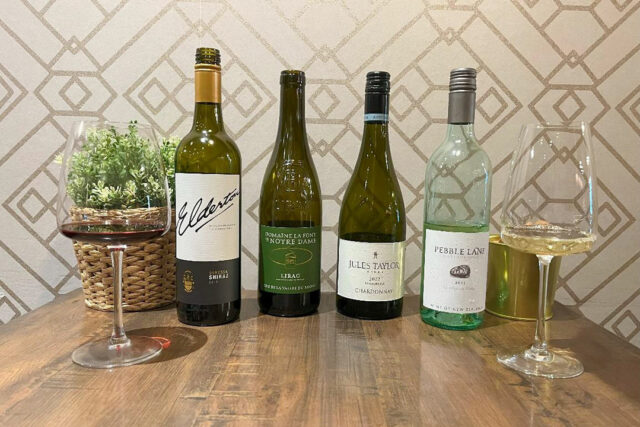
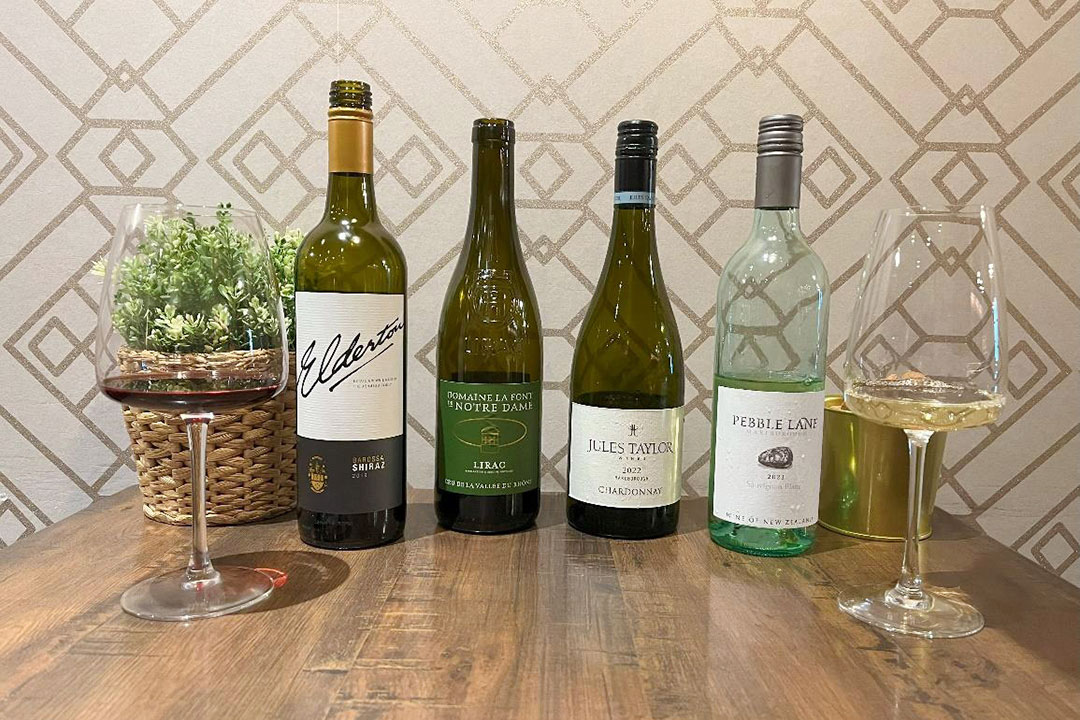
L to R: Elderton Barossan Shiraz, Domaine la Fonte Notre Dame Lirac, Jules Taylor Marlborough Chardonnay and Pebble Lane Marlborough Sauvignon Blanc

Being in the domestic imported liquor business is really a huge challenge for new players. It is a very oligopolistic market where there are just a handful of huge importers that dominate the importation of wines, beers, and spirits presently sold in the country. So, when a new company joins the competition, the new company needs to create its own niche to survive.

Like any good businessman this was what JoJo Vega and his partners at Don Revy did.

THE BACK STORY
Don Revy Philippines, Inc. is a collaboration between partners Jojo Vega, Piers Kinloch, the late Robbie Ferguson. The three partners met at a Singapore Telecom (Singtel)-sponsored Global System for Mobile Communications Conference, way back in 2003.

Jojo Vega is the only Filipino among the three, while both Piers and Robbie are Brisbane, Australia-based since the late 1990s but were both originally from Scotland. Jojo, who started his career in San Miguel Corp. (SMC) as a truck salesman fresh out of college, had just left SMC after 15 long years during which time he rose through the ranks to become its Assistant Vice-President of Sales at the time of his departure. Jojo then worked for Globe Telecom. Globe is partly owned by Singtel, while both Piers and Robbie had business interest with Optus, one of the biggest telecom companies in Australia, and also a wholly owned subsidiary of Singtel.

Robbie back then was married to a Filipina from Bacolod, so when he would come visit the Philippines, he would hang out with Jojo for a few days first in Manila. That was how the friendship was cemented, and by the late 2000s, the trio already spoke about doing business together in the Philippines, and since all of them enjoy drinking alcohol (we know the Scottish do), and with Jojo’s background in SMC, the decision to import and distribute liquor came to fruition. Thus, the birth of Don Revy.

As Jojo pointed out to me, the Don Revy logo has three bottles which symbolize each of the three partners.

THE WHITE WINE OPPORTUNITY
The company started with wines — as we know the spirits market is very brand-driven and had a more difficult level of entry. In Jojo’s research of the wine industry, he realized that white wines are not that big, and most importers compete in the red wine category. Based on import numbers, white wines are just around 25% of the total wine market, so Jojo saw this number as an opportunity to introduce better white wines into the market.

And where else to go for internationally renowned whites than to go bring in the Sauvignon Blancs from New Zealand’s Marlborough region?

While Marlborough and NZ whites have been around for ages, NZ wines were never priorities here in our market, because NZ is better known for white wines, for Sauvignon Blanc, than reds, and Philippines is a majority red-wine drinking country like most of our Asian counterparts.

So not only was it the whites that Don Revy was looking at, but wines from NZ as a country in general as their niche to enter this competitive industry.

Their first wine imports came in 2013, and all were from NZ. They covered three wine regions of New Zealand — Marlborough, Gisborne, and Hawkes Bay — under three different brands: Pebble Lane (a proprietary label), Jules Taylor, and Mills Reef.

BUSINESS INTEGRATION
Like every new importer, the first order of business was to get distribution, so Don Revy did that immediately. The targets primarily were on-premises establishments — restaurants, bars, cafes and hotels.

Retail has always been challenging because of the expensive listing fees that are involved. During the early stages of Don Revy, among the three partners, Robbie Ferguson, who had moved to Manila by then, was the most involved, as Piers was still Brisbane-based, and Jojo was employed as a high-ranking executive in MNCs Samsung, and then Huawei. But in 2017 Jojo left his corporate life to become a full-fledged partner at Don Revy and teamed-up with Robbie to further cement the foundation of the company.

Unfortunately, in 2018 tragedy struck Don Revy when one of the founding partners, Robbie, passed away untimely. Jojo then took over the entire day-to-day operations of the company, while Piers remained a loyal supporter remotely from Australia.

Soon, following the vision of the three partners, Don Revy embarked on their “brick and mortar” strategy. First, they wanted a place of their own to showcase their products. This was when Bevvy came to existence. Bevvy, which is a colloquial term for booze or alcoholic beverages in Australia, seemed like a perfect name. Don Revy had an office and depot in Pasong Tamo in Makati City, and the partners thought it would be cool to forward-integrate and have their own restaurant-bar. After all, they were growing, and more principals were visiting Manila than ever, so, a place of their own seemed ideal — even economical — to not only host their foreign visitors but also do events.

To their credit, Bevvy grew to be more than a Don Revy extension. With its good food and cozy ambience, Bevvy became a secret resto-bar for appreciative customers who needed a place to unwind and recharge.

Aside from Bevvy, Jojo saw an opportunity to go into retail, and joined the bidding process to be the liquor concessionaire of the Mitsukoshi department store in BGC. Don Revy won this bidding fair and square. With Mitsukoshi, Don Revy now has another outlet to showcase their products. Over the course of time, Don Revy added beers (Jojo Vega’s expertise from his SMC background) to their portfolio, with four brand imports from three countries, including the world’s first and original pilsner, Pilsner Urquell from the Czech Republic. They also tried their hands with spirits — scotch whiskies in particular, since both Piers and Robbie were originally from Scotland.

BEVVY
Bevvy is literally a hole in the wall as this resto-bar is as inconspicuous as they come. There is no sign, nor indication of where it is located. And even if you get the address from Google and use Waze, you still need a bit of help from the security guard in the compound to locate this place. But once you overcome that obstacle, believe me, this resto-bar is worth going to.

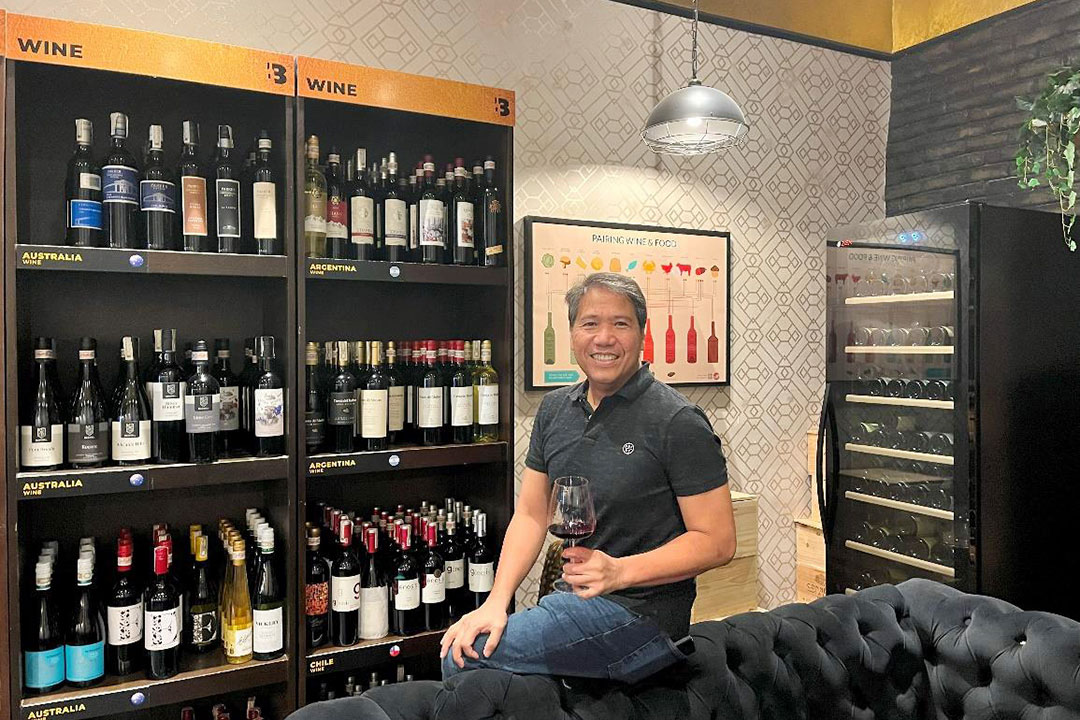
I recently visited Bevvy and met up with Jojo Vega and chef Bheng Velarde, Bevvy’s consultant. The menu is not only wine-friendly, but reasonably priced. And the liquor selection is priced at retail prices, which makes it like Terry’s Selection, Barcino, and other importer-cum-restaurateurs that deal directly with end-consumers.

A good dinner for two can be only P3,000++ and this already comes with a decent bottle of wine — this is hard to beat.

Bevvy top-sellers tasted:

Lemongrass Calamari — deep fried to a crisp perfection and served with ranch dressing. Menu price: P425

Fish & Chips — thankfully NOT made from brittle, structure-less dory but made with cod, it comes with homemade potato wedges, and is served with ranch dressing. Menu price: P550

Barbequed Glazed Beef Ribs — a five-hour oven-baked chuck ribs glazed with homemade BBQ sauce. Menu price: P1,180

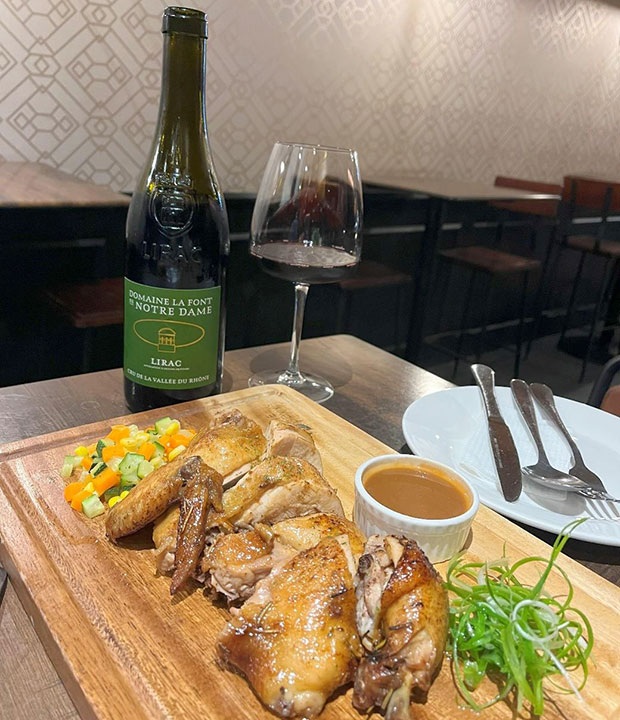
Herb Roasted Chicken — a five-hour oven-roasted half-size chicken seasoned with special herbs and spices. Menu price: P680

TASTING NOTES OF WINES TASTED AT BEVVY

Pebble Lane Sauvignon Blanc 2021, Marlborough, NZ: “I have tried several vintages of this wine and it has always been consistent, lovely notes of quince, lychee, though more subtle nose than most Marlborough Sauvies, this wine is clean, crisp, delectable and super quaffable even on its own.” Bevvy price: P910.

Jules Taylor Chardonnay 2022, Marlborough, NZ: “a more sophisticated Chardonnay with nice balance of cream, oak, and acidity, the wine has notes apricot and walnuts and has enough weight and acid backbone to go with a lot of dishes, nice long lime rind finish.” Bevvy price: P1,270.

Domaine la Font de Notre Dame Lirac 2019, Southern Rhone, France: “I rarely had a chance to taste Lirac as its not a normal Rhone Valley go-to wine, but this one made with usual Southern Rhone varietal-mix dominated by Grenache is very decent, with red cherry flavors, noticeable acids, friendly tannins, mineral and herbaceous notes, and juicy all the way.” Bevvy price: P1,090.

Elderton Shiraz 2019, Barossa, South Australia: “This wine captures the typicity of the Barossan Shiraz, fruit forward, alluring aromatics, flavors of ripe sweet berries, peppercorn and cassis, and ends with lingering bitter-sweet finish.” Bevvy price: P1,630.

Don Revy just reached their milestone 10th anniversary and already passed the prescription period of a newbie in this industry. They are no longer the new kids on the block and are here to stay and contribute to this industry.

Don Revy products can be purchased online, at on-premises establishments, and retailers which range from Rustans to 7-Eleven, and in Mitsukoshi, and, of course, in Bevvy.

For more information, including reservations at Bevvy, contact them at 8556-3312, or e-mail drink@donrevy.com.

The author is the first Filipino wine writer member of both the Bordeaux-based Federation Internationale des Journalists et Ecrivains du Vin et des Spiritueux (FIJEV) and the UK-based Circle of Wine Writers (CWW). For comments, inquiries, wine event coverage, wine consultancy and other wine related concerns, e-mail the author at wineprotege@gmail.com, or check his wine training website https://thewinetrainingcamp.wordpress.com/services


Dining In/Out (09/21/23)

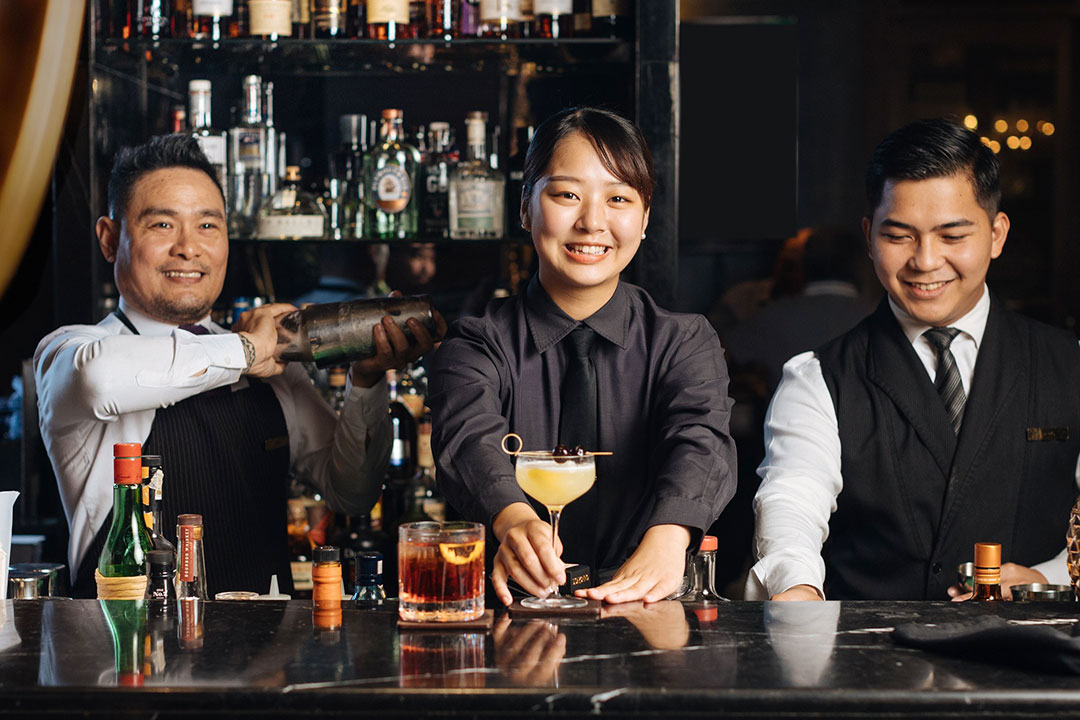
MAO MATSUMOTO (c) with The Peninsula Manila Team

Peter: The Bar takes over The Peninsula Manila

TOKYO isn’t just a culinary hub. It’s also one of the world’s classiest cocktail capitals, where mixologists can mix a classic Manhattan that will knock your socks off. That’s exactly what guest bartender Mao Matsumoto of The Peninsula Tokyo’s Peter: The Bar aims to accomplish this Saturday, Sept. 23, when she takes up her spot at The Bar of The Peninsula Manila during her takeover. For the one-night-only event, Ms. Matsumoto will take her passion for cocktails from her skybar home on the 24th floor of The Pen Tokyo to The Pen Manila where she will shake up gin-, vodka-, and whiskey-based cocktails from Peter: The Bar’s menu, as well as serve unique drinks crafted especially for the occasion like Mao’s Charm, Tokyo Joe, and Edo Palace. For inquiries on Peter: The Bar Takeover At The Peninsula Manila, call 887-2888, extensions 6691 and 6694 (Restaurant Reservations), e-mail diningpmn@peninsula.com or visit peninsula.com.


Coke collaborates with gaming company on new flavor

COCA-COLA has launched a new limited-edition flavor from Coca-Cola Creations, done in collaboration with Riot Games, the publisher and developer of League of Legends. The result is Coca-Cola Ultimate Zero Sugar which is the first collaboration with a gaming company on a Coca-Cola flavor. Accompanying the product’s release are in-game and digital experiences for players across the globe.  For an interactive experience, players will be transported to the Coca-Cola Creations Hub, the home for unique Coca-Cola Creations digital experiences, by scanning the QR code on a Coca-Cola Ultimate Zero Sugar bottle or can. One offer available now on the Creations Hub is the Ultimate Emote Generator, an Instagram filter allowing players to view themselves in the style of League of Legends emotes for social sharing. “Coca-Cola Ultimate boasts a striking design, delivers a unique taste of +XP for gamers during their adventures, and elevates their gaming experience by giving them a refreshing drink,” said Adrian Manlapig, Marketing Manager, Coca-Cola Philippines, in a statement. Coca-Cola Ultimate Zero Sugar fuses the two iconic brands with a packaging design that features black and various shades of gold. The familiar Coca-Cola Creations logo is complemented by a bespoke “Ultimate” crest and features a blue Hextech glow. The design showcases a Coca-Cola Spencerian Script font, inspired by the Nexus Crystals in League of Legends. Coca-Cola Ultimate Zero Sugaris now available nationwide in the Philippines. For more information, visit www.coca-cola.com/creations.


Nespresso introduces its smallest machine yet

NESPRESSO’s latest innovation in its machine line is the Vertuo Pop, its smallest yet most impactful Vertuo machine to date. It can brew four cup sizes, whether hot or iced, without sacrificing valuable counter space. The Vertuo Pop machine line — which is partly made with recycled materials, both the machine and its packaging — comes in Liquorice Black, Spicy Red, Coconut White, Pacific Blue, and Mango Yellow. A new sixth color, Aquamint, will be available in the Philippines by November. Like other Vertuo machines, the Vertuo Pop uses Nespresso’s Centrifusion Technology through which the machine can read the unique barcode of every Nespresso Vertuo blend and utilize the exact water volume required for optimal brewing. This allows users to explore four varying cup sizes based on their preferred cup at any time of the day: Espresso (40 ml), a Double Espresso (80 ml), a Gran Lungo (150 ml), or a Mug (230 ml). Meanwhile, Nespresso will be opening its seventh boutique this month, this time at the SM Mall of Asia. It will carry a wide selection of premium coffees, simple-to-use machines, and coffee accessories. There will also be interactive displays. One can find the Vertuo Pop and other Nespresso machines online via www.nespresso.ph, and at the boutiques in Power Plant Mall, Podium Mall, Robinsons Magnolia, One Bonifacio High Street Mall, Mitsukoshi BGC, Ayala Center Cebu, and soon at SM Mall of Asia, and in pop-up stores in Greenbelt 5, Shangri-La Plaza, TriNoma, and Alabang Town Center.


Krispy Kreme is giving away a trip to Korea

TO MARK the brand’s 86th anniversary, Krispy Kreme Philippines will be giving a lucky customer a trip to Korea via the 86 OG® Holiday Giveaways. The winner will explore the land of K-pop, K-drama and anything K-culture in a four-days-three-nights sponsored tour which includes an exclusive visit to the Krispy Kreme South Korea factory store. Also up for grabs in the promo are an iPhone 14 128gb and an iPad 10th generation for the 2nd and 3rd prize, respectively. Eighty-three winners will receive a one-month supply of a dozen Original Glazed doughnuts and Signature Brewed Coffee. The promo is open to all OG Card members who purchase a dozen of any of the participating combo products from Sept. 15 to Oct. 15: a dozen Original Glazed doughnuts plus any of the Pepsi products (Pepsi Regular, Pepsi Black, 7Up, Mountain Dew, Mirinda, Mug, Gatorade, or Premiere Bottled Water); a dozen Mixed Doughnuts plus any of the Pepsi products; a dozen Assorted Doughnuts plus any of the Pepsi products; and, a dozen Premium Assorted Doughnuts plus any of the Pepsi products. OG Cards are available for P195 in all Krispy Kreme store or through delivery via now.krispykreme.com.ph, GrabFood, foodpanda, Pick.A.Roo and Groover.


Red Ribbon now offers new Caramel Delight Cake

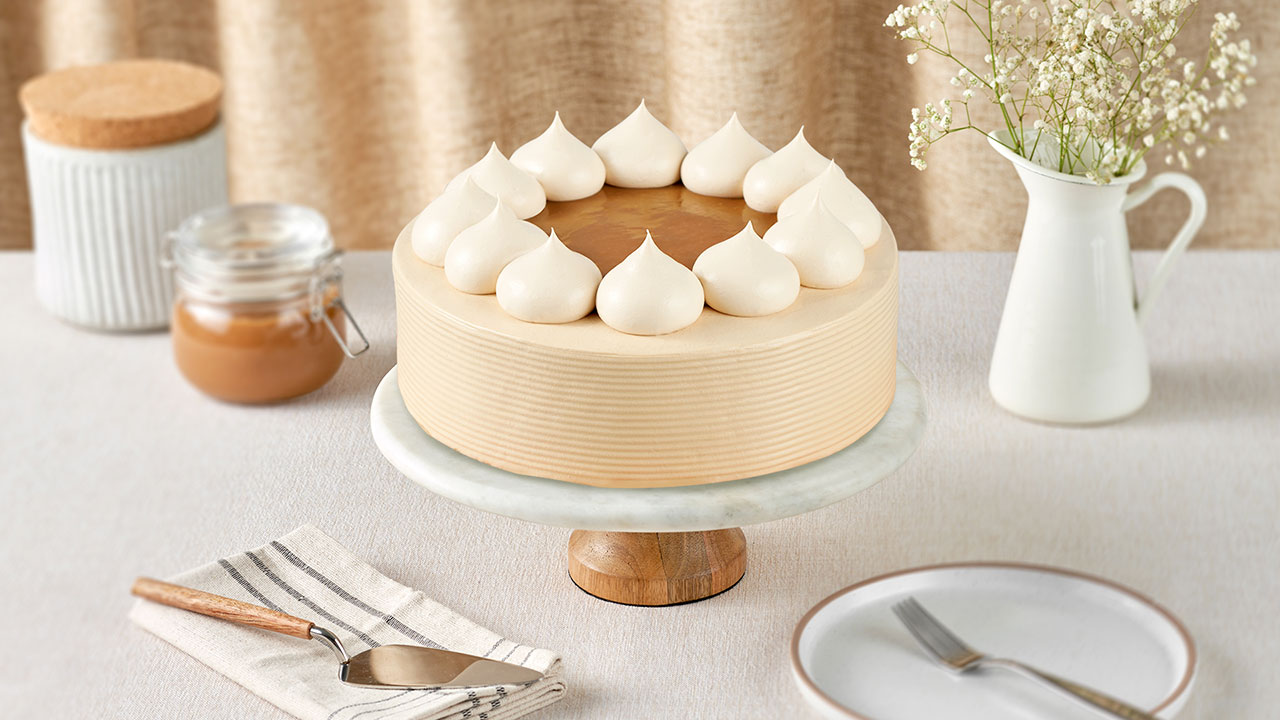
RED RIBBON has just come out with the new Caramel Delight Cake. The cake has soft chiffon layers with cream-colored ice cream in between, caramel icing, cream drops as toppings, and caramel syrup at the center. Prices start at P479 for the Junior size and P669 for the Regular size. It is available at all Red Ribbon outlets and can also be ordered via Red Ribbon’s delivery website, the Red Ribbon app, via delivery hotline at #87777, or through the Grab Food and Foodpanda apps.


McDonald’s Twister Fries are back

MCDONALD’S Twister Fries have made their way back to McDonald’s stores. The McDonald’s Big Mac and Twister Fries Meal is available for a limited time only. The Twister Fries can also be enjoyed as a solo item or as a free upgrade to any McDonald’s Large Meal with Fries, and are now available via dine-in, take-out, drive-through, and McDelivery, in Regular and Sharing sizes. They may also be purchased via channels such as GrabFood, foodpanda, PickARoo, and SM Online.

Low liquidity levels setting back local corporate bond market, say investors

THE PHILIPPINE corporate bond market is still suffering from low liquidity levels, resulting in a low amount of issuances compared with government bonds and leaving it behind Southeast Asian counterparts, investors said.

“For the bond market, I think the Philippines needs to be more competitive compared to those in the region. In terms of size, we are lagging [behind] our ASEAN peers,” said Maria Cristina B. Gabaldon, deputy head of Metrobank’s investment management division.

“I guess it has to do with the number of issuances. We need more supply of bonds. We need to deepen the capital market,” she added in a panel discussion at the Advancing the Philippines Bond Market Conference on Wednesday.

Compared with regional peers, the Philippine government remains dominating the bond market, said BPI Wealth Head of Investment Solutions Gladys Buenaventura.

“In other countries, it’s relatively equal. Here, we still see limited corporate issuers,” she said.

According to the Asian Development Bank’s Bond Monitor, corporate bonds comprised only 13.6% of the outstanding local currency bonds in the second quarter.

Ms. Gabaldon said demand exists for corporate bonds, but the country lacks issuers.

“We need more supply of bonds. We need to deepen the capital market. I think demand is there. It depends on the tenor. Some retail investors are asking for the short-term tenors while some companies want longer tenors. So I think corporates and BTr (Bureau of the Treasury) should take advantage of this demand,” she said.

Ms. Buenaventura likewise said increasing market makers could solve the liquidity issue on the corporate side.

She added that bond literacy in schools could help drive the demand for bonds, and thus increase the liquidity in the market as well as accessibility of the market to the public.

“As we know, most Filipinos are very familiar with stocks. It’s so easy for them. But once we start talking about bonds, it’ll take time for us to actually explain to them how the whole instrument works,” Ms. Buenaventura said.

She noted that a more “curricular” rating system for the issuances could help investors assess what they are investing in and compensate them for the risk they are taking.

BDO Unibank Vice-President and Fixed Income Manager Jason Samson L. Clemente, Jr. added that transparency is also lacking, and improving it could help in expanding the market. — Aaron Michael C. Sy

Champagne demand softens after post-COVID boom years, LVMH says

IHOR N-UNSPLASH

DEMAND for LVMH’s Champagne brands is moderating this year after the boom that followed COVID-19 lockdowns, according to a top executive at the luxury conglomerate.

There was a “general sense of revenge pleasure,” in 2021 and 2022 after consumers were stuck at home, Moët Hennessy Chief Executive Officer Philippe Schaus said in an interview. The drinks and wines division he oversees generated about 7.5% of first-half revenue at parent company LVMH Moët Hennessy Louis Vuitton SE.

“2023 is a bit more complicated, because this effect of COVID is fading out, and there’s a lot of inflation in all countries,” Mr. Schaus said. “So we see that we are going back to normal.”

Mr. Schaus pointed to a drop in Champagne consumption at home. But other markets are holding up well.

“We have seen this summer that there was no abating of the demand for high-end Champagne” in beach and nightclubs across the Greek island of Mykonos and the Italian Riviera, as well as top restaurants in Paris, Mr. Schaus said. The division’s brands include Dom Pérignon, whose Plénitude 2 vintage 2004 bottle costs €495 ($528) in France.

Organic sales at the drinks unit fell 3% in the first half, hurt by a slowdown in Cognac consumption in the US.

LVMH’s wines and spirits division has been acquisitive in the recent past, with deals including an investment in the pricey Champagne label Armand de Brignac, co-owned with rapper Jay-Z. Earlier this year, LVMH bought a majority stake in rosé wine maker Château Minuty.

Mr. Schaus said LVMH isn’t looking at buying more alcohol brands, describing its portfolio as strong. But the executive expects more consolidation in the Champagne region.

“There are about 300 Champagne maisons so I can imagine that there will be mergers, for sure, because 300 is a lot,” he said. “It’s super fragmented.”

The Luxembourg-born executive spoke at Château de Saran, which is surrounded by vineyards belonging to Moët & Chandon near the town of Epernay in northern France. The interview took place during the harvesting period, known as les vendanges.

Mr. Schaus said volumes are plentiful. Rising temperatures have made yields more erratic, but the industry has been resourceful and has adapted to climate change over the past few centuries, Mr. Schaus said. “Champagne will continue to evolve. But I promise you, in 100 years, people will still be doing Dom Pérignon and Moët & Chandon.”

LVMH is the biggest maker of Champagne since it also owns the Krug, Ruinart, Veuve Clicquot, and Mercier labels.

Comité Champagne, the industry trade group, in July said it expects its producers to ship 314 million bottles this year, down 3.7% from last year. — Bloomberg

Cebu Landmasters, NTTUDA tie up to develop residential towers

LISTED property developer Cebu Landmasters, Inc. (CLI) and NTT UD Asia Pte. Ltd. (NTTUDA) will create a new joint venture (JV) company as the two companies partnered to develop residential towers in Cebu City.

“This is also to disclose to the exchange that both companies are now preparing formal notifications to the Philippine Competition Commission (PCC) and intend to secure PCC clearance for the new JV company which shall be known as CLI NUD Ventures, Inc.,” CLI said in a stock exchange disclosure on Wednesday.

The new company comes as the partners signed an agreement to develop premium-grade residential towers in Cebu City.

CLI is a real estate developer with over 116 development projects across 16 major locations in Visayas and Mindanao. It currently has a residential portfolio consisting of more than 37,000 units valued at P122 billion.

Its portfolio includes the Premier Masters, Garden-Series, Casa Mira, and Villa Casita Residential offerings.

Meanwhile, NTTUDA is an international developer of commercial properties such as office buildings, residences, and other mixed-use developments in Southeast Asia.

In the first half of the year, CLI’s consolidated net income rose 32% to P2.1 billion versus the P1.6 billion posted a year ago.

On Wednesday, shares of CLI at the local bourse closed unchanged at P2.55 apiece. — Revin Mikhael D. Ochave

Keeping the old and adding the new

JUST in time for the runup to its fifth anniversary, Sheraton Manila is keeping some of the old but is also introducing the new — particularly a new executive chef and several new executives.

Earlier this week, Sheraton Manila showed off the Sheraton Club, an exclusive venue for Marriott Bonvoy members (the Sheraton chain was acquired by Marriott International in 2016 after purchasing its parent, Starwood). There, they introduced their new Italian Executive Chef, Andrea Burzio.

Mr. Burzio is installing a “prenza e cena (lunch and dinner)” Italian spread at the hotel’s S Kitchen restaurant. For that, he teased guests with a one-meter-long lasagna, which is set to enter S Kitchen in October.

General Manager Anna Vergara said in a speech that they began operations in January 2019 — its return to the Philippines after three decades — and we know what happened a year later.

“The past five years were not a walk in the park,” she said. She told BusinessWorld that in those five years, the hotel had been used as a quarantine facility, while they bolstered their food and beverage operations so they could offer takeout and delivery during the COVID-19 pandemic.

“During the pandemic, we obviously had to cut down on a lot of things. We wanted to make sure that we survived. Because of that, we discovered a lot of efficiencies,” she told BusinessWorld. “We realized that these efficiencies can be applied in the ‘real’ world.” These include the same stringent hygiene standards enforced during the height of the pandemic, but also making more use of their online capabilities — including within the management board, where they continue holding online meetings.

Aside from Ms. Burzio, Ms. Vergara introduced a new Director of Sales and Marketing for the hotel, Ria Galvez. She introduced us as well to the Director of Food and Beverage, Czats Lopez. Feminism looks strong in this workplace, and Ms. Vergara mentioned that seven out of nine members of the executive board were women. Ms. Vergara, who had been General Manager since the Sheraton’s 2019 opening (it must be noted that Ms. Vergara’s status as a General Manager of an international hotel chain is also a rarity in the city), spoke about the difference of a woman’s touch. “I don’t want to be very biased against our male counterparts. But for us, for women, I think the biggest advantage is the nurturing talent that we have that comes out naturally,” she said. “A majority of our women leaders, we are actually mothers, so they use that as an advantage in taking care of our associates (and guests).”

The countdown to the January anniversary — the celebrations for the fifth anniversary will kick off on Jan. 14, 2024 — kicks off with holiday room packages and even a wedding campaign (10% off food and beverage for a 2024 Sheraton Manila Grand Ballroom wedding). — JLG

TDF yields drop before Fed, BSP policy decisions

BW FILE PHOTO

YIELDS on the central bank’s term deposits dropped on Wednesday as both tenors were oversubscribed on expectations of a rate pause this week.

The term deposit facility (TDF) of the Bangko Sentral ng Pilipinas (BSP) fetched bids amounting to P434.066 billion on Wednesday, well above the P300-billion offering but a tad lower than P446.698 billion for a P340-billion offer seen a week ago.

Broken down, tenders for the seven-day papers reached P263.423 billion, higher than the P180 billion auctioned off by the central bank and the P248.137 billion in bids for a P200-billion offering seen the previous week.

Banks asked for yields ranging from 6.3% to 6.515%, lower than the 6.33% to 6.575% band seen a week ago. This caused the average rate of the one-week deposits to decrease by 6.15 basis points (bps) to 6.4576% from 6.5191% previously.

Meanwhile, bids for the 14-day term deposits amounted to P170.643 billion, beyond the P120-billion offering but failing to beat the P198.561 billion in tenders for a P140-billion offer seen on Sept. 13.

Accepted rates for the tenor were from 6.3275% to 6.525%, also lower than the 6.34% to 6.58% margin seen a week ago. With this, the average rate for the two-week deposits fell by 3.64 bps to 6.4863% from 6.5227% logged in the prior auction.

The BSP bank has not auctioned 28-day term deposits for more than two years to give way to its weekly offerings of securities with the same tenor.

The term deposits and the 28-day bills are used by the BSP to mop up excess liquidity in the financial system and to better guide market rates.

Term deposit yields went down ahead of the widely expected pause from both the US Federal Reserve and the BSP at their meetings this week, Rizal Commercial Banking Corp. Chief Economist Michael L. Ricafort said in a Viber message.

The US Federal Reserve was set to announce overnight its policy decision after a two-day meeting.

The Fed hiked borrowing costs by 25 bps at its July meeting, bringing its target rate to 5.25-5.5%, the highest level in 22 years.

Meanwhile, the Monetary Board will hold its own review on Thursday, where it is likely to keep rates steady for a fourth straight meeting, according to 14 of 17 analysts in a BusinessWorld poll last week.

Mr. Ricafort said headline inflation could fall within the 2-4% target by the fourth quarter or in the first quarter of 2024 due to a high base, which would be a key factor in the BSP’s decision making.

The country’s headline inflation rose to 5.3% in August from 4.7% in July. It marked the 17th straight month inflation breached the central bank’s 2-4% target.

For the first eight months, inflation averaged 6.6%, still above the BSP’s 5.6% forecast. — K.B. Ta-asan

King-king mine operator seeks foreign investors

ST. AUGUSTINE Gold and Copper Ltd. is updating the preliminary feasibility study (PFS) for its King-king copper-gold project in Davao de Oro as it seeks foreign investors, a company official said.

“We are having our 2013 PFS updates. Hopefully, it will be ready by early next year,” St. Augustine Chief Operating Officer Michael G. Regino told reporters on the sidelines of a mining forum of the Chamber of Mines of the Philippines.

“They might be ready by January,” he said about the updates.

Mr. Regino said the updated study would allow the company to see revisions on current prices, revenues, and cost of the project.

“We believe that the financials will definitely be a lot better than the 2013 PFS,” he said. “You need to update the study and the cost to determine the viability.”

He said the project, which requires an initial $2 billion, would need investments from foreign investors.

“Projects of this size, definitely would need big money, so you would need a partner, big investors,” he said.

He added that the company Is in talks with multiple foreign investors, but “[they] are just waiting for the PFS to be completed.”

He said that based on the company’s original plan, it would take an estimated four years to put up the plant and open pit.

“Copper is really becoming a need because of [the electric vehicle] revolution and the increase in use of copper in each car is threefold,” he said.

Mr. Regino said the project’s 23-year mine life is estimated to bring 3.1 billion pounds of copper, 5 million ounces of gold, and nearly 10 million ounces of silver.

In the first five years, the company expects to extract 150,000 tons of copper per year.

The King-king copper-gold project is part of a mineral production sharing agreement between the Philippine government and Nationwide Development Corp.

St. Augustine is responsible for the overall development and operation of the project. — Adrian H. Halili

Recycling beverage cartons

FREEPIK

In May 2022, Congress passed Republic Act (RA) 11898 to amend the law on solid waste management and make producers responsible over their products’ packaging waste. This was in response to the issue of what to do with products at the end of their life cycle. The law made manufacturers or producers, and not just consumers, also responsible for this.

RA 11898 “institutionalize[s] the extended producer responsibility mechanism as a practical approach to efficient waste management, focusing on waste reduction, recovery, and recycling, and the development of environment-friendly products.” The law requires “producers to be environmentally responsible throughout the life cycle of a product, especially its post-consumer or end-of-life stage.” It is in this context that I now raise the issue of producers’ seemingly limited capacity to locally recycle, particularly used beverage cartons or multi-layer “paper bottles.” Consumers are inclined to think that beverage cartons, being paper-based, are more friendly to the environment than plastic bottles. While this may be true, paper bottles are still not easy to recycle since they contain not only paper layers but also plastic and aluminum layers.

Given this, how can local producers effectively comply with the mandate of RA 11898 if they have limited capacity to undertake the local recovery, recycling, reuse, and proper disposal particularly of used beverage cartons? Locally, is there actually a way to make paper bottles even more environment-friendly in terms of both carbon footprint and recycling?

Studies indicate that paper bottles with plastic and aluminum layers take less energy to make than other beverage packaging. They are also light and space-efficient to transport because of their material and shape. And they can better store perishable items like milk, juices, soups, and sauces. Beverage cartons are thus great packaging, but they are difficult to recycle.

It is in this line that Plastic Action (PACT), in a paper, recommends the calibration of policies with respect to the use of beverage cartons or paper bottles. And the recommendation, particularly in Singapore, is to limit the use of beverage cartons only “to highly perishable food products.” This is given the fact that Singapore has no local recycling facility for used beverage cartons.

PACT was started by World Wildlife Fund-Singapore and is based on WWF’s No Plastic in Nature Initiative. According to WWF-Singapore, PACT is a business initiative that aims to reduce waste and move towards a circular economy. It pushes for science-based decisions for responsible production and consumption.

In what PACT refers to as a “Guidance Pack on Used Beverage Cartons” for Singapore, it said beverage cartons have “debatable recyclability,” and should thus be “reserved for highly perishable liquid foods that require the preservation of flavor and nutrient value, and benefits from a lengthened shelf-life.” For drinking water, plastic bottles could be retained, PACT said, noting that “plastics with recycled content would have a lower environmental footprint than beverage cartons.”

PACT added, “Beverage cartons should not be used as a replacement for drinking water plastic bottles, simply to accommodate consumers’ demand for plastic removal. The disposal of the beverage carton will also be a problem especially in Singapore’s waste management context.”

Moreover, “the intended design of the beverage carton would not contribute significantly to the shelf life of drinking water. Neither does drinking water require the preservation of flavors or nutrients.” In short, why use paper bottles for water when plastic will do just fine, for now.

PACT added, “Although beverage cartons are theoretically recyclable, their actual recyclability is debatable. This is because: Firstly, a beverage carton cannot be 100% recycled back to a new beverage carton. Secondly, the recovered materials from recycling are either downcycled or made into products that are unrecyclable. [And], although advances in recycling technology can improve the recyclability of beverage cartons, there are very few facilities with such advanced technology, raising the question of the term ‘recyclable’ from a country’s waste management context.”

PACT noted that Singapore does not have its own recycling facility for used beverage cartons, and the nearest one is in neighboring Selangor, Malaysia. But the Malaysian facility “is only able to recover paper [from used beverage cartons], while the remaining plastic and aluminum are downcycled into a composite material (a material that is made from at least two very different materials).”

I believe the Philippines can take the lead of PACT on this given the country’s limited capacity to undertake the recycling of used beverage cartons. I know only of Nestlé Philippines, Tetra Pak Philippines, Green Antz Builders, and JunkNot collecting used beverage cartons and repurposing them into durable materials for making tables and chairs.

While other producers are also getting into recycling, capacity is still limited. In this sense, if more local and imported products come in paper bottles or beverage cartons, just so to save on freight and limit plastic use, then much of their discarded packaging will still end up in landfills. Consumers also need to do their part in collecting, cleaning, and turning over their used cartons.

My concern is not so much the recyclability of beverage cartons but the Philippine capacity to do so. With proper facilities in place, paper bottles can in fact be recycled, with the paper, plastic, and aluminum content separated. But, until more facilities or more producers collect and recycle discarded cartons, we need to consider alternatives.

My call is that importers and local producers, in determining packaging for their products, should steer clear of materials that cannot be commercially recycled, reused, or repurposed. Meantime, they should also consider investing in facilities that can locally recycle, reuse, or repurpose the very packaging materials they produce.

While the priority is for producers to always use fully reusable packaging, this is easier said than done. An option, particularly for beverage makers, is to use recycled PET, or at least collect and recycle most of their PET or plastic bottle. As for those using beverage cartons or paper bottles, they need to initiate more programs to collect and recycle their used packaging products.


Marvin Tort is a former managing editor of BusinessWorld, and a former chairman of the Philippine Press Council

matort@yahoo.com

Treasury bureau looking to issue tokenized bonds within the year

BW FILE PHOTO

THE BUREAU of the Treasury (BTr) is looking to conduct a pilot test of tokenized bonds among government securities eligible dealers (GSED) within the year.

The BTr has not decided on the issue size, Deputy Treasurer Erwin D. Sta. Ana told reporters on Wednesday, but is looking at offering smaller denominations.

He said the denominations for the tokenized bonds could be lower than the P5,000 minimum investment for retail Treasury bonds.

Tokenized bonds are exchanged digitally through a blockchain.

The tokenized bonds use a value known as a token to take the place of the securities’ sensitive data and secure them.

Mr. Sta. Ana said in a speech at the Advancing the Philippines Bond Market Conference 2023 held on Wednesday that the BTr is working on issuing a total of two tokenized bonds.

The BTr is conducting an internal study on the tokenized bonds with inputs from government financial institutions to potentially implement tokenization for retail bonds and attract more digital investors.

“We’re currently studying it. We did the study to initially pilot it with institutional investors, with our GSEDs, and possibly the government institutions. Later on, once the proof of concept is okay, then we can venture into retail,” Mr. Sta. Ana said.

“We’d like to roll it out first to the institutional investors and then later on, to harness what this technology offers, which is to further enable fractional shares in terms of onboarding more digital investors,” he added.

He said that the BTr will announce the pilot tokenized bond offering soon.

The BTr is also planning to issue a sukuk and a retail dollar bond before the end of the year, he added.

“The BTr is trying to introduce Sukuk bonds through the LGU (local government unit) bonds financing framework. We have launched this as well. We have been speaking with LGU executives. We have seen interest from at least three, five first-class cities, so efforts are on the way,” Mr. Sta. Ana said.

The Sukuk bond issue would mark the Philippines’ debut in the Islamic bond market.

National Treasurer Rosalia V. de Leon said last week that the securities could be issued before the end of the year or in the first quarter of 2024. — A.M.C. Sy