Home Blog Page 4247

Slight inflation uptick seen in Sept.

Philippine annual inflation in September is expected to settle within the range of 5.3% to 6.1%, the Bangko Sentral ng Pilipinas said. — PHILIPPINE STAR/EDD GUMBAN

By Keisha B. Ta-asan, Reporter

INFLATION likely quickened in September due to pump price hikes, higher electricity rates, and the peso depreciation against the dollar, analysts said.

A BusinessWorld poll of 17 analysts yielded a median estimate of 5.4% for September inflation, at the low end of the 5.3-6.1% forecast of the Bangko Sentral ng Pilipinas (BSP).

If realized, September inflation would be  slightly faster than the 5.3% print in August, but lower than 6.9% in the same month in 2022. It would also be the highest print in four months or since 6.1% in June.
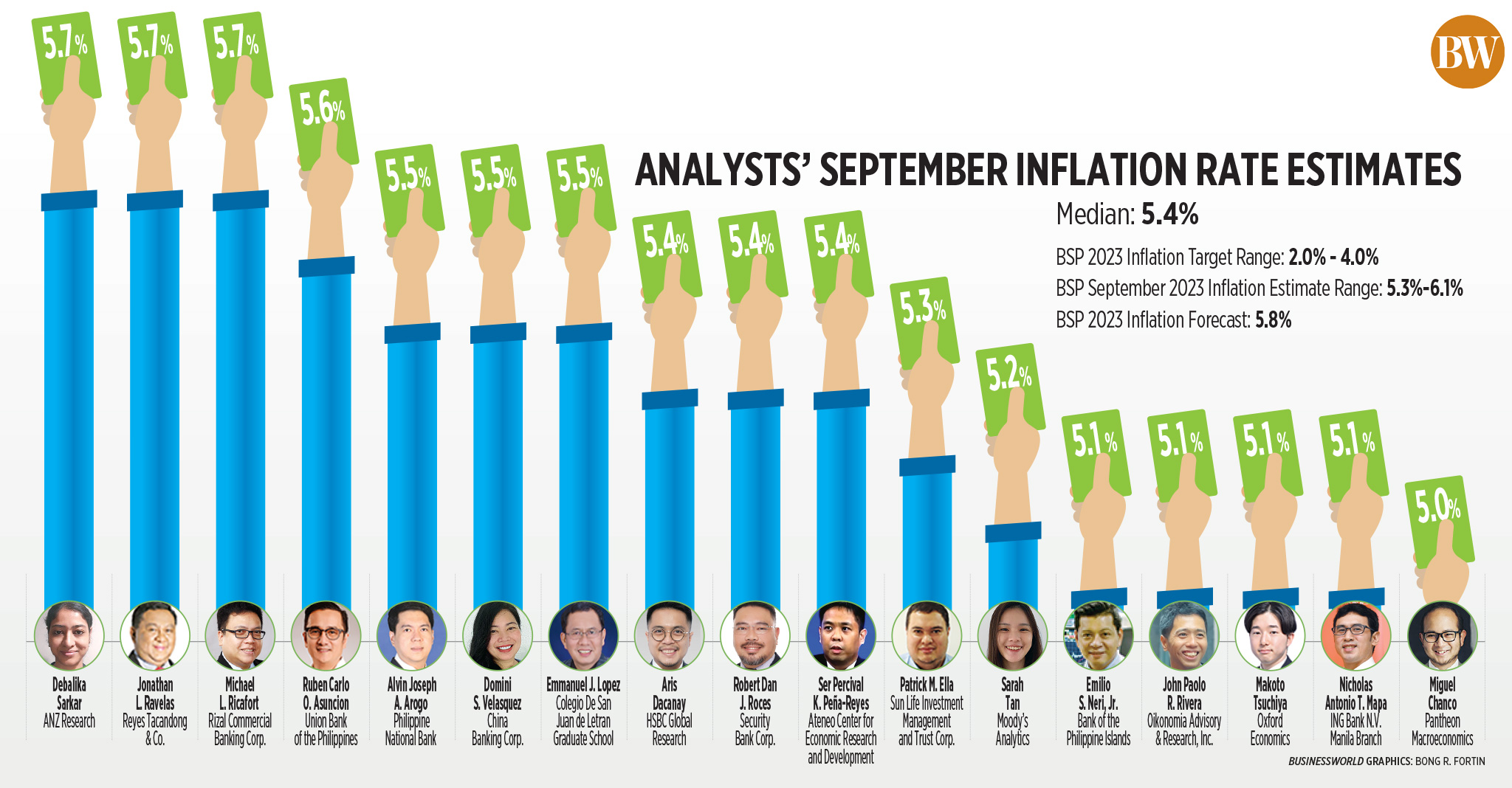
Analysts’ September inflation rate estimates

Inflation in September will likely breach the central bank’s 2-4% target range for the 18th straight month.

The Philippine Statistics Authority (PSA) is scheduled to release the latest consumer price index (CPI) data on Oct. 5 (Thursday).

“Higher prices of fuel, electricity, and key agricultural commodities, as well as the peso depreciation are the primary sources of upward price pressures in September,” the BSP said in a statement on Friday.    

“Meanwhile, lower rice and meat prices could contribute to downward price pressures for the month,” it added.     

In September alone, oil companies raised pump prices for gasoline by P2.50 per liter, diesel by P3.90 per liter, and kerosene by P0.80 per liter.

Customers of Manila Electric Co. (Meralco) saw higher electricity bills in September after the overall rate went up by P0.5006 per kilowatt-hour (kWh) to P11.3997 per kWh.   

HSBC economist for ASEAN (Association of Southeast Asian Nations) Aris Dacanay said electricity rates rose more than 4% in September, reflecting the higher energy import bill due to the depreciation of the peso against the dollar.

The peso finished trading at P56.575 per dollar on Friday, gaining 40.5 centavos from its previous close of P56.98. In September alone, the peso has slightly strengthened by two centavos or 0.03% from its Aug. 31 finish of P56.595.

However, China Banking Corp. Chief Economist Domini S. Velasquez said higher electricity rates from Meralco may have been offset by lower rates in other provinces like Batangas, Pampanga, and Bohol.

She noted that prices of fish and fruits remained elevated last month and increases in cooking gas prices may have also added to upward inflationary pressures in September. 

Cooking gas prices rose by P6.65 per kilogram in September, marking the second straight month of price hikes.

“On a positive note, rice and vegetable prices, which were the primary drivers of food inflation in August, eased due to the mandated rice price cap and relatively favorable weather (i.e., no strong typhoons this month),” Ms. Velasquez said.

Sarah Tan, an economist from Moody’s Analytics, noted that rice prices have cooled due to the imposition of a price ceiling in early September. The spike in rice prices was one of the main drivers of inflation in August.

“Notably, the average price of locally produced regular milled rice in Metro Manila has fallen about 20% from its end-August peak,” Ms. Tan said.

Starting Sept. 5, the Marcos administration imposed a price ceiling of P41 per kilo for regular milled rice and P45 per kilo for well-milled rice.

Meanwhile, core inflation may have settled at 5.9% in September, Ms. Velasquez said.

If realized, this would be lower than the 6.1% print in August. It would also be the first-time core inflation fell below the 6% level since the 5.9% print in October 2022. 

“We won’t be surprised if higher oil prices have spilled over to core (inflation) already,” Bank of the Philippine Islands Lead Economist Emilio S. Neri, Jr. said.

For the rest of the year, ANZ Research economist Debalika Sarkar said global oil prices may remain elevated amid tight supply.

“While some effort has been made to stabilize domestic food prices, domestic retail pump prices continue to adjust to global oil price movements,” she said. “The low oil inventory also implies a faster pass-through in the absence of adequate fiscal controls.” 

Ms. Sarkar said another round of transport fare hikes, which may be implemented in November, could further add upward pressure on inflation.

“Overall, we do not see the monthly inflation print falling back below 4% year on year this year,” she said.

The BSP earlier said it still sees inflation falling within the 2-4% target in November, but raised its average inflation forecast for 2023 to 5.8% (from 5.6% previously).

Philippine National Bank economist Alvin Joseph A. Arogo said it is still possible for the headline print to fall within the target by fourth quarter if inflation will not accelerate past 5.5% in September.

“However, the risk to this view is elevated due to El Niño, typhoons, oil production cuts, and prolonged Russia-Ukraine war,” Mr. Arogo said.

On the other hand, Patrick M. Ella, economist at Sun Life Investment Management and Trust Corp., said inflation may return to the 2-4% target range by the first quarter next year instead, and not in the fourth quarter as previously expected.

A surge in consumer spending ahead of the holiday season in the fourth quarter may put the 2-4% target range out of reach, Colegio de San Juan de Letran Graduate School Associate Professor Emmanuel J. Lopez said.

Barring any new shocks, Ms. Velasquez said inflation is still on track to return to the 2-4% target band in the fourth quarter.

“Hence, we think that the BSP can still keep its policy rate on hold at 6.25% this year, especially if third-quarter GDP (gross domestic product) comes out weaker than anticipated,” she said.

The PSA will release the third-quarter GDP data on Nov. 9.

The Monetary Board has kept its key interest rate at 6.25% for a fourth straight meeting last month. This was after it hiked policy rates by 425 basis points from May 2022 to March 2023.

Ms. Velasquez noted that recent supply shocks to inflation could be addressed by non-monetary measures.

“However, we are cognizant that another rate hike in November is a live possibility if the peso weakens further given another Fed rate hike,” she added.

The US Federal Reserve earlier signaled it would keep rates higher for longer, even as it opted to keep the target Fed funds rate unchanged at 5.25-5.5% at its meeting last month.

The Fed’s next meeting is from Oct. 31 to Nov. 1, while the BSP is scheduled to discuss policy on Nov. 16.

Retail dollar bond sale may exceed $1 billion

A person shows U.S. dollars at a currency exchange store in Manila, Philippines, October 21, 2022. — REUTERS

By Luisa Maria Jacinta C. Jocson, Reporter

THE GOVERNMENT’S retail dollar bond (RDB) sale will likely exceed $1 billion amid strong demand, the Bureau of the Treasury (BTr) said.

“We’re seeing the demand, we’re close to the $1 billion initially that we targeted. We are confident that until next week we’ll be able to raise more than $1 billion,” BTr Officer-in-Charge Sharon P. Almanza said in a briefing on Friday.

The government on Wednesday raised $611.2 million from the auction of its onshore retail dollar bonds. The minimum issue size of the offer was set at $200 million.

This is the Philippines’ second retail dollar bond issuance, but the first under the Marcos administration. In 2021, the Philippines raised $1.6 billion from its maiden retail dollar bond offering.

Finance Secretary Benjamin E. Diokno said on Friday that it is possible to upsize the offer due to the high demand.

“Actually, the initial offering was $200 (million), because we really wanted to limit our indebtedness. But you know, demand is close to a billion as of (Friday)… and maybe we can even raise (the size) because this bond is considered domestic, so that’s okay. We have some leeway in domestic borrowing,” he said in mixed English and Filipino.

Ms. Almanza noted the government has not completed its domestic borrowing program this year, “so we can still accommodate even if we reach the $1 billion during the offer period.”

The government is planning to borrow P2.207 trillion this year. Broken down, this consists of P1.654 trillion from domestic sources and P553.5 billion from foreign sources.

In the first seven months, gross domestic borrowings reached P1.17 trillion, data from the BTr showed.

Ms. Almanza said the government may possibly cut short the offer period for the bond offering. “As we said during the launch, it’s possible that we may (cut), but for now, there is no plan to,” she said in mixed English and Filipino.

The offer period for the RDBs started on Sept. 27 and is scheduled to end on Oct. 6. The issue date is on Oct. 11.

The five-and-a-half-year bonds fetched a coupon rate of 5.75%. It was also awarded at rates ranging from 5% to 5.75%, bringing the average to 5.509%. The bonds are also payable every quarter until its maturity on April 11, 2029.

SUKUK BONDS
Meanwhile, the government is planning to launch Sukuk bonds before the end of the year.

“We’ll go back to the Middle East to sell our Sukuk bonds. At the end of November,” Mr. Diokno said.

The offer size for the bonds is “more or less, initially $1 billion,” he added.

Ms. Almanza said that the minimum denomination for the Sukuk bonds is at least $200,000.

Mr. Diokno noted that these are not retail bonds and will mainly be for institutions.

“As of today, we have chosen our lead managers, six. So I think that will complete our borrowing,” he added.

Also Mr. Diokno said that the government’s planned Euro bonds will likely be launched by next year.

“We were going around, there is demand for Euro bonds,” he added.

In April 2021, the government raised €2.1 billion from a triple-tranche offering of euro-denominated bonds.

ADB earmarks $4B for PHL lending program for 2024

BW FILE PHOTO

THE ASIAN Development Bank (ADB) is allocating as much as $4 billion worth of loan financing for the Philippines annually starting next year through 2029 to support its development projects.

ADB Country Director for the Philippines Pavit Ramachandran said the multilateral lender is looking to earmark between $3.5 billion and $4 billion for the lending program in 2024.

“This year, we’re looking at about anywhere from $3.5 billion to $4 billion in terms of our lending. Next year, we expect a similar allocation and a lot of this is on infrastructure, not only urban mobility and connectivity, but also flood resilience,” he told reporters on the sidelines of a forum last week.

For next year’s lending program, Mr. Ramachandran said they already know which projects will be included.

“We just have to lock in the exact amounts and timelines with the government,” he added.

Mr. Ramachandran said the $3.5 billion to $4 billion range would likely be the earmarked lending program per year under the ADB’s new Country Partnership Strategy (CPS) from 2024 to 2029.

“I think we’re looking at that being the lending. It’s also consistent with what we’ve been doing now for the last two or three years, because these are large, complex infrastructure projects but also some budget support mixed in on some strategic areas. That will be about 30% of the overall program, the share of budget support (then) the remainder will be largely project investments,” he said.

The ADB is currently working on its CPS 2024-2029 for the Philippines. The current partnership strategy for 2018-2023 focuses on “policy reforms, institutional capacity development, and financing investments that promote high and inclusive growth.”

Mr. Ramachandran said the new CPS will likely be released by the second half of 2024, adding that consultations are currently ongoing.

The CPS will also have a strong focus on climate change and social protection.

“There will be a climate resilient infrastructure pillar, this is very much aligned with the flagship projects. We are supporting the preparation and development of a number of these on urban mobility, flood resilience, and connectivity,” Mr. Ramachandran said.

He said the ADB is supporting the Philippines’ transition to upper middle-income country by investing in health, education and social protection projects.

“We’re really trying to ramp up private sector engagement, both PPPs (public-private partnerships) which are very much part of the government’s agenda as well, in terms of delivery of infrastructure programs, but also dedicated private sector investment in green energy, digital development, and affordable housing,” Mr. Ramachandran said.

The ADB’s 2023 lending program is focused on eight projects and programs, four of which are policy-based loans aimed to support post-pandemic business recovery, reforms in the agriculture sector, and inclusive finance.

Before the end of the year, Mr. Ramachandran said he is hopeful that the $1.95-billion loan for the Bataan-Cavite Interlink Bridge Project will be approved by the ADB board.

“We are making good progress with it, one of the projects is of course the Bataan-Cavite interlink bridge over Manila Bay… we are trying to have it approved, it’s on a tight timeline,” he said.

Data from the ADB showed that the 32-kilometer bridge will “provide a permanent road link between the provinces of Bataan and Cavite, the key missing link in the road network of the National Capital Region, Central Luzon and Calabarzon regions.”

Mr. Ramachandran also noted that the ADB is working on supporting the government’s 197 infrastructure flagship projects (IFPs).

Meanwhile, the World Bank approved $600 million worth of financing for the Philippines to support the government’s digitalization efforts.

The multilateral lender said the country’s first Digital Transformation Development Policy Loan aims to support digital infrastructure policies, expand financial inclusion and boost growth of digital services.

“Greater adoption of digital technology can improve the efficiency and transparency of government services, empowering individuals who were previously far away from decision-making centers,” Ndiamé Diop, World Bank country director for the Philippines, said in a statement. Luisa Maria Jacinta C. Jocson

DBCC set to review macroeconomic assumptions

REUTERS

THE DEVELOPMENT Budget Coordination Committee (DBCC) is expected to review its macroeconomic and fiscal program assumptions at its next meeting, taking into consideration government underspending and lower growth forecasts from multilateral lenders.

Finance Secretary Benjamin E. Diokno told reporters on Friday that the DBCC will see if growth targets need to be changed after the economic performance in the first semester.

In the first half, gross domestic product (GDP) growth averaged 5.3%, lower than the government’s 6-7% target.

“There are some changes from the Asian Development Bank (ADB) and World Bank, so we will review the growth targets, where we are on inflation, and then of course we will also review (government) underspending,” he said in mixed English and Filipino. 

Multilateral agencies recently downgraded its Philippine growth projections after GDP grew by 4.3% in the second quarter, its slowest growth in over two years. The weaker-than-expected second-quarter expansion was partly driven by the 7.1% contraction in government spending.

The ADB recently lowered its Philippine growth outlook to 5.7% this year from 6% previously. The ASEAN+3 Macroeconomic Research Office (AMRO) also cut its GDP projection for the Philippines to 5.9% from 6.2% previously.

The World Bank is set to release its East Asia and Pacific Economic Update today (Oct. 2).

Asked if the DBCC will likely revise targets, Mr. Diokno said “there is always a chance, based on the most recent information.”

“Well, I think the general sentiment, at least based on my conversation with the World Bank, (is that) globally every country is being downgraded, but the good news is the Philippines will remain to be the fastest growing in this part of the world. We beat China, we beat Vietnam and Indonesia. Our growth is still faster,” he added.

The DBCC, which last met on June 9, is scheduled to hold another meeting before the end of the year.

Mr. Diokno also noted that a team from the International Monetary Fund (IMF) is conducting its Article IV Consultation mission for the Philippines since Sept. 21. A press briefing is scheduled on Oct. 3 (Tuesday).

The IMF earlier said it may revise its growth outlook for the Philippines, after slower-than-expected second-quarter GDP expansion.

The National Economic and Development Authority (NEDA) earlier said GDP has to expand by at least 6.6% in the second half to be able to meet the government’s 6-7% target.

Meanwhile, Mr. Diokno said the DBCC will also review its fiscal program since some key tax measures may not be approved by Congress in time for implementation in 2024.

“There are many measures that may not be passed this year, but there are some measures that will, so we will review (that). We do that every quarter,” he added.

For example, the Department of Finance’s (DoF) proposed junk food tax currently has no sponsor at the Senate and House of Representatives.

Mr. Diokno said he does not expect the junk food tax proposal to be passed this year.

“We will just rely on those bills that are likely to be passed. For example, single-use plastics (and) digital payment, that will go through,” he added.

In June, the DoF announced it was pushing for a tax on junk food and an increase on the tax on sweetened beverages. It earlier said that the combined measures could yield P76 billion in revenue in the first year of implementation.

Revenues from the junk food tax alone could generate around P20 billion, according to the department.

The government set its deficit ceiling at P1.499 trillion this year, equivalent to 6.1% of GDP. Its fiscal program this year is set at P3.729 trillion in revenues and P5.228 trillion in disbursements. — Luisa Maria Jacinta C. Jocson

Megawide’s NAIA move hinged on partner, control

By Revin Mikhael D. Ochave, Reporter

MEGAWIDE Construction Corp. has tied its decision on whether to bid for the P170.6-billion upgrade of the country’s biggest international airport to finding a partner and taking a majority stake in a project consortium.

“If there is no partner, then no. If there is a partner, then we will see. If Megawide is just a minority in a consortium, then no,” Megawide Chairman and Chief Executive Officer Edgar B. Saavedra told reporters at the sidelines of a launch event in Quezon City last week.

The rehabilitation of the aging Ninoy Aquino International Airport (NAIA) aims to improve the facility’s annual passenger capacity to at least 62 million from 35 million. The deadline for bid submission is on Dec. 27.

“We want to be a significant (owner) because otherwise our value will be put to waste,” Mr. Saavedra added.

Manuel Louie B. Ferrer, Megawide vice-chairman, said the company had yet to acquire bid documents for the NAIA project. 

“We’re not yet sure if we will participate. Maybe we won’t (participate) because the parameters are quite stringent,” Mr. Ferrer said.

“We haven’t acquired the bid documents so we don’t know the details. We haven’t decided yet,” he added.

Despite this, Mr. Saavedra said Megawide is willing to engage with the winning bidder for any construction requirements of NAIA’s rehabilitation.

In December 2020, the proposal for NAIA’s rehabilitation under a partnership between listed infrastructure firm Megawide and Bangalore-based GMR Infrastructure was rejected due to operational and financial viability issues.   

In 2017, the Megawide-GMR duo secured the contract to build the new terminal building of the Clark International Airport, which was handed over to the government in January 2021.

Megawide and GMR Airports International BV also formed the GMR-Megawide Cebu Airport Corp. joint venture that previously managed the Mactan-Cebu International Airport.

In December last year, Megawide completed the sale of the airport venture to Aboitiz InfraCapital, Inc.

In August this year, the government opened the public bidding for the public-private partnership to upgrade and operate NAIA. The contract term up for bidding is 15 years and is extendable by another 10 years.

Some of the potential bidders for the NAIA rehabilitation are San Miguel Corp., Manila International Airport Consortium, and Turkish infrastructure firm Cengiz Insaat Sanayi ve Ticaret A.S.

In the first half, Megawide logged P363.16 million in attributable net income, a reversal of the P125.68 million net loss a year ago. The company’s total revenues surged 52.4% to P11.16 billion from P7.32 billion last year.

PH1 World Developers sets P11-B projects

REAL ESTATE company PH1 World Developers, Inc. (PH1WD) launched two projects valued at P10.6 billion in the greater Manila area, bolstering its horizontal and vertical property portfolio.

“Through our newest projects, you will see what PH1WD is about — disruption. We will challenge industry conventions and set new standards in property development,” PH1WD President Gigi G. Alcantara said during the launch event in Quezon City on Friday.

The new projects are the Northscapes San Jose Del Monte, a horizontal housing in Bulacan, and Modan Lofts Ortigas Hills, a high-rise development in Taytay, Rizal. 

“We promise disruption and, with our DNA of innovation, we bring you developments that give you extra: extra space, extra convenience, and extra value,” Ms. Alcantara added.    

PH1WD’s parent, listed infrastructure firm Megawide Construction Corp., will be in charge of the design and construction of the two projects.   

Northscapes San Jose Del Monte is a 337-unit development with an estimated sales value of P1.9 billion. It marks PH1WD’s foray into the horizontal housing segment.   

According to PH1WD, North-scapes San Jose Del Monte covers a land area of more than 46,000 square meters (sq.m.). The property will feature technologies such as SolarSave solar panels, ResiShade tinted windows, and Tropicool insulated walls.   

The units are the single-attached Elia, the townhouse end-unit Salana, and the middle unit townhouse called Alba. All will have two storeys with three bedrooms each and are priced from P3 million to P8 million.   

All units will be equipped with 2.25-kilowatt solar panels, while streetlights and amenities will be solar-powered.   

“Landscapes San Jose Del Monte is our foray into horizontal development. We want to show that a sustainable, green lifestyle is accessible to every Filipino at any market segment. Not only that, through Megawide’s engineering technologies such as precast, we can ensure higher quality, consistency, and durability in terms of construction,” PH1WD Landscapes General Manager Eric Gregor Tan said.   

Meanwhile, PH1WD’s Modan Lofts Ortigas Hills has an estimated sales value of P8.7 billion. It will feature 986 residential units in a lot area of about 16,500 sqm.   

The available spaces are studio, one-bedroom, and two-bedroom units priced from P5 million to P10 million.   

According to the company, Modan Lofts will feature its AddLoft technology, which allows more space across the units.   

“AddLoft increases the total volume of livable space by up to 38% through a specific loft structure that maximizes the high ceilings of each unit,” PH1WD Assistant Vice-President for Project Development Spike Ching said.   

“It offers residents the freedom to customize their living spaces and maximize functionality in each unit based on their needs and lifestyle,” he added.   

Meanwhile, PH1WD announced that it has a horizontal development project in the pipeline situated in Trece Martires, Cavite. The company is also looking at projects in the Visayas, particularly in Cebu.

For its next vertical development, the company disclosed the location to be in Pasig City.   

Megawide Chairman Edgar B. Saavedra said during the launch event that more projects are in the pipeline for PH1WD.   

“Right now, we have three projects but we still have another three in the pipeline. We will be launching by end of the year or first quarter next year. In real estate, you cannot book the revenue until the completion. A lot of these projects are in the initiation phase. Most of them will start recognizing the revenue by 2025 or 2026,” Mr. Saavedra said.   

Mr. Saavedra said the capital expenditure for the six projects is more than P20 billion.   

He also hinted at the possibility of PH1WD conducting an initial public offering by 2026, as well as not hitting less than P3 billion in earnings before interest, taxes, depreciation, and amortization by 2025.   

“By 2025 or 2026, we (PH1WD) will be bigger than Megawide in terms of bottom line. Eventually, PH1WD will be the biggest contributor to Megawide,” Mr. Saavedra said.   

In July, Megawide shareholders approved the 100% acquisition of PH1WD’s capital stock as part of the listed firm’s efforts to tap the properties market and provide affordable housing for below-middle-income or middle-income levels.

Other PH1WD projects include vertical developments such as The Hive Residencies in Taytay, Rizal as well as the My Enso Lofts condo in Quezon City. — Revin Mikhael D. Ochave

PLDT targets launch of 11th data center next year

PLDT Inc. expects to launch the first phase of its 11th data center next year, its top official said, as he outlines the listed telecommunications company’s plan to put up more data centers.

“VITRO Sta. Rosa is actually our 11th data center. This is going to be up by the second quarter of 2024. What we are planning now is for our 12th data center,” Victor S. Genuino, president and chief executive officer of ePLDT, Inc. said during the Philippine Digicon 2023 last week.

ePLDT, the data center arm of PLDT, is mainly engaged in digital business solutions and the development of end-to-end technologies for enterprises.

Mr. Genuino said the first phase of the 11th data center is to be launched sometime next year, with its capacity potentially reaching a total of 50-megawatt (MW) load.

ePLDT earlier announced its plan to construct VITRO Sta. Rosa on a five-hectare lot in Sta. Rosa, Laguna. It previously set the capacity by 2024 at about 14 MW, which can be expanded up to 50 MW upon full operation.

“What’s gonna happen next year is we are going to launch the first phase of our data center in the first half of 2024, for the 11th. Then we expect the full data center fit up of 50 MW total load to be finished by the first quarter of 2025,” he told reporters on the sidelines of the event.

For the company’s planned 12th data center, PLDT is aiming to double the expected capacity of its 11th site, Mr.  Genuino said.

“Initially, the capacity that we are looking at is double the existing size that we have. VITRO Sta. Rosa would have a total load of about 50 MW. We are now looking for a site that can generate roughly 100 MW,” he said.

Mr. Genuino said the global average cost, depending on a data center’s geographical location, ranges between $6 million to $9 million per MW.

“What would dictate how much that would be is the geographical terrain of data centers. That is the kind of range we’re looking at. Globally, this is the acceptable standard,” he said.

The company is also considering emerging technologies for its planned data center addition, Mr. Genuino said.

“We need to anticipate and understand where technology is headed. I think next year 2024, 2025 will be a good basis for us to see what we build — do we build a normal data center, do we build a hyperscale data center or do we build a generative AI (artificial intelligence) data center,” he added. — Ashley Erika O. Jose

Paris Fashion Week: Hermes goes sleek, Coperni adopts AI, Dries Van Noten chooses layers, jumpsuits at Saint Laurent, Dior gets frayed, and Pierre Cardin chooses the Communists for show

HERMES

HERMES artistic director Nadege Vanhee-Cybulski evoked a country garden for her spring show at Paris Fashion Week on Saturday, seating the audience among wildflowers and grassy borders as she showed sleek coats, silk skirts, and slim, skin-baring dresses.

Models marched down a runway strewn with vegetation, wearing monochrome looks mostly in taupe or crimson, including fitted leather dresses that molded to the body. Coats were also tailored in leather, or cashmere.

The show was briefly interrupted when, about halfway through, a protestor jumped from the audience onto the runway, holding up a sign that called for the label to stop using exotic skins such as crocodile or ostrich hides.

Audience member Bryanboy, a digital creator whose real name is Bryan Yambao and who regularly attends runway shows, leapt out of his seat and snatched the banner away from the protester.

“It’s rude to disrupt a show that people have been working on for months,” he told Reuters after the show. “I love an Hermes exotic,” he said, gesturing towards his leather bag.

There have been several incidents involving protesters disrupting catwalk shows this season, including at a Coach show in New York.

COPERNI
Coperni designers Sebastien Meyer and Arnaud Vaillant held their fashion week outing in a vast underground sound research center in the heart of Paris, showcasing sporty ultra-modern styles with tech devices, the Humane Ai (artificial intelligence) Pin, fastened to lapels.

A shifting wall of loudspeakers signaled the start of the show. Models, including Naomi Campbell, emerged on the runway, moving swiftly in loose suits, sheer fitted dresses, bra tops and jeans.

“The clothes are designed to be worn lightly,” according to show notes and the designers pared back styles with open-backed dresses and shortened trouser hems for leggy looks, while leaving shirt sleeves extra-long, dangling like scarves.

The soundtrack bounced around the room, a composition featuring sounds of moving fabric, and, at one point, the tinkle of a triangle instrument — just as clothing with triangle cutouts was shown.

Adding to the show’s futuristic bent were sportswear pieces and flat, square-toed sneakers from a collaboration with Puma, while some models carried the label’s Swipe bag CD player, complete with headphones.

The label, founded in 2013, is known for generating buzz during Paris Fashion Week, last year spray painting a dress on Bella Hadid, and more recently, sending robot dogs onto the runway.

DRIES VAN NOTEN
Dries Van Noten unveiled a layered collection for spring, mixing patterns and sparkles into a line-up of tailored coats and loosely worn dress shirts at Paris Fashion Week last Wednesday.

Models strode down the concrete runway of a hollowed-out building in central Paris, parading long trench coats and suit jackets thrown over transparent skirts, Bermuda shorts, and trousers with short hems.

The color palette was muted, mostly tones of beige, green and prune, with fresh accents from shimmery tops, sheer fabrics embellished with embroidery, and the occasional long, pheasant feather, fixed atop the heads of some models.

The collection served to explore contrasting ideas, adding feminine touches to masculine tailoring by changing proportions, while mixing formal and casual looks, to create something “spontaneous and free-thinking,” according to the show notes.

After the show, Mr. Van Noten trotted out for his bow, waving at the crowd, who erupted into applause.

One of an influential group of designers known as the Antwerp Six, who graduated from the Royal Academy of Fine Arts in the early 1980s, Mr. Van Noten has a loyal fan base, and is known for his unique approach to mixing lavish prints and patterns.

The label is part of the Spanish perfumes and fashion company Puig, which also owns labels including Paco Rabanne, Jean Paul Gaultier, Nina Ricci, Carolina Herrera and Charlotte Tilbury.

SAINT LAURENT
For his spring collection, Saint Laurent designer Anthony Vaccarello sent out an elevated offer of khaki bustier jumpsuits and cargo pants, blending them into a glamorous lineup of sheer tops, T-backed mini-dresses and ruffled chiffon that floated down the runway.

For the evening runway show, the Kering-owned label shifted its venue to the left bank of the Seine River, offering a fresh view of the Eiffel tower — the opposite side of its customary spot — seating its audience in a stark set lined with marble walls, under the rotating light beams of the famous monument.

Models marched up a broad staircase to reach the sprawling space in towering sling-back heels, modeling pencil skirts and roomy-legged trousers, neatly cinched at the waist, worn with open-backed bodysuits and silk blouses.

Sunglasses, aviation hats and natural leather belts completed the looks, which came mostly in autumn tones of beige, olive, purple and a rusty brown.

The show closed the second day of Paris Fashion Week, which has drawn fashion crowds and celebrity fans to the French capital.

DIOR
Dior designer Maria Grazia Chiuri unveiled a spring collection last week that mixed masculine and feminine styles, with full, airy skirts in black mesh and solemn tailored jackets, throwing in faded fabrics, unfinished edges and tops baring one shoulder.

Ms. Chiuri said she sought to revisit stereotypes of women while updating the codes of the fashion house in a contemporary manner, allowing women to choose what suits them.

“It’s a reflection about image, about the narrative and how we build — in some way — a stereotype in our mind,” Ms. Chiuri told Reuters.

Models wove around a darkened set lit up with bright yellow and pink screens showing artwork by Elena Bellantoni of advertisements since the 1960s, featuring caricatures of women’s roles. “I used yellow and pink — colors that are used for highlighter pens — because I wanted to highlight the discourse that has put women in a cage for 70 years,” Bellantoni told reporters.

Ms. Chiuri used knitwear techniques to lighten the weight of a pleated skirt, and took on pointy-toed kitten heels, turning them into gladiator shoes, with rows of straps running up the leg, fastened with pearls.

Intricate ivory knit dresses, an ample jean jacket and a ruffled dress came in faded colors, as if aged, while a dress was embellished with embroidered flowers.

“I really like this idea, to think how the material can change with time,” said Ms. Chiuri, who designed a couture gown worn by Queen Camilla at a banquet at the Palace of Versailles for King Charles’ recent state visit in France.

The LVMH-owned fashion label’s show saw onlookers angle for photos of celebrities, including Blackpink member Jisoo, Charlize Theron, Elle Macpherson and Rosalia.

PIERRE CARDIN
Paris Fashion Week kicked off last week with a Pierre Cardin show in the headquarters of France’s Communist Party, which was bathed in blue light to conjure up the color of the ocean.

It was the French label’s second show at Paris Fashion Week since founder Pierre Cardin died in 2020, building on its space-age catwalk in March after a gap of more than two decades.

Rodrigo Basilicati Cardin, the late designer’s great-nephew, told reporters the new collection was based on the color blue, inspired by the ocean and dedicated to the protection of the planet.

Models showcased dresses in indigo blue, on a deep blue catwalk under the cavernous reinforced concrete dome of the futuristic building designed by Brazilian architect Oscar Niemeyer.

Early last year, French Communist Party leader Fabien Roussel presented his election program at the Espace Niemeyer, but the building is occasionally rented out for fashion shows, music videos or other events. — Reuters

NDC board approves P11-million investment in digital energy platform

THE board of directors of state-owned National Development Co. (NDC) has approved an P11-million investment in a digital energy platform called SolX Technologies, Inc., its officials said.

SolX is a technology startup that offers an end-to-end digital energy solutions platform that helps local businesses in identifying power contracts and retail electricity suppliers.

NDC Assistant General Manager of Special Project Group Saturnino H. Mejia said the investment will be under NDC’s Startup Venture Fund.

“The idea of the Startup Venture Fund is that we must have a co-investment partner,” Mr. Mejia told reporters in Filipino at a media briefing on Friday. “We need to have a matching co-investment partner.”

NDC Assistant General Manager of Corporate Communications Group Leopoldo F. Acot said that NDC’s co-investment partner in SolX is a Japanese investment firm called Realtek.

“It takes time to match and go through due diligence,” Mr. Acot said. “[But] we are trying to move as quickly as we can now.”

Realtek will also invest P11 million in SolX through its office in Singapore that handles investments in ASEAN, he added.

Jerahmeel Chen, chief innovation officer at NDC, said that the energy platform aims to bring down the cost of power as it will help consumers choose where to buy their electricity.

“The nice thing about SolX is that they get the contracts of the suppliers and get contracts from the buyers. So, if you are… a consumer [who] doesn’t know where to buy, they will provide the marketplace,” said Mr. Chen.

The Startup Venture Fund, which is mandated under the Republic Act No. 11337 or the Innovative Startup Act, “shall be used to match investments by selected investors in startups based in the Philippines.”

The headquarters for the Startup Venture Fund will be located in one of NDC’s biggest projects, the Philippine Innovation Hub.

Last week, NDC participated in the groundbreaking ceremony of Glovax Lifesciences Corp.’s Glovax Vaccine Plant project, which obtained the former’s board of directors’ approval on April 27.

In May, NDC together with the Board of Investments and Glovax signed a memorandum of understanding to collaborate in the development of the plant.

NDC said it will be investing P150 million in the vaccine plant, which is slated “to bolster self-reliance and vaccine preparedness, enabling the nation to better respond to future pandemics.” — Justine Irish D. Tabile

Spiciest Porsche SUV yet

The new Cayenne Turbo GT, the top model in Porsche’s flagship SUV range, is roomy and practical while boasting track-worthy handling. Porsche has thoroughly revised the third-generation Cayenne, extensively improving the model’s powertrain, chassis, design, and equipment. — PHOTO FROM PGA CARS

Flagship Turbo GT headlines all-new Cayenne range

AS SPICES GO, the cayenne pepper is among the hottest. It registers between 30,000 to 50,000 Scoville heat units. But never mind that obscure unit of measurement; what you can probably relate to is that cayenne peppers are 12 times hotter than jalapeño.

Cayenne peppers are hot, flavorful, and actually good for the body.

No surprise then that Porsche named its flagship SUV after this bold and wonderfully fiery spice.

And now, the newest iteration of this groundbreaking, game-changing SUV has landed on Philippine shores. And no less than the awe-inspiring Cayenne Turbo GT is leading the charge. The top model in Porsche’s SUV range arrives in Porsche Philippines’ showrooms as a clear demonstration of the new Cayenne’s significantly upgraded features.

Porsche has thoroughly revised the third generation of the Cayenne, extensively improving the model’s powertrain, chassis, design and equipment. Besides the new Cayenne Turbo GT, Porsche Philippines also currently offers the Cayenne and the Cayenne S that come in SUV and Coupe body styles. All the new Cayenne models were recently introduced as part of Porsche Philippines’ 27th anniversary celebrations.

Even more powerful, faster and more dynamic than the previous model, the Cayenne Turbo GT is roomy and practical while boasting of track-worthy handling. In its latest upgraded version, the model’s 4.0-liter, twin-turbo V8 puts out 659hp — a 19hp increase — and 850Nm. The boost results in a zero-to-100kph sprint time of 3.3 seconds and a top speed of 305kph.

Despite the increase in power, the V8 remains bulletproof because of its modified pistons, connecting rods, crankshaft, and timing chain drive. A sport exhaust system emits sound that sets the Turbo GT model apart from the other Cayenne models. A widened track, revised front axle camber, sport tuning and a ride height lower by 15mm compared to standard lead to sharper cornering performance.

Identifying the new Cayenne Turbo GT are its exclusive 22-inch Neodyme wheels, larger air intakes, rear apron, wheel arches and matte-black badges. Just as distinctive are the model’s lightweight carbon pieces. Improving aerodynamics are the adaptive spoiler and prominent spoiler lip.

Like the Cayenne Turbo GT, the Cayenne and Cayenne S models have completely redesigned front and rear ends, characterized by a new hood, grille, bumpers and rear apron. The Cayenne and Cayenne S are now equipped with LED matrix headlights while the Cayenne Turbo GT receives HD matrix headlights.

Powering the Cayenne is a V6 engine with a power output rising to 353hp and torque to 500Nm — 13hp and 50Nm more compared to the previous model’s. The Cayenne S comes with a twin-turbo 4.0 petrol V8 producing 474hp and a massive 600Nm.

Among the other new features of the latest Cayenne is the Porsche Driver Experience. First seen in the fully electric Porsche Taycan, it places frequently used controls on or beside the steering wheel, including the gear selector that is now on the dashboard. The redesigned cockpit also integrates a curved, 12.6-inch digital instrument cluster, a 12.3-inch central Porsche Communication Management display, and an optional 10.9-inch screen passenger display.

MTRCB puts spotlight on contractualization issues

FOLLOWING Senator Ramon “Bong” Revilla, Jr.’s plea to the Office of the President (OP) on Friday to consider the effect of It’s Showtime’s 12-day suspension on its “no work-no pay” workers, the Movie and Television Review and Classification Board (MTRCB) released a statement clarifying that these are “two separate and distinct matters.”

In the statement shared to the press via e-mail, the board said that the suspension only underscores “the broader and more pressing matter of contractualization within the entertainment industry.”

The MTRCB on Thursday denied the motion for reconsideration (MR) filed by GMA Network, Inc. and ABS-CBN Corp. on the agency’s earlier decision suspending It’s Showtime for 12 airing days.

“The practice by the Producer, or Management, to not regularize their employees, even when a show has been airing live for six days a week, for over a decade, highlights a much bigger problem than the show’s 12-airing-day suspension,” the board said in its statement.

“We sincerely empathize with the hard-working individuals who will be affected once the suspension takes effect,” it added.

In the meantime, the MTRCB will continue to uphold its mandate in “ensuring the ethical compliance of broadcasting content by any production company or television network pursuant to Presidential Decree No. 1986.”

The inability of the management to provide regular employment should not impinge on this duty, the board said.

Mr. Revilla said on Friday that It’s Showtime will likely appeal the suspension to the OP within 15 days from the receipt of the MR decision, so as not to “punish those working hard day in-day out just to eke out a living.”

The noontime show continues to air while the case is pending. — Brontë H. Lacsamana

SEC cautions against investing in two more unauthorized entities  

THE SECURITIES and Exchange Commission (SEC) warned the public against investing in Wisteria Lane and Menggay Benta Slot Paluwagan as these entities are unauthorized to solicit investments.

In an advisory posted on its website, the SEC said that Wisteria Lane is allegedly offering accommodation with amenities via its Facebook page and Airbnb application or website. The entity offers two units at Azure Urban Resort Residences in Parañaque City.

According to the corporate regulator, Wisteria Lane is presenting investments ranging from P30,000 to P500,000 with a promise to earn 5% monthly and a contract with a lock-in period of six months from the date of signing. The entity provides options for payout via bank transfer or post-dated checks.

It added that investors are entitled to 5% off on daily rates in all of the Airbnb business at Azure, a shared monthly income of P2,500 to P50,000 from the Airbnb and alleged other businesses, and a 5% commission for every “successful referral.”

“The scheme employed by Wisteria Lane shows indication of a possible Ponzi Scheme where monies from new investors are used in paying fake profits to prior investors and is designed mainly to favor its top recruiters and prior risk takers and is detrimental to subsequent members in case of scarcity of new investors,” the SEC said.

“Based on the commission’s database, Wisteria Lane is not registered as a corporation or a partnership with the commission,” the regulator said, adding that the entity has not secured prior registration nor license to solicit investments as prescribed under sections 8 and 28 of the Securities Regulation Code.

Meanwhile, the SEC said in a separate advisory that Menggay Benta Slot Paluwagan/Nyu Meng’s Paluwagan was flagged since it is unregistered and does not have a license to solicit investments.

The corporate regulator added that the entity is allegedly enticing people to invest a minimum of P1,000 in the form of paluwagan slots or cash benta slots with promised earnings for the money-raising schemes of up to 210% to 225% income in 15 days.

“Menggay Benta Slot Paluwagan/Nyu Meng’s Paluwagan offers different ‘paluwagan’ slots with corresponding names, income, and inconsistent maturity periods. There is no certain computation or matrix on how much income is given per amount invested,” the SEC said.

“The public is hereby advised not to invest/to stop investing in the investment scheme being offered by Menggay Benta Slot Paluwagan/Nyu Meng’s Paluwagan, and its representatives,” the corporate regulator added. — Revin Mikhael D. Ochave

ADVERTISEMENT
ADVERTISEMENT