Home Blog Page 4235

Mitsubishi Motors launches Xpander Cross’ new variant

MITSUBISHI Motors Philippines Corp. (MMPC) has launched the Xpander Cross Outdoor Edition, further strengthening the company’s local offerings. 

In a statement on Monday, MMPC said the vehicle will be on a limited release as only 300 units would be for sale across all dealerships, which started on Oct. 1.

The limited variant of the company’s Xpander Cross sport utility vehicle (SUV) offering is priced at P1.363 million.

According to MMPC, the Xpander Cross Outdoor Edition comes with new exterior accessories such as a tailgate spoiler, tailgate garnish, mudguard, and rear bumper protector. 

The car brand added that a new color option called Green Bronze Metallic is also available only for the outdoor edition.

“This limited edition of Xpander Cross embraces a rugged SUV image, breaking away from the conventional multi-purpose vehicle (MPV) design,” MMPC said.

MMPC said the new Xpander Cross variant targets individuals engaged in an active lifestyle.

“Whether it’s a spontaneous weekend camping trip or a planned family expedition, this vehicle is designed to accommodate your active family lifestyle,” MMPC said.

Meanwhile, MMPC partnered with Japanese outdoor brand Ogawa on exclusive accessories for the Xpander Cross Outdoor Edition.

Some of the exclusive Ogawa accessories include a side tarp tent, two camping chairs with a travel case, and an adjustable mesh table with a carrying bag. The accessories are included in every vehicle purchased. 

“This dynamic vehicle caters to the adventurous spirits of modern families, accommodating both husband and wife behind the wheel, and promising a truly unique driving and weekend outdoor experience,” MMPC said. 

As of August, industry data showed that MMPC sold 50,439 units, up 67% from 30,207 units in the same period last year.   

MMPC’s eight-month sales figure is equivalent to a market share of 18.26%, the second largest among car brands. — Revin Mikhael D. Ochave

Auditing the auditors: enhancing audit oversight

FREEPIK

Throughout my extensive career as an external auditor (including being the Head of the Audit and Assurance Division), I primarily viewed my role as that of a service provider. However, transitioning into a position on the Board of Directors with oversight responsibilities over external auditors, I am provided with a fresh perspective. I used to think that the audit would have been easier had the client been more cooperative and helpful.

Now, I recognize that a more collaborative and proactive approach from auditors can significantly contribute to a smoother audit process. The view is definitely different from the other side of the fence. This shift in viewpoint has led me to propose a fundamental re-evaluation of the traditional Audit Committee practices in the Philippines.

REASSESSING THE STATUS QUO: A CALL FOR EVALUATION
In the Philippines, the practice of audit committees proposing the re-appointment of existing external auditors, and stockholders routinely approving the proposal, has become customary. In recent years, however, there are increasing demands from investors, regulators, and other stakeholders, especially those from Western economies, for audit committees to take on a more proactive role in evaluating the performance of their external auditors. I propose that such evaluation be adopted locally.

This evaluation, ideally conducted on an annual basis, serves the dual purpose of enhancing audit quality and nurturing a robust auditor-client relationship through open and meaningful dialogue.

Assessment tools have been developed by different auditing firms and by different CPA organizations but almost all firms and organizations agree that the tool should cover the following areas:

1. the qualifications and performance of the external auditors (generally referring to the engagement team);

2. the audit firm’s quality processes and approaches (including Audit Quality Indicators or AQIs);

3. the interaction and communication between the auditors and the audit committee and company; and,

4. the independence, objectivity, and professional skepticism of the auditors.

QUALIFICATIONS AND PERFORMANCE
The engagement team, particularly the engagement partner, is the face of the audit firm to the audit committee/company. The quality of service and the sufficiency of resources provided by the engagement team will define the perception of the performance of the audit firm. Thus, in the evaluation process, questions like the following should be asked — Did the team possess the skills and expertise regarding the company’s industry and business? Did the team proactively identify the industry and business risks and make suggestions and insights to bear in the discussions with the audit committee? Did the team meet the committed deadline or proactively inform the audit committee why the deadline would not be met? Overall, did the team deliver value for money?

FIRM’S QUALITY PROCESSES
Having worked in one of the largest auditing firms in the country for over 30 years, I know that big firms have quality systems and processes in place. Generally, there are eight elements to quality processes of audit firms:

1. Leadership and Governance

2. Firms Risk Assessment Process

3. Ethics and Independence

4. Acceptance and Continuance Procedures

5. Resources

6. Engagement Performance

7. Information and Communication

8. Monitoring and Remediation

In some Western countries, audit firms prepare AQIs, more commonly referred to as Transparency Report, where they publish mainly the eight elements mentioned above as these apply to them. The AQIs, usually quantitative, include average partner load, staff oversight (i.e., ratio of partner to managers and staff), average years of experience per level, training hours, turnover rate, etc. and could also include qualitative like the academic qualifications and professional affiliations of the leaders of the firm, results of internal and external inspections, etc. These AQIs/Transparency Reports are used by audit committees as part of their evaluation of their auditors.

In the evaluation of the external auditors at a firm level, questions should be raised, like — How is the firm perceived in the business community? How are they perceived in the professional community where they belong? Which companies are engaging them?

Recently, the Securities and Exchange Commission (SEC) has been engaging different stakeholders (primarily audit committees and audit firms) about the implementation of AQIs on audits of publicly listed companies. While these large audit firms have the quality systems in place, they still need to set up a separate monitoring system for these indicators.

COMMUNICATION AND INTERACTION
There are several touchpoints during the engagement of an auditor — from planning meetings (where there are items required to be discussed with management and audit committee), to sudden meetings to discuss issues arising or noted during the audit, to finalization meetings (before the financial statements are finalized) and summary meetings (post audit) to discuss comments noted during the audit.

The timing and quality of communication is important in measuring the performance of the auditors. Are they proactive — are expected issues (say, arising from changes in standards effective in the coming year/s) and likely impact to the company communicated and explained to management and audit committee? Are items or circumstances that might prevent the company from meeting the regulatory deadline communicated in a timely manner? Are emerging trends (like ESG, cybersecurity, AI) included in the meetings with top management?

INDEPENDENCE, OBJECTIVITY, AND SKEPTICISM
The audit profession has identified the threats to independence — self-interest, self-review, familiarity, intimidation, and advocacy — and has also identified mitigating controls (or in extreme cases, avoidance or cessation). Indeed, the external auditors must be likened to Caesar’s wife: to be above suspicion.

The audit committee’s interaction with the auditors during the audit provides a window where independence and objectivity can be observed. Did the auditors explicitly state to the audit committee their independence to take on the engagement (as part of required communication to the client)? Was there an evident objectivity when they evaluated items subject to judgements and estimates (e.g., actively challenging some assumptions of management)? Did the auditors evaluate the adoption of accounting standards and assess its propriety over an alternative accounting treatment?

UTILIZING ASSESSMENT TOOLS: A PATH FORWARD
Incorporating assessment tools into the evaluation process can effectively measure auditors’ strengths and identify areas for improvement. These tools provide audit committees with a structured framework to engage in informed discussions regarding auditors’ performance. By openly sharing the results of these assessments, audit committees can foster better coordination and elevate the overall quality of audits.

CONCLUSION
As the dynamics of audit oversight evolve, it is imperative for audit committees in the Philippines to embrace a more proactive and comprehensive approach. By undertaking rigorous evaluations, grounded in key performance areas and supported by assessment tools, audit committees can wield their oversight responsibility to their fullest potential. This transformation promises to elevate audit quality, enhance auditor-client relationships, and ultimately reinforce the integrity of financial reporting in the business landscape.


Jessie C. Carpio is a member of Boards of Directors with some oversight over external auditors. He sits on the Boards of some US subsidiaries in the Philippines. He was the head of audit and assurance of one of the top auditing firms in the country prior to his retirement.

map@map.org.ph

jccarpio627@gmail.com

Fast and Furious: Paris collector offers drives in famous movie cars

MOVIECARSCENTRAL.COM

PARIS — Dreaming of taking a tour in a Volkswagen Beetle like in the Herbie films, a Fast and Furious-style muscle car, or a replica of a Back to the Future DeLorean? A French car collector offers just that in a new car museum south of Paris.

In a big hangar in Etrechy, 50 km south of Paris, former car dealer Franck Galiegue, 39, is displaying a collection of 43 vintage cars that have either featured in famous movies or are replicas of them.

Mr. Galiegue, who started to collect cars at age 21, said one of his top pieces is one of two remaining 1970s Chevrolet Chevelle Malibus that Ryan Gosling drove in the 2011 action film Drive.

“They often have several back-up cars in movies, since they do stunts and break a few. In this case, they used three — one was completely destroyed and only two remain: this one and the other one, which Ryan Gosling owns and drives in Los Angeles,” he said.

The Chevelle is not for hire, but Mr. Galiegue’s Movie Cars Central operation offers paying visitors the chance to take a spin in more than 10 mostly US-made vintage car models that have featured in movies. (Visit the website here: Movie Cars Central – Rental and driving of movie cars and TV series)

“I wanted to do something like a museum, but it must be a living thing, so that people can drive the cars, either here on our terrain or even on the road,” he said.

One of those cars for hire is a DeLorean, transformed to resemble the time-travel machine from the 1985 film Back to the Future.

Mr. Galiegue also owns two Batmobiles, including a replica of the one in the 1989 Tim Burton-directed Batman film, a Ford Gran Torino from the series Starsky & Hutch, and Magnum’s Ferrari 398 GTS. He owns 12 cars from the Fast and Furious series, eight of which are originals.

The museum will soon have three new cars including one from the 1987 RoboCop movie. — Reuters

World-class public space Parqal adds to critical mass of Aseana City

PARQAL is located within Aseana City in Parañaque. — COMPANY HANDOUT

PROPERTY developer D.M. Wenceslao and Associates, Inc. (DMW) has officially opened Parqal, which it described as an “unexclusive, world-class public space,” in Aseana City in Parañaque City.

Merging the concept of park and kalye, Parqal is envisioned to improve pedestrian accessibility and mobility, Delfin Angelo C. Wenceslao, chief executive officer of DMW, told reporters on the sidelines of the launch event on Friday.

“Right now, we don’t see a lot of people prioritizing it,” he said of modern urbanism, where streets are regarded as the lifeblood of the city. “For us, the two major facets of the city are its parks and streets.”

“Most of the other developments in the area are higher density, so we wanted this area to be less dense, acting as the lung of the entire city.”

The four-hectare pedestrian-friendly linear park is at the center of Parqal, which also features retail stores and offices.

“We envisioned this as a main street of the entire city. We want to have the services here that will feed and accommodate all the residents inside Aseana City,” Mr. Wenceslao said.

There are canopy-covered, open space sandwiched between nine four-storey buildings in Parqal, which stretches from Diokno Boulevard to Macapagal Boulevard.

About 60% of the property is an open area, according to Mr. Wenceslao.

The first and second floors of its buildings are available for commercial use, while the third and fourth floors contain office spaces for lease.

“We’re focused on adding to the critical mass of Aseana City,” Mr. Wenceslao said. “Building more residential and commercial products, especially as the country rebounds from the pandemic, there will be more demand for spaces like that.”

He added that the priority of the project is providing an “unexclusive world-class public space” where pedestrians can walk from Roxas Boulevard to the Bay area.

“This is just one-third of the entire stretch of Parqal,” he said on expecting future developments from the property. “The next two are from Macapagal to Roxas, then Diokno to Manila Bay.”

Most of Parqal’s commercial and office spaces is expected to be occupied by December, alongside the activation of its sports and wellness areas, Mr. Wenceslao said. — Miguel Hanz L. Antivola

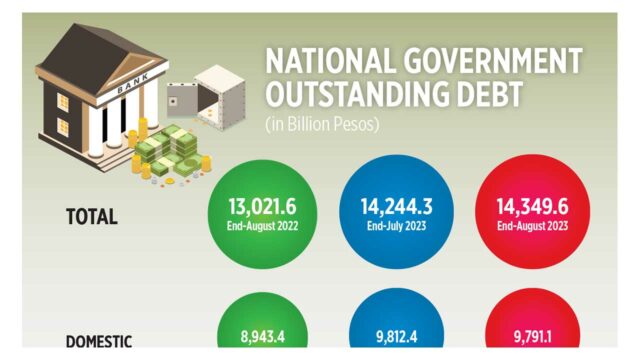
National Government outstanding debt

THE NATIONAL GOVERNMENT’S (NG) outstanding debt reached a record P14.35 trillion as of end-August, mainly due to the peso depreciation against the US dollar, the Bureau of the Treasury (BTr) said on Monday. Read the full story.

National Government outstanding debt

Gov’t partially awards T-bills as rates rise

STOCK PHOTO | Image by RJ Joquico from Unsplash

THE GOVERNMENT made a partial award of the Treasury bills (T-bills) it auctioned off on Monday at higher yields on expectations that inflation picked up last month.

The Bureau of the Treasury (BTr) raised just P12.916 billion via the T-bills on Monday, short of the P15-billion program, even as total bids reached P27.574 billion, higher than the amount on the auction block.

Broken down, the Treasury made a full P5-billion award of the 91-day T-bills as tenders for the tenor reached P10.01 billion. The three-month paper was quoted at an average rate of 5.698%, 10.3 basis points (bps) above the 5.595% seen last week. Accepted rates ranged from 5.68% to 5.725%

The government also raised P5 billion as planned from the 182-day securities as bids for the tenor reached P9.106 billion. The average rate for the six-month T-bill was at 6.023%, up by 5.5 bps from 5.968% seen last week, with accepted rates at 5.975% to 6.054%.

Meanwhile, the BTr borrowed just P2.916 billion via the 364-day debt papers, below the P5-billion plan, despite demand for the tenor reaching P8.458 billion. The average rate of the one-year T-bill rose by 9.6 bps to 6.215% from the 6.119% quoted for a full award last week. Accepted yields were from 6.15% to 6.25%.

At the secondary market before Monday’s auction, the 91-, 182- and 364-day T-bills were quoted at 5.7049%, 5.9828%, and 6.1941%, respectively, based on PHP Bloomberg Valuation Reference Rates data provided by the Treasury.

T-bill yields rose ahead of the release of September inflation data on Thursday, Rizal Commercial Banking Corp. Chief Economist Michael L. Ricafort said in a Viber message.

“The higher awarded T-bill rates today reflected market expectations for a higher inflation rate in September,” a trader added in an e-mail on Monday.

Inflation likely quickened in September due to higher pump prices and electricity rates and the peso’s depreciation against the dollar, analysts said.

A BusinessWorld poll of 17 analysts yielded a median estimate of 5.4% for September inflation, near the low end of the Bangko Sentral ng Pilipinas’ (BSP) 5.3-6.1% forecast for the month.

If realized, September inflation would pick up from the 5.3% print in August but would be lower than 6.9% in the same month in 2022.

September will also be the 18th straight month that inflation was above the BSP’s 2-4% target for the year.

The government will not auction off Treasury bonds (T-bonds) on Tuesday due to its ongoing public offering of retail dollar bonds (RDBs) set to end on Oct. 6. The RDBs will be issued on Oct. 11.

The Treasury wants to raise P150 billion from the domestic market this month, or P60 billion via T-bills and P90 billion via T-bonds.

The government borrows from local and foreign sources to help fund its budget deficit, which is capped at 6.1% of gross domestic product this year. — A.M.C. Sy

CEU board clears Javier, Yuvienco for independent directors  

CEU.EDU.PH

THE board of listed Centro Escolar University (CEU) approved the recommendation for the nomination of two independent directors as part of bolstering the company’s leadership structure.

In a stock exchange disclosure on Monday, CEU said its board approved the report of the nomination committee on Sept. 29, which provided the recommendation of national scientist and former University of the Philippines president Emil Q. Javier and Lope M. Yuvienco as nominees for independent directors.

Mr. Javier served as an independent director since 2012.

“The personal qualifications of both Dr. Javier as well as his experience in the field of education is crucial for CEU,” the company said.

“The prevailing conditions of the education sector require the guidance of Dr. Javier who is already familiar with the peculiar circumstances of the university,” it added.

According to CEU, the nomination and engagement of Mr. Javier as independent director will be presented for stockholders’ approval during the annual stockholders meeting on Oct. 27.

Meanwhile, the company said Mr. Yuvienco became a member of the board of directors on March 21.

He was a former independent director of AXA Philippines and ORIX Metro Leasing Corp., director for regulatory and government sector of Buenaventura Echauz & Partners, and former vice-president of Citibank N.A., Manila

Mr. Javier and Mr. Yuvienco will join the other nominees for directors, namely: Basilio C. Yap, Ma. Cristina D. Padolina, Benjamin C. Yap, Alejandro C. Dizon, Emilio C. Yap, Maria Corazon M. Tiongco, and Johnny C. Yap.

Shares of CEU at the local bourse were last traded on Sept. 29, when it closed at P8.20 apiece. — Revin Mikhael D. Ochave

Energizing growth: The role of fossil fuels in economic development

(Part 1 of a series)

This writer has come up with a new series on “Energizing growth,” looking at the role of energy policies in helping sustain or curtail economic growth of countries.

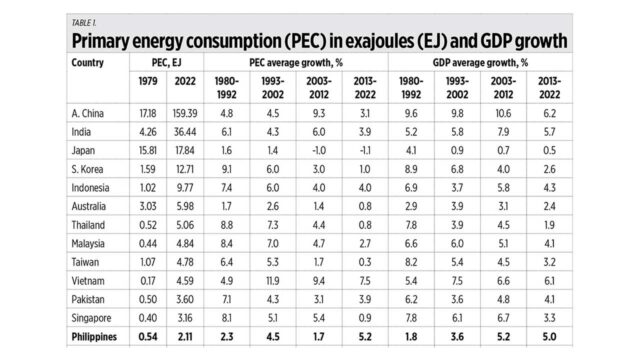
I constructed the accompanying table showing the primary energy consumption (PEC) in exajoules (EJ) of many countries, and the average growth rates of their PEC and gross domestic product (GDP) from 1979 to 2022 or over 43 years. I chose 1979 as the base year because that is within the 1960s and ’70s which was the period with the highest PEC for many European countries.
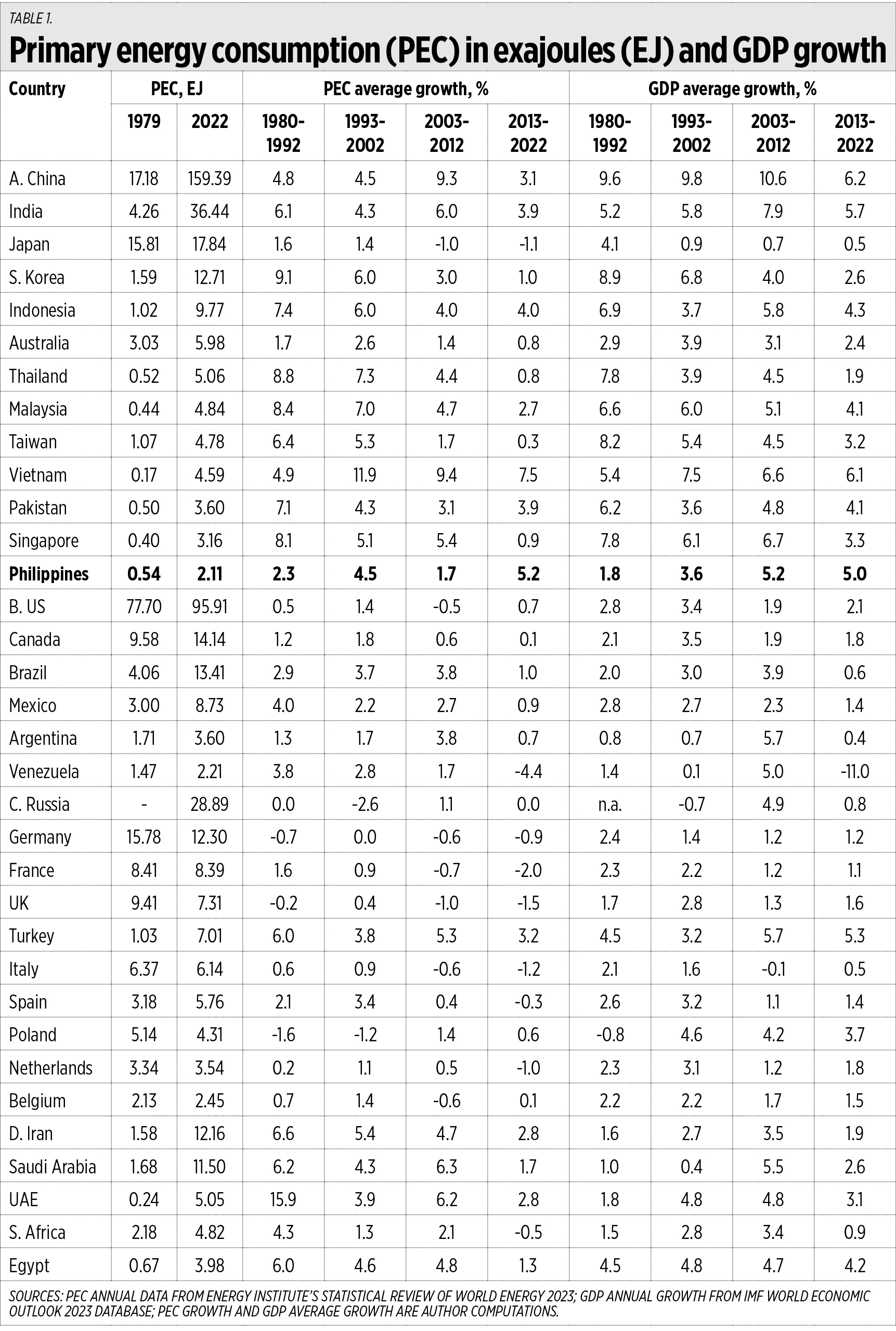
PEC covers not only power or electricity generation but also fuel for transportation (land, sea, and air). So, the bulk of PEC by countries are from fossil fuels, with a clear example being Singapore. Its PEC of 3.16 EJ in 2022 saw 99% of it coming from fossil fuels: 84% from oil (transportation) and 15% from natural gas (power generation).

I grouped the countries into four: Group A are East Asians plus India and Australia; Group B are North and South Americans; Group C are Europeans, and Group D are Middle East countries and Africans.

The numbers show the following.

One, when it comes to PEC levels, all countries in Groups A, B, and D have expanded from 1979 to 2022. Many Group C countries experienced PEC declines over the same period: Germany, the UK, Italy, France, Poland. I find this mind-boggling.

Two, when it comes to PEC growth, Group A countries have had the fastest expansion over the 43 years covered, 1979 to 2022. Japan is an exception among the Group A as it is infected by the anti-fossil fuel movement in G7, and Group C countries have had the slowest growth, especially Germany, the UK, and Italy. The next slowest is Group B.

Three, when it comes to GDP growth, we see the same trend: Group A has the fastest growth except for Japan, which has been crawling below 1% over the past three decades. Group C has the slowest, growth, especially Italy, Germany, and France.

So, the lessons and policy implications are clear:

One, if countries want faster economic growth, their PEC must expand fast, and since the bulk of PEC is from fossil fuels (oil, gas, and coal), countries should not put a brake on fossil fuel use.

Two, if countries want slow growth, the Europeans, especially Germany, the UK, and Italy, provide clear examples of how, with four decades of actual data in PEC decline and crawling growth, even degrowth. Venezuela in South America is another example of a country exhibiting PEC decline over the last decade and growth contraction over the same period.

Three, the Philippines, in particular, has had the smallest PEC among the countries in the table. There are no reasons to expect that if the country should slow down or cut its fossil fuel consumption that it would be able to sustain high growth. Our main national agenda and priority should be fast, sustained growth to provide more jobs, more bright lights for our people, and higher government revenues to pay off and reduce the ever-rising public debt while sustaining public infrastructure spending.

Meanwhile, here are three notes.

One, check out the recent energy reports in BusinessWorld (written by Sheldeen Joy Talavera): “DoE endorses 86 projects for operating permits” (Sept. 20), “DoE says still on track to hit renewables goal” (Sept. 28), and, “Indonesia assures PHL of continued access to coal” (Oct. 1).

The bulk of those 86 projects are oil plants, peaking plants to avoid blackouts as more intermittent sources enter the grid. Thank you, Indonesia for your generous assurance.

Two, there were short rotating blackouts in some parts of Metro Manila last Sunday evening, Oct. 1. The National Grid Corp. of the Philippines (NGCP) issued a statement that night: “At 6:45 p.m., NGCP monitored a grid disturbance affecting the San Jose-Nagsaag 500-kV transmission line 2 and multiple power plants in Luzon and resulting in automatic load dropping (ALD).”

See that? (A) a “grid disturbance” of a transmission line in Bulacan (San Jose) and Pangasinan (Nagsaag) affected four large power plants in distant Quezon province, and, (B) this all happened on a Sunday night when power demand was low.

I hope that the NGCP will not blame the power plants again and this time admit that it was their fault, that their 500-kV transmission line started it, and that they continue to be unable to modernize and improve their transmission lines.

“Automatic load dropping” means rotating blackouts because the power supply is not there due to a NGCP transmission line (or “highway”) problem. Some electricity consumers and end-users in Luzon were adversely affected. But the bigger victim is the Philippine economy because of the image it presents: that 32 years after the huge and frequent blackouts of 1991-1992, occasional rotating blackouts and yellow-red alerts still continue.

Come on, NGCP. Help the country have a good image when it comes to power generation stability. Please, no more blackouts due to your frequently faulty transmission lines. No more delayed projects that lead to congestion in power-surplus islands and the inability to send electricity to power-deficit islands.

Three, check out this column’s recent “Energy realism” (not alarmism) series: Part 1, “Energy realism: Raising consumption and economic growth” (June 29); Part 2, “Energy realism: G7, BRICS, and other big Asian economies” (July 5); Part 3, “Energy realism: Oil-coal consumption and NGCP’s delayed projects” (July 13); Part 4, “Energy realism: Decarbonization and deindustrialization” (Aug. 17); “Economic basis of net zero is zero” (Sept. 5); and, Part 5, “Why we need more coal, gas and nuclear power plants (Sept. 14).


Bienvenido S. Oplas, Jr. is the president of Bienvenido S. Oplas, Jr. Research Consultancy Services, and Minimal Government Thinkers.

minimalgovernment@gmail.com

Suspect in rapper Tupac Shakur’s 1996 slaying charged with murder in Las Vegas

TUPAC SHAKUR (center) in a scene from the 1994 film Above the Rim. —IMDB

AN ADMITTED former street gang leader was arrested on Friday on a charge of murder in the Las Vegas shooting death of hip-hop star Tupac Shakur nearly three decades ago, a long-unsolved crime that became a defining moment in the history of rap music.

Duane “Keffe D” Davis, who police said was long suspected and began implicating himself in a series of public statements in recent years, was taken into custody outside his home a day after a grand jury in Clark County, Nevada, returned an indictment against him.

The indictment was presented during a brief hearing on Friday to a judge who ordered Mr. Davis, 60, to remain jailed without bond until an initial court appearance set for next Wednesday.

Mr. Davis was charged with one count of murder with a deadly weapon for his alleged role in leading a group of men to kill Mr. Shakur in a 1996 drive-by shooting near the Las Vegas strip.

Authorities described Mr. Davis as the “shot caller” of a hurried plot to avenge the beating of his nephew, Orlando Anderson, inside the MGM Grand Garden Arena by Mr. Shakur and members of his entourage on the night of Sept. 7, 1996, not long before the shooting.

Mr. Davis “orchestrated the plan that was carried out to commit this crime,” Metropolitan Police Department Lieutenant Jason Johansson said at a news conference.

It was not immediately clear whether Mr. Davis had secured legal representation.

Police showed hotel security footage of several men kicking and punching a person they identified as Mr. Anderson near a bank of elevators before security personnel broke up the altercation. One of those seen attacking Mr. Anderson was identified as Marion “Suge” Knight, co-founder and then-CEO of Los Angeles-based Death Row Records, which produced Mr. Shakur’s records.

That incident, Mr. Johansson said, led to “the retaliatory shooting death of Tupac Shakur.”

After obtaining a gun from an unnamed associate, Mr. Davis, along with Mr. Anderson and two other men, Terrence Brown and Deandre Smith, boarded a white Cadillac and rode off to locate the black BMW that Marion Knight had driven away from the hotel with Mr. Shakur as his passenger.

When Mr. Davis and the others caught up to Mr. Shakur and Mr. Knight’s vehicle, shots were fired from the Cadillac into the passenger side of the BMW. Mr. Shakur, struck four times, died in a hospital six days later at the age of 25.

Mr. Knight, who was grazed in the head by a bullet fragment but suffered only minor injuries, was sent to prison the following month for violating terms of his probation in a previous assault case when he was caught taking part in the MGM melee.

Authorities did not say who actually fired the gun at Mr. Shakur. The three others in the Cadillac with Mr. Davis are all since deceased.

A rival “gangsta” rap star from the New York-based record label Bad Boy Entertainment, Christopher Wallace, was shot to death in Los Angeles in March 1997 in a murder that still remains unsolved.

Mr. Wallace, who performed as Notorious B.I.G., had become embroiled in an escalating East Coast-West Coast rap feud before his death, and his killing was rumored to have been a possible act of retaliation for Mr. Shakur’s murder months earlier.

RIVAL GANGS
Mr. Johansson said the violence at the MGM stemmed from animosity between two rival Los Angeles-area street gangs — the South Side Compton Crips, of which Duane was the reputed leader, and Mob Piru, with which Death Row Records and Mr. Knight were closely affiliated.

Members of both groups were in Las Vegas the night of the killing to attend a world heavyweight title boxing match between Mike Tyson and Bruce Seldon.

Mr. Johansson said detectives had pieced together most of the circumstances and people involved in the events that led to the shooting in the first few months of their investigation, but they long lacked admissible evidence to seek criminal charges.

The case was “reinvigorated” in 2018 by “Davis’s own admissions to his involvement in this homicide investigation that he provided to numerous different media outlets.”

Mr. Davis, a self-described gang leader, had admitted in interviews and in his 2019 memoir, Compton Street Legend, that he was in the Cadillac from which shots were fired at Mr. Shakur’s vehicle.

That sparked a renewed push by police to solve the case, leading investigators to obtain a search warrant for Mr. Davis’ home in July. Additional evidence uncovered there paved the way for the indictment, Mr. Johansson said.

Mr. Shakur, an influential performer widely regarded as one of rap music’s greatest artists, was also one of its most commercially successful, selling more than 75 million records worldwide.

He was best known for raw lyrics laced with violence, sex, and profanity describing life in the ghetto. His album All Eyez on Me, released shortly before his death, celebrated his own outlaw image.

Beloved by his fans and detested by politicians for songs that sometimes celebrated violence and misogyny, Mr. Shakur was no stranger to trouble, having spent much of the last two and a half years of his life in and out of court, jail, or hospitals.

Mr. Shakur, who became arguably more popular in death than in life, was inducted into the Rock and Roll Hall of Fame in 2017.

Mr. Knight, his manager, pleaded no contest in a Los Angeles courtroom in September 2018 to a charge of manslaughter for a 2015 hit-and-run killing in Compton, accepting a 28-year prison sentence under a deal with prosecutors days before his murder trial was to begin.  Reuters

The Marketplace set to open its 38th Philippine store at Parqal

THE Marketplace is opening its 38th Philippine store at Parqal in Aseana City in Parañaque City on Oct. 4.

For its grand opening, The Marketplace Parqal will hold a one-day only flash sale featuring P99 deals, buy one take one offers, and 50% off some items.

The Marketplace Parqal offers a range of food items, organic products and international brands, as well as premium meat choices, different cheeses and wines.

Shoppers can also find global brands such as Casino, Waitrose, El Corte Ingles, No Brand, and Meadows at The Marketplace Parqal.

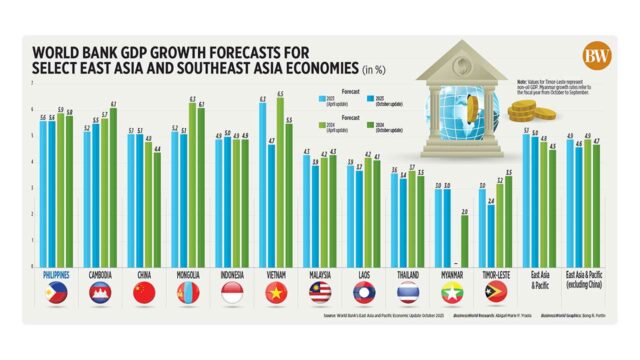
World Bank GDP growth forecasts for select East Asia and Southeast Asia economies

THE WORLD BANK expects the Philippines to be the fastest-growing economy in Southeast Asia this year, despite trimming its gross domestic product (GDP) growth projection due to persistent inflation and global headwinds. Read the full story.

World Bank GDP growth forecasts for select East Asia and Southeast Asia economies

SGV goes 100% renewables

PROFESSIONAL services firm SGV & Co. is taking a step towards achieving sustainable operations as it shifts to renewable energy (RE) sources to power its buildings, the firm said on Monday.

“By transitioning to renewable energy sources, SGV aims to significantly reduce greenhouse gas emissions, decrease dependence on non-renewable energy, and contribute to a cleaner and greener future,” SGV Chief Sustainability Officer Clairma T. Mangangey said in a media release.

“This commitment underlines our dedication to leading by example, taking responsibility as a corporate citizen, and inspiring other organizations to follow suit,” she added.

The firm said it had partnered with its building operators Marilag Corp. and US-based venture capital firm Owl Ventures in shifting to renewables through the green energy option program of the Department of Energy.

The program is a voluntary policy mechanism under the Renewable Energy Act of 2008 that allows users consuming at least 100 kilowatts of power to choose a purely RE source to meet their energy requirements.

“The decision to go to 100% renewable energy is a strategic step informed by rigorous assessment and careful planning,” SGV said.

“SGV has worked with a leading renewable energy provider to ensure a reliable and seamless transition. The work has resulted in a comprehensive renewable energy strategy that encompasses solar, wind, and other renewable sources for powering the SGV buildings,” it added.

The company did not disclose its RE provider.

According to the company, the transition has been facilitated by “a series of technology upgrades, energy efficiency measures, and employee-engagement initiatives” to optimize energy consumption throughout its buildings.

The firm also said it had invested in energy consumption measures, lighting upgrades, and employee awareness campaigns to promote sustainability and responsible energy use. — Sheldeen Joy Talavera